A dog bee sting can seem scary, especially if you didn’t actually see the bee sting your dog. Rather, your dog has dramatic signs like limping or a swollen face that seem to appear out of nowhere. To help you know what to do in this situation, Dr. Lauren Blackwelder, friend of integrative veterinarian Dr. Julie Buzby, discusses how to recognize, treat, and prevent dog bee stings. Plus, she explains when you need to take your dog to the vet.
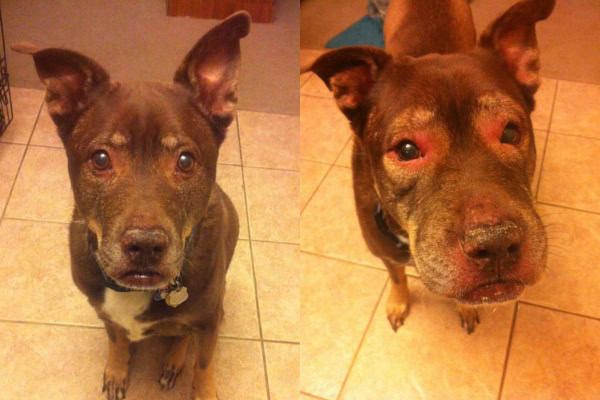
My first experience with a dog bee sting was during my clinical year of veterinary school. I came home late one night after a long day on my anesthesia rotation to find that my beloved dog, Sasha, had apparently turned into a Shar Pei while I was away. Her entire face was swollen, her eyes puffy and red, and she was panting.
I’ll let you in on a little secret: Often, veterinarians’ “doctor brains” turn off when we deal with our own pets. I absolutely panicked! Fortunately, she was fine. But it definitely gave me lifelong empathy for dog parents who have found themselves in this scenario.
What happens when a bee stings a dog?
When a bee stings your dog, it injects venom through its stinger. This venom contains compounds that cause pain, swelling, itching, and inflammation. Unfortunately, for dogs who are allergic to bee stings, envenomation (getting stung) triggers a life-threatening allergic reaction.
Additionally, if the nasty sting was from a honeybee, the barbed stinger may remain embedded in the dog’s skin. Bumblebees and wasps, on the other hand, have smooth stingers so they can sting multiple times and don’t leave their stingers behind.
While the focus of this article is on bee stings, most of the information pertains to wasp stings, too.
What are the symptoms of a dog bee sting?
Most of the time, you don’t actually witness the bee stinging your dog; you just see the aftermath. Depending on the location of the sting, your dog might be showing some of the following symptoms of a bee sting:
- Pain and swelling at the sting site: Dogs explore the world nose-first, so a majority of canine bee stings occur on the muzzle or face. Thus, one of the most classic signs we see in dogs stung by bees is an almost caricature-like facial swelling. However, the swelling can also occur on a paw or another location on the body.
- Redness and heat around the sting: The skin may feel hot to the touch, and some redness might be visible.
- Licking the affected area: The pain and inflammation from the bee venom may make the dog want to lick, rub, or chew at the area.
- Vocalizing and whining: Dogs may cry or whimper when the sting happens and for some time afterward.
- Limping: Some dogs are stung on their paws or legs, especially if they inadvertently step on a bee. This can cause your dog to start limping from the pain.
- Excessive drooling and shaking the head: Dogs will sometimes try to eat the bee, leading to a very unfortunate sting inside the mouth. Stings in or around the mouth can cause excessive drooling in dogs, lip licking, or head shaking.
What to watch for after a bee sting
After a bee sting, it is important to watch your dog closely for several hours to ensure the symptoms don’t continue to progress.
In some cases, stings in the mouth or around the face, nose, or neck can cause enough swelling to make it hard for the dog to breathe. If your dog is coughing, gagging, wheezing, or seems to be struggling to breathe, seek emergency care immediately.
Additionally, if your dog has been stung by many bees at one time, it is best to contact your vet promptly. He or she may recommend bringing your dog in for evaluation.
Finally, as you are about to learn, signs of an allergic reaction to bee venom earn the dog an immediate trip to the nearest emergency hospital.
How do you know if your dog is having an allergic reaction to a bee sting?
Just like in people, some dogs can have an allergic reaction to a bee sting. These cases can be more serious (or even deadly). Interestingly, a dog who has experienced multiple stings is more likely to have an allergic reaction. This is the case whether the dog receives many stings at once or has repeated bee sting events.
Dogs experiencing an anaphylactic reaction (severe allergic reaction) may show symptoms such as:
- Significant facial swelling: Your dog’s face might be uniformly puffy, even if the dog was stung elsewhere. Sometimes the swelling also extends down the neck a bit.
- Difficulty breathing: You might notice your dog breathing fast or struggling to breathe.
- Vomiting: Some dogs become nauseous or vomit as part of the allergic reaction.
- Diarrhea: Sudden-onset diarrhea can be a sign of anaphylaxis.
- Collapse: Sometimes dogs will become weak and collapse.
- Pale gums: If the dog is in shock, the gums may look pale pink, white, or bluish when you lift a lip. (Normally, the gums should be bubblegum pink.)
- Hives: Your dog may have many raised areas on the skin (hives) if he or she is having an allergic reaction.
Often, these signs will show up within about 10 minutes or so after the bee stings the dog. But sometimes it can take hours. For this reason, it is important to monitor your dog carefully for several hours after a bee sting.
If you see these signs of an allergic reaction, make an emergency vet visit right away. Do not attempt to treat your dog yourself or wait and see what happens.
Bee sting treatment for dogs
As long as the dog is not showing signs of an allergic reaction or severe swelling of the face and neck, treatment of canine bee stings should focus on keeping the dog comfortable and controlling pain. Often, this can be done at home.
Note: Each dog is an individual, so it is best to consult with your vet before attempting to treat a bee sting at home. Also, if there is a chance your dog could be having an allergic reaction or the swelling is restricting your dog’s breathing, he or she needs to go to the vet immediately for treatment.
If appropriate for your dog’s situation, the vet may recommend some of the following at-home treatments for bee stings:
Apply ice or a cold towel
You can apply ice to the sting site if your dog will tolerate it and the sting is located somewhere easy and safe to ice. I wouldn’t try to hold ice to a sting inside a dog’s mouth, though!
Remember that you should never hold an ice pack directly on your dog’s skin. Wrap the ice in a cloth or towel before applying it. Also, don’t leave it in place for more than 10-15 minutes.
If your dog would tolerate it better, you can also try holding a cold, damp towel against the site for about 10 minutes.
Ask your vet about giving antihistamines for dog bee stings
With your vet’s approval, over-the-counter antihistamines such as Benadryl for dogs are sometimes useful for soothing a bee sting on a dog. They help minimize the immune response to the bee’s venom and may make your dog more comfortable.
It is important to consult your vet before giving your dog Benadryl or other over-the-counter medications for a canine bee sting. This helps ensure the medication you pick is safe for your dog and given at the correct dose. (For example, some forms of Benadryl are combined with a decongestant that can be dangerous for dogs. Or liquid versions may contain xylitol (birch sugar), which is toxic for dogs.)

Don’t give your dog any human pain medications
Although the sting may be sore, remember that you should not give your dog Advil or other pain medications made for people. Also, even if you have some leftover pain medications that were prescribed to your dog for a different problem, don’t give them without consulting your vet.
Remove the stinger if you see it, but don’t panic if you can’t find it
If you can identify the location of the bee sting, check for a stinger and carefully scrape it out with the edge of a credit card. (Don’t use tweezers to remove the stinger. They may squeeze more venom into the site since the venom sac stays with the stinger.)
However, if you don’t know where the sting happened or can’t find a stinger, don’t panic! It likely either fell out, was never there in the first place, or will fall out on its own.
Over the following days, it is a good idea to keep an eye on the area of the sting(s). Should you notice signs of skin infection like redness, pain, or discharge, contact your vet.
Keep your dog from scratching or rubbing the area
Bee stings are itchy and painful. Thus, it can be a good idea to distract the dog to keep him or her from further traumatizing the area. A gentle walk (if the sting wasn’t on the foot) or using mental stimulation toys and games for dogs may help keep your dog’s mind, mouth, and nails off the sting site.
Contact your vet for any concerns
If you aren’t sure what to do about a bee sting or your dog is having a reaction to the sting, contact your vet. He or she can advise you about whether home treatment or veterinary treatment is best. Dogs who are experiencing an anaphylactic reaction or struggling to breathe definitely need emergency veterinary treatment.
But even some dogs who aren’t allergic to bee stings may still benefit from veterinary attention if the sting seems particularly bothersome or the dog got a lot of stings. After evaluating your dog, the vet may sometimes prescribe a short course of a steroid like prednisone for dogs. This can help decrease inflammation and keep the immune response under control.
What is the recovery time after a dog bee sting?
Thankfully, most dogs who get an uncomplicated bee sting start to feel better quickly. The symptoms usually lessen or resolve after a few hours, with the dog being back to baseline in a day or so. If this isn’t the case, or it seems like your dog is getting worse, contact your vet promptly.
Dogs who are experiencing a severe allergic reaction may need IV fluids, injectable medications, and other treatments. The veterinary team typically monitors the dog in the hospital at first. Then, once your dog is stable and the danger seems to be over, your dog can head home with you.
Can you prevent canine bee stings?
Short of keeping them in a bubble, it’s nearly impossible to completely prevent bee stings in dogs. If your dog is outside in an area where there are bees, stings are always a possibility.
That being said, it is a good idea to try to avoid places that are heavily populated by bees. This is especially important if your dog has been stung before or has had an allergic reaction to a bee sting. For those dogs, subsequent stings increase the chance of a severe allergic reaction.

Additionally, researchers are looking into immunotherapy (allergy shots) for bee-allergic dogs. Hopefully, this can help prevent life-threatening anaphylactic reactions to bee stings in dogs in the future.
All the buzz about dog bee stings
Bees are wonderful and so important for the environment. But being stung by a bee is no fun for us or for our dear dogs. Knowing what to look for and how to tell the difference between mild and severe reactions can help put your mind at ease and keep your pup safe if he or she gets a little too close to the business end of a bee!
Has your dog ever been stung by a bee?
Please share below.