Can you give a dog Benadryl? Although many over-the-counter human medications are not recommended, Benadryl for dogs has its place in veterinary medicine. Integrative veterinarian Dr. Julie Buzby explains how, why, and when Benadryl is used for dogs.

Can you use Benadryl for dogs?
Benadryl (also known as diphenhydramine) wins the award for being the human medication that my veterinary clients most commonly ask me about administering to their dogs.
I find myself frequently answering my clients’ questions about Benadryl use for allergies, anxiety, travel, and other doggie dilemmas.
The good news is that Benadryl (xylitol-free) is generally safe for most dogs. Unlike many other human medications that have potential for causing serious harm, oral Benadryl has a wide margin of safety.
Before you grab for the Benadryl, always check the label to make sure it doesn’t contain xylitol, an artificial sweetener that is dangerous for dogs. Also, Benadryl may be contraindicated in dogs with certain health conditions. We’ll get to more on both of these caveats at the end of this article.
Despite the fact that over-the-counter Benadryl is not FDA approved for veterinary use, it’s safe and helpful for treating several conditions in dogs including the condition the dog is presenting in photo below.
What do you think is going on with the dog in this picture?
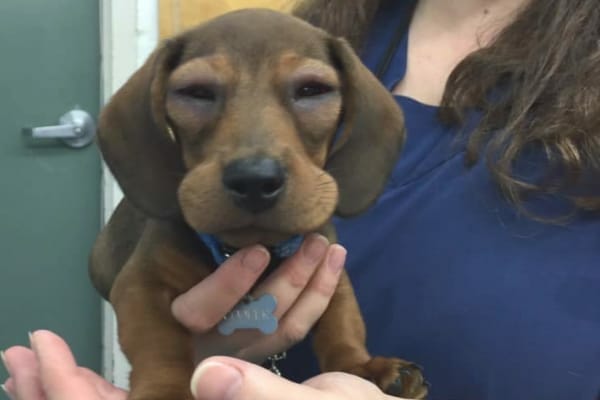
If you guessed anaphylactic allergic reaction, you are correct! These types of reactions can occur due to anything from vaccinations to insect bites or stings. (If you know anyone who carries an Epipen, it’s because they too are prone to this life-threatening type of allergic reaction.)
Benadryl for dogs who’ve had an anaphylactic reaction
Since I like to use my veterinary experiences to explain conditions and medications, let’s meet Cooper, a Pug who almost died in my arms after a routine vaccination. Immediately prior, Cooper’s family had checked out at our reception desk. Cooper was ambling at the end of his leash, sniffing the ground. I had waved goodbye and moved on to my next appointment.
As they prepared to leave, Cooper vomited. His dad felt embarrassed, apologized for the mess on the floor, and offered to clean it up. Thankfully, my astute receptionist quickly put the pieces together. She raced around the corner, took one look at Cooper’s swelling muzzle, scooped him up, and rushed him into our treatment area.
The Pug’s little gums were turning a sickening greyish color and his rectal temperature was starting to climb. To treat Cooper, he received an injection of diphenhydramine and a cocktail of other medications. Thankfully, the Benadryl and other medications did the job. Cooper went home that evening with no issues at all.
The most common and impactful use for Benadryl in veterinary medicine is the scenario I just described above—treating allergic reactions.
How Benadryl works in an anaphylactic reaction
Next, let’s look at the following five important points to understand how Benadryl works in an anaphylactic reaction.
- Benadryl is an antihistamine. (We’ll use this information in point 5 below.)
- Mast cells, which reside throughout the dog’s body, are a part of the immune system. They’re a type of white blood cell. Each mast cell is of full of tiny granules called histamine. We see mast cells in highest concentrations in a dog’s skin, respiratory, and gastrointestinal tract. The image below illustrates a mast cell.
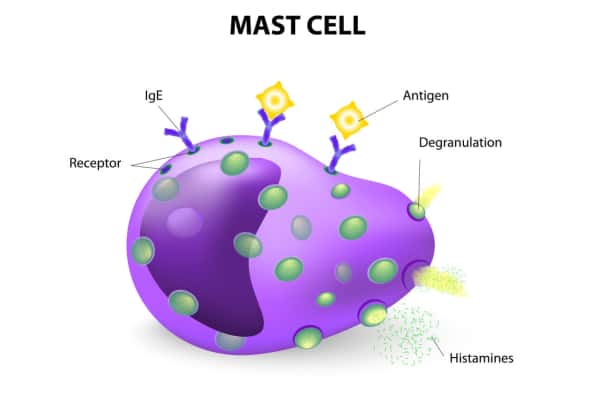
When mast cells note a potential foreign invader, the cells trigger the immune system by “degranulating.” Degranulation dumps histamine and other powerful chemicals into the surrounding tissue to summon the rest of the immune system “army.”
Allergies are simply the body’s immune system overreacting and inappropriately ramping up to fight something that should not normally be considered a threat. Histamine and other chemical mediators dumped by mast cells cause the characteristic symptoms of allergies.
- Benadryl, our ANTI-histamine, blocks receptors on the blood vessels and smooth muscle. This prevents histamine from binding to cells in the immune system involved in allergic reactions—avoiding the overreaction and allergy symptoms.
Benadryl pre-medication for dogs before vaccinations
Now, back to Cooper. Three years later, when Cooper’s vaccines were next due, we prepared for the worst and again administered Benadryl. But this time, I had his parents administer oral diphenhydramine an hour prior to his appointment. I wasn’t sure if it would be enough to completely prevent a reaction, given the gravity of his previous reaction. I told his parents to plan to hang around the vet clinic for 45 minutes after the appointment so I could keep a close eye on him.
With Benadryl on board, Cooper was fine. He showed no signs of a reaction. He received a big gold star in his chart where I’d documented in detail both his allergic reaction and our success in “pre-medicating” him with oral diphenhydramine.
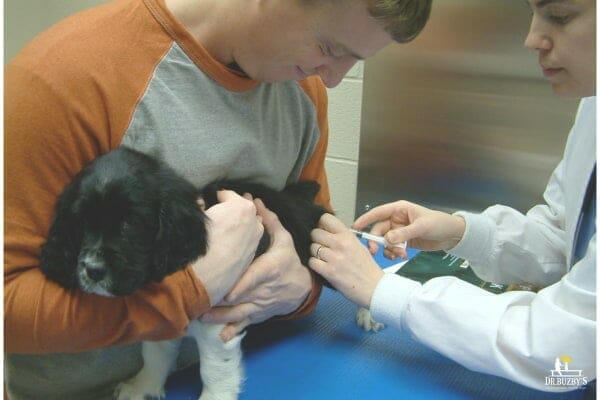
If your dog has ever had an allergic reaction to a vaccine, the first step is to determine what your dog reacted to, if possible. Avoiding the reaction entirely is better than treating the aftermath!
Sometimes, because some vaccines are “combo” injections, and because we often give multiple vaccinations in the same visit, we don’t know what exactly the dog reacted to. For dogs with a history of allergic reactions to vaccines, I will often split up their vaccines for future appointments, so we can be sure we know what they are reacting to if they have another reaction.
For any dog with a history of vaccine reactions (no matter how small), “pre-medication” with Benadryl is a critical part of the plan if and when vaccines must be administered again. If you are concerned about a vaccine reaction, speak with your veterinarian about whether pre-medication may help your dog.
Some veterinarians may recommend an appropriate dose of Benadryl at home before your appointment. Others may give your pet an injection of Benadryl at the appointment prior to the vaccines. Your veterinarian also may want to discuss whether certain vaccines should be given to your dog at all.
As a side note, because we now typically give pets vaccines less frequently than we did years ago, and through the use of titers in dogs, dogs who have vaccine reactions have more options than they once did.
In general, for a healthy dog with no previous history of vaccine reaction, the small risk of him or her having a reaction does not outweigh the risk of contracting a preventable disease. Routine vaccination is very important for preventive health! (For more on vaccines, please check out my article that outlines which dog vaccines are necessary.)
Benadryl for dog’s bee sting
Dog bee sting reactions can range from mild localized swelling to anaphylaxis. If your dog has been stung by a bee, giving him or her a dose of Benadryl is a safe and effective way to reduce the immune response and avoid a severe reaction. If you can, try to remove the stinger from your dog’s skin, and give a dose of xylitol-free oral Benadryl (with guidance from your veterinarian) as soon as possible.
If your dog suffers a bee sting and experiences a reaction that doesn’t get better with Benadryl, seek emergency veterinary care.
Benadryl for itching
Because it affects the immune system, Benadryl can help with some types of itching in dogs. Contact reactions to irritants such as poison ivy can improve with Benadryl.
The most common cause of itching in dogs is allergies. Dogs can experience seasonal allergies, food allergies, environmental allergies, and others. Benadryl can provide minor relief for some types of allergies, such as environmental allergies, but is ineffective against other types, like food allergies.
Giving Benadryl for dogs with environmental allergies (atopy)
Next, let’s look at the effectiveness of Benadryl for dogs with environmental allergies.
Environmental allergies are a common health problem for dogs. Remember, mast cells that trigger allergy symptoms are highly concentrated in their skin.
Unfortunately, while giving dogs Benadryl for seasonal allergies is a reasonable starting point, it’s not nearly as effective as other categories of drugs. Benadryl just doesn’t seem as effective for dog allergies as it is in people. In other words, while Benadryl played a role in saving Cooper’s life after his acute allergic reaction, Benadryl is unlikely to play the role of hero for dogs with environmental allergies.

Fortunately, there are many other allergy medicines for dogs beyond Benadryl for treating environmental allergies. Hyposensitization injections (“allergy shots”) and drugs like Apoquel® and Cytopoint® are just a few choices available. Since the days when I was in vet school, veterinary medicine has made great strides and we now have many safe, effective solutions available for dogs who suffer from atopy.
When it comes to environmental allergies in dogs, there is no one size fits all. This can be a challenging condition to treat, and sometimes treatment can involve a bit of trial and error to see what works for an individual dog. If your dog deals with environmental allergies, your veterinarian will work with you to come up with a plan to suit your dog’s specific needs.
Using Benadryl for dogs with mast cell tumors (MCT)
Now that we have a measure of understanding on Benadryl’s effectiveness for anaphylactic reaction and environmental allergies, let’s look at a third condition. Let’s understand Benadryl’s role in reducing side effects of histamine release from mast cell tumors (MCTs).
Recently, I met Zeus, a 10-year-old Boxer who presented to me for acupuncture for dogs. Before doing his acupuncture, I spent a few minutes talking to his parents about Benadryl. Why?
Zeus had recently been diagnosed with a mast cell tumor—the most common malignant skin tumor in dogs (though they can occur internally also).
Like the name implies, mast cell tumors are loaded with histamine-containing mast cells. This is why an antihistamine (Benadryl) can help reduce side effects of histamine release from MCTs.
If you’d like to learn more about MCTs, you can find a wealth of resources and information on Dr. Sue Ettinger’s website. Dr. Sue Ettinger is a practicing veterinary cancer specialist, international speaker, book author, and vlogger (video blogger). Also known as Dr. Sue Cancer Vet®, she is my go-to resource for the latest in cancer treatments for pets. She shared the image below as a quick snapshot on mast cell tumors. .

Is Benadryl an effective sleep aid for dogs?
As I alluded to above, one side effect of Benadryl is sleepiness. Sometimes pet parents will give their dogs Benadryl to creatively leverage this side effect—for car travel, during Fourth of July fireworks, or other occasions where the dog needs a mild sedative “to take the edge off.”
While sleepiness is a potential side effect, Benadryl is not actually an effective sleep aid by any means. In some instances that side effect can be used to a dog’s benefit.
Essentially, giving Benadryl is the equivalent of drinking a glass of milk before boarding a plane to calm your nerves if you have severe anxiety about flying. Think very mild (if any) efficacy as a sedative. The sedative impact may decrease with chronic Benadryl use because a dog may develop a tolerance to this effect.
It is important to remember that Benadryl is not an anti-anxiety medication. If your dog experiences anxiety related to travel, noises (fireworks and dogs, for example), or other situations, he or she may benefit more from a medication that will address the underlying anxiety rather than just causing drowsiness. Discuss your concerns with your veterinarian, and they can offer appropriate solutions for your pup.
Is Benadryl effective to help a dog’s nausea when traveling?
On paper, at least, Benadryl is also an anti-emetic, which means a drug that helps prevent vomiting. I mentioned its use for dogs who are traveling. It can be helpful for dogs on road trips both by “chilling the dog out” a bit, but also because it may help with car sickness.
However, if your dog struggles with motion sickness, there are much better drugs available to address these concerns. Speak with your veterinarian about other options.
What dose of Benadryl should my dog take?
Benadryl dosage for dogs depends on what condition you’re treating, how many times a day you’re giving it, and your dog’s body weight. There are also various formulations of the drug—Benadryl tablets, liquid Benadryl, even time release formulations. This affects proper dosing too.

That’s why you should not give your dog Benadryl or any other over-the-counter medication without first asking your veterinarian if it is safe, and what dosage is appropriate for your dog.
A word of caution about Benadryl and dogs with health conditions
Benadryl may be contraindicated with certain health conditions. It should be used with caution with ailments such as seizures in dogs, heart disease in dogs, or high blood pressure (i.e. hypertension in dogs). Your vet will review what other medications your dog is taking, whether Benadryl could interfere with these medications, and help you determine the proper dosing for your dog.
Checking the Benadryl label is crucial for your dog’s health and safety
Please note, when administering Benadryl to your dog, it’s generally fine to use the human formulation that you buy over-the-counter. However, it’s vitally important that the Benadryl formulation not contain xylitol (an artificial sweetener commonly used in products intended for people) or any other ingredients that are harmful to dogs.
Also known as birch sugar, xylitol is toxic to dogs and leads to severe low blood sugar and/or liver damage.
Diphenhydramine must be the only active ingredient in the product. If you’re not certain whether the medication you have is safe for your dog, ask your vet.
Consult your veterinarian about giving your dog Benadryl
Finally, the good news about giving dogs Benadryl is that, when used properly, it is a safe medication. However, before administering Benadryl to your dog, I highly encourage you to check with your veterinarian.
What questions do you have about Benadryl for dogs?
Please comment below.


I think I killed my dog with Benadryl two days ago. I can’t stop thinking it was my fault. She was a senior Pomeranian with Sick Sinus Syndrome, but not on any current medications. She seemed like she had a cold so I took her to an emergency vet, they said her vitals were fine and we could take her home. I gave her Benadryl (for the first time) as her skin condition had really flared up and I wanted to make her more comfortable. Within an hour I found her dead.
Dear Kelly,
Goodness I am so sorry for the loss of your little pup. I can only imagine how traumatic and devastating that must have been. Even though the timing would make anyone suspect the Benadryl, I am not sure this contributed to your dog’s passing. It could have been purely coincidental so PLEASE don’t blame yourself for this!!! There are so many factors to consider and unfortunately you may never really know what happened. Your girl’s passing was very quick so I would not think she suffered or felt pain. I hope with time your heart will begin to heal and you can allow yourself some grace. Wishing you comfort and peace. ♥
Just want to let people know xylitiol is also known as birch sugar
Hi Joseph,
Yes! Thank you for bringing up this important piece of information!
Just wanted to mention that Benadryl is not going to help your fur baby against snake bites. I see people doing this all the time.
Hi Terry,
While Benadryl can be one of the many medications/treatments used for a snake bite, it may not be enough to resolve things on its own. Benadryl only acts to fight histamine and cannot combat all the problems snake venom can cause. It is still recommended to have your dog examined by a vet if you suspect a snake bite has taken place. Thank you for bringing up this important point!
We are NOT advocating skipping the vet 🙂 but my husband and I have treated about 100 snake bites over the last 30 years or so that we have had multiple dogs at any time (rescues) in a country setting.
This is all we give when we suspect or are sure of a snake bite and it works wonderfully. We had only 2 cases where we actually took a dog to the ER for multiple snake bites and the dogs were in shock, but when we arrived, about 40 minutes later, the dogs were already feeling and looking much better (i.e. out of the danger zone)!
HOWEVER, the snakes we have here (South Louisiana) are mainly cottonmouths and copperheads. We don’t know how it would work with rattlers and coral snakes but we think that giving your pet Benadryl can only help with those too.
Hi Marie,
I agree, Benadryl can be an important first line of treatment for snake bites. This simple medication can be administered quickly at home while you work on contacting your vet. Thanks for sharing your experience!
Hello, I just have a question I’m very curious to know if giving a cat an injection of antihistamines before rabies vaccine will hinder the immune response? And will they have adequate immunity against rabies? Thank you so much , I do read here that it’s OK to do that. But I’m wondering if they will have a lesser immunity versus an animal who hasn’t had the antihistamine? And if there is studies that I could look up to show immune responses in both with antihistamines and without?
Hi Sue,
This is a great question that applies to dogs and cats alike. I did not have time to do a ton of research or find specific research articles. I did however find this great article published by the World Small Animal Veterinary Association (WSAVA): https://www.ncbi.nlm.nih.gov/pmc/articles/PMC7166872/
It is a VERY long article. But at the end there are a list of frequently asked questions and #92 addresses your specific concerns. It states “The use of antihistamines or anti‐inflammatory doses of glucocorticoid pre‐revaccination is acceptable and does not interfere with the vaccinal immune response.”
I hope that helps a bit. Thank you for bringing up this important topic!
My 3 year old dog will not stay in his bed at night. I have tried a crate in a separate room, he just barks the whole night. I tried putting him in our bed and he jumps out and barks at me. I tried a comfy bed beside my bed and he stays for a bit then gets up and barks at me. He wants me to go into the spare room and sleep with him in that bed. It’s ridiculous and I am not getting any sleep! I am considering Benadryl or Gravol for a couple nights to get him into a routine. Any advice would be appreciated!
Hi Leah,
I am sorry you are dealing with this behavioral issue in your young dog. Unfortunately, medical management is probably not the best solution since this does not seem to be a medical issue. You may be able to utilize melatonin for a few days, but you would definitely have to get that approved by your vet. I hate to say this, but you will probably see better results with some tough love. Your dog has trained you well and you may have to take a stand to break this unwanted behavior. How many nights in a row have you been successful at sleeping in your own bed without him? It may be time to contact a veterinary behavior specialist. Hoping you can get some relief soon. Wishing you the best of luck.
I have my dogs sleeping with me but not for the reason I am going to put here for you. There is research lately suggesting that sleeping with pets may have positive effects on physical and emotional health. Some benefits of sleeping with your dog include: reduced stress, improved sleep quality, lower blood pressure, regulated heart rate, reduced cortisol levels, increased sense of security, decreased loneliness, and eased insomnia. Here is a link to some references you can look up and an article by a psychologist and an MD on the subject: https://www.sleepfoundation.org/animals-and-sleep/sleeping-with-pets.
Of course, you will have to determine for yourself whether the benefits outweigh any of the down sides. I hope you find a solution. Good luck!
Four days ago, I groom my dog I shaved her ball because she was matted . now she refuses to stay outside. She keeps running into her cage. She still eating and drinking but she’s eating things off the floor and off the ground it’s like she is Hallucinating, she shakes as well like she is cold. , is this some type of allergic reaction?
Hi Carmelita,
I understand your concerns with this strange behavior in your dog. Without examining her myself, I can’t make specific conclusions as to why she is behaving this way. Your best bet is to schedule an appointment with your vet to have her evaluated. I am hopeful they can find some answers and get her feeling better very soon. Best wishes and good luck!
My dog had a reaction to a rabies vaccine about two hours afterwards. She became super restless scratching with rear legs ears twitching and panting. She had also been treated for eye problem at same time so we thought she was maybe having eye pain but then decide to take her back. Well before we got ready to go she finally settled. When I called vet they said no way was vaccine reaction that it wouldn’t have went away without treatment. But she had never acted this way before. Is that true that a reaction wouldn’t resolve?
Hi Linda,
I understand your concern over this strange behavior you witnessed in your pup. Without examining your dog, myself, I can’t make specific conclusions. What you describe is puzzling and does not sound like any vaccine reaction I have seen before. That doesn’t mean it couldn’t be a reaction though. Most vaccine reactions I deal with present as swelling of the face or a lump at the injection site. You may never know for sure what caused this odd behavior. Hopefully it will not be an issue with future vaccinations. Best wishes to you and your sweet girl.
Thank you so much for all this important info! It’s very helpful in getting my head around my elderly dogs hacking and occasional spit ups and vomiting foamy & bile type substances. It’s very helpful! Thanks again! Candyce
I want to give my chihuahua Benedryl cherry flavor. The inactive ingredients list it contains sucrose. Is that safe?
Her weight is 7lbs, how much Benadryl liquid should I give her?
She also takes Gabapentin 25mg for pain can she take at the same time with Benadryl?
Hi Brenda,
Sucrose is similar to table sugar and is nontoxic for dogs. The sugar that needs to be avoided is Xylitol. Unfortunately, since I haven’t examined your pup myself, I can’t say for sure if Benadryl is a good choice for your dog. I recommend you talk to your vet and make sure the Benadryl won’t have any interactions with your dog’s current medications or cause unwanted side effects.
My dog, 8, ingested whole mangoes this spring and suffers from mango rash that is spreading from his belly to his back, legs, and chin. He’s been treated by a vet, who has tried, in order: apoquel AND cytopoint together, then antibiotic, He’s taking prednisone and apoquel. Efforts to wean him from prednisone haven’t worked—his belly is hairless and varies in color from blush to crimson. I’m alarmed the rash is spreading. I’m administering 5mg of melatonin, since I’ve had success in restoring hair to a bald spot (NOT a hot spot). It’s not unusual for humans in Hawaii to get mango rash from handling mangoes. The skin sap (urushiol) can be brutal. Any advice you can provide would be welcome. My boy is suffering..
Hi Mary,
I am sorry your boy is suffering from this severe skin irritation. Honestly, I had never heard of mango rash before and had to look it up. According to my research, the rash should only occur on the skin where it made contact with the rind of fresh mangos, or it can occur inside the mouth if the mango rind was eaten. Most information also states that the rash usually resolves in about a week with or without treatment. Since your pup is experiencing this rash over such a large portion of his body and it has lasted for such a long period of time, I am highly suspicious that this may have another cause and not actually be related to mangos at all. Of course, without examining your pup myself, I can’t offer specific conclusions or recommendations. My best advice is to talk to your vet about more in-depth investigation. Has any lab work been performed? I would want to rule out autoimmune diseases and also consider a diet trial in case this is a food protein or carbohydrate allergy. Hoping you can get to the bottom of this quickly and find the best way to offer your sweet boy relief. Best wishes and good luck!
I have a Yorkshire 15 lb. 14 year old We give him Triflexis monthly but he still has some itch concerns . we tired 1/2 a tablet of Benadryl but doesn’t seem it help. He rolls around on the carpet or rug and chews his front paws some as well as inside his hind legs some. Also what doseage a full table and how many times day and everyday or how frequent ? Thank you
Hi David,
I am sorry your Yorkie is struggling with itching issues. What you are describing sounds like allergy symptoms. Allergies can be caused by many things like food or environmental causes (dust mites, pollen, grass, etc.). While Benadryl works great for some dogs, others just don’t respond well to this medication. I highly recommend you talk to your vet about other anti-inflammatory medications. They may want to try a different antihistamine or give your pup an injection to stop the immune system from reacting so strongly to the allergy stimulus. They might offer a referral to a veterinary dermatology specialist that can perform allergy testing to see exactly what your dog is reacting to. As for the Benadryl, most tablets are 25mg each but you would need to read the label on your box to be sure. If this is the case with your tablets, then your dog is currently taking the recommended dosage. You would need to discuss the frequency of administration with your vet as your dog may have specific issues that would change the usual recommendations. Generally, it is safe to give the correct dose of Benadryl every 8 hours as needed and this can cause mild sedation.