Many orthopedic or neurologic conditions affecting dogs may worsen over time. Spinal stroke in dogs, also known as fibrocartilaginous embolism (FCE), is just the opposite. Often a side effect of strenuous play, this type of stroke requires an astute dog parent and prompt medical attention, but has the potential for a happy ending. Integrative veterinarian Dr. Julie Buzby shares what you need to know about spinal stroke in dogs: its symptoms, treatment, and prognosis.
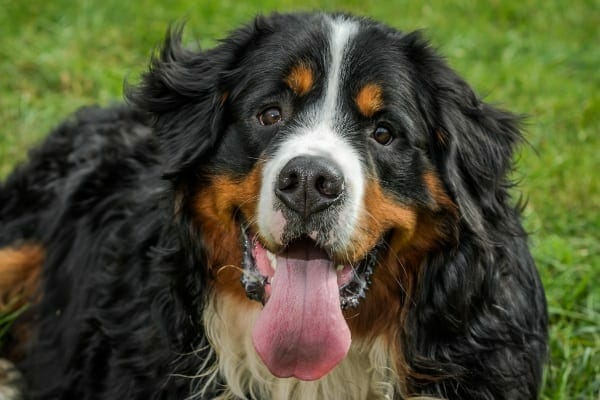
“I just don’t get it, doc. Jasper was fine this morning. Ate his breakfast like normal, went outside to play fetch, and now this.” Jasper’s distraught owner relayed his account of that morning’s events to me. Jasper, a five-year-old Bernese Mountain Dog, had been the picture of health.
But then—when he’d jumped to catch a tennis ball—he yelped and fell. He needed help getting up, and his dad knew immediately something was wrong and rushed him to the vet clinic.
Looking at Jasper sitting in my exam room, I wouldn’t have thought at first anything was wrong. He still had the same goofy, slightly drooly grin he always greeted me with. His eyes were bright, and he wasn’t whining or acting painful. But my initial neurologic examination made me very concerned. Jasper had a hard time rising in his hind end, and when he walked, his right hind leg knuckled and dragged behind.
“This looks serious,” I told his owner. “I’m glad you got him in so quickly. Let’s start with some tests.” Jasper’s bloodwork and X-rays were completely normal. He didn’t give me any signs of pain anywhere. This wasn’t an orthopedic injury; there was definitely something wrong with his nervous system. I advised his owner to take him to the local veterinary neurologist for an MRI. He did so right away.
Unfortunately, Jasper’s MRI confirmed my suspicion. Jasper had a fibrocartilaginous embolism (FCE), sometimes referred to as a spinal stroke.
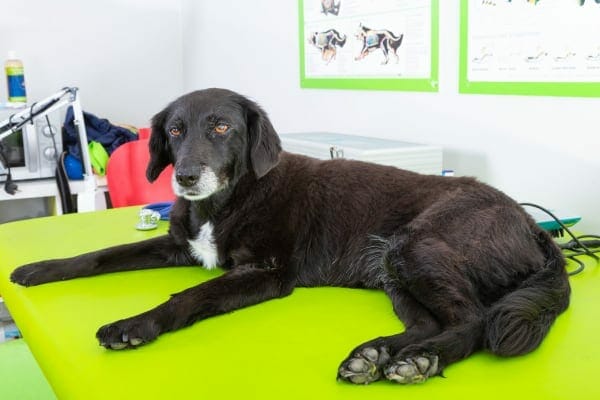
Spinal anatomy in dogs
To get a better idea of what happens in a spinal stroke, first we need to review some anatomy. Dogs’ spinal cords are protected by a series of bones called vertebrae. Between each vertebra is a cartilaginous intervertebral disc. These discs are there to cushion the vertebrae and to allow the spine some flexibility and movement.
What is a spinal stroke or FCE?
Like other types of strokes, FCEs occur due to an obstruction in a blood vessel. But a spinal stroke in dogs is unique because material from an intervertebral disc—not a blood clot—clogs the blood vessel.
A spinal stroke in dogs occurs when a piece of a disc breaks off, enters the bloodstream, and blocks blood flow to a portion of the spinal cord. The location of the blood vessel that is obstructed determines which portion of the spinal cord is affected and therefore what clinical signs are noted.
Which dogs are most commonly affected?
Most dogs with this condition are relatively young (three to six years old) and healthy. FCE occurs more commonly in giant and large breed dogs and is typically associated with some sort of mild trauma or physical activity like playing fetch.
What are the signs of an FCE?
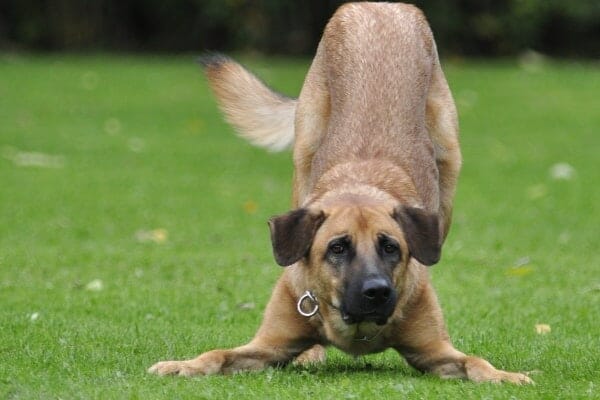
A spinal stroke results in a rapid onset of clinical signs—usually weakness or paralysis in one or both hind legs, although front legs also can be affected. Depending on where the FCE occurs, one side of the body may be affected more than the other. Although the initial injury causes discomfort, FCE does not result in long-term pain.
The following signs may be seen in dogs who have experienced a spinal stroke:
- Loss of coordination (ataxia).
- Characteristic knuckling gait where they are unable to right the paws. (See how to test for knuckling in dogs by watching this video: Knuckling in Dogs: How to Test A Dog for Conscious Proprioception.)
- Weakness in one or more limbs.
- Complete paralysis in one or more limbs.
- Signs that are more profound on one side of the body than the other.
Keep in mind that the signs may vary depending on the severity and location of the spinal stroke.
Is there hope for dogs who suffer a spinal stroke?
If your dog has suffered a spinal stroke, I want to offer you two pieces of good news that may give you some peace of mind.
- After the first 24 hours, the clinical signs associated with FCE typically won’t continue to progress. Things may look bad on day one, but remind yourself that you are seeing the worst of the worst. From here, your dog’s weakness or paralysis will either stay static or improve.
- Unlike some other conditions, a dog who had a spinal stroke is not at an increased risk for it happening again. Once you and your dog make it through this episode, you shouldn’t have to lose sleep over the potential of it reoccurring.
What is the treatment for a spinal stroke?
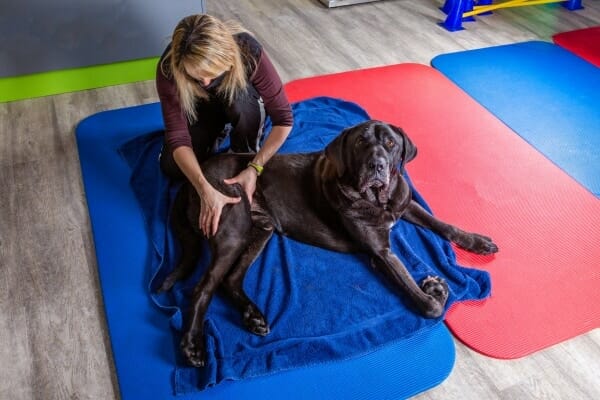
Unfortunately, there is no specific medical treatment that can reverse the effects of an FCE. However, that doesn’t mean that there isn’t hope. Supportive care and rehabilitation go a long way in helping these dogs regain strength.
If your dog has a spinal stroke, ask your veterinarian about rehabilitation options. Many general veterinary practitioners offer some degree of rehab services, or they may refer you to a veterinarian who specializes in physical therapy and rehabilitation. Also, the American Association of Rehabilitation Veterinarians maintains a searchable database to help you find a rehabilitation professional.
Underwater treadmills assist with walking and build strength
An underwater treadmill is a wonderful tool for dogs who have suffered a spinal stroke. The buoyancy of the water allows the patient to go through the full range of motion required for normal walking without the added stress of full weight bearing. Moving through the water also gives the muscles some resistance to improve strength.
Think about the last time you tried to walk in the swimming pool. The water made you feel lighter but it was harder to walk. The same goes for dogs on an underwater treadmill.
Laser therapy reduces inflammation
Laser therapy for dogs can also be very helpful in reducing inflammation and improving blood flow. This is beneficial as the body heals from the spinal stroke.
Ultimately, every case is different, so work with your veterinarian to find the recovery plan best suited for your dog.
What is the prognosis for FCE?
An individual dog’s prognosis after a spinal stroke varies depending on where the FCE occurs, which parts of the body are affected, the severity of the initial signs, and how quickly treatment is initiated.
The goal of rehabilitation and supportive care is to regain as much function as possible. In many patients, improvement occurs in as little as three to four months. Some dogs make almost a complete recovery. You’d never know anything ever happened, except for a shuffling gait now and then. Many dogs go on to live otherwise normal lives.

Challenges of caring for a paralyzed dog
Other dogs, unfortunately, must deal with long-term issues related to their paralysis. They may need ongoing therapy to assist with movement and strength. Because they may not be able to reposition themselves well, they are also prone to secondary issues such as skin infections or bedsores.
Paralyzed dogs could have difficulty urinating and defecating, and may rely on their owners to express their bladders. This can lead to other issues such as frequent urinary tract infections in dogs. Dogs with more severe paralysis will need frequent follow-up visits with their veterinarian as well as diligent at home care to stay on top of their recovery.
Additional ways to assist your dog’s recovery
Depending on your dog’s specific needs, your veterinarian may discuss slings or harnesses to help with support and movement.
Traction is also key in getting around on hard flooring, so Dr. Buzby’s ToeGrips® dog nail grips can be immensely helpful for dogs recovering from FCE.
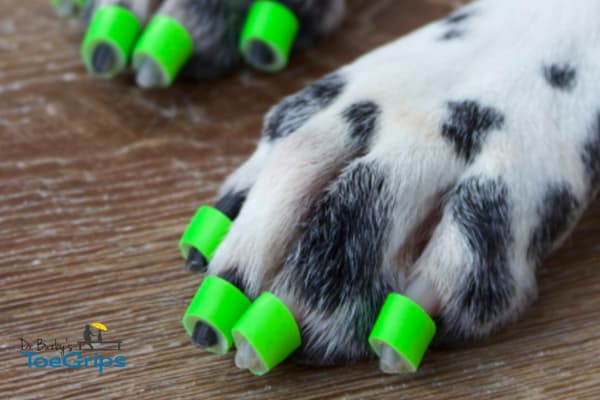
In addition, ToeGrips may also enhance conscious proprioception—the body’s ability to sense the position of the limbs and placement of the paws. Dogs who are recovering from a spinal stroke need to have their ToeGrips glued on because dragging/scuffing the paws will tug the grips off the nails. Here is a short video to explain how, when, and why I recommend this…
Back to Jasper
I am happy to report that Jasper is doing well. After working with the neurologist to diagnose his FCE, we collaborated with a veterinary rehabilitation facility to tailor a treatment plan to Jasper’s needs.
Compared to some, his condition was relatively mild, affecting only his right hind limb. We used a combination of medication, an underwater treadmill, laser therapy, and range of motion exercises at home.
Now Jasper gets around without much help and still chases his tennis ball after breakfast every morning. He hasn’t let FCE slow him down one bit, or put a damper on his love of life!
If your dog has suffered a spinal stroke, don’t lose hope—even if the prognosis seems bleak at first. Work with your veterinarian or rehabilitation professional to develop a plan, and take it one day at a time.

Has your dog had a spinal stroke?
Please share your story below. We can all support each other.


Our 15 year old Sadie, mini long hair Dixie, was perfect one second and unable to use her hind legs the next. Rushed to emergency services and we were told, it’s not discussed, probably Neuro muscular. She did not improve as hoped her regular vet diagnosed FCE. He told us she will never regain movement in her back legs. She is scheduled for an evaluation for hydrotherapy The therapist gave us a glimmer of hope based on results from patients with similar diagnosis. Being totally paralyzed now, is it unreasonable to have some hope for movement?
Hi Marilyn,
I am so glad you are getting your girl into rehabilitation. I really think you will see many benefits for Sadie, even if she doesn’t regain the ability to walk. But it is definitely NOT unreasonable to hold onto hope! Give the therapy a good chance and lets just see what Sadie can do. I am praying for you and Sadie. Please keep us updated on her progress!
My Greyhound Jet had a spinal stroke 6 weeks ago on a sunday multi greyhound walk his back legs just went thank god he was on the leash at the time as we were walking past horse fields like the comment before he was sitting down back legs sticking out thank the lord we was in an area we could get a car to him off straight to the vets where he was diagnosed with spinal stroke i had never heard of it before he stayed at the vets for 5 days but was standing up the day after the episode had to help him empty his bladder with a catheter for a week he’s getting better every day but still not 100% he poos while walking and have to stop him walking off while peeing or it goes all over the front legs he has weekly laser treatment which is relatively cheap £17 not bad he’s hasn’t started water therapy yet but will very soon I’m so glad i found your site its really put my mind at rest i was panicking like crazy the first night and thats when i researched the condition yours was the first i found thank you so much for your help
Hi David,
I am glad to hear Jet is recovering and has a good prognosis for the future. It sounds like you have partnered with a great rehabilitation team, and they have a good plan in place. Thank you for sharing your story with us. Best of luck to you and Jet for many happy days together in the future. Keep us updated!
My 5 year old female welsh terrier suffered sudden rear leg paralysis in late August she was just hanging around the house. She is a very active dog. We immediately went to the neurologist and did the MRI. The emergency vet thought it was a FCE but after the MRI it turned out to be a ANNPE- Acute Non-compressive Nucleus Pulposus Extrusion. Similar symptoms and similar treatment- physical therapy, laser and underwater treadmill. She got herself up on her fee the next day and was walking on her own in 11 days. She now wears Dr. Buzby’s toe grips to protect the middle nails on her affected limb from getting scuffed up. II has been 3 months and she is walking, running and playing. We are continuing physical therapy to get her to as close to 100% as we can. Don’t give up on your dog. Here is her recovery video- https://www.youtube.com/watch?v=dI36HuptSb0
Hi Lisa,
Thank you for sharing Chante’s story with us! Your video is amazing and it was great to see her running and playing again. Best wishes to you both for many more happy years together.
Our 8, almost 9, year old shepherd/boxer mix just had this occur. She was fine Saturday, walks, playing in yard and at 4:20 am, starting dragging her left leg/paw. Scared me so bad. My sister and brother in law came to help. My husband has dementia. Emergency vet said FCE. Called my vet Monday and got us in with a neurologist surgeon. He ran a real tests, CT, and ruled out many things.,
Says is probably FCE. I am a bit overwhelmed, but will get Dixie started in PT asap. I’m hopeful she can get use to walking on 3 good legs. Pls say a pray for me as my hands a full with my husband as well.
Hi Tammy,
I am glad to hear that your girl was diagnosed with FCE instead of other more life-threatening possibilities. It’s much easier to tackle a problem when you know what you are facing! It sounds like you have a good plan in place and a great veterinary team to lean on. I am hopeful that your dog can regain more mobility and a good quality of life. My heart goes out to you with all you are dealing with on a daily basis. Caregivers have the toughest jobs. Remember to take care of yourself and don’t hesitate to accept help from those around you! Best wishes to you and your family.
My Frenchie had an episode where she lost control of her back legs , walking like a drunk, Being a Frenchie I thought she had IVDD and rushed her to vet. She didn’t think it was her back cause she could not find a source of pain. I had had a dog that was paralyzed even after the surgery before because we did get it in time…. so I knew time was an issue so I took her to another vet and they agreed that it was her back and referred me to a neurologist. I could not get in right away and in the mean time i had been keeping her quiet , with crate rest and meds. She had been getting better each day and the neurologist said he could find no damage , he suspected that it was a spinal stroke. I felt so relieved.
Hi Darlene,
I am glad to hear your Frenchie is going well and didn’t suffer long term effects. What a relief it must have been to get such a positive diagnosis! You were wise to act quickly and to stay persistent searching for answers. Give your sweet girl a hug from me. Best wishes!
On Sept 30th my Siberian Husky who was 11 years old and 4 months suffered a spinal stroke and was unable to walk again. When he attempted to get up and walk, he continuously fell down and yelped in pain. He had been fine previously all day when I took him to the dog park. When I took him to my vet, she attempted to do some tests but was unable to finish the tests. He died in the office. This was so heartbreaking and it left me baffled with his paralysis knowing he was fine all day!
Dear Therese,
I am so sorry to read of your loss. Thank you for sharing your experience with all of us. I hope you are able to find his memories blessing. Hugs to you.
Finn, our beautiful White Swiss Shepherd, suffered an FCE in October 2020 at 1 1/2 years old. My husband was playing with him in our family room, when all of a sudden Finn yelped and sat down on the floor. A visit to an emergency vet and an MRI confirmed the stroke.
Initially, both of Finn’s hind legs were affected, but about 48 hours following the stroke, he began to regain mobility and with a combination of exercises and time, he recovered very well. A year later, we only see an occasional small offset wobble in his right hind leg when he’s tired.
We know we were extremely lucky – it was so scary. For anyone out there going through this now, be patient and hopeful!
Hi Nina,
So happy to hear that Finn recovered well from his FCE. Like you said, it is definitely scary to watch and recovery is sometimes a slow process but thankfully there is often some light at the end of the tunnel. Thanks for sharing his story and for your words of encouragement to others.
Can bladder control be one of the symptoms associated with FCE? My pup seems unable to realize when he is urinating. He will walk around as he urinates and many times in the house. He is a 5 month old Irish wolfhound and had an FCE episode about 8 weeks old. He has recovered some but still struggles with his back left leg and the urination issue. What is my next step? Can something be done to help with the urination issue?
Hi Charles,
Sorry to hear that your Irish Wolfhound puppy had a FCE and is still having some urinary issues. Without examining him and performing some tests, I can’t say for sure if this is related to an issue with his neurologic system (such as residual damage from the FCE) or a problem with his urinary system (such as urinary incontinence from an anatomical issue) or due to another reason. I would recommend following up with your vet so he or she can do a full neurologic exam and potentially some other testing to try to get to the bottom of this. Best of luck with your big furry guy!
Hi,
My Border Collie Dora suffered a spinal stroke four weeks ago while I was walking her on the beach. Dora is ten years old. As it happened on a Sunday we had to take Dora to see the
emergency vet. We were told that Dora had suffered a spinal stroke, she lost the power in her back legs. The vet did the scan and could not find anything so thankfully surgery was ruled out. Dora stayed at the vets for six days and was put through all kinds of physio. The vet sent us videos everyday of Dora doing her physio. When we brought her home we had to us a sling to help her walk. It all felt very daunting and scary. After about three days we noticed that she
was trying to push herself up. Dora started to shuffle around the floor on her bottom. After
four days she was lifting herself up and doing a few steps. We were told by the vet to walk
Dora six or seven times a day and after three weeks being home she is walking, she still has
some weakness but her back legs are getting stronger, she is on the beach at least three times a day. We were told that walking on the sand is good for the balance. So we are not
using the sling but when we take Dora out we always carry the sling. Her recovery has been
fantastic as the vet said that we may see an improvement in six weeks. So there is light at the end of the tunnel for anyone who is going through this with their dog.
Hi Jackie,
Thanks for sharing Dora’s story of hope with us! I am so glad to hear that she has made such amazing progress! What an encouragement for other dog parents who are facing the same scary situation. ❤
So, last night, my cousin/roommate’s dog yelped when he was running with my great dane. He is an 8 year old Australian shepherd. When we ran over to him, his back legs were sticking out straight and he was sitting as straight as he could. After the initial Yelp, he seemed to be in no pain at all, but could not move his back legs.
My cousin is between jobs and cannot afford an MRI for him. We ruled out snake bite and injury. I had never heard of this condition, bit everything fits for what happened. We got him back inside and laid him down on his bed. At 3 AM he was able to get up in his own and walked out the door to potty. His movement is awkward, but he’s doing well 24 hours later. 4th of July weekend, I am so fortunate to know a former vet. I see their advice, Merlin is doing a LOT better today. It’s amazing the recovery we’ve been seeing in him.
Hi Valerie,
What a scary experience you and your cousin had with Merlin. I’m so glad to hear that he is doing better today and I hope he continues to make a full recovery!❤
My 14yo dobe/ rott mix suffered what turned out to be an FCE last Tuesday. Rushed him to the emergency vet and thats where he was diagnosed. The vet had high hopes and said most dogs recover just fine after s couple week, but age of course plays a factor. That Friday we followed up with our regular vet and he to agreed it was FCE. He said to give it until this past Friday and if he didn’t show improvement we could try prednisone. He has been on that and has shown improvement, but still having issues. We have woods floors which helps with his accidents but not walking. We did buy your toe grips and they have helped, although because his still curls the toes on the one leg, they do fall off, but they have really helped. A few more days on prednisone and hopefully he shows improvement. I really appreciate all the info your site provides. Gives me hope he will get better.
Dear Arthur,
I am glad to hear your senior boy is showing some improvement since starting prednisone. Thank you for the kind words about the articles and the ToeGrips. I really appreciate you taking the time to share your experience. Praying your sweet guy will have a full recovery and many happy days ahead. Best wishes to you both. ♥
My 11 yr old lab pit had an FCE 5 years ago. He was at UC David for a week where they ran tests and helped him get mobility. She recovered well except one hind leg had remained weaker than others. A year ago he had a tumor on his paw that exploded after being aspirated which resulted in him almost having surgery. The vet at the last minute after sedation decided that she would not be able to do it without cutting his whole leg which would result in bad quality of life. We decided to pick him up and heal his paw which we were told would never heal. He has had mostly good days but yesterday his leg that has always been weak is weaker and he can barely stand. No longer eating and I feel he had another stroke. I do not know what to do. I have to help him stand and even lay down.
Dear Maria,
I am sorry you are in such a difficult situation with your senior boy. How are things today? If your dog’s condition is declining or there has been no improvement, I highly recommend you get him to the vet as soon as possible. There are too many possibilities for me to make specific conclusions. I hope you are able to find the help you need to restore your dog’s quality of life or make some hard decisions about letting go. Praying for your strength and comfort.