Many orthopedic or neurologic conditions affecting dogs may worsen over time. Spinal stroke in dogs, also known as fibrocartilaginous embolism (FCE), is just the opposite. Often a side effect of strenuous play, this type of stroke requires an astute dog parent and prompt medical attention, but has the potential for a happy ending. Integrative veterinarian Dr. Julie Buzby shares what you need to know about spinal stroke in dogs: its symptoms, treatment, and prognosis.
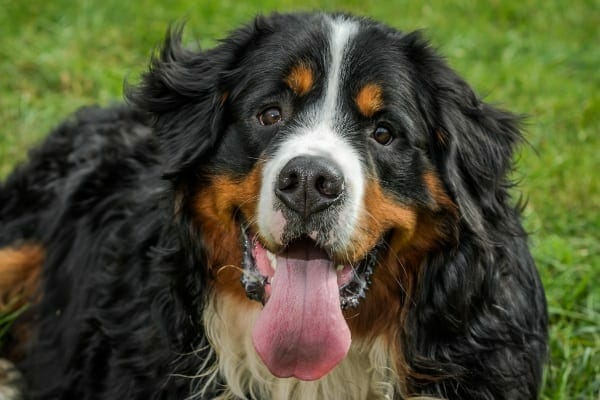
“I just don’t get it, doc. Jasper was fine this morning. Ate his breakfast like normal, went outside to play fetch, and now this.” Jasper’s distraught owner relayed his account of that morning’s events to me. Jasper, a five-year-old Bernese Mountain Dog, had been the picture of health.
But then—when he’d jumped to catch a tennis ball—he yelped and fell. He needed help getting up, and his dad knew immediately something was wrong and rushed him to the vet clinic.
Looking at Jasper sitting in my exam room, I wouldn’t have thought at first anything was wrong. He still had the same goofy, slightly drooly grin he always greeted me with. His eyes were bright, and he wasn’t whining or acting painful. But my initial neurologic examination made me very concerned. Jasper had a hard time rising in his hind end, and when he walked, his right hind leg knuckled and dragged behind.
“This looks serious,” I told his owner. “I’m glad you got him in so quickly. Let’s start with some tests.” Jasper’s bloodwork and X-rays were completely normal. He didn’t give me any signs of pain anywhere. This wasn’t an orthopedic injury; there was definitely something wrong with his nervous system. I advised his owner to take him to the local veterinary neurologist for an MRI. He did so right away.
Unfortunately, Jasper’s MRI confirmed my suspicion. Jasper had a fibrocartilaginous embolism (FCE), sometimes referred to as a spinal stroke.
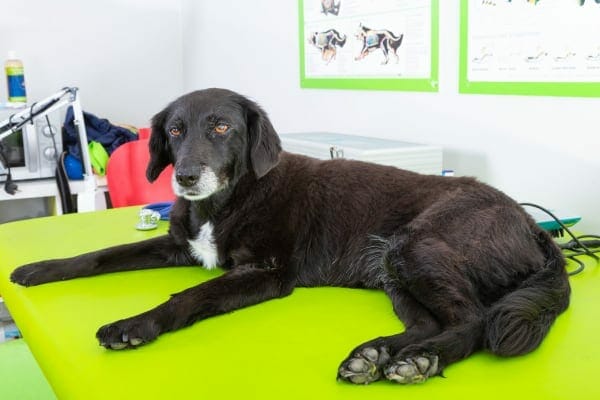
Spinal anatomy in dogs
To get a better idea of what happens in a spinal stroke, first we need to review some anatomy. Dogs’ spinal cords are protected by a series of bones called vertebrae. Between each vertebra is a cartilaginous intervertebral disc. These discs are there to cushion the vertebrae and to allow the spine some flexibility and movement.
What is a spinal stroke or FCE?
Like other types of strokes, FCEs occur due to an obstruction in a blood vessel. But a spinal stroke in dogs is unique because material from an intervertebral disc—not a blood clot—clogs the blood vessel.
A spinal stroke in dogs occurs when a piece of a disc breaks off, enters the bloodstream, and blocks blood flow to a portion of the spinal cord. The location of the blood vessel that is obstructed determines which portion of the spinal cord is affected and therefore what clinical signs are noted.
Which dogs are most commonly affected?
Most dogs with this condition are relatively young (three to six years old) and healthy. FCE occurs more commonly in giant and large breed dogs and is typically associated with some sort of mild trauma or physical activity like playing fetch.
What are the signs of an FCE?
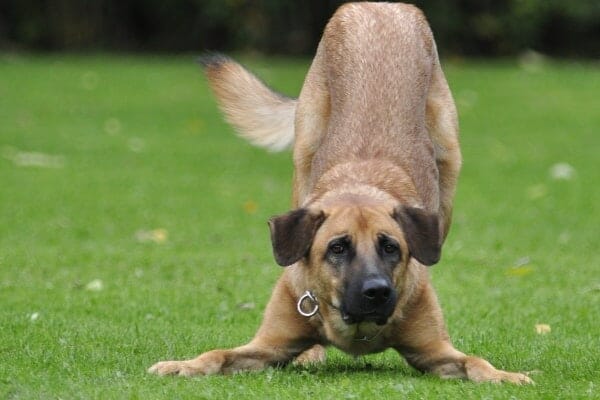
A spinal stroke results in a rapid onset of clinical signs—usually weakness or paralysis in one or both hind legs, although front legs also can be affected. Depending on where the FCE occurs, one side of the body may be affected more than the other. Although the initial injury causes discomfort, FCE does not result in long-term pain.
The following signs may be seen in dogs who have experienced a spinal stroke:
- Loss of coordination (ataxia).
- Characteristic knuckling gait where they are unable to right the paws. (See how to test for knuckling in dogs by watching this video: Knuckling in Dogs: How to Test A Dog for Conscious Proprioception.)
- Weakness in one or more limbs.
- Complete paralysis in one or more limbs.
- Signs that are more profound on one side of the body than the other.
Keep in mind that the signs may vary depending on the severity and location of the spinal stroke.
Is there hope for dogs who suffer a spinal stroke?
If your dog has suffered a spinal stroke, I want to offer you two pieces of good news that may give you some peace of mind.
- After the first 24 hours, the clinical signs associated with FCE typically won’t continue to progress. Things may look bad on day one, but remind yourself that you are seeing the worst of the worst. From here, your dog’s weakness or paralysis will either stay static or improve.
- Unlike some other conditions, a dog who had a spinal stroke is not at an increased risk for it happening again. Once you and your dog make it through this episode, you shouldn’t have to lose sleep over the potential of it reoccurring.
What is the treatment for a spinal stroke?
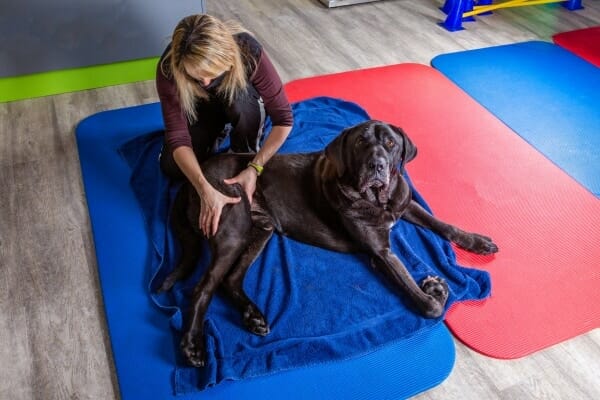
Unfortunately, there is no specific medical treatment that can reverse the effects of an FCE. However, that doesn’t mean that there isn’t hope. Supportive care and rehabilitation go a long way in helping these dogs regain strength.
If your dog has a spinal stroke, ask your veterinarian about rehabilitation options. Many general veterinary practitioners offer some degree of rehab services, or they may refer you to a veterinarian who specializes in physical therapy and rehabilitation. Also, the American Association of Rehabilitation Veterinarians maintains a searchable database to help you find a rehabilitation professional.
Underwater treadmills assist with walking and build strength
An underwater treadmill is a wonderful tool for dogs who have suffered a spinal stroke. The buoyancy of the water allows the patient to go through the full range of motion required for normal walking without the added stress of full weight bearing. Moving through the water also gives the muscles some resistance to improve strength.
Think about the last time you tried to walk in the swimming pool. The water made you feel lighter but it was harder to walk. The same goes for dogs on an underwater treadmill.
Laser therapy reduces inflammation
Laser therapy for dogs can also be very helpful in reducing inflammation and improving blood flow. This is beneficial as the body heals from the spinal stroke.
Ultimately, every case is different, so work with your veterinarian to find the recovery plan best suited for your dog.
What is the prognosis for FCE?
An individual dog’s prognosis after a spinal stroke varies depending on where the FCE occurs, which parts of the body are affected, the severity of the initial signs, and how quickly treatment is initiated.
The goal of rehabilitation and supportive care is to regain as much function as possible. In many patients, improvement occurs in as little as three to four months. Some dogs make almost a complete recovery. You’d never know anything ever happened, except for a shuffling gait now and then. Many dogs go on to live otherwise normal lives.

Challenges of caring for a paralyzed dog
Other dogs, unfortunately, must deal with long-term issues related to their paralysis. They may need ongoing therapy to assist with movement and strength. Because they may not be able to reposition themselves well, they are also prone to secondary issues such as skin infections or bedsores.
Paralyzed dogs could have difficulty urinating and defecating, and may rely on their owners to express their bladders. This can lead to other issues such as frequent urinary tract infections in dogs. Dogs with more severe paralysis will need frequent follow-up visits with their veterinarian as well as diligent at home care to stay on top of their recovery.
Additional ways to assist your dog’s recovery
Depending on your dog’s specific needs, your veterinarian may discuss slings or harnesses to help with support and movement.
Traction is also key in getting around on hard flooring, so Dr. Buzby’s ToeGrips® dog nail grips can be immensely helpful for dogs recovering from FCE.
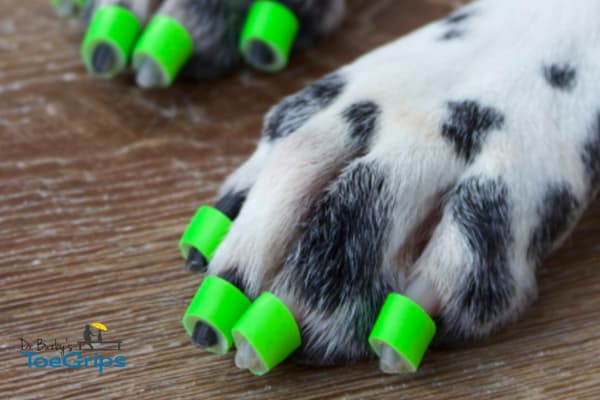
In addition, ToeGrips may also enhance conscious proprioception—the body’s ability to sense the position of the limbs and placement of the paws. Dogs who are recovering from a spinal stroke need to have their ToeGrips glued on because dragging/scuffing the paws will tug the grips off the nails. Here is a short video to explain how, when, and why I recommend this…
Back to Jasper
I am happy to report that Jasper is doing well. After working with the neurologist to diagnose his FCE, we collaborated with a veterinary rehabilitation facility to tailor a treatment plan to Jasper’s needs.
Compared to some, his condition was relatively mild, affecting only his right hind limb. We used a combination of medication, an underwater treadmill, laser therapy, and range of motion exercises at home.
Now Jasper gets around without much help and still chases his tennis ball after breakfast every morning. He hasn’t let FCE slow him down one bit, or put a damper on his love of life!
If your dog has suffered a spinal stroke, don’t lose hope—even if the prognosis seems bleak at first. Work with your veterinarian or rehabilitation professional to develop a plan, and take it one day at a time.

Has your dog had a spinal stroke?
Please share your story below. We can all support each other.


Hello! My 6 year old mutt Yeti loves to chase the ducks of course in our neighborhood. One day about a year and a half ago he took off running to the ducks and collapsed in the road and yelped out of pain. We rushed him to the vet the next day and he was diagnosed with FCE.
He was basically bed ridden for a month, we carried him to go the bathroom (he’s 85 pounds) and basically did everything for him for that month. Through the month we saw him slowly be able to stand on his own but his right hind leg still dragged quite a bit. We watched him carefully every day and then we started seeing him be able to turn his paw over on his own.
The hardest part really was seeing him depressed, you could just see it in his eyes that he wanted to be able to chase the ducks again. Eventually he was walking around on his own and didn’t need any assistance but has had a limp ever since. After walks now or if he plays with other dogs then sometimes he does need help getting into my car because it’s lifted and he can be uncoordinated at times especially playing in the snow or icy trails with other dogs. If he hops up on the couch then sometimes it takes a little while for him to get that hind leg up on there as well. My question is, is the limp just part of the neurological disconnection or is it because he is in pain? My vet said to refrain him from jumping on the couch but it’s always been more his couch than my own lol. She also said that walks really aren’t recommended and rest is the only option. He went almost four months without really a walk and I did see major improvements but his depression was killing me.. I hated seeing him look out to the trails and the ducks and just look at me with those eyes of need of freedom. Of course I want to do what’s best for him and maybe I was wrong to start walking him and taking him places again so that’s my ultimate question, is the limp because he is in pain? The limp hasn’t gotten better or worse so I’m wondering if that’s just the most he will recover or should I really be trying to get him to a full recovery? I will do what it takes to help him, I just am not sure if I should be stressing so hard because of what our vet said.. He’s been his happy self again and it’s been a year and a half but constantly in the back of my mind, I am always stressing about if I could do more for him or if I’m causing him discomfort or making things worse. Thank you so much in advance for any advice!
Hi Ashley,
I understand your concerns about Yeti’s recovery and his lingering mobility issues. While rest is best initially after an injury like this, it is good to start slow controlled walks and start working in some physical therapy over time. The saying “if you don’t use it, you lose it” is very true. I would not think the walks are causing discomfort. Of course, without examining your pup myself, I can’t make specific conclusions. I assume Yeti has regained what mobility his body is capable of, and this is probably the best it will be. If you want to know for sure, I highly recommend you schedule a consultation with a veterinary rehabilitation professional. Physical therapy can do miraculous things and there’s no telling what is possible when working with a rehab vet. I hope this gives you some peace of mind and maybe some things to discuss with your vet. Wishing you both the best for a very happy future!
we have Buddy a lovely harmless wee-Chon , he’s 10yrs old and was playing with our daughters dog in another room
we heard a cry from buddy and found him limping on his front leg . 20 mins later he was walking on it ok and thought nothing of it .
later in the evening he was laying next to me he got up and did a reverse sneeze and crying very loudly, then collapsed on his front legs into me
and just stayed there.
I layed him on the floor with him panting and in distress.
Contacted the local vets and was told to bring him straight down. Buddy had zero movement by now , the vets gave him pain killers and run tests and said it was a spinal injury and had no use with all his 4 legs or body . Not sure what to do from this point and was given an option to operate the next day at a estimate cost of 5 to 8k plus extra costs post opp or putting him to sleep … he loved walks and running around and couldn’t bare to see him paralyzed or in pain for the rest of his short life.
we miss him terribly but hope we did the best for Buddy .
Glad I found your website it’s been a nightmare for us
Dear Alan,
I am so sorry for your loss of Buddy. I can only imagine how difficult it must have been to have faced such an emotional decision about your beloved pup with so little time to process what was happening. You definitely did the right thing for your sweet boy by allowing him peace and relief from his suffering. I have no doubt Buddy knew how much you loved him and that your presence was a comfort during his last moments. May his memory stay with you always and continue to be a blessing in your life.
I’m afraid my story already has a sad ending, but today being what would have been my boy’s 8th birthday, I found myself once again looking for answers and came across spinal stroke.
He was a beautiful blue Great Dane, 6 years 9 months old, called Tank. He’d had issues with his cruciate ligaments in his hind legs (surgery in both) but he was doing really well. His last day ironically he was better than ever. We walked on the beach, he wanted to play with me doing a little ‘zoomie’ even, he ate breakfast.
I came back from having lunch and he’d been vomiting – I presumed he’d drank sea water – but it wasn’t getting better and he was lethargic so I took him to the vet.
There was nothing obvious but he stayed in for observation and fluids. When they were happy for him to go back home, I came to collect him, but a wobble in his hind legs made the vet worried. I walked him around the foyer a little, but then he just collapsed. His front legs both gave way and his eyes glazed.
He never walked again and 5 hours later, stopped breathing.
Reading this today I wonder if it was a spinal stroke. There was talk at the time that it might be a stroke, but ultimately we’ll never know. I hope this story might help in some way.
Dear Mike,
My heart goes out to you with your loss of Tank. It sounds like he was a magnificent boy. Without having seen him myself, there are just too many possible causes to make specific conclusions. While a stroke is definitely possible, I would also be suspicious about a splenic tumor that may have ruptured. This can happen with little to no warning and cause a dog to pass very quickly. No matter what the cause, I am glad you were able to be there with him. I am sure your presence was a comfort. Thank you for being willing to share your story with our readers. This may be the bit of information someone else needs to make sense of their own difficult situation. May Tank’s memory live on to be a blessing in your life.
I’m so sorry for your loss! The vet thought my 13 year old pit lab had a spinal stroke. He referred me to Louisville for Neurologist appt. I never made it there because it was going to be really expensive and I didn’t have the money. so I was working and saving to take him but my baby passed today also! He was fine one second, and then I noticed he wasn’t breathing. Just a real deep one every so often. I watched my baby slip away and I couldn’t do anything about it. I called the vet but by the time we got ready to go, he was slipping away. I decided to lay with him as he did. he was my first dog by myself. I trained him and we did everything together for 13 years. I’m so lost right now. and so sad. I’m so sorry about your baby, I just wanted you to know, I’m right there experiencing the same thing💔💔💔
Dear Cherron,
My heart aches for you with your recent loss of your pup. I can only imagine how much you miss him but am so thankful you were able to be by his side during his last moments. I am certain your presence was a comfort and have no doubt he knew how much you loved him. Thank you for being willing to share your experience and offer sympathy to others in a similar situation. May the memories of the good times with your sweet boy be a blessing. Wishing you brighter days ahead.
My girl had a sudden injury, we are not sure what. She previously had oddly swollen paw right after play for years. Now fast forward to this past weekend when suddenly she stopping sitting pretty. This is her go to for treats. Then she wasn’t sitting. And now she’s walking but part knuckling and part awkward gait. It stresses me out because she is such a go all the way and play kind of girl. She’s 6 and a pit/shepherd mix with predisposition to hips and knees but the emergency vet checked and those are good. Should I fear a stroke? And what are my options? We see her regular vet tomorrow.
Hi Brandice,
This is quite puzzling. Without examining your dog, myself, it is hard to make specific conclusions. I would not suspect this to be a stroke, but of course it cannot be ruled out without some testing/imaging. It definitely sounds neurologic in nature and needs some investigation. What did you find out from your vet? You may end up needing to see a specialist to get a definite diagnosis. I hope your girl is doing better today and you have found the answers you need. Feel free to leave an update if you have a chance.
My large mixed breed (Great Pyrenees mix) male dog, Clancy, suffered an FCE when he was 5 years old. He’s now a geriatric 13 year old but I was telling my oncologist today about his original diagnosis as she too has dogs and is a “dog lover” and had never heard of an FCE. My doc and I spend more time talking about dogs than anything else at my appointments!
I’m commenting here on ancient history for Clancy primarily so anyone reading this with newly diagnosed FCE in their dog will realize recovery can be either virtually total or very, very good for their dog, just as it was for us.
Clancy was a healthy middle aged big dog and while chasing cows one day at my friends ranch in his typical “weekend warrior” mode, he suddenly sat down in the field and stopped moving. He wouldn’t come when I called to him so we drove my truck to get him, picked him up (not too easily only because he weighed about 120 pounds at the time!) and off to the vet. At first he seemed to be in no pain at all so I was very puzzled as to what was going since it was obvious he had no control over either of his hind legs. Long story short, he was diagnosed with an FCE and although both back legs were originally “paralyzed” my vet told me he had a good chance of recovery in his back legs. Even though she was a personal friend as well as a great vet, I thought she must be crazy and was just saying stuff to make me feel better. I certainly did not believe he could have a full recovery. Well, turns out she was completely correct (excellent vet and since we were also good friends I never told her I doubted her!) and within 3 or 4 months Clancy didn’t even have a limp, gait problems, or anything else wrong. I did have to use a sling with him as he went through his recovery but I did not take him anywhere for rehab classes, etc, I just worked with him to walk and slowly exercise every day with his sling and he eventually recovered with no extra expense to me, This is not to say dogs with FCE don’t need some sort of rehab but since I had a vet friend keeping tabs on Clancy we had a relatively easy recovery period.
Fast forward to 2023 and he now spends most of his time on his bed next to mine and walks slowly and arthritically to go outside but he’s almost 13 and it’s just “old age”at this point in his Golden Years. He has lived a normal, happy life and the FCE never reared its ugly face after those few months many years ago.
Just an old story with a very happy ending which is apparently not uncommon for his type of diagnosis.
From Rebecca and Clancy-dog
Hi Rebecca,
Thank you so much for sharing Clancy’s story with us! I am sure this will be exactly what someone else needs to hear to bring hope to a difficult situation. It makes my heart happy to know Clancy made a full recovery and has lived such a long and joy filled life. Give your sweet boy a hug for me! Bless you both. ♥
Needed to hear this! We’re waiting for the MRI on my dog who suddenly lost use of her hind leg. No explanation so I’m hoping this is the answer and she won’t need surgery. Thank you!
Dear Lori,
Praying you received good news and there is a clear path forward. Wishing you and your sweet girl the best! ♥
Hi from Australia. Thank you for this. Our 12 yr old chocolate lab Pippa, collapsed and was paralysed about a month ago. We were devastated and took her to our vet thinking we would be putting her down. He said he thought it was spinal stroke. He said as long as she continues to improve there is hope… A month on she still cannot stand and walk on her own but can turn herself 360 deg if necessary and shuffle along to get food.. We towel walk her outside to toilet and we play food games.. She is not unhappy and wags her tail a lot. We pray she will walk again. So great to find this support page. Thank you!
Hi Diane,
I am sorry Pippa has experienced this tragic condition but glad to hear she is still fighting and has a decent quality of life. If the towel walking is becoming difficult, there are some great harnesses that allow you to offer support to the hips and can be left in place so they are ready to go when needed. The one I like the best is the Help ‘Em Up Mobility Harness. Here is a link to an article that mentions this device and others that might be beneficial for your girl: Hip Support for Dogs: 7 Solutions
Praying for continued healing for Pippa and wishing you all the best!
Hello from Brazil, my pinscher dog, 14 years and six months old, I think he had spinal stroke, he has three herniated discs and problems with his spine. He is cardiac, he has heart failure in the most advanced stage with mitral valve regurgitation problems. This week he was walking normally, he didn’t show any alarming signs of fatigue, however, last Tuesday he was coughing a lot, but he was anxious to walk, when he was walking through the grass he screamed and fell. When he fell, he went totally rigid, his eyes were looking like they were going to pop out, and right after he started to convulse, his tongue turned blue. I took him to the vet and they found that it would be cardiogenic pulmonary edema, he was hospitalized until Thursday.
We noticed that he was no longer able to walk properly, his legs were bent over, it takes a lot of effort to get up, he gets tired just getting up, and he can’t even take a few steps, which he was able to do before and he feels a lot of pain. We took him to the cardiologist on Friday, and she said that these mobility problems in the legs, paws and hips have nothing to do with the heart problems. The cardiologist just said it must be his herniated disc. He is taking a variety of medications, apart from the ones for the heart, for the spine, he’s taking tramadol, glucosamine and omega 3, he only urinates when I carry him out to the yard and hold him, and he’s having a really hard time defecating, his paw is fully curved when he tries to walk, not steadying on the ground. In the state where I live, there are still no such therapies for dogs, such as hydrotherapy. Then, the only thing he does is rest… The cardiologist said that it was not good for him to try to walk because of his heart condition, but he really wants to walk but as soon as he tries to walk for a few staggering he falls sitting down and sometimes he falls down and gets tired.
Any advice for us? Thanks for the amazing article full of information, it was through it that I found out about the existence of Spinal Stroke. And, thank you for giving me hope about his legs, I think what makes it worse is that he is elderly and has an advanced heart condition…
Hi Gabrielly,
I am so sorry your dog is struggling with so many issues at once. It sounds like you are doing what you can to maintain his health and wellbeing. Since I haven’t examined your guy myself, it is hard to make specific recommendations. My best advice is to make sure you are taking into consideration your sweet boy’s quality of life. We want so badly to keep our beloved dogs with us as long as we can, but sometimes saying goodbye can be the most loving option and the only way to give them peace and rest. Make sure you keep your vet up to date with how things are progressing. It is never a bad idea to discuss palliative care. Here is an article with additional information that may be helpful: Using a Quality of Life Scale for Dogs
I hope you can find the answers you need to make the best decision for you and your senior boy. Wishing you both the best.
Hey Dr my 10 year old Labrador retriever we think suffered a FCE she woke up dragging her back end one leg paralyzed the other still moving our ER vet said either FCE or LS disease but they wanted us to go see a nurologisg fit MRI we had already reached a money cap! So I’m reaching out because she was 10 older and had althritis already we tried inflammatory meds and steroids for 3 days no improvement so we chose that it was best to euthanize could have we done anything different? She had lost function of her bladder and colon
Hi Rob,
I know it is hard to make decisions when you don’t have all the answers. It sounds like you did everything you could, and your senior girl was still suffering. Choosing euthanasia may have been the most loving way to give her peace and rest. Try not to dwell on the “what ifs” and allow yourself some grace. I hope with time your heart will heal. May her memory be with you always.
my 5 year old black lab was having a typical day however right before dinnertime. he was zooming around as dogs often do when he yelped a blood curdling yelp. he was down panting and paralyzed. he made the 1 1/2 jour trip to the emergency vet. because yes. it was sat evening and that was our closest option. how could this serious. injury happen in out living room. ?
four months later …. he s regained movement in both his rear legs. he will always have a disability in his tear right leg i fear but i ll take it. what a nightmare but lucky for hoovie it had a happy ending. he suffered a fce we had never heard of this before. thanks for listening
he still looks a little puzzled when his leg “shorts”
out but it hasn t slowed him dowb and i am thankful for his recovery ….
Hi Karen,
I am sorry you had to endure that scary and traumatic event with your sweet boy. What a blessing he has made almost a full recovery and is back to living his best life. Thank you for sharing your experience with our readers as this may give someone else hope in a difficult time. Best wishes to you and your pup.
I’m so glad I’ve found this post and reading the comments has been very comforting. Four days ago while at the dog park, our Siberian husky dropped and let out a big sequel that we’ve never heard before. He has lost mobility in his hind legs. We rushed him to the local vet who had performed tests and an X-ray which looked fine. We then were referred to a nearby emergency hospital where he had a CT Scan done. After concluding that there was no problems with his spine the vets said that it’s most likely that he suffered from an FCE event.
He spent one night in the hospital and has now been at home for the last 3 days. I’ve been doing physical therapy with him 3x daily including light stretching and range of movement exercises. His right hind leg is almost completely paralysed while his left hind leg is at about 75% strength Id say.
He’s got to the point where he can pull him self up and I’ve even seen him hobble on 3 legs however the immobilised right leg is bothering him. We are going to book him in to hydrotherapy sessions soon and hopefully that helps with his recovery.
Dr Buzby, One thing we’re struggling with is his urination. on the first morning after we picked him up he had a big pee but by yesterday afternoon (about 35 hours later) he still hadn’t gone again and we took him down to the local vet to have it extracted. We are unsure if he is just anxious to pee not being able to do it in the places he normally goes or if he’s lost control of his bladder. I’ve tried manually expressing him but have had no luck and being a larger dog I’ve been told that this is much harder to do. Is there anything we can do to get him to pee more regularly without having to go the vet?
He also hasn’t defecated since being home however the vet has given us some Duphalac laxative that hopefully will help.
Thank you
Hi Joel,
I am glad you are seeing some improvement in your Husky and the hydrotherapy sessions will be a wonderful addition! You are right to be concerned about his urination and defecation. Since I haven’t examined your pup myself, I can’t make specific conclusions. But I am suspicious it is all related to the nerve damage and not behavioral or due to anxiety. As your dog continues to heal, these issues should resolve as well. In the meantime, please make sure your vet is aware you are having difficulty expressing the bladder at home. They may need to prescribe a muscle relaxer to make the process easier. Also, urinary catheters are not ideal as they increase the risk of a bacterial infection in the bladder, but this may be needed temporarily if no other options seem to be working. The rehab/physical therapy vet you will be seeing for hydrotherapy may also be able to provide some direction in how to handle this issue at home. I hope your boy is feeling well today and pray he makes a full recovery.
Good Morning,
My 8 year old very lively cocker spaniel Oscar suffered an FCE coming up to 11 weeks ago now, he was on complete crate rest for 4 weeks 3 lots of tablets a day, we had to carry him everywhere. He started Hydrotherapy and has now had 10 sessions, this has made so much difference to his progression and balance. He is still limping and dragging is left hind leg but is much happier and is now running round the garden wanting to play. I am still a bit apprehensive of taking him out for a walk just yet as i also have a 19 month old cocker. When would be the best time to start taking out on short walks and would it be best to take him on his own at first. Will his limp completely go after time. Thanks.
Hi Yvonne,
I am so glad to hear that Oscar has improved since starting the hydrotherapy. I can only imagine how happy he must be to be mobile again! Since I haven’t examined your pup myself, it is difficult to make specific conclusions about prognosis and recommendations on progression of therapy. Are you seeing a veterinary rehabilitation professional for the hydrotherapy sessions? If so, this would be the best person to ask. A rehab vet can let you know what goals are attainable based on how Oscar has progressed thus far. They can also give you recommendations on what exercises are safe to do at home and how to keep slowly increasing the difficulty to make sure Oscar is being challenged in a positive way. Make sure your vet is aware of how things are going at home and any concerns you may have. I hope your sweet boy can continue working hard to make a full recovery. Bless you both!
Hello there,
I’m glad I came across this website and the posted comments are recent which is great. Our 6.5 year old large Pomeranian (?cross.? Rescue dog so we aren’t sure) was diagnosed with FCE yesterday after presenting much the same as the other stories. He is quite lethargic and quiet which is likely from the gabapentin. There hasn’t been any sign of improvement, although we think we saw him wag his tail a bit when he saw my husband this morning. The incident happened Saturday evening so less than 2 days ago. Are we being unrealistic to expect any hopeful signs at this point? I am right to understand that it can take 5-14 days for beginning signs of improvement? Like other people’s dogs Skipper is a happy, playful dog who loves walking the trails with me. Seeing him like this is so sad.
Thanks you Yvonne..
Hi Shawna,
I am sorry your dog is struggling with the symptoms of a spinal stroke. I don’t think it is wrong to be hopeful that you will see some improvements soon, but also don’t get discouraged if you don’t. This may take some time and just because you aren’t seeing progress yet doesn’t mean it won’t happen. Make sure you are staying in close contact with your vet and keep them updated on how this recovery process is progressing. Praying for a full recovery and wishing you the best.