Dog head tremors can be a bit disconcerting. One minute your dog is normal, and the next he or she seems to be nodding “yes” or shaking “no” on repeat. To put your mind at ease, integrative veterinarian Dr. Julie Buzby explains the causes, symptoms, diagnosis, and treatment of idiopathic head tremors in dogs.
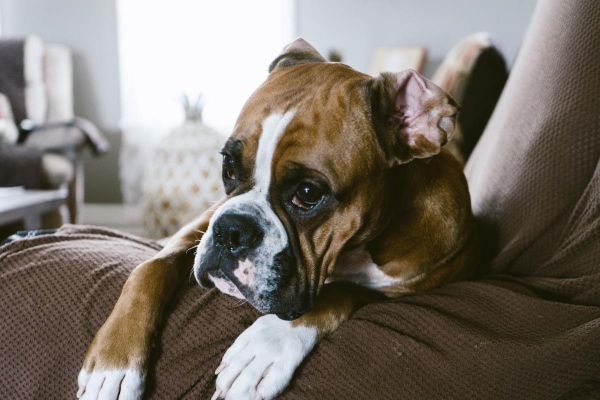
“It was the strangest thing. When I looked over at Dudley, his head was shaking up and down over and over again, almost like one of those bobblehead dolls. After a few minutes, the nodding stopped and he wandered over to play with a toy like nothing had happened.”
As my client said those words to me, the condition that immediately popped into my head was idiopathic head tremors in dogs. But I knew that before jumping to that diagnosis, I needed to gather more information to ensure that her beloved English Bulldog wasn’t suffering from a more serious neurologic condition.
Since dogs can occasionally have seizures that involve the head, the first order of business was to determine if what my client was seeing was truly a head tremor.
What are dog head tremors?
I explained that the term “tremor” describes the involuntary shaking or trembling of a body part. When this trembling is localized to the head, it is called a head tremor.
Head tremors in dogs are considered to be a type of involuntary muscle movement disorder. In other words, your dog cannot control when or how the muscles are moving. Head tremors mostly occur when dogs are awake, but can sometimes happen while a dog is sleeping.
What are the symptoms of head tremors in dogs?
In dogs who are experiencing a head tremor, their head may shake up and down (as if they were nodding “yes”) or side to side (as if they were shaking their head “no”). Occasionally, dogs can also have a rotational tremor. These movements are typically small yet rapid.
While they might look a bit similar at first glance, head tremors are different from seizures because dogs do not lose consciousness with head tremors. Also, seizures in dogs may cause other signs such as twitching of the muscles of the face, loss of bowel or bladder control, or involuntary limb movements. These signs are absent with head tremors.
What causes head tremors?
Unlike in seizures where the causes are better understood, the exact mechanism of action behind head tremors is not clear. However, some researchers have theorized that activation of certain areas of the brain can cause head tremors. More specifically, head tremors may be connected to stimulation of the groups of neurons within the brainstem that helps with patterned motor activity.
In a condition called idiopathic head tremor syndrome, these neurons seem to activate spontaneously and without any obvious trigger. However, there are a variety of neurologic and neuromuscular disorders that can also cause dog head tremors. They include:
- Central nervous system disorders
- Congenital disorders affecting brain development
- Damage or injury to the cerebellum (i.e. the part of the brain that controls coordination)
- Low blood sugar (i.e. hypoglycemia)
- Toxin exposure (e.g., pyrethrin, drug overdoses, various poisons)
For the purposes of this article though, we will focus on idiopathic head tremors.
What are idiopathic head tremors in dogs?
Many of the conditions in the list cause head tremors that are more persistent or chronic. But canine idiopathic head tremor syndrome (IHTS) is characterized by head tremors that are intermittent and self-limiting. They can start and stop at random. And in some instances, you may be able to halt a tremor by drawing your dog’s attention to something else such as a toy or a dog treat.
What causes idiopathic head tremors in dogs?
As alluded to earlier, the term “idiopathic” means that there is no obvious cause for the tremors. However, some veterinary researchers believe these episodes are stress-related. Other studies propose that illness, various medications, heat cycles (in female dogs), and surgery may be triggers for head tremors.
Which dogs are prone to idiopathic head tremors?
There also may be a genetic link as certain dog breeds are more susceptible to IHTS. Predisposed breeds include:
- Boxers
- Doberman Pinschers
- English Bulldogs
- French Bulldogs
- Labrador Retrievers
- Spaniels
While there doesn’t seem to be any sex predisposition for IHTS overall, some reports indicated it is more likely to affect male Doberman dogs than female Doberman dogs. Also, most dogs with idiopathic head tremors will experience their first episode around two to three years of age. But it is possible for older dogs or senior dogs to experience IHTS as well.
What are the tremor episodes like?
These tremors occur spontaneously and may only last for a few minutes at a time. In fact, the majority of idiopathic head tremor episodes last less than five minutes. However, in some cases, the head bobbing may last for up to an hour. And there are a few reports of tremors lasting more than 12 hours per day.
Some dogs may experience idiopathic head tremor episodes multiple times in a day or in a week. But for other dogs, the episodes may be few and far between.
Most dog parents will notice head tremors while their pup is awake. But it is possible to see head tremors in dogs while sleeping. This is different from the limb-twitching or vocalizing that you might notice when your puppy or senior dog sleeps.
The video below illustrates what a tremor episode may look like. If you find this disturbing, you may want to skip this video.
How are idiopathic head tremors in dogs diagnosed?
If you suspect your dog is experiencing head tremors or other neurologic signs, it is important to contact your vet promptly. Based on the information you provide, your vet will advise you on whether you need to make an emergency vet visit, schedule a vet visit during regular business hours, or continue to monitor your dog.
Since idiopathic head tremor syndrome is a diagnosis of exclusion, your vet will want to rule out other causes of your dog’s symptoms before making a diagnosis of IHTS. This usually involves collecting a medical history, performing a physical examination, and running diagnostic tests.
Medical history
A detailed medical history will be important. The more you can remember about what your dog was doing prior to the episode, what you saw during the episode, and how long it lasted, the easier it will be for your vet to figure out what is going on. Also, having a video recording of your dog during one of these episodes can help immensely!
In order to be IHTS, the only clinical sign present should be the head tremor itself. The tremor can be in any direction (vertical, horizontal, or sometimes rotational) and may stop when someone distracts the dog.
On the other hand, if the dog has a history of loss of urinary bladder control, drooling, difficulty walking, or loss of consciousness during the episode, it may be more likely the dog is experiencing seizure activity rather than IHTS. Or, especially in an older dog or senior dog, head shaking, a head tilt, and being a wobbly and off-balance dog could point to old dog vestibular disease (i.e. doggie vertigo), not IHTS.
Physical examination
A comprehensive physical exam, with an emphasis on the neurologic exam, is also an important part of the diagnostic process. Dogs with idiopathic head tremors should not have any persistent neurologic abnormalities or other abnormal findings on their physical exam.
Diagnostic testing
Depending on your dog’s symptoms, your vet may also recommend specialized testing including:
- Bloodwork
- Infectious disease panels
- CT scan
- MRI
- Cerebrospinal fluid (CSF) analysis
For dogs with idiopathic head tremor syndrome, these tests will appear normal, thus ruling out many of the other conditions that can cause head tremors (plus some of those that cause seizures or other neurologic problems).
What is the prognosis for idiopathic head tremors?
In many ways, if your vet diagnoses your dog with idiopathic head tremors, this is good news! Unlike seizures, idiopathic head tremors are not dangerous for dogs. They don’t cause sharp elevations in body temperature. And they shouldn’t cause any bodily harm (like if a dog were to hit their head or fall down the steps during a sudden seizure).
Plus, unlike other causes of head tremors, idiopathic head tremors are not a sign of a bigger and potentially serious problem. They don’t cause pain or discomfort, don’t tend to progress, and don’t require ongoing monitoring.
In fact, some studies show that the tremors may stop altogether in about 66% of affected dogs. But even for those dogs with long-term idiopathic head tremors, their prognosis is still good. These episodes of head tremors do not impact their overall quality of life.
What is the treatment for idiopathic head tremor syndrome?
Since it is such a benign condition, there is usually little reason to attempt to medically treat idiopathic head tremors in dogs. This works out well since there also aren’t any medications, including anti-convulsants, which can effectively and reliably stop the tremors.
Interestingly, while it sounds almost too easy to be true, distraction halted the head shaking in 87% of dogs according to a study in Veterinary Medicine International. Therefore, the main “treatment” is to remain calm and try to distract the dog with a toy or treat to see if the head tremor stops.
Speak with your veterinarian
Idiopathic head tremors may look a bit odd, but they are nothing to fear. Other causes of head tremors, however, can be more serious. If your dog starts shaking his or her head side to side or up and down, or showing other neurologic signs, head to your veterinarian to get some answers.
Hopefully, just like my sweet Bulldog patient that I told you about earlier, it will turn out that your dog has idiopathic head tremors. If that is the case, you can breathe a sigh of relief. Chances are good that the head tremor may bother you more than it bothers your dog. And like I told my client, IHTS doesn’t pose any danger to your dog and shouldn’t interfere with him or her continuing to live life to the fullest.
Does your dog have idiopathic head tremors?
Please comment below.


My Aussie bulldog has them only recently. At the moment for the last 12 days he has 2-3 a day.
Will this slow down? Or it’s an off week? Or could this be the start of a new normal?
He is always distracted out of them.
The only thing I worry about is if I’m not around to help him.
Can they manage on their own?
My work is dog friendly so he is with me all day, but now I’m too scared to leave him alone for a day
Since they happen daily
Sam
Dear Sam,
I am sorry your pup is struggling with head tremors daily. I understand why you are concerned and how hard it must be to even consider leaving him alone. Unfortunately, there is no way to know what the future holds. Even if I could personally examine your dog, I would not be able to tell if the frequency of these episodes would stay the same or change. He should be able to manage but you could think about getting a pet camera in your house. They make some that allow you to talk through them. I was thinking that maybe if you could see what he was doing and then talk to him it might be enough to distract him out of the tremors. Praying your sweet boy can continue to find joy in his days. Wishing you both the best.
My 7 year old cocker spaniel has been having head tremors roughly once a month they last 1-2 minutes after his tongue and gums are very pale. He’s back to normal straight after. My vet wants to medicate with EPI meds and prednacare I’m not 100% happy with this as these episodes aren’t affecting my boy and after and his bloods etc are all normal. Any advice greatly received
Hi Bev,
I understand your hesitancy to start these medications. But the symptoms you describe have me very concerned. Idiopathic head tremors should not cause your dog’s tongue and gums to become pale. These symptoms lead me to believe that there is something else going on and more investigation is warranted. Your vet may be exactly right in thinking this is seizure activity. I am not sure what testing has already been done and you may want to reach out to a veterinary neurologist for guidance. I hope you can find some answers and ensure your sweet boy is happy and healthy. Wishing you both the best and good luck!
Hi I have an Old English Bulldog, Indie is 4 years old next week, we took on Indie when she was 20 weeks old, we’re not quite sure of how she was treated for the 8 weeks her previous owner had her but stories tell us it wasn’t good, anyway she came to us and on the 2nd night she had her first head tremor, I done what most do and panicked, this lasted about 5 minutes and went on its own as I didnt know what to do to help, I took her to the vet she had bloods etc done all came back clear and we were told they were IHTS , she had these occasionally and we got used to them , the custard creams and honey really didnt help, but a tennis ball worked amazingly !
Over the last few years the episodes have varied widely, sometimes she’ll have a couple in a day then none for a few days, other times she’ll have one very long one, about an hour then nothing for a few weeks so we are pretty random, I do wonder if hers are related to her anxieties, she came to us with anxieties which have only got worse since having her spayed despite help from top behaviourists and our total love for her.
Hi Tracy,
Thank you for sharing your experience with our readers. Indie has such an interesting story, and it helps others to know what they might experience with their own dogs. I am glad your sweet girl seems to be thriving despite her anxiety and head tremors. I think it is so cool that a tennis ball is her therapy! Wishing you and your pup continued success and many happy years ahead. And please give Indie a hug for me. ♥
Our 2.5 year old Frenchie girl, who’s fixed, woke up at 7am this morning with her first bout of IHTS. Have to say it was quite troubling. She has seen the vet this morning and had a thorough exam to rule out of issues. She’s been shaking her head up and down quite a bit since the first one both awake and now as she’s trying to sleep. She had a busy past three days with surprise visitors which affected her sleep patterns. Everything else about her is normal. Guessing stress did bring it on.
Hi Andrew,
I bet that was quite a shock and can only imagine how worried you must have been. What a blessing your girl showed no abnormalities on her exam and seems to be ok otherwise. I hope with time the tremors will subside and she can relax a bit. How are things today? Feel free to leave an update if you have a chance.
My 2 1/2 year old Pitbull/border collie/Shar-Pei/Mastiff/etc. male just woke me up presenting with the up-down tremor. Called the emergency vet and they said it wasn’t an emergency and to call back if it got worse. It didn’t, he’s fine now, but was very scary. The only symptom was the head shaking. We can’t afford all of the tests. I guess it’s something we have to live with. Hoping it was a one time thing.
Hi Susyn,
I am sorry you experienced this scary episode with your young dog. While I am glad the symptoms resolved on their own and he is back to normal, I am worried this may happen again. I recommend you contact your vet and let them know what happened. They can tell you if any testing is needed and give you an estimate of the cost. Please be honest with them about your financial concerns. Most vets will tailor their treatment plans to work with your wants and needs. Hoping your sweet boy will continue to thrive and wishing you both the best for a happy future.
My boxer begs these tremors about twice a year. When it happens we give him cbd and it’s gone within minutes. Then we follow up with a couple
Of days of cbd and he’s good for a year or so. I was terrified the first time it happened. But by the third time I had to try cdb since there’s nothing else. And it worked.
my dog started to exhibit head tremors before he was age 2, but in taking him to the vet it helped me discover that he had lyme! not sure if the two were connected but it makes sense in some way as lyme can affect the nervous system. after he recovered from lyme with antibiotics the tremor would come back from time to time, mostly when he was stressed (or really, when i was!). it freaked me out, but never seemed to bother him. it always stops when he licks something, so i learned to remain calm and just get him to lick my hand. perhaps also to note, they often come on when he is settling to rest and is sleepy.
we live in the woods and last year he got into old trash a bear must have torn up. it gave him a real terrible exposure to mycotoxins or what our vet called “garbage gut”. we almost lost him – dr. buzby you should do an article on that! i wish i knew to give him activated charcoal right away, it would have helped his recovery and helped me feel capable in a moment of total helplessness. the vet monitored him for 24 hours and when he could lift his head up on his own i took him home to continue his care. he was having full body tremors on and off for days to detox as much as his sweet body could. all we could do was wait and see. he came out having to relearn how to walk, and exhibiting some neurological damage. we didn’t have the money to run all the tests but we do know that his paws clearly don’t communicate 100% to his brain where he is in space. he’s just a wobbly guy now! the head tremors come back in waves (definitely more frequent than before) but they still don’t seem to bother him at all, and still are resolved by licking. he is back to his sweet self and happy as ever, even with a new walk that makes everyone smile. definitely good to know if there are other issues affecting the tremors and to keep in contact with a trusted vet, but seems to me some pups are just different and special in a twitchy funky way!
Hi Rhea,
Thanks for sharing your dog’s story! I’m so glad that he has recovered from Lyme disease and garbage gut (this is a great article suggestion) and is still living his best life with his new funky walk. You are doing a great job taking care of him and I can tell what a special part of the family he is! I hope he continues to do well and doesn’t have any more medical issues for a while.
My Boxer developed tremors around 10 years of age She had a history of refractory idiopathic epilepsy since age 4 She was hospitalized as the tremors would not stop She had every possible test available After a week in intensive care her Neurologist tried a trial of Vitamin B 1 ( thiamin) and she completed recovered and went on to live the rest of her life seizure free
Hi Martha,
Wow, that is amazing! So glad your Boxer was able to make a full recovery with the use of Vitamin B1. Thank you for sharing your story with us. I am hopeful this will be just the thing someone else needs to hear while going through a similar situation. Best wishes!
Can I get Martha’s email address to reach out to her? I have a similar situation and would like to reach out to her.
Hi Michelle,
I’m sorry but I can’t give out any personal information of other readers. You could try replying directly to Martha in the blog comments thread to see if she will respond. Hoping you can find the answers and support you need. Best wishes and take care!
thanks for the info
I believe my dog might have ipht . not sure until studies ate done to rule out other causes but mri are so expensive i won’t know for sure.
I have a mix of bulldog..
thanks
Hi,my olde tyme bulldogge is now 3 he had
one of these episodes when he was about 6 months and has just had one at midnight on the 17th July.Our vet diagnosed nodding head syndrome at the time,it was just his head every other body function was normal and lasted approx 5 minutes,I will get him checked but if as before do not think anything to worry about,Regards,
Gary Falkingham
Hi Gary,
I am sorry to hear your dog was experiencing these episodes. Thank you for consulting your veterinarian to make sure he is okay. Wishing for strength and health for you and your pup. ♥
My Boston Terrier Ricky Bobby has them. Everything else was ruled out and the big sign was that I can quickly distract him out of it. We did try eliminating things as well and found taking him off his particular flea & tick prevention greatly reduced, but did not stop, them. He’s perfectly fine otherwise and is more scary for the humans to watch than him 🙂
Hi Shelly,
I am glad your pup is still happy and enjoying life despite these aggravating head tremors. Thank you for sharing your experience with our readers. Wishing you both the best!
My almost two year old bulldog is currently experiencing head tremors. It’s a worrying thing to watch seeing her like that, since I’ve never had a dog before.
She’s currently in season with some stress due to a dog next door
Dear Hayley,
I am sorry your young dog is experiencing head tremors. Has she been examined by a vet? I ask because this may not be idiopathic head tremors but could instead be something more serious. Please make sure your vet is aware of these episodes and keep them updated! Best of luck to you and your girl.