Dog head tremors can be a bit disconcerting. One minute your dog is normal, and the next he or she seems to be nodding “yes” or shaking “no” on repeat. To put your mind at ease, integrative veterinarian Dr. Julie Buzby explains the causes, symptoms, diagnosis, and treatment of idiopathic head tremors in dogs.
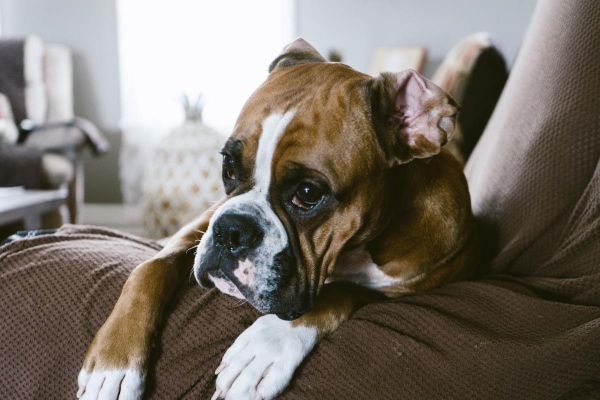
“It was the strangest thing. When I looked over at Dudley, his head was shaking up and down over and over again, almost like one of those bobblehead dolls. After a few minutes, the nodding stopped and he wandered over to play with a toy like nothing had happened.”
As my client said those words to me, the condition that immediately popped into my head was idiopathic head tremors in dogs. But I knew that before jumping to that diagnosis, I needed to gather more information to ensure that her beloved English Bulldog wasn’t suffering from a more serious neurologic condition.
Since dogs can occasionally have seizures that involve the head, the first order of business was to determine if what my client was seeing was truly a head tremor.
What are dog head tremors?
I explained that the term “tremor” describes the involuntary shaking or trembling of a body part. When this trembling is localized to the head, it is called a head tremor.
Head tremors in dogs are considered to be a type of involuntary muscle movement disorder. In other words, your dog cannot control when or how the muscles are moving. Head tremors mostly occur when dogs are awake, but can sometimes happen while a dog is sleeping.
What are the symptoms of head tremors in dogs?
In dogs who are experiencing a head tremor, their head may shake up and down (as if they were nodding “yes”) or side to side (as if they were shaking their head “no”). Occasionally, dogs can also have a rotational tremor. These movements are typically small yet rapid.
While they might look a bit similar at first glance, head tremors are different from seizures because dogs do not lose consciousness with head tremors. Also, seizures in dogs may cause other signs such as twitching of the muscles of the face, loss of bowel or bladder control, or involuntary limb movements. These signs are absent with head tremors.
What causes head tremors?
Unlike in seizures where the causes are better understood, the exact mechanism of action behind head tremors is not clear. However, some researchers have theorized that activation of certain areas of the brain can cause head tremors. More specifically, head tremors may be connected to stimulation of the groups of neurons within the brainstem that helps with patterned motor activity.
In a condition called idiopathic head tremor syndrome, these neurons seem to activate spontaneously and without any obvious trigger. However, there are a variety of neurologic and neuromuscular disorders that can also cause dog head tremors. They include:
- Central nervous system disorders
- Congenital disorders affecting brain development
- Damage or injury to the cerebellum (i.e. the part of the brain that controls coordination)
- Low blood sugar (i.e. hypoglycemia)
- Toxin exposure (e.g., pyrethrin, drug overdoses, various poisons)
For the purposes of this article though, we will focus on idiopathic head tremors.
What are idiopathic head tremors in dogs?
Many of the conditions in the list cause head tremors that are more persistent or chronic. But canine idiopathic head tremor syndrome (IHTS) is characterized by head tremors that are intermittent and self-limiting. They can start and stop at random. And in some instances, you may be able to halt a tremor by drawing your dog’s attention to something else such as a toy or a dog treat.
What causes idiopathic head tremors in dogs?
As alluded to earlier, the term “idiopathic” means that there is no obvious cause for the tremors. However, some veterinary researchers believe these episodes are stress-related. Other studies propose that illness, various medications, heat cycles (in female dogs), and surgery may be triggers for head tremors.
Which dogs are prone to idiopathic head tremors?
There also may be a genetic link as certain dog breeds are more susceptible to IHTS. Predisposed breeds include:
- Boxers
- Doberman Pinschers
- English Bulldogs
- French Bulldogs
- Labrador Retrievers
- Spaniels
While there doesn’t seem to be any sex predisposition for IHTS overall, some reports indicated it is more likely to affect male Doberman dogs than female Doberman dogs. Also, most dogs with idiopathic head tremors will experience their first episode around two to three years of age. But it is possible for older dogs or senior dogs to experience IHTS as well.
What are the tremor episodes like?
These tremors occur spontaneously and may only last for a few minutes at a time. In fact, the majority of idiopathic head tremor episodes last less than five minutes. However, in some cases, the head bobbing may last for up to an hour. And there are a few reports of tremors lasting more than 12 hours per day.
Some dogs may experience idiopathic head tremor episodes multiple times in a day or in a week. But for other dogs, the episodes may be few and far between.
Most dog parents will notice head tremors while their pup is awake. But it is possible to see head tremors in dogs while sleeping. This is different from the limb-twitching or vocalizing that you might notice when your puppy or senior dog sleeps.
The video below illustrates what a tremor episode may look like. If you find this disturbing, you may want to skip this video.
How are idiopathic head tremors in dogs diagnosed?
If you suspect your dog is experiencing head tremors or other neurologic signs, it is important to contact your vet promptly. Based on the information you provide, your vet will advise you on whether you need to make an emergency vet visit, schedule a vet visit during regular business hours, or continue to monitor your dog.
Since idiopathic head tremor syndrome is a diagnosis of exclusion, your vet will want to rule out other causes of your dog’s symptoms before making a diagnosis of IHTS. This usually involves collecting a medical history, performing a physical examination, and running diagnostic tests.
Medical history
A detailed medical history will be important. The more you can remember about what your dog was doing prior to the episode, what you saw during the episode, and how long it lasted, the easier it will be for your vet to figure out what is going on. Also, having a video recording of your dog during one of these episodes can help immensely!
In order to be IHTS, the only clinical sign present should be the head tremor itself. The tremor can be in any direction (vertical, horizontal, or sometimes rotational) and may stop when someone distracts the dog.
On the other hand, if the dog has a history of loss of urinary bladder control, drooling, difficulty walking, or loss of consciousness during the episode, it may be more likely the dog is experiencing seizure activity rather than IHTS. Or, especially in an older dog or senior dog, head shaking, a head tilt, and being a wobbly and off-balance dog could point to old dog vestibular disease (i.e. doggie vertigo), not IHTS.
Physical examination
A comprehensive physical exam, with an emphasis on the neurologic exam, is also an important part of the diagnostic process. Dogs with idiopathic head tremors should not have any persistent neurologic abnormalities or other abnormal findings on their physical exam.
Diagnostic testing
Depending on your dog’s symptoms, your vet may also recommend specialized testing including:
- Bloodwork
- Infectious disease panels
- CT scan
- MRI
- Cerebrospinal fluid (CSF) analysis
For dogs with idiopathic head tremor syndrome, these tests will appear normal, thus ruling out many of the other conditions that can cause head tremors (plus some of those that cause seizures or other neurologic problems).
What is the prognosis for idiopathic head tremors?
In many ways, if your vet diagnoses your dog with idiopathic head tremors, this is good news! Unlike seizures, idiopathic head tremors are not dangerous for dogs. They don’t cause sharp elevations in body temperature. And they shouldn’t cause any bodily harm (like if a dog were to hit their head or fall down the steps during a sudden seizure).
Plus, unlike other causes of head tremors, idiopathic head tremors are not a sign of a bigger and potentially serious problem. They don’t cause pain or discomfort, don’t tend to progress, and don’t require ongoing monitoring.
In fact, some studies show that the tremors may stop altogether in about 66% of affected dogs. But even for those dogs with long-term idiopathic head tremors, their prognosis is still good. These episodes of head tremors do not impact their overall quality of life.
What is the treatment for idiopathic head tremor syndrome?
Since it is such a benign condition, there is usually little reason to attempt to medically treat idiopathic head tremors in dogs. This works out well since there also aren’t any medications, including anti-convulsants, which can effectively and reliably stop the tremors.
Interestingly, while it sounds almost too easy to be true, distraction halted the head shaking in 87% of dogs according to a study in Veterinary Medicine International. Therefore, the main “treatment” is to remain calm and try to distract the dog with a toy or treat to see if the head tremor stops.
Speak with your veterinarian
Idiopathic head tremors may look a bit odd, but they are nothing to fear. Other causes of head tremors, however, can be more serious. If your dog starts shaking his or her head side to side or up and down, or showing other neurologic signs, head to your veterinarian to get some answers.
Hopefully, just like my sweet Bulldog patient that I told you about earlier, it will turn out that your dog has idiopathic head tremors. If that is the case, you can breathe a sigh of relief. Chances are good that the head tremor may bother you more than it bothers your dog. And like I told my client, IHTS doesn’t pose any danger to your dog and shouldn’t interfere with him or her continuing to live life to the fullest.
Does your dog have idiopathic head tremors?
Please comment below.


My three year old French Bulldog just started the up and down head tremors today and it scared me so bad. I rushed her to the vet and they gave her medications for anxiety, nerve pain, and an anti inflammatory. They want to see her in a week to do bloodwork. She has had about 8 episodes so far. It does seem to happen like others have said, when she’s relaxed and laying down, trying to fall asleep. I have wracked my brain trying to think of what may have started it… we recently ( about a month ago) switched her food, gave her a bath two days ago and maybe water got in her ear canal. Just want it to go away. Distracting her doesn’t stop it, so trying to learn about it at 11 pm. In bed while keeping a close eye on her.
Hi Kristen,
I am sorry your young dog has started showing these worrisome neurologic signs. Glad you were able to get her to your vet quickly and start the process of narrowing down the cause. Hoping the medications will start working and you will see an improvement soon. Praying for answers and a positive outcome for your sweet girl.
Kristen
We’re going to a very similar if not same situation with not even our 1yr old mix pit. Reading your post I was curious if you figured out what caused it and a solution as our vet said if anything we have to go CT scan and MRI so hoping you’d be able to share your outcome so can help my pup. Thank you
My 16 month old English bulldog Winnie just started this yesterday and it freaked my wife and I out. she had about 7-8 episodes the first day and seemed very confused/concerned (maybe because she could sense we were scared). We took her to the vet and her blood work came back spotless. Bet basically just said keep an eye on it because it wasn’t electrolyte/blood sugar related. Do you have any general timeline for how long we should expect this to be an issue? Various forums suggest it gets better but don’t really list a timeline for reference.
Hi Brandon,
I understand your concern for Winnie, and I can only imagine how scary it was when this first started. Unfortunately, no one really knows what to expect with idiopathic head tremors. For some it is a lifelong issue, but thankfully does not seem to cause any negative effects. If the episodes start to increase significantly in their frequency or Winnie develops any new symptoms, I recommend informing your vet right away. They may end up scheduling a consultation with a neurologist just to be on the safe side. Hoping your sweet girl will continue to thrive. Wishing you both a long and happy life together.
My just turned 4 yr old lab has been having head tremors in the evening as he is settling down next to me on the couch or on his bed for the last few days. I had a dog with intractable epilepsy that I had to have put down in February so this was very stressful for me. I’m glad I found this site. I will make a vet appointment this week to rule out something more serious but I am not nearly as stressed out about this now. Thank you.
Hi Michele,
I am sorry for the loss of your other pup earlier this year and can only imagine how worried you must have been when these head tremors popped up in your Lab. I am glad the article was able to offer some peace of mind. How did the vet appointment go? Hoping you received good news, and all is well. Wishing you and your sweet boy the best.
I came across this article at 4:40 am when I was awakened by my 3-year-old lab’s trembling head. I had never heard of such a thing and googled and landed here. He did have a stressful 2-hour drive in the car yesterday and I wonder if that somehow caused this. I will be watching closely to see if it happens again. It didn’t bother him a bit and he has no other symptoms. I am the only one who lost sleep over it! Thank you for making this information available.
Hi Candace,
I am glad your Lab did not seem to be bothered by this episode. Hoping this was a one-time thing and you won’t have to worry about it in the future. I do think it would be wise to mention this to your vet. At the very least they can make a note of it in your dog’s medical record. Best wishes!
I will absolutely mention this to my vet. Thank you!
In 2019 My Boxer Moose developed intermittent head tremors at a 1 1/2 years old. The first one lasted about 5 minutes and was at 9 pm. We saw it occur about 6 times over the next year Then stopped. for a solid 2 years. It did occur again twice back in March of 2022 but have not seen any since. The only consistent thing i’ve noticed is it always occurs in the late afternoon or evening.
Hi Dana,
I am glad Moose’s condition has remained stable and these tremors are not a constant issue. Thank you for sharing your experience with our readers. Hoping your sweet boy will continue to thrive and live a long happy life. ♥
I’ve just come across this site after like everyone else has been up all hours googling.
My speinger spaniel has had head tremmers
since 2016. That’s the last is 30 seconds maybe once twice a year then all of a sudden last Tuesday. He had a long one which lasted about 15 minutes and he’s been having six every day for the last week which is intermittently lasted 30 seconds, five minutes 10 seconds all at random times. But like your post sometimes smells toys distract him and it stops.
The vet has put him On epiphen which hasn’t helped and also now levetiracetam this still hasn’t helped. He is still having the head tremors. Because he is so drugged up he can hardly walk straight banging into walls no balance it’s heartbreaking. They are now saying if the blood levels are at a normal level as they should be and they have said the meds should be working by now they want to send him
For a ct scan which is going to cost thousands. Is it worth me doing this as I’ve come across your page and I’m now a little reserved in doing this.
Any advice would be greatly appreciated
Dear Latoyah,
I understand your concern for your Spaniel as you face some difficult decisions. It does make me wonder why the head tremors have all of a sudden starting increasing in frequency and duration. A CT or MRI would be the next best step in trying to get answers, but that doesn’t mean you have to have answers. It all really depends on your dog’s quality of life. If he is struggling and suffering, then you would either need to move forward with more testing and treatment or make a choice to pursue palliative care. Have you talked to a veterinary neurologist about your pup? If not, it might be a good idea to ask about a referral or a consultation. I am hopeful you will find the information needed to make the best decision for you and your dog. Wishing you all the best for happier days ahead.
I noticed that our 16 week old Mini Daschund puppy has head tremors which always occur after he has been active and is then needing/wanting a puppy nap. There are no tremors when he is asleep, or when he is playing during the day. When I see the tremors it generally means that a sleep is on the way and he needs a cuddle to help him on his way…
Hi Bryan,
This is very interesting! Thank you for sharing your experience. While it seems these head tremors in your puppy are benign and not causing a problem, I would recommend you mention them to your vet so they can make a note of it in his medical record. It is always good to play it safe and err on the side of caution. Best wishes!
Our 4yo male Frenchie has seizure disorder and is on levetiracetam, phenobarbital and zonisamide which have stopped seizures for the past 3 months.. Tremors and seizures presented uncontrollably after Ibdd back surgery initially.
Head Tremors preceded seizures but now come many mornings and don’t result in seizures.
We treat tremors by making sure Bruno isn’t laying down and supplying treats or food till they stop – a minute or so. We always take Bruno out to pee after.
Our neurologist feels that the chewing action disrupts the tremors.
We are going to check out the low blood sugar angle as they come 7-8 am usually after sleep or during sleep. Thanks for the thorough article!
Michael Klee
Hi Michael,
Thanks for your kind words about the article and for sharing your Frenchie’s story. I’m glad that the chewing motion seems to help disrupt the tremors, and it is great that he hasn’t had a seizure for several months. I hope he continues to do well!
Our 8 year old French Bulldog started having up and down head tremors last year. We did bloods and a CT scan and found nothing but a middle ear infection. Weirdly he was put on a long dose of antibiotics and they stopped. Then two days after being off them he had another one. More antibiotics and they stopped again. He’s been two days of no antibiotics and he’s had two in four days. Not sure if it’s a coincidence but he was tremor free for 6 months! Back to the vet tomorrow.
Hi Jo,
That is so strange! I am sorry you are dealing with this chronic middle ear issue with your pup. What did you find out at the recheck last week? Praying for answers and hoping your dog can make a full recovery. Feel free to leave an update if you have a chance.
My 16 year old staffy has had two seizures that started last week out of the no where, and is under the care of a vet, After the second seizure i noticed some head tremors that were really sublet and then today seemed a little stronger however seems I can touch my dog and he will snap out of them. What is the correlation to seizures and head traumas????. My beloved dog was put on potassium bromide 1ml daily. a couple days ago. I have read numerous message sent to you and your articles and would so value your thoughts too. Thank you for your time..my heart and mind is weighted heavy by these events
Hi Karen,
I understand your concern for your senior boy and these worrisome neurologic symptoms he is displaying. The brain is a complicated and wonderous thing. I am not sure what the connection is between your dog’s seizures and these head tremors other than there must be an interconnected part of the brain that is being stimulated. Or else it is just pure coincidence that these issues are happening around the same time. It may be a good idea to seek a consultation with a veterinary neurologist. They could offer testing to rule out various causes and try to get some answers. Praying your sweet boy can remain happy and maintain a good quality of life. Wishing you both the best as you continue life’s journey. ♥
My 1 year old Shepherd, Jack Russell, Dachshund, Pit mix recently began having the “no” head tremor. It is very scary, indeed. She is having maybe one tremor (lasting a few minutes) every 3-4 days. Our vet said to just keep an eye on her for signs of focal seizures, but was not inclined to think our pup is having anything other than head tremors.
Hi Elyse,
I can imagine how scary these episodes must seem. I am glad your vet did not find any other abnormalities and is comfortable with monitoring at home for now. Thank you for sharing your experience with our readers. I hope your sweet girl will continue to live a long and happy life. Wishing you both the best.