Dog head tremors can be a bit disconcerting. One minute your dog is normal, and the next he or she seems to be nodding “yes” or shaking “no” on repeat. To put your mind at ease, integrative veterinarian Dr. Julie Buzby explains the causes, symptoms, diagnosis, and treatment of idiopathic head tremors in dogs.
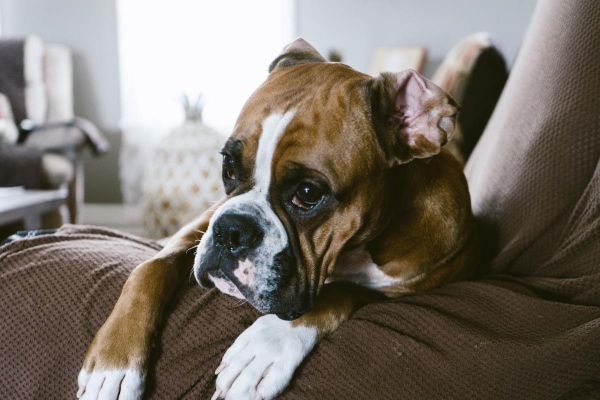
“It was the strangest thing. When I looked over at Dudley, his head was shaking up and down over and over again, almost like one of those bobblehead dolls. After a few minutes, the nodding stopped and he wandered over to play with a toy like nothing had happened.”
As my client said those words to me, the condition that immediately popped into my head was idiopathic head tremors in dogs. But I knew that before jumping to that diagnosis, I needed to gather more information to ensure that her beloved English Bulldog wasn’t suffering from a more serious neurologic condition.
Since dogs can occasionally have seizures that involve the head, the first order of business was to determine if what my client was seeing was truly a head tremor.
What are dog head tremors?
I explained that the term “tremor” describes the involuntary shaking or trembling of a body part. When this trembling is localized to the head, it is called a head tremor.
Head tremors in dogs are considered to be a type of involuntary muscle movement disorder. In other words, your dog cannot control when or how the muscles are moving. Head tremors mostly occur when dogs are awake, but can sometimes happen while a dog is sleeping.
What are the symptoms of head tremors in dogs?
In dogs who are experiencing a head tremor, their head may shake up and down (as if they were nodding “yes”) or side to side (as if they were shaking their head “no”). Occasionally, dogs can also have a rotational tremor. These movements are typically small yet rapid.
While they might look a bit similar at first glance, head tremors are different from seizures because dogs do not lose consciousness with head tremors. Also, seizures in dogs may cause other signs such as twitching of the muscles of the face, loss of bowel or bladder control, or involuntary limb movements. These signs are absent with head tremors.
What causes head tremors?
Unlike in seizures where the causes are better understood, the exact mechanism of action behind head tremors is not clear. However, some researchers have theorized that activation of certain areas of the brain can cause head tremors. More specifically, head tremors may be connected to stimulation of the groups of neurons within the brainstem that helps with patterned motor activity.
In a condition called idiopathic head tremor syndrome, these neurons seem to activate spontaneously and without any obvious trigger. However, there are a variety of neurologic and neuromuscular disorders that can also cause dog head tremors. They include:
- Central nervous system disorders
- Congenital disorders affecting brain development
- Damage or injury to the cerebellum (i.e. the part of the brain that controls coordination)
- Low blood sugar (i.e. hypoglycemia)
- Toxin exposure (e.g., pyrethrin, drug overdoses, various poisons)
For the purposes of this article though, we will focus on idiopathic head tremors.
What are idiopathic head tremors in dogs?
Many of the conditions in the list cause head tremors that are more persistent or chronic. But canine idiopathic head tremor syndrome (IHTS) is characterized by head tremors that are intermittent and self-limiting. They can start and stop at random. And in some instances, you may be able to halt a tremor by drawing your dog’s attention to something else such as a toy or a dog treat.
What causes idiopathic head tremors in dogs?
As alluded to earlier, the term “idiopathic” means that there is no obvious cause for the tremors. However, some veterinary researchers believe these episodes are stress-related. Other studies propose that illness, various medications, heat cycles (in female dogs), and surgery may be triggers for head tremors.
Which dogs are prone to idiopathic head tremors?
There also may be a genetic link as certain dog breeds are more susceptible to IHTS. Predisposed breeds include:
- Boxers
- Doberman Pinschers
- English Bulldogs
- French Bulldogs
- Labrador Retrievers
- Spaniels
While there doesn’t seem to be any sex predisposition for IHTS overall, some reports indicated it is more likely to affect male Doberman dogs than female Doberman dogs. Also, most dogs with idiopathic head tremors will experience their first episode around two to three years of age. But it is possible for older dogs or senior dogs to experience IHTS as well.
What are the tremor episodes like?
These tremors occur spontaneously and may only last for a few minutes at a time. In fact, the majority of idiopathic head tremor episodes last less than five minutes. However, in some cases, the head bobbing may last for up to an hour. And there are a few reports of tremors lasting more than 12 hours per day.
Some dogs may experience idiopathic head tremor episodes multiple times in a day or in a week. But for other dogs, the episodes may be few and far between.
Most dog parents will notice head tremors while their pup is awake. But it is possible to see head tremors in dogs while sleeping. This is different from the limb-twitching or vocalizing that you might notice when your puppy or senior dog sleeps.
The video below illustrates what a tremor episode may look like. If you find this disturbing, you may want to skip this video.
How are idiopathic head tremors in dogs diagnosed?
If you suspect your dog is experiencing head tremors or other neurologic signs, it is important to contact your vet promptly. Based on the information you provide, your vet will advise you on whether you need to make an emergency vet visit, schedule a vet visit during regular business hours, or continue to monitor your dog.
Since idiopathic head tremor syndrome is a diagnosis of exclusion, your vet will want to rule out other causes of your dog’s symptoms before making a diagnosis of IHTS. This usually involves collecting a medical history, performing a physical examination, and running diagnostic tests.
Medical history
A detailed medical history will be important. The more you can remember about what your dog was doing prior to the episode, what you saw during the episode, and how long it lasted, the easier it will be for your vet to figure out what is going on. Also, having a video recording of your dog during one of these episodes can help immensely!
In order to be IHTS, the only clinical sign present should be the head tremor itself. The tremor can be in any direction (vertical, horizontal, or sometimes rotational) and may stop when someone distracts the dog.
On the other hand, if the dog has a history of loss of urinary bladder control, drooling, difficulty walking, or loss of consciousness during the episode, it may be more likely the dog is experiencing seizure activity rather than IHTS. Or, especially in an older dog or senior dog, head shaking, a head tilt, and being a wobbly and off-balance dog could point to old dog vestibular disease (i.e. doggie vertigo), not IHTS.
Physical examination
A comprehensive physical exam, with an emphasis on the neurologic exam, is also an important part of the diagnostic process. Dogs with idiopathic head tremors should not have any persistent neurologic abnormalities or other abnormal findings on their physical exam.
Diagnostic testing
Depending on your dog’s symptoms, your vet may also recommend specialized testing including:
- Bloodwork
- Infectious disease panels
- CT scan
- MRI
- Cerebrospinal fluid (CSF) analysis
For dogs with idiopathic head tremor syndrome, these tests will appear normal, thus ruling out many of the other conditions that can cause head tremors (plus some of those that cause seizures or other neurologic problems).
What is the prognosis for idiopathic head tremors?
In many ways, if your vet diagnoses your dog with idiopathic head tremors, this is good news! Unlike seizures, idiopathic head tremors are not dangerous for dogs. They don’t cause sharp elevations in body temperature. And they shouldn’t cause any bodily harm (like if a dog were to hit their head or fall down the steps during a sudden seizure).
Plus, unlike other causes of head tremors, idiopathic head tremors are not a sign of a bigger and potentially serious problem. They don’t cause pain or discomfort, don’t tend to progress, and don’t require ongoing monitoring.
In fact, some studies show that the tremors may stop altogether in about 66% of affected dogs. But even for those dogs with long-term idiopathic head tremors, their prognosis is still good. These episodes of head tremors do not impact their overall quality of life.
What is the treatment for idiopathic head tremor syndrome?
Since it is such a benign condition, there is usually little reason to attempt to medically treat idiopathic head tremors in dogs. This works out well since there also aren’t any medications, including anti-convulsants, which can effectively and reliably stop the tremors.
Interestingly, while it sounds almost too easy to be true, distraction halted the head shaking in 87% of dogs according to a study in Veterinary Medicine International. Therefore, the main “treatment” is to remain calm and try to distract the dog with a toy or treat to see if the head tremor stops.
Speak with your veterinarian
Idiopathic head tremors may look a bit odd, but they are nothing to fear. Other causes of head tremors, however, can be more serious. If your dog starts shaking his or her head side to side or up and down, or showing other neurologic signs, head to your veterinarian to get some answers.
Hopefully, just like my sweet Bulldog patient that I told you about earlier, it will turn out that your dog has idiopathic head tremors. If that is the case, you can breathe a sigh of relief. Chances are good that the head tremor may bother you more than it bothers your dog. And like I told my client, IHTS doesn’t pose any danger to your dog and shouldn’t interfere with him or her continuing to live life to the fullest.
Does your dog have idiopathic head tremors?
Please comment below.


I hope someone can help. My boy Ace a toy labrodoodle is right at one year old.
Oct. 14 (6-7months old) He had his first seizure No convulsing or drooling but crossed legs, loss of balance, and then seemed to sleep it off for about 3-4 hours and was fine
Dec. 31 didn’t have one that we are aware of until New Year’s Eve. But he started dripping urine, lost balance, collapsed on side and seemed unconscious for 3-5 minutes. My wife and I rushed him to the ER but before we got there he started improving and over the course of 20 minutes he was up and alert and moving around. We ended up not going in the ER and he improved overnight – would get lost in a stare some but by morning was 100%.
Feb 11 Just before the Super Bowl he had his third one and it was similar to the one on New Years. Dripped urine. Loss of balance and body control. Threw up twice. Seemed to lose consciousness and we got him into banfield two days later. Showed the videos.. He again was improved although he seemed to be in that post stage for much longer. Nearly a full 24. And upon recovery shook his head twice the next day but that was it. But made a full recovery. After blood work vet found nothing. Tested him for valley fever – negative.
Feb 21 (yesterday) my wife came home from work at 3pm and found him on his side collapsed. We immediately took him to the ER. They gave him some fluids and kept him there and suggested blood work but we told them we just had blood work less than 10 days ago and was reported negative. They suggested we see a neurologist and sent us home with him still with stiff legs and a wobbly head but the neurologist wasn’t open and doesn’t have an appointment until March 6. Overnight he did alot of scratching his ear.
It’s now 9:20pm the next day – over 24 hours and he is still delayed in response and jumpy at most sounds. He also has shaked his head a couple of times and has occasional twitches. He seems very restless. Now seems to be itching his side a lot.
He seemed a bit better this morning and to be about 80% recovered in terms of energy and awareness earlier this afternoon and I was feeling good about it being behind us, but he is now sitting like his head and shoulders are heavy and still having moments like of not being aware or delayed in response.
I feel helpless and we are now 700 dollars in with no information. Every symptom I Google for him seems to be bad news and suggest immediate care but no one seems to know anything. His age gives me hope and hoping it’s epileptic.
Sorry for the length of this. I just want him to be okay and get some actual help. I’m in the Phoenix area if anyone has quality vet suggestions
Dear Adam,
I understand your concern for your young pup. I have to admit that these symptoms have me worried and I don’t have any great suggestions. I do think a neurologist is the way to go with something as strange and severe as what your dog is experiencing. Also…. please forgive me for mentioning scary things, but is your dog fully vaccinated? I ask because any time I have a young dog with neurological symptoms, rabies is on the top of my rule out list since it can have such devastating results to the health of any humans the dog would be in contact with. Hoping the specialist can get some answers and find a clear path forward with the appropriate treatment. Praying for healing and wishing Ace all the best for a full recovery.
Hi! Our 5 year old boxer gets them from time to time! I think it scares us more than anything! We just run and grab a spoonful of pb and have him lick the spoon until it goes away! I had posted on a Boxer Facebook page and many suggested that and it works everytime! Still is terrifying though!
Hi Jamie,
What a great idea. Peanut butter for the win! Thanks for sharing this bit of advice with us.
Hi Dr Buzby,
Our English Setter started experiencing head tremors the morning after we picked him up from a board and train center. All of the tremors seem to be originating from his neck area. We are pretty sure it’s a ptsd or stress reaction to E collar training. He has previously only had positive reinforcement training and has all basic obedience and is a sweet guy! But, we were having trouble with his prey drive distractions while on leash. Anyhow, the tremors have decreased each day since he’s been home. We are now day 5 post training and only a few very minor neck tremors noted. and we of course, are not using E collar. Our vet thinks likely due to trauma of board and train, but is not completely ruling out focal seizures. He also had lab work which is normal. Have you seen this happen or heard of such a response? We have multiple videos if you are interested. Thank you,
Hi Marci,
What a strange situation! I have never heard of E collar training causing this type of issue, but I guess anything is possible. If these tremors continue or they begin to increase in frequency, it might be worth reaching out to a specialist for advice. I would hate to assume this is a side effect of the training methods used and end up missing something serious that needs attention and treatment. How are things today? Hoping all is well and wishing you both the best.
We have an English bulldog with idiopathic head tremors. We see a bulldog who specializes in English and French bulldogs. He has told us to try a tablespoon of honey or a bit of ripe banana. Tremors stop almost instantly.
Hi Kristi,
Wow, very interesting! Thank you for sharing!
our 6 yr old siberian husky rescue has exhibited a plethora of problems (uveo dermatological syndrome, stomatitis, micro hepatica and these tremors) in the 2 years since rescue pulled him and we took him – the tremors are short and he eats, listens and motors around during them – they last 15 to 120 seconds normally and are usually subtle as opposed to noticeable
– the vet chiro, since his atlas is always out, (probably from the uveo) adjusts him and treats him for lymph drainage in his head and we perform that at home as well – she suggested there was perhaps some relationship to parkinson’s in humans – so he is on Tien Ma Gou Teng Yin and CBD oil – that stopped him for 4 months but now they happen, and more frequently than before – this was an helpful piece of knowledge and calming to our concern though we will not neglect checking further for neurological malfunctions in the future – we are thankful to learn that this is not an uncommon phenomena and we thank you for the post
Hi Ron and Heather,
That is very interesting! Thank you for sharing your experience with this condition and offering some insight. I am glad your boy seems to be doing well despite his episodes. Wishing you all the best for many happy years to come.
Hi Julie, I have a 3 1/2 Australian Bench Kelpie who this morning at 11.30 showed symptoms of head shaking/tremors, gave me a fright, this happen 4 times over 3/4 of an hour the longest was about 20 seconds. Got him to the vet straight away and discussed possible causes, such as eating something while out walking in the morning, he is not one to scavenge, or into my compost, but there is an electric fence around that and my vegetable garden, thought it is not on, the dogs know its not a place to go.
Been reading information as we are about to go on holiday and my dogs travel with us, so will need to keep an eye on him. Gave my vet two videos of his tremors for his records.
Has had not further tremors since this morning.
Hi Murray,
I am sorry your young boy has started exhibiting these worrisome symptoms. I think it was a wise decision to get him to your vet quickly for evaluation. The videos were a great idea! Hoping this is all in the past and it will be smooth sailing from now on. Enjoy your holiday and wishing you both nothing but the best!
Thank you for this informative article. Our now 4 yo, 45 lb multi-gen labradoodle (probably a higher genetic mix of poodle/spaniel than lab) had her first head/whole body wobble episode when she was 3. It has only happened a few times since then, always in the evening, and is gone by the morning. During the episode, she is fully able to comply with her obedience/trick commands; distractions do not snap her out of it. We showed a video of an episode to her vet, who checked her out, did a full blood panel, ruled out any obvious causes and suggested we take her to a neurologist if they continued. Since they are infrequent, don’t seem to cause her any distress, and she’s perfectly normal after a night’s sleep, we have not gone that route. Your column is reassuring — even though she isn’t our first dog, we didn’t know this was a “thing.”
Hi Barbara,
I am glad your girl is doing well despite her strange episodes. What a blessing her lab work was normal, and your vet did not find any urgent cause for concern. Hoping she will continue to live a long a happy life. Wishing you all the best and give your sweet girl a hug for me.
Our rescue pup Lulu is a lab/husky mix and has developed head tremors in the last year. She is 3.5 years old. The first time it was after a round of Simparica for lice. after researching I found that Simparica has a not great track record and can affect some dogs neurologically. Everything that others have described, has been our experience as well. Comes on often while laying down, can be distracted easily, still responds to commands, lasts about 5 minutes. Another round of tremors came on after we had given her Benadryl for a couple wasp bites. She is also a bit of a nervy, suspicious dog, startles easily. I am thinking to look into a holistic vet that can maybe offer some supplements to support her nervous system? I just feel so horrible for her when it’s happening and I do really hope that it is IHTS and not something else.
Dear Holly,
I understand your concern for Lulu and these tremors she is experiencing. She is a lucky girl to have you advocating for her health and well-being. I think finding a holistic vet is a great idea. If you find something that works well for your girl, please leave us an update and share your experience. Wishing you both the best and praying for many happy years ahead.
I have a one and a half year old havanese, yorkie and powderpuff mix who’s had a wobbly head for some time. At first it was really scary(for me), but now it seems fine. It bothers him very much, but it doesn’t seem to hurt him at all. I noticed the stress bit though, and my dog is a very anxious dog. He doesn’t like other dogs, he gets really scared of cars and bikes and he seems to struggle a lot with anxiety. So it was very interesting to read that stress might be a factor to his wobbly head. Either way, definitely something we will work on, and then maybe his head will calm down
Hi Vega and Günther,
Head tremors can definitely be a bit scary looking at first, and it does seem like some dogs are more bothered by them than others. Your plan of reducing his stress and anxiety levels to see if it reduces the tremors sounds like a good one. There are a variety of natural options for stress relief (calming pheromones like DAP/Adaptil, calming treats or supplements, etc.), as well as anti-anxiety medications. Your vet could help you figure out what might be the best place to start for him.
I hope this works! Feel free to give us an update.
my 13 Yr old girly has over the last few months ,done a slow head nodding ,its occasionally when she lays down,it only last seconds. could it be a trapped nerve ? I worry it could be a stroke. She sees a vet regularly because of other health issues, had bloods done ,all came back within normal parameters
Hi Bev,
I understand your concern for your senior girl. Have you discussed this strange behavior with your vet? It might be a good idea to see if you can get this on video as it can be hard to make a diagnosis when there are no symptoms to evaluate on physical exam. I am glad your pup’s lab work looks normal and she has no other health issues. Hoping you can get some answers and ensure your sweet girl remains happy and healthy.
My year old husky pit mix just started with head tremors two days ago, and at first it was really scary to watch! He doesn’t seem at all bothered by them (and even tried to play through them!) We are able to distract him and break the tremors, too. I’d say it’s been happening 2-3 times per day for about 3-5 minutes each time.
I do feel quite bad, but I think it’s bothering me more than him.
Hi Julie,
Head tremors can definitely be disconcerting at first! I’m glad that your pup doesn’t seem bothered by the tremors and that you can usually distract him out of them. If you have any other concerns about his health, it doesn’t hurt to check in with your vet, but overall it sounds like they are the typical idiopathic head tremors. Thanks for sharing!