If you are staring at a new lump on your dog, “skin tag or something more sinister?” might be the question weighing on your mind. Ultimately, your vet is the best person to provide that answer. But to help in the meantime, integrative veterinarian Dr. Julie Buzby discusses the causes, appearance, diagnosis, and treatment options for a dog’s skin tags.
As dog parents, we all have those moments where our fingers find a new lump or bump on our furry friend, and our heart skips a beat. Understandably, detecting anything out of the ordinary can easily cause some concern (or, at the very least, a late-night internet search).
So, do you know if what you are looking at is a skin tag or something worse? Well, that’s exactly what you are about to discover.
What are dog skin tags?
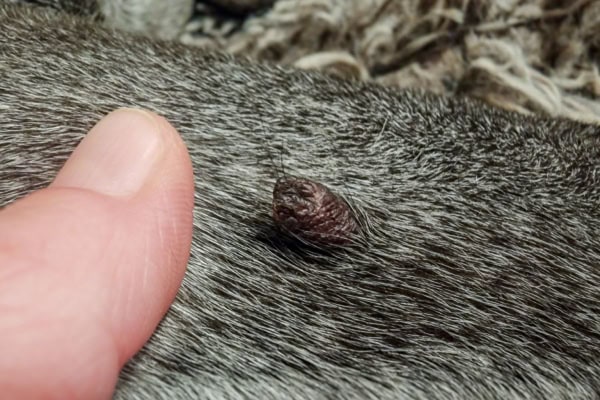
Skin tags are benign growths that look like an extension of the skin and pose no threat to a dog’s health. They are actually pseudotumors—skin growths that can have a mass-like appearance but are not true tumors or cancers. As you may guess based on the name, epithelial cells from the outer layer of a dog’s skin make up skin tags.
When located on the body, a skin tag is also known as an acrochordon. And ones on a dog’s eyelid may be called meibomian cysts or fibrovascular papillomas, depending on the underlying cause.
What do skin tags look like?
Skin tags usually form over areas of the body that are subject to high pressure, such as the elbows, knees, and chest. There can be some variation in what skin tags look like. They are:
- Round or conical
- Sometimes elongated with a small stalk-like base
- Usually flesh colored but can be pink, grey, or black
- Variable in size, ranging from a few millimeters to a centimeter or more
- Non-painful unless traumatized or ulcerated
- Typically solitary, but can occur as a plaque of numerous small skin tags in areas of chronic irritation
- Located on top of a dog’s skin (not within or below the skin)
Is it a dog skin tag or a tick?
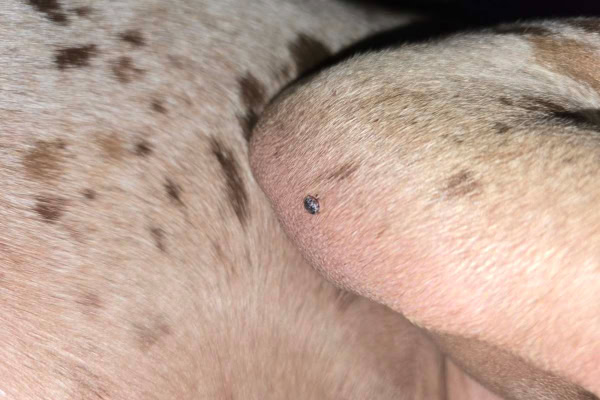
Sometimes, a skin tag can look like a tick, and vice versa. Thanks to a tick’s mouthparts, it can firmly attach itself to a dog, making it almost look like it is growing from the dog’s skin. Plus, a tick’s small size and dark color can closely resemble that of a skin tag.

The key to telling the difference is that ticks have tiny legs, and skin tags don’t. If you are checking a dog for ticks and aren’t sure whether you found a tick or a skin tag, using a magnifying glass or taking a picture on your phone and zooming in usually gives you the answer.
Is it a nipple or a skin tag?
Both male and female dogs have paired rows of nipples on their bellies. Since nipples are conical, flesh colored, and small, dog parents sometimes mistake them for a skin tag (or a tick). If you aren’t sure if it is a skin tag or a nipple, look at the same area on the other side of your dog’s belly. If you find a similar structure, it is probably a nipple.
Is it a dog skin tag or a cancerous mass?
Determining if you are looking at a skin tag or a cancerous mass can be more challenging. Sometimes, a skin tag is a long, thin, pink, dangly mass that looks nothing like a tumor. But other times, a small skin tag can look a lot like a mast cell tumor in dogs, a histiocytoma in dogs, or other types of skin tumors.
As we will discuss in a bit, having your vet examine and test the growth is the best way to definitively distinguish between a skin tag and a cancerous tumor.
Why do dogs get skin tags?
One of the biggest reasons dogs develop skin tags is chronic irritation from lying on rough surfaces or wearing a collar or harness. Allergies play a role, too, because inflammation can lead to excessive licking and scratching, which can further irritate the skin. Finally, papillomavirus and genetics may also cause a dog to develop skin tags.
Skin tags can occur in any dog, but develop more commonly in older dogs. Additionally, dog breeds with excess skin or skin folds may have a higher risk of skin tag formation. This is most likely due to irritation from the skin folds rubbing together.
Some predisposed breeds include:
- Basset Hounds
- Beagles
- Boxers
- Bulldogs
- Cocker Spaniels
- Pugs
What should I do if I find a skin tag on my dog?
Thankfully, skin tags are not an emergency. If you find one, do not squeeze it or try to remove it yourself. There is a slight chance that a nodule resembling a skin tag could be skin cancer, such as a melanoma in dogs or a mast cell tumor. Traumatizing the tumor could make it worse. And squeezing a tick may introduce the organisms that cause tick-borne diseases in dogs into your dog’s body.
Instead, it is best to make a note about the location, size, and shape of any skin tags you find. And maybe take a picture, too.

Then, either bring this information to your pup’s next exam (if one is coming up soon) or go ahead and make an appointment with the vet (if the possible skin tag looks inflamed or otherwise worrisome).
How will the vet determine if it is a skin tag?
During the appointment, the vet will carefully examine the growths you noticed. Plus, he or she will check your dog over for any lumps you may have missed. Next, the vet may recommend a fine needle aspiration (FNA) or biopsy to further characterize the growth, especially if he or she is suspicious that it is a cyst or mass, not a skin tag.
Fine needle aspiration involves using a small needle to collect cells from the skin growth and then evaluating them under a microscope. However, it doesn’t always work well for very small or firm masses. In those cases, a biopsy is necessary. The vet will collect a larger piece (or sometimes the entire lump) and submit it for testing.
What is the treatment for dog skin tags?
The treatment approach will depend on the size of the skin tag, its location on the dog’s body, and whether the tag is causing any discomfort. If the skin tag is small and not irritated, the vet may simply suggest monitoring it closely for growth or other changes. On the other hand, removal might be the right choice for an irritated or ulcerated skin tag, one that is likely to get easily traumatized due to its location or size, or one in a sensitive area.
Surgical removal is a good option and is generally curative if the vet removes the whole thing. Sometimes the vet can remove a skin tag using sedation and a local anesthetic. Other times, especially if the skin tag is large, performing the surgery under general anesthesia may be best.
In addition to traditional surgery, cryosurgery in dogs and carbon dioxide laser ablation are also good options for removing a dog’s skin tag.
Do not try to remove your dog’s skin tag at home
In case you are wondering if you can remove a dog skin tag at home, the answer is a resounding, “NO.” Do not try to remove a dog’s skin tag yourself. The area may become infected and may bleed a lot. Plus, there are no over-the-counter medications that can effectively numb the area to address the pain your dog would experience if you tried to cut the skin tag off.
What if my dog’s skin tag starts bleeding or seems irritated?
Sometimes, skin tags can be injured during grooming or from playing too roughly with another dog. If a skin tag on your dog is bleeding, or if something has irritated the skin tag and now your dog is licking it, make sure to apply an Elizabethan collar or inflatable collar to prevent further trauma. Then contact your vet for further instructions.
Is it possible to prevent skin tags?
There is no foolproof way to prevent skin tags from forming. But there are some lifestyle changes that may decrease the risk of dogs developing them.
- Give your dog soft bedding to lessen pressure on the elbows and knees
- Make sure that collars and harnesses fit snugly but not so tightly as to cause irritation
- Work with your vet to manage your dog’s allergies or other irritating skin conditions
- Routinely bathe your dog to keep the skin clean
- Consider using omega-3 fatty acids for dogs to support skin health
Check your dog for lumps regularly and keep a record of them
In addition to taking steps to decrease skin tag formation, it is a good idea to get in the habit of checking your dog for new skin lumps on a regular basis. Many dog parents like to do this as part of a larger 5-minute dog health scan.
Should you find a mass, add a description to your dog’s health journal. Some dog parents even keep a page with a list of the different masses and their locations. This is helpful information for your vet. And it can also be good to share with the groomer to decrease the chances he or she will accidentally catch a mass with the clippers or comb.
Skin tags aren’t scary, but you need to ensure it really is a skin tag
The great news about a dog’s skin tags is that they are essentially harmless. Yes, they can bleed or get irritated occasionally, but that is the worst that can happen. They aren’t cancerous, and they don’t affect your dog’s overall health.
That being said, it is critical to ensure that what you think is a skin tag is actually a skin tag. A tick that is mistaken for a skin tag can transmit tick-borne diseases. And a cancerous mass that is assumed to be a benign skin tag could spread to other areas of the body. Therefore, it is important to bring new masses to your vet’s attention and comply with their recommendations regarding testing and treatment.
Does your dog have any skin tags?
Please comment below