Can dogs eat vegetables? Absolutely! Many nutrient-rich veggies make great doggie snacks. But which ones are safe for dogs? And which ones are not? Integrative veterinarian Dr. Julie Buzby helps you discover 14 vegetables most dogs can eat and how to prepare them. Plus, she shares four vegetables you should never feed your dog.
Although humans and dogs have different nutritional needs, we can all benefit from eating our vegetables. Vegetables are good for dogs in all stages of life, from puppies to grey-muzzled seniors.
What are some of the benefits of giving dogs vegetables?
Veggies are delicious and nutritious, whether given as snacks or as supplements to your dog’s normal diet. Here are just a few of the general benefits:
- Weight management—Dogs who are overweight benefit from veggie treats because they’re low in calories and help them feel full faster. When your dog feels satisfied, he or she is less likely to overeat or act like he or she is starving. I often recommend a “green bean diet” (adding a portion of green beans with each meal) to help my overweight doggy patients combat hunger while reducing calorie intake.
- Digestive health—The fiber found in vegetables promotes healthy digestive tract and dog anal gland function, and helps prevent constipation in dogs.
- Immune health—Vegetables have important nutrients that can help boost the immune system and fight off illness.
- Diabetes management—Vegetables can help regulate blood sugar levels in dogs with diabetes.
- Anti-oxidants—Vegetables are natural anti-oxidants that help reduce the risk of some diseases.
- Training rewards—Veggies can make excellent treats to give during training. Crunchy vegetables like carrots can be an especially motivating reward for some dogs.
14 vegetables safe for dogs to eat
As you probably know, not all “human food” is safe for dogs. Before giving your dog anything outside of his or her normal diet, you should always make sure it is safe. There are many vegetables dogs can eat. The following are my top 14 favorites to share with my clients.
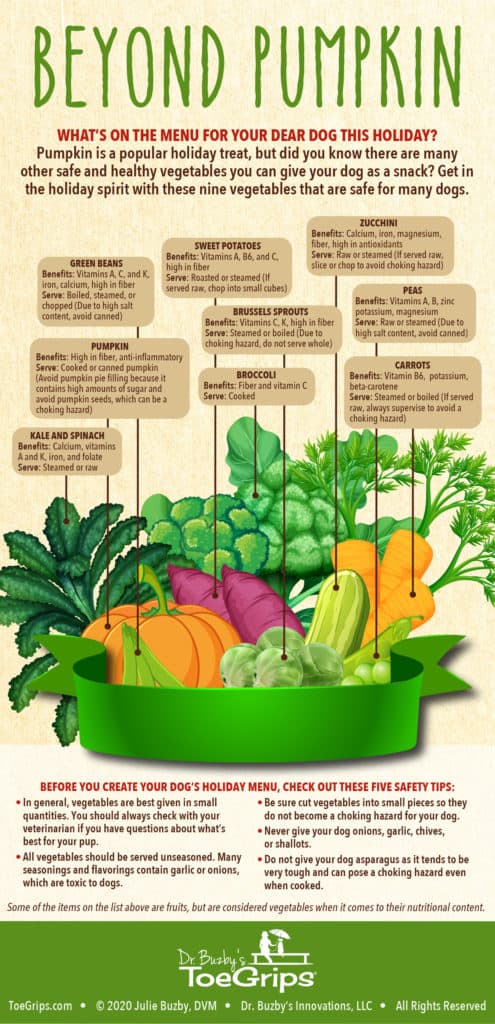
1. Pumpkin
Ignoring debate over whether pumpkins are technically fruits or vegetables, they are #1 on my list of dog-safe veggies!
Your senior dog can benefit from pumpkin, because it’s high in fiber and can help combat stool problems. If your dog has diarrhea, the fiber will help thicken his or her stool by absorbing water. Conversely, if your canine companion is constipated, the extra fiber will help move things along.
Pumpkin also contains pepita oil, which is a type of omega-6 fatty acid known as linoleic acid. This particular fatty acid is shown to have anti-inflammatory effects, especially for your dog’s skin.

Cooked or canned pumpkin is the best (and easiest) way to serve pumpkin to your dog. When shopping for pumpkin, pay close attention. Plain canned pumpkin is my recommendation. Make sure you don’t inadvertently pick up pumpkin pie filling, which is loaded with added sugar and spices.
Introduce pumpkin to your dog’s diet by offering one to two tablespoons of it mixed with his or her other food. Don’t be alarmed if your dog’s stool color turns a bit orange.
2. Broccoli
Broccoli is another one of my favorite vegetables that dogs can eat. It is an excellent source of fiber and can also provide vitamin C, which is essential for a healthy immune system.
It’s best served cooked with no seasonings. However, small pieces of raw broccoli stalks also get a thumbs up. Dogs love a good crunchy treat, and this makes a great low-cal snack.
Be sure to serve bite-sized pieces so they do not become a choking hazard, especially if you have a small breed dog.
Dogs should eat broccoli in limited quantities because it can cause irritation to the lining of the esophagus and stomach if eaten in excess. Additionally, too much broccoli can give your dog stinky gas.
3. Carrots
I love giving carrots to dogs. Carrots are a good source of potassium, vitamin B6, and an excellent source of beta-carotene.

Beta-carotene gives carrots their signature orange color. This compound is used in the production of vitamin A, an essential vitamin that helps your dog’s immune system and vision. A deficiency in vitamin A can lead to night blindness.
Many dog owners serve carrots steamed or boiled. A one-ounce serving of carrots contains ten calories. This is a very filling, low calorie meal that is ideal for dogs that need to lose weight. Personally, I love feeding my dogs raw carrots. They’re great crunchy treats that dogs love.
To prevent choking, always supervise your dog and serve appropriately sized carrot pieces.
While carrots are low in calories, they are high in sugar. So you’ll want to avoid giving carrots to your dog if he or she is diabetic.
4. Green beans
As mentioned in our post on how to host a happy and nutritious Thanksgiving for dogs, green beans are a great source of vitamins A, C, and K. Green beans also provide minerals like iron and calcium.
Due to their low-calorie, high-fiber content, they can be very beneficial for dogs with diabetes. In addition, green beans are a go-to for dieting dogs because they help them feel full, are low in calories, and are fiber rich.
Green beans can be served boiled, steamed, or chopped. Avoid adding seasonings, and also steer clear of canned green beans that contain large amounts of salt. Start by giving your dog two to three green beans a day, making sure the amount of treats never tops ten percent of his or her diet, unless otherwise directed by your veterinarian.
5. Kale and spinach
Dark leafy greens like spinach and kale are an excellent choice of vegetables for your dog. These vegetables are high in:
- Calcium—Important for healthy bones
- Vitamin K—Crucial for the blood’s ability to clot
- Vitamin A—Supports your dog’s vision
- Iron—Integral component of hemoglobin, which helps red blood cells carry oxygen to tissues in the body
- Folate—Necessary to facilitate absorption of nutrients from food into the small intestines
Kale and spinach can be served steamed or raw, but don’t add any seasonings. One or two raw leaves are perfect for a snack, or you can shred the leaves and add them to your dog’s bowl at mealtime.
Too much kale can contribute to urinary problems and bladder stones due to its high-calcium content. Like any treat, give in moderation. If your dog is prone to bladder stones or if you have any questions about kale for your dog, please speak with your veterinarian.

6. Brussels sprouts
Brussels sprouts are another high-fiber vegetable. They contain vitamins C and K, and trace minerals like magnesium, which supports cellular metabolism and muscle function.
When preparing Brussels sprouts for your dog, avoid using any oils or seasonings. When feeding, start with one or two Brussels sprouts at a time. If your dog eats too many Brussels sprouts, he or she can become gassy and bloated, leading to abdominal discomfort.
Serve Brussels sprouts steamed or boiled for your dog. Cut each one into smaller pieces since whole, round Brussels sprouts pose a choking hazard for small and medium-sized dogs.
7. Zucchini
Zucchini contains calcium, iron, magnesium, and fiber, promoting a healthy gastrointestinal tract.
Serve zucchini raw or steamed. Steaming makes them softer and easier to chew if your dog prefers a less crunchy treat.
Start with three to four slices at a time and avoid zucchini that has seasonings or salad dressings. Many of these flavorings contain garlic and onions which are toxic for dogs (more on that below). Some dressings also contain an ingredient called xylitol (or birch sugar) that is extremely toxic to dogs. Xylitol toxicity in dogs can cause hypoglycemia (low blood sugar), seizures, liver failure, and, unfortunately, even death.
8. Sweet potatoes
Sweet potatoes are another high-fiber food that make for a very tasty treat. Found in many commercial dog foods, sweet potatoes are a great source of vitamins A, B6, and C.
There are many ways to serve sweet potatoes to dogs. If fed raw, they should be chopped into small cubes. Steaming or roasting the sweet potato makes them much softer, tastier, and less of a choking hazard. Introduce sweet potatoes by giving your dog three or four slices at a time.
Like carrots, sweet potatoes are high in sugar content, so overweight and diabetic dogs should avoid them in their diets.
9. Peas
Snow peas and sugar peas are great for your dog! They’re a good source of vitamins A and B and minerals like potassium and magnesium. Zinc is another mineral in peas that plays a role in a healthy immune system and thyroid gland function.
To feed your dog peas, steam or boil them. A one-ounce serving of peas contains just twenty calories— making them a perfect low-calorie snack.

Avoid canned peas with high salt contents. Peas also contain purines, a type of protein, so dogs with urinary incontinence and kidney issues should avoid them.
10. Corn
Corn is another vegetable that is very common in dog food. Although it is sometimes villainized as a “filler,” corn has many nutritional benefits, including:
- Easily digestible carbohydrates that serve as a great energy source for dogs
- Linoleic acid: This nutrient is not produced by dogs. Supplementing through corn is a great way to help your dog maintain healthy skin, coat, and immune system
- Rich in fiber that supports digestive health and motility
While corn is safe, corn on the cob is not. Corn on the cob should never be fed to dogs because the cob is not digestible. If your dog eats a corn cob, it can get lodged in the stomach or intestines, causing damage to the gastric lining or even requiring emergency surgery.
If you want to give your dog corn, steamed kernels are best. Always check the corn first to make sure it does not have extra seasoning or high salt content. And remember to leave off the butter for your dog’s portion.
11. Celery
Like many of the other vegetables discussed, celery is low in calories, fat, and cholesterol. This makes it another great veggie treat for dogs on a diet.
Celery should be thoroughly washed and fed raw. Dogs who love a good crunch are often celery fans. However, it is not as flavorful as some of the other vegetables. So, don’t be surprised if your dog isn’t interested in eating it.
12. Cooked white potatoes
Cooked white potatoes are another safe vegetable for dogs. They are an excellent source of vitamin C, vitamin B6, iron, and magnesium—which are important for your dog’s immune system and nervous system. However, the operative word here is “cooked.”
Raw potatoes are toxic for dogs. They are part of the nightshade family and contain a substance called solanine. Cooking removes the solanine from the potato. Otherwise, the solanine causes stomach upset, vomiting, and possible bloating.
13. Cauliflower
Cauliflower is a super vegetable because it contains a wide variety of healthy nutrients, including:
- Fiber
- Vitamin K
- Antioxidants
- Vitamin A
- Vitamin C
- Beta-carotene
- Minerals like potassium, calcium, and magnesium
Cauliflower can be fed cooked or raw, and should be cut into bite-sized florets.
While cauliflower is a great addition to your dog’s diet, it is important not feed too much of it. Because cauliflower is so fibrous, dogs may choke on it or develop an upset stomach.
14. Beets
Beets are one of the most anti-oxidant rich vegetables. With an 88% water content, beets also contain folate, fiber, vitamin C, and essential minerals. Therefore, beets are very beneficial for your dog’s skin and coat health.
Don’t panic if you see small amounts of red or pink coloring in your dog’s urine after he or she eats beets. They contain a pigment that can affect the color of urine. Consult your veterinarian if your dog’s urine remains discolored 48 hours after discontinuing feeding beets.

What vegetables should dogs not eat?
Now that we have discussed vegetables that are safe and tasty for your dog, let’s briefly talk about some vegetables that should never be fed to your dog.
1. Onions, garlic, chives, and shallots
Vegetables in the Allium family are toxic for dogs as they can damage red blood cells. Vegetables in this family include:
- Onions
- Garlic
- Chives
- Shallots
If your dog consumes one of these foods, please consult your veterinarian immediately. Your dog may need emergency treatment, otherwise he or she could become anemic. Signs of illness can take days to present, so call your vet right away if you think your dog may have eaten one of these vegetables.
2. Mushrooms
While some mushrooms might be safer than others, it is generally a good idea to avoid giving any mushrooms to your dog. Some mushrooms can cause your dog to experience diarrhea, stomach pain, and nausea. Other mushrooms are even more toxic to your dog, resulting in severe life-threatening illness.
For example, some mushrooms that might be found in your yard or along a hiking trail, can cause liver failure, kidney disease, lethargy, seizures, and even death. With many different species appearing similarly, wild mushrooms can be especially dangerous to dogs. To be safe, I recommend avoiding mushrooms altogether.
3. Unripe tomatoes
Just like potatoes, tomatoes are part of the nightshade family. The nightshade toxins are most prominent in unripe tomatoes and tomato plants. Therefore, it is important that your dog never consume tomato plant leaves/stem or green, unripe tomatoes.
If your dog does manage to get a hold of a tomato plant, I recommend consulting your veterinarian immediately. Clinical signs that you might see in your dog include:
- Gastrointestinal upset (vomiting, diarrhea)
- Dilated (enlarged) pupils
- Depression
- Decreased energy
- Increased heart rate
4. Any vegetables that pose a choking hazard
Throughout this article I mentioned the importance of cutting vegetables into bite-sized pieces and properly cooking them to avoid a choking hazard. This is very important because choking can become a serious emergency. Fibrous vegetables that are hard to chew like cauliflower and celery call for extra caution. Also, monitor your dog closely.
How do I prepare vegetables for dogs to eat?
Steamed. Boiled. Raw. When it comes to preparing vegetables for dogs, there are many options. Preparation methods vary based on the type of vegetable, the way it is being fed, and your dog’s preference.
If your dog turns up his or her nose at vegetables, I recommend switching up how they are prepared. Personally, my dog and I won’t eat raw broccoli. But, we both love steamed broccoli. The same may be true for you and your dog, too!
The following are some general ideas on how to prepare vegetables as a snack for your dog. However, some veggies do have “best practices” for preparation, as mentioned above.
Raw
Raw vegetables make perfect treats. They are easy to grab, and you can take them with you anywhere. Baby carrots are a favorite for my dog!
When feeding raw veggies, properly cleaning them is extremely important. Cooked vegetables are exposed to higher temperatures that kill bacteria and microbes. Obviously, raw vegetables are not.
The only way to remove bacteria is by properly washing the vegetables before giving them to your dog. Proper scrubbing and washing will also remove dirt and pesticides.
Steamed
Steaming is a great way to prepare vegetables for your dog. I love this option because it is fast, easy, and preserves nutrients.
Here are a few tips for steaming:
- Wash the vegetables thoroughly before steaming.
- Chop the vegetables into uniform, bite-sized pieces for consistency in cooking time.
- Once steamed, be sure to cool the veggies so your dog does not burn his or her mouth.
Steamed vegetables are cooked just long enough to heat them up. While being slightly softer than raw, the vegetables still have a crisp texture.
Boiled
If your dog is missing teeth or has a sensitive mouth, boiled vegetables might be a good option. Boiled vegetables are softer than raw or steamed vegetables—making them easier to chew. Because boiling involves a higher temperature and submerging the vegetables in water, they will be somewhat less nutrient dense. All of the same tips on steaming vegetables (listed above) apply to boiling vegetables.

Are there other ways to prepare vegetables for dogs to eat?
Maybe your dog isn’t a fan of vegetables, and you want to get creative with your cooking. Here are some of my favorite tricks for preparing vegetables for my senior dog:
- Pureed—Use a blender to mash-up thoroughly washed vegetables. Some dogs prefer the applesauce-like texture of pureed vegetables. Pureed vegetables can also be easily mixed in with regular dog food.
- Frozen—Frozen vegetables are a great summer treat! Most fresh vegetables should be washed thoroughly and then cooked prior to freezing.
With your list of vegetables dogs can eat, you can chews wisely
Even if your senior dog enjoys a high-quality commercial diet, vegetables have numerous health advantages that make them a beneficial (and tasty) supplemental treat. Keep in mind that these vegetables are not intended to provide a fully balanced diet for your dog, and should not be his or her sole food group!
Try out a variety of vegetables to learn which ones your dog loves the most. And remember, if you’re trying a new dog-safe vegetable, always offer a very limited amount at first. If you’re not sure whether a vegetable is safe given your dog’s background and health history, ask your veterinarian for advice and guidance.
Does your dog love veggies? Which ones?
Share in the comments below — and let us know your quick preparation tips. We’d love to hear!


Chachi is a 14 years old miniature German Schnauzer and has been on a J/D Vegetarian kibble diet. Over the past few years I added approximately 2 tablespoon of similar brand canned dog meat add to enhance the meal. However, I noticed over the winter he was losing weight and then began to either refuse his meal or either vomit it. Frequently in the morning before breakfast he vomited gastric juices. I had him to the vet and on visible examination could not find anything wrong and advised me to withdraw the canned dog food. Chachi from birth has been a picky eater and when I did this he flatly refused to eat. I then alternately tried finely chopped cooked chicken/turkey breast/beef liver and small pieces of fish as enhancers. SUCCESS. Over the past month he is eating regain his lost weight, no further vomiting and my sparky old fellow has returned.
This is a whole new adventure for us, and I know I am on the right track.
My questions are there any recipes I could follow and what pitfalls to avoid? Peggy
Hi Peggy,
I’m so happy to hear that you found a way to get Chachi eating again, gaining weight, and feeling more like himself! That is wonderful news! Adding a small amount of chicken, turkey, liver, or fish to his food to tempt him to eat shouldn’t affect his overall nutrition significantly, assuming he is still mostly eating the J/D with the meats as just an appetite enhancer. However, if the “toppers” are making up a good portion of his diet, it may be worth working with a veterinary nutritionist to ensure that all his nutritional needs are met. You can search for a veterinary nutritionist here: Find a Veterinary Nutritionist
Best of luck to you! I hope Chachi continues to eat well and feel great!
I make my little Chihuahua Zoey’s food due to a horrible time where she developed gastroenteritis and I almost lost her. We also found that she’s allergic to many proteins so I now feed her white Albacore Fish with brown rice, pumpkin, and a vegetable. Typically I use carrots, broccoli, spinach, and sweet potatoes since those are her favorites. She also gets a little bit of prescription kibble but prefers what I make for her but what dog wouldn’t. Changing her diet saved her life.
Hi Noreen,
Zoey is one lucky pup! Thank you for sharing your experience with our readers. Wishing you both the best and keep up the good work!
Being a dog owner I’m curious to know what should I do if my dog accidentally eats vegetables like onions or mushrooms.
Hi Josaph,
Any time your dog ingests something that could be toxic, your best bet is to call your veterinarian. They can let you know if you need to bring your dog to the clinic for testing and treatment or if you can handle the situation at home. After ingesting SOME substances, and if caught early enough, your vet may have you administer a measured dose of hydrogen peroxide by mouth to your dog to induce vomiting. This is only recommended for certain situations. If your vet thinks this is the best course of action, they will give you the correct dose to administer and follow up to ensure the substance was eliminated from the body. You can also call a pet poison hotline as long as you are aware they charge an upfront fee for the phone consultation.
I know that onions are toxic but I just wanted to point out that I believe many mushrooms are safe. (I would definitely keep them away from wild ones). Perhaps this may alleviate a part of your worries.
My dog got a onyon one time is fine just a tinny bit is ok just do not feed 🧅 to dog plz
Hi Love,
Since onions are toxic to dogs, I would not recommend intentionally feeding your dog any amount of them. But sometimes accidents happen, and they ingest food that we didn’t intend. In the future if your pup gets ahold of onion or any other toxic substance, don’t hesitate to reach out to your vet for advice. 🙂
My dogs love all vegetables. With 3 labradors it was a less expensive option than boxed treats. Baby carrots raw , green beans steamed, sweet potatoes wedges raw, cabbage and lettuce leaves raw, Brussels sprouts raw, canned pumpkin and not a vegetable but great snack is red apple slices (no seeds attached) They eat better than I do lol
Hi Karen,
These are all great ideas! Thank you for taking the time to share your experience with our readers.
I like to give my dog a celery stalk each night. I give it as an aid to help her teeth stay cleaner and much less expensive than “greenies” dental treats.
Hi Dawn,
This is a great idea! Thanks for sharing.
We eat a high vegetable diet and our dogs love them too. While cooking they are waiting to see if a piece should fall (maybe on purpose😊or if we have a bit of leftovers. We feed, as treats: beans, carrots, and this summer they have loved the zucchini that bounced off the cutting board. We have had a huge harvest and now they are helping to eat it up!
Hi Kathy,
This sounds wonderful. You have some very lucky pups!
Any vegetarian chew treat substitute? Not treats that have to be made, but good on their own?
Hi,
I am sure there are vegetarian dog treats on the market. There are so many brands and products available it is impossible to keep up with all the options. Also, it can be hard to know if all the ingredients and additives are safe. This is why I like offering vegetables! You can always talk to your vet about their recommendations for your pup.
Thank you for the advisement.
What would you think about giving asparagus if it were cooked and pureed in a food processor? Our girl absolutely loves asparagus and has chosen it over meat (I mean, she ate the meat but she chose the asparagus first). I have stopped giving it to her but am wondering about pureeing it.
Hi again!
Asparagus is nontoxic to dogs but may cause a diuretic effect. So other than the possibility of increased urination, it should be safe for your girl.
I had a cocker spaniel growing up who ate all sorts of vegetable scraps my mother tossed to her while preparing dinner (she would not eat wilted lettuce). But asparagus tips were a no-no. She developed a severe rash on he belly both times, second time the vet attributed it to the asparagus.
My Rottsky mixes love raw carrots and frozen (raw) cut green beans. I’m switching the younger one to celery from carrots because of digestive issues; she mostly likes tearing them apart. But I can’t feed her whimzees for dental health anymore, they seem to be a vomit-inducing culprit. She’s on Hill’s prescription digestive kibble now, still with chopped chicken —skinless, baked — as a topper at breakfast. I give my older dog, who is in palliative care for bone cancer, a handful freeze-dried duck or beef as a topper at supper (to be sure she eats), just the chopped chicken at breakfast, with regular large breed kibble (and zesty paws hip & joint bites, as she also has arthritis, poor girl).
Hi Karen,
Thanks for sharing your experience with us. Your girls are lucky to have you taking such good care of them. Praying the palliative care will offer many happy days ahead. Best wishes to you and yours. ♥
I don’t give our girl allium family foods but have read that garlic isn’t toxic in small, therapeutic doses. Another online, well-known veterinarian says that garlic contains a “tiny” amount of thiosulfate (whereas onions contain a LOT). The 20+-year-old Japanese study that caused the “No Garlic” uproar showed no outward physical changes, no anemia, no Heinz body anemia, but it did show some oxidative stress when the blood was viewed under a microscope (I believe the dogs were given 1.25ml/kg in extract form over a seven day period). The study’s critics showed that a 32kg dog would have to eat approximately 35 cloves per serving and 245 cloves over the week long study period to receive the amount of thiosulfates that the study used – and even THAT amount did not cause Heinz body anemia. The original Japanese researcher went back and reversed his conclusion in light of the criticism and further research even saying that small amounts were good for heart health. Other research since that Japanese study have shown blood pressure benefits, blood sugar regulation benefits as well as other heart benefits IF FRESH garlic is used for therapeutic purposes.
Like I said, I don’t feed garlic because I don’t feel the need right now but if a condition arose where I thought the benefits of garlic would help our girl I definitely would give her therapeutic doses of fresh garlic (prepared in the proper way; crushing and allowing to sit for the specified time period before serving). I would NOT feed a garlic supplement nor pre-chopped garlic.
I forgot to add that the same well-known, online veterinarian said that some research has shown that at least some dogs of Japanese decent do appear to be more susceptible to harmful effects of garlic and probably should generally avoided out of a preponderance of caution.
Yes, it is true that some Japanese breeds are at an increased risk for oxidative erythrocyte injury due to genetically inherited changes to their red blood cells.
Hi Amy,
I looked through several studies on this topic and read through the conclusions of some of the newer research articles about sulfur-containing oxidants in Allium spp. Everything I find states that garlic is more toxic than onion and that it is 3-5 times more potent than onion in dogs. Ultimately, any supplements or therapies administered to your dog should be discussed with your veterinarian.
Ceba loves anything in the cabbage family. He also helps me pick green beans and kale, but none of his harvesting makes it into the produce basket, LOL.. I have to cut him off from eating too many. Both dogs get pumpkin every night because my Lhasa was having anal gland problems. Now after 6 months no blocked anal gland, and the pumpkin for Ceba has firmed his stools. A perfect solution.
Hi Karyl,
It sounds like Ceba is living his best life and enjoying every minute. I am glad the pumpkin helped with the anal gland issues. Thanks for sharing!
can dogs eat watermelon
Hi Annette,
Yes! Watermelon is safe for dogs. It is recommended to first remove the rind and seeds (they can cause intestinal blockage if too many are ingested). Thanks for asking! Wishing you and yours all the best.