Heartworm disease in dogs is a life-threatening, preventable condition. Unfortunately, a lot of myths and misunderstandings are widespread—particularly on social media—regarding heartworm prevention. From home remedies to coconut oil for heartworms, integrative veterinarian Dr. Julie Buzby helps separate the myths from facts when it comes to preventing and treating heartworm disease in dogs. Fair warning: The heartworm pictures in dogs that follow are graphic.

As a veterinarian, it’s my passion to help animals. Oftentimes we are facing battles over which none of us have any control, such as cancer. But I do admit I find even deeper sadness in treating a patient for a preventable disease, especially when pet parents thought they were doing what’s best for their beloved canine companion.
Practicing in the south, I’ve seen PLENTY of heartworm disease in dogs. Mosquito bites spread heartworms, so we definitely don’t get a break from it. The tragedy is that preventing this condition can be so simple.
Currently, the biggest obstacle facing heartworm disease is misinformation. Widespread myths—fallacies like dogs can’t get heartworms in cold weather or home remedies can treat heartworms—aren’t just dangerous but can be deadly for dogs.
Let’s break down some of the most common myths I’ve encountered regarding heartworm disease in dogs. As your dog’s biggest advocate, I want you to feel empowered to make the best choice for the health of your pets.
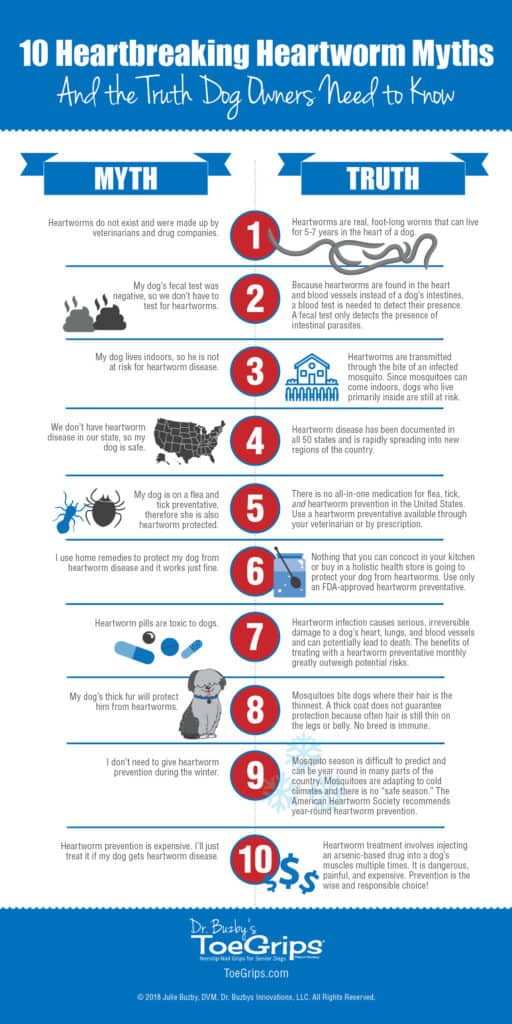
1. MYTH: Heartworms in dogs do not exist. Veterinarians and drug companies made them up.
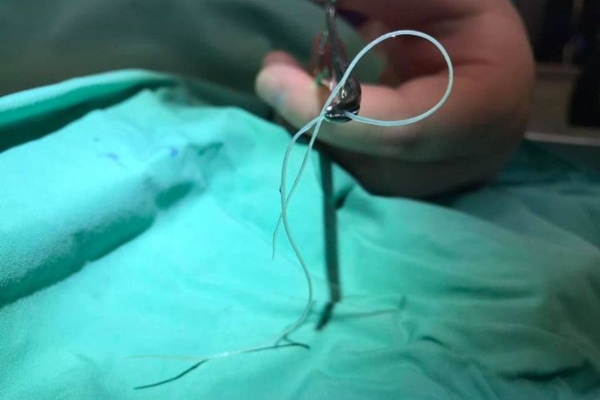
FACT: Heartworms are real worms that can grow up to a foot long, and can live for five to seven years in the heart of a dog.
Unfortunately, even if you don’t believe heartworms exist, they are real. See the pictures of heartworms in a dog’s heart and lungs below as proof.

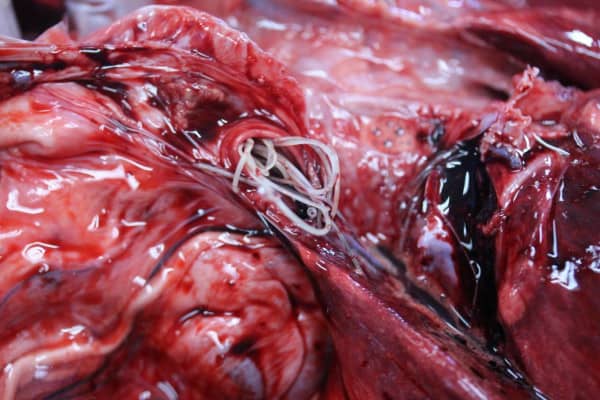
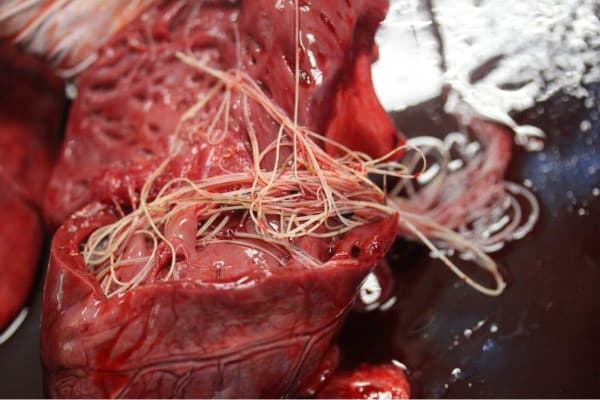
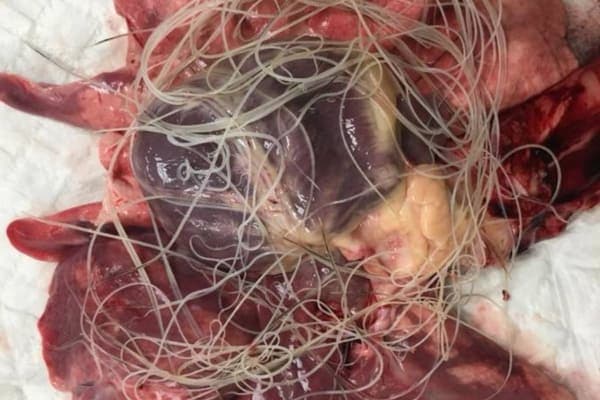
A heartworm picture is worth a 1000 words. These heartworm pictures from a necropsy (animal autopsy) of a dog’s heart and lungs post-mortem aren’t easy to look at, but they clearly show that heartworms exist. You can see the mass of heartworms in and around the dog’s heart.
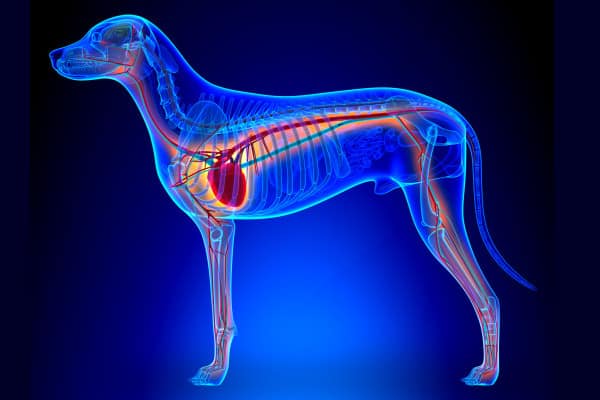
These are foot-long worms that live in the heart, the lungs, and the associated blood vessels. Left untreated, heartworms can live from five to seven years in dogs and cause significant damage to the heart and lungs during that time. Sadly, in some cases, heartworm disease can lead to congestive heart failure in dogs or even death.
Plus, the worms reproduce inside the host dog to create microfilaria (i.e. baby heartworms). When a mosquito bites an infected dog, it can pick up those microfilaria and spread heartworm disease to another dog. Therefore, having heartworms not only puts your dog’s health at risk, but also the health of other dogs in the area.
Remember that your veterinarian is there to help you and your pets. Veterinarians do not and will not make up health conditions to make a profit or for whatever other nefarious reasons people may suggest. Vets want to help you take the best care of your pets so they can have the longest, healthiest lives possible!
2. MYTH: A home remedy will protect a dog from heartworm disease.
FACT: There is no effective “at home” or “natural” heartworm prevention for your dog.
Essential oils. Pumpkin seeds. Lemon juice. Vinegar. Turmeric. Coconut oil. I have heard about every single concoction that people have posted on social media as a potential natural heartworm preventative. There is no home remedy that a dog owner can mix in any form that will prevent a dog from getting heartworms.
While I have a healthy respect for some home remedies when used appropriately (and certainly, it is very important that you use the right ones with veterinary guidance), they are not an appropriate prevention (or treatment) for heartworm disease.
And since I’ve mentioned essential oils, if they are in your consideration set for your dog in any way, it is crucial you do your research. Certain types of essential oils are dangerous for dogs. There are a few that are safe, but you need to use them judiciously. Please ask your vet before exposing your dog to oils at home.
Herbs, pumpkin seeds, and other “natural” remedies do not protect dogs from heartworms.
Also, various foods and herbs have been suggested to prevent or treat heartworms in dogs as well. I had one client tell me she had read that she should be feeding her dog pumpkin seeds for heartworm prevention. As far as I could ascertain, the fibrous seeds were meant to flush the worms out of the digestive tract. Not only do heartworms not live in the digestive tract, but feeding pumpkin seeds would not be an effective method for ridding a dog of intestinal parasites either.
We have so many effective options for heartworm preventions: oral, topical, injectable. I have yet to find a dog that didn’t have some viable option for effective heartworm prevention, no matter the breed or other health conditions. Please administer FDA-approved heartworm preventative monthly for your dog.
Use FDA-approved products specifically labeled for preventing heartworms
While discussing the topic of preventions, make sure the FDA-approved prevention you’re giving your dog is labeled specifically for preventing heartworms. Some products protect against other parasites, such as intestinal worms, fleas, and ticks. But not all flea and tick medicine prevents heartworms. If you’re not sure, check with your vet to make sure your dog is receiving the prevention he or she needs.
3. MYTH: There are home remedies that can get rid of heartworms in dogs.
FACT: It is not possible to treat heartworms in dogs at home. Once a dog becomes infected, he or she needs a course of injectable medication to get rid of the heartworms.
Once the vet diagnoses a dog with heartworms, we are too late for the preventing stage. The worms have taken residence in the dog’s heart, lungs, and thoracic vessels, and we need to take action to clear the infection as quickly as possible to mitigate damage to the heart.
As much as I might wish there to be a quick and easy home remedy to get rid of heartworms in dogs, that is not the case. Heartworm treatment involves a series of intramuscular injections, deep in the muscles of the dog’s back, of a compound called melarsomine.
Proposed home remedies such as garlic, herbs, black walnut, etc. have not shown any impact on heartworms in dogs. In fact, garlic (which is what I’ve most commonly heard as a proposed home remedy) can be toxic to dogs. So again, please use caution with home treatments for your dog, and discuss them with your veterinarian first.
4. MYTH: Coconut oil can cure heartworms.
FACT: Coconut oil does not cure heartworms in dogs.
As discussed, the only effective treatment for heartworm disease in dogs is a series of injections of melarsomine.
For some reason, a few years ago, coconut oil emerged as a fabled silver bullet in pet care. My clients were using coconut oil to try to treat everything from heartworm disease to allergies to skin infections (i.e. pyoderma in dogs). You can use coconut oil as a moisturizer (I’ve sometimes recommended it for older dogs with dry noses), but its usefulness is more limited than the internet would have you believe. I can say with confidence that coconut oil cannot cure heartworms in dogs.
Again, as with all potential home treatments, consult your vet.
5. MYTH: Indoor dogs don’t need a heartworm preventative.
FACT: All dogs in areas affected by heartworms should be on heartworm prevention.
This is a discussion I’ve had with pet parents many times. Do indoor dogs need heartworm prevention? The answer is a resounding YES.
Unfortunately, mosquitoes know no man-made boundaries. Whether it is a house or a fenced in yard, mosquitoes can fly. They’re also blown by the winds, so certainly, they can travel the country. They can get indoors and bite unprotected dogs inside the house.
Even an indoor dog who rarely goes outside for more than a walk or potty break is still at risk for heartworms. It only takes one bite from one mosquito to infect a dog with heartworms. There are up to 30 different species of mosquitoes that transmit heartworms and they can all slip into a house quite easily. I have diagnosed heartworms in paper trained dogs who don’t even go outside to relieve themselves. Yes, mosquitoes bite inside our homes.
Please keep your dog on heartworm prevention, even if he or she stays primarily indoors.
Along similar lines, spraying for mosquitoes is not enough to prevent heartworm disease. And yes, dogs who live in gated communities should still be on heartworm prevention.
6. MYTH: Dogs don’t need heartworm preventative during the winter months because it’s cold outside.
FACT: Dogs can be infected with heartworms year-round.
Cold temperatures do not safeguard dogs from heartworm disease and the insects that carry it. I’ve seen many sad cases of dogs who have tested positive for heartworms. The dogs’ owners stopped giving preventative during the cooler half of the year—the winter months.
So can dogs get heartworm in the winter? Unfortunately, yes. Some species of mosquitoes are adapting to colder climates. Plus, heartworm disease exists year-round in the host animal—such as a coyote, fox, wolf, or an infected dog. Thus, it is really important to give year round prevention.
Is the risk of contracting heartworm disease decreased in colder temperatures? Maybe. But I am not willing to gamble my pets’ or my patients’ health on an unknown. The risk is not zero, and heartworm disease is so much easier, cheaper, and less invasive to PREVENT than it is to TREAT.
I recommend to all my clients to keep their dogs on heartworm prevention year-round.
7. MYTH: A dog’s thick fur will protect him or her from mosquito bites and thus heartworms.
FACT: Heartworms are spread through mosquito bites. Dogs with thick fur are still at risk of being bitten by mosquitoes, and therefore potentially becoming infected with heartworms.
“My dog has a really thick coat. There’s no way the mosquito can bite through it.” This is a common misconception that a dog’s thick fur protects him or her from getting heartworm disease. I’ve heard this from my veterinary clients with Chows, Huskies, and other long, thick-coated dogs.
The truth is that mosquitoes bite pets where the hair is thinnest. Often the hair, even in a thick-coated dog, is still thin on the legs or the belly. And that’s where the mosquito is going to bite. I have personally treated heartworm positive Pomeranians, Huskies, and other breeds that are known for their thick undercoats. It’s not a protection. Mosquitoes will find the dog’s soft inner groin, belly, and skin where the coat is thinnest.
8. MYTH: We don’t have heartworm disease in our state.
FACT: All 50 states (and worldwide) have documented cases of heartworm disease in dogs. Not only has it been recorded, but it is also on the rise.
Here is a true story that helps illustrate why this is the case: A client came to me with a dog that needed to be treated for heartworm disease. While talking to them I discovered the dog and pet parent had moved into the area from a different state about three years prior.
I was sad for the dog, of course. But I was also sad because that dog, during those three years, had served as a “reservoir of infection” for the area. That means that if a mosquito bit the infected animal, then that mosquito would then become infected and potentially infect other dogs. It is a domino effect.
Secondly, the convenience and ease of travel in today’s world fans the spread of heartworm disease. After hurricane Katrina, for example, over a quarter of a million pets—many of whom were heartworm positive—were shipped around the United States in this great concerted rescue effort. As encouraging and uplifting as this was, it also guaranteed the increase of heartworm incidence around the country.
At this point, no state is heartworm-free. If you’d like to learn more, check out the American Heartworm Society’s heartworm tracking incidence map.
9. MYTH: If a dog’s fecal test is negative, heartworm testing isn’t necessary.
FACT: Testing for heartworm requires a blood sample, and is a separate test from a fecal test, which is generally used to diagnose intestinal parasites.
Many other species of worms (hookworms, roundworms, and tapeworms, for example) are internal parasites that live in the intestines, in the gastrointestinal tract. Heartworms live in the circulatory system—the lungs, the heart, and the associated blood vessels. And because heartworms are present in the heart and the circulatory system (not the intestine), it takes a blood test for dogs to detect them.
To test for heartworms, veterinarians administer a specific heartworm antigen test (not a fecal test for dogs) using a few drops of blood from the dog. Often the lab test results are available in just 10 minutes.
10. MYTH: Heartworm pills are toxic to dogs.
FACT: Heartworm preventatives have been extensively studied for both efficacy and safety, and have wide safety margins.
I understand the concern about what we are putting into our bodies and our dogs’ bodies. But I always tell my clients that with everything in life we have to weigh the benefits versus the risks.
There are many safe FDA-approved heartworm preventatives on the market. My own personal dogs get a monthly heartworm preventative, because I’d never open them up for the risk of contracting heartworm disease. The potential risk posed to them by the preventative medications is far less than the risk of either heartworm disease or treatment.
BONUS MYTH: Herding breeds should not take heartworm prevention
FACT: When given at the dose on the label, heartworm preventatives are safe for herding dogs with the MDR1 mutation.
Certain dog breeds—Border Collies, Australian Shepherds, Shelties, and others—may have a mutation in a gene called MDR1 that impacts their ability to metabolize certain drugs. One of the drugs well documented to give these dogs trouble is ivermectin. Since many heartworm preventions contain ivermectin or drugs in a similar class, it is understandable that dog parents may be leery of giving heartworm prevention to dogs who could have the MDR1 mutation.
That being said, the dose of ivermectin in monthly heartworm preventions is much lower than the amount of ivermectin that would make a dog sick, even one with the MDR1 mutation. Plus, the manufacturers of Heartgard®, Interceptor®, ProHeart®, and Revolution® have tested their products for safety in dogs with the MDR1 mutation. And the FDA has determined those preventatives are safe for dogs with the MDR1 mutation. (Just because a preventative isn’t on that list, doesn’t mean it is unsafe. Please talk to your vet about what is best for your dog.)
Interestingly, the dogs I’ve seen with ivermectin toxicity usually get sick after being at the barn with their owner who was deworming horses. As you might imagine, the dose for horses is much larger than for dogs. And horse deworming paste is usually apple flavored or something else enticing to a precocious pup. So it goes like this. The horse spits some out, the dog licks it up, and it makes the dog sick.
As an integrative veterinarian with 25+ years of experience, I have not seen a dog get ivermectin toxicity from an FDA-approved heartworm preventative when given at appropriate (i.e. labeled) doses.
Let’s bust these myths about heartworm disease in dogs together
If you see people propagating these myths about heartworm disease in dogs on social media, please help set the record straight. Ultimately, dogs are the ones who suffer when we get this wrong. That’s why it’s so important to bust the myths about home remedies such as coconut oil and pumpkin seeds for heartworms in dogs. And it’s why it’s so important to correct misunderstandings such as indoor dogs don’t need heartworm preventative.
Finally, the benefits of a heartworm preventative outweigh the risks. If you are interested in more information, I encourage you to check out my companion article, Do Senior Dogs Need Heartworm Medications and my podcast episode, 10 Heartbreaking Heartworm Myths.
Also, speak with your veterinarian about heartworms or which heartworm preventative is the best choice for your dog. Together, you and your vet can keep your dog safe from this preventable disease.
What other myths about heartworm disease in dogs have you heard?
Please comment below.



In the 1st comment from Carol , she stated her dog had elevated liver enzymes, I did not understand if she thought heartworm preventive caused it. I have a 14 yr old border terrier that has been on heartgard forever. When he was 12 his liver enzymes were off the chart, my vet put him on Denamarin after a month they were back to normal. After several months she said I could stop the Denamarin . Forward two years & a month ago he was throwing up , I took him in & vet did bloodwork liver enzymes were over 3000 , he has been on Denamarin again for almost a month, had blood work again & its 55 now . I plan on keeping him on Denamarin . He still takes heartgard & nexgard . Is there any reason to think they cause elevated liver enzymes? The first time it happened we thought he might have gotten something with xylitol but?? not sure really what caused it. This time I have been careful what he gets because he had a stroke between those episodes ( he couldn’t walk for over a week- he has recovered from that & on good days chases squirrels) . Do you have discussions on liver problems.
Hi Sherri,
I understand your concern for your pup and think he is lucky to have you advocating for his health and well-being. While there are dogs that may have a sensitivity to certain medications, I am not aware of heartworm or flea prevention being a cause of liver dysfunction when given at the recommended dosages. Also, if a medication is going to cause a problem, we usually start to see symptoms or lab work abnormalities early on when the medication was first started. If heartgard was going to cause a problem for your pup I wouldn’t expect it to take 12 years to cause damage to the liver. Here are links to other articles about liver problems:
1. What Does a High ALP in Dogs Mean?
2. High Liver Enzymes in Dogs: A Vet Explains What It Means
3. Liver Disease in Dogs: Signs, Symptoms, Causes, Treatment
Hoping your boy will continue to respond well to the Denamarin. Wishing you both all the best and keep up the good work!
My dog was sick with elevated liver enzymes about 1 month ago – found nodules on sonogram. Simce that time i am making her food- low protein, low fat, govong probiotics, enzymes doimg mich better with strong appetite and good stool. I am hesitant to give her the monthly heartworm plus . What do u think?
Hi Carol,
I understand your concern for your pup. She is very lucky to have you taking such good care of her and making her home cooked meals. Unless your girl has an allergy to one of the ingredients in the heartworm prevention, I would definitely recommend you continue giving the prevention on schedule. Hoping your girl can continue to remain stable and wishing her all the best for many happy days ahead.
I just got home from the vet , my dog,(lab), tested positive for heartworm,(he was a rescue, found abandoned) . the vet said the “control” lit up before the other part of the test….he said that the dog had “full blown” heartworms….he is approximately 3years old, and he would NOT give him a rx for heartworm medicine, because it might kill him .he said that he had never successfully cured a dog of heartworms that was over the age of five, and that we need to seriously think of our options…to treat for 1,400. or let him die whenever the time comes….. your opinion?
Hi Tina,
I am sorry your Lab has received this diagnosis. Without personally talking with your vet, it is hard for me to make assumptions about the choices that have been made. I will give you facts and try to offer information and hope you can use it to decide how to proceed with your boy. Also, it is always ok to seek a second opinion if you have lingering concerns or unanswered questions. You deserve to feel confident in the medical care your pup is receiving and need to have trust in the vet you choose to partner with. There is some evidence to show that (in rare cases) dogs that are heartworm positive can have a deadly reaction when given certain heartworm preventatives. In the past, preventatives containing ivermectin as their active ingredient were thought to be safer and often used in heartworm positive dogs with great success. The gold standard for heartworm treatment is giving Melarsomine injections to eliminate the adult heartworms (this is probably the $1400 you were quoted). If dogs are not healthy enough to receive the injections or if there are financial limitations that will not allow this type of treatment, then vets have used a “slow kill” method to achieve a heartworm negative status. This other method uses heartworm preventatives (usually one with Moxidectin as the active ingredient) to ensure a dog does not contract any new/additional heartworms while waiting for the current worms present to finish their life cycle and die naturally. Often a vet will prescribe Doxycycline to give at the same time, as it has been shown to weaken the heartworms and allow them to die off faster. Generally, it can take 6-9 months for adult worms to finish their life cycle and die. This is why it is recommended to recheck a heartworm test at 6 months post treatment and again at 12 months. Some dogs will show a negative test at the 6-month mark, but all should be negative by 12 months. I am not aware of any age limitations as it pertains to successful heartworm treatment. Here are the official recommendations for treatment and testing as outlined by the American Heartworm Society: https://www.heartwormsociety.org/veterinary-resources/american-heartworm-society-guidelines
And here is a link to an article published in the Frontiers Veterinary Science Journal that disucsses the “slow kill” method with Moxidectin and Doxycycline: https://www.frontiersin.org/articles/10.3389/fvets.2021.702018/full
Sorry for such a lengthy reply but I wanted to make sure you were well informed! Hoping this will help guide your conversations with your vet and give you the courage to keep advocating for your sweet boy’s health and well-being!