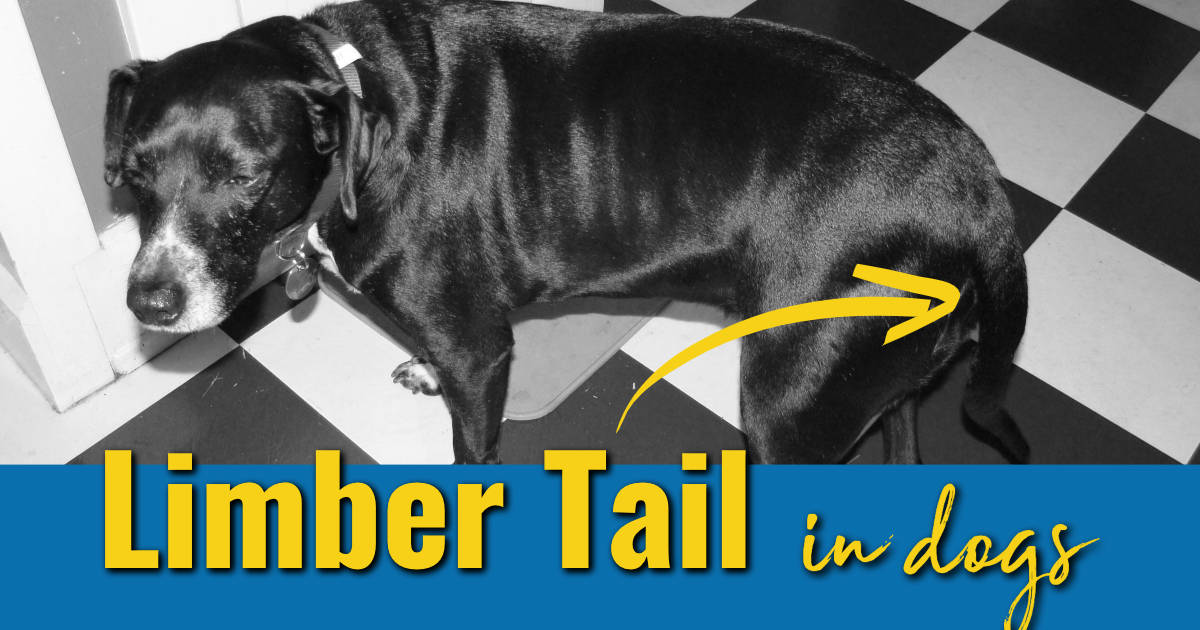
If your dog’s tail “goes limp” or “looks broken” after swimming (or even after a bath), it could be limber tail syndrome in dogs (a.k.a. acute caudal myopathy or swimmer’s tail). Integrative veterinarian Dr. Julie Buzby shares one dog’s experience with this painful condition, which often has a mysterious water association. By the end of this article, you’ll know the facts, causes, symptoms, and treatment for limber tail.
“I’m taking Banjo to the vet. Call me when you can.”
My sister lives four hundred miles away, so receiving this voicemail from her one Saturday morning, I immediately knew something was majorly wrong with her dog. Banjo had just gotten a clean bill of health at a routine vet visit the previous day. What changed between then and now?
When I called her back, my sister explained that she believed her dog had broken his tail after hitting it on her bed frame. Her beloved dog’s tail was suddenly limp and crooked.
Diagnosis: Limber tail syndrome
Talking to my sister, a condition that causes dogs to have a limp tail came to mind. I asked if her dog had been in the water yesterday. She confirmed he’d had a bath that day.
“I think he has something called limber tail syndrome,” I explained. “The bad news is it’s excruciatingly painful. The good news is he’s going to be fine.”
If your four-legged friend looks to beat the summer heat with a dip in the lake, a romp in the waves, or a cold water bath, be on the lookout for a suddenly droopy and limp tail. It very well might be limber tail syndrome.
Summer-related hazards are not limited to heat stroke in dogs; limp tail syndrome is something we see more frequently in warmer seasons.

What is limber tail syndrome?
Limber tail syndrome, or acute caudal myopathy, is a relatively common condition in which a dog’s tail either drops down from the base or extends horizontally three or four inches and then droops downward.
A number of other names are sometimes used to describe limber tail syndrome, including:
- Limp tail syndrome
- Swimmer’s tail
- Bent tail
- Broken wag
- Cold tail
- Dead tail
- Frozen tail
- Lab tail
- Rudder tail
Limber tail is common in sporting and hunting dogs like Labrador Retrievers, Golden Retrievers, Setters, Pointers, and Foxhounds.
What causes limber tail in dogs?
While the exact cause of a dog’s limp tail isn’t always known, it may be caused by damage to the muscles of the base of the tail. Think of it as the muscles being sprained or strained.
One research study examined four Pointers that had been diagnosed with “cold tail.” Bloodwork and electromyography confirmed evidence of damage to the muscles of the tail.
This muscle damage is usually caused by overuse during swimming or bath time.
Why is my dog’s tail suddenly limp?
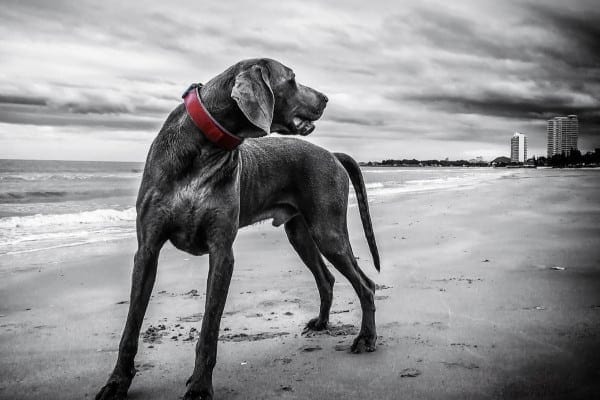
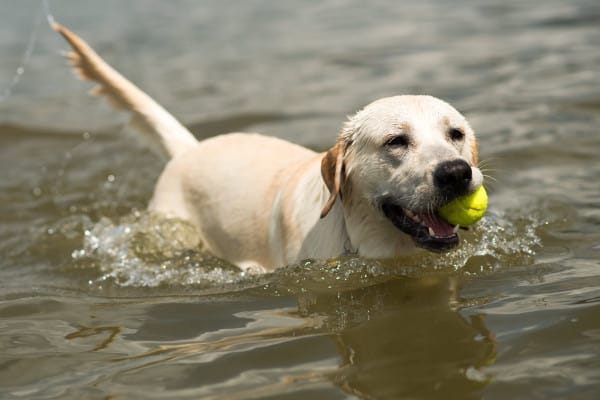
A dog naturally uses his or her tail for balance. When in the water, the tail aids in steering and changing directions in addition to balance—sort of like a boat’s rudder. Overexertion during water activities can cause a limp tail.
However, other conditions can also predispose dogs to developing limber tail. This includes:
- Cold weather and cold temperatures
- Temperature and humidity changes
- Long periods of time spent in a kennel
- Rapid increase in exercise (no training/building up to it)
- Exposure to cold water
If you have ever exercised during winter, you know that your muscles are tight and need to be “warmed up,” especially in cold temperatures. This is why it is important to stretch before exercising. Sudden exercise/exposure can increase the risk of muscle injury or strain. It’s the same for our dogs, too.
A common misdiagnosis
Unfortunately, limber tail may be commonly misdiagnosed as other conditions such as:
- Trauma to the tail
- A prostate problem
- An anal gland problem
- A fracture in the hind end
- A disc herniation or intervertebral disc disease in dogs (IVDD)
- An infection
While it’s important to rule out these more serious conditions, limber tail is often the most likely diagnosis, particularly for water-loving dogs with the classic symptoms.
Symptoms of limber tail syndrome
Limber tail syndrome is a strange phenomenon, and its sudden onset can be surprising. Especially if your dog loves the water, it’s important to know common symptoms and risk factors of limber tail syndrome. Limp tail symptoms can include:
- Pain at the base of your dog’s tail (where the tail meets the body)
- An inability for your dog to hold the tail normally
- Dog’s tail hanging limp and droopy-looking
- Dog’s tail limp and swollen
- Reluctance to wag or move the tail due to pain
- Licking or chewing of the tail
- Recent exposure to water such as an ocean, lake, river, or cold water bath
- Recent strenuous work or exercise, especially for sporting breeds like English Pointers, Labradors, or Beagles
- Prolonged crate confinement from travel or being home alone
Exposure to water is a consistent clue in all the cases that I’ve seen over my 25+ years as a veterinarian. It’s important to note, however, that recent water activity is not a requirement for a diagnosis of limber tail.
My dog’s tail is limp: Pain or no pain?
As you can see from the list of symptoms above, signs of swimmer’s tail can vary. This is because every case occurs due to a different muscle injury, and no two dogs are the same.
In most cases, if your dog’s tail is limp from limber tail, it is usually painful. This is especially true for dogs who are very active and tend to overuse their tail.
In some cases, the injury may be very mild, so your dog’s tail might be limp but not painful. Think about it like a rolled ankle. Sometimes you take a weird step and just roll your ankle a little. It’s stiff, but you can still walk fairly pain-free. Other times, you roll your ankle so badly that it’s injured to the point that you need a boot or cast.
This variation in pain is very similar to what a dog with a limp tail might feel. Also, keep in mind that dogs are very stoic and may mask pain.
Overall, limber tail tends to be painful more often than not.
How is limber tail syndrome diagnosed?
Thankfully, limber tail is a fairly easy diagnosis to make. Your vet will perform a physical exam to look for signs of injury, pain, and abnormalities in the tail.
If your dog has the “classic history” of swimming a lot recently, your vet might be able to diagnose limber tail right away. If not, he or she might need some diagnostics to help rule out other problems first.
For example, limber tail can present similarly to a dog with a broken tail. In order to diagnose between limber tail versus a fractured or broken tail, your veterinarian might take X-rays. The findings from X-rays can help rule out some of the other disease possibilities mentioned above, too.

What is the treatment for limber tail in dogs?
If your dog has been diagnosed with limber tail, you are probably eager to know what’s next. How do you treat a limp tail? Thankfully, dogs with limber tail syndrome typically only take a few days to recover. With a combination of rest, time, and anti-inflammatory medication for pain, most dogs significantly improve within a short period.
In addition to anti-inflammatories, your veterinarian might prescribe a medication called gabapentin. Gabapentin for dogs is becoming more common as a treatment option. I personally like prescribing gabapentin for limber tail because it usually has fewer side effects than anti-inflammatories. Also, gabapentin can help calm down dogs who are energetic and don’t want to rest.
Home treatment for limber tail
Speaking of resting, this is the most important part of treating a dog with limber tail. If you want a home treatment option for your dog with a limp tail, rest is the best thing you can provide for your dear dog.
As I mentioned, limber tail usually happens from overuse. So, in order for a dog’s limp tail to heal, the tail needs to rest. I know this is easier said than done, though. How do you stop a happy dog from wagging his or her tail? If you have an enthusiastic dog, the answer is, you probably can’t.
However, you can avoid creating excitement to help reduce the amount of wagging. This means no doggy play dates with friends, no guests over to the house if that excites your dog, limiting activity to leash walks only, and less playing at home.
On the other hand, it is important not to restrict your dog too much by putting him or her in a crate for long periods. As we discussed above, extended periods in a crate can actually be a cause of limp tail. Lying in a crate, especially if it is small, can make your dog’s tail muscles stiff. This can make your dog’s limp tail even more sore and painful.
Most importantly, you should avoid giving your dog baths or letting him or her swim while healing.
You may be wondering, “What can I give my dog for limber tail?” Unfortunately, there are no over-the-counter medications that are safe and would help a dog with a limp tail. If you want to give your dog more than just rest, ask your vet about adding treatment with a hot or cold pack. The ice or heat pack can be used to help reduce swelling and inflammation in the tail.
How long does limber tail last?
Fortunately, limber tail usually only lasts a few days.
For example, my sister shared that Banjo was once again happily greeting her by smacking his tail into her legs after just a couple of days.
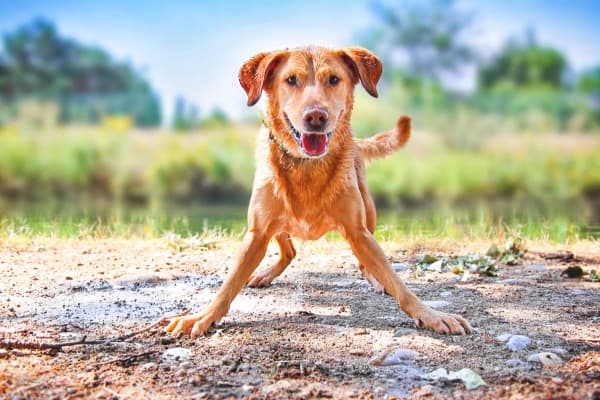
Interestingly, a few of my patients with this diagnosis have received immediate relief from veterinary spinal manipulation (i.e., a dog chiropractic adjustment of the sacrum), but this is not always the case.
What is the prognosis for limber tail?
On top of healing quickly, I am happy to say that the prognosis for limber tail is usually very good. If you allow time for the tail muscles to heal and your dog to rest, the tail should make a full recovery.
If the rest period is not long enough, it is possible that your dog will re-injure his or her tail.
How can you prevent limber tail?
Some dogs, especially those predisposed to limber tail, can develop the condition a second time. I have even had a client whose dog’s tail is limp after swimming every summer.
The best way to avoid this from happening to your dog is through conditioning. By exercising your dog and slowly building up to more strenuous activities, you can help your dog strengthen his or her muscles.
Think about if you were training for a marathon or to climb a mountain. You can’t just wake up one day and decide to complete this activity. You spend months training and preparing your body. The same needs to happen for your canine companion.
If your dog spends all year resting and then is suddenly active all day long as soon as summer hits, his or her tail is more likely to become fatigued and injured. It’s important for you to help your dog build up strength by starting with short swims a few times a week. By slowly adding more time in the water, your dog should be better prepared.
Just like before you exercise, you should always “stretch” your dog. Of course, I don’t mean actually stretching your dog’s legs into fancy poses or anything like that. Rather, I mean giving your dog a bit of time to warm up and stretch his or her legs.
For example, if your dog has been confined in the car or kennel, give him or her a short leash walk. This will help your dog calmly and naturally stretch those muscles. Once your dog has had a chance to stretch, you can let him or her run, play, and swim!
This “warm up” isn’t a guaranteed way to prevent limber tail from happening again. So, if you see your dog’s tail limp after a bath or other activity, you should stop and check them. You may even want to give your furry friend a tip-to-tail dog wellness scan.
As always, please speak with your veterinarian if you’re concerned about your dog’s tail or any other body parts!
A simple action plan
This summer, as you venture outdoors, know the signs and risks of limber tail in your water-loving dog. If you do see a sudden onset of symptoms, you’ll be one step closer to a diagnosis. And you’ll be ready to set up an appointment with your veterinarian to formulate a plan.
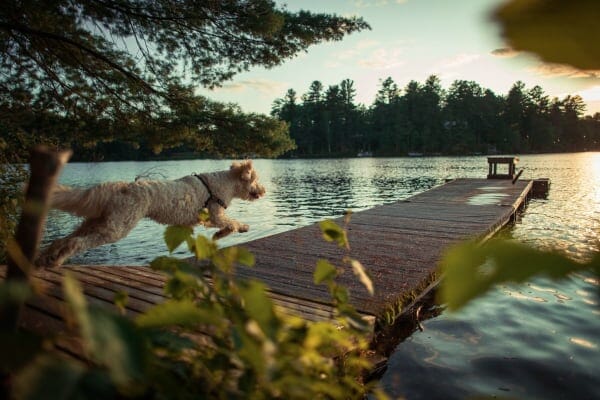
Now, enjoy the warmer days and have a ball watching your canine companion make a huge splash—whether that’s in your bathtub, off the end of a dock, or in the waves of the salty tide.
Has your dog ever had a limp tail after swimming or bathing?
Please comment below. We can all learn from each other.


Gave my dog a bath around 7:30 that morning around 3:30 took for a walk and the tail was looking good. Brought him inside go to sleep around 6:30pm around 7:30. He woke up. He was in pain. Took him to the vet. They examined him and said he had a limp tail. They gave him an injection of methadone 10 mg and I’ve been given him gabapentin and carprofen for the past two days and now the tail is slowly coming back to normal. And he is not in pain. Only thing I can think of is possibly the bath that morning caused it.
Hi Dave,
I am sorry your boy experienced this painful condition. I too would suspect the bath to be the culprit. So glad your pup is improving and pain free. Wishing him all the best and keep up the good work!
Thank you for this article. My 3-year old female cockapoo (w/docked tail) was given this diagnosis a week ago and was sent home with NSAIDS + pain meds and instructions to sideline activity. She is normally very happy and enjoys activity, inc. ball playing. She isn’t completely better yet so after talking again to her Vet, we’ve decided to do blood work and xrays next week, just to ensure nothing else is at play. I wiish they could tell us what they are feeling and where it hurts.
Hi Tammie,
I’ve wished my patients could tell me what was going on so many times, too! I think that your plan of a recheck exam with X-rays and bloodwork is a great one. Fingers crossed all the testing comes back normal and she is back to her happy ball-playing self soon! Please feel free to keep us updated.
My Cape Shore Water Dog is going through this right now it’s the second time he has had it. As I suspected he got over it last time and you reaffirmed what I thought he will get over it with rest.
Hi Darrell,
I am sorry your pup is dealing with limber tail for the second time. I am glad the article was able to offer clarity and peace of mind. Wishing your boy a speedy recovery!
I appreciate your thorough article. This morning my 2 year old Golden Retriever woke up with a sad tail. Nothing directly happened to cause it. I can only think that we played too much fetch yesterday. We have been heating it (she really enjoys that) and resting. I think she’s soaking up all the pampering (we don’t mind it either). Glad it’ll be better in a few days. If it’s not- to the vet we go!!
Hi Angela,
Thank you for the positive feedback about the article! I am sorry your Golden experienced this worrisome condition but glad she enjoyed resting and getting tons of attention. Hoping things resolved quickly and all is well today. Best wishes to you both and take care!
The article is very interesting and useful. I live in Mexico and it’s not a very well-known syndrome. My dog started with discomfort eight months ago, biting his tail suddenly, especially when he got excited. First they thought it was an allergy to the change of diet, then their anal glands, then the deterioration in their cartilages by age (8 years) so they took RX. Now he was in kindergarten and he swam a lot in the lake and he arrived very, very badly. He has a hard time defecating so he cries when he does. Initially the veterinarian continued with treatment as if it were a joint but I found this article and we saw that it responded perfectly to his condition. He has been ordered the gabapentin but it has already been 4 days and his improvement has been very slight, how long can it take to improve?
Hi Patricia,
I am sorry your boy is experiencing this painful condition. It can take several days for it to resolve but I would have thought there would be improvement by now. Hoping the gabapentin will be exactly what he needs and that you will see results with a little more time. Wishing your sweet boy healing so he can get back to living his best life!
My pup woke us up this morning by loudly yelping and tucking her tail. I suspect she has limber tail as she finally got to swim yesterday after the pool was too cold over winter. She’s a very active dog and is very sad right now and confused. I had no idea this was a thing!
Hi Sydney,
Yes that does sound suspiciously like limber tail. It has been a few days now, so hopefully she is starting to feel better! If not, don’t hesitate to reach out to your vet for help.
Hello, my 4 yr old Scottish Terrier was boarding at the breeder’s over the weekend. (Out for regular playtime and not confined to kennel or crate). When I picked him up I thought I noticed he was holding his tail down funny, but he does hold it down now and again. I gave him a warm bath that evening and since it was a warm evening I just towel dried him. When we went to bed I noticed he was shivering so I put a warm heating pad against him and the shivering stopped and he slept well all night.
The past 4 days he still continues to hold his tail down in a curved shape. Typically his tail is straight up especially if he sees another dog and he even will hold it almost completely across his back.
He has held it up these past few days when encountering another dog, but not erect, and only for amoment, and certainly not over his back..
I have felt his tail, gently held it up and he shows no indication of pain. He is eating and having bowel movements as normal.
I’m going to see if I can get him into see the vet this morning.
Hi Cynthia,
I am sorry your boy is experiencing these worrisome symptoms. Without examining him myself, it is hard to make specific recommendations. I will say that based on what you describe, this does not sound like limber tail to me. I am concerned there is something else contributing to his odd behavior that needs to be investigated right away. If you have not already had your vet examine your pup, I encourage you to schedule an appointment as soon as possible. Hoping all is well and praying for a positive outcome. Best wishes to you and your sweet boy.
Very helpful article! My three year old heeler typically has a very confident tail position, curled up and quick to wag. Yesterday evening while playing fetch in the yard with his brother, they had a passing collision and I immediately noticed his tail dropped, he was looking around like he didn’t know what happened and for the rest of the evening the tail was down and he was very reluctantly only wagging the tip. I have been watching him this morning and he doesn’t want to sit and hasn’t finished his breakfast. After finding your article, it does sound like he has a sprain or strain. He is not as enthusiastic about swimming as his brother typically but three days ago at the lake he did swim more than he usually does. Perhaps the combination of more water work and the accident playing led to a more serious strain. We’ll let him recover for a few days and monitor. If it isn’t better, I’m thinking a chiro adjustment might help in this case. Thanks again for such a complete explanation of this occurrence.
Hi E,
Thank you for the positive feedback about the article. I am glad you were able to recognize the signs of a tail strain and can monitor your boy for any changes over the next few days. Hoping he will make a full recovery and wishing you all the best!
Thank you for the informative article! We returned from a camping trip today and had to bathe our 8-year-old Belgian Malinois, Zephyr, due to the muddy conditions. Despite his dislike for baths, he endured it. Later, I noticed his unusual behavior, including a squeak and a hanging tail. He seemed uncomfortable and retreated to my office. After reading your article, I wonder if the bath’s water pressure might have caused his discomfort.
Hi Natalie,
I am sorry Zephyr is enduring this painful condition. It does sound like he is experiencing limber tail. I would not blame the water pressure, as this is usually caused by cold temperatures, muscle strain, or overuse. Please reach out to your vet and see if they can prescribe some pain medication as this can cause a great deal of discomfort. Hoping Zephyr will heal quickly and can get back to living his best life very soon. Best wishes and good luck!
Brought our Golden Retriever for a swim and run and it was a bit breezy and were small waves coming to shore. We threw a couple of sticks into the water for him to fetch swimming into the waves. After that we took him for a bit of a run in the bush along a path abs back to swimming for a bit. He seemed fine until that evening when we went to bed. He kept panting excessfully and couldnt get comfortable. The next morning we noticed that his tail was limp and wasn’t his active self. I researched this and it appears that it is a strain/sprain at the base of his tail. We will keep him calm for the next few days and if not any better, we will be bringing him in to see our vet. This is the first time this has happened and he is loves being in the water.
Hi Deborah,
I am sorry your Golden had to experience this painful condition. Hoping it resolved quickly and did not need additional intervention from your vet. Praying all is well and wishing you many happy days ahead.
Awesomely helpful article!!!!!!! THANK YOU……… XOX. 😊
Our girl🐕 looks identical to the dog pictured in the article above “X-rays maybe recommended”…. Her dog friend had been on vacation for 3weeks and yesterday when they got together at the lake for a play date she was exceptionally rambunctious. She’s usually a bit pensive in water activities but NOT yesterday. The water temp was COLD. (Typical Colorado March temps in the 40’s ish…..). Her tail today was vertical 3” out and hung down. Reluctant to wag with her normal enthusiasm . When I tried to touch it she YELPED which in 5 years I’ve never heard her do. Of course it’s a holiday weekend so finding this article has been a HUGE relief. Cannot say thanks enough……….
Hi ElizabethRose,
I am sorry your girl is dealing with this painful condition. Thank you for the positive feedback! I am glad the information was insightful and helped to empower you as you advocate for your girl’s health and well-being. Hoping all is well and she has made a full recovery. Best wishes and give your sweet girl a hug for me! ♥
I just came across this article and I think I will be able to sleep tonight. My husband and I just got home from a vacation and we had been gone 8 days. Our 16 month chocolate lab was home with his auntie but we had two feet of snow while we were gone. My husband plays hard with him everyday so he’s had over a week off so it was probably the cold and the exercise he hasn’t had in a week that did it, or maybe he banged his tail greeting us when we got home late last night. Either way I noticed his tail goes out about three or so inches and then straight down. He still wags it but it just hangs down and he doesn’t seem bothered by it at all unless I try to touch him to see if it’s swollen. He just moves away so we can’t touch his tail at all. Other than that he is acting and eating normally. Still going to the bathroom normally. He just hasn’t asked to go outside much since the play session and has been laying around. Before the playtime he was wanting outside every 15 minutes to run around. I’m calling the vet in the morning but not rushing to ER because I have a feeling it’s just limber tail and not a broken tail!
Hi Heather,
I am glad to know the article was informative and helped to give you some peace of mind. I think it is good you are still planning to reach out to your vet just to remain cautious. Thank you for sharing your experience with us. Hoping with rest and time your boy will be feeling good as new again soon. Best wishes and take care!
My 2 yr old boxer came down with this same thing last winter when we got a lot of fresh snow. We spent a couple of hours playing in the snow (which she absolutely loves!) and that same evening we noticed her tail hanging limply. It took about a week for her to completely recover.
Yesterday we got some fresh snow over a foot deep. I made sure she had a sweater and a coat on before going out and I limited her time out to be no more than 45 mins at a time. We went out 4 times during the day yesterday and this morning she woke up in pain with a limp tail again! I grew up with boxers my entire childhood but back then they docked the tails of boxers ( which is illegal here now) so I had no idea this was a thing. I gave her some gabapentin leftover from spaying and she’s resting comfortably. I feel awful letting this happen again but she is such a high energy dog that needs to get out and run daily. She is in top shape but I wish there was a way to prevent this from happening again but since she’s had it 2 times now I’m sure it will happen again. If anyone has any suggestions I would love to hear them,
Thanks
Hi Michele,
I am sorry your Boxer has experienced this painful condition for a second time. I am not sure of a good way to prevent this but wonder if it would help to give an anti-inflammatory medication before playing in the snow? It could be worth a try. I encourage you to reach out to your vet for advice and guidance. How is your girl feeling today? Hoping all is well and she has made a full recovery. Thank you for sharing your experience with us!