Wondering how to help a dog lose weight? While it might feel daunting in the moment, it doesn’t have to be. Integrative veterinarian Dr. Julie Buzby provides 13 practical tips to use during your dog’s weight loss journey. Plus, she explains why being at an ideal body weight is so important for your dog’s long-term health.
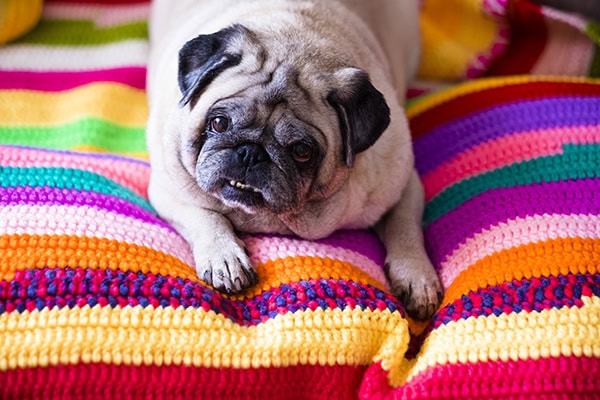
If your dog has gained a few too many pounds, he or she is not alone. The 2018 U.S. Pet Obesity Prevalence Survey revealed that 55.8% of dogs were overweight or obese. And when the survey was repeated again in 2022, that number had climbed to 59%. Pet obesity is a big problem, and unfortunately, it’s only continuing to grow as time goes on.
Interestingly, the 2022 version of the study also reported that 36% of dog parents classified their dog’s body condition score as “normal” when their dog was, in fact, overweight or obese. This underscores the importance of understanding what an ideal body condition score looks like and how to achieve it.
Carrying extra weight can significantly impact your dog’s health and quality of life, which is why veterinarians put such an emphasis on keeping your dog at an ideal weight and helping overweight or obese dogs lose weight.
Why does excess body fat in dogs matter?
Believe it or not, fat is more that just an inert squishy blob. It actually releases over 50 different adipokines (signaling molecules) that can play a role in inflammation, immune system function, heart health, metabolism, and more. Thus, both the added weight itself and the fact that fat is biologically active can work against overweight dogs.
Overweight dogs are more prone to arthritis and joint pain
Needing to support and move a heavier body places a greater physical strain on cartilage, tendons, ligaments, and bones during everyday activities such as walking, running, and climbing stairs. Plus, fat deposits release inflammatory substances, which may accelerate the progression of osteoarthritis in dogs. Together, these factors can lead to pain, stiffness, and decreased mobility in overweight dogs.
Excess weight can impact your dog’s heart and lung function
Being overweight forces your dog’s heart and lungs to work harder every day. The heart must pump blood to a larger body mass, increasing the strain on it, and potentially raising the risk for some heart diseases in dogs. Additionally, excess fat around the chest and abdomen can limit lung movement and make breathing more difficult.
As a result, overweight dogs may tire more quickly during exercise. Plus, they may struggle to regulate their body temperature and have poor heat tolerance, leading to an increased risk of heatstroke in dogs. In dogs with respiratory conditions such as laryngeal paralysis in dogs, brachycephalic obstructive airway syndrome (BOAS), or collapsed trachea in dogs, obesity may also worsen symptoms and lead to a decreased quality of life.
Overweight dogs may be at a higher risk of developing diabetes
Extra weight can lead to insulin resistance, meaning your dog’s cells don’t respond to insulin as effectively. While this doesn’t directly cause diabetes in dogs, it may raise the risk of a dog becoming a diabetic. Plus, in already diabetic dogs, being overweight can make blood sugar regulation more challenging.
Being overweight raises the risks during anesthesia and surgery
If your dog ever needs a dental cleaning, spay or neuter, or another surgical procedure, being overweight can increase the risk of complications. It may be harder for your dog to breathe under anesthesia, and the increased weight places additional strain on the heart. Overweight dogs may also take longer to recover after surgery and have a higher risk of the incision not healing properly.
While many overweight dogs have surgery safely every day, helping your dog maintain a healthy weight is a great way to reduce risk.
Dogs may have less energy when carrying extra pounds
Elevated weight causes extra strain on the whole body. This can lead to your dog feeling tired and easily exhausted. For a medium-sized dog who is 10 pounds overweight, some people say that is the equivalent of you carrying a 30- to 40-pound backpack everywhere you go. That takes a lot of extra work and energy!
Overweight dogs are prone to a variety of other medical conditions
In addition to what we have already discussed, being obese may also predispose a dog to the following health problems:
- Skin fold infections
- Urinary tract infections (UTIs in dogs)
- Poor gut health in dogs
- Torn ACL in dogs
- Hip dysplasia in dogs
- IVDD in dogs
- Cancer
- Pancreatitis in dogs
- Kidney disease in dogs
- Hypertension in dogs (high blood pressure)
- Poor immune system responses
As more is learned about the effects of obesity on the body, it is likely that this list will continue to grow.
Keeping your dog at an ideal weight may help him or her live longer
As you have learned, overweight dogs are at greater risk of developing a variety of health problems that can decrease their lifespan. In addition to living fewer years overall, they may also experience more pain and reduced mobility during their final years.
This information isn’t meant to shame or worry you. Rather, it is hopefully a way for you to see why weight really does matter. The good news is that it isn’t too late. Helping your dog achieve a healthy weight can reduce many of these risks and enable him or her to live a longer, happier, and more active life.
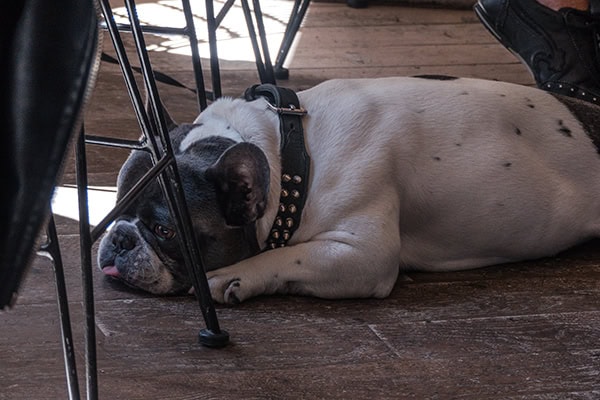
13 tips to help a dog lose weight
If you are ready to help your dog lose weight, use these 13 tips to create a simple and effective weight-loss plan.
Tip #1: Start by talking to your vet
Before making significant changes to your dog’s diet or exercise routine, schedule an appointment with your veterinarian. While overeating and lack of exercise are the most common reasons dogs become overweight, certain medical conditions can also contribute to weight gain or make losing weight more challenging.
For example, hypothyroidism in dogs slows your dog’s metabolism, meaning he or she burns fewer calories throughout the day. Dogs with hypothyroidism may gain weight even without eating more. Another condition, Cushing’s disease in dogs, causes the body to produce too much cortisol (the “stress hormone”). This can increase your dog’s appetite, cause weight gain, and lead to a pot-bellied dog appearance.
Finally, some medications, especially long-term steroids like prednisone for dogs, can also increase appetite and make weight gain more likely.
Benefits of a vet visit
During the visit, your veterinarian can determine whether an underlying medical condition may be contributing to your dog’s weight gain. He or she can also give you an idea of your dog’s ideal weight, calculate how many calories your dog should eat each day, and create a personalized weight-loss plan that helps your dog lose weight safely while still getting the nutrition he or she needs.
Starting with a veterinary exam ensures you’re treating the whole dog—not just the number on the scale.
Tip #2: Learn how to assess your dog’s body condition score
While the scale is helpful for tracking changes over time for a particular dog, determining a dog’s body condition score (BCS) is often a more effective way to determine if he or she is overweight, underweight, or an ideal weight.
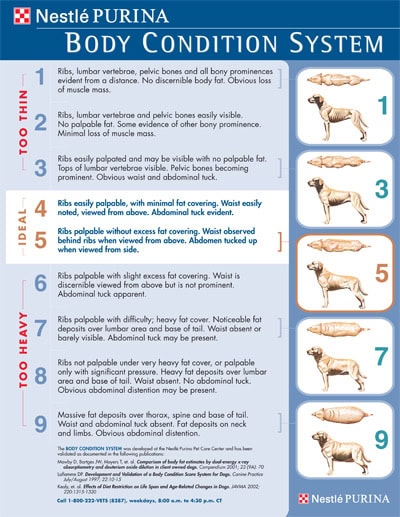
BCS evaluates how much fat your dog has by looking at and feeling his or her body. Most veterinarians use a 9-point scale where a 4 or 5 out of 9 is an ideal weight, a 1 out of 9 is severely underweight, and a 9 out of 9 is severely obese.
BCS is such a great tool because it applies to all dogs, regardless of size or breed. For example, if you had two 30-pound dogs standing next to each other, that number on the scale doesn’t tell you if they are a healthy weight. But if you knew one had a BCS of 4 out of 9 and the other was a 7 out of 9, you would know which one needed to lose weight (the 7/9) and which one didn’t (the 4/9).
To find your dog’s body condition score (BCS), follow these steps:
1. Find a dog body condition scoring guide
Use a veterinary BCS guide to help you determine your dog’s score. My favorite is the Purina BCS chart (see below). The words and images will help guide you as you score your dog. Plus, Purina now has a dog 3D body condition score tool that gives you a rotating image of a dog with each BCS from the top and side.
2. Feel your dog’s ribs
To get started, place your hands on each side of your dog’s rib and gently rub down his or her sides. If you easily feel each rib beneath a thin layer of fat, your dog is likely an ideal weight. Very prominent ribs mean your dog might be too thin. And if you must press firmly to find the ribs through a thick layer of fat, your dog might be overweight.
3. Find your dog’s waist
Have your dog stand, and then position yourself so you have a birds-eye-view of your dog’s back. He or she should have a noticeable waist that narrows behind the ribs and widens again at the hips. If your dog appears oval or barrel-shaped from above, he or she is likely overweight.
4. Look for an abdominal tuck
Now, with your dog still standing, look at your dog from the side. Your dog’s abdomen should tuck upward behind the ribcage, creating a gentle uphill slope toward the back legs. If his or her belly hangs level with the chest or sags downward (and there is no tuck), your dog might be overweight.
5. Check for fat deposits
Check your dog for fat deposits in certain areas of the body. One of the easiest spots to evaluate is the back at the base of the tail. If there is a “bubble” of fat there, your dog might be overweight. Other places to examine for extra padding include the neck, shoulders, chest, and lower back.
6. Put it all together
Use the information you’ve gathered from looking at and feeling your dog in combination with your BCS chart to determine your dog’s body condition score. Remember, a score of 4 or 5 is ideal, 6 and above is overweight, and 3 and below is underweight.
If you are feeling unsure about the number you got, you can also ask your veterinarian to review BCS scoring with you during your dog’s next appointment. It might feel hard at first. But once you know what a healthy body condition looks and feels like, you’ll be better equipped to monitor your dog’s weight and catch small changes.
Tip #3: Weigh your dog often
While body condition score is one of the best ways to tell if your dog is overweight, monitoring your dog’s weight loss with a scale is also important. Knowing your dog’s starting weight and watching how the numbers change will give you a clear way to measure your dog’s progress.
Routine weight checks are important because they help ensure your dog is losing weight at a safe, healthy pace. Ideally, a dog would lose about 1-2% of his or her body weight each week. Losing weight too quickly can lead to health problems and muscle loss, while losing weight too slowly may mean it’s time to adjust your dog’s diet or exercise routine.
If you don’t have a scale at home or your dog is too big for your scale, ask your veterinarian if you can periodically stop by for a quick weight check. Many veterinary hospitals are happy to let clients use their scale during business hours, and some offer this service free of charge without requiring an appointment. (Tip: It’s a good idea to call ahead and ask about your vet’s policy before showing up with your dog.)
Keep a record of your dog’s weight in your phone, a notebook, or a pet health app. Watching the numbers gradually move in the right direction can be encouraging and will help you and your veterinarian determine whether your dog’s weight-loss plan is working.
Tip #4: Find non-food ways to bond with your dog
Many of us naturally express affection through food. We offer treats, table scraps, or “just one more bite” because it feels like a simple way to make our dogs happy.
And that’s okay…sometimes. Treats absolutely have a place when bonding with or training your dog. The key is being intentional about them, especially during a weight-loss journey.
One of the most helpful mindset shifts is realizing that food isn’t the only way to bond with your dog. Dogs value your attention and presence just as much as they value treats. Replacing some of those food rewards with other forms of connection like a walk, a game of fetch, a petting session, or simply sitting together on the couch can strengthen your bond while also supporting your dog’s health goals.
Tip #5: Determine how many calories your dog needs
One of the most effective ways to help your dog lose weight is to know how many calories he or she should be eating each day and then stay within that number.
Your veterinarian can calculate your dog’s daily calorie needs based on factors such as his or her ideal body weight, age, activity level, and spay/neuter status. Or, you can also use an online calorie calculator, such as the Merck Veterinary Manual’s calorie calculator, to figure out how many calories your dog needs.
Note: Using a calorie calculator at home will require you to determine your dog’s body condition score and have a reasonable estimate of his or her ideal weight. If you need help, please ask your veterinarian.
Once you know your dog’s daily calorie goal, you (or your veterinarian) can use the calorie information on your dog’s food bag or food can label to determine how much of your dog’s food you should feed him or her each day. Because the calorie count per cup or can differs from food to food, knowing how much of that particular food to give your dog to reach your goals is going to be much more effective than just sort of giving your dog “less food” and hoping it works.
Don’t forget about other sources of calories
Dog food isn’t the only source of calories you need to keep track of! Don’t forget to include everything your dog eats—treats, table scraps, bones, dental chews, food used during training, etc. Those extra calories should be deducted your dog’s total calorie allotment for the day when determining how much food to feed your dog.
For simplicity, use this equation: Total allowed calories per day = calories from dog food + calories from other sources (which should be less than 10% of the total calories).
Note: Online calculators provide estimates. If your dog is losing weight too fast, consult your veterinarian to re-evaluate. Or if your dog isn’t losing weight fast enough, evaluate the diet plan to determine what to adjust.
Tip # 6: Use a measuring cup instead of eyeballing it
When I ask dog parents how much dog food they feed, I often hear, “I just eyeball it.” While that may work for some dogs, it’s not ideal if you are trying to get your dog to lose weight.
Even small differences in portion size can add up over time. A little bonus kibble at each meal may not seem like much, but those extra calories can make it difficult for your dog to lose weight (or even cause him or her to gain more). This is especially true for small and senior dogs, who can struggle to maintain an ideal weight.
Thus, instead of guessing, use a measuring cup to ensure you feed your dog the exact amount of food you calculated and keep portion sizes consistent.
Tip #7: Consider feeding your dog a weight loss food
If your dog needs to lose weight, consider a weight-loss dog kibble. These diets are specially formulated to provide fewer calories per cup or can while still supplying all the essential nutrients your dog needs. Many are also higher in protein to help preserve muscle mass during weight loss and higher in fiber to help your dog feel fuller between meals. These weight-loss diets are available both over the counter and by prescription.
Note: When changing your dog’s food, remember to transition to the new food gradually over 5 to 10 days to help prevent stomach upset.
Tip #8: Skip the table scraps
Sharing food with your dog can be tempting—especially when he or she gives you those irresistible puppy-dog eyes. However, table scraps are often much higher in calories, fat, and salt than your dog needs. Just like treats, even small bites of table scraps here and there can add up quickly and slow your dog’s weight-loss progress. Plus, there is the added challenge of knowing how many calories are in each piece of food you give your dog.
For all these reasons, if you want to share food with your dog, consider offering healthy, low-calorie options like safe fruits and veggies instead. (More on this soon.)
Tip # 9: Reduce the overall number of treats you give your dog
Treats are often one of the biggest hidden sources of calories in a dog’s diet. While they may seem small on their own, they can quickly add up, making it difficult for your dog to lose weight.
As a general rule, treats should make up no more than 10% of your dog’s daily calorie intake. However, if your dog is trying to lose weight, you may need to limit treats even further.
This might mean cutting down on the overall number of treats and/or breaking larger treats into smaller pieces. Your dog will still appreciate the reward, even if it’s only a tiny bite.
It’s important to remember too that “treats” are more than just dog biscuits. As mentioned earlier, dental chews, training treats, bully sticks, peanut butter, table scraps, and the contents of food puzzles all contain calories. Thus, you should include them in your dog’s daily calorie budget.
Tip #10: Choose healthy treats
If you feel the need to still give your dog treats, that’s okay. Helping your dog lose weight doesn’t mean treats have to disappear altogether. But treats should be chosen wisely.
One option is to set aside a portion of your dog’s daily kibble allotment to use as treats throughout the day. This allows you to reward your dog as you wish without adding extra calories.
The other option is to use healthy, low-calorie treats, such as:
- Carrots: Serve steamed, boiled, or raw
- Green beans: Boil, steam, or chop plain green beans for your dog
- Cucumbers: Slice raw cucumbers for a hydrating treat
- Zucchini: Dogs may eat zucchini raw or steamed
- Small amounts of other dog-safe vegetables or fruits dogs can eat
- Special low-calorie healthy dog treats
Note: Some of these veggies like carrots or cucumber could potentially pose a choking risk when raw. Cut them into appropriately-sized pieces for your dog and supervise him or her closely. Also, feed these fruits and veggies in moderation to avoid GI upset.
If your dog finds these treats “boring,” you can try freezing the vegetables or putting them into a food puzzle or toy. This also provides great enrichment.
Give green beans the green light
Green beans deserve their own section in this article because they’re one of my favorite foods to recommend for dogs trying to lose weight.
Dog parents may understandably worry that reducing their dog’s food will leave him or her feeling hungry. Green beans can help with that! Instead of feeding a hungry dog extra kibble (or their regular meal), supplement with salt-free green beans. Green beans are not only low in calories but, because of their high fiber and water content, also very filling for dogs. This makes them the perfect way to help ensure your dog feels full without significantly increasing his or her calorie intake.
Also, dogs love green beans! Many dogs enjoy their crunchy texture, whether they’re served fresh, frozen, or plain canned. This makes them a perfect treat or snack for dogs as well. Finally, if your dog takes medication and needs it disguised in a treat, I like using green beans because I can split the pods in half and replace the beans inside with the pill.
Note: Ensure you are giving your dog green beans without added salt, butter, oil, or seasonings. Plain green beans are the safest option for dogs.
Tip #11: Take your dog on a walk daily
Diet plays the biggest role in weight loss. But regular exercise is an important, natural way to help your dog become healthier too. A daily walk is one of the best ways to support your dog’s weight-loss journey. Walking burns calories, strengthens muscles, improves heart health, and provides valuable mental stimulation.
Just like strength training in humans, it’s important to gradually build up your dog’s strength and stamina. If your dog isn’t used to regular exercise, start slowly. Begin with a 10-15 minute walk each day. As your dog’s fitness improves, gradually increase the length, distance, or speed of your walks.
Keep in mind that overweight dogs, especially those who are seniors, have arthritis, or have other medical conditions, may tire more easily. Watch your dog’s body language, take breaks when needed, and avoid exercising during the hottest part of the day.
Tip #12: Find other fun ways to exercise your dog
In addition to walking, there are other ways to get your dog moving and burning calories. The more physical activity your dog has throughout the day, the better.
Fun activities to do with your dog include:
- Playing fetch
- Swimming
- Playing tug-of-war
- Agility
- Obstacle courses
- Nose work or scent games
- Training sessions
- Playing with other friendly dogs
Remember, exercise should always be enjoyable. The goal isn’t to exhaust your dog but to build healthy habits that you both want to continue.
Doggie daycare can help keep your dog active while you are at work
If your dog enjoys socializing with other dogs, doggie daycare can be a great way to encourage him or her to move. At doggie daycare, many dogs spend much of the day walking, playing, and exploring. This allows them to burn far more calories than they would lounging at home. Just be sure that the doggie daycare knows to stick to your dog’s diet.
Tip #13: Get the whole family on board
One of the biggest obstacles to successful weight loss for your dog is consistency throughout the home. If one person is carefully measuring meals while another is sneaking scraps under the table, your dog’s weight loss can quickly get off track. To help keep that from happening:
- Make sure everyone in the home knows the weight-loss plan and exactly how much food and how many treats your dog should receive each day.
- Try posting your dog’s feeding schedule on the refrigerator with checkboxes to ensure your dog is never double-fed.
- If multiple people enjoy giving treats, place your dog’s daily treat allowance into a small container each morning. Once the container is empty, your dog has had all of his or her treats for the day.
- Encourage kids, significant others, or friends to join you for your dog’s walks or play sessions. This can make the activities more enjoyable and help you stay motivated.
When everyone works together, your dog has a much better chance of reaching and maintaining a healthy weight.
Small steps, big paw-sibilities
Remember, successful weight loss doesn’t happen overnight. Aim for slow, steady progress and celebrate small victories. Don’t get discouraged if your dog falters or plateaus along the way.
Helping your dog lose weight isn’t about achieving a certain number on the scale. It’s about giving him or her the healthiest, happiest life possible. While changing your dog’s diet, limiting treats, and adding more exercise may take time and consistency, the reward of seeing your dog feel better is worth it.
You and your dog can do it!
What has be helpful in your dog’s weight loss journey?
Please share tips below.

