Can dogs have Tums® for an upset stomach? The short answer is no. Tums aren’t likely to help as much as many other options, and they might make things worse. Integrative veterinarian Dr. Julie Buzby explains why Tums aren’t a good idea for GI upset in dogs, what veterinarians do sometimes use Tums for, and eight things you can do instead of giving your dog Tums.

When your dog has an upset stomach, you naturally want to do everything you can to help him or her feel better. This may lead pet owners to wonder if they can use something they already have at home—Tums®, for example—to help give their dog some relief.
However, while Tums might do the trick for your tummy ache, they are far from the best choice for your dog.
What are Tums?
Tums® are an over-the-counter antacid for humans that contain calcium carbonate as the active ingredient. They work by neutralizing stomach acid that is already present in the stomach. This is different from some other types of antacids, like famotidine (Pepcid®) or omeprazole (Prilosec®), that prevent acid secretion in the stomach.
Can dogs have Tums for an upset stomach? No
Despite the fact that Tums can provide relief for people with problems like acid reflux and sour stomach, you should not give them to your dog to treat an upset stomach for several reasons. Let’s discuss each one.
1. There are many better options than Tums for dogs with GI upset
One of the biggest reasons not to give Tums to a dog with an upset stomach is that they aren’t as safe and effective as many other at-home or veterinary treatments. Dogs’ digestive systems vary a bit from those of humans. They have a more acidic stomach (lower pH), and it takes less time for food to move through the digestive tract. These differences may make Tums less effective for dogs than humans.
As you will learn later, other solutions like bland or low-fat diets, antacids that block acid secretion rather than neutralize existing acid, probiotics, and other options have a much better chance of helping your pup feel better than Tums does.
2. Sugar-free Tums may contain sugar substitutes that can make your dog sick
Dogs should definitely not have sugar-free Tums, but maybe not for the reason you are thinking of. Contrary to what you may read online, most sugar-free Tums and the generic equivalents don’t currently contain the sugar substitute xylitol, which is toxic to dogs.
Note: The inactive ingredients may vary between manufacturers. Thus, while not likely, it could be possible to accidentally give your dog a version of sugar-free Tums that is made with xylitol (sometimes listed on the label as birch sugar, wood sugar, or birch bark extract). This could be dangerous or even fatal.
While less dangerous than xylitol, the artificial sweeteners in sugar-free Tums can still be problematic. For example, sorbitol, the sugar substitute in some sugar-free Tums, can lead to diarrhea in dogs when consumed in large quantities.

3. Dogs with GI upset may need to see the vet, not take a Tums
Sometimes, a touch of vomiting or diarrhea will clear up on its own. But GI issues can also be a sign of a bigger problem that needs veterinary care. Tums aren’t going to be helpful for GI obstructions, pancreatitis in dogs, hemorrhagic gastroenteritis (HGE in dogs), and systemic diseases like kidney disease or liver disease in dogs.
The longer you try to treat your dog with Tums before heading to the vet, the longer it is before your dog gets the care he or she needs.
4. Long-term use of Tums may lead to elevated blood calcium
The high levels of calcium carbonate in an occasional Tums aren’t likely to be a problem for most dogs. (For example, if you gave your dog a Tums or two without realizing it wasn’t a good idea.)
However, long-term use of Tums in dogs could cause elevated blood calcium (hypercalcemia in dogs). Left unchecked, hypercalcemia can lead to kidney damage, cause increased stomach acid production and GI upset, and interfere with muscle function. Thankfully, elevated calcium levels should resolve when the dog stops taking Tums.
Can dogs take Tums for other conditions?
While not useful for GI upset, vets may recommend Tums for a few other conditions.
Tums as a treatment for hypocalcemia (low blood calcium) in dogs
Tums are a good source of calcium for dogs suffering from hypocalcemia (low blood calcium).
Female dogs who are nursing a large litter or who did not receive the correct amount of dietary calcium during pregnancy may develop dangerously low blood calcium levels. This condition is commonly called eclampsia in dogs. After stabilizing the dog with IV calcium, the vet might send her home on Tums as a continued source of calcium.
Note: Do not give Tums to your pregnant dog unless your vet instructs you to do so. Calcium supplementation during late pregnancy can actually make a dog more likely to develop eclampsia.

The vet may also include Tums as part of the treatment plan for dogs with hypocalcemia due to primary hypoparathyroidism. In hypoparathyroidism, the dog has decreased levels of PTH, a hormone that ensures calcium levels are high enough. The calcium in Tums can help affected dogs maintain adequate calcium levels (along with other treatments).
Tums for dogs with kidney failure
Sometimes, kidney failure in dogs can lead to elevated blood phosphorus levels. While not typically the first-line treatment, vets do sometimes use Tums to help lower phosphorus levels in these dogs. (Calcium and phosphorus regulation are interconnected.)
However, Tums don’t tend to work as well as other phosphorus binders. And if the dog develops hypercalcemia, use of Tums can contribute to mineralization of organs.
What if my dog gets into a bottle of Tums?
Dogs seem to like Tums, so there may be situations in which a dog accidentally gets into a bottle of Tums and eats a large number of them. If that happens, the safest thing to do is call your vet or an animal poison control center for advice (a fee may apply).
Be prepared to tell the vet or toxicologist:
- The type of Tums (e.g., Tums Extra Strength Assorted Fruit 750 mg calcium carbonate per tablet)
- Approximately how many you think your dog ate
- Any medications your dog is taking (Tums can interfere with other medications)
- If your dog has underlying health problems
- Your dog’s approximate weight
Also check the label for xylitol (might be listed as birch sugar, wood sugar, birch bark extract, and various other names). Based on current information, most sugar-free Tums don’t contain xylitol. But in the event that your dog did ingest a product containing xylitol, make an emergency vet visit immediately. Xylitol toxicity in dogs can be fatal.
Possible effects of eating a large quantity of Tums
The vet or toxicologist will address the specifics of your dog’s situation. Generally speaking, the calcium in Tums is poorly absorbed from the GI tract. Healthy dogs might develop short-lived hypercalcemia (high blood calcium), but as long as the kidneys are working normally, the blood calcium typically normalizes within about 24 hours. Diarrhea or constipation in dogs is possible, and the dog may have chalky white stools as a side effect if he or she ate a lot of Tums.
However, this doesn’t make ingesting a bottle of Tums safe for dogs in all cases. Thus, rather than assuming everything will be fine, please contact your vet or a toxicologist if your dog eats Tums.
Also, keep in mind that even if the Tums themselves don’t end up being a problem for your dog, if he or she swallowed any parts of the bottle, that could cause a GI obstruction.
What can I do for my dog instead of giving Tums?
If your dog seems uncomfortable due to vomiting, diarrhea, or acid reflux in dogs, these eight solutions may work better than Tums.

1. Decide if your dog needs to go to the vet
Before you start pursuing any home remedies for your dog’s GI upset, evaluate how your dog is feeling. A vet visit may be in order if you notice these signs:
- Vomiting frequently, vomiting for more than a day or two, or bloody vomit
- Dog diarrhea with blood in it, diarrhea that lasts multiple days, or large volumes of diarrhea
- Being a lethargic dog (laying around, not being interested in interacting or playing, weak)
- Having a hunched appearance or holding a play-bow position (indicators of abdominal pain)
- Poor appetite that lasts for more than a few meals
- Sunken eyes or dry gums (signs of dehydration in dogs)
- No improvement or worsening of the condition after trying home remedies
If you are worried about your dog, it is best to check in with the vet. He or she can give you some ideas to try at home or get your dog scheduled for an appointment.
2. Feed your dog a bland diet
Feeding a bland diet for dogs is a great way to address mild diarrhea or vomiting. These sorts of diets are designed to be easy to digest and gentle on the stomach.
One option is to use cooked chicken (with no salt, seasoning, or marinade) and plain white rice. Give your dog small amounts at first. Then slowly increase how much you offer him or her to make sure that your dog’s stomach can handle it.
Alternatively, you may be able to pick up a few cans of a prescription bland diet from your vet.
3. Consider keeping your dog on a low-fat diet
Sometimes it can be helpful to put your dog on a low-fat veterinary prescription diet. This could be a short-term measure to get through an acute episode of GI problems. Or the vet may recommend keeping your dog on a low-fat diet long term to prevent future issues.
Lowering dietary fat is helpful because diets that are higher in fat are harder to digest and lead to slower stomach emptying in dogs. This can increase the chances of acid reflux and generalized GI discomfort. Plus, high-fat diets may predispose dogs to pancreatitis.
Note: If your dog is already on a prescription diet or strict diet plan, do not make any changes without consulting your veterinarian first. And remember to transition your dog to a new diet slowly to decrease the chances of GI upset.
4. Feed your dog smaller meals more frequently
Feeding smaller meals throughout the day can also be helpful for dogs with acid reflux and other GI issues. Since there is less food in the stomach at a given time, it is easier for the dog to move the food through the stomach. This, in turn, may decrease GI discomfort or the chances of acid reflux.
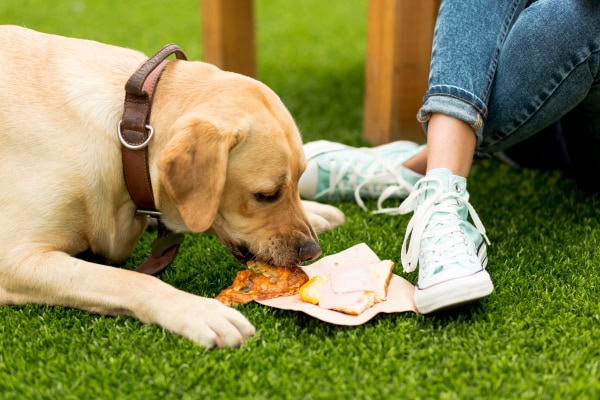
5. Avoid giving your dog table scraps
While it can be hard to resist those pleading eyes, it is best to avoid table scraps and stick to feeding your dog his or her regular food or a bland or low-fat diet. Table scraps may be high in fat, which can worsen existing acid reflux or predispose the dog to pancreatitis. And spicy or acidic foods may trigger acid reflux, too.
6. Ask your vet if your dog would benefit from an acid reducer
Rather than reaching for the Tums, consider asking your vet if your dog could benefit from a medication that reduces stomach acid secretion. Two popular options are famotidine for dogs and omeprazole for dogs. These antacids work at the level of the acid-secreting cells in the stomach. They decrease GI acidity by blocking the release of stomach acid, making them much more effective than Tums.
Note: Both of these medications are available over the counter. However, you should consult your vet before trying them because they aren’t right for every dog and every situation.
7. Improve your dog’s gut health with probiotics and prebiotics
Probiotics for dogs are beneficial for pups who are currently experiencing a GI problem or are prone to digestive difficulties. They help repopulate the gut with good bacteria and protect against overgrowth of harmful bacteria. Plus, probiotics can support the immune system, help with weight management, and even reduce anxiety.
Ideally, you would use a probiotic supplement made for dogs. However, in a pinch, plain low-fat yogurt (regular or Greek) can provide some probiotics until you can get an actual probiotic supplement. When giving your dog yogurt, it is important to avoid sugar-free varieties (which may contain xylitol) or full-fat, sweetened, or flavored yogurts. And only give your dog a small amount. Be warned, too, that some dogs can’t digest the lactose in yogurt, which could lead to further GI upset.
It can also be helpful to provide prebiotics for your dog. These are the “food” for the good bacteria in the gut. Plain canned pumpkin for dogs is a great source of prebiotic fiber as well as vitamins and minerals. However, do not give your dog pumpkin pie filling as it may contain sugar, spices, or xylitol, which are harmful to dogs.
8. Ensure your dog has adequate water
Water plays an important role in digestion. If your dog is dehydrated, his or her GI system may not be functioning optimally. This can lead to constipation or other issues. Thus, ensuring your dog has access to fresh, clean water and encouraging him or her to drink is great for decreasing the risk of GI issues.
Skip the Tums
While Tums are useful for some conditions in dogs (namely, low calcium and high phosphorus), they aren’t the right choice for dogs with GI problems. If you think your dog looks like he or she needs a Tums, consider giving your vet a call instead. He or she can advise you about whether home remedies or a veterinary visit will be the next best step in getting your dog’s tummy back to normal.
How do you help your dog feel better when he or she has an upset stomach?
Please comment below.