If your dog has a cruciate ligament rupture or partial tear, you may be wondering about treatment options. Dr. Susan Davis—internationally recognized author, physical therapist for animals, and friend of Dr. Julie Buzby—shares from her decades of experience how you can support, advocate, and make the right treatment decision for your senior dog.

Without a doubt, ruptures of the cranial cruciate ligament account for the majority of my physical therapy caseload at any given point in time. Why are there so many?
My theory involves the indoor lifestyle we shifted our companion pets, particularly dogs, toward, the past four decades. Add to that, more human work hours, less time for the owner to take their dog on leash walks, plus a shift from the use of indoor carpeting to smooth, hardwood, and tile flooring.
Back in the 1930s to 1970s, most dogs lived outdoors and spent their time on grass and dirt, not jumping on and off furniture onto slippery surfaces. Cruciate ligament tears were rare. Fast forward to the present day. Most dog owners are acutely aware of the cruciate ligament, though they may know it as the “ACL.”
What is the cranial cruciate ligament in dogs?
The equivalent to the human being’s anterior cruciate ligament (ACL) is the dog cranial cruciate ligament (CCL). It is a band of fibrous tissue located in the dog’s hind legs at the knee (stifle) joint. The ligament provides inner crossover stability to prevent forward slippage of the shinbone (front of the tibia), relative to the long thigh bone (femur).
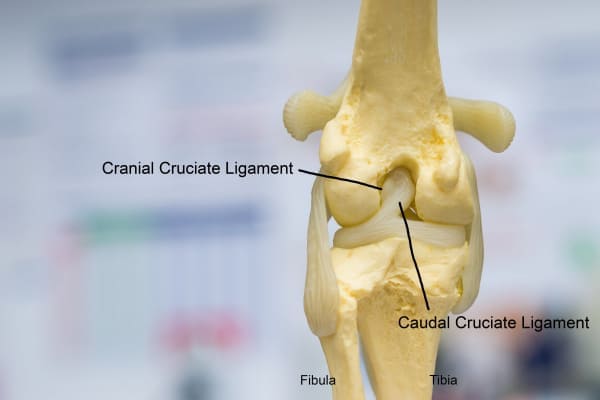
Though we have this ligament in common with our canine companions, theirs ruptures much differently than ours. The upright, two-legged human gait is less susceptible to ACL ruptures with normal activity. A person’s ACL ruptures swiftly and completely from trauma and sports-related injuries.
The dog’s CCL is subjected to different biomechanical forces in their down-on-all-fours gait along with a slightly different shape and angle of the tibial plateau. Running, turning, and sliding on slippery surfaces cause gradual wear and tear of the dog’s CCL. It begins to stretch, tear, and slowly degrade. Sometimes it tears fully, called a rupture. Other times it tears only partially. In both cases, compromised stifle joint stability leads to injury to the meniscus (the cartilage shock absorber) and arthritis.
What are the signs of a cranial cruciate ligament tear in dogs?
The first outward sign of cranial cruciate ligament damage is lameness. The dog may either hold the limb up completely or put only partial weight on it. We call this toe-touching. The dog begins to shift its weight onto the other hind limb. That is why a dog with a ruptured CCL has a 25 to 50% chance of tearing the other hind leg’s CCL within 12 to 16 months!
The key to recovery from the rupture (and prevention of the other side tearing) is rapid timing of diagnosis and intervention. Getting started right away promotes early healing, can help prevent full rupture, and reduces the risk of the opposite side tearing.
How is a cranial cruciate ligament tear diagnosed and treated?
Early diagnosis of CCL tear is imperative to your dog’s future health. If your dog is limping or holding up a limb, do not delay in making a veterinary appointment.
Diagnosis of CCL rupture happens through observation, the performance of a drawer test, a radiograph (X-ray), or sometimes an MRI. The drawer test involves the veterinarian or physical therapist placing their hands around the dog’s stifle joint, using a gliding motion used to test the “tightness” of the ligament. A ‘positive drawer’ or ‘cranial drawer sign’ means the ligament is too loose and ruptured (completely torn) or has merely a partial tear.
If your dog has a ruptured CCL, surgical correction followed by rehabilitation is the best form of treatment. On the other hand, your dog might not need surgery if the CCL is partially torn. Partial tearing of the cruciate ligament presents various treatment options.
It’s important to weigh the pros and cons of surgery in terms of a dog’s size, health status, activity level, and lifestyle. Surgery requires recovery of at least 12 to 16 weeks. Smaller (less than 22 pounds) and leaner dogs tend to manage better without surgery than their larger or overweight friends do. If your dog has a partial cruciate ligament rupture but is standing and walking on the limb, non-surgical treatment options may be reasonable.
11 non-surgical treatments for dogs with partial cruciate ligament ruptures
Here are 11 non-surgical treatments for dogs with partial CCL tears and also dogs with a full cruciate rupture that cannot have surgery for reasons such as advanced age, medical risk of undergoing anesthesia, bleeding disorder, seizures, or financial constraints.
1. Rest and activity restriction
For the next six weeks, plan to reduce the length and intensity of walks and possibly crate or confine your dog several hours per day to allow for healing. Playing or rough housing with other dogs is off limits for a few weeks. Your veterinarian will help you understand what degree of exercise restriction is right for your dog.
2. Medications
Your veterinarian may prescribe anti-inflammatory and pain medications.
3. Ideal body weight
Ask your vet or physical therapist to assess your dog’s body weight compared to normative values for the same age and breed. This is called the body condition score. Check to see if a ‘waistline’ is visible while standing over your dog, looking down at their body shape, and feel if the ribs are easy to find or if a heavy layer of fat makes it difficult to feel them. If your dog is overweight, start a weight loss plan right away. An obese or overweight dog is predisposed to a cruciate ligament rupture or tear.
Get started now discovering your dog’s canine body condition score.
4. Healthy diet and supplements
Keep your dog’s diet lean: provide healthy treats, plenty of hydration, and supplements for anti-oxidant control of inflammation. Ask your veterinarian whether additional senior dog supplements for cartilage support or omega-3 fatty acids for joint inflammation may be helpful.
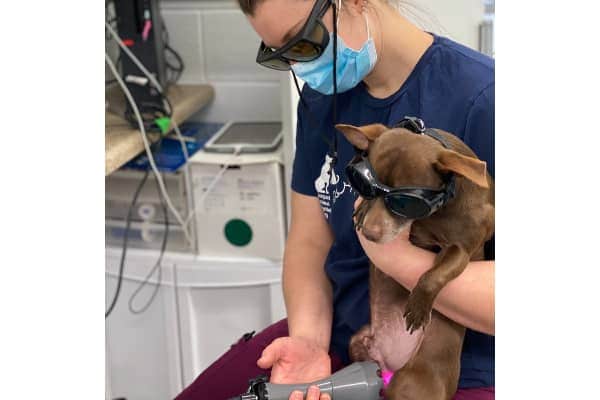
5. Physical therapy using cold laser for 6 to 12 sessions
A common question I hear is, “Will cold laser help grow a new ligament or reattach the torn ligament?” Unfortunately, the answer is no.
Cold laser therapy for dogs will not regenerate a new ligament or reattach the torn portion of the ligament. But it should help reduce joint inflammation, swelling, and pain. It may also help in the process of scar tissue formation as the body tries to stabilize the joint.
6. Electrical stimulation
Electrical stimulation uses various forms of electrical current delivered through lead wires which are attached to sticky electrodes placed over the stifle joint and thigh. This treatment helps blood rush in and nourish the ligament and surrounding anatomical structures, relieves inflammation, reduces pain, and assists weakened muscles to contract and strengthen.
7. Massage
Using the palm of your hands in a flat position, massage the sides, front, and back of the dog’s knee in circular directions with light to medium pressure.
8. Passive range of motion exercises in dogs
Gently bend and straighten the stifle (knee) and hock (ankle) joints, using your hands, and do not go beyond the scope of natural movement currently available.
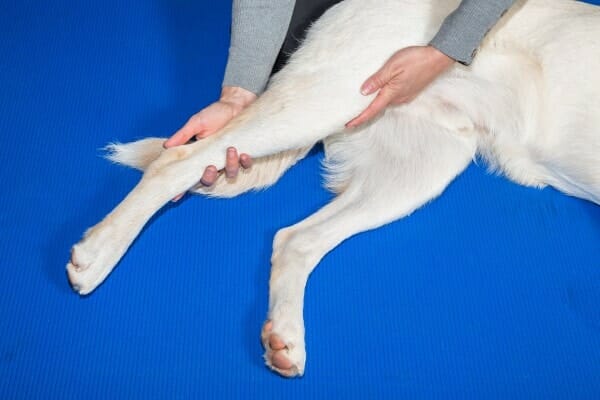
Learn more about passive range of motion exercises for senior dogs.
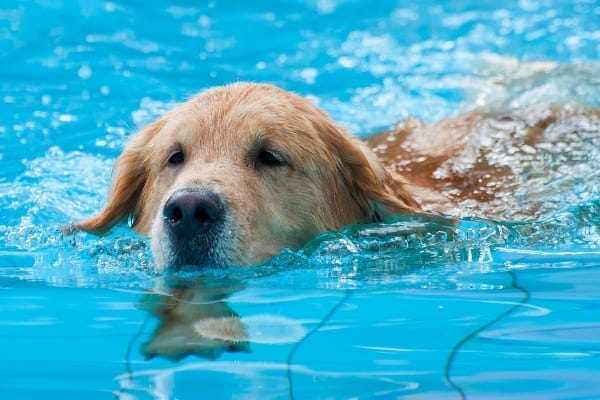
9. Underwater treadmill
Underwater treadmill or swimming water therapy provides a safe buoyant medium to strengthen the limb while undergoing restriction of normal walking activity.
10. Braces
External stability provided by a brace or soft support helps speed the healing process and supports the joint during activity. Dog CCL braces are an alternative to surgery in many cases though inferior to surgery for a complete rupture of the CCL.
Braces are available in prefabricated or custom forms. Custom braces require casting the dog’s hind limb and sending the removed cast to a certified orthotist for precise molding of a brace specific to your dog. Custom braces are more expensive than prefabricated types but provide superior support.
11. Regenerative medicine
Stem cell transplant injections and platelet-rich plasma (PRP) injections are emerging as alternative treatments for non-surgical management of partial cruciate ligament ruptures in dogs. However, they are invasive, expensive, and lacking firm evidence of long-term outcomes on ligament healing. Stay tuned as more research is performed.
Back on the move in no time
If your senior dog is hobbling around, the first course of action is to pay a visit to your veterinarian. Then, diagnosis in hand, you can consider all your options both surgical and non-surgical. Ask as many questions as you need to and never forget you are your dog’s advocate and voice.
With the expert care of your veterinarian and support from your dog-loving friends and family, your senior dog will be back on the move in no time.

Has your dog had a cruciate ligament rupture?
Share your experience so we can learn together what worked and helped your canine companion the most!


My 9 year old 13 lb. Poodle/chihuahua has a fully torn ACL according to vet. I took her the second day after she came back from outside with right back leg limping. He suggested rest/anti inflammatories to try. Other option is surgery.
He did say she will get arthritis. I would like to avoid surgery if possible but don’t want to risk more damage if the rest does not work. So what does that mean for her if surgery is not done? Will she be able to walk normally and without pain? Thank you
Hi Karen,
I am sorry your little pup has injured her knee. It is possible for some dogs to make a full recovery without surgery, but this usually involves pretty intensive physical therapy for several months. The main goal is to reduce inflammation and pain and allow the body to put scar tissue around the joint to help keep it stabilized. Of course, the joint will never be completely normal again, but some dogs are able to obtain close to normal mobility. You may want to ask for a consultation with the surgeon just so you have all the details and know what options are available. I will attach links to other articles with more information. Hoping you can get the answers you need to find a clear path forward. Best wishes to you and your sweet girl.
1. Dog Torn ACL Treatment Without Surgery: A Rehab Vet’s Approach
2. TPLO Surgery for Dogs with a Torn Cruciate Ligament
3. Torn ACL in Dogs: Signs, Symptoms, Surgery Options
4. A Veterinarian Answers Your TPLO Recovery FAQs
One day after a walk, My 3 1/2 year old 16 pound JRT X began to “sloppy sit”. He was also reluctant to sit, climb stairs, or jump on the couch. In addition, he was having great difficulty rising from a laying position. He never exhibited a limp and was very eager to walk. The examining veterinarian suspected he had a partial CCL tear. His knee felt stable. Rest and meloxicam were recommended.
Three weeks later, when we returned to Canada from the US, we consulted with a rehab veterinarian. X-rays of the knees were obtained and a very small effusion was noted on the affected knee. A rehab plan was put in place, Including meloxicam, UC II, omega 3s, home exercises, laser therapy and assisi loop. He was not a fan of UWTM and it was aborted because his gait was so awkward.
We are now 12 weeks post injury. We have gradually increased leashed walks. On three separate occasions, we have experimented with discontinuing the meloxicam. He tends to go between 5 and 10 days acting normally, and then suffers a setback (The first time he developed a slight limp in his affected leg. It only lasted minutes. The second time he started to show some reluctance sitting again. And now, after being off pain medication for 9 days, he is showing lameness in the opposite shoulder.
Obviously, he is back on meloxicam and restricted activity once again until things settle down. I’m just wondering how long he can stay on pain medication? And, how do we gauge how hard to push him if he is on pain medication? My fear is that if his pain is controlled, he will soldier on we may exercise him more than we should.
Hi Jill,
I am sorry your boy is dealing with this ongoing issue with his knee. I am glad you have seen such great improvement with rehabilitation but understand your concern and frustration with these relapses. Without personally examining your boy, it is hard to make specific conclusions about his pain tolerance and offer advice on how far to push things. It is ok to use NSAIDs long term as long as liver and kidney values are being routinely monitored for changes. If your pup is not currently taking a good quality joint supplement, I would highly recommend you ask your vet about adding one to his treatment regimen. Hoping you can get the pain and inflammation under control and allow your boy to return to more normal function. Best wishes for continued healing and success. Keep up the good work.
I have an 11.5 year old bull terrier boxer mix and over the weekend my boy tore his CCL (maybe a partial tear the vet was rather vague). He is on gabapentin for a week as well as carprofen. He limps or sometimes hops on 3 legs, sometimes he walks with a bit of weight on his leg. He is able to go downstairs fine and actually can walk upstairs as well although we try to lift up his backend when he lets us. I lean towards conservative management and no surgery, #1 his age and #2, he is managing OK. He was a very active boy when he was younger but has slowed down the past year or two. I just hope he isn’t in too much pain when the medicine is over next week 🙁
Hi Erica,
I am sorry your senior guy has endured this difficult knee injury. From what you describe, it does sound like he could do well with medical management. I strongly recommend you consider rehabilitation and physical therapy to help with the recovery process. I will attach links to other articles with more information on medical management and surgical correction just so you can make a fully informed decision. Don’t hesitate to ask your vet for more pain medication if you think it is needed. You are your dog’s best advocate and know him better than anyone! Wishing you all the best of luck and praying for a positive outcome.
1. Dog Torn ACL Treatment Without Surgery: A Rehab Vet’s Approach
2. Torn ACL in Dogs: Signs, Symptoms, Surgery Options
3. Dog ACL Brace? Veterinarians Share Answers
4. TPLO Surgery for Dogs with a Torn Cruciate Ligament
Just want to say thank you for answering everyone.
My 8yr old pit bull *70lb* has a partial knee tear. Sometimes she keeps the leg completely off the ground and sometimes like on her walks she walks with both legs and pulls hard. I have mixed feeling the vet said sometimes surgery is the way to fix it and one bad knee can sometimes cause the other one to tear. Is it possible for a partial tear to heal without surgery?
Hi Stephen,
Thank you for the kind words. I understand your concern for your girl and think it is great you are searching for advice. Yes, it is definitely possible for a cruciate injury to heal without surgery. Now there is no 100% guarantee, but I have seen it in my own patients. Here is a link to another article with more information: Dog Torn ACL Treatment Without Surgery: A Rehab Vet’s Approach
Hoping you can find the answers you need to make the right decision for your pup. Praying for healing and wishing your sweet girl the best of luck for a full recovery.
What are your thoughts about prolotherapy for partial CCL tear?
Also, what type of activity restriction to you recommend?
Hi Julie,
Unfortunately, I do not have any personal experience using prolotherapy on my own patients. I do see how it could be beneficial for certain dogs that are trying to avoid surgery. As far as activity restriction, I focus on controlled slow leash walks once the majority of the inflammation and pain is under control. Also, stairs and jumping are a big NO. Here is a link to a recent article that discusses this topic more in depth: Dog Torn ACL Treatment Without Surgery: A Rehab Vet’s Approach
My 3 yo miniature boxer came in completely lame on left hind leg last month. it was visibly swollen 24 hrs later. The vet diagnosed a ccl rupture amd put him on pain meds. Next morning he was right as rain, full weight bearing, jumping up on hind legs, wanting to run full speed and play. We kept him leashed for a couple weeks. Weaned him off the pain meds and symptoms never returned. I took him to another ver where tplo surgery was scheduled and she said she wouldn’t feel comfortable putting him through surgery as well as he’s doing. Still no signs of any limp or favoring, perfect sit test, no signs of inflammation and completely off meds for almost 2 weeks now. This vet recommended I let him resume normal activity and said if it’s really torn, symptoms will return within a month. The ONLY thing we notice is when he’s playing frisbee, after running at full speed for a while he seems to hobble a bit on that leg just ever so slightly, and it seems to appear and disappear, not consistent. We only notice it because we are on high alert. It’s very subtle and he has no issue or hesitancy jumping in and out of the truck or stiffness/limping later in the day either. Does this sound like a ccl rupture or other soft tissue injury?
Hi Angela,
What a puzzling case! It is definitely odd that he had visible swelling and significant pain that then disappeared so rapidly and never returned. I agree that with that level of improvement, it makes sense not to go through with the TPLO surgery at this time. Without having examined him, I can’t really say with much degree of confidence what sort of injury he had. It could have been a small partial CCL tear or some other variety of ligament or muscle injury, but we may never know for sure. If you notice his subtle lameness after running for awhile starts to worsen, it may be worth trying to get an appointment with a veterinary orthopedic specialist. These doctors are amazing at figuring out some of these mystery lameness cases. Best of luck to you!
Wow! Same story here with my 1 year old golden retriever. She woke up in the morning and couldn’t bear any weight on her left hind leg. She yelped when getting on the sofa and walked around with a lame leg at the vet. X ray was taken (not the sedated special angle x ray) and orthopedic vet confirmed inflammation and partial tear. By 3pm I went to pick her up, she walked like nothing has happened. They said they didn’t give her anything and she was probably high on adrenaline due to the vet visit. Next morning she walks just fine. No favoring of her “good” leg. Even use the “bad” leg to go up and down on sofa. I indeed gave her Meloxicam in the morning so perhaps it is the drug. Now it has been 2 days and still no sign of any lameness. I follow the doctor’s order by limiting her exercise to leashed walk. She is her usual self – playing with leaves, sticks, and pulling the leash constantly. I am not sure if this is normal for partial tear of ACL.
Hi Seneca,
I am amazed your girl was able to return to normal function so quickly after her injury. While this is not typical it is possible the Meloxicam was able to reduce the inflammation enough to hide any other symptoms. Hoping the partial tear will not continue to progress to a full tear. Praying this is all in the past now and your girl can keep living her best life for years to come.
Hi Dr. Buzby,
Our 4 year old Yorkie mix (9 pounds) landed at a weird angle jumping off my lap in a hurry (to chase a bird) and cried out in pain the second she landed. It has been 9 days now, and she is still holding up her injured leg most of the time. She is still jumping up and down off the couch and I can touch her knee all over and she doesn’t flinch. We had X-rays done and the drawer test……one vet said it was a fully ruptured CCL and the second vet (looking at the same X-rays) said likely a “minor” tear. So, do we wait and see for another few weeks in case it heals, or go straight to TPLO to avoid arthritis? This is a dog that needs to be able to hop on and off beds and other furniture for the next 10+ years. Thanks!
Hi Lola,
I am sorry your little pup has injured her knee. Unfortunately, without examining your dog myself, it is hard to make specific recommendations. If she is completely non-weight bearing on the leg, then I would probably lean more towards surgery. I think your best bet is to talk to the surgeon or orthopedic specialist that would do the surgery and get their expert opinion. You may also want to schedule a consultation with a veterinary rehabilitation/physical therapy specialist. They can offer therapies and treatments to not only decrease pain and inflammation but also strengthen the weakened muscles and improve the use of your dog’s injured leg with or without surgery. How is your sweet girl doing today? Hoping things have improved and wishing you both the best of luck for many happy days ahead.
Our 14 1/2 year old Shihtzu Maltese has a complete CCL tear in his right leg and a partial in his left. The left occurred approximately six weeks ago, and as we were trying conservative therapy he developed a complete tear in the right last week. The surgeon is recommending surgery on both of his legs and we are unsure what to do. He is overweight, not very active in general. and is happy with a short walk every day. At this point however he is unable to walk at all and needs to be carried everywhere. Other than his weight (approximately 20 pounds) he is otherwise in generally good health, as we have just recently had bloodwork done on him with only a mild elevation in his kidney and liver values that the vet said he was not concerned about. We are unsure what to do. We are concerned about the recovery from this surgery, however with tears in both legs and an inability to walk at all right now, I am concerned that conservative therapy may not help him as he does not have a “good” leg to support him. If we do decide to go the surgery route, the doctor said he could do one at a time or perform both at the same time. Is this surgery something you would put a dog at his age through, and if so, would you have both legs done at once , or would you have the surgeries performed separately? Appreciate your thoughts.
Hi Margo,
I am so sorry your senior guy is dealing with knee issues in both rear legs! I know you are worried about the risks of anesthesia, but age alone is not a reason to avoid surgery. Here are two other articles with more information about this exact topic:
1. Is My Dog Too Old for Surgery?
2. Is My Dog Too Old For Anesthesia?
Since your dog is in so much pain and cannot walk on his own, I am not sure you have many options other than surgery. Without surgical correction of his injured knees, you may be facing decisions about his quality of life. If your dog was able to partially use one leg, then having one surgery at a time might be a good option. But because your boy cannot use either leg, it could benefit you to have them both done at the same time and shorten the recovery time. Without examining your dog, myself, it is hard to make specific recommendations. These are great questions for your vet or the surgeon who would perform the knee surgeries. I also highly recommend you get in touch with a veterinary rehabilitation professional. They could be extremely helpful prior to surgery and especially after. I hope you find the answers you need to make the best decision for you and your senior guy. Praying all goes smoothly and he is back to living his best live very soon!
my 7 year old make stafy has a partial c
ligament was considering surgery but he seems to be doing OK on jetamine infection monthly he’s walking on it even wants to run at times one vet advised against another said yes dint no what to do I don’t really want to put him through it if can cope without he’s 22k any advice plz
Hi Margaret,
I understand why you are concerned about this partial cruciate ligament tear in your pup. Without examining your boy, myself, it is hard to make specific conclusions and recommendations. I am glad he seems to be doing well with the monthly injections. If your dog is walking well, able to do his normal activities, and enjoying life, then it may be ok to forgo the surgery for now. Ultimately, you have to find a vet you trust and let them guide you through this process. Listen to your own instincts as you know your dog better than anyone. Wishing you and your sweet boy nothing but the best.
Hi. My 55 lb. GSD had TPLO back in 2017.. it’s a great surgery and she recovered fast. She’s now 12.5 and has a partial tear on the other leg., Her surgeon recommended we do another TPLO and a PRP “booster” at the same time because she has elbow dysplasia for which we did 3 rounds of PRP and it worked wonders. We also do PT twice a week just to keep her strong and limber, it includes massage, cold laser, dry needling, strength training and she swims once a week. She’s always been on a raw diet + supplements…. So she’s a very active and healthy girl and I want to do whatever is best for her and if that’s another TPLO I’ll do it, But I’m concerned about her age and how well she’ll recover, also if she’ll be depressed from the lack of activity she currently has even with the partial tear. Then I’m confused by what I read on non-surgical approach of building scar tissue, etc. would love your input.
Hi Keli,
I love all of the therapies and treatments you are currently utilizing to help keep your Shepherd girl going. She is lucky to have you taking such an active role in advocating for her health and well-being. There are many factors that have to be considered when deciding if a dog is a good surgical candidate. Age alone should not prevent you from pursuing another TPLO for your pup. Here is a link to another article with more information: Is My Dog Too Old for Surgery?
As for the non-surgical approach, there is much greater risk of advancing arthritis formation in the affected joint than if it is surgically corrected. The cruciate ligament is responsible for keeping the knee joint stabilized. Without an intact ligament, the body has to come up with another way to keep the joint from sliding around unnaturally. To do this, the body will attempt to fill the spaces around the joint with scar tissue. While this will help to stabilize things, it will also decrease the range of motion and cause permanent changes. I would suggest you talk to your vet or the surgeon who would perform the TPLO this time and get their expert opinion. They can let you know what would best benefit you and your senior girl. I am hopeful you will find the answers you need. Wising you the best and keep up the good work!
I have a 7 year old Labrador Retriever. He has always been a very athletic boy, running and frisbee catching at its best. which has probably led to his injury Im being told. In December 2022 he began limping after chasing our son on a snowmobile through deep snow. I took him to the vet for evaluation and they mentioned a CCL tear but didnt feel at that time that he had one and started pain meds and Anti-inflammatory. Five days later he was literally standing in the yard and yelped and immediately stopped using his leg. After an xray and exam under anesthesia, he was dx with a partial tear. At first I wanted to avoid surgery at all costs just because I hate seeing pets go through that so thus far we have tried meds and laser therapy with massage but he only seems partially better. It has been 6 weeks since the injury. So needless to say, we meet with a surgeon tomorrow 3/21 to discuss repair. My heart tells me that this will be the best way to get him as close to being able to do his things he loves. My understanding is Natural healing only creates scar tissue around th eligament which isnt strong and chances he will re-tear are high, where this should reinforce the ligament and give him a better outcome- I hope? He is in great shape and weight is perfect. Thoughts or reassurance Im making the right call for my boy? It stinks to see him not being able to go and be the active boy he is.
Hi Jennifer,
I am sorry your Lab has hurt his knee and you are having to make this difficult decision. I do usually prefer surgery for larger breed dogs. I just feel like they are able to return to more normal function after the surgical site has healed. There are many different surgical repair options for a torn cruciate ligament. Each procedure has its pros and cons and helps to stabilize the joint in a different way. The surgeon should tell you which procedure is best for your pup’s specific case. I think you will be very pleased with the outcome. Just don’t rush the recovery period and make sure you are doing the exercises and physical therapy at home that the surgeon recommends. Praying for smooth sailing and a full recovery for your sweet boy!