Hearing the phrase “gallbladder mucocele in dogs” as your sweet pup’s diagnosis may leave you feeling a bit unsure of what this means for him or her. Integrative veterinarian Dr. Julie Buzby explains the causes, symptoms, diagnosis, treatment, and outlook for a gallbladder mucocele in dogs. Armed with this information you will better be able to help and support your dog.
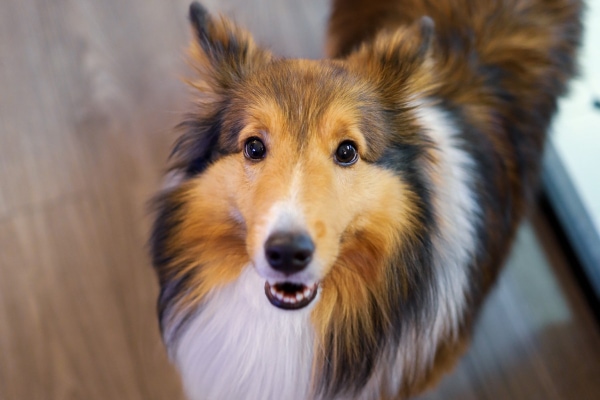
Bijou the Sheltie is notoriously a bit of a picky eater. He was one of the few puppies I’ve met that turned up his nose at the squeeze cheese I often offer to distract from vaccines. I mean, what dog doesn’t like bright orange processed goo? Bijou. That’s who. Over the last six years he’s occasionally skipped a meal here and there. His owner and I kept track of his dental health to make sure that wasn’t an issue, and we ran yearly bloodwork. He had always been the picture of health.
But then something changed. Bijou went from picky to downright not eating. He became lethargic. He started vomiting. His dad knew something was wrong, and brought him to me right away.
Bijou has always been a little standoffish with me—maybe he never forgave me for assuming he’d like squeeze cheese. But this time he barely acknowledged my existence. He let me do a full exam without much resistance, save for a little wince when I palpated his belly. Something was very not right.
Getting to the root of Bijou’s problem
Unfortunately in dogs, lethargy, vomiting, and inappetence are somewhat nonspecific. I couldn’t tell just by looking at him what was troubling Bijou, though I thought I could see a little yellow tinge in the white of his eyes. But maybe it was the lighting in the exam room. I knew we needed to do some diagnostics.
I started by taking X-rays. Maybe he’d eaten something he shouldn’t have? He wasn’t the most trustworthy dog when his dad was at work. X-rays looked clear—nothing was obviously wrong in his abdomen. We ran some bloodwork and that’s when my level of concern raised significantly. Bijou’s liver values were through the roof. Apparently, I wasn’t imagining the yellowing of his eyes—he really was jaundiced.
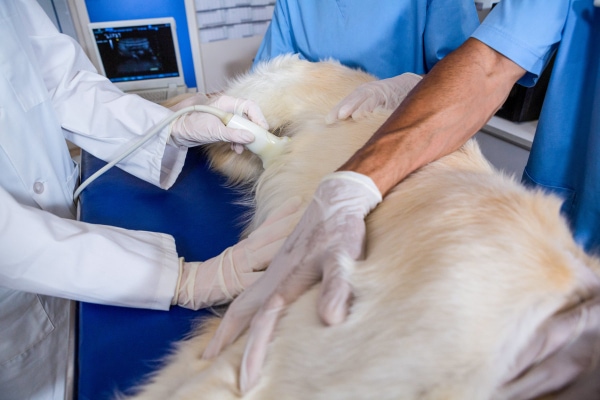
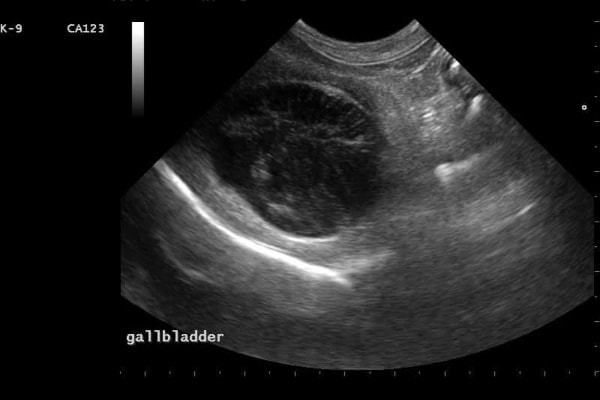
The next step was an ultrasound because I knew something was going on with his liver, and I hadn’t seen an obvious problem like a tumor on X-rays. As it turned out, his liver looked ok on ultrasound. However, his gallbladder looked like a sliced kiwi when it should be a clear black circle. This odd appearance to the gallbladder meant Bijou had a gallbladder mucocele.
What is a gallbladder mucocele?
You may have heard about people having gallbladder issues (or suffered some yourself). But did you know dogs also have gallbladders? The gallbladder is like a little balloon tucked up in between liver lobes.
The liver produces bile from bile acids, bile salts, water, cholesterol, and other components. Bile flows from the liver through bile ducts into the gallbladder where it is stored. Then the larger common bile duct takes bile from the gallbladder into the intestines to aid in the digestion and excretion of toxins.
Normally bile is a thin liquid. However, in some dogs, the consistency of bile inside the gallbladder becomes thicker due to an accumulation of mucous. As a result, a canine gallbladder mucocele forms. The mucous-laden biliary sludge can become too thick to travel through the common bile duct. This causes the gallbladder to become distended and potentially obstructed, unable to empty. Gallbladder obstruction can make a patient very sick, just like Bijou.
What causes a gallbladder mucocele in dogs?
Let’s back up for a minute to see how a gallbladder mucocele happens. There is still so much that veterinarians and researchers don’t fully understand about gallbladder mucoceles, but here is what they have learned so far.
If the gallbladder isn’t appropriately contracting to send bile to the intestines, bile acids build up inside it. This can cause inflammation of the gallbladder wall, which in turn increases mucous production, compounding the problem. The more mucous that builds up, the thicker the bile becomes, and the greater the chance of obstruction.
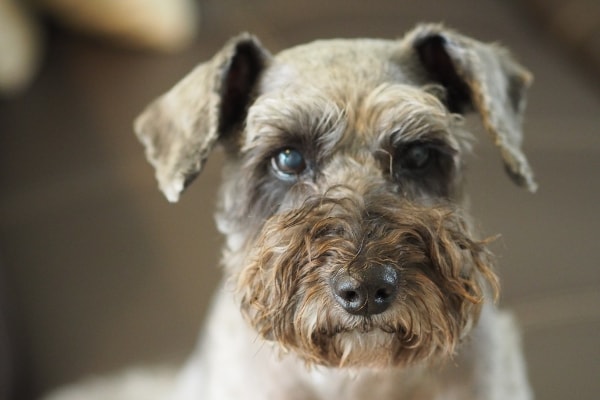
There is a presumed genetic component that predisposes some dogs to develop gallbladder mucoceles. They are more commonly diagnosed in Shetland Sheepdogs, Miniature Schnauzers, Cocker Spaniels, and Dachshunds.
Additionally, certain metabolic disorders can increase the chance of a dog developing a gallbladder mucocele. Pups with Cushing’s disease in dogs are 29 times more likely to develop a mucocele. Diabetes and hypothyroidism in dogs also increase the likelihood of a gallbladder mucocele. These conditions may alter the way fat is metabolized, and make it more difficult for the gallbladder to contract to release bile.
What are the symptoms?
Just like we saw with Bijou, usually dogs with gallbladder mucoceles are pretty sick. Clinical signs can include:
- Vomiting
- A lethargic dog
- Decreased appetite
- Jaundice (yellowing of the eyes, gums, or skin)
- Painful abdomen
- Fever
Not all dogs with mucoceles have all of these symptoms, and all of these symptoms can be associated with other diseases. For this reason, It is very important to seek veterinary care immediately if your dog is showing any of these signs.
How is a gallbladder mucocele diagnosed?
Your vet will start with a physical exam to assess for jaundice, abdominal pain, fever, or other abnormalities. Next, he or she will probably consider further diagnostics like bloodwork.
Usually the bloodwork involves a complete blood count, which assesses white and red blood cell numbers and platelet numbers. The vet will also run a chemistry panel, which looks for signs of kidney disease, liver disease in dogs, diabetes mellitus, electrolyte imbalances, and other conditions. Dogs with a gallbladder mucocele tend to have elevations in their liver values, much like my canine patient did.
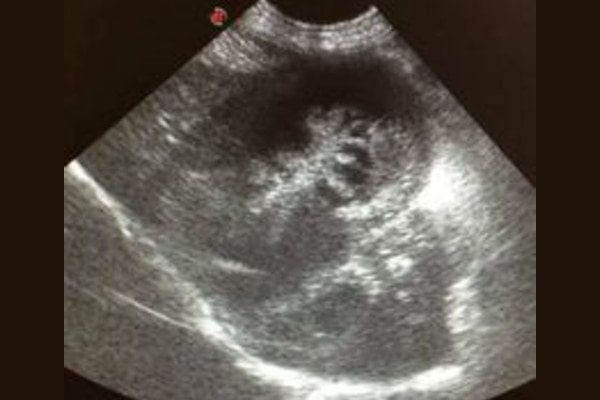
If your vet suspects a gallbladder mucocele or other problem with the internal organs, he or she will probably recommend an abdominal ultrasound. This test allows the vet to assess the liver, contents of the gallbladder, and other abdominal organs. Typically, a normal gallbladder should be a black circle on ultrasound. However, if it looks like a sliced kiwi due to mucous accumulation, the dog probably has a gallbladder mucocele.
What is the treatment for a gallbladder mucocele?
In some milder cases, medical management can be successful. Your vet may recommend starting your dog on ursodiol, a medication that can sometimes improve the flow of bile out of the gallbladder. However, vets typically only try it for dogs who have not yet become extremely ill from the mucocele. A low-fat diet may also be beneficial. Generally speaking, medical management is usually reserved for dogs who are incidentally diagnosed with a gallbladder mucocele and are not clinically ill from it yet.
However, the best course of action for dogs who are showing symptoms at the time of diagnosis is emergency surgery to remove the gallbladder (i.e. cholecystectomy). If a mucocele is causing biliary obstruction, the risk is that if not removed, it may lead to gallbladder rupture. Gallbladder rupture can make the dog even sicker and is potentially fatal.
Gallbladder removal surgery
Gallbladder removal surgery is often rather involved. Your veterinarian may refer you to a specialty hospital for intensive care and the surgery. In addition to removing the gallbladder, the surgeon may take a sample of the liver or bile to send off for bacterial culture. The information gleaned from this may guide treatment and which antibiotics are more likely to be successful in battling infection.
Sometimes during surgery bile can leak into the abdomen. Alternatively, it may already have been present if there was a gallbladder rupture prior to surgery. Bile is very irritating and this can lead to an inflammatory condition called peritonitis. If this happens, the dog may need abdominal drains placed to manage peritonitis after surgery.
What is the prognosis for dogs with a gallbladder mucocele?
Unfortunately, gallbladder mucoceles do not always lead to a happy outcome. The mortality rate (i.e. death rate) for dogs undergoing gallbladder removal surgery for this condition can be as high as 20-25%. However, if surgery is successful, dogs can have a normal life expectancy. The earlier in the condition the dog has surgery, the higher the likelihood of a successful outcome.
The good news is that the gallbladder is not an essential organ so dogs can do fine without it. As mentioned earlier, the function of the gallbladder is to store bile. So after gallbladder removal, the bile just travels directly from the liver to the intestines as the liver produces it. Some dogs may require a special diet or lifelong medication, but their prognosis after surgery is good overall.
The veterinarian will closely monitor dogs undergoing medical treatment for a gallbladder mucocele. This will likely involve routine bloodwork and ultrasounds to ensure that the gallbladder does not become obstructed. If the dog does end up having a gallbladder blockage, there is a risk the gallbladder could rupture and/or the dog could need a cholecystectomy.
If you are interested in learning more about the outlook for the two options, a 2019 article in the Journal of Veterinary Internal Medicine compared the long-term survival of dogs treated for gallbladder mucocele by cholecystectomy, medical management, or both. The researchers determined that while surgery is the treatment of choice, medical management can be a good option for some dogs.
Back to Bijou
Despite being very sick when he was first diagnosed, Bijou is alive and well today. His dad took him to our local specialty hospital where a board-certified veterinary surgeon removed his gallbladder. Thankfully, it had not yet ruptured and his surgery was otherwise routine.
I recheck Bijou’s bloodwork every few months, keep him on a low fat diet, and he’s back to his old self.
If your dog isn’t feeling good, the best thing you can do for him or her is to head to the veterinarian. The sooner you get a diagnosis—be it a gallbladder mucocele or something else—the sooner you can start treatment and hopefully get your pup feeling better again.
I understand it can be scary and confusing sometimes to navigate health issues with a beloved furry family member, but just take it one step at a time. You and your veterinarian both have your dog’s best interests in mind. Work closely with your vet, and follow his or her recommendations.
Have you had a dog with a gallbladder mucocele?
Please share his or her story and any words of advice for other dog parents.


My little cricket was diagnosed with a sludgy gallbladder a year ago (at age 13) she was prescribed ursidiol. She was doing great, then got sick real quick and spent a week in the hospital with a blockage from a developing mucocele. She escaped emergency surgery because her liver enzymes started to improve. Five weeks have passed and she is doing wonderful but I’m having her gallbladder removed next Thursday while she is feeling healthy. I think this gives her the best chance at a longer life because it’s a ticking time bomb if you wait…..she could get a blockage or ruptured gallbladder literally at any moment. When they are symptomatic the surgery outcome is basically a coin flip, otherwise, when they are feeling good it’s as low as 5% mortality rate. I’m fortunate to have an awesome emergency/internal medicine outfit where I live….its the best I’ve ever seen. I just hope she stays healthy for a few more days and surgery goes well. Hoping this can help someone in the same situation…….dogs are very special and it’s a tough decision but I feel I’m making the best choice for cricket.
Hi Nate,
I am sorry Cricket is having issues with her gallbladder. What a blessing she was able to stabilize and improve enough to pursue surgery with a much lower risk. Thank you for sharing your experience as I am certain this will offer hope to others. Praying all goes smoothly and wishing your girl the best of luck at a full recovery. Feel free to leave an update if you have a chance and let us know how Cricket is doing.
Our 6 y.o. Coton de Tulear had emergency gallbladder removal for mucocele on 4/25/24. He had normal blood work in August of 2023 but on 4/17/24, after behaving quite normally and eating his usual dinner, he suddenly vomited up 5 puddles of food and liquid and then became lethargic. We had dealt with minor tummy upsets when he was younger so removed his water and waited 12 hours to see if the vomiting recurred. He kept down water and several small meals of canned boiled chicken in broth the next day, However on 04/19 he refused food, went out for his potty walk and promptly vomited up foamy bile and food from the previous day. Off to our regular vet we went. Blood work showed elevated liver enzymes, and radiography showed no obstructions but questionable gallbladder appearance. He got a shot of Cerenia and scrips for Clavacillin and Denamarin along with canned GI/lowfat prescription food. He seemed to get better everyday until the evening of 4/24 when he started panting, pacing, and licking his lips. He could not get comfortable, so I took him back to the vet the morning of 4/25. Liver enzymes were now through the roof, so she sent us to the earliest available pet ER. After ultrasound the vet there told us he had a mucocele that had not ruptured but likely would soon. He explained the risks of the surgery and said he would take the chance with a younger otherwise healthy dog, so we did.
Our fella sailed through the surgery and came home the next day. We are on day 9 of his 14 day recovery, and he is healing nicely. We have a ramp for our steps, and one of us sleeps on the floor near him at night. He wears an inflatable donut cone during the day and a flexible e-collar overnight. He is being a very good boy.They sent off tissue for liver biopsy and also had his gallbladder checked. No neoplasms, but the gallbladder was so close to rupture. We are thankful for a skilled surgeon, ICU care overnight, and a good ultrasound tech. We are hopeful for his complete recovery from this problem that we had no idea existed.,
Hi Kay,
Goodness, what a scary series of events you have been through over the last couple months. I am glad the surgery was a success and your boy seems to be healing well. Thank you for sharing your experience with us. I am sure this happy story will offer others hope when facing a similar situation. Hoping your pup has made a full recovery and is living his best life. Feel free to leave an update if you have a chance. Bless you!
I lost my 13 yr old Maltipoo to this in Oct of 2022. She suddenly started throwing up, no other symptoms. I immediately got her in to my vet. We’re very rural, so they’re not a 24 hr hospital, and don’t have a lot of fancy equipment. My vet ran tests, Abby’s liver enzymes were way too high. She wanted to keep her. She said the next day she wanted to find someone to do a sonogram on her, but again, small towns, and not many vets do this. So finally late that night, she suggested we drive down to U of I, where they have an animal hospital, because they’re teaching veterinary. We took the drive, only to find out nobody was there on the weekends to do sonograms. We left a few thousand dollar fee for her to stay and drove the couple hours home. No more got home and the vet down there called, telling us Abby was very very ill. They gave her an IV because she was dehydrated and her belly started swelling. Using a needle, she extracted some to see what it was. Blood. She called in someone to do emergency sonogram. She told us, Abby had a huge waxy substance at her gallbladder. She’d never seen anything so large. She said Abby was so ill, it was her opinion surgery would never give the OK to do surgery, and even if they did, we were looking at $10k-15k. Plus, in her opinion, Abby would never make it. I’m the dog person. I’m the one who always wants dogs, my husband says, yes dear. Abby was definitely my girl. This was the most difficult decision I’ve ever had to make. It still breaks my heart. I didn’t want to say bye to my Abby girl, but it was best for her. This muco whatever it’s called, is devastating.
Dear Theresa,
My heart aches for you with your tragic loss of Abby. I can only imagine how emotional it must have been to make the decision to say goodbye but feel certain it was the most loving option. Thank you for being willing to share your story with us. It offers comfort to others to know they are not alone while navigating this tough path. I hope as the years have passed your heart is beginning to heal. May Abby’s memory stay with you always and continue to be a blessing in your life.
I’m so sorry to hear about your Abby. I am going through similar with my dog, except we know what’s wrong – gallbladder sludge – but they haven’t offered surgery as an option, instead just giving her medicine to clear it up (which I’m reading will lead us exactly to what you went through). AND we seem to be in the exact same geographical area. We drive down to Peoria for better vetting. They’re taking her spleen soon due to a mass – I’m going to ask why not just take the gallbladder at the same time. Thank you for sharing your experience.
Dear Anita,
My heart goes out to you as you face this difficult situation with your pup. Praying for clarity as you make some tough decisions over the next few weeks. Bless you and your sweet girl.
My 16 year old pug mix Chrissy, was diagnosed bybultrasound with a gallbladder mucolele 2 weeks ago. Bloodwork is normal. No vomiting. Symptoms are reduced appetite and soft, infrequent stools. we completed 7 days of antibiotics, Clovamax and andcappetiye stimulant. So far the medication Ursidol has not been offered. Do you think it would be helpful? Can medications and diet change improve or reduce the mucolele? The vet said she is not a candidate for surgery?
Hi Jackie,
I am sorry you are facing this difficult situation with your senior girl. While Ursodiol might be helpful, medical management is usually reserved for cases where the mucocele was an incidental finding and the dog has no symptoms at all. Since your girl is showing some signs of decreased appetite and abnormal bowel movements, the recommendation would be surgery. I am curious to know why your vet said your pup is not a candidate for surgery, especially if her blood work is normal? Don’t forget you can always ask for a consultation with a specialist if needed. Hoping you can get the answers you need to find a clear path forward. Praying for a positive outcome for Chrissy.
My 13yr old mixed breed was suddenly vomiting, lethargic, and not eating and was diagnosed with Gallbladder Mucocele using ultrasound and the recommendation was cholecystectomy and splenectomy (nodule on spleen). My dog Pax is now 8 days post surgery now and he has had a slow recovery, 6.5 days in the hospital, and today stopped eating and it’s a fight to try and get his medications into him. I am beginning to lose hope he’s going to make it through.
I wanted to provide some info on actual costs, based on my experience in South Florida because information on the internet is woefully wrong or So FL is outrageously more expensive. I am not happy about initial estimates from the ER hospital given at the outset, but had I known the cost I’ve have sustained so far 8 days in, I would not have done the surgery due to our being retired and fixed income and would have had my sweet boy euthanized.
At this point, he was discharged on after 6 days and now is day 8 post surgery. He had eaten and seemed better spirited on day 7, but now is no longer eating and it is a wrestling match to try and get his oral medication into him, which is 14 prescriptions.
Diagnosis cost: $2803
Surgery and post surgery care for 6.5 days: $20571.
Total cost to date: $23375.
The initial surgery estimate was $10K to $13K, required an $11k deposit, which I agreed to because just 9 days prior we had to euthanize our other dog for a ruptured mass in her spleen, so I was sensitive to putting another dog down in less than 2 week and I didn’t realize how difficult this surgery is for dogs. I received an additional cost estimate via email while Pax was still not even awake from surgery and additional estimates came every other day in the amounts of $2 to $3 thousand each, requiring approx. 90% deposit, and a final bill settlement at discharge of an additional $4500. I have no issue with the quality of medical service and care, but I feel something is lacking in the cost estimating process when you are ultimately off by nearly 2x and are providing cost increase estimates via email while the dog is still under anesthesia and the surgeon is telling you they finished and accomplished what the set out to do.
I don’t wish this on anyone and I am devastated by our two sweet elder dogs coming down with life ending/threatening conditions within 10 days of each other, but I do wish I had a realistic explanation of how high the costs could go from the outset as I was completely helpless and felt like I already spent so much money, I have to follow thru. But now I am feeling even worse as I lose hope about the eventual outcome or potential additional costs to take him back to the same ER.
Dear Mark,
I am sorry Pax has been through so much in the last few weeks. I can only imagine what a financial burden this has become for you and your family. I hope your sweet boy can keep fighting and gain back his quality of life. Thank you for being willing to share your story with us. Praying for a miracle and wishing you all the best. ♥
Pax update: Thank you for the kind words, fortunately after about 10 days post surgery Pax began picking up in energy and eating. After 2 weeks he was much more normal and I would say now at about 7 weeks out from surgery he completely back to normal, other than he is maintaining a preference for the ground turkey we put in his Kibble to coax him back into eating. Kibble without ground turkey gets us intense stares.
I couldn’t be happier that he is still with us and back to his old happy self, but as previously mentioned, the diagnosis and treatment cost is a strain that we will take a while to get beyond. After 5 weeks of healing, to destress all three of us, we took him across the state to Ft. Myers Beach and Sanibel and walked trails and beach parks. He had a great time and is a good car traveler, but not a fan of pools or seawater.
Seeing the still hurricane devastated area helped put my financial issue into perspective on how much worse things can be.
My best wishes to any that have to undergo serious medical problems with their family fur buddies.
Hi Mark,
I am so glad Pax has made a full recovery and has resumed living his best life. Thank you for the update! I am sure your story will give hope to others when facing a similar situation. Wishing you all continued success and happiness. Take care!
so sorry for your loss of your fur baby…i have a little dog and for 5 yrs been fighting to keep her alive..episode 2019 was first in special hospital and cost 1,300. but since then she comes down with same symptoms again and again. see vet. get test and meds and is better. but this month is different. she was sick early June and then 2 weeks later. each time cost 400. now she is acting like not feeling well. but no severe symptoms yet. she is 12 yrs old. c
seriously considering putting her to sleep. i cant afford to keep putting out this kind of money . hear surgery is way out of .my ball park. thanks for sharing, Mary
Hi Mary,
My heart goes out to you as you face this recurring issue with your senior girl. I am sorry the cost of her medical care is putting you under so much financial strain and limiting your options moving forward. Sometimes saying goodbye can be the most loving option even when it breaks our hearts to even consider it. I hope you can find the answers and advice you need to make the best choice for everyone involved. Praying for strength and comfort. Bless you and your sweet girl.
On January 3, 2024, my 13-year-old Cocker Spaniel was casually diagnosed with galbladder mucocele during an abdominal ultrasound. Dumbo was and continues to be asymptomatic, and blood tests are always normal. He was put on a low-fat (3.5%), chicken and turkey diet, rich in vegetables and low in carbohydrates. As snacks between meals, pieces of apple, pear and blueberries. After just over a month he lost weight and appears rejuvenated. He even went back to jumping on the couch without needing help. As medications he only takes one tablet of Denamarin a day, because the vet advised against giving him Ursodiol because his gallbladder has become very distended (3.9 times) and therefore the contractions caused by Ursodiol could cause rupture of the gallbladder and consequent peritonitis. Two subsequent ultrasounds were performed in Dumbo, but without any improvement. Given his age and above all the fact that he appears normal and his blood tests are always perfect, I am very reluctant to have him operated on. How much longer can I wait, repeating ultrasound and blood tests every month, to see if he finally improves, before possibly deciding to operate? And is it really better not to give him Ursodiol? Any help and information on this matter is truly appreciated. Thank you.
Hi Stefano,
I understand your concern for Dumbo with this chronic gall bladder issue he is facing. Unfortunately, there is no way to know how long he can go before it ruptures or causes other serious complications. I am not sure if giving the Ursodiol would be advised and think it was wise of your vet to be so cautious. It may be time to ask about a consultation with an internal medicine specialist. They can give you more information about treatment options and what is recommended for your boy based on his specific medical details. I hope Dumbo is still feeling well and living his best life. Wishing you both the best of luck for many happy years to come.
I wanted to give this info a bump given the somewhat grim outcomes of previous studies:
RESULTS 45 (64%) dogs were included in the elective group and 25 (36%) in the nonelective group. Group mortality rates were 2% (1/45) and 20% (5/25), respectively, and differed significantly.
CONCLUSIONS AND CLINICAL RELEVANCE Dogs that underwent elective cholecystectomy had a considerably lower mortality rate than previously reported.
Source: https://avmajournals.avma.org/view/journals/javma/252/8/javma.252.8.970.xml
Looks like there is some hope there!
Hi C,
I love it when there are specific numbers to share, especially when it comes from a reliable source. Thank you for this great information!
Is anyone in the States doing lsp. cholecystectomy in dogs with mucoceles?
Hi Tina,
Yes, there are specialists here in the U.S. that will perform laparoscopic surgery for many different conditions.
Hi there! I wanted to share my story of my eight-year-old long haired Chihuahua, who just underwent his gallbladder removal surgery. I live in NC, his surgery was 10k (no insurance). He was diagnosed with mucocele. Bentley had his surgery on a Wednesday stayed until Sunday that week in the ER. His total bilirubin level kept going up and vets didn’t understand why. As soon as the levels dropped some they were ready to discharge him. He’s home now, very thirsty but barely eating. Also his stomach is super super bloated, he literally looks pregnant. I can tell it’s very uncomfortable for him. Is this normal, almost a week after surgery?
Hi Alondra,
I am so sorry your little guy has endured so much over the past few weeks. I understand why you are worried, and I agree this has me concerned too. Without examining your boy myself, I can’t make specific conclusions, but I do think this needs to be evaluated by your vet (or the specialist/surgeon). Please reach out to them as soon as possible and make them aware of the bloating, discomfort, and lack of appetite. Hoping for answers and a clear path forward. Praying for healing!
Hello,
My 7 y.o. Golden Ret/Mix was just diagnosed yesterday with this. I have called every vet in a 2 hour radius. No one seems to think this is an emergency. Out of 4 places, only (1) can do it before the end of the year. I don’t think she will make it 2 more months. She still drinks, but will not eat. My vet mentioned medicine. I’m hoping this will help her until the surgery on the 28th of December. I guess I just don’t see how this isn’t considered more of an emergency type surgery considering the gallbladder can rupture.
Hi Jen,
Goodness I am so sorry you are stuck in this difficult situation with your girl. I understand your concern and agree that moving forward with treatment sooner rather than later would be my choice. I am glad you have a date set (even if it is several weeks away) and pray your sweet girl will remain stable until then. Hoping the medication will help and wishing your pup all the best for a full recovery.
My dog, 3 lb toy Chihuahua, was diagnosed with gallbladder sludge. My vet found it by dog bloodwork that showed extremely high liver enzymes. After fasting bloodwork was done I was sent to an internal medicine vet. The internal vet did an ultrasound and found the gallbladder sludge. Stomach meds and an antibiotic were prescribed for my pup. I’ve learned that their diet is really important.
Hi K,
I am glad you were able to get a diagnosis so quickly. Hoping your little guy will respond favorably to the medications and is able to make a full recovery. Feel free to leave an update as things progress. Best wishes to you both!
My almost age 14 Shih Tzu just had gall bladder surgery last Friday. He was first diagnosed with gall bladder sludge about 11 months after he started vomiting, not bile every morning. We tried Ursodiol and Pepcid, and all seemed to be going well. Ultrasound was fine about 6 weeks ago. Then all of sudden, he got really sick over Memorial Day weekend. He vomited really bad a few times and wasn’t feeling well. The vet recommended gall bladder removal even tho the liver enzymes were high. She felt they wouldn’t go down while gall bladder was there. He is doing well now after not eating after surgery for about 3 days. I will take him in on Tuesday for suture removal and liver recheck. The lab confirmed it was mucocele and secondary inflammation.
Hi Diane,
I am sorry your senior guy had to go through this difficult surgery but what a blessing he is doing well and on the road to recovery. Hoping you received a good report at the recheck appointment. Feel free to leave an update and let us know how things are going. Wishing you and your sweet boy all the best!
I would like to know where to find a very low fat diet for gallbladder mucocele. Just started Ursodoil. Prescription canned foods did not agree and loaded with bad ingredients such as carageenan and crushed pecan shells and pork by products.
Hi Lori,
Unfortunately, since I am not personally involved with your dog’s medical care, I can’t make specific recommendations about diet and nutrition. It may be best to look into making a home cooked diet so you can control the ingredients and will know exactly what your dog is consuming. I highly recommend talking to a specialist. Most veterinary nutritionists are willing to schedule phone consultations and can guide you through the ingredient selection process. The reason I like to involve a nutritionist is to make sure the home cooked diet is not lacking in essential nutrients and is complete. I hope this helps a bit. Best of luck to you and your pup.
My 7yr old Sheltie Cody is on ursidiol and a low fat high fiber food. I order from Chewy it is Hills prescription WD stew, Cody loves it.
He had a mucous cell a few years ago but with antibiotics and Ursidiol and low fat high fiber food he has done ok. Lately his ALKP #’s are very high 1500. So now we will see a board certified Internist,All his other numbers are perfect! Not sure what’s causing this number to rise. I have an ultrasound at least once a year to check the gallbladder, this time it does show like it’s trying to form another mucous cell. He has no other symptoms he’s doing good otherwise.
Hi Sandra,
I’m so glad to hear that Cody has been doing well on his ursodiol and WD stew! Hopefully you got good news from the visit with the internal medicine specialist and were able to work with them to keep Cody feeling great despite the rise in ALKP and changes on the ultrasound. Best of luck to you and him!
What is considered low fat diet after removing gallbladder?
Hi John,
There isn’t a lot of research to prove that a low-fat diet is necessary after the gallbladder is removed but is still recommended just as a precaution. There are no specific numbers for what low fat should be, but most prescription low fat dog foods have 10% or less crude fat.
Hi Julie,
My nearly 14 y/o shihtzu was diagnosed with this about 6 months ago. Due to her age my vet did not recommend surgery and prescribed Ursodiol as well as Denamarin and a low fat diet. He originally told me that she would stay on these medications in hopes that it would keep her ducts from being blocked. Now she is on her last refill of Ursodiol and he says she can come off of it which contradicts what he originally said. The other day when I took her in for a check up he claimed to have done an ultrasound and came back and said her gallbladder is clean and she doesn’t need the medication anymore – which again confuses me bc before he talked like it was something that would not go away completely. When I paid my bill, I was only charged for a visit and not an ultrasound so it left me questioning if he actually did one. I didn’t want to make any kind of accusations but wondering if I should take her elsewhere for a second opinion. She’s doing well but has had high liver values for over a year… other than that she is doing great! You wouldn’t know she’s 14 y/o and I hope to keep her with me for as long as I possibly can as she is my baby. 🥰 I worry that my vet has given up on her since she can be a bit of a diva when it comes to them trying to do xrays/ultrasounds etc. Any advice or information you could give would be greatly appreciated. Thank you, Ashley.
Dear Ashley,
I am sorry your senior girl is having these ongoing issues with her gallbladder and liver. Since I was not present for her past exams, it is hard to know why certain choices were made. Without playing a personal role in your dog’s medical care I can’t make specific conclusions or recommendations about her treatment. It might be a good idea to discuss your concerns with your vet and have an honest conversation about how things have progressed with time. Don’t hesitate to ask hard questions or request more information that would help you gain some clarity. With that being said, it is always ok to get a second opinion. Do whatever you need to be comfortable with the choices that are being made for you and your sweet girl. She is lucky to have someone like you advocating for her health and well-being. Praying for a positive outcome and many happy days ahead for you both.