Hearing the phrase “gallbladder mucocele in dogs” as your sweet pup’s diagnosis may leave you feeling a bit unsure of what this means for him or her. Integrative veterinarian Dr. Julie Buzby explains the causes, symptoms, diagnosis, treatment, and outlook for a gallbladder mucocele in dogs. Armed with this information you will better be able to help and support your dog.
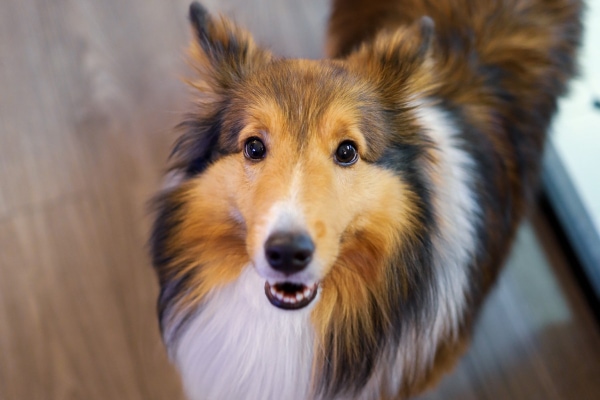
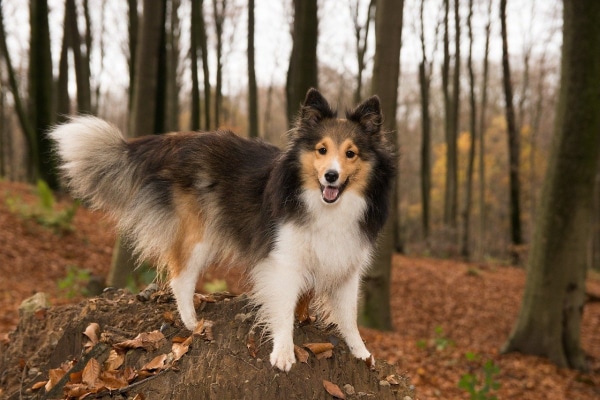
Bijou the Sheltie is notoriously a bit of a picky eater. He was one of the few puppies I’ve met that turned up his nose at the squeeze cheese I often offer to distract from vaccines. I mean, what dog doesn’t like bright orange processed goo? Bijou. That’s who. Over the last six years he’s occasionally skipped a meal here and there. His owner and I kept track of his dental health to make sure that wasn’t an issue, and we ran yearly bloodwork. He had always been the picture of health.
But then something changed. Bijou went from picky to downright not eating. He became lethargic. He started vomiting. His dad knew something was wrong, and brought him to me right away.
Bijou has always been a little standoffish with me—maybe he never forgave me for assuming he’d like squeeze cheese. But this time he barely acknowledged my existence. He let me do a full exam without much resistance, save for a little wince when I palpated his belly. Something was very not right.
Getting to the root of Bijou’s problem
Unfortunately in dogs, lethargy, vomiting, and inappetence are somewhat nonspecific. I couldn’t tell just by looking at him what was troubling Bijou, though I thought I could see a little yellow tinge in the white of his eyes. But maybe it was the lighting in the exam room. I knew we needed to do some diagnostics.
I started by taking X-rays. Maybe he’d eaten something he shouldn’t have? He wasn’t the most trustworthy dog when his dad was at work. X-rays looked clear—nothing was obviously wrong in his abdomen. We ran some bloodwork and that’s when my level of concern raised significantly. Bijou’s liver values were through the roof. Apparently, I wasn’t imagining the yellowing of his eyes—he really was jaundiced.
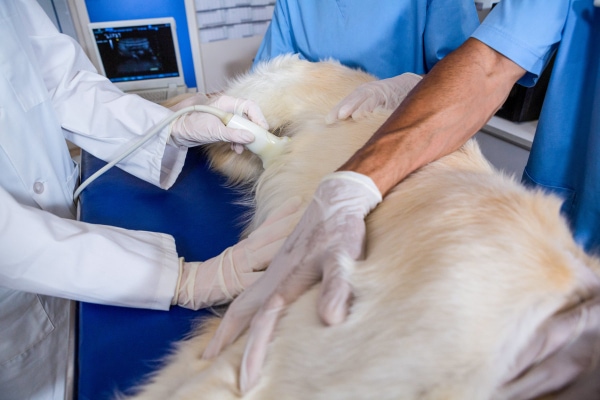
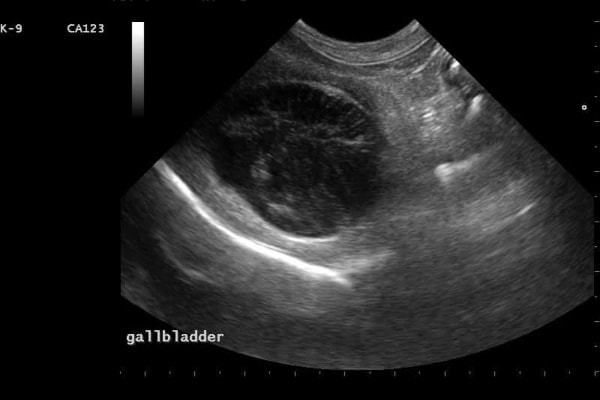
The next step was an ultrasound because I knew something was going on with his liver, and I hadn’t seen an obvious problem like a tumor on X-rays. As it turned out, his liver looked ok on ultrasound. However, his gallbladder looked like a sliced kiwi when it should be a clear black circle. This odd appearance to the gallbladder meant Bijou had a gallbladder mucocele.
What is a gallbladder mucocele?
You may have heard about people having gallbladder issues (or suffered some yourself). But did you know dogs also have gallbladders? The gallbladder is like a little balloon tucked up in between liver lobes.
The liver produces bile from bile acids, bile salts, water, cholesterol, and other components. Bile flows from the liver through bile ducts into the gallbladder where it is stored. Then the larger common bile duct takes bile from the gallbladder into the intestines to aid in the digestion and excretion of toxins.
Normally bile is a thin liquid. However, in some dogs, the consistency of bile inside the gallbladder becomes thicker due to an accumulation of mucous. As a result, a canine gallbladder mucocele forms. The mucous-laden biliary sludge can become too thick to travel through the common bile duct. This causes the gallbladder to become distended and potentially obstructed, unable to empty. Gallbladder obstruction can make a patient very sick, just like Bijou.
What causes a gallbladder mucocele in dogs?
Let’s back up for a minute to see how a gallbladder mucocele happens. There is still so much that veterinarians and researchers don’t fully understand about gallbladder mucoceles, but here is what they have learned so far.
If the gallbladder isn’t appropriately contracting to send bile to the intestines, bile acids build up inside it. This can cause inflammation of the gallbladder wall, which in turn increases mucous production, compounding the problem. The more mucous that builds up, the thicker the bile becomes, and the greater the chance of obstruction.
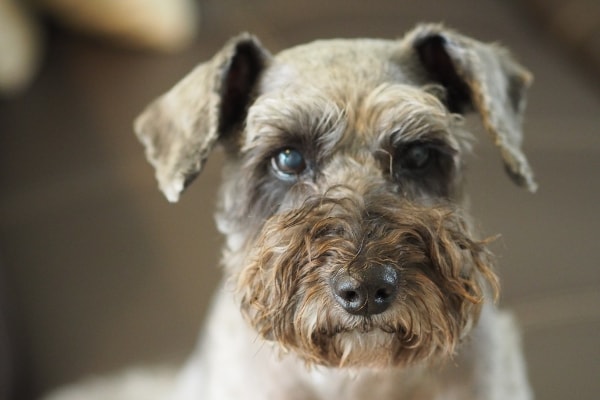
There is a presumed genetic component that predisposes some dogs to develop gallbladder mucoceles. They are more commonly diagnosed in Shetland Sheepdogs, Miniature Schnauzers, Cocker Spaniels, and Dachshunds.
Additionally, certain metabolic disorders can increase the chance of a dog developing a gallbladder mucocele. Pups with Cushing’s disease in dogs are 29 times more likely to develop a mucocele. Diabetes and hypothyroidism in dogs also increase the likelihood of a gallbladder mucocele. These conditions may alter the way fat is metabolized, and make it more difficult for the gallbladder to contract to release bile.
What are the symptoms?
Just like we saw with Bijou, usually dogs with gallbladder mucoceles are pretty sick. Clinical signs can include:
- Vomiting
- A lethargic dog
- Decreased appetite
- Jaundice (yellowing of the eyes, gums, or skin)
- Painful abdomen
- Fever
Not all dogs with mucoceles have all of these symptoms, and all of these symptoms can be associated with other diseases. For this reason, It is very important to seek veterinary care immediately if your dog is showing any of these signs.
How is a gallbladder mucocele diagnosed?
Your vet will start with a physical exam to assess for jaundice, abdominal pain, fever, or other abnormalities. Next, he or she will probably consider further diagnostics like bloodwork.
Usually the bloodwork involves a complete blood count, which assesses white and red blood cell numbers and platelet numbers. The vet will also run a chemistry panel, which looks for signs of kidney disease, liver disease in dogs, diabetes mellitus, electrolyte imbalances, and other conditions. Dogs with a gallbladder mucocele tend to have elevations in their liver values, much like my canine patient did.
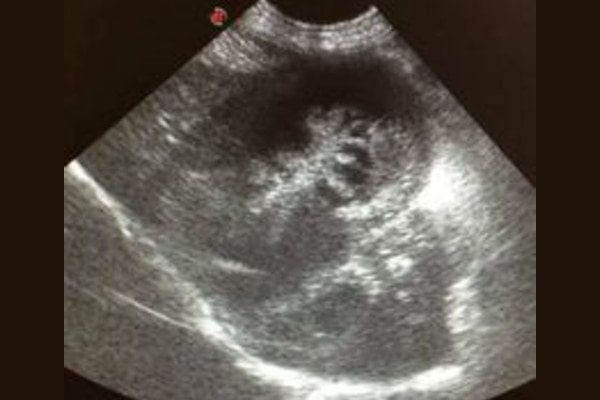
If your vet suspects a gallbladder mucocele or other problem with the internal organs, he or she will probably recommend an abdominal ultrasound. This test allows the vet to assess the liver, contents of the gallbladder, and other abdominal organs. Typically, a normal gallbladder should be a black circle on ultrasound. However, if it looks like a sliced kiwi due to mucous accumulation, the dog probably has a gallbladder mucocele.
What is the treatment for a gallbladder mucocele?
In some milder cases, medical management can be successful. Your vet may recommend starting your dog on ursodiol, a medication that can sometimes improve the flow of bile out of the gallbladder. However, vets typically only try it for dogs who have not yet become extremely ill from the mucocele. A low-fat diet may also be beneficial. Generally speaking, medical management is usually reserved for dogs who are incidentally diagnosed with a gallbladder mucocele and are not clinically ill from it yet.
However, the best course of action for dogs who are showing symptoms at the time of diagnosis is emergency surgery to remove the gallbladder (i.e. cholecystectomy). If a mucocele is causing biliary obstruction, the risk is that if not removed, it may lead to gallbladder rupture. Gallbladder rupture can make the dog even sicker and is potentially fatal.
Gallbladder removal surgery
Gallbladder removal surgery is often rather involved. Your veterinarian may refer you to a specialty hospital for intensive care and the surgery. In addition to removing the gallbladder, the surgeon may take a sample of the liver or bile to send off for bacterial culture. The information gleaned from this may guide treatment and which antibiotics are more likely to be successful in battling infection.
Sometimes during surgery bile can leak into the abdomen. Alternatively, it may already have been present if there was a gallbladder rupture prior to surgery. Bile is very irritating and this can lead to an inflammatory condition called peritonitis. If this happens, the dog may need abdominal drains placed to manage peritonitis after surgery.
What is the prognosis for dogs with a gallbladder mucocele?
Unfortunately, gallbladder mucoceles do not always lead to a happy outcome. The mortality rate (i.e. death rate) for dogs undergoing gallbladder removal surgery for this condition can be as high as 20-25%. However, if surgery is successful, dogs can have a normal life expectancy. The earlier in the condition the dog has surgery, the higher the likelihood of a successful outcome.
The good news is that the gallbladder is not an essential organ so dogs can do fine without it. As mentioned earlier, the function of the gallbladder is to store bile. So after gallbladder removal, the bile just travels directly from the liver to the intestines as the liver produces it. Some dogs may require a special diet or lifelong medication, but their prognosis after surgery is good overall.
The veterinarian will closely monitor dogs undergoing medical treatment for a gallbladder mucocele. This will likely involve routine bloodwork and ultrasounds to ensure that the gallbladder does not become obstructed. If the dog does end up having a gallbladder blockage, there is a risk the gallbladder could rupture and/or the dog could need a cholecystectomy.
If you are interested in learning more about the outlook for the two options, a 2019 article in the Journal of Veterinary Internal Medicine compared the long-term survival of dogs treated for gallbladder mucocele by cholecystectomy, medical management, or both. The researchers determined that while surgery is the treatment of choice, medical management can be a good option for some dogs.
Back to Bijou
Despite being very sick when he was first diagnosed, Bijou is alive and well today. His dad took him to our local specialty hospital where a board-certified veterinary surgeon removed his gallbladder. Thankfully, it had not yet ruptured and his surgery was otherwise routine.
I recheck Bijou’s bloodwork every few months, keep him on a low fat diet, and he’s back to his old self.
If your dog isn’t feeling good, the best thing you can do for him or her is to head to the veterinarian. The sooner you get a diagnosis—be it a gallbladder mucocele or something else—the sooner you can start treatment and hopefully get your pup feeling better again.
I understand it can be scary and confusing sometimes to navigate health issues with a beloved furry family member, but just take it one step at a time. You and your veterinarian both have your dog’s best interests in mind. Work closely with your vet, and follow his or her recommendations.
Have you had a dog with a gallbladder mucocele?
Please share his or her story and any words of advice for other dog parents.


When you quote 20-25% mortality rate with the gall bladder removal, does this include ruptured gallbladder’s as well as elective, gallbladder removal‘s? As you know, a ruptured gall bladder, it’s going to have a much worse outcome and many more potential complications, than an elective gallbladder removal. I’m considering having my dogs gallbladder removed as she has mucoceles(classic kiwi pattern) showing with US. However, I’ve never seen a statistic that high for the mortality which gives me pause..
Hi Monica,
Yes, the percentage quoted does include elective and non-elective surgeries. Here is a quote from one source I researched:
” Overall mortality rates are reported to be between 20–39% for this disease, however, early surgical intervention may significantly reduce mortality rates.”
This is from the American College of Veterinary Surgeons website. Here is the link in case you want to read more from the source: https://www.acvs.org/small-animal/gallbladder-mucocele#:~:text=Dogs%20with%20gallbladder%20mucoceles%20that%20undergo%20cholecystectomy%20and,early%20surgical%20intervention%20may%20significantly%20reduce%20mortality%20rates.
I hope you can find the answers you need to make the best choice for your pup. Praying for a positive outcome!
Our beloved Monte passed away last month after a mucocele ruptured his gallbladder. He underwent emergency surgery but it was too late. He’d been healthy and it was a total shock. I don’t regret putting him through the surgery — we had to try everything. (The pricetag — yikes. The very next day, we signed our other dog up for pet health insurance!) Here’s my question. Another commenter mentioned that her dog had had a limp a few weeks before, and it’s a symptom of gallbladder pain. Is this true? I can’t find it anywhere else online. Our Monte had also had a limp a month before and the vet couldn’t find the cause. It did stop and we figured maybe he’d pulled a muscle. Thank you.
Hi Betsy,
I am sorry for your tragic loss of Monte. Even though the surgery was too late, I am glad you tried and gave your sweet boy the chance. As far as the limping is concerned, I am not sure this is a specific sign of gall bladder pain. Sometimes abdominal pain can cause dogs to “limp” or show pain when walking, but this is not always the case. I am glad you were able to get pet health insurance for your other dog. Hoping you will not need to utilize it and are headed for smooth sailing in the future. Thank you for sharing Monte’s story with us. Wishing you the best.
Hi! My poor dog had his gallbladder removed due to gallbladder microcell. Unfortunately, it’s been two weeks and he presents the same as before his gallbladder was removed. He still looks in pain and absolutely miserable. He’s very picky about what he will eat. He has muscle spasms in his front legs after eating and he won’t move from lying on the couch. I don’t think our vet knows what is wrong with him still. They said they are trying to “jump start” his liver. (The biopsy came back fine) he also doesn’t drink water. Just curious if anyone has encountered this or had any suggestions.
Hi Jennifer,
I understand your concern for your pup and am sorry he is having so many issues since his surgery. It worries me that he isn’t drinking water. Please make sure your vet is aware of this problem and keep them up to date as his recovery process continues. Praying things will get better quickly and your sweet boy will make a full recovery. Feel free to leave an update if you have a chance.
Maxie also had surgery for a ruptured gallbladder. We are in our 2nd going 3rd week post surgery. I noticed that she had become a very picky eater.
Hi all,
I’m looking for for experience with gallbladder mucocele and high liver enzymes.
We have a 12.5 year old dachshund who had extremely high alp and other high enzymes during lab work in November.
We followed up with an ultrasound which showed a mucocele.
He is currently asymptomatic.
We met with a surgeon and surgery cost is around 6k.
Currently we are on ursodiol, milk thistle and denamarin.
I have concerns about putting him through surgery at his age along with the cost but if this is definitely going to prolong his life I’m for it.
Can anyone share their experiences?
I also suspect he has cushings which started this discovery but that testing has been put on the back burner for now.
Hi John,
I am sorry you are facing this difficult decision for your Dachshund. I hope you will find the comments left by other readers to be helpful. I wish I could tell you the best course of action, but this is one of those instances where there is no straight forward answer. Generally, if the dog is asymptomatic, I tend to go with medical management. It is never wrong to get a second opinion when dealing with issues of this magnitude. I hope you can find the answers you need to make a decision with which you can be at peace. Praying for a positive outcome for your sweet boy and a long and happy future.
My 10 year old black mouth cut had high liver levels I was told she had pancreatitis in December. I brought her in for annuals in February and the X-ray showed a large mass on her liver. An ultrasound was conducted and the radiologist did not recommend surgery because he thought laying on her back during surgery would cause the mass to crush her other organs nor did he and the vet thought it could be removed. I asked for a referral so I could get a second opinion and though the surgery was 7k, it was completed and they were able to remove the entire mass which weighed almost 10 pounds.
Hi Judy,
WOW! That is impressive! I am so glad your senior girl made it through anesthesia and the surgery was successful. Thank you for sharing your experience with our readers. I am certain this will give hope to others in a similar situation.
I’m in the same boat, john. my 13 yr old doxie has Cushings and has an “early mucocele”. blood work is good & shows no symptoms of gallbladder issue.
I’m going through this now
My 10 year old white doxie that is deaf and genetically bred in the worst way (2 major surgeries already and a pet store purchase) had his ultrasound today and he definitely has a mucocele
He is my heart and one of the best dogs I have had the pleasure of having in my life
I’m struggling right now on what is best for him. We are also waiting for the results on possible lymphoma, his lymph nodes in his neck are enlarged – he is on anti vomiting meds now to be able to keep his food down but his stool is bright yellow and then a green slime forms over it
I’m being told at a specialty vet hospital the surgery will be between 10-15 thousand dollars and at his age and the mortality rate of the surgery I’m just numb and shocked and don’t know what to do
My vet should have the radiology report within 48 hours and hopefully by that time we will know if we are dealing with lymphoma as well
Dear Dawn,
My heart aches for you as you face this difficult situation with your senior boy. While you are advocating for him and addressing his needs, please make sure you are taking care of yourself as well. I can only imagine what an emotional toll this is taking and the amount of worry and stress you must be under. I am praying for comfort for you both. Wishing you strength as you navigate this tough road ahead. Bless you and your sweet little guy.
Thank you
His pathology came back and he does not have lymphoma his salivary glands are enlarged and were mistaken for lymph nodes
He went today for surgery and just came out of it an hour ago and doing okay – hopefully coming home Sunday
I hope for a few more great years with this special little guy! We ended up taking him to Michigan state university and they were so reasonable with pricing and so compassionate and thorough
I feel like the weight of the world has been lifted and I can breathe again
Hi Dawn,
This is such great news! So glad the surgery was a success and what a relief you don’t have to worry about lymphoma. I am happy to hear you had a great experience at MSU. Thank you for the update. Wishing you and your sweet boy continued health and happiness!
My dog is awaiting confirmation of her diagnosis next week, but I appreciate you sharing MSU was helpful and reasonable. We live close by and plan to take her there if she needs surgery. Do you mind me asking what the cost ended up being?
My 10 year old Jack Russell Cheyenne spayed female underwent cholecystectomy about 3 weeks ago. Gall bladder had a small rupture. bacteria culture and liver biopsy showed negative.
Currently on Denemarin and Ursodial. Liver values test last week showed ALKP at 1237 and ALT at 509, all other values in normal range. Incision has completely healed. Eating and general mood has improved dramatically. I will be retesting liver values in a month. Are there any changes I should consider, such as low fat diet or other medications?
Hi John,
I am so glad Cheyenne’s surgery was successful and she was able to make a full recovery! A diet change might be a good idea and medication may be needed, but these decisions will probably be based on what the lab work looks like at the next recheck. Make sure you discuss these concerns with your vet so you can feel comfortable with the choices made going forward. Wishing you both many happy days ahead. Bless you!
Julie,
Cheyenne’s values have improved a lot since November
ALKP was 1237 now 258
ALT was 509 now 167
She’s off all medication at this point, has her energy back, and seems normal.
What’s the deal with Cushings disease?
Every time the liver values are slightly out of whack, the vets bring up Cushings.
It’s my understanding that Cushings is very hard to diagnose.
Hi John,
Wow! This is great news! I am so glad Cheyenne’s liver values have improved and you were able to discontinue her medications. Ugh…yes Cushing’s is tricky. There is just so much information to discuss it may be easier to share some articles with you. Here are links to other articles on this site about Cushing’s disease:
1. Cushing’s Disease in Dogs: Symptoms, Diagnosis, Medications
2. Trilostane for Dogs With Cushing’s Disease
3. What Does a High ALP in Dogs Mean?
I hope this helps a bit. Cheyenne may have some additional diagnostic tests in her future. But for now, let’s celebrate this win over her gallbladder disease! Thank you for the update. This has made my day. ♥
Can you please tell me how much more risky this surgery is for dogs with Cushing’s disease?
My vet said she needs to get her gallbladder removed and we are going to meet with a surgeon soon. This is scary !
Hi Diane,
I understand your concern for your dog with this upcoming surgical procedure. Unfortunately, I am not familiar with the exact risks associated with gallbladder removal and Cushing’s disease. This would be a great question for the specialist! I would be curious to know what you find out at your meeting with the surgeon. Feel free to leave an update if you have a chance. Praying for a successful surgery and a full recovery for your dog!
My sweet baby girl Serenity (chihuahua mix) has been diagnosed with this as of today. I noticed her change in attitude and activity early and requested bloodwork from our vet. We confirmed high liver numbers and proceeded to an emergency care vet who did an ultrasound and confirmed this condition. She’s very young (3) and stable enough that our vet is confident she will come thru a removal surgery. We are hopeful as she is very much my whole world.
Monday she will have her gallbladder removed and hopefully start recovery and continue to live a long and pampered life.
I am relieved in some ways and in more ways still worried. I cannot express the importance of pet insurance. I’m thankful that we are financially in a position to help our baby and heartbroken its such a high expense for others (8k for ours)
Hi Kayla,
I am so glad you noticed the changes in your pup’s behavior and were able to get her medical attention quickly. I am glad the vet was pretty confident about positive results and a good prognosis. How did surgery go today? I am praying your sweet girl is resting comfortably and in the healing process. I hope Serenity will make a full recovery and have many happy years ahead. Bless you both. ♥
My 14 year old sweet Daphne, cocker spaniel just got diagnosed with a ruptured gallbladder.
It took a week for the diagnosis. She has pancreatitis, thought I’d was that until blood work. Impossible to get an ultrasound, finally did. Our vet found a place after 7 attempts that might be able to do the surgery.
I’m torn.
She completely bounced back after antibiotics and 2 IVS eating and is bouncy and bright
My vet said very risky surgery especially at her age.
Going to go see what the surgeon says.
I don’t know how long she can live just on antibiotics.
Praying for guidance.
She’s my world.
Dear Johanna,
My heart goes out to you and this difficult situation you are in with Daphne. I honestly feel like there is truly no right or wrong answer when it comes to whether to pursue surgery or not. I definitely think talking to the surgeon is a great idea. They can give you their recommendation and let you know what they think is best. I am glad the antibiotics have helped, and your sweet girl is feeling better. I hope you can find the answers you need to make the best choice for you and Daphne. Praying for strength and clarity for you and a positive outcome for your pup. ♥
Johannah – curious to know if you went through with the surgery & how things went and how your baby is doing. My 13 year old may need his out and I am worried with his age and other conditions (heart & kidney disease) the surgery may be too much for him. Although he has a lot of life left in him for his age so we are torn too. Waiting to talk to internal med vet….
I am curious how your precious baby is doing. I am faced with the same dilemma. My 14 y/0 mixed terrier, Belle, was diagnosed in November, 2022, with a GBM. Here it is January, 2023 and we are still “walking on eggshells” with her. Every day I worry about her. She is currently on Ursodiol, Vitamin E and a low fat diet. I want her to be well so I have considered the surgery. The next thought is I don’t want to put her through the surgery and possibly lose her. She is doing good and happy. She doesn’t even behave like she is sick. She is my heart and best friend. If I do the surgery and lose her, I will feel so guilty; if I don’t do the surgery and her gallbladder bursts, I will feel so guilty. Damned if I do and damned if I don’t.
Hi Teresa,
I am sorry you are in such a difficult situation with your senior girl. I can only imagine the daily worry you must feel for Belle. I wish I had some good advice or could tell you what the right choice would be. If you haven’t spoken to a specialist, this could be a good way to gather more information and help with these tough decisions. Praying for clarity and strength to face this uncertain road ahead. Bless you both.
I lost my Joy, a Border Terrier, to this horrible disease 8 months ago. She was 13. She had full blood work every year and had just had a normal “well visit” a few weeks before she suddenly got very ill. A few weeks before, she had experienced a temporary limp on her front paw, which I later learned can be a sign of gallbladder pain. One morning she vomited in the morning. I was not too concerned. She seemed fine. However, while taking her daily walk, she vomited again. By later that afternoon she could not even keep down water. She also experienced backward sneezing, which can be caused by acid reflux. Joy had experience d those before, but we thought it was seasonal allergy related. So many things I did not know. The vet ordered bloodwork and found high liver and bilirubin levels. She ordered antibiotics and an elective ultrasound appt. The test was scheduled for 2 weeks later at Med Vet. Too long to wait in my opinion. After a few days on meds, she appeared to stabilize, but then went downhill again. I rushed her to Med Vet and asked for an emergency ultrasound. The dreaded diagnosis of a gallbladder on the verge of rupture was made. I did not want to put her through a major surgery, especially after seeing the high mortality rate and possible complications following surgery. The ER vet agreed. Joy passed away in my arms. I now live with the “what ifs.” Should I have let her go through surgery? I now see where many dogs survive, although I see that surgery outcomes are better with dogs that have been diagnosed before symptoms. She was my world, the best friend I’ve ever had. I don’t think I will ever come to peace with my decision. But I would have hated it if she suffered following the surgery. No good answers. I miss her terribly and just don’t know if I will ever be able to go through this grief again. Till we meet again sweet Joy….
Dear K.,
I am so sorry for your loss of Joy. I know it is impossible to stop running scenarios through your head and let go of the “what ifs”. Please know you did right by your sweet girl and made the best choices with the situation you were dealt. Saying goodbye was completely unselfish and came from a place of love. I know you would have done anything in your power to keep her with you if you felt it was truly best. What a blessing to have spent 13 years together. I have no doubt she knew how much she was loved. I hope with time your heart will heal and her memory will be a blessing. ♥
My dog passed away recently due to this surgery. I regretted putting her through it. I watched her suffer post surgery and did not make it.. 7 hours of pain. I was at the hospital through it all. She was 11. Her gall bladder has not ruptured. But I still lost her. Don’t regret not letting her go through the surgery. I regretted letting her go through it. She was my whole world.
Dear Joyce,
I am sorry for your recent loss of your senior girl. My heart goes out to you as you work through your grief. Thank you for being willing to share your experience and offer advice. I hope you will be able to hold on to all the good memories of your sweet girl as you continue life’s journey.
We just experienced this diagnosis within the last week. Our sweet Abigail (Australian Cattle Dog mix) showed no signs of anything out of HER ordinary last Saturday and then on Sunday, 12/18, she was vomiting—- couldn’t keep water down, lethargic, etc… She was between 14-15 yrs old, as we rescued her a little over 13 years ago. This very diagnosis was confirmed to us the next day after an overnight stay at the emergency hospital where she was on liquids, anti-nausea, low dose antibiotics and some pain medication. This being her ONLY major health issue in all of the time we have had her, my husband opted for surgery, as it was explained (and I feel the vets believed) all would be well, despite her age. Recovery anticipated to be a bit longer, but not one noted that in their professional opinion, it wouldn’t be beneficial to her not to have the surgery. The emergency vet found another clinic in town that was able to complete the surgery the next day. The post-op complications were scarier than the explanation of the surgery itself, after speaking to the surgeon. Despite this, we proceed. The surgery went well; her gall bladder was severely diseased, liver looked fine, stomach full of bile. Unfortunately, she passed shortly after while in recovery. Our hearts are broken; however, after reading this article, I understand the bigger picture better. Her senior panel blood work was always normal. She never had a change in appetite, her drinking patterns, or urination—- nothing. Her activity level was declining, but she was a senior dog, who would have bursts of spontaneous energy as if she was 10 yrs younger. She was actively involved in her duties as an older sister to our younger dog. Her sass level didn’t decrease at all. I have been trying to figure out what we missed over the last week, and it seems that it truly can be a surprise diagnosis. HOWEVER, I feel that we were misinformed to some degree, and looking back, her poochy stomach was something I should have questioned more, instead of accepting that it was her being a bit overweight. Also the typical changes that come with aging are also similar to this diagnosis. I wish her regular vets would have picked up on it sooner… maybe she would still be with us. As a dog mom who lost her sweet girl, 6 days ago, emergency and speciality veterinary medicine preyed upon our love for our pet with this particular diagnosis. Our story and so many others in this thread could have been avoided—- yes, we would have lost them, their suffering was profit in someone else’s pocket, and I hate that part of me didn’t advocate strong for her, as her mom, I should have put my foot down. I know my husband felt strongly about this surgery because of the “what ifs”, as she was overall pretty healthy, and we were initially informed to believe that she would be okay. I didn’t want to lose her either, but the post-op complications were scarier to me. I knew I would find a way to cope with aftermath of not proceeding with the surgery, but he wouldn’t be able to if we didn’t try—- so surgery she got. My heart knew we were going to lose her either way, and the recovery was just more painful for her, and so she past when her vitals were being taken in recovery… without us. Sometimes the hardest decisions, are the best decisions for your pet and yourself. Her diagnosis was just another emergency hospital franchise making a profit—- lesson learned. This article, and those linked to it, have helped tremendously in trying to understand what we and her regular vets missed along the way, so thank you.
Dear Sarah,
I am so sorry for the loss of your sweet Abigail. You are right that this diagnosis can show up very suddenly with no prior warning. There is probably nothing you or your vet missed. I hope you can let go of the burden of guilt and allow yourself some grace. I understand how emotional these decisions can be, especially when your husband had different ideas of how to proceed. In this situation, I honestly don’t think there was a right or wrong choice. There was no way to know your girl wouldn’t make it through recovery and gain extra precious time with her loved ones. I can only imagine the grief you are experiencing. With that being said, please know the emergency hospital was not pushing for surgery just to make a profit. They didn’t even perform the surgery as you mentioned they found another clinic to send her to the next day. No veterinary professional enjoys seeing a dog suffering or wants to endure their loss. Many times, after losing a patient, my colleagues (myself included) will beat ourselves up over this for weeks and then it still comes to mind in the middle of the night for months to years later. Your precious girl was important, and her loss was a tragedy felt by all who had a part in her story. I hope with time your heart will heal and Abigail’s memory will be a blessing to you and your family.
I have a 8 year old rough collie that I adore. She started urinating all over.. the doctors office did bloodwork and checked for a UTI. All came back normal.. The urination started back in July 2025 and I asked for more testing . She had an ultrasound done in August 2025. The doctor that did the Ultrasound found her kidneys were very low and that she had muculi around the gallbladder and the report said it was advanced. She has been on unison and proin. She is doing well. I am with a new vet and have requested an Ultrasound to be done in December. The current vet said that is not a surgery for her to have , due to problems following. I watch her to make sure she is eating , drinking , urinating and her coloring is good. I am nervous about this.,
Hi Tracy,
I understand your concern for your pup. I think it is good you are continuing to advocate for her and pushing for more answers. Hoping her condition can be maintained with medications since your vet doesn’t seem to think she is a good candidate for surgery. Please keep us updated and I wish you all the best as you navigate this difficult path.
Don’t feel bad, our dear Sparky was euthanized almost two weeks ago. He was 14 years old and had pulmonary hypertension and thyroid disease. I did not feel that he would make it through the surgery and I didn’t want him to suffer more if he got complications. He was on Denamarin and lasted 7 months after diagnosis.
I also am reading these comments to see if we made the right decision. Terrible decision to make.
Dear Lea,
I am sorry for your loss of Sparky. Take comfort in knowing you gave your sweet boy a wonderful life. I am certain he knew how much he was loved. May his memory be a blessing to you and your family. Wishing you peace and comfort.
Hi K. I’m so sorry for your loss of Joy. I see this comment is from 2022 but I’m sure the loss is no less present. Joy’’s story is nearly identical to my Alice. She was my 12 year old chihuahua mix who has been with me since she was 6 months old. She was my heart and soul. I had to make the same impossible decision as you for Joy just 3 days ago. Her symptoms came out of nowhere on early Saturday morning she vomited. Appeared lethargic and sitting up , would not lay down. She’d drink water and pee but wouldn’t eat. I took her to the urgent vet Sunday morning as she continued to vomit and appeared in worse pain. We got some extended blood work done and fluids and meds , opting to do the ultrasound Monday when our normal vet opened. Her vomiting also stopped and she drank water on Sunday so we thought she might improve with fluids and meds. When we met with our vet Monday and went over the blood work, her bilirubin levels were 6.7 and the ultrasound revealed a mucocele. The vet didn’t feel confident in surgery so he referred us to an urgent VCA vet where we rushed her. An hour later, the Vca vet came out and said “has anyone discussed Alice’s prognosis with you?” And proceeded to say that she needed 30k surgery to remove her gallbladder immediately or euthanasia. They said it was close to 30% success rate given her age and condition of her gallbladder. My wife and I went to the car, sobbing and frantically calling family who could offer guidance. Ultimately, I decided to do the surgery because any shot was worth it. I charged two credit cards and asked to hold her to say goodbye before surgery the next morning. While holding her and asking more questions about when she was likely to pass (after the surgery v during), I felt her sigh in my arms and knew she’d rather fall asleep in my lap. 3 days later, i question and regret every action or lack of action I made regarding her care, health, diet, etc.
She also has hypothyroidism which has been managed since 2022 with medication. She was otherwise showing no signs of slowing down. The complete opposite. She did a 4 mile hike , all 10lbs of her, on the prior Sunday . She walked twice a day for 20-30 minutes. She was our weekend warrior hiker and adventurer. She slept a lot but all of our dogs do (we had 3 Senior and one 6 year old, but we also had to put down our Frenchie from age related issues two weeks ago). So now we are down to a pack of two within a couple of weeks and I’m struggling to understand the suddenness of Alice and the decision to not try the surgery.
Reading your comment about Joy helps bring me some peace with the decision, thought I’m so early in this grief journey, I know I’ll struggle for quite some time with accepting my decision to give Alice a soft goodbye.
Dear Whitney,
I am so sorry for your loss of Alice. I can only imagine how much you miss her and understand the need to ponder all the “what ifs”. You made a loving choice to prevent your girl from experiencing further suffering and pain. What a blessing you were able to hold her until the last breath. Praying for your comfort and peace. May Alice’s memory stay with you always and be a source of joy in your life.
I have just gone thru this nightmare with my beloved 11 yr old Havanese Lexi. Lexi was diagnosed with Cushing disease 2 yrs ago but we had managed her disease with periodic checkups with my vet and medicating her with Trilostane and Thyroxine for her thyroid issues.
Unfortunately this past Memorial Day Lexi became lethargic and started vomiting. We were away visiting in another state so I wound up taking her to a 24hr animal hospital. After numerous blood tests and ultrasounds Lexi was diagnosed with a gallbladder mucocele. Emergency surgery was recommended. Surgery was performed and the gallbladder was found to have started leaking. Gallbladder was removed and abdomen was flushed, drain put in and she was put on antibiotics. A gastric nose tube was also placed to try to assist in getting her to take some nourishment. Lexi appeared to come out of the surgery okay and I was hopeful she would make it thru the postoperative period. But 4 days later I was given the option of allowing them to perform another surgery as the vet indicated that she was “leaking” inside (giving a 20 to 30 percent chance of survival) or euthanizing her. I held Lexi in my arms as she left me. The pain of loosing her is as fresh today as the day it happened. I pray I made the right decisions. I am in no way making any judgement on the treatment she received and the Drs who administered it. What I will comment on is the lack of compassion and empathy that I received. As I sat holding my set friend for the last time an aide came in wit a clipboard to give a final accounting of my bill so far and to tell me I was over the high limit that they were holding on my credit card by $1000 so she needed my card to run it again. I just pointed to my purse thru my tears and told her to take the card…after which she came back into the room where I’m attempting to say my goodbyes and asked me to sign the receipt. I essentially paid for Lexi’s euthanasia and cremation before she was even dead. Lexi isn’t my first dog nor will she be my last, but it’s the first time I was ever treated like that. I’m not sure what kind of a world we are living in today, but it’s not the same one I grew up in. Lexi’s total bill was over $9000. However after going over the final bill when I could finally think straight it was found that I had been overcharged for the intravenous meds they had been providing her by over $500, which they did finally refund to my card. I also requested copies of all her records, which I am entitled to by law. It took almost a month to the day of Lexi’s death, after numerous phone calls, and emails, to finally get her records. I think of her everyday.
Dear Marion,
I am so sorry for your tragic loss of Lexi. It is so hard to say goodbye, but especially under emergency circumstances when you are away from home. It hurts my heart to know that the events surrounding her passing were less than what you expected and seemed cold and uncaring. I also try to make sure all the paperwork and financial details are taken care of prior to euthanasia. This is so that after the dog has passed, the owner can spend as much time as needed with their beloved pup and then leave when ready without having to have a conversation with staff while emotional. I feel like this was probably the intention of the clinic you were receiving services from, but it just did not come across well. It is always a bit tricky when dealing with a large bill like is common for emergency/specialty care. I hope the memories from the past 11 years will overshadow the events of those last moments. Praying you will be comforted in the knowledge that you made a difficult decision to give Lexi the peace and rest she deserved after a lifetime of loyalty and dedication. I have no doubt she knew how much she was loved. May her memory be a blessing as you continue on life’s journey.