A heart murmur in dogs is a symptom, not a diagnosis, and can have different causes with varied outlooks. Some are harmless, but others can be very serious. Integrative veterinarian Dr. Julie Buzby equips you with information about the causes, symptoms, diagnosis, and treatment for heart murmurs in dogs.

Every time I do a physical exam on one of my patients, I always listen carefully to his or her heart and lungs. It’s an important part of the check-up, and one of the reasons I believe wellness exams are a critical part of protecting your dog’s health. I hope that when I am done listening, I can smile and say, “Everything sounds great!”
But I would also much rather find a heart murmur while your dog is still feeling and acting totally normal. This way, we can take a proactive approach to finding the reason for the murmur and determining the best course of action. Without that wellness exam, a heart murmur could easily go undiagnosed until it starts causing some serious problems. By then, more damage is done, and we are playing catch-up.
- What is a heart murmur in dogs?
- Heart anatomy
- What does a heart murmur mean?
- How are heart murmurs in dogs graded?
- What causes heart murmurs in dogs?
- What are the symptoms of a heart murmur?
- How are heart murmurs diagnosed?
- What is the treatment for heart murmurs in dogs?
- Prognosis for heart murmurs in dogs
- Dog heart murmur FAQ
- The "heart" of heart murmurs in dogs
What is a heart murmur in dogs?
A heart murmur is an abnormal sound that can be heard when listening to the heart using a stethoscope. The murmur itself is not a diagnosis, but it does give us a clue that something may be going on. Some heart murmurs are caused by heart diseases, and others are less worrisome.
What does a heart murmur in a dog sound like?
Normally, when listening to your dog’s heart with a stethoscope, your vet would hear a crisp “lub-dub” sound. However, sometimes he or she may hear a “whoosh” superimposed over the beat. This abnormal heart sound is called a murmur.
Heart anatomy
To understand heart murmurs in dogs, you need to know a bit about the structures in the heart. There are four chambers that make up the heart—the right atrium, the right ventricle, the left atrium, and the left ventricle.
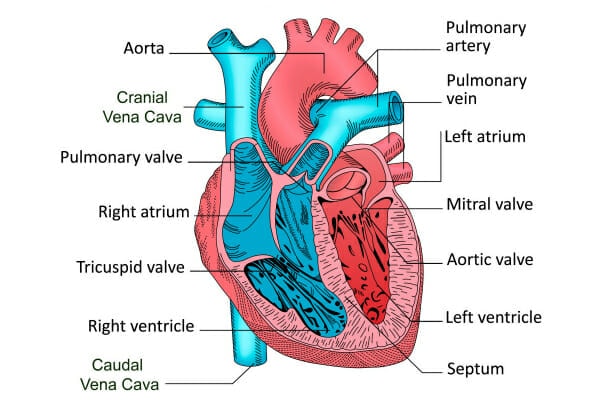
To keep the chambers separated, small heart valves open and close as each chamber pumps and fills with blood. Pressure gradients in the heart work with the valves to keep blood flowing in the correct direction.
Blood enters the right atrium, then passes through the tricuspid valve and into the right ventricle. The right ventricle then pumps the blood through the pulmonic valve and into the main pulmonary artery, which leads to the lungs. As blood flows through the lungs, it picks up oxygen.
Oxygenated blood then flows from the pulmonary veins into the left atrium, then on to the left ventricle via the mitral valve. Finally, the left ventricle pumps the blood through the aortic valve and into the aorta. This large artery sends blood to the rest of the body.
What does a heart murmur mean?
The sound of the murmur comes from turbulent blood flow within the heart. The heart’s valves are supposed to ensure unidirectional blood flow. To cause a heart murmur, blood may be flowing backwards through a leaky valve, being forced through a narrowed valve, or moving through an abnormal hole or vessel connection in the heart. Or sometimes the blood is thin and watery, which changes the flow dynamics.
With many potential underlying causes, it’s very important to try to find out what may be going on anytime a new murmur is found.
How are heart murmurs in dogs graded?
In order to describe the severity of a heart murmur, we use a numerical grading system. One method of classification involves grading the intensity or loudness of the murmur on a scale from one to six.
The following chart defines heart murmur grades in dogs:
| Grade I | Very faint, requires careful listening in a quiet room |
| Grade II | Soft but consistent |
| Grade III | Moderate in intensity and easier to hear |
| Grade IV | Loud but no palpable thrill (vibration of the chest wall caused by turbulent blood flow) |
| Grade V | Loud with palpable thrill |
| Grade VI | Loud enough to be heard with stethoscope off chest wall, palpable thrill |
Your vet will also classify the murmur based on its location. For example, a dog might have a left-sided murmur that is loudest over the location of the mitral valve. Knowing over which area the murmur is loudest may help pinpoint which valve or structure is problematic.
A murmur may also be described based on when it occurs. Sometimes the “whoosh” noise is heard on the “lub” of the heartbeat, sometimes on the “dub,” and sometimes both.
Systolic murmurs are the most common and occur when the heart is contracting. Alternatively, a diastolic murmur is heard while the heart is relaxed and filling. Other murmurs are classified as being continuous, meaning they are heard constantly.

What causes heart murmurs in dogs?
Because a murmur is simply auditory proof of turbulent blood flow somewhere in the heart, many aspects of heart disease in dogs can be accompanied by a murmur. Some are more concerning than others.
Innocent murmurs
In young puppies, a heart murmur could be physiologic (a result of normal processes in the heart). In these cases, the murmur occurs because the pup is growing rapidly, especially in large breeds. This type of murmur is also known as an innocent murmur since it is not usually a sign of a problem. It typically goes away on its own after a few weeks.
If your vet suspects your puppy may have an innocent murmur, he or she will check for the murmur again at the next visit. If it’s still present, then it may not actually be an innocent murmur. At that point, your vet will probably recommend further diagnostics.

Anxiety-related murmurs
Sometimes, stressed or anxious dogs may develop a heart murmur. This is usually because the heart is pumping very quickly. Like with physiologic murmurs, they eventually go away on their own. If your dog finds trips to the vet stressful, ask your veterinary team for tips to help relieve fear and anxiety. Your vet can also prescribe anxiety-reducing medications like gabapentin for dogs to help your dog feel less nervous about a vet visit.
Anemia or low protein
Underlying illnesses can cause a heart murmur even when there is no evidence of primary heart disease. When dogs are suffering from anemia (low red blood cell numbers) or have low protein in their blood, the consistency of the blood changes. This creates a functional murmur. Once your vet treats the underlying disease, the murmur usually resolves on its own.
Heart disease
When true heart problems are present, murmurs will develop due to structural damage to the heart muscle or the valves. Heart disease in dogs may be congenital (present from birth), inherited (genetically linked), or acquired.
Heart disease in puppies
Heart murmurs in puppies are sometimes due to congenital heart defects. Inherited conditions that may cause heart murmurs include:
- Patent ductus arteriosus (PDA) in dogs: An abnormal connection between the aorta and the pulmonary artery. During fetal development, the ductus arteriosus allows blood to bypass the lungs since they are not yet functional. The ductus arteriosus should close at birth. If it does not close, blood flows directly from the aorta into the pulmonary artery, creating a murmur that is heard continuously.
- Pulmonic stenosis: Narrowing of the pulmonic valve, causing the heart to work harder and exert more pressure to push the blood through the opening. To understand how this creates turbulent blood flow, think about what happens to the water coming out of a garden hose if you close part of the opening with your thumb.
- Subaortic stenosis: Narrowing at the base of the aortic valve, causing the heart to work harder and exert more pressure to push the blood through the opening. The garden hose analogy applies here, too.
- Ventricular septal defects: A hole in the wall separating the right and left ventricles. This allows blood to flow freely between the ventricles as the heart pumps. This turbulent blood flow is responsible for the abnormal sound heard in dogs with VSD.
Heart disease in adult or senior dogs
Heart murmurs found in adult or senior dogs are usually caused by acquired heart disease. These conditions may include:
- Mitral valve disease in dogs
- The edges of the mitral valve (and sometimes tricuspid valve) may become wrinkly and misshapen. This prevents the valve from closing tightly and allows blood to flow “backward” from the ventricle to the atrium, thus creating a murmur.
- Mitral valve disease is especially common in middle-aged to older small breed dogs, including:
- Cavalier King Charles Spaniel
- Toy Poodle
- Shih-Tzu
- Maltese
- Chihuahua
- Miniature Dachshund
- Pomeranian
- Dilated cardiomyopathy (DCM in dogs)
- The walls of the heart, especially the ventricles, may become thin and weak, preventing the heart from pumping blood effectively.
- This condition can be hereditary in some breeds, such as:
- Doberman Pinscher
- Boxer
- Great Dane
- Irish Wolfhound
- Newfoundland
- Some dogs have developed diet-associated DCM after being fed grain-free, exotic ingredient, or boutique diets.
- Heartworm disease in dogs
- Adult heartworms live in the right side of the heart and pulmonary artery where they take up space and interfere with heart valve function. This sometimes creates a heart murmur.
- Not all heartworm positive dogs will develop a murmur.

It is important to note that the grade of a heart murmur doesn’t always correlate with the severity of the disease. Dogs with mitral valve disease do tend to have louder murmurs as their disease progresses. However, the vet may hear a moderate murmur on physical exam for months or even years before it becomes problematic.
Alternatively, dogs with DCM may only have a faint murmur or no murmur at all, even when their heart is failing significantly. Unfortunately, sometimes the first signs of DCM are acute collapse or sudden death.
Congestive heart failure
Over time, heart disease can lead to congestive heart failure in dogs (CHF). This occurs when the heart cannot efficiently pump enough blood to keep up with the body’s demands. Blood also tends to back up in the heart and vessels. CHF can cause blood pressure problems and/or fluid build-up in the abdomen or the chest cavity.
What are the symptoms of a heart murmur?
Since heart murmurs can result from many different underlying causes, symptoms have a wide range. In some cases, you might not know that your dog has a heart murmur unless you have a stethoscope or your vet finds the heart murmur on a physical exam.
If your dog has a heart murmur that is grade IV or higher, you may be able to feel it as a vibration when you place your hand on your dog’s chest. Each beat causes a palpable thrill.

You can also detect arrhythmias (abnormal heart rhythms) by feeling your dog’s chest. Heart beats should be a steady, repeatable pattern of “lub” and “dub.” If it feels like there are extra heart beats or abnormal patterns, this may indicate heart disease, so contact your veterinarian.
Symptoms associated with heart murmurs can be classified as mild, moderate, and severe.
Mild heart murmur symptoms
The following mild symptoms can be seen in dogs with heart murmurs:
- Occasional cough
- Mild or infrequent exercise intolerance
- Incidental murmur in asymptomatic patient
Moderate heart murmur symptoms
Some signs of more significant heart disease may include:
- A lethargic dog
- Weakness
- Exercise intolerance
- Weak pulses
- Coughing, especially at night
- Increased rate or effort of breathing while awake, resting, or sleeping
- Unwillingness to lie down to rest or sleep
- Weight loss
- Lack of appetite
- Pendulous abdomen
If you notice any of the signs above, make an appointment with your veterinarian.
Life-threatening signs of heart disease in dogs
Keep a close eye out for:
- Pale gums or blue gums (cyanosis)
- Acute collapse
- Abnormal posture with elbows winged out and neck outstretched
- Respiratory distress or difficulty breathing
If your dog is showing any of these signs, this is an emergency. Seek veterinary care immediately.
Heart murmur and coughing in dogs
The most common symptom we see in dogs with heart disease is coughing with varying degrees of severity. In some cases of congestive heart disease, fluid backs up around the lungs (pleural effusion) and causes coughing. The cough may or may not be productive and is usually most notable at night.
If you notice your dog coughing, you may be thinking about a respiratory virus or allergies rather than cardiac disease. However, heart problems are a main cause of coughing in dogs, and the cough may be the first or only symptom noticed.
How are heart murmurs diagnosed?
Your vet will listen to your dog’s heart in a quiet room to diagnose the heart murmur. It is also easiest to hear the murmur when your dog isn’t nervous, shaking, or panting. Depending on your dog’s age, medical history, and the intensity of the murmur, your vet may recommend additional diagnostic tests such as:
- Blood tests and urine tests to look for anemia or low blood protein.
- Blood pressure measurement to look for hypertension (high blood pressure) in dogs or hypotension (low blood pressure).
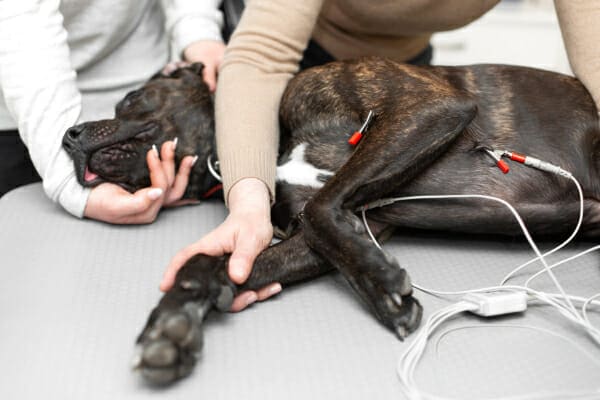
- Electrocardiogram (EKG) to evaluate your dog’s heart rate and rhythm for arrhythmias or other abnormalities.
- Chest X-rays to evaluate heart size and shape, size of the vessels, and the appearance of the lung fields.
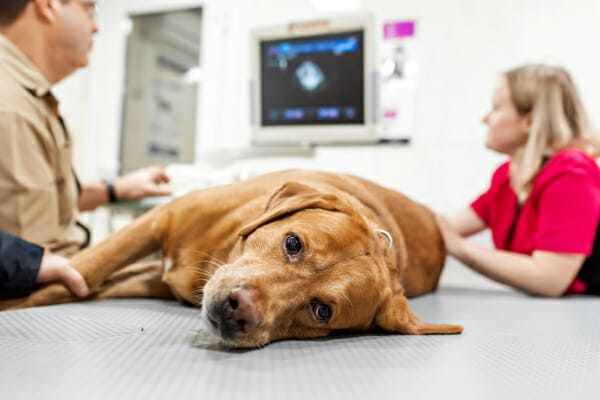
- Echocardiogram (ultrasound of the heart) to evaluate the function and size of the heart chambers, flow of blood through the heart valves, pressures in different areas of the heart, and overall anatomy of the heart. Some vet clinics offer echocardiograms. In other cases, your vet may refer your dog to a veterinary cardiologist, so he or she can perform the echocardiogram, evaluate your dog, and formulate a treatment plan.
What is the treatment for heart murmurs in dogs?
Your vet will consider the underlying cause of the murmur and the results of any diagnostic testing when he or she formulates a treatment plan. The intensity of the treatment plan generally matches the severity of the condition.
No treatment/wait and see
In some cases, a heart murmur is not an indication for treatment of any kind. For example, innocent murmurs or stress/anxiety murmurs typically resolve as the animal grows or calms down. In other cases, it may be best to monitor and see how the murmur progresses or if other signs develop before treating.
Medical management
Many causes of heart murmurs in dogs can be treated with medicine. Sometimes the medicine is intended to manage the symptoms of the disease rather than act as a primary treatment. Such is the case for dogs with valve disease. We don’t have medicine to fix the valves, but medical treatment can help make the heart pump more efficiently, manage blood pressure, and help limit the effects of congestive heart disease.
Usually, dogs on medications for heart disease will be on medication for life. Most heart conditions are progressive, so these patients usually require periodic dose or medication adjustments to make sure they’re on the best treatment plan to maintain a good quality of life.
Although not a direct treatment for heart disease, the benefits of Omega-3 essential fatty acids for dogs are numerous, including promoting good heart health. Thus, your veterinarian may recommend a fish oil supplement depending on your pup’s particular illness.
Surgical treatment
A few causes of heart murmurs in dogs can be treated surgically. For example, a veterinary surgeon can close a PDA to prevent blood from flowing abnormally from the aorta to the pulmonary artery. Surgical repairs may cause the murmur to either resolve or lessen in intensity.
Some dogs with cardiac arrhythmias may have a pacemaker surgically implanted. Arrhythmias may or may not accompany heart murmurs in dogs.
Prognosis for heart murmurs in dogs
Unfortunately, with so many possible underlying factors, it is impossible to give generalized guidelines for life expectancy for dogs with heart murmurs. Even for dogs with similar conditions, prognosis varies on an individual basis.
Many dogs live for several years after being diagnosed with a heart murmur. For others, their condition deteriorates more rapidly—occasionally within days or weeks. Dogs with severe congenital abnormalities often have poor prognoses without surgical intervention.
Your vet will be able to give you information most relevant to your dog and his or her condition. A heart murmur is certainly not an automatic death sentence, so explore treatment options that will work best for your dog and your family.
Dog heart murmur FAQ
Can a heart murmur in a dog go away?
It depends on the cause. Innocent murmurs, physiologic murmurs, and murmurs caused by anxiety can be temporary or intermittent. A dog may have an audible murmur at the vet clinic for a check-up, but would sound normal when relaxing at home.
Additionally, in situations where the underlying cause of the murmur can be resolved, the murmur may go away. For example, a physiologic murmur in an anemic dog is likely to go away once blood values return to normal.
However, heart murmurs that result from abnormalities of the heart structure, such as those associated with mitral valve disease, dilated cardiomyopathy, or septal defects, are here to stay. As the disease progresses, they may also increase in intensity.
When your vet diagnoses your dog with a heart murmur, he or she can give you more information about how likely it is to go away and/or how it may change over time.
How serious is a heart murmur in dogs?
This is another “it depends” question. Sometimes a murmur is nothing to worry about, and sometimes it’s an indication of a dangerous, life-threatening condition. If your dog has a heart murmur, talk to your vet about next steps.
How long can a dog live with a heart murmur?
There is no standard answer since the cause of the murmur, severity of the heart issue at the time of diagnosis, how quickly the disease progresses, the dog’s response to treatment, and other factors all influence how long a dog can live with a heart murmur.
Generally speaking, most patients that I’ve diagnosed with new murmurs live for several more years, especially with good medical management. Some have more severe conditions that shorten their lifespans. And some have murmurs that never cause any problems at all!
Can a heart murmur cause a dog to cough?
Absolutely! Coughing is a very common symptom of heart disease in dogs. In fact, if I have an older small breed dog that presents to me for coughing, I’m more suspicious of underlying heart disease than primary respiratory or infectious diseases. It is that common!
As a caveat, remember that the murmur itself is not causing symptoms, but the underlying condition causes both the heart murmur and the signs of disease.
The “heart” of heart murmurs in dogs
I know it can be concerning when your veterinarian detects a heart murmur. But the good news is that some dogs with heart murmurs still have many good, happy years ahead of them.
Ensure you bring your dog to the vet for a wellness visit at least once a year (or twice a year for senior dogs). This greatly increases the odds that your dog’s murmur will be found before it starts causing problems.
Follow your vet’s recommendations for additional testing and work with him or her to create a monitoring and treatment plan. This early intervention may go far in minimizing the symptoms of heart disease and delaying the onset of CHF.

Does your dog have a heart murmur?
Feel free to share his or her story below.
This post was originally published on August 11, 2021 and updated on January 12, 2026.


My Lhasa, Taschi was diagnosed when she was 13 years old in 2024 with a grade 4. She showed no symptoms at the time. My then Tibetan Terrier Ceba, had a grade 2 murmur as well, (I lost Ceba last year to cancer and he was exactly one year older than Tasch)… but Taschi was referred to a cardiologist and after an Electrocardiogram (EKG) the doctor put her on Vetmedin 2.5 mg twice a day.
An aside…Right after their diagnoses of murmurs, I was sitting in the waiting room of an emergency clinic at two in the morning, when Ceba was having GI issues, I read an article in a AVMA publicatio;
and learned about the effects of having a dog on the grain free diets that are not supplemented with Taurine and a uptick of diagnosed heart murmurs. That was a big slap in the head, as that’s what I had been feeding both dogs. I immediately did a gradual change in their diet.
Tasch turned 15 on Oct.19, 2025 and so far, she has still not shown any symptoms. Her breathing rate while sleeping is still between 4 to 6 counts in 15 minutes which comes out around 16 t0 20 breaths per minute, and no coughing which is really a good thing. She, of course, is slowing down because of age and some knee and back problems…but so far her heart murmur is being maintained with the Vetmedin. So this, so far, is a good story.
Dear Karyl,
I am so sorry for all you have been through over the past 2 years. What a blessing Taschi is doing well, and the medication seems to be keeping things under control. I appreciate you taking the time to share your story with us. It helps others to know they are not alone when facing a similar situation. Praying for continued success for your girl and wishing you both many happy days ahead.
Thank you for sharing your story. My 10 year old Maltese Maddie was just at the Vet last Monday July 29th, 2026 & the Vet told me that her heart murmur is at a 4 & she recommended doing X-rays of her heart. I took her back on Friday, JULY 3, 2026 to have X-rays done & the vet told me then that her murmur is graded @ a 5, & she told me that it has to do with matrial & is quite common. She put her on Vetmedin 1.25mg every 12 hours. She also recommended that the X-rays be sent to a cardiologist for consult, so I told her to definitley do this. She told me that the Cardiologist may recommend a different medication, or he or she may be OK with what my vet started Maddie on yesterday July 3, 2026. She told me that it will take a week to receive the report from the Cardiologist, & she would call me as soon as she receives the report.
Needless to say that my husband & I have spent the last 2 days crying our eyes out, & the thought of being without our little Maddie. We have 2 other female Maltese ages 8, & 2. My 2-year old is my 7th female Maltese I’ve had & I’ve had them all since they were 8-weeks old. Unfortunately, I was in a very abusive & violent relationship when I got my 1st Maltese, & she was violently killed at 16 weeks old by the psycho guy I was in this relationship with. That has been with me for 26 years & it left such a deep scar on my mind & heart, that scar will never heal. I love my girls more than my husband. They are my emotional support system & I truly love them more than anything or anyone in my entire world. It’s so unfair that God doesn’t let these animals who are taken great care of & loved so much live longer. I will try to update you on the Cardiologist report when I receive it. Please pray for better news🙏 Thank you again for sharing your story. 💞
Hi Kimberly,
I know things are scary right now and it is especially difficult when emotions are high. You are doing everything you can to make sure Maddie is well taken care of, and she is lucky to have you in her life. What did you find out from the cardiologist? Hoping you were able to get some good information and there is a solid plan for the future. Feel free to leave an update if you have a chance. Wishing you and all your beloved pups many happy days ahead.
my 4 year old rat terrier was born with a heart murmur. it has now progressed to stage 5 and he started furosimide and vetmedin twice a day. I’m looking into finding a way to get him the heart surgery he needs if he is strong enough to go under anesthesia. he has exercise intolerance, coughing, and sleeps a lot. I can’t imagine life without him and my children love him like crazy too. this experience has made me regret not finding a way to get financial help sooner for his surgery as it will cost thousands of dollars and traveling to a different state. I’m just hoping it’s not too late! things took a turn for the worse very quickly. God bless all of your fur babies and mine!
Dear Maria,
I am so sorry your dog’s health is declining, and you are facing this difficult situation. Praying for clarity and strength as you navigate this emotional path. Bless you both. ♥
hi my dog became ill so I was booked in with the pdsa and they told me bellas got a heart murmur and fluid in her lungs and cannot get better then we had to go again for a check up and repeatedshes poorly but I never thought she still had time with me we were awake threw the nights but
she couldn’t resting dropped of and woke to find she still wasn’t in bed so I looked for her she was just standing in my living room I picked her up she was so cold even though I had the heating on for her but she couldn’t rest 2 hours later she had hid and when I found her she must of just passed as she was cold like when I picked her up it broke my heart she died 3 weeks before her 13th birthday she was so beautiful not one nasty bone in her body I miss her so much as I had her 1yrs after my hubby died i love you bella boo boo I sing your song i made for you and you always came and gave me kisses when I sang it to you
Dear Reader,
I am so sorry for your loss of Bella. It is clear she was dearly loved, and I am certain she knew how much you cared about her. May her memory stay with you always. Wishing you brighter days ahead. ♥
my shipoo aged 5 and a half has been diagnosed with a heart murmur at a routine checkup for vaccinations. it is out of the blue as she is like a mountain goat springing about. she is booked for a scan. however, she is strange at night and I wonder if it’s connected. she sleeps well in her crate with another dog in our room but then she has phases of sudden waking.. whining and anxious panting.. trying to get out of the crate. I thought she being naughty. I let her outside and then she goes back sleep+ not happy to be sent back. in crate) and then does it again. last night I was so tired I let her on bed. could she be waking with palpitations or something?
Hi Susan,
I am sorry your pup is exhibiting these worrisome behaviors in the night. I have not heard of dog’s waking with palpations, but I guess anything is possible. What you describe sounds more like what I would expect with dementia/cognitive dysfunction, but your girl is quite a bit younger than my normal dementia patients. Without being able to examine her myself it is hard to offer specific conclusions. Hoping the echocardiogram will offer some definitive answers and praying for a clear path forward with treatment. Wishing you both nothing but the best.
My 4 year old Oliver, frenchton, was diagnosed today with a heart murmur, grade 3.
He doesn’t really show any symptoms. We will be seeing a cardiologist in the next month to have a more thorough look at his heart. My anxiety is going crazy though, does this mean a likely shortened life for him? He gives the appearance of being as healthy as an ox…..
This is so upsetting.
Hi Chris,
I am so sorry Oliver is facing this worrisome heart issue. I am glad you have an appointment scheduled to see the cardiologist as they will be able to answer all your questions about prognosis and what to expect in the future. There really isn’t enough information at this point to know if this will shorten Oliver’s life. Many dogs are diagnosed with heart murmurs and go on to live long happy lives. Try not to let the fear of the unknown weigh you down. There is hope and I pray your boy will receive favorable results. Feel free to leave an update after you see the specialist. Best wishes to you both!
Hi! Heart murmurs are so serious. I’m heartbroken..lost my chihuahua baby Kahlua on February 27-2025.. my life is not the same..Bless your baby .and hope gets the best care..🙏🏻❤️
Dear Alexa,
I am sorry for the loss of your Chihuahua. Wishing you brighter days ahead. Bless you. ♥
I have lost many throughout my life and i am saddened ,and the pain never leaves but i have expectancy to see them all one day in heaven,God bless you and hope you keep adopting others in need of family.