
Summary: A miniature Dachshund named Tango is diagnosed with intervertebral disc disease. Integrative veterinarian Dr. Julie Buzby recounts the story, shares why IVDD in dogs occurs, and explains what to expect at the vet visit.
Understanding why IVDD occurs in some dogs
If you have ever owned or loved a Dachshund, you are probably familiar with the most common spinal disease in dogs—intervertebral disc disease, commonly referred to as IVDD.
But I don’t like to talk about “diseases,” I like to talk about dogs. So our story begins with a MUCH loved four-year-old miniature Dachshund named Tango.
His family doted on him like he was the crown prince and often expressed their love with treats, extra helpings of dog food, and bits of bacon snuck under the breakfast table. Tango weighed in at a whopping thirty pounds. Based on his frame, he should have weighed about fifteen. (To learn your dog’s ideal weight, please read my article: Canine Body Condition Score.) His owners were embarrassed. They knew Tango was too heavy, but they couldn’t seem to break their bad habits.
Concerned about the impact of this practice on his health, I had encouraged weight loss through several methods: cutting back his treats, feeding a lower calorie diet (and less of it), and gentle exercise. But so far, we had been unsuccessful at helping Tango shed his extra pounds.
Now Tango sat on his mom’s lap in my exam room, and they both looked very worried. His mom explained that he was reluctant to get up from his bed, and when he did, he walked like a drunken sailor. She set him gingerly on the exam table, and he stood with a hunched back. I could read the pain in his face.
My heart sank. This was Type I intervertebral disc disease until proven otherwise.
Type 1 intervertebral disc disease
Type I intervertebral disc disease is common in some dog breeds including:
- Corgi
- Lhasa Apso
- Cocker Spaniel
- Beagle
- Pekingese
- Shih Tzu
- Dachshund

But miniature Dachshunds, like Tango, are regarded as the highest risk breed. According to a 2016 article published in the Journal of Canine Genetics and Epidemiology, Dachshunds are at 10-12 times higher risk than other breeds to develop IVDD. In fact, one in five Dachshunds will show clinical signs related to IVDD at some point in their life.
These statistics probably have you wondering, “Why?” The answer may surprise you.
The problem is chondrodystrophy
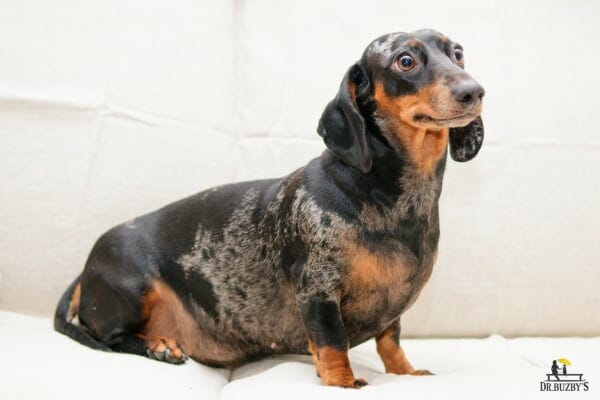
Type I disc extrusion is most often encountered in breeds like Tango that are chondrodystrophic. The University of California Veterinary Genetics Laboratory describes chondrodystrophy as “a trait that defines many dog breeds and is characterized by reduction of long bone length (shorter legs) as a consequence of early changes in the structure of growth plates.”
But what does this have to do with a dog’s spine?
How a dog’s spine works
The dog’s spine is really an ingenious design. It needs to be rigid to provide protection for the spinal cord but also flexible to allow for movement. Thus, instead of one solid bony structure encasing the spinal cord, the dog’s spine (like a human’s) is a long, bony column made up of many individual vertebrae. From the base of the skull to the sacrum (pelvic region), there are 27 vertebrae that make up the dog’s spine. Between the vertebral bodies, there are small “washers” that act as cushions. These structures are called intervertebral discs.
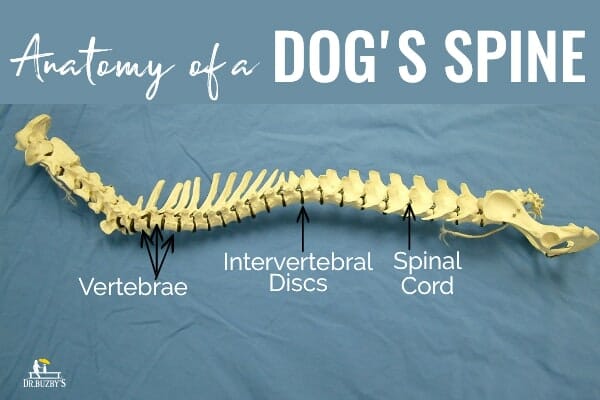
Anatomy of a dog’s disc: the “jelly donut” analogy
A disc is much like a jelly-filled donut. In the middle is the nucleus pulposus, or the jelly in our analogy. It is predominantly made of water and acts as a shock absorber. It is surrounded by the annulus fibrosis, or the donut—a tough, fibrous ring of tissue bands. Together, they absorb shock for the spine and protect the spinal cord from injury.
When the “jelly” hardens and the disc ruptures
Disc degeneration can occur in any breed of dog. But for chondrodystrophic dogs, because of an autosomal dominant genetic mutation, it starts very early in life (beginning in puppyhood) and continues at an accelerated rate. Changes in cell types within the nucleus pulposus (the jelly) render it less jelly-like and more rigid in consistency. The discs also begin to calcify. Wear and tear over time can lead to a breakdown of the unhealthy annulus (the donut), and the nucleus ruptures through the path of least resistance (out the top of the donut).
When the disc herniates, the nucleus (jelly) shoots out and hits the spinal cord causing swelling (edema) and hemorrhage (bleeding). The spinal cord suffers from both bruising and compression. As you can imagine, neither are good for the delicate cable of nerves that we call the spinal cord. The trauma to the cord manifests as pain and weakness. In some cases, paralysis can result.
Location, location, location
Disc rupture can occur anywhere in the dog’s spine, but most occur in the thoracolumbar region or mid cervicals (neck). About 3/4 of acute disc herniation happen in the discs located from the last few thoracic vertebrae to the first lumbar vertebrae.
The explanation I’ve heard for this is because the thoracic vertebrae have stabilization from the rib cage, but the lumbar vertebrae don’t have ribs attaching. So the thoracolumbar junction is a leverage point for instability and torque. Further, one ligament that runs between the vertebrae to provide stability tapers and disappears in this region.
No “mom guilt” allowed
If you’ve been through back problems with your Dachshund, past or present, I know it’s tempting to lament the “what ifs.” But this is not likely something you caused or could have prevented.
Dr. Bill Thomas, a veterinary neurologist at the University of Tennessee College of Veterinary Medicine, explains it this way, “Chondrodystrophic dogs don’t extrude discs because of activity. They extrude their discs because they are chondrodystrophic.
Chonodrodystrophic dogs develop chondroid degeneration of their discs. This is genetic. It has nothing to do with activity and nothing to do with the length of their back. It is a genetically determined defect in the metabolism in the disc. There are a lot of specific biochemical changes but the basic problem is the disc loses water content. So instead of being soft and flexible, it becomes dried out and brittle. Most importantly, it is no longer able to withstand daily stress and stain. Eventually, the ligaments tear.
These biochemical changes start at weeks of age. And there is no evidence that exercise or activity affects this degeneration.”
Type 1 IVDD in dogs occurs in young to middle-aged dogs
When you understand the underlying pathology—the early and rapid degeneration of chondrodystrophic discs—two odd things make perfect sense:
1. These dogs present with acute (sudden onset) symptoms, but in most cases, there is actually no history of a trauma causing disc herniation. In some cases, a traumatic event (like colliding in play or jumping down from the bed) occurred prior, but it’s not the ultimate cause. It’s the straw that breaks the camel’s back—no pun intended.
2. Type I intervertebral disc disease typically occurs in young to middle-aged dogs, like Tango.
Interestingly enough, there is another type of IVDD associated with older dogs. This is Type II IVDD, affecting mostly large breed dogs, and the underlying cause is different.
Diagnosing IVDD: The vet examination
As I examined Tango, I explained to the little Dachshund’s owner that I was worried about his back. She nodded in agreement because we had discussed this concern at almost every prior wellness visit.
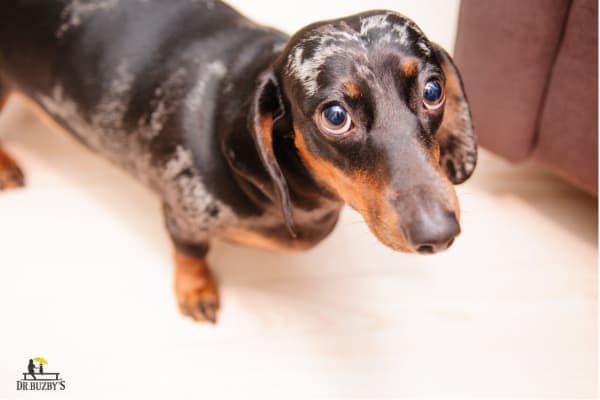
Performing a head-to-tail exam
In the interest of being thorough, I performed a head-to-tail exam, listening to his heart and lungs, checking his eyes and ears, and palpating his belly. Next, I gently palpated the Dachshund’s vertebrae, from the base of his skull, working my way down. As I neared the middle of Tango’s spine, he yelped and dipped his back away from my hand. Often we repeat tests on a physical exam to confirm that they are an accurate representation of the dog’s response. But I certainly didn’t want to repeat hurting him. I believed him the first time.
Finally, I came to the moment of truth—his neurologic examination. This would help me determine if a disc seemed the likely cause of his problems and also localize where, approximately, in the spinal cord the disc was damaged.
The neurologic exam: checking reflexes
As I checked his reflexes, I explained to Tango’s family what I was looking for. The reflexes in his back legs were brisk and normal which told me that he had a classic thoracolumbar herniation. If they had been sluggish or absent, I would have determined the problem was in the lower lumbar spine. If all four limbs were abnormal, the problem would have been higher up in the spinal cord—in his neck.
Next came the two most critical parts of the test:
Checking conscious proprioception
I used two techniques to make sure Tango could feel his feet. In the first, I supported his body and flipped his hind paw upside down in a “knuckled over” position. A normal dog should flip the foot back briskly—to stand on the paw pads instead of the top of the foot. (For a demonstration on how I test for conscious proprioception, please watch the video below of a healthy dog’s reaction.)
Tango was very, very slow to replace his foot in the normal position. I repeated this test several times on each hind paw.
This technique evaluates “conscious proprioception”—the brain’s conscious awareness of where the body is in space—and helps to determine if the nerve pathways to the brain are intact. Tango’s were, but he was much slower than normal to “right” his hind feet.
Incidentally, this is a test that I teach my veterinary clients who own a dog with back issues. It’s an important prognostic indicator and easy to learn to do at home.
Testing for deep pain
Finally, I gently pinched Tango’s toes with a hemostat to make sure he could feel his feet. This may be the worst test I have to do on dogs. Seriously, it always makes me cringe, and I know I look like Dr. Jekyll to the clients, but it’s a critical test that can’t be skipped. I’ll explain why in a second.
Tango definitely could feel the pinch. The little Dachshund let out a yelp. It’s important to note that a dog moving/pulling his leg away from the pinch is not a positive test. I needed to see Tango consciously respond through an obvious change. In other words, I was looking for a head turn, vocalization, or even the dog trying to bite me. This ensures that his brain had received the signal of pain from his toe.
Why testing for deep pain is critical in determining IVDD
When the ability to feel deep pain in the limbs goes away, we grade the dog a 5 out of 5 on the IVDD grading scale, and the prognosis (expected outcome) becomes much worse. The gold standard treatment for grade 5 dogs is surgery. Had Tango shown me that he was not aware that I was pinching his toe, I would have recommended emergency back surgery, called a hemilaminectomy. This surgical procedure has a great recovery rate when deep pain is still intact. Around 96% of dogs will recover fully. When deep pain is lost, however, that recovery rate drops to 50%.
IVDD Grading Scale
In grade 1, the dog is painful but has no change in gait and no neurologic deficits. In grade 2, the dog experiences pain, weakness, and decreased conscious proprioception. Grade 3, 4, and 5 worsen incrementally. By grade 5, the dog can no longer move the back legs (and front legs too if the disc is located in the neck), cannot urinate normally, and does not feel his back legs.
- Grade 1 – Pain only
- Grade 2 – Change in gait (ie. drunken sailor gait) plus conscious proprioceptive deficits
- Grade 3 – Partial paralysis (called paresis)
- Grade 4 – Paralysis with pain perception present
- Grade 5 – Paralysis with loss of deep pain perception
Tango’s IVDD was a grade 2
With confidence, I explained to Tango’s owners that I was almost certain he had a herniated disc in his thoracolumbar spine. He could still move his legs, and he could still feel them. He could stand, but he was weak. My examination graded Tango at a 2 on the scale.
Other possible causes of IVDD-like symptoms
“Is there anything else it could be?” Tango’s mom asked.
Although Tango was practically speaking the words, “Help me, I have intervertebral disc disease,” we had not proven it.
The “runner up” diagnosis was a fibrocartilaginous embolism (FCE)—a poorly understood condition in which a piece of cartilage breaks off and lodges in a blood vessel, causing neurologic signs similar to IVDD. (For more on FCE, please read my article, Spinal Stroke in Dogs: How Love and ToeGrips® dog nail grips Helped Ozzie Recover.)
I also mentioned less likely options like trauma to the spinal cord, or even cancer. But given Tango’s age and breed, this was IVDD until proven otherwise.
X-rays and advanced diagnostic testing
You may be wondering about X-rays and whether they would be needed to confirm the diagnosis.
The answer is…maybe. Discs don’t show up on a normal radiograph (X-ray) unless they are calcified—meaning they have become hard and mineralized. Seeing a mineralized disc on X-rays from a Dachshund would be about as shocking as seeing a mosquito in the summer.
Plus, most older dogs will have them. Just because there is a mineralized disc on radiographs doesn’t mean that there is disc compression on the cord. But sometimes a calcified disc can be positioned in such a way to suggest herniation. Additionally, X-rays can show a narrowing of the spaces between the vertebrae.
But it’s important to understand that your veterinarian cannot diagnose IVDD based only on radiographs. Advanced diagnostic imaging is necessary to confirm the diagnosis—such as a myelogram, CT scan, or MRI.
That said, your vet may or may not recommend radiographs if IVDD is suspected. I explained all this to Tango’s owner, and we elected not to do radiographs.
Grade 2 IVDD dogs are, by definition, still walking. In the vast majority of cases, we recommend medical (non-surgical) management at this stage.
Now that I had conducted a thorough exam, it was time to develop a treatment plan for Tango.
Tango’s treatment plan
In part two of this blog post series on IVDD in dogs, I share Tango’s treatment plan and recovery. Don’t miss out! Please sign up for Dr. Buzby’s Barkworthy, my weekly dog health email, so you’re sure to receive “the rest of the story” delivered to your inbox. Plus, when you sign up now, you’ll receive my free e-book, Seven Ways to Love Your Senior Dog.
Do you have a question or comment about IVDD?
Please comment below. We can all learn from each other.


Hi Dr. Buzby,
Thank you for this wonderful blog it has really helped ease my mind. My senior dog Simba has recently been in a lot of pain. He has a history of patella surgery on the left and ACL on the right. He has been taking Rimadyl anti inflammatory for several years which has helped with arthritis. Newly, he seems to be in a different type of pain, which started upon return from vacation. He is arching his back when walking and seems to have muscle atrophy to the hind legs. He still walks but his gait has changed to a waddle like motion. He seems to be in extreme discomfort when trying to sit or lay down, where he circles many times and whimpers or yells. He has had one or two accidents lately but still defecting and peeing on his own. We tried tramadol for pain but he gets really anxious.
I took him to the vet where we had x rays and there is clear degenerative changes in his thoracolumbar spine. The vet says he has a slip disc with slight decrease in vertebral space between the adjacent vertebrae.
For treatment she does not recommend surgery. She gave me the option of steroid treatment with a muscle relaxer and if all else fails “to put my dog down”. You can imagine how upset I got.
After reading your blog it sounds like Simba is grade two. Are there any back braces, physical therapy, medication, ect you would recommend and or have used to help him recover. What is the risk of me trying steroids and holding off on surgery? Is surgery successful in 13 year old dogs? Any help and advice would be greatly appreciated.
Sincerely,
Dr. Stephanie Lubin
Hi Dr. Lubin,
I am so sorry you are dealing with such a difficult situation with Simba. He is very lucky to have someone like you in his life who is willing to take such an active role in advocating for his health and wellbeing. I highly recommend you have him evaluated by a veterinary neurologist/neurosurgeon. I have definitely seen senior dogs have successful outcomes with this type of surgery. As long as your boy maintains motor function to his rear legs and can still feel deep pain, it can be ok to try pain meds and anti-inflammatories with strict cage rest to see if the nerve damage can heal a bit on its own. In the meantime, there are several things that can help with the recovery process. I am not aware of any back braces for this type of injury in dogs, but routinely recommend physical therapy, supplements, and other treatments such as laser therapy. You may want to reach out to a veterinary rehabilitation professional or an integrative vet that can offer a combination of western and eastern medicine. I will attach links to other articles with more information. I am hopeful you can find the answers and advice you need to make the best decision for you and your senior guy. Wishing Simba the best of luck!
1. IVDD: Can a dog recover without surgery?
2. IVDD Surgery: When Your Vet Recommends Surgery for Your Dog
3. Natural Pain Relief for Dogs: 13 Methods
Hi Dr Busby, I’m on holiday in France with our 13yr old dog, Mudflap. He is a dingo/Kelpie crossbreed from Central Australia and in good condition for his age. He has occasionally developed temporary rear leg lameness over the least few years, but has always recovered full use of his legs afterwards. Our home vet tells us that he has a bit of arthritis that is normal for his age. But last week while running along the street, he turned too quickly into our house and pinched/damaged/twisted something and he now walks with a slight left rear leg limp and snake like gait. He has a little knuckling on his right foot indicating the proprioception problem of which you speak. A local vet held and stretched out his rear legs and he didn’t wince, and i think she said this indicated he didn’t have a severely slipped/herniated disc, but rather neurological spinal degen. Could you please give me any advice as i am possibly about to embark on an expensive scanning process with him and my understanding of French is very limited. I guess i’m interested in….
– can toe grips re-stimulate lost or damaged neural pathways and possibly correct the knuckling and snaking?
– what other non-invasive treatments are there?
– how much spinal surgery is conducted on 13yr old dogs for nerve impingement problems, who have natural spinal arthritis anyway?
– does glucosamine and green lipped muscle supplements work?
Finally he has improved a little…how long do i give him before moving to scans etc?
Many thanks from Provence!
LOVE your website
Jon
sorry i meant to say knuckling on the left foot!
Hi Jon,
I am sorry your senior guy has injured himself while you are on vacation and away from your home vet. Since I haven’t examined him myself, I can’t make specific conclusions, but it definitely sounds like he has a neurological issue. The most common and conservative way to treat IVDD medically is to have the dog taking anti-inflammatory medications and have them very restricted to crate rest. Sometimes I will even add on a muscle relaxer if needed. ToeGrips can help give extra stability/traction while the hind limbs are weakened and help stimulate proprioception in the toes and foot. They will not do anything for the spinal cord or nerves close to the damaged spinal disk and will probably not correct the knuckling or snaking. The goal of treatment at this point is to reduce inflammation around the damaged disk and spinal cord. As the inflammation resolves, the function should return if the spinal cord is not too badly damaged. This healing process can take several weeks. If you are interested in surgical correction of the IVDD or just need advice, I highly recommend you talk to a veterinary neurologist. Glucosamine and green lipped muscle supplements do help quite a bit and would be great to add to pain medications prescribed by the vet. I hope you can find the answers you need to make the best decision for you and Mudflap (love his name!). Feel free to leave an update if you have time. Wishing you both the best!
Hi Dr. Buzby,
Thank you for sharing this helpful information. My 2 year old maltipoo was just diagnosed yesterday with a herniated disc by my regular vet. She cannot walk unassisted as she is very wobbly and would fall to the side if I was not supporting her. She can’t stand from sitting without assistance. She can bend and lift her back legs on her own but her paws knuckle as she walks and most of the time the legs are dragging. I have been reading a lot about IVDD and the paws knuckling seem to be an indicator that it could be more serious. I’m really unsure where the line is between trouble walking but still manageable medically and paralyzed in need of emergency surgery. When the vet checked her he said she had delayed function in her back legs and she was already dragging and knuckling then, but I don’t know what the signs are that it could be getting worse. She peed twice today and pooed once which makes me hopefully she hasn’t lost all neurological function. I am currently giving her pain meds, anti inflammatories, a muscle relaxer and antacids as prescribed by my vet and keeping her on bed rest. Given her symptoms, do you think we should consider surgery or should we only consider surgery if she is completely paralyzed in her back legs and cannot feel pain? Any advice or guidance you can provide would be much appreciated!
Thank you in advance.
Hi Beatrix,
I am sorry your pup has experienced a herniated disc so early in life. I am glad she is being treated and seems stable for now. In my experience, there is a much greater chance of a positive outcome with surgery if it is performed before a dog completely loses sensation in the limbs. I will attach links to other articles that may offer additional information. I highly recommend you talk with a veterinary neurologist in your area. They can give you their expert opinion and answer any lingering questions. I hope you find the answers you need to make the best decision for you and your sweet girl. Praying for a positive outcome and a complete recovery.
1. IVDD Surgery: What If Your Vet Recommends Surgery for Your Dog?
2. IVDD: Can a dog recover without surgery?
3. IVDD in Dachshunds: Lady Penelope’s Experience
Hi Dr Buzby. Thanks for your very useful articles on this topic. Today, my Yorkie, Benji suddenly started to topple to the left side and could not walk properly on his hind leg/s. I immediately took him to the vet. He says Benji has poor placing reflex but deep pain is present and referred me to get an X-ray and an ultrasound. I read what you said about X-rays, so will the ultrasound provide additonal informationhelp to pick up if it is an IVVD? Thanks in advance.
Hi Trish,
I am glad you were able to get Benji examined so quickly. It sounds like your vet has a good plan in place to try and make a diagnosis. Since I have not seen your dog personally, it is hard to know the details and offer specific advice. While x-rays are good at imaging bone, ultrasound is better to evaluate soft tissue. The ultrasound may also be used to evaluate blood vessels or help rule out other causes of the decreased placing reflex besides IVDD. If your referral is with a neurologist, they may recommend a CT or MRI as well. Just remember that you need to be honest with your vet about your concerns and ask as many questions as you need to feel comfortable with the progression of tests and/or treatment. I hope your sweet boy will recover fully and that you get a diagnosis that allows for a happy future. Best wishes to you both and keep us updated!
Hello Dr. Buzby.
Our family recently have a Coton de tulear puppy and we did a health DNA check with Embark and the result came back showing that the pup inherited one copy of a variant and has increased risk of type 1 ivdd. My question is will the pup eventually develop ivdd with this condition or it’s something that can be prevented? Thank you!
Hi Quinn,
Congratulations on the new puppy! This is an excellent question. Based on our current understanding of IVDD, having one copy of the variant doesn’t automatically mean your pup is doomed to have IVDD at some point. However, it is helpful information because knowing that the pup could have an increased risk of IVDD can help you to take some precautions to help protect the back and neck. One of the most important things you can do is keep your pup at an appropriate body condition score. Being overweight or obese greatly increases the risk for IVDD. You may also want to consider getting some steps or ramps that your pup can use to get up on the bed/couch or into the car to prevent him or her from jumping up and down. While I don’t typically recommend starting young puppies on a joint supplement like Encore Mobility, it is definitely something to keep in mind for the future. Best of luck to you and your new furry family member!
Hi Dr. Buzby,
My 2 year old Chihuahua loves to run, leap and chase her sister (a 2 year old cat) and play. She is my heart and I was shocked to hear her yelping in the backyard last week. I went to pick her up and she was in extreme pain, writhing and panting. All the vets in my area were booked for 5 days and I finally got an appointment today where the doctor told me that she has a herniated disc and most likely IVDD. When she does walk, she’s like a drunk salior and her back legs cross, tripping over them and landing on her bum. I’m so sad and worried – it’s been terrible to see her in so much pain. She’s on three types of pain meds and strict crate rest for two weeks.
My question is this – will this be a chronic condition that comes and goes? Is it possible that this was a singular episode and won’t happen again? What can I do now that I know she has this disease? Thank you so much for your help!
Hi Christine,
Sorry to hear about your sweet Chihuahua’s IVDD episode. It is so difficult to watch a beloved dog struggle to walk when just days before everything was normal. It sounds like the vet has a great plan with the multiple types of pain meds and cage rest. You can learn more about non-surgical IVDD recovery in my article IVDD: Can a dog recover without surgery?. Sometimes unfortunately dogs with IVDD do require surgery (more about that in my article IVDD Surgery: What If Your Vet Recommends Surgery for Your Dog?)
Your question about reoccurrence is a good one. In general, there is always the potential that the IVDD could flare up again, either in the same location or in different location. Depending on what studies you look at, around 20% of dogs who have IVDD surgery and 40% of dogs who don’t have surgery may end up having an IVDD episode again. As far as what you can do to prevent further episodes, keeping her at a correct body condition score is very important (learn more about BCS from Your Dog’s Body Condition Score (BCS): Find Your Dog’s Number in 3 Easy Steps). Avoiding her jumping and twisting can also help prevent IVDD. That is a harder one because she loves to run, leap, and play with her kitty sister. You will probably have to find some balance between letting her having fun and protecting her back once she has recovered (and definitely be very good about strict cage rest in the recovery time period). I wish you all the best and hope she recovers well. If you have any doubts about how she is doing during the recovery period, don’t hesitate to reach out to your vet for a recheck exam.
Hello Dr. Buzby! Thank you for give so much information about this topic to us pet parents that feel lost and confused on what is happening to their fur baby! Our dog Biscuit has recently been diagnosed with possible IVDD. We had to bring her to an emergency vet on the Saturday prior to 4th of July just 2 weeks ago. They took X-rays and did testing on her to see if they could figure out what was wrong. The knuckling test she did not try to pull her toes back in the correct position at all. And the test she did pushing down along her spine she reacted slightly to the pressure. She has never made any noise of being in pain, but we knew that she had something going on because she was stumbling on her hind side and walking very slow. It came on out of nowhere and very all of a sudden.
As of now we have been keeping her on restricted movement. (She’s not caged, but we have gates the stairs to the second floor and both my son and myself have slept downstairs on the couch and air mattress since this has happened. She is on prednisone (weaning off), methocarbamol (2 times a day), and gabapentin (also 2 times a day). She has days where she seems better than others, but we know she is still not right. I’m trying to figure out if we need to get a CT Scan or if we should continue the current treatment and see if she gets better? It’s so hard to know when they can’t tell us how they truly feel! I at least now understand a bit more of what it is she most likely has, but feel like without a CT Scan we won’t know for certain.
Hi Sheri,
Sorry to hear that Biscuit may have IVDD. It sounds like you and your son are doing a great job taking care of her. That is so sweet that you are sleeping downstairs with her. ❤ It is hard to watch our beloved pets struggle and be unsure if they are making the progress that they should. Since I haven’t examined Biscuit, I can’t really tell you if you should or should not go forward with the CT. The best way to get an answer would be to have her rechecked by your vet or a veterinary neurology specialist. He or she would be able to tell you if Biscuit is recovering as expected or if he or she thinks that Biscuit should have imaging such as a CT to confirm this diagnosis, evaluate the discs and spinal cord further, and check for other problems. I hope you are able to find some clear direction for Biscuit and that she recovers well!
So glad I came across your article!!! My 8 yr old shih tzu/yorkie mix suddenly began yelping in pain a few weeks ago and I was thankful that her vet immediately suspected her lower discs were inflammed and he also said there was not much cartilage in between the lower vertebrae. He has been doing acupuncture along with laser treatment and I give her CBD with turmeric and frankenscense. She is not yelping in pain as much any longer but still seems to get “twinges” every once in awhile. Would those be muscle spasms? I am thinking she would benefit from the gabapentin and perhaps look into the carprofen. I was wary of meloxicam for the possible side effects. She is all I have left but don’t want her to suffer . I think she is a grade 1 from your description. I have ramps and carry her up and down the stairs as I live on the second floor. I look forward to your input . Thank you !
Hi Susan,
It sounds like you are doing a great job caring for your dog and I am glad that overall her pain has lessened! It does sometimes seem like dogs with IVDD will have painful twinges. These could be muscle spasms or potentially nerve root pain (pain that comes from the area where a nerve exits the vertebrae and sometimes radiates outward). I would suggest mentioning those twinges to your vet and getting his opinion on ways to improve your dog’s pain control. This may be in the form of medications like gabapentin or carprofen (as you mentioned) or potentially other therapeutic modalities. Since I can’t examine your dog myself, I can’t say for sure which of these options would be best but it sounds like your dog is in great hands with your vet! I hope she continues to improve, and I am so glad that you found the article helpful! If you haven’t already, you may want to check out my other articles on IVDD: IVDD: Can a dog recover without surgery? and IVDD Surgery: What If Your Vet Recommends Surgery for Your Dog?. All the best to you and your sweet pup!
Great article. Came across it because my 14.5 year old Beagle has a compressed disk in her neck. She can still walk, hind legs look like they’re slow, and she has to be coaxed out of bed. With her age we aren’t going to do surgery (I think it’s level 2). Doing gabapentin, muscle relaxer, and anti-inflammatory/pain med.. it’s so hard to watch her like this.
Hi Lisa,
Sorry to hear that your Beagle has IVDD in her neck. It is definitely hard to watch our beloved pets struggle, but it sounds like you are doing a great job caring for her. I hope she responds well to her medication plan and is back to feeling like herself again soon. I’m glad the article was useful for you too!
We just got a beagle basset hound shih tzu mix from shelter. He is about 4 months old. His sister’s dna results came back positive for IVDD gene and unfortunately, she was put down this week because of it. Should I be worried that he has the same genes? Is there something I can do to prevent the same fate? I am panicking he will go through the awful nightmare that his sister did. Thanks so much in advance for your help!
Hello Jackie, There is not a genetic test directly for “IVDD” although there has been some recent publications on the identification of a gene associated with chondrodystrophy in dogs, which is a related issue: https://www.dachshund-ivdd.uk/testing-for-ivdd/dna-test-for-ivdd/ I don’t think you need to panic, my friend. You cannot fight genetics. But you can keep your dog lean and fit throughout life, and I’d also recommend purchasing pet health insurance. Enjoy your puppy! ♥️
I just lost my 12 year old pit bull mix to IVDD, it was horrible, she was still there, her mind like the prior woman said, but it happened all so quickly. My primary vets misdiagnosed her and said it was arthritis and gave pain meds, however she then was lame and in discomfort which quickly turned into not being able to walk and then not able to use the back legs, so sad, I was heart broken, she was 12 but had great bloodwork and no arthritis and seemed 1/2 her age. So upsetting that this happened suddenly to her, I keep trying to see if I pulled her on the leash too hard, let her jump up on the bed and other things which are put lots of wear and tear on her back. She had a great life just wished it didn’t end so abruptly and in this manner.
Dear Santhe, I’m so sorry for your loss. I hope your memories together are a comfort to your heart. I sincerely believe that you did nothing to cause the issue for her. Please accept my deepest sympathies. ?
Hi. I’ve worked with pets for 20 years as a veterinary assistant. I just stumbled on your website looking for a connection between IVDD and hardwood floors. I just a week ago lost my 2nd giant breed to Grade 4 IVDD. My Saint had already been operated on by a team of Neurosurgeons at UGA 3.5 years prior, herniated another disc. I lost a Newfoundland to it approx 8 years ago as well. I’m also a basset hound person, so I am aware of type 1 IVDD. But this is 2 giant breeds in a row I’ve lost to type 2, wondering if you have written the article on causes of type 2 in giant breeds yet. It is one of the most heartbreaking ways to lose a dog, their mind is still there. I like the toe grips idea a lot, look forward to your response. Thank you
Hi Leanne, I’m so sorry to hear of your recent loss. I know how heartbreaking that is. We have a 4-part series of articles on IVDD, and this one: https://toegrips.com/intervertebral-disc-disease-dogs/ should contain the information you are looking for.
Very good article. I would like to know what large breeds can have this. By reading it it made me think ones like sight hounds would be a breed that would have this. I really enjoy learning new w. Thank you.
One other thing, I have a 2 1.2 yr old standard poodle that is My service dog. I would really like to know if your gorGeous would help him to not slip on the stores floors. He will get shoes when I have $60 to get some. Thank you for the great read and I really want to know if the ToeGrips would work for what I asked about.
Hi Heather,
Thanks for reading and for your kind words.
1. We will be covering Type II IVDD, the IVDD of large breed dogs, in a few weeks. Stay tuned!
2. Yes, we do have several service and therapy dogs who use ToeGrips for slippery floors. You might enjoy this article: toegrips.com/toegrips-save-day-harry-service-dog
If you have further questions, please reach out to our customer care team at [email protected]. Thanks!