Vestibular disease in dogs can look very scary. It is essentially dog vertigo. Most commonly seen in senior dogs, they can appear to go from perfectly healthy to completely off kilter in a moment, usually with no warning signs. Integrative veterinarian Dr. Julie Buzby shares her experience diagnosing old dog vestibular disease, and how dramatic symptoms don’t always mean a devastating prognosis.

Working as a veterinarian, my days are full of ups and downs. My passion for working with senior dogs means I deal with a lot of very serious health conditions in my patients.
Sometimes, however, dramatic clinical signs are not necessarily an indication of a severe underlying problem.
What is vestibular disease in dogs?
Vestibular disease in dogs is a problem affecting the vestibular system, the part of the nervous system responsible for balance and coordination. Symptoms can appear literally overnight and are often quite dramatic.
One of the most common types of this condition is idiopathic vestibular disease in dogs, also known as old dog vestibular disease.
Old dog vestibular disease
Idiopathic vestibular disease occurs most commonly in senior dogs, which is why it is sometimes called old dog vestibular disease. Sudden changes in coordination can be especially scary in older dogs, but fortunately this is one condition that looks worse than it is! Let me explain by introducing a senior dog with old dog vestibular disease.
Meet a senior dog with old dog vestibular disease
Lola, a 13-year-old Blue Heeler, arrived at my clinic with very serious symptoms. She was lovingly cradled in her dad’s arms with her head tilted distinctively. Her eyes were rapidly scrolling back and forth over and over again, like something you’d see in a Looney Tunes character.
Lola’s parents explained the events of the past few days and how suddenly Lola’s symptoms had developed with no apparent explanation. Now she could hardly stand up without falling to one side. At 13, they feared that their sick dog would not be going home with them that day.
I gently scooped Lola from her dad’s arms and performed a physical examination and then a neurologic examination. Despite initial fears that this appointment would end in euthanasia, I then knew I could offer Lola’s parents a glimmer of hope.
A surprising prognosis
Although we still needed to do some diagnostic testing to rule out more serious conditions, I was able to offer some hope that their senior dog would recover with minimal long term effects and possibly none.
Lola was suffering from old dog vestibular disease, or idiopathic vestibular disease. Idiopathic simply means the disease’s origin is unknown. We really don’t know for sure why it happens.
The key part of the syndrome’s long name is the word “vestibular.”
What is the vestibular system?
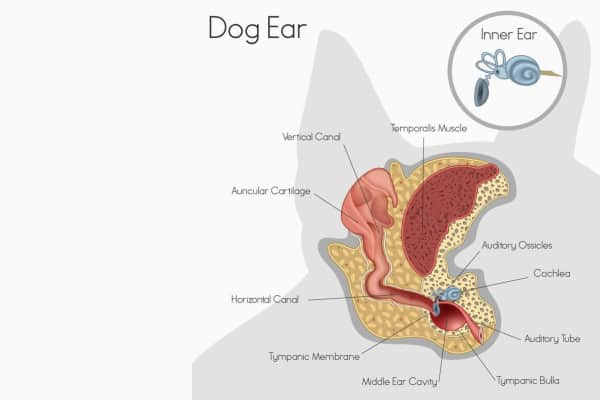
“Vestibular” refers to the vestibular system, which is a complex network of structures located in the dog’s inner ear and brain. The vestibular system perceives the body’s orientation with respect to the earth’s gravitational field and facilitates normal movement. The brain, eyes, and body use the information gathered by the vestibular apparatus to maintain proper posture and balance.
What are the symptoms of old dog vestibular disease?
Symptoms of old dog vestibular disease are mainly associated with coordination and balance. Onset of clinical signs can be quite sudden, literally overnight.
Because the vestibular system is in charge of balance, dogs with vestibular disease often experience dizziness and have difficulty walking in a straight line. If you’re thinking, “that sounds a lot like vertigo in humans,” you’re on the right track.
Old dog vestibular disease can be likened to vertigo in humans, and symptoms of dog vertigo are similar to symptoms of vertigo found in people.
In dogs, classic clinical signs of vestibular disease include:
- Abnormal posture, especially standing with legs spread wide: If they feel off balance, dogs may adopt a wide-based stance to keep from falling over.
- Head tilt: Looking a bit like an inquisitive expression, a head tilt is the most common symptom of vestibular disease in dogs.
- Impaired coordination: Think about trying to walk after spinning around in a desk chair; this is the degree of dizziness that can occur.
- Loss of balance: Dogs with vestibular disease may repeatedly fall over, even if they’re standing on a flat surface.
- Rapid eye movement when awake, called nystagmus: This uncontrollable repetitive eye movement can be side-to-side, up and down, or circular.
- Circling: Sometimes dogs will repetitively walk in circles. After all, it seems to them like the room is spinning!

What causes vestibular disease in old dogs?
By definition, the word “idiopathic” means we don’t truly know what causes old dog vestibular syndrome. It occurs for no apparent reason. It is truly a mystery!
Although it’s the most common form, idiopathic vestibular disease is not the only cause of vestibular disease in dogs. Additionally, vestibular disease can occur in younger dogs as well. Some other conditions can affect the vestibular system, and cause similar vestibular signs.
These conditions can include:
- Ear infections: Because the vestibular apparatus is in the ear, inflammation in the middle or inner ear (otitis media/interna) can cause problems with the vestibular system.
- Hypothyroidism in dogs: In rare cases, hypothyroid dogs can have abnormal blood flow or nerve function leading to symptoms of vestibular disease.
- Trauma: Physical damage to the vestibular apparatus can also impact its function.
- Tumors: Some tumors of the inner ear or brain can put pressure on the vestibular apparatus.
- Tickborne diseases: Certain tickborne diseases can affect the nervous system, including the vestibular system.
- Toxin or drug side effects: Drugs such as metronidazole can affect the vestibular system in rare cases.
Central vs. peripheral vestibular disease
Vestibular disease is a broad term that encompasses many different conditions. It can be broken down into central vestibular disease and peripheral vestibular disease. The central vestibular system includes the cerebellum and brain stem. The peripheral vestibular system is located in the inner ear. Both contribute to balance and coordination.
It’s important to note that idiopathic vestibular disease affects the peripheral vestibular system (inner ear) and not the central system (brain stem). Because of this, you shouldn’t see mental dullness or generalized weakness. If those are present, your veterinarian will likely be thinking about other causes for your dog’s clinical signs.
I expect my patients with old dog vestibular disease to maintain their overall strength and mentation even though their balance and equilibrium are terribly out of whack.
Old dog vestibular disease vs. stroke
The most common concern that my clients share with me when their dogs develop vestibular disease is this, “I think my dog had a stroke.” Indeed, with sudden onset of a head tilt, nystagmus, and lack of coordination, the comparison we could reasonably draw to human conditions is signs of a stroke.
Fortunately, strokes are much less common in dogs than in people. Age of onset of these signs is also significant, as canine strokes tend to happen in younger adult dogs. In a senior dog presenting with these clinical signs, idiopathic vestibular disease is much more likely than stroke.
What dogs are at risk for vestibular disease?
Idiopathic vestibular disease can happen in dogs of any breed, size, or gender. It is most common in senior dogs, and occurs more frequently in German Shepherds and Doberman Pinschers.
How is old dog vestibular disease diagnosed?
Idiopathic vestibular disease is a diagnosis of exclusion, meaning we diagnose it by ruling out other possibilities.
At your dog’s veterinary appointment, your veterinarian most likely will give your dog a thorough physical and neurologic examination, evaluate your dog’s medical history, and have routine bloodwork checked. This is usually enough to make a diagnosis of exclusion,
Sometimes things are not as clear cut, and it can be difficult to definitively rule out certain possible causes. Your vet may recommend referral to a veterinary neurologist for more advanced diagnostic tests.
Additional diagnostics may include MRI (magnetic resonance imaging) or CT (computed tomography) scan, or evaluation of cerebrospinal fluid (CSF) in rare cases.
Treatment for idiopathic vestibular disease in dogs
There is no direct treatment for idiopathic vestibular disease. Treatment can include outpatient or inpatient supportive care for the symptoms, lots of TLC, and sometimes alternative treatments like acupuncture for dogs.
I also make sure to prescribe anti-nausea medication (like Meclizine for dogs or Cerenia for dogs), even in dogs who are not vomiting. That unrelenting dizziness can cause debilitating nausea. (Having personally experienced a period of such dizzying vertigo that I couldn’t safely stand up, I’ve developed new sympathy for dogs with vestibular disease.)
Some patients with old dog vestibular disease are too dizzy or nauseous to eat or drink well, Supportive care in those cases may include IV fluids or nutritional support.
Most cases of idiopathic vestibular disease in dogs can be treated at home rather than in the hospital.
Home remedies for vertigo in dogs
If your veterinarian has diagnosed your dog with geriatric vestibular disease, you may be wondering what you can do at home for your dear dog. In addition to following your veterinarian’s treatment plan, you can make sure your canine companion is comfortable and safe. Here are several things to consider:
- Make sure you have soft, padded bedding for your dog to relax on.
- Keep your dog away from potential hazards like stairs or swimming pools.
- Some dogs with vestibular disease can have a hard time eating or drinking and may need their food bowls brought to them or even hand fed. (Need more tips? Check out my article on how to feed a dog with vestibular disease.)
- Using a sling or towel under your dog’s abdomen when he or she walks can prevent falling.
- Certain physical therapy exercises for dogs with vestibular disease may also help.
Additionally, dogs with vestibular disease have trouble rising and are unsteady on their feet. Our company’s signature product, Dr. Buzby’s ToeGrips® dog nail grips, can improve traction on slippery floors for these dogs and may also provide increased proprioceptive stimulus, improving the dog’s overall stability through neural pathways to the brain.

The main focus of home treatment for vestibular disease in dogs is to keep them safe. The sudden loss of balance and coordination can lead to falls without warning, so making sure they can’t fall down stairs, off furniture, into water, or other dangers is paramount.
Lots of therapeutic snuggles are also encouraged (if your dog enjoys them)!
Can old dog vestibular disease be prevented?
As the exact cause of idiopathic vestibular disease is unknown, we don’t have an effective way of preventing it. Old dogs develop this condition seemingly randomly, out of nowhere. The best thing you can do for your senior dog is to be aware of his or her overall health and notice any changes so they can be addressed quickly.
Vestibular disease in dogs: Life expectancy
Fortunately, despite the dramatic clinical signs, canine idiopathic vestibular disease has an excellent prognosis (prospect of recovery) and does not impact life expectancy. This non-painful condition is usually self-limiting, meaning it will resolve on its own, generally within one to two weeks. In fact, clinical signs that are improving within a few days also helps the veterinarian confidently diagnose vestibular disease..
In many cases the head tilt (a classic sign of old dog vestibular disease) does not go away. But this does not negatively impact a dog’s quality of life. Also, dogs who have recovered from idiopathic vestibular syndrome do not typically experience it again and go on to live out the rest of their days as if this scary episode never happened.
As a veterinarian, I often half-joke with my clients that the whole ordeal takes years off the parents’ lives, though!
Idiopathic vestibular disease FAQs
We’ve already covered the question I’m most frequently asked, “Did my dog have a stroke?” But there are some other questions pet owners commonly ask about old dog vestibular disease.
- Is vestibular disease in dogs fatal?
- No! Old dog vestibular disease is not life-threatening and generally resolves on its own.
- Can vestibular disease recur?
- While technically possible, it is extremely rare for a dog to experience idiopathic vestibular disease more than once. I have never seen it happen in the 25+ years I’ve been practicing!
- How long does vestibular disease in dogs last?
- It can vary, but old dog vestibular disease usually starts improving within a few days and resolves within 1-2 weeks. However, in some cases the head tilt does not go away. Fortunately, the head tilt does not impact quality of life.
A happy recovery from vestibular disease
To this day, Lola holds a special place in my heart. She was the high point of my first year as a veterinarian.
Don’t get me wrong. I was sad to see Lola and her owners endure a few tough days, but the outcome was far better than my clients’ initial expectations.
A few days after her initial examination, Lola strolled out of our hospital, tail happily wagging. A slight (and endearing, if truth be told) head tilt was all that remained as a reminder of her bout with vestibular disease. Lola and her family went on to share many, many more happy and healthy days together.
Knowledge is power
If your older dog experiences symptoms like Lola’s, get to the vet as soon as possible, but proceed with hope. Odds are, your dog can rebound and recover from what can be a dizzying, but not devastating, disease.
Has your dog experienced canine vestibular disease?
Share your story with us!
This post was originally published on ,August 3, 2023 and updated on October 5, 2026.


This article has put my mind at ease somewhat and I am having a glimpse of hope. My sweet 14 year old pup (a red healer and corgi mix) is having all these classic symptoms from yesterday morning.. fearing we would lose him, we headed to the urgent care. It’s been 36 hrs and I’m hoping for improvement… so far not much but keeping my hopes up..
Dear Sumitra,
I am sorry your senior guy is experiencing these worrisome symptoms. Hoping you will start to see improvement soon and praying for a full recovery. ♥