Vestibular disease in dogs can look very scary. It is essentially dog vertigo. Most commonly seen in senior dogs, they can appear to go from perfectly healthy to completely off kilter in a moment, usually with no warning signs. Integrative veterinarian Dr. Julie Buzby shares her experience diagnosing old dog vestibular disease, and how dramatic symptoms don’t always mean a devastating prognosis.

Working as a veterinarian, my days are full of ups and downs. My passion for working with senior dogs means I deal with a lot of very serious health conditions in my patients.
Sometimes, however, dramatic clinical signs are not necessarily an indication of a severe underlying problem.
What is vestibular disease in dogs?
Vestibular disease in dogs is a problem affecting the vestibular system, the part of the nervous system responsible for balance and coordination. Symptoms can appear literally overnight and are often quite dramatic.
One of the most common types of this condition is idiopathic vestibular disease in dogs, also known as old dog vestibular disease.
Old dog vestibular disease
Idiopathic vestibular disease occurs most commonly in senior dogs, which is why it is sometimes called old dog vestibular disease. Sudden changes in coordination can be especially scary in older dogs, but fortunately this is one condition that looks worse than it is! Let me explain by introducing a senior dog with old dog vestibular disease.
Meet a senior dog with old dog vestibular disease
Lola, a 13-year-old Blue Heeler, arrived at my clinic with very serious symptoms. She was lovingly cradled in her dad’s arms with her head tilted distinctively. Her eyes were rapidly scrolling back and forth over and over again, like something you’d see in a Looney Tunes character.
Lola’s parents explained the events of the past few days and how suddenly Lola’s symptoms had developed with no apparent explanation. Now she could hardly stand up without falling to one side. At 13, they feared that their sick dog would not be going home with them that day.
I gently scooped Lola from her dad’s arms and performed a physical examination and then a neurologic examination. Despite initial fears that this appointment would end in euthanasia, I then knew I could offer Lola’s parents a glimmer of hope.
A surprising prognosis
Although we still needed to do some diagnostic testing to rule out more serious conditions, I was able to offer some hope that their senior dog would recover with minimal long term effects and possibly none.
Lola was suffering from old dog vestibular disease, or idiopathic vestibular disease. Idiopathic simply means the disease’s origin is unknown. We really don’t know for sure why it happens.
The key part of the syndrome’s long name is the word “vestibular.”
What is the vestibular system?
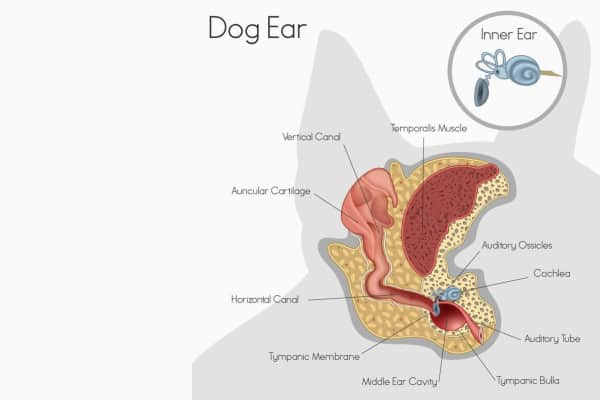
“Vestibular” refers to the vestibular system, which is a complex network of structures located in the dog’s inner ear and brain. The vestibular system perceives the body’s orientation with respect to the earth’s gravitational field and facilitates normal movement. The brain, eyes, and body use the information gathered by the vestibular apparatus to maintain proper posture and balance.
What are the symptoms of old dog vestibular disease?
Symptoms of old dog vestibular disease are mainly associated with coordination and balance. Onset of clinical signs can be quite sudden, literally overnight.
Because the vestibular system is in charge of balance, dogs with vestibular disease often experience dizziness and have difficulty walking in a straight line. If you’re thinking, “that sounds a lot like vertigo in humans,” you’re on the right track.
Old dog vestibular disease can be likened to vertigo in humans, and symptoms of dog vertigo are similar to symptoms of vertigo found in people.
In dogs, classic clinical signs of vestibular disease include:
- Abnormal posture, especially standing with legs spread wide: If they feel off balance, dogs may adopt a wide-based stance to keep from falling over.
- Head tilt: Looking a bit like an inquisitive expression, a head tilt is the most common symptom of vestibular disease in dogs.
- Impaired coordination: Think about trying to walk after spinning around in a desk chair; this is the degree of dizziness that can occur.
- Loss of balance: Dogs with vestibular disease may repeatedly fall over, even if they’re standing on a flat surface.
- Rapid eye movement when awake, called nystagmus: This uncontrollable repetitive eye movement can be side-to-side, up and down, or circular.
- Circling: Sometimes dogs will repetitively walk in circles. After all, it seems to them like the room is spinning!

What causes vestibular disease in old dogs?
By definition, the word “idiopathic” means we don’t truly know what causes old dog vestibular syndrome. It occurs for no apparent reason. It is truly a mystery!
Although it’s the most common form, idiopathic vestibular disease is not the only cause of vestibular disease in dogs. Additionally, vestibular disease can occur in younger dogs as well. Some other conditions can affect the vestibular system, and cause similar vestibular signs.
These conditions can include:
- Ear infections: Because the vestibular apparatus is in the ear, inflammation in the middle or inner ear (otitis media/interna) can cause problems with the vestibular system.
- Hypothyroidism in dogs: In rare cases, hypothyroid dogs can have abnormal blood flow or nerve function leading to symptoms of vestibular disease.
- Trauma: Physical damage to the vestibular apparatus can also impact its function.
- Tumors: Some tumors of the inner ear or brain can put pressure on the vestibular apparatus.
- Tickborne diseases: Certain tickborne diseases can affect the nervous system, including the vestibular system.
- Toxin or drug side effects: Drugs such as metronidazole can affect the vestibular system in rare cases.
Central vs. peripheral vestibular disease
Vestibular disease is a broad term that encompasses many different conditions. It can be broken down into central vestibular disease and peripheral vestibular disease. The central vestibular system includes the cerebellum and brain stem. The peripheral vestibular system is located in the inner ear. Both contribute to balance and coordination.
It’s important to note that idiopathic vestibular disease affects the peripheral vestibular system (inner ear) and not the central system (brain stem). Because of this, you shouldn’t see mental dullness or generalized weakness. If those are present, your veterinarian will likely be thinking about other causes for your dog’s clinical signs.
I expect my patients with old dog vestibular disease to maintain their overall strength and mentation even though their balance and equilibrium are terribly out of whack.
Old dog vestibular disease vs. stroke
The most common concern that my clients share with me when their dogs develop vestibular disease is this, “I think my dog had a stroke.” Indeed, with sudden onset of a head tilt, nystagmus, and lack of coordination, the comparison we could reasonably draw to human conditions is signs of a stroke.
Fortunately, strokes are much less common in dogs than in people. Age of onset of these signs is also significant, as canine strokes tend to happen in younger adult dogs. In a senior dog presenting with these clinical signs, idiopathic vestibular disease is much more likely than stroke.
What dogs are at risk for vestibular disease?
Idiopathic vestibular disease can happen in dogs of any breed, size, or gender. It is most common in senior dogs, and occurs more frequently in German Shepherds and Doberman Pinschers.
How is old dog vestibular disease diagnosed?
Idiopathic vestibular disease is a diagnosis of exclusion, meaning we diagnose it by ruling out other possibilities.
At your dog’s veterinary appointment, your veterinarian most likely will give your dog a thorough physical and neurologic examination, evaluate your dog’s medical history, and have routine bloodwork checked. This is usually enough to make a diagnosis of exclusion,
Sometimes things are not as clear cut, and it can be difficult to definitively rule out certain possible causes. Your vet may recommend referral to a veterinary neurologist for more advanced diagnostic tests.
Additional diagnostics may include MRI (magnetic resonance imaging) or CT (computed tomography) scan, or evaluation of cerebrospinal fluid (CSF) in rare cases.
Treatment for idiopathic vestibular disease in dogs
There is no direct treatment for idiopathic vestibular disease. Treatment can include outpatient or inpatient supportive care for the symptoms, lots of TLC, and sometimes alternative treatments like acupuncture for dogs.
I also make sure to prescribe anti-nausea medication (like Meclizine for dogs or Cerenia for dogs), even in dogs who are not vomiting. That unrelenting dizziness can cause debilitating nausea. (Having personally experienced a period of such dizzying vertigo that I couldn’t safely stand up, I’ve developed new sympathy for dogs with vestibular disease.)
Some patients with old dog vestibular disease are too dizzy or nauseous to eat or drink well, Supportive care in those cases may include IV fluids or nutritional support.
Most cases of idiopathic vestibular disease in dogs can be treated at home rather than in the hospital.
Home remedies for vertigo in dogs
If your veterinarian has diagnosed your dog with geriatric vestibular disease, you may be wondering what you can do at home for your dear dog. In addition to following your veterinarian’s treatment plan, you can make sure your canine companion is comfortable and safe. Here are several things to consider:
- Make sure you have soft, padded bedding for your dog to relax on.
- Keep your dog away from potential hazards like stairs or swimming pools.
- Some dogs with vestibular disease can have a hard time eating or drinking and may need their food bowls brought to them or even hand fed. (Need more tips? Check out my article on how to feed a dog with vestibular disease.)
- Using a sling or towel under your dog’s abdomen when he or she walks can prevent falling.
- Certain physical therapy exercises for dogs with vestibular disease may also help.
Additionally, dogs with vestibular disease have trouble rising and are unsteady on their feet. Our company’s signature product, Dr. Buzby’s ToeGrips® dog nail grips, can improve traction on slippery floors for these dogs and may also provide increased proprioceptive stimulus, improving the dog’s overall stability through neural pathways to the brain.

The main focus of home treatment for vestibular disease in dogs is to keep them safe. The sudden loss of balance and coordination can lead to falls without warning, so making sure they can’t fall down stairs, off furniture, into water, or other dangers is paramount.
Lots of therapeutic snuggles are also encouraged (if your dog enjoys them)!
Can old dog vestibular disease be prevented?
As the exact cause of idiopathic vestibular disease is unknown, we don’t have an effective way of preventing it. Old dogs develop this condition seemingly randomly, out of nowhere. The best thing you can do for your senior dog is to be aware of his or her overall health and notice any changes so they can be addressed quickly.
Vestibular disease in dogs: Life expectancy
Fortunately, despite the dramatic clinical signs, canine idiopathic vestibular disease has an excellent prognosis (prospect of recovery) and does not impact life expectancy. This non-painful condition is usually self-limiting, meaning it will resolve on its own, generally within one to two weeks. In fact, clinical signs that are improving within a few days also helps the veterinarian confidently diagnose vestibular disease..
In many cases the head tilt (a classic sign of old dog vestibular disease) does not go away. But this does not negatively impact a dog’s quality of life. Also, dogs who have recovered from idiopathic vestibular syndrome do not typically experience it again and go on to live out the rest of their days as if this scary episode never happened.
As a veterinarian, I often half-joke with my clients that the whole ordeal takes years off the parents’ lives, though!
Idiopathic vestibular disease FAQs
We’ve already covered the question I’m most frequently asked, “Did my dog have a stroke?” But there are some other questions pet owners commonly ask about old dog vestibular disease.
- Is vestibular disease in dogs fatal?
- No! Old dog vestibular disease is not life-threatening and generally resolves on its own.
- Can vestibular disease recur?
- While technically possible, it is extremely rare for a dog to experience idiopathic vestibular disease more than once. I have never seen it happen in the 25+ years I’ve been practicing!
- How long does vestibular disease in dogs last?
- It can vary, but old dog vestibular disease usually starts improving within a few days and resolves within 1-2 weeks. However, in some cases the head tilt does not go away. Fortunately, the head tilt does not impact quality of life.
A happy recovery from vestibular disease
To this day, Lola holds a special place in my heart. She was the high point of my first year as a veterinarian.
Don’t get me wrong. I was sad to see Lola and her owners endure a few tough days, but the outcome was far better than my clients’ initial expectations.
A few days after her initial examination, Lola strolled out of our hospital, tail happily wagging. A slight (and endearing, if truth be told) head tilt was all that remained as a reminder of her bout with vestibular disease. Lola and her family went on to share many, many more happy and healthy days together.
Knowledge is power
If your older dog experiences symptoms like Lola’s, get to the vet as soon as possible, but proceed with hope. Odds are, your dog can rebound and recover from what can be a dizzying, but not devastating, disease.
Has your dog experienced canine vestibular disease?
Share your story with us!
This post was originally published on ,August 3, 2023 and updated on October 5, 2026.


Thanks for this informative and reassuring article. I hadn’t seen anything like this before and it was worrying at first, but comparing it to vertigo makes a lot of sense as it seems to come and go. Glad to hear that it doesn’t mean the end!
Hi AC,
I am glad the article was informative and comforting. Hoping your pup is feeling better and wishing them all the best!
Thank you so much for explaining this. I just spent a few hours at the emergency vet with my 15 years old sweet old lady Ayla and she was diagnosed with this. It breaks my heart to see her like this and I was very scared but your words really helped me. Thank you so much from Ayla and I.
Hi Luisa,
Thank you for the kind words. I am so glad the article was informative and helped give you some peace of mind. I encourage you to read through our other two articles on vestibular disease as they may offer some great tips as you navigate this tricky path (I will link them below). Try not to let the hard days be discouraging. You can do this! Praying your sweet girl makes a speedy and full recovery.
1. How to Feed A Dog With Vestibular Disease: A Comprehensive Guide
2. 10 Tips and Exercises for Dogs with Vestibular Disease
hi! my dog is almost 15 and just got diagnosed today! it’s been so scary n sad. is ur baby doing any better? is she taking anything? I hope ur baby recovers soon. our vet said the first 48 hrs are the most severe. we came home w nausea n dizziness meds. hoping for improvements in a few days.
Hi Danae,
I hope you will start to see improvements very soon. Wishing you both all the best and praying for a full recovery for your senior pup.
Thank you for your post. I spent entire day searching the internet. I have a 21 year old dog. Fluffy.It would seem things always get worse not better. I know she has age related problems and like people more than one. But , Thank you very kindly
Dear Robert,
I am sorry Fluffy is struggling, but I am glad you found the article to be helpful. Hoping things will start to improve and wishing you both nothing but the best.
Thank you or this information, Dr. Buzby! Our Boston Terrier, Coco, just turned 15. she is deaf and blind from a cataract (she only has one eye). She was still happy, playing and wanting to walk up to 3 weeks ago. She was wobbly on her feet and her head tilted to the left so she was started on 12.5 mg of meclizine. But over the past 3 weeks, she has started to pace for hours in the evenings, doesn’t seem comfortable when trying to sleep during the day and even more unsteady on her feet (falling backwards on her back when trying to poop). She also peed in the house for the 1st time ever and marked the front deck twice. Now she is starting to shiver a lot. Your article mentions that vestibular disease goes away on its own, but it’s been over 3 weeks now. Like Lola’s parents, we are wondering about her quality of life if the vestibular disease is not going away 🙁
Dear Geraldine,
I am sorry your senior girl is struggling with these ongoing vestibular symptoms. While vestibular disease does resolve on its own, some dogs continue to have some mild issues. With what you describe, I am suspicious there may be something else contributing to this problem. Many of the signs you mentioned are associated with dementia or canine cognitive dysfunction and all of these symptoms are possible with the formation of a brain tumor. Without more testing and being able to personally examine your girl, it is hard to offer specific conclusions and recommendations. I will attach links to other articles with more information and great advice from our readers. Hoping you can get the answers you need to find the best path forward. Wishing you and your sweet girl comfort and peace.
1. Signs of Dementia in Dogs: Stages, Symptoms & Treatment
2. Signs of a Brain Tumor in Dogs: 16 Symptoms To Watch For
3. Using a Quality of Life Scale for Dogs
4. 10 Tips and Exercises for Dogs with Vestibular Disease
sorry I also meant to add that she is back on her food eating happily, I’m giving her wet food to make it easy to digest.
I’m also giving her a few days of antibiotics (amoxicillin) in case she has an infection or something.
she won’t even go up the 3 steps to my balcony now, it’s as if she understands that she’s too wobbly to risk it.
thanks so much for any help, you are so kind to reply to all these comments ❤️
Thanks for this! I live on a small island in Thailand without a vet. I care for some of the semi wild beach dogs.
I went to the mainland for a few days only to hear that ‘my’ dog was off her food, wobbling about and falling over. head tilt etc.
we saw that her upper claw had grown into her pad and it was very inflamed. I’d been trying to cut it for some time but she wouldn’t let me.
anyway today we cut and removed it (with help from a lady who runs a dog sanctuary).
She seems better, no more shaking legs, but still wobbly and as if she can’t see (or maybe coordinate?) properly, when I put a treat down it’s like she can’t find it so quickly.
she is old (maybe 11? we don’t know) but has always been very healthy.
she came on a walk with me not long after with her usual joy for life.
anyway my question is could the pad injury have triggered this condition do you think? or something else?
if she doesn’t get better soon we will try to bring her to the mainland but this will be stressful for her as she’s never been before.
thanks 🙏🏼
Hi Louisa,
Thank you for caring for these pups and especially your sweet senior girl. ♥ From what you describe, I do think this could be vestibular disease. I would not expect the paw pad injury to cause these types of symptoms, but I guess we can’t completely rule out the possibility. If the injury were contributing, I would think an infection was to blame. It is great you are covering her with antibiotics! Honestly, if your girl is eating and drinking well, feeling ok, and otherwise seems normal, I would probably give this more time. If your situation was different, I would normally recommend having her evaluated by a vet as soon as possible just to err on the side of caution. But I understand how things are a bit different when living in a remote area and dealing with a semi wild dog. How are things today? Hoping you are seeing a gradual improvement and praying your girl can make a full recovery. Wishing you both all the best and feel free to keep us updated on any progress.
thanks so much for your reply. she’s doing a lot better but still a bit wobbly. she can’t go down stairs any more, it’s like her brain can’t figure it out and she has to jump down if she does want to go up and down 2-3 stairs. (the max she can do).
but she’s still Sharp in other ways mentally.
the one odd thing is when I put down her food she kind of has to kind of wave her head to find it. if you or anyone knows what this means, please comment
***important for other owners and vets!! I’ve been giving her b complex as recommended by some and I feel there is an improvement with every pill.,****
idk if it’s this disease or something else. it’s sad that she can’t be the alpha that she was but she seems generally very happy and still eating well. thanks for caring 🙏🏼❣️
Hi Louisa,
I am so happy to get this positive update! Thank you for sharing the information about the B vitamins! I am not sure why you are seeing the strange behavior when she tries to eat. It makes me wonder if her depth perception or sense of smell has been affected. Wishing you both many happy days ahead and keep up the great work!
My Paige has all the signs of vestibular disease. Her first bout was stressful for her and the family. It disappeared after 3 days. About 3 weeks later it came on once again. Same symptoms with a calmer dog… almost like she knew “oh,!it’s this again”.
My concern is it continues to return about every 2-3 weeks. Feels too frequent.
Wondering how you feel?
Brenda
Hi Brenda,
Poor Paige! That does sound like it would be quite stressful for her and for you. While typically old dog vestibular disease does resolve, occasionally (in about 17% of cases) there is a recurrence of clinical signs. However, before assuming she falls into the category of unlucky dogs who get old dog vestibular disease repetitively, I think it would be worth checking in with your vet and/or a veterinary neurologist to ensure there isn’t something else going on that is precipitating the signs. I hope you are able to find some answers and relief for her!
Do they ALWAYS have the rapid eye movements, when they have a vestibular issue?
I thought my 15+year old Bennie was having hind leg weakness, but I’m starting to believe this is a vestibular episode, instead.
Because of his legs seeming weak and the fact that we both spend far too much time just lying around, I vowed to take him on more frequent but shorter walks today (our heat has returned, which makes it harder) but he started experiencing apparent dizziness along with less control of his legs. I had to wrap a towel around him to keep him upright, and he kept listing to his left. I did get him to walk out to the kitchen for a little snack and some water, but he was so wobbly we just put him back on the bed. Earlier in the day, while lying down, he shook his head (as dogs do) and that kind of flipped him over onto his side – not sure if that was pain or massive dizziness. He isn’t yelping or whimpering – just frustrated and confused. He does tremble, a bit, when he’s trying to stand and walk. Though he seems to be holding his head to one side (bending to the left, a bit), there’s very little head tilt and no eye movements that I’ve seen.
He’s experienced VERY short episodes (seconds) of this earlier this summer – both times after coughing or retching, so his vet thought it might’ve just been a very temporary loss of oxygen causing dizziness. This current episode has lasted over half the day so far, though.
Unfortunately, Bennie is both kinds of incontinent so, when he can get outside or really even get up by himself we have hygiene issues.
I’ll be calling his vet Monday and watching him like a hawk until then, but getting him to potty or into the car to go to the vet is proving difficult – so I’m hoping for some reassurance that this *could* be vestibular.
Hi Cara,
I am sorry Bennie experienced these worrisome symptoms and understand your concern. This could be vestibular disease, but other more serious conditions definitely need to be ruled out first. Were you able to have him evaluated by your vet? What did you find out? Hoping all is well and your boy has made a full recovery. Feel free to leave an update if you have a chance and wishing you both nothing but the best.
Sorry I never updated. It was scary but, once we realized it wasn’t a stroke or anything more serious, we just did what it took to help him get through the dizziness. After 10 days, he came out the other side no worse for wear.
I blew my knee out, in the process of the “event” (having to support him while walking in very awkward ways, so I definitely got the worst of it!
Hi Cara,
So glad Bennie was able to make a full recovery. So sorry about your knee! Hoping all is well and wishing you better days ahead.
I am so happy I found this! I read so many articles and am grateful for this blog. I left a comment before about Cushings and you were very helpful.
These symptoms sound like my sweet Bear! Out of the blue Thursday, he began acting strange. A month before that, he had a sort of off balance stumbling gait and by time I rushed him to the Vet hospital in Asheville, it was over, and he was fine. Until last Thursday when he began to have these ‘episodes.’ the only thing no one has mentioned (that I’ve read so far) is Bear draws up his front paw and sometimes his left paw and he shakes (scared? pain?) and makes whimpering noises. I thought seizures but the vet and I aren’t sure about that.
He had an episode in the lobby of the veterinary and she said it wasn’t like a seizure – but she didn’t mention this possibility!
Since she is the emergency vet, I do have an appointment next week with my regular vet.
But emergency did do bloodwork and x-rays of the heart/lungs. All was fine except liver values (he has pancreatitis) but his liver values always seem to be off. His T4 test was low – so they did the more extensive one that they had to send off and I am waiting.
Could this vestibular disease cause the drawing up of his paws? Also, he hunches his back. I thought pain but he doesn’t flinch when I rub his belly or back.
ANd, in between the episodes, he’s completely normal! Except more sluggish. He wants to go for a walk.
His appetite is normal. No vomiting. Urinates outside. Defecates outside. Everything seems normal except when this “attack’ hits.
I have him on gabapentin right now in the case he is in pain, for the anxiety, and just in case this is a type of seizure (though it happens many times in a day).
This has made me so worried and sad. But if it is vestibular disease, maybe there is hope.
Hi Kat,
Goodness, you have been through so much with Bear over the past several months. I understand why you are worried with the emergence of these new “episodes”. From what you describe, this does not sound like vestibular disease, but without examining your boy myself it is hard to make specific conclusions. It may be a good idea to ask for a consultation with a veterinary neurologist. Hoping the gabapentin will help keep things under control. Thank you for the update! Wishing you all the best and praying for a clear path forward.
Thank you for replying, if you could allow me one more comment.
After doing more research and watching his ‘episodes’ over and over I do believe it is something else too. He just had one. I haven’t been picking him up or holding him close, so I can watch better.
He puts his head on the floor and his body is tensed up –the paw drawing up is if he is on his side, but if not, he’s almost flat to the floor except maybe the hunched back- and he makes a strange whimpering sound not like a ‘normal’ whimper, and while he doesn’t seem unaware, he’s also a little far away eyed. He will shake but that could be fear or pain. It lasts anywhere from seconds to several minutes, then it is like nothing happened. Now I am second guessing that this isn’t a type of seizure.
He has had unsteady gait – wobbly hind legs – and last night he was walking sideways – though that could have been the gabapentin (last time he was on it, he didn’t have this happen though).
I will wonder if the Rimadyl did this as he was not having this prior to Rimadyl. Though it could be coincidental.
The emergency vet has no idea or clue what it is and likely too busy with emergencies to dig into this. But, I’ll see what his regular vet thinks when he’s back from vacation.
Breaks my heart. He has been though so much and is such a tough little guy.
Thank you – it helps to write it out.
I know you can’t diagnose but maybe some of this sounds familiar. Like when you wrote about Liver failure and how they can have the ‘praying position’ – but he had a liver biopsy in October 2023 and it was okay.
Hi Kat,
You are always welcome to submit as many comments as you like! Sometimes they get backlogged, and it takes me longer to respond but I will eventually get back to you. I agree, what you describe makes me suspicious about seizure activity. If you can catch one of these episodes on video, it could be very helpful to you vet when you see him after he is back from vacation. The gabapentin could be to blame for the wobbly rear legs, but this could also be associated with this mystery neurological issue Bear is dealing with. Hoping your vet will get back soon and can start to investigate the situation. Praying for answers and a clear path forward. Feel free to keep us updated on how things go. ♥
I thought I’d give an update – maybe it’ll in some small way help others who may have a similar situation to mine.
For the last 2 days (unless it happens when I am asleep but before it was happening often during the day), there have been no more of those ‘episodes’ of whimpering, head lowered, staring. Over the week, they grew less intense from the very intense ones.
And, in fact, he’s looking bright-eyed again. He’s doing things he’d stopped doing a little over a week ago, like following me into rooms, or sitting by the stairs wanting to go to the lake for a walk. Today he wanted to run up my driveway for his “lunch” like he used to do. He even jumped up all excited knowing food was coming (he never lost his appetite during all of this though!). He did lose his balance when he happily ‘stood’ on hind legs but he was happy and excited!
There is still back leg weakness but he’s walking better.
The other day, I took him off the gabapentin for 36 hours just to be sure the weakness wasn’t the gabapentin but he still had it after 36 hours, so I continued the gabapentin but I’m not giving the full dose – I decided to try some different doses and times with the gaba so he’s not sedated or feeling too tired on it and so I can watch how he progresses.
Just in case this was spasms, I have massaged his back. I walk him but not far so he can gather strength, and not be depressed that we aren’t going anywhere (for me too!).
He’s looking more like the Bear I know. But I am being cautiously optimistic, since this may be the start of some problems – worsening of old or beginning of new. However, I am hoping this was “just” a reaction to the Rimadyl. I won’t give him any more of that as a precaution.
As an aside, I did show the emergency vet a video I took but she was still baffled.
Once I have those liver comparisons from October’s numbers/biopsy to the other day, and one the thyroid numbers come in from the outside lab, maybe I’ll have another picture.
I don’t know if this will help anyone at all but I want to say that sometimes with time things do resolve – or at least resolve to a comfort level that’s not alarming. And sometimes you have to try different things I guess.
thank you for this blog – I read everything that comes in my inbox, and more.
Hi Kat,
I am so glad to hear Bear is doing better! Hoping the biopsy results will come back quickly and offer some clarity to the situation. One thing to note is that many internal medicine specialists have found that gabapentin causes less of the ataxia side effects at higher doses. So, while it may seem counterintuitive, if you increase the dosage, you may see an improvement even if this is due to the mediation. Of course, I would never recommend changing the dosage of any medication without consulting with your vet. They need to be aware of the details so they can monitor things closely. Thank you for the update. I will continue to pray for a full recovery for your boy. Bless you both!
Hi Kat!
I’m so glad you wrote this. My dog has the exact same thing. Head tilt, hunched back, walking to the side ( off balance) and whimpering. I’ve noticed that he has these “episodes” usually right after he jumps off the couch. I’m not sure if it’s the impact of the jump, but he’s no longer allowed on the couch/bed for that reason. We’ve gone to the neurologist, did a brain scan, and about 4 different Veterinarians. Showed multiple videos of his “episodes” but nobody has an answer for me. I’m still hoping to find some more information to help my dog. I hope you find out a little bit more information about your pup and thank you for sharing your story!
Hi Erika,
Wow, that is so strange! I am sorry that despite all the testing and vet visits you are still left with more questions than answers. I can only imagine how frustrating that must be. Hoping as you continue advocating for your boy you will find the answers you need. Praying for healing and a clear path forward.
Our 14 year old mixed breed dog, Daisy has been wretching and dry heaving several times a day for over 6 months. She still
appears alert, has a great appetite and walks 2 miles a day. Many trips to the vet left everyone clueless. In the last several weeks she has had two episodes of disorientation and drifting off to one side. Urgent care vet diagnosed her with vestibular disorder. She prescribed Cerenia and that seemed to stop the wretching and dry heaves. But symptoms would return once we stopped the meds. I also tried NausX which does the same thing but a lot less expensive. Is one better than the other? Can either one be used on a daily basis indefinitely?
Hi Patty,
I am sorry Daisy is dealing with ongoing retching and dry heaving. While vestibular disease is definitely a possibility, this may need some more in-depth investigation. Has your girl had any lab work done recently? If not, that would be a good place to start. Cerenia and NausX have two different active ingredients and they work on different receptors in the body. Some dogs do better with one or the other but in general, Cerenia is considered to be more effective. Neither one of these medications is labeled for indefinite use, but honestly, if you are facing a palliative care situation or end of life care, the benefits may outweigh any risks of long-term use. Hoping you can find what works best for your girl and brings you peace of mind. Wishing you both comfort as you navigate this unknown path. Bless you.