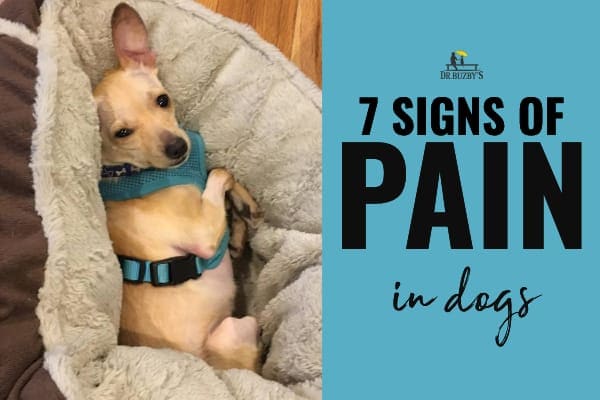
Photo credit: Dr. Shelly Kamath Pancoast.
This is the real-life story of a dog named Howard who demonstrated initially subtle (but rapidly escalating) signs of pain associated with a sudden tear of his stomach. The videos below (along with pictures and descriptions) are a powerful illustration of
Howard’s backstory
Weeks prior to this episode, Howard had experienced unexplained back pain. (For a deep dive into the anxiety-pain connection, please read my article: Chronic Pain in Dogs—An Interview with Dr. Ralph Harvey. ) His critical care veterinarian (who also happens to be his owner) took Howard to a neurologist for advanced imaging in the quest for a diagnosis.
Our little protagonist had three MRIs, cerebrospinal fluid taps, and extensive bloodwork. Everything came back normal. His diagnosis remained a mystery, yet Howard continued to deteriorate.
A painful dog and a mom’s quick actions
Finally, Howie’s pain became so severe that he started biting his humans. Humane euthanasia was on the table due to the intensity of Howie’s pain, but neurologist Dr. Lauren Marini proposed administering immunosuppressive doses of prednisone and a chemotherapy drug called Cytosar.
Six hours into the 24-hour infusion of Cytosar, Howie was almost back to normal. In light of the progression of
The first video below of Howie (wearing a red harness) was taken immediately after he perforated his stomach. Just 30 seconds prior, he had been totally normal—playing and jumping.
When he became acutely painful, his mom began videotaping the episode, thinking it would be helpful for the neurologist to see Howie’s behavior. She had no idea what was really wrong with her dog.
Howard’s painful condition quickly escalated
But after he vomited, his astute ER vet mom realized that his symptoms were pointing to an “acute abdomen” (translated as belly emergency). In hindsight, the high doses of prednisone had likely predisposed him to this issue.
His mom’s decisive, quick actions saved his life. She rushed him to the specialty facility where she works; he was in surgery within three hours of the video footage that was captured of him (see below). The stomach tear was identified and repaired.
Three days later, Howie was back home with his family.
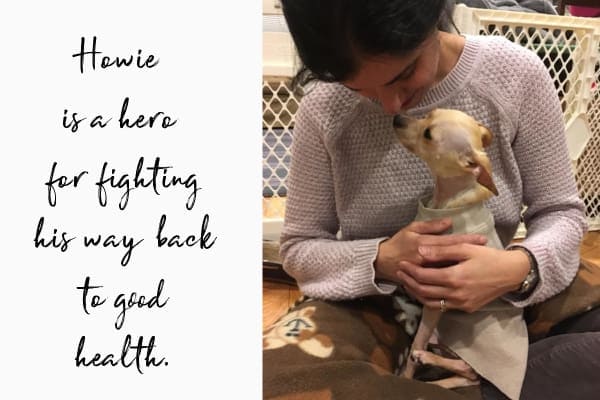
Photo credit: Dr. Shelly Kamath Pancoast.
7 Signs of pain in dogs
We can learn a lot from Howie’s story and his videos. Recognizing signs your dog is in pain and promptly seeking veterinary care might just save your dog’s life one day.
1. Disengaging from the family and decreased activity level
Dogs may exhibit signs of pain by secluding themselves, often subtly, as a means of protection. Watch for:
- Apprehensiveness about being held
- Hiding behind or under furniture
- Unwillingness to be part of family activity
- Reluctance to rise, lie down, and/or walk
- Avoiding or struggling on stairs
- Reluctance to jump up on couch/beds
2. Change in facial expression and ear carriage
While dogs can’t tell us where it hurts, they do express pain through their facial expressions and ear placement. In the photo below, Howie is exhibiting classic signs of pain through his facial expression. In your dog, watch for:
- Ears laid back
- Eyes hard or squinted
- Pupils dilated
- Grimacing consistent with facial muscle contraction

Photo credit: Dr. Shelly Kamath Pancoast.
3. Abnormal posture and gait
Your dog may exhibit physical signs of pain through a change in posture or the way he carries himself. In the video below, Howard’s
- Tail tucked or held awkwardly
- Hunched appearance or c
urved topline - Abnormal stretching (as seen in the video)
- Inability to sit or lie comfortably/restlessness
- Limping/favoring a leg
- Unwillingness to lift head or turn neck
Video credit: Dr. Shelly Kamath Pancoast.
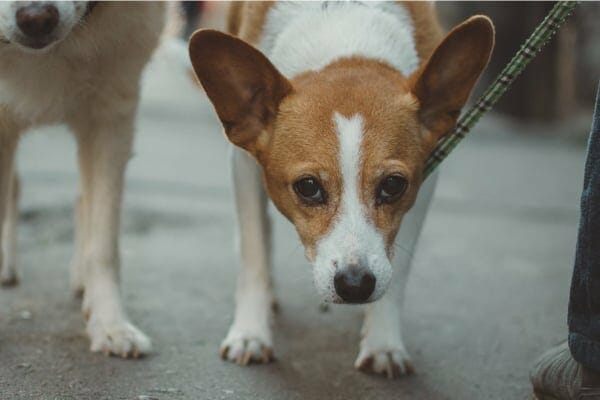
This dog is carrying his head low, which can indicate neck pain.

4. Vocalizing: The pinnacle of pain in dogs
Please note that points 3 and 4 in this list of signs of pain in dogs are placed in this order on purpose. When I initially saw Howie’s video above, I knew it was the perfect way to visually dispel the myth that a dog in pain will cry or moan. Granted, this does happen, as exhibited in the next video of Howie, but a dog crying in pain is the exception to the rule, not the rule. Most dogs suffer silently.
However, if you do observe the following vocalizations from your dog, contact your veterinarian immediately:
- Dog crying in pain
Dog howling, groaning, or whining in a way that is consistent with distress- Dog whimpering in pain
Howard showed signs that his pain was becoming more severe and began vocalizing in distress.
Please note, the following video may be disturbing to watch. Howie’s mom captured the video to share with the neurologist before she realized how serious his condition was. Again, if you find this disturbing, you may want to skip this video which illustrates a dog crying in pain.
WARNING—Graphic Video: Dog vocalizing in pain
In this video, in addition to crying, we see Howie stretching again, flattening back his ears, and demonstrating an inability to get comfortable due to pain.
Video credit: Dr. Shelly Kamath Pancoast.
5. Changes in behavior or habits
Changes in your dog’s behavior are worth noting. When a dog stops doing something that he’s always
- Change in appetite (typically decreased)
- Uncharacteristic signs of aggression
- Loss of housebreaking
- Sleep/wake cycle changes/restlessness at night
- Shaking or trembling

6. Self licking or biting
In the videos, you may have noticed Howie turning to nip at his flanks. Dogs often bite at, gnaw on, or lick parts of their bodies that hurt. Here are some examples:
- Dogs with arthritis may obsessively lick painful joints or limbs.
- In some cases, lick granulomas (a self-inflicted sore from incessant licking) can be linked to nerve pain. For example, lick granulomas on the front legs may be linked to cervical disc disease.
- Dogs can bite at their tail as a response to pain in the hind end.
7. Increased heart and respiratory rates
The previous six points are all subjective, meaning that they are based on human opinion. Heart rate and respiratory rate are objective measures of pain in dogs. They can be quantified and aren’t affected by human bias.
When a dog is in pain, his or her heart rate and breathing will increase. If you’ve ever been in acute pain, you recognize that the same is true for humans. Dogs in distress often pant.
To learn more about your dog’s normal vital parameters so you can recognize abnormalities, please check out my podcast: Learn Your Dog’s Normal Vital Signs.
A happy ending for Howard
As you can see in the video below, Howard recovered quickly and is playing again—without pain!
Video credit: Dr. Shelly Kamath Pancoast.
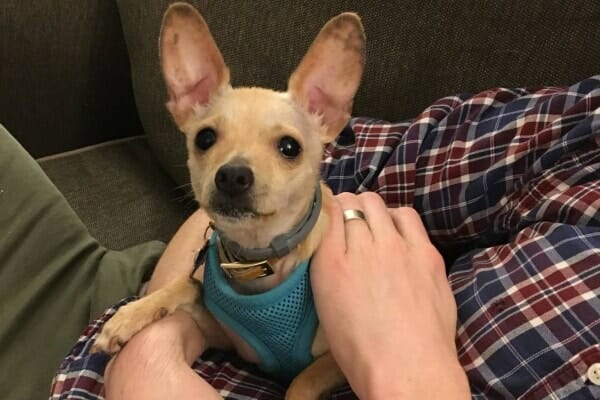
Photo credit: Dr. Shelly Kamath Pancoast.
A letter to Howard from his family
Thanks to Howie’s mom’s swift action, the numerous veterinarians who provided him excellent care at Ocean State Vet Specialists and Bay State Veterinary Emergency and Speciality Services, and the deep pockets of pet insurance, Howie made a full recovery. I absolutely love this note that his family wrote him on social media:
Dear Howard,
Thank you for not dying from MUE or your septic abdomen.
Love,
Your Family
Howie is a hero for fighting his way back to health and for exemplifying signs your dog is in pain. His mom, Dr. Shelly Pancoast, and I post his story and videos here in the hope that they will help other dog owners recognize and react quickly to pain in their own dogs.
What questions do you have about signs of pain in dogs?
Please comment below. We can all learn from each other.


Hi,
I’ve got 2 beautiful. pure white Japanese Spitz.. Turbo (male) is almost 9 years old &
Crystal ( female) is 8.5 years old.
My Babies are both healthy, bright eyed, & very active.. They both go to The Happy Puppy every 2 weeks for a bath, de shed, nails etc. They are surprisingly very low maintenance given their colour & double coat & the fact that we have 10 acres for them to run around on. Turbo absolutely loves getting brushed. As soon as I pick it up he starts barking & spinning in circles. Not that he needs brushing. I just do it because he loves it.
Crystal thrives on near constant ‘belly-rubbing therapy’.
However, since Turbo was 18 months old he started getting lumps all over his body that really irritate & cause him a lot of pain. The older he gets the more he gets.
Initially the vet said they were warts & not to worry. Then he said they were sebaceous cysts & not to worry. But as the lumps grew bigger he would look miserable, go off his food, growl if we walked near him & be constantly licking & chewing at them. When the lumps burst it is full of pus & blood & heaps of stuff that looks like cottage cheese. It also smells bad. The vet cleans it up & gives Turbo an injection of antibiotics, steroids & 10 days of oral antibiotics. Within a day Turbo is all good again. But this is happening all the time now. He has 1 particular lump that never goes away & erupts nearly every 2 weeks. It is at least 2 or more inches wide. on his lower back. It looks & acts more like a large boil. Even the groomer said the same. Whenever they use the hair dryer on him it’s erupts. So they usually avoid that area. We keep it clean & trim around the area to minimise infection. He usually needs antibiotics every 2-3 months though. So lots of vet visits which isn’t what upsets us. It’s the fact that the lumps itch & irritate him constantly. We’ve had them tested many times but we always get the same answer. We’ve tried many different diets, gut health supplements, fish oil & medicated shampoos. There are no rashes or other skin problems other than the lumps. He’s never had fleas or ticks but he does get grass seeds occasionally. He’s had all his vaccinations, nexgard spectra & worming needles.
We’ve been seeing a different vet the past 12 months & he has suggested getting the largest cyst on his lower back surgically removed which we are getting done in a few weeks time.
Turbo is such a beautiful, happy loving boy. We just want him to have some relief from these lumps & hopefully find out how to prevent them.
Also we’ve been worried that Crystal might catch them. She has never had any lumps until 2 months ago. It’s not a huge lump like Turbo’s is but she doesn’t like it touched. It. It’s not quite an inch in size.. We’ve also had it tested too with the same results as Turbo. It hasn’t burst yet thankfully.
If you have any ideas or suggestions it would be much appreciated.
Turbo & Crystal are our Babies, & we absolutely love & cherish them just like we do our 7 adult children. ( Some days even more so ).
Hi Nerissa,
I am sorry Turbo is living with these worrisome cysts. They can be extremely frustrating and tend to be a lifelong issue. The good news is they are not contagious but rather develop due to a dog’s own genetics and skin condition. I will attach links to other articles with more information. Hoping Turbo’s upcoming surgery is successful and praying for relief for your sweet boy.
1. Sebaceous Cyst in Dogs: Appearance, Diagnosis, and Treatment
2. Follicular Cysts in Dogs: Types, Appearance, and Treatment
3. Dog Cyst vs. Tumor: How Can You Tell?
My dog is 12
She has been hiding and not with the rest of the family at times.
The biggest problem is she is trembling in her back legs. We went for a walk. I had to carry her after just a short while.
The vet has given her pain pills . Nothing else. Her gums are red as well.
What should I do and ask for to help her???
Hi Kate,
I am sorry your girl is experiencing these worrisome symptoms. Unfortunately, without being able to examine her myself it is hard to make specific conclusions and recommendations. This does sound like it needs to be investigated. Has your pup had any routine lab work done recently? Some of what you describe also sound like the early stages of dementia/canine cognitive dysfunction. Here is a link to another article with more information: Canine Cognitive Dysfunction Checklist: Could Your Dog Have Dementia?
Don’t forget you can always ask for a second opinion or a consultation with a specialist. Hoping you can continue to partner with your vet to ensure your girl receives the care she needs. Wishing you both all the best.
my dashound dog has yelped a couple off times but don’t know why but don’t seem himself
Hi Joanne,
I understand why this has you concerned. It would be a good idea to have your Dachshund evaluated by your vet. Hoping you can get some answers and ensure your sweet pup is happy and healthy.
My dog is usually very calm.
He’s acting strange !
He suddenly stiffs up and try’s to get away from me,
After a while he’ll lay down and sleep.
He’s also drooling a lot.
Hi Nancy,
The symptoms you are describing have me concerned. I think it would be best to err on the side of caution and have your dog examined by your vet. Hoping all is well today. Praying for a positive outcome.