If you are new to administering subcutaneous fluids for dogs (i.e. SQ fluids), you may be feeling a bit overwhelmed by the process. But help is here. Integrative veterinarian Dr. Julie Buzby provides detailed step-by-step instructions (complete with pictures and video). Also, she answers some common FAQs to empower you to confidently give your dog subcutaneous fluids.
Finding out you need to give your beloved senior dog subcutaneous fluids can come with a mix of emotions. On one hand, it is something concrete you can do to help your dog. But on the other hand, it involves sticking a needle in your dog and using a complicated-looking fluid setup.
I understand that the idea of giving your dog subcutaneous fluids can be a bit intimidating. But it doesn’t have to be. This article provides a step-by-step administration guide and answers some FAQs to take the fear and mystery out of giving your dog subcutaneous fluids. I know you can do it!
If you are looking for the answer to a specific question regarding fluids, you may want to skip to the FAQs section (or if you don’t see the answer there, call your vet). Otherwise, let’s start looking at the nuts and bolts of the process.
What equipment do I need to administer subcutaneous fluids?
The first step to learning how to give fluids to your dog is ensuring you are prepared and have all the materials ready. Your vet will give you most of the supplies you need, but there are some things you can gather from your home that might make the process easier.
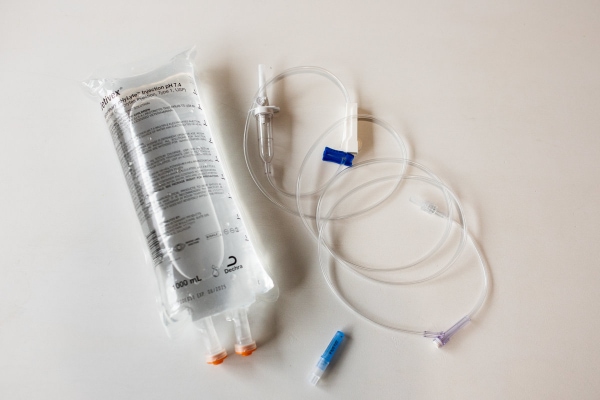
To set up the fluids, you need:
- Coat hanger or some other way to hang the fluid bag
- Bag of fluids
- Drip set (also called a fluid line or extension line)
- Needle (usually an 18 gauge)
- Sharpie
- Paper towels
- High value rewards for your dog
- Someone to help you restrain your dog (if necessary)
- A blanket or towel if your dog likes being wrapped up
- And of course, your dog
How do I assemble the subcutaneous fluids set?
Now that you have your materials gathered, you are ready to follow the steps to set up the fluids.
(Note: These instructions start you from “square one” of assembling the fluid administration set. However, it is possible that the veterinary team may have already done some of these steps for you. Also, it is worth noting that your vet might have demonstrated the technique in a slightly different order. There are multiple ways to arrive at the same endpoint.)
Attaching the fluid line to the bag
1. Remove the fluid bag and fluid line from their packaging.
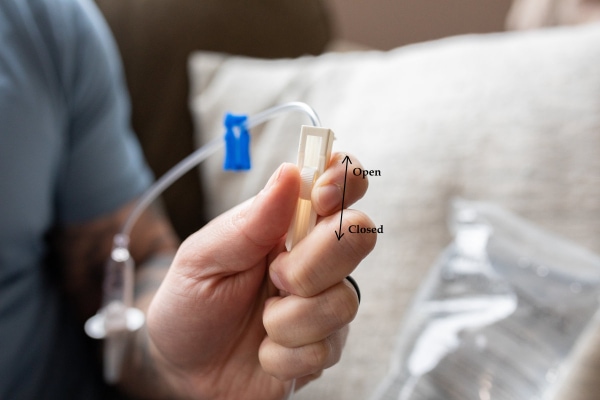
2. Examine the fluid line. There is usually a white “lock” (i.e. clamp or fluid rate controller) with a rolling mechanism on the line. Typically, this flow controller is set in the “open” position. You can tell that it is “open” because the clamp will slide up and down the line. Close the clamp by moving the roller all the way down. This will squeeze the tubing to close the line, and the clamp should no longer move.
3. Next, pick up the fluid bag. On one end there is a rubbery tab (usually it is white) or a plastic cap. Remove this cap or tab from the fluid bag and set it aside (or throw it in the trash as you won’t need it again). You may need to pull fairly hard on the tab to get it off. Be careful not to let the newly exposed opening on the fluid bag touch anything because this part should remain clean.
NOTE: You can do this while the bag is hanging or lying on the table as no fluid will leak out until the bag is punctured by the fluid line.
4. Go back to the fluid line and look for the end with a pointy, plastic tip that has a cover on it. Remove the cover from the tip. Be careful not to touch the pointed part as it needs to remain clean.
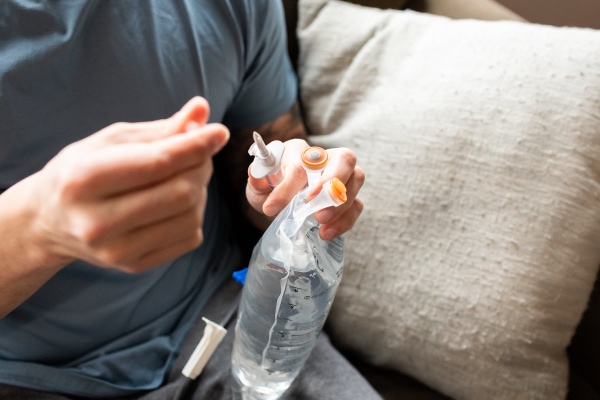
5. Insert the white pointed end of the fluid line into the fluid bag where you opened it in step 3. You may have to use a forceful twisting motion to push the point all the way into the bag. It is important that the point is secured properly to prevent leaks from occurring.
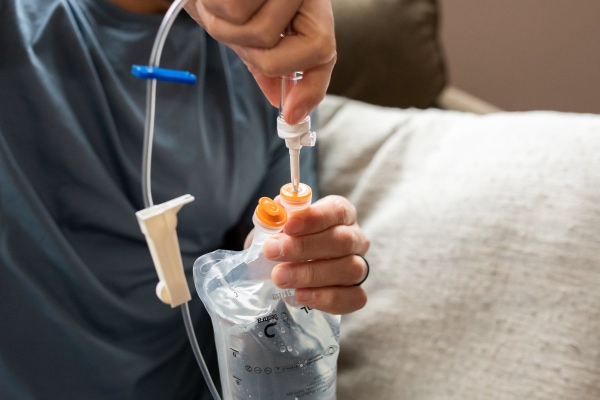
NOTE: Now the bag is punctured and has a hole in it. You do not want to remove the fluid line from the bag, otherwise the fluids will spill.
Hanging the bag up and marking the fluid amount
6. Now that the fluid line is attached to the fluid bag, you can hang the bag up (if you haven’t already). This is where a coat hanger can come in handy. Alternatively, you can hand the bag to your assistant.
TIP: If you hang the bag higher, gravity will assist you and make the fluids flow faster (therefore making the administration faster). But, you want to still be able to see the bag to monitor the amount of fluids given. Ideally, the bag would be about three feet above your dog’s back.
7. Look at the lines measuring the fluids on the bag and determine how many milliliters (mls) of fluid each line represents (usually 100 ml, but could be 50 ml for a smaller bag). Then use a Sharpie pen to make a line indicating the “stop point” that corresponds to the volume of subcutaneous fluids you need to give your dog. This dosage will vary with each dog and will be based on your veterinarian’s recommendations.
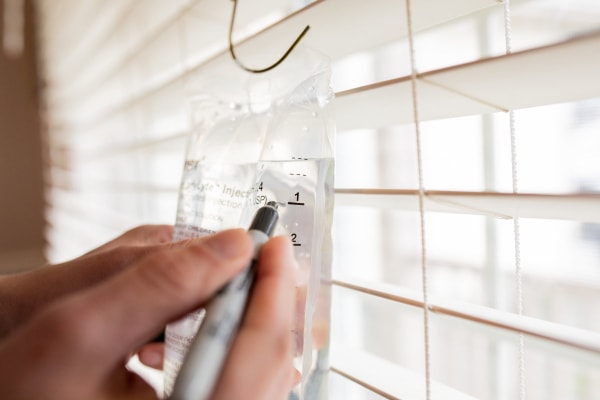
NOTE: It is much easier to measure the amount of fluids before you start administering them. Try to remember to take the time to do this first.
Preparing the fluid line
8. Look for a clear chamber on the fluid line at the end closest to the bag and squeeze the bulb to allow fluids to fill the chamber about halfway.
NOTE: Depending on how you have the bag positioned, squeezing the bulb can add or remove fluid from the chamber. If the bag is upright (i.e. with the chamber below the bag), squeezing the bulb will cause more fluid to enter the chamber. But if you turn the bag upside down so the chamber is on top and then squeeze the bulb, it will push some fluid back into the bag. This is helpful to remember if you accidentally fill too much of the chamber with fluids.
9. Now look at the end of the fluid line not inserted into the fluid bag. There is a plastic cap covering this end. Carefully remove the cap. Be sure not to touch the end of the line, as this should remain as clean as possible too. Also, keep the cap clean and nearby because you may need it later.
10. Open the fluid flow control clamp on the fluid line by rolling the circle upward. Allow fluid to flow through the line until the entire line is filled and a small amount of fluid drips out of the uncapped end. Then close the clamp to stop the flow of fluid.
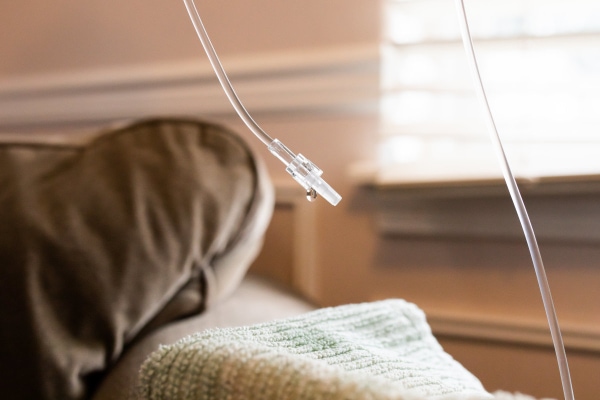
NOTE: This step helps ensure you don’t accidentally inject air under your dog’s skin when you first start running the fluids. A few bubbles of air under the skin aren’t a big deal, but a fluid line full of air can be uncomfortable for your dog until the body absorbs it. Thankfully, it isn’t usually dangerous, though.
11. Either temporarily replace the cap on the fluid line or hold onto the fluid line close to the end to keep the tip from touching anything. Then pick up your needle and remove the clear cap at the base or peel away the paper and plastic wrapping to expose the hub of the needle. This end should be kept clean too.
12. Attach the exposed base (i.e. hub) of the needle to the exposed end of the fluid line. Be sure it is firmly attached to prevent leaks or the needle falling off. Some fluid lines also have a locking collar that you twist around the base of the needle once you attach it, but others do not. Both types work fine.
How do I give subcutaneous fluids to my dog?
Now that the fluids are fully assembled, you are ready to give them to your dog.
Preparing yourself and your dog
1. Choose a location that is comfortable for you and your dog. If your dog is small, I recommend having him or her on a table or in your lap. Some of my clients will even wrap their small dog in a towel to help him or her feel secure and safe. On the other hand, large dogs usually do best standing on the floor or lying down—either in a dog bed or nestled between your outstretched legs.
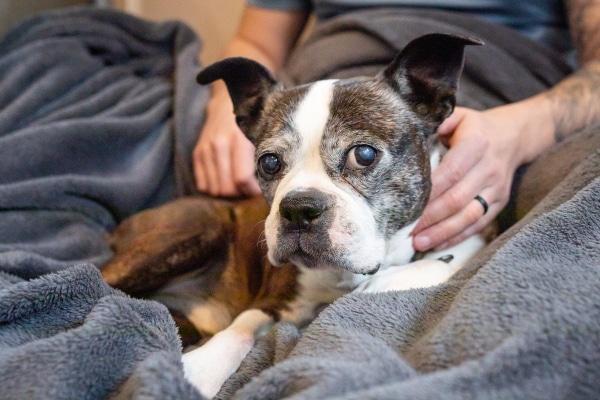
NOTE: The fluid bag should be hanging about three feet above your dog as mentioned above. Make sure the needle on the fluid line can easily reach your dog without any tension in the line.
2. Properly restrain your dog so he or she is not moving around a lot. A high-value treat can provide extra encouragement for your dog to stay still. One of my favorite tricks is to wipe peanut butter on the wall at the level of the dog’s nose. Then, the dog will stay in one place and be busy licking the peanut butter instead of paying attention to you and the fluid therapy.
If you need help keeping your dog still, ask a friend or family member to assist you. They can give your dog a gentle hug by wrapping one arm under the dog’s neck and placing the other arm over the dog’s back or around the dog’s back end.
TIP: Finding ways to keep your dog still is quite helpful. The more your dog moves, the slower the fluids will run. Also, if your dog is still, he or she is less likely to notice the fluids being administered.
Inserting the needle.
3. Locate the loose skin that is between your dog’s shoulder blades. This is where you will insert the needle. (It is also possible to give SQ fluids over your dog’s hip, but this location tends to be used less commonly.)
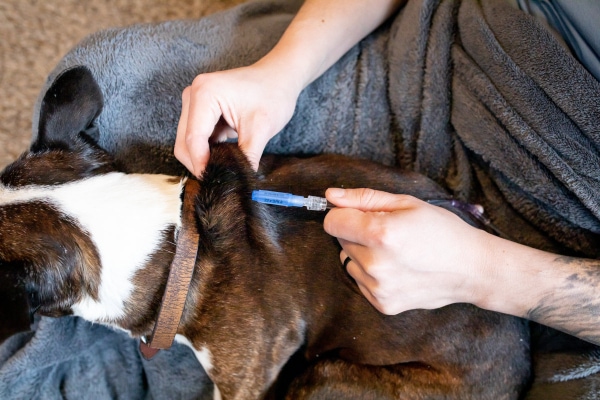
4. Carefully uncap the needle. (Save this cap for later).
5. While holding the needle in one hand, use the other hand to gently pinch and slightly lift the loose skin between the shoulders to create a “tent.” I like to squeeze, rub, and wiggle the skin a bit as I hold it up. This is a good way to distract your dog from the needle poke.
6. Hold the needle at the base of this tent and begin inserting the tip of the needle into the skin at a 30 to 45 degree angle. Fully submerge the length of the needle under your dog’s skin. Then release the tent but continue to hold the needle in place.
TIP: Inserting the needle should be a firm and steady motion. You do not want to jab it in or go slowly and shakily. If you want to practice inserting a needle before administering fluids to your dog, try performing the same motion on an orange or banana. This will give you a feel for how much pressure to use. (Be sure to discard these practice needles because they will be too dull to use on your dog.)
Administering the fluids
7. Use one hand to continue to hold the needle in place. Use the other hand to release the rolling lock of the clamp on the fluid line. You should begin to see the fluids dripping into the chamber and flowing through the fluid line. The clamp should be “wide open” so that the fluids are running quickly.
TIP: If fluids are dripping down the side of your dog instead of going under the skin, you may have accidentally pushed the needle out through the other side of your dog’s skin. Simply withdraw the needle slightly so that the tip is under the skin again and continue giving the fluids. If that doesn’t work, temporarily shut off the fluids, withdraw the needle, and insert it into a slightly different location.
8. As the fluid therapy continues, keep your dog still and calm. Use a gentle voice to reward him or her for standing still.
TIP: If the fluids are running slowing, try to gently reposition the needle under the skin or change the angle without removing the needle. Also, ensure the clamp on the fluid line is open all the way.
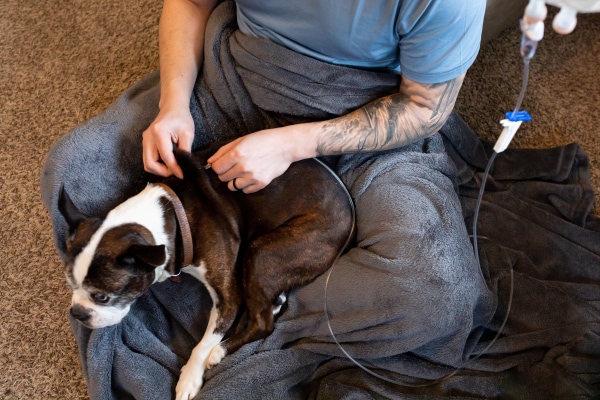
9. Keep an eye on the Sharpie line you made earlier to monitor the fluid volume you have given so far, and keep a hand on the needle at all times.
NOTE: Sometimes you will give the full volume of fluids in one location. Other times your vet may instruct you to divide the fluid volume up over multiple areas. If this is the case, follow the instructions for shutting off the fluids and withdrawing the needle (steps 10 and 11) and then repeat the fluid administration process starting with step 5.
Removing the needle
10. When the fluids reach the line you’d made with the Sharpie pen, then your dog has received the full dose. Next, roll the lock of the clamp on the fluid line back into the closed position. Once the fluids have stopped flowing, use one hand to completely back the needle out of your dog’s skin.
11. Once you have removed the needle completely, use your fingers, gauze, or a paper towel to put pressure on the spot where the needle was. This will help prevent bleeding or fluids leaking out.
12. Carefully place the cap back on the needle. Pay close attention to what you are doing because recapping the needle is when most people accidentally poke themselves.
13. Reward your dog for being so good during the procedure. And pat yourself on the back because you have finished the hard part. All you have left is to put things away.
Putting the fluid set away
14. Remove the needle (with its cap on) from the end of the fluid line. Replace it with a new clean needle as described above. This will help prevent bacteria from growing in the fluid set and ensure you always have a clean, fresh needle for the next time.
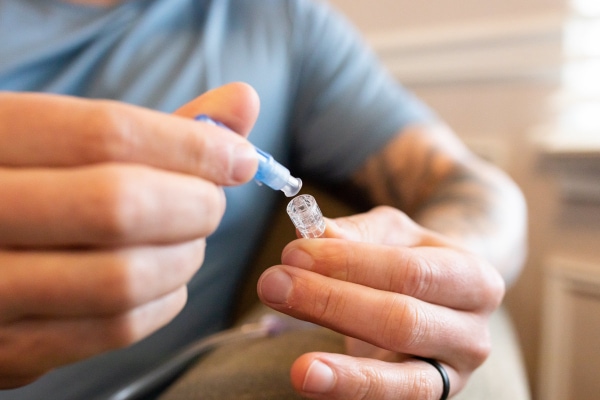
15. Double check that nothing is leaking and that you have properly capped the needle. Store the bag at room temperature in a safe place until it is time for the next dose. Since the fluid set is already assembled, you can make your new Sharpie mark for the next time. Then you’ll be ready to start on step 1 of the “how do I give subcutaneous fluids” when the next fluid needs administered.
Phew! You did it! Hopefully, administering subcutaneous fluids wasn’t as difficult or scary as you thought. But even if you did struggle with it the first time, remember that it should get easier as you do it more often. You can always consult with the veterinary team if you need some additional help.
Also, you may want to watch the video below.
How to give SQ fluids: A step-by-step video tutorial
To help you feel more confident and add to your knowledge base, I’ve created this step-by-step video tutorial of how to give subcutaneous fluids to your dog at home. Check it out, and then read on for answers to eight FAQs.
Fluid FAQS
After you finish giving your dog the fluids (or before you start), you might also have some questions that pertain to aspects other than just how to administer the fluids. Hopefully, you will find the answers in my fluid FAQs section helpful. If not, or if you have other concerns, please reach out to your vet.
FAQ #1: Why might my dog need subcutaneous fluids?
Vets use fluid therapy to treat a variety of conditions. In the hospital setting, the vet can administer either subcutaneous fluids or IV (intravenous) fluids. SQ fluids are great for dogs who are mildly dehydrated and need a quick and easy fluid boost before heading home with their parents. On the other hand, the vet will use IV fluids for dogs who are sicker, undergoing anesthesia, or hospitalized.
In the home setting, IV fluids would be difficult to administer and potentially dangerous. However, subcutaneous fluids are safe and simple to do at home.
The most common use for at-home subcutaneous fluid administration is to help improve quality of life and slow disease progression in cases of chronic kidney disease in dogs. However, the vet may also recommend it for other conditions that cause dehydration.
FAQ #2: Are there alternatives to subcutaneous fluids?
Other than in-hospital IV fluids (as mentioned in FAQ #1) and subcutaneous fluids, the other way to get more fluids into a dog is oral fluid therapy. This may involve:
- Ensuring the water dish is always full of fresh, clean water to promote drinking
- Adding water to dry food
- Feeding canned food since it is about 75-80% water
Sometimes these measures can be sufficient in the early stages of kidney disease in dogs or for other minor issues. However, there often comes a time when the dog needs more fluids than oral fluids alone can provide. This is where subcutaneous fluids can come to the rescue.
However, this doesn’t mean you have to do the subcutaneous fluids at home. Another option is to bring your dog to the veterinary clinic and have one of the veterinary team members administer the fluids if you would be more comfortable with that approach.
FAQ #3: What are the side effects of subcutaneous fluids in dogs?
Thankfully, fluids are very safe, and the side effects are minor.
Migration of the fluids
The most common thing that dog parents notice right away is that their dog might look like he or she has a camel hump. This is completely normal! The hump is where the fluids are sitting because they haven’t been absorbed yet.
You may notice this hump stays between the shoulder blades, falls to the side so your dog looks lopsided, or sometimes even divides between two or three places or slides down to the chest or legs. Over the next four to six hours, the fluids will diffuse and be absorbed, and the hump will resolve.
If the subcutaneous fluids are not fully absorbed by the time you are supposed to give the next dose, please contact your veterinarian before administering any further fluids. Based on the information you provide (or an examination if warranted), your vet can advise you on how to proceed.
Bleeding or leaking at the administration site
The other side effect dog parents may notice is bleeding or leaking at the site where the needle was inserted. This happens sometimes and is not usually a concern. If the skin becomes tight from all the fluids, some of the fluid may squeeze back out. Or sometimes the needle may accidentally hit a small skin blood vessel and cause your dog’s skin to bleed (just like if we got poked or bit by a bug).
If this happens, apply pressure to the area for about 30 seconds and the leaking or bleeding should resolve. If it doesn’t, or you have questions or concerns, please contact your veterinarian.
Minor pain or soreness
Additionally, some dog parents notice that their dogs seem to be painful or irritated at the spot where the needle was inserted. Just like when you get a vaccine, sometimes the area can be a little sore.
If you think the fluid “hump” is uncomfortable for your dog, you can try massaging the area gently to release some of the tension. Or, if the injection site seems to be bothering him or her, you can also apply a cold pack wrapped in a towel for two to three minutes.
However, if you think your dog is unusually painful after subcutaneous fluids, please don’t hesitate to reach out to your vet for reassurance and guidance as well.
FAQ #4: How much subcutaneous fluid should I give my dog?
Your dog’s veterinarian will help you figure out the volume and frequency of subcutaneous fluids that is best for your dog. This will depend on your dog’s size and the reason for the fluids, among other things. The fluid volume or frequency may also change as your dog’s kidney failure, or other condition, progresses.
FAQ #5: Is it normal for my dog to pee a lot after subcutaneous fluids?
Yes, some dogs will urinate more after fluid administration because they are no longer dehydrated. If this happens, it is a good sign because it means that the fluids have been absorbed and are working. But if you become concerned that your dog is peeing too much, please contact your veterinarian.
FAQ #6: Will my dog still drink water after subcutaneous fluids?
Since you gave your dog some fluids under the skin, he or she may or may not feel the need to drink as much water for a bit. However, clean, fresh water should always be readily available for your dog in case he or she wants it.
FAQ #7: Will my dog be tired after receiving subcutaneous fluids?
Your canine companion might be tired or even a rather lethargic dog after receiving fluids (especially if he or she is easily stressed). It is okay if your dog wants to rest for a few hours after therapy. If the lethargy continues or you notice other symptoms, please contact your veterinarian.
FAQ #8: Can I warm up the fluids before giving them to my dog?
While you should always store fluids at room temperature, sometimes warming them up can make administration less uncomfortable for your dog. To warm up the fluids, fill a sink or large bowl with warm water. Place the fluid bag in the water upside down (with the connection between the bag and line out of the water) for five to ten minutes until the fluids are approximately body temperature (or a bit cooler).
Safety note: Do NOT microwave the fluids. They can become too hot for your dog and can burn him or her (and you).
The veterinary team is here to help
I hope that you now feel more confident in your ability to give your dog subcutaneous fluids. While it may feel outside your comfort zone at first, I believe that you can do it!
However, if you have tried administering subcutaneous fluids at home and it wasn’t for you, I want you to know that’s ok too! Whether you (or your dog) aren’t a fan of needles, it was difficult to restrain your dog, or something else happened, giving fluids can be challenging.
If you encounter some bumps in the road, please discuss your experience with your veterinary team. They would be happy to give you more tips in person if you want to keep trying. Or, if you have decided it is best for you and your dog not to keep doing SQ fluids at home, they can help you develop a new plan.
Have you given your dog subcutaneous fluids?
Please comment below to share your experience and any tips you want to give to other readers.


My 15 year old Shitzu girl was diagnosed with Congestive heart failure and Chronic Kidney disease. Fluid build up found in her lungs which was placed on Furosemide diuretics and had been on them for 3 months before she developed dehydration and anemia. My baby girl drank water all day and urinated frequently. My girl started having collapsing episodes looked like seizures. I took her to the vet where they ran lab work and it showed she’s severely dehydrated and needed 300ml of subq fluids asap. fluids were administered at Vet office in the same spot(between shoulder blades) in under 10 minutes. I felt that was too much fluid all at once but what do I know. My girl kept moaning in pain all night and refused to eat nor drink water. She wasn’t able to stand up. Following morning by 9am she was again refusing to eat & drink water which shortly after starting seizing again, head tilting and circling and banging her head on floor and against furniture. I carried her and placed her on her soft bed to prevent injury. My baby was crying in pain it looked like she was experiencing a heart attack or kidney failure. it was heartbreaking to watch her suffer. we had to take her to Vet to be put down to sleep. The most difficult decision we had to make but couldn’t see her suffer anymore. My question is, is it possible that 300ml of fluid by subcutaneous in the same site too much for her body to handle. Was this possibly fluid overload? too much for her heart? We’re trying to make sense of what could’ve gone wrong.
Dear Elizabeth,
I am so sorry for the loss of your beloved pup. I can only imagine how difficult it must have been to see her decline so quickly. From what you have described, I definitely don’t think the fluids are to blame. This sounds like a rapid progression of heart failure and kidney failure and that the fluids just were not able to make enough of a difference to prevent the decline. I am almost positive you would have seen the same succession of events even if your pup had not received any fluids at the vet office that day. It is normal to ponder all the “what ifs” while grieving, but I hope with time you can find peace. Praying for healing and comfort for your heart.
Thank you for this amazing blog that helps people bring the dogs into their senior years in a safe healthy way. It’s very overwhelming with the sub Q I was doing very well at first and now he’s trying to get away from me. He’s screaming. I switch up the spots so it’s not too much in one area. I don’t know why he’s fighting me all the sudden he’s only 7 pounds but he’s very strong and he keeps pulling back with a needle goes in for and I have to try and restrain him. I have no help it’s just me is there any advice out there to help me understand why all of a sudden he’s now giving me a problem giving him the shot he gave me a problem in the very beginning, but then he got used to it. It’s been about three months maybe four months now but this past week he’s been terrible soon as he sees me getting ready he runs any ideas you give me is greatly appreciated. By the way, he’s very fussy eater always has been and with the kidney failure his appetite is changed so there’s not any food reward that I could really give him. I’ve tried all of it he don’t like peanut butter. He turns his nose up to chicken some days of the days he eats it but he’s very very fussy that’s not going to distract him.Thank you everybody.
Hi Laurie,
I am sorry your senior boy has started having anxiety associated with his subcutaneous fluids. There could be some adjustments that can be made to your routine or technique that would help lessen his negative reaction. But without being able to witness this behavior for myself, it is hard to know what to suggest. My best advice is to call your vet and tell them about this new problem. They may be able to schedule you an appointment where you can come into the clinic and demonstrate what you are doing at home so they can offer advice and help troubleshoot. Hoping you can continue to partner with your vet to ensure your boy is getting the care he needs. Praying for comfort and peace for you and your sweet boy. Bless you both. ♥
Hi quick question. My puppy has received fluids about 4 days ago and is constantly peeing. She sometimes even has to pee every two hours. She used to be able to hold her pee for longer. I do go back to work in a couple of weeks and I’m afraid she’ll have accidents around the house. Not sure if her body is still absorbing the fluids but how long do you think she’ll have to pee more frequently than usual.
Hi Rosy,
I understand your concern for your puppy and think it is wise you are reaching out for advice. Fluids (whether given IV or subcutaneous) should be absorbed within minutes and the kidneys process them rather quickly (within a few hours). There is no possibility that the fluids given 4 days ago are still causing increased urination in your puppy today. If you are still noticing abnormally frequent urination, then this needs to be brought to your vet’s attention. I am not sure what your pup was being treated for initially, but this could be a sign that her condition is not well controlled or that something else is now contributing to the situation (such as a urinary tract infection). Hoping all is well and praying for clear answers. Feel free to leave an update and let us know what you find out.
I’ve been giving my 15 year old pup Bijou sub q fluids for 3 weeks now and it seems to be really helping. She’s getting used to the routine. She was diagnosed with kidney failure and I have her on a kidney diet plus myriads of supplements. My question is I just opened a brand new 1000ml Vetivex bag yesterday and it fell on the floor and got a leak in the bag. What do I do with it? Is there an alternative way to administer the fluids or is it sterile compromised and I need to throw the whole bag away now? I don’t want to waste fluids if they’re still perfectly good. Let me know what the right thing to do is please thank you! Molly:)
Hi Molly,
I am sorry Bijou is facing these ongoing kidney issues but glad you are going the extra mile to maintain her quality of life. If the bag fell on the floor and leaked, then the sterility is definitely compromised. While the probability of introducing infection at the injection site may be relatively low, I am not sure I would risk it. If something like this happened at the clinic, we would trash the whole bag and open another one. Wishing you and Bijou all the best. Keep up the good work!
We’ve been giving my 4-kg Papillon SQ fluids to treat stage four kidney failure for about six months. He’s extremely docile and calm throughout the procedure. As his skin has become tighter, it’s been harder to find good needle sites. The biggest problem we’ve faced is leaking while administering the fluids. I realized that the needle was going through and through because when I lifted (tented) the skin to insert the needle it lifted in a small pyramid shape rather than an elongated prism-like shape. Now I know to check for that and change my grip as I lift the skin if needed. No troubles since then.
I would have liked to have known that could happen earlier, so I thought I’d share it here for others.
I also have a question: In the past 6 months, we’ve missed our dog’s SQ administration on two days (relatively far apart). But I was wondering how many days in a row it’s safe to miss. He was diagnosed in May, is stage four now, and is in a slow decline but relatively stable.
Thank you!
Dear Melissa,
I understand your concern for your pup as his health continues to decline. He is very lucky to have you taking such good care of him and advocating for his well-being. I applaud you for taking on this type of treatment at home and sticking with this commitment for so many months. Unfortunately, there is no way to know exactly how much these extra fluids are affecting the kidney function (without running expensive daily blood tests) and therefore we also aren’t sure what the negative effects will be if the fluids are missed for a few days. The only thing you can really assess at home is how often your boy is urinating, if the color of the urine looks extremely concentrated or dilute, and whether his gums are nice and slick or if they are staring to become sticky/tacky and dry. Missing a day or two is probably not life threatening, but things can change quickly. How is your boy doing today? Hoping he is still by your side and enjoying life. Praying for your strength and comfort. Bless you both.
We just starting giving our 11 1/2 year old Golden these fluids. The first time we did it she was not able to relax and lay down. She would keep getting.up every few minutes including at night. Not sure if we did something wrong. She did not have this reaction when it was done at the vet. She didn’t sleep at all at night and kept us all up.
Hi Kathy,
Sorry to hear that you and your dog both had a sleepless night after trying the subcutaneous fluids at home. That would definitely be stressful! Has she had any other episodes of nighttime restlessness in the past? Dogs can sometimes get a bit sore from the needle insertion or the fluids themselves but generally I wouldn’t expect it to keep a dog up all night in most cases. I suppose though that if she already has some arthritis pain, doggie dementia (canine cognitive dysfunction) or other condition, the combination of that plus some discomfort from the fluids could have been enough to push her over the edge. Alternatively, it is quite possible that it was just coincidence that she was restless after the fluids. If this continues, I’d recommend reaching out to your vet. Since he or she can examine your dog and knows your dog’s history, your vet can help you get to the root of the issue. I hope things improve soon and you both are able to get some rest!
Also, you may find this article helpful: Senior Dog Anxiety at Night? 9 Solutions for Better Sleep
Thank you for answering this question. We have been giving our 16-year-old lab fluids for about 3 weeks. Last night he did the exact same thing; pacing all night and was obviously uncomfortable. He was up so we were up. He does have a history of what I called “doggo sundowners” and arthritis which we usually medicate him for when he has espisodes. This really cleared up some questions for us. Thank you.
Hi Marie,
So glad you were able to find the support and peace of mind you needed! Your boy is very lucky to have you taking such good care of him and going the extra mile to ensure he remains happy and healthy. Wishing you both all the best and praying for continued success. Keep up the good work!
Dr. Buzby,
We are just beginning this journey with our stage 2-3 Border Collie. She is 10 yrs. Old. I wanted to thank you for your video and hope we will be able to do this. we cant afford to keep taking her to the vet for the fluid administration. But I know we will do everything to make her life better. We pray she will stay with us much much longer.
Thank you again,
Hi Craig,
I have faith that you can learn how to administer the fluids to your dog! I know it seems intimidating at first, but soon it will become second nature to you and to her. It hope it goes well and helps her to feel like herself for as long as possible. If you have questions, feel free to reach out to your vet or to me. We are here to help!
Hi Dr. Buzby, thanks for this information, it helped me understand a few things better. But I am searching for an answer about whether a dog’s body, if it is recovering, does not absorb as much sub-q fluid? I have a 12-year old mixed breed female, spayed, who was originally 70 pounds. She had pneumonia from what seemed to be mega-esophagus in April and was then diagosed with stage 2 kidney disease, heart murmur, splenic mass (could be benign or cancerous). 500 ml of Ringer’s a day was recommended after she had a 3-day IV treatment in the clinic (in addition to other drugs). She originally could take the whole 500 ml but cannot any more. The fluid stops dripping and her skin on the back of her neck is very tight at 300ml the last week, and today it stopped at 250. I am stopping it and removing the needle when this happens. She has regained about 4 pounds of the 14 pounds she lost and at times seems cheerful and energetic an other times lies sleeping but breathing too fast so wonder if she is in pain. .I say this because I think she is recovering some but not sure because her bloodwork has not been done for several weeks. .And maybe other pet parents giving sub-q fluids have this happening too.
Hi Ellen,
I understand your concern for your pup and think it is good you are reaching out for advice. Unfortunately, without being present while the fluids are being given it is hard to troubleshoot this issue or make specific conclusions. There are reasons that a dog’s body would not adequately absorb subcutaneous fluids, but recovery should not cause this problem. I think it would be best to contact your vet and explain what is happening. They may want you to bring your girl in for a recheck and have you demonstrate your fluid administration process so they can narrow down the problem. Hoping you can get things back on track and wishing your girl all the best.