If your dog has a cruciate ligament rupture or partial tear, you may be wondering about treatment options. Dr. Susan Davis—internationally recognized author, physical therapist for animals, and friend of Dr. Julie Buzby—shares from her decades of experience how you can support, advocate, and make the right treatment decision for your senior dog.

Without a doubt, ruptures of the cranial cruciate ligament account for the majority of my physical therapy caseload at any given point in time. Why are there so many?
My theory involves the indoor lifestyle we shifted our companion pets, particularly dogs, toward, the past four decades. Add to that, more human work hours, less time for the owner to take their dog on leash walks, plus a shift from the use of indoor carpeting to smooth, hardwood, and tile flooring.
Back in the 1930s to 1970s, most dogs lived outdoors and spent their time on grass and dirt, not jumping on and off furniture onto slippery surfaces. Cruciate ligament tears were rare. Fast forward to the present day. Most dog owners are acutely aware of the cruciate ligament, though they may know it as the “ACL.”
What is the cranial cruciate ligament in dogs?
The equivalent to the human being’s anterior cruciate ligament (ACL) is the dog cranial cruciate ligament (CCL). It is a band of fibrous tissue located in the dog’s hind legs at the knee (stifle) joint. The ligament provides inner crossover stability to prevent forward slippage of the shinbone (front of the tibia), relative to the long thigh bone (femur).
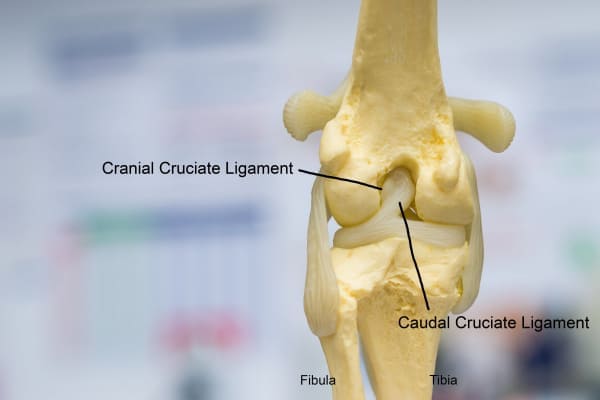
Though we have this ligament in common with our canine companions, theirs ruptures much differently than ours. The upright, two-legged human gait is less susceptible to ACL ruptures with normal activity. A person’s ACL ruptures swiftly and completely from trauma and sports-related injuries.
The dog’s CCL is subjected to different biomechanical forces in their down-on-all-fours gait along with a slightly different shape and angle of the tibial plateau. Running, turning, and sliding on slippery surfaces cause gradual wear and tear of the dog’s CCL. It begins to stretch, tear, and slowly degrade. Sometimes it tears fully, called a rupture. Other times it tears only partially. In both cases, compromised stifle joint stability leads to injury to the meniscus (the cartilage shock absorber) and arthritis.
What are the signs of a cranial cruciate ligament tear in dogs?
The first outward sign of cranial cruciate ligament damage is lameness. The dog may either hold the limb up completely or put only partial weight on it. We call this toe-touching. The dog begins to shift its weight onto the other hind limb. That is why a dog with a ruptured CCL has a 25 to 50% chance of tearing the other hind leg’s CCL within 12 to 16 months!
The key to recovery from the rupture (and prevention of the other side tearing) is rapid timing of diagnosis and intervention. Getting started right away promotes early healing, can help prevent full rupture, and reduces the risk of the opposite side tearing.
How is a cranial cruciate ligament tear diagnosed and treated?
Early diagnosis of CCL tear is imperative to your dog’s future health. If your dog is limping or holding up a limb, do not delay in making a veterinary appointment.
Diagnosis of CCL rupture happens through observation, the performance of a drawer test, a radiograph (X-ray), or sometimes an MRI. The drawer test involves the veterinarian or physical therapist placing their hands around the dog’s stifle joint, using a gliding motion used to test the “tightness” of the ligament. A ‘positive drawer’ or ‘cranial drawer sign’ means the ligament is too loose and ruptured (completely torn) or has merely a partial tear.
If your dog has a ruptured CCL, surgical correction followed by rehabilitation is the best form of treatment. On the other hand, your dog might not need surgery if the CCL is partially torn. Partial tearing of the cruciate ligament presents various treatment options.
It’s important to weigh the pros and cons of surgery in terms of a dog’s size, health status, activity level, and lifestyle. Surgery requires recovery of at least 12 to 16 weeks. Smaller (less than 22 pounds) and leaner dogs tend to manage better without surgery than their larger or overweight friends do. If your dog has a partial cruciate ligament rupture but is standing and walking on the limb, non-surgical treatment options may be reasonable.
11 non-surgical treatments for dogs with partial cruciate ligament ruptures
Here are 11 non-surgical treatments for dogs with partial CCL tears and also dogs with a full cruciate rupture that cannot have surgery for reasons such as advanced age, medical risk of undergoing anesthesia, bleeding disorder, seizures, or financial constraints.
1. Rest and activity restriction
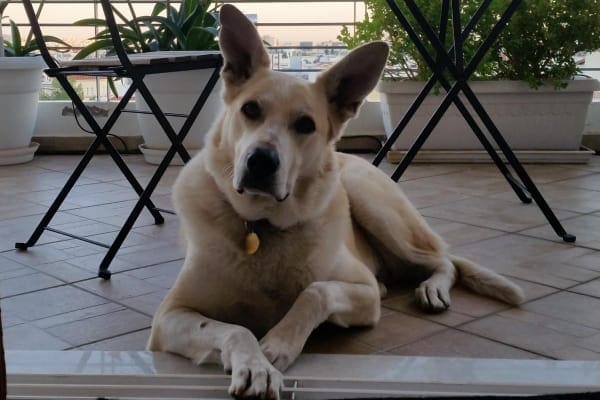
For the next six weeks, plan to reduce the length and intensity of walks and possibly crate or confine your dog several hours per day to allow for healing. Playing or rough housing with other dogs is off limits for a few weeks. Your veterinarian will help you understand what degree of exercise restriction is right for your dog.
2. Medications
Your veterinarian may prescribe anti-inflammatory and pain medications.
3. Ideal body weight
Ask your vet or physical therapist to assess your dog’s body weight compared to normative values for the same age and breed. This is called the body condition score. Check to see if a ‘waistline’ is visible while standing over your dog, looking down at their body shape, and feel if the ribs are easy to find or if a heavy layer of fat makes it difficult to feel them. If your dog is overweight, start a weight loss plan right away. An obese or overweight dog is predisposed to a cruciate ligament rupture or tear.
Get started now discovering your dog’s canine body condition score.
4. Healthy diet and supplements
Keep your dog’s diet lean: provide healthy treats, plenty of hydration, and supplements for anti-oxidant control of inflammation. Ask your veterinarian whether additional senior dog supplements for cartilage support or omega-3 fatty acids for joint inflammation may be helpful.
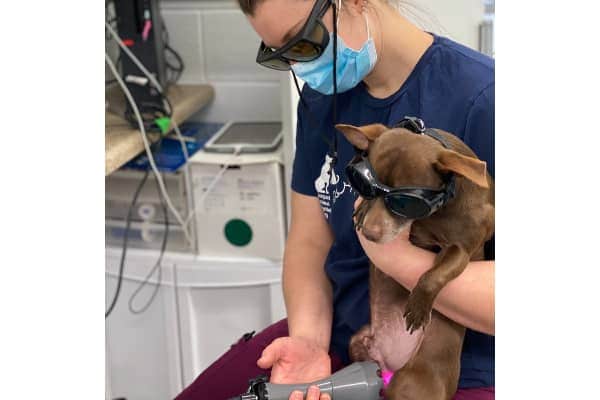
5. Physical therapy using cold laser for 6 to 12 sessions
A common question I hear is, “Will cold laser help grow a new ligament or reattach the torn ligament?” Unfortunately, the answer is no.
Cold laser therapy for dogs will not regenerate a new ligament or reattach the torn portion of the ligament. But it should help reduce joint inflammation, swelling, and pain. It may also help in the process of scar tissue formation as the body tries to stabilize the joint.
6. Electrical stimulation
Electrical stimulation uses various forms of electrical current delivered through lead wires which are attached to sticky electrodes placed over the stifle joint and thigh. This treatment helps blood rush in and nourish the ligament and surrounding anatomical structures, relieves inflammation, reduces pain, and assists weakened muscles to contract and strengthen.
7. Massage
Using the palm of your hands in a flat position, massage the sides, front, and back of the dog’s knee in circular directions with light to medium pressure.
8. Passive range of motion exercises in dogs
Gently bend and straighten the stifle (knee) and hock (ankle) joints, using your hands, and do not go beyond the scope of natural movement currently available.
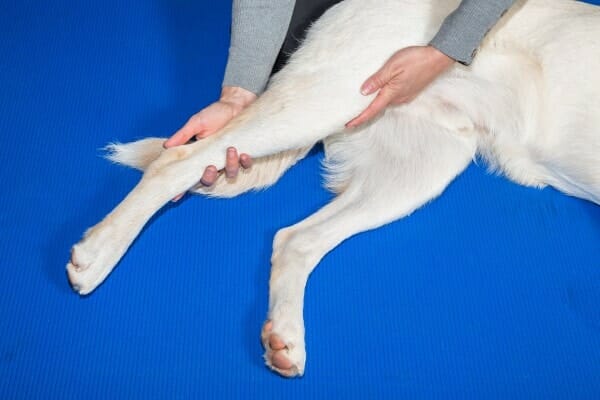
Learn more about passive range of motion exercises for senior dogs.
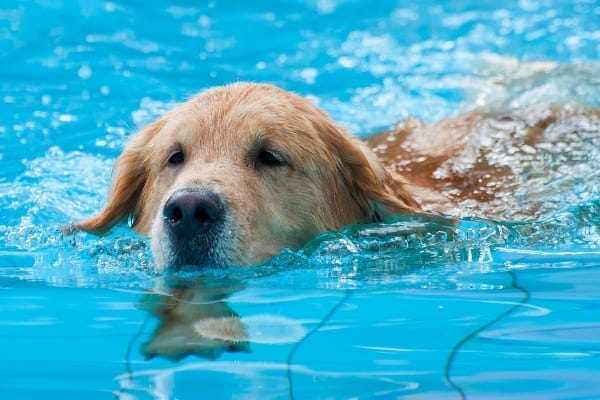
9. Underwater treadmill
Underwater treadmill or swimming water therapy provides a safe buoyant medium to strengthen the limb while undergoing restriction of normal walking activity.
10. Braces
External stability provided by a brace or soft support helps speed the healing process and supports the joint during activity. Dog CCL braces are an alternative to surgery in many cases though inferior to surgery for a complete rupture of the CCL.
Braces are available in prefabricated or custom forms. Custom braces require casting the dog’s hind limb and sending the removed cast to a certified orthotist for precise molding of a brace specific to your dog. Custom braces are more expensive than prefabricated types but provide superior support.
11. Regenerative medicine
Stem cell transplant injections and platelet-rich plasma (PRP) injections are emerging as alternative treatments for non-surgical management of partial cruciate ligament ruptures in dogs. However, they are invasive, expensive, and lacking firm evidence of long-term outcomes on ligament healing. Stay tuned as more research is performed.
Back on the move in no time
If your senior dog is hobbling around, the first course of action is to pay a visit to your veterinarian. Then, diagnosis in hand, you can consider all your options both surgical and non-surgical. Ask as many questions as you need to and never forget you are your dog’s advocate and voice.
With the expert care of your veterinarian and support from your dog-loving friends and family, your senior dog will be back on the move in no time.

Has your dog had a cruciate ligament rupture?
Share your experience so we can learn together what worked and helped your canine companion the most!


Hello – perhaps you can give me some insight about a tripod dog that just partially tore his left CCL. The dog is approx. 1 year old and is probably part Malinois. He is lean and fit. We provide him with 3 small home cooked meals a day because he apparently has Acid Reflux.
I don’t know how or when he lost his right front leg.
We were told to rest the dog for the next 3 weeks.. He is on the pain medication, Gabapentin and an anti-inflammatory , Carprofen.
I am just wondering what the prognosis might be with a partial tear of the CCL healing in a young dog who is missing one front leg. Have you had any experience in treating a tripod with such an injury?
I am a Physical Therapist, I know the value of the modalities you recommended as part of the rehab but unfortunately I don’t have them available to me. Maybe I could get the dog in the pool later in the rehab process???
Do you have any suggestions for me. to help this dog through ha successful course of rehab? I would certainly appreciate any suggestions you might have. Thank you
Hi Holly,
I am sorry your young pup is dealing with this injury to his left rear leg. Since his missing limb is a front leg, I am not sure it will have as much of an impact on his healing as would be expected if the other rear leg was missing. I would not suspect there to be a difference in prognosis. Since I haven’t been able to personally examine your boy and don’t know all the details of his injury (x-rays, presence of joint changes, degree of inflammation, etc.) it is hard to offer specific recommendations for what exercises and therapies to recommend. For now, the goal is to reduce inflammation and manage pain. Laser therapy and joint supplements would be a good start. Here is another article that may be helpful as well: Dog Torn ACL Treatment Without Surgery: A Rehab Vet’s Approach
Hoping you can find the answers you need to determine the best path forward (whether that means medical management or surgery). Praying for healing and wishing you both all the best.
I’m curious if Cyplexinol®, (Ostinol) can truly offer pain relief for my dog’s arthritis?
Hi Mary Lou,
This is a great question. Unfortunately, I don’t have any personal experience with this particular treatment. There are lots of studies on stem cell therapies and how they affect different orthopedic conditions in dogs. My best advice is to discuss this with your vet and see if they think it’s worth trying. They can then monitor for efficacy and any potential side effects. Wishing you and yours all the best!
Hi I love that you answer comments. Thankyou. My dog the other week started limping. Couldn’t move much. I put her on msm, other supplements she went to the vet they did an xray and whilst I can’t remember the exact things that was said I believe partial acl tear and mild arthritis.
They said she was an ideal candidate for surgery.
I’ve booked in for NTA surgery but what’s making the decision harder now is that her limp has 90% gone well mostly gone.
Am I putting her through unnecessary ordeal? She’s 10 a German shepherd kelpie and is overweight at 28kg which we are working on. We also have steps so ideally she’ll be able to use them again.
My thinking was it’s better give her surgery at 10 then at 12 if it develops to a full blown rupture. Will the surgery slow arthritis progression?
Thanks in advance
Hi Ness,
I am sorry your girl has injured her knee. She is very lucky to have you searching for information and advocating for her well-being. While surgery is the “gold standard” for treating a CCL tear in dogs, it isn’t the only option. There are some dogs that make a full recovery with dedicated care and physical therapy (although it is not a quick or easy path to take). It would definitely be better for your girl to have surgery now rather than in a few years if surgery is in her future. Surgery would help to prevent ongoing damage to the affected joint which, in turn, also slows the progression of arthritis. I will attach links to other articles with more information that will hopefully help you to make an informed decision on how to proceed. You can also ask your vet about getting started with a veterinary rehabilitation professional prior to surgery to not only help your girl lose some weight but also to ensure inflammation stays at a minimum. Then you will already be established as a patient and can start physical therapy as soon as the surgery is completed. Wishing your sweet girl all the best for many happy years ahead. Feel free to keep us updated on how things go!
1. Torn ACL in Dogs: Signs, Symptoms, Surgery Options
2. Dog Torn ACL Treatment Without Surgery: A Rehab Vet’s Approach
3. TPLO Surgery for Dogs with a Torn Cruciate Ligament
4. A Veterinarian Answers Your TPLO Recovery FAQs
6-year-old 125lb cane corso mix just got diagnosed with a partial CCL tear. After an afternoon running around outside, he started limping. It was most noticeable after he was laying down for a while but would go away the more he walked around, even not being noticeable at some points. When it didn’t go away after a couple of days, we took him to the vet where he got diagnosed based on swelling in his knee and a positive sit test. They said because he’s weight-bearing, surgery wasn’t necessary at this point. Also, they did not do x-rays because it would’ve required sedation and they were confident in the diagnosis. He’s on strict rest for two weeks and then slowly incorporating more activity every two weeks for a total of 8 weeks. During the 8 weeks, no stairs, no off-leash walks, no jumping. He’s on Gabapentin for paid and mild sedation and Carprofen for inflammation. We live in a city rowhome so we’ve cordoned him off on the first floor. The vet said don’t let him on the couch but that’s where he always relaxes (and there isn’t anywhere for him to go otherwise) so we’re helping him up and down as much as we can.
We’re concerned about him not pooping with the lack of walks, especially now that he’s on all this medication. Do we just let him out more frequently and hope he goes? Any advice?
Also, I’m doing as much research as I can, but it seems there’s a lot out there that even good recovery from strict rest can still lead to surgery. Should we be getting prepared for him to have the surgery even if the recovery goes well and he improves?
Hi Joe,
I am sorry your big guy has experienced this injury to his knee. I don’t think you need to worry about his lack of defecating at this point. It may not occur as regularly as it used to, but as long as he is still going and the consistency is normal, things should be ok. His decrease in defecating may be due to a lack of walking but I also see this frequently with joint pain as it is hard for them to get into the right “posture” to go. While I hope he can make a full recovery with rest and medical management, I do think it would be wise to start saving financially and preparing for surgery in the future. Surgery is more commonly needed in bigger dogs (their joints are carrying more weight) and most dogs that experience a CCL rupture in one knee have the same thing occur in the other knee within a year. I will attach links to other articles with more information so you can gather as much knowledge on this subject as possible. Hoping things will go smoothly and praying for a full recovery for your sweet boy.
1. Torn ACL in Dogs: Signs, Symptoms, Surgery Options
2. Dog Torn ACL Treatment Without Surgery: A Rehab Vet’s Approach
3. Dog ACL Brace? Veterinarians Share Answers
4. TPLO Surgery for Dogs with a Torn Cruciate Ligament
5. A Veterinarian Answers Your TPLO Recovery FAQs
6. Dog Crate Rest: 9 Tips for Success from a Vet (Plus 5 FAQs)
My 10 year old Shar Pei has a torn ACL. I have been treating with Rymadyl and she gets around quite well. I was wondering if gabapentine would work better.
Hi Pete,
This is a great question! Gabapentin works best when paired with Rimadyl for this specific condition as the Rimadyl is what helps reduce inflammation. While pain control is important, inflammation is also a huge concern. I hope this helps and I wish your sweet girl all the best!
Hello Dr. Buzby,
I am on an information quest for my 18 month old English Mastiff.
Post xrays today it was concluded that it’s most likely a partial ACL. Drawer test was done manually and there was too much movement for their liking.
I’m concerned about this immediate solution of surgery which has high risk/high reward, particularly for Mastiffs who have a higher fatality under anasthesia.
I’m curious about isolating her movement, reducing her weight, continuing with carprofen and adequate (first dose was today) and if there is a possibility of recovery/improvement over 8 – 12 weeks.
Have you seen any examples of that?
Should I have an MRI done to see what we are working with?
Partial tears will heal if managed, right?
I’m a health teacher specializing in using our environment to heal ourselves so I’d love to see if I can help the poor baby naturally and avoid an invasive/6k surgery.
Thanks!
Hi Molly,
I understand your concern for your young Mastiff and think it is great you are searching for alternative methods for treatment. There are many things that can be done to see if a partial tear will heal without having to pursue surgery. It isn’t a guarantee that surgery won’t be needed at some point, but you can definitely give it a try and see what can be accomplished. I would encourage you to look into physical therapy, holistic treatments, maybe a knee brace, and start a good quality joint supplement. I will attach links to other articles with more information. Wishing you all the best as you start this hopeful journey. Bless you and your sweet big boy.
1. Dog Torn ACL Treatment Without Surgery: A Rehab Vet’s Approach
2. Dog ACL Brace? Veterinarians Share Answers
3. Natural Pain Relief for Dogs: 17 Methods from a Vet
Today our 10 year old shi tzu was diagnosed. with CCL after noticing her limping more over the last week and not using her back right leg.
She is about 1.5 kgs overweight and the vet advises an op and has also prescribed daily pain killer tablet.
Really appreciate your clear ‘plain speaking’ explanation of the reason which has helped me to understand her diagnosis.
Thank you, Fiona
Fiona,
Sorry to hear that your pup was diagnosed with a CCL tear. It can definitely be a lot to process so I’m so glad that the article helped you better understand what was going on with her. I wish you and her all the best as you navigate this new diagnosis. ❤️
my 10 year old staffy is still very playful, she partially torn her ccl 9 days ago and the more she walks the less noticeable it looks. She’s on gabapentin, carprofen and trazdone now because she’s very energetic. we’ve covered anything she might try to jump on but it’s hard because she wants to go outside and sunbathe (we don’t trust her to be offleash in our backyard and she won’t just hangout with her harness on). This vet we saw isn’t her normal one, and I’m very hesitant to trust her, but she’s essentially said surgical intervention is the only way. doggo is toe touching and very willing to sprint after a squirrel.
Hi Rachel,
I am sorry your girl has injured her knee but glad to hear the pain seems to be under control. The vet you saw was giving sound advice, but it could have been better worded. While surgery isn’t the ONLY way, it is the best, and many studies have shown that surgery offers better outcomes than other forms of treatment. Any treatment other than surgery is aimed at reducing inflammation and trying to strengthen muscles to offer better stability but will not repair or replace the torn ligament. I will attach links to other articles with more information. Hoping you can get the answers needed to find the best path forward. Praying for healing for your girl and wishing her a full recovery.
1. Dog Torn ACL Treatment Without Surgery: A Rehab Vet’s Approach
2. Dog ACL Brace? Veterinarians Share Answers
3. Torn ACL in Dogs: Signs, Symptoms, Surgery Options
4. TPLO Surgery for Dogs with a Torn Cruciate Ligament