Hearing the phrase “gallbladder mucocele in dogs” as your sweet pup’s diagnosis may leave you feeling a bit unsure of what this means for him or her. Integrative veterinarian Dr. Julie Buzby explains the causes, symptoms, diagnosis, treatment, and outlook for a gallbladder mucocele in dogs. Armed with this information you will better be able to help and support your dog.
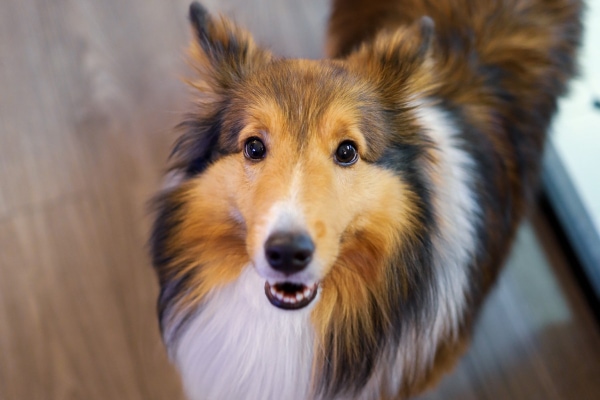
Bijou the Sheltie is notoriously a bit of a picky eater. He was one of the few puppies I’ve met that turned up his nose at the squeeze cheese I often offer to distract from vaccines. I mean, what dog doesn’t like bright orange processed goo? Bijou. That’s who. Over the last six years he’s occasionally skipped a meal here and there. His owner and I kept track of his dental health to make sure that wasn’t an issue, and we ran yearly bloodwork. He had always been the picture of health.
But then something changed. Bijou went from picky to downright not eating. He became lethargic. He started vomiting. His dad knew something was wrong, and brought him to me right away.
Bijou has always been a little standoffish with me—maybe he never forgave me for assuming he’d like squeeze cheese. But this time he barely acknowledged my existence. He let me do a full exam without much resistance, save for a little wince when I palpated his belly. Something was very not right.
Getting to the root of Bijou’s problem
Unfortunately in dogs, lethargy, vomiting, and inappetence are somewhat nonspecific. I couldn’t tell just by looking at him what was troubling Bijou, though I thought I could see a little yellow tinge in the white of his eyes. But maybe it was the lighting in the exam room. I knew we needed to do some diagnostics.
I started by taking X-rays. Maybe he’d eaten something he shouldn’t have? He wasn’t the most trustworthy dog when his dad was at work. X-rays looked clear—nothing was obviously wrong in his abdomen. We ran some bloodwork and that’s when my level of concern raised significantly. Bijou’s liver values were through the roof. Apparently, I wasn’t imagining the yellowing of his eyes—he really was jaundiced.
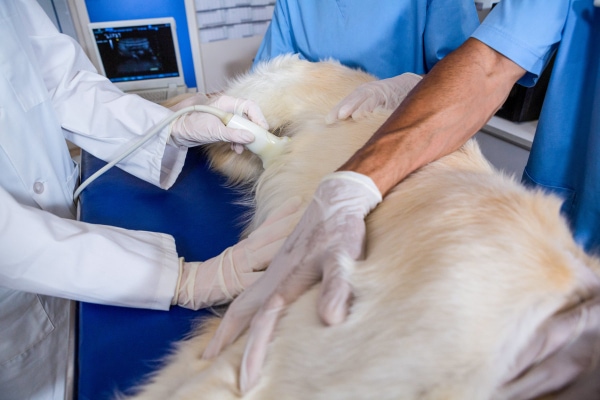
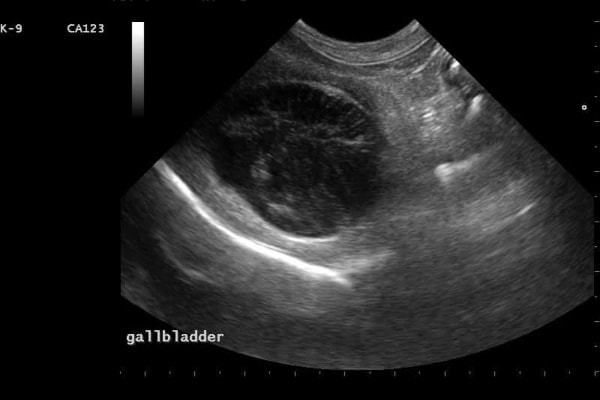
The next step was an ultrasound because I knew something was going on with his liver, and I hadn’t seen an obvious problem like a tumor on X-rays. As it turned out, his liver looked ok on ultrasound. However, his gallbladder looked like a sliced kiwi when it should be a clear black circle. This odd appearance to the gallbladder meant Bijou had a gallbladder mucocele.
What is a gallbladder mucocele?
You may have heard about people having gallbladder issues (or suffered some yourself). But did you know dogs also have gallbladders? The gallbladder is like a little balloon tucked up in between liver lobes.
The liver produces bile from bile acids, bile salts, water, cholesterol, and other components. Bile flows from the liver through bile ducts into the gallbladder where it is stored. Then the larger common bile duct takes bile from the gallbladder into the intestines to aid in the digestion and excretion of toxins.
Normally bile is a thin liquid. However, in some dogs, the consistency of bile inside the gallbladder becomes thicker due to an accumulation of mucous. As a result, a canine gallbladder mucocele forms. The mucous-laden biliary sludge can become too thick to travel through the common bile duct. This causes the gallbladder to become distended and potentially obstructed, unable to empty. Gallbladder obstruction can make a patient very sick, just like Bijou.
What causes a gallbladder mucocele in dogs?
Let’s back up for a minute to see how a gallbladder mucocele happens. There is still so much that veterinarians and researchers don’t fully understand about gallbladder mucoceles, but here is what they have learned so far.
If the gallbladder isn’t appropriately contracting to send bile to the intestines, bile acids build up inside it. This can cause inflammation of the gallbladder wall, which in turn increases mucous production, compounding the problem. The more mucous that builds up, the thicker the bile becomes, and the greater the chance of obstruction.
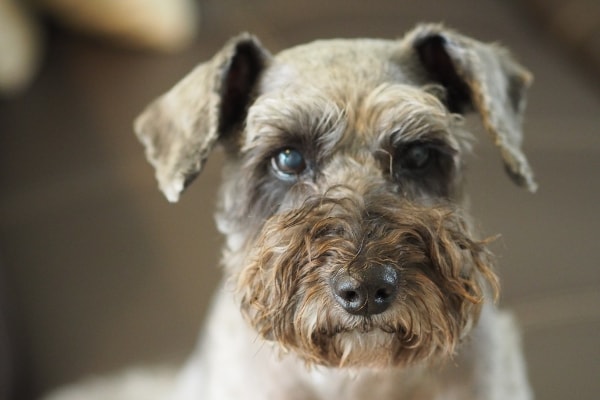
There is a presumed genetic component that predisposes some dogs to develop gallbladder mucoceles. They are more commonly diagnosed in Shetland Sheepdogs, Miniature Schnauzers, Cocker Spaniels, and Dachshunds.
Additionally, certain metabolic disorders can increase the chance of a dog developing a gallbladder mucocele. Pups with Cushing’s disease in dogs are 29 times more likely to develop a mucocele. Diabetes and hypothyroidism in dogs also increase the likelihood of a gallbladder mucocele. These conditions may alter the way fat is metabolized, and make it more difficult for the gallbladder to contract to release bile.
What are the symptoms?
Just like we saw with Bijou, usually dogs with gallbladder mucoceles are pretty sick. Clinical signs can include:
- Vomiting
- A lethargic dog
- Decreased appetite
- Jaundice (yellowing of the eyes, gums, or skin)
- Painful abdomen
- Fever
Not all dogs with mucoceles have all of these symptoms, and all of these symptoms can be associated with other diseases. For this reason, It is very important to seek veterinary care immediately if your dog is showing any of these signs.
How is a gallbladder mucocele diagnosed?
Your vet will start with a physical exam to assess for jaundice, abdominal pain, fever, or other abnormalities. Next, he or she will probably consider further diagnostics like bloodwork.
Usually the bloodwork involves a complete blood count, which assesses white and red blood cell numbers and platelet numbers. The vet will also run a chemistry panel, which looks for signs of kidney disease, liver disease in dogs, diabetes mellitus, electrolyte imbalances, and other conditions. Dogs with a gallbladder mucocele tend to have elevations in their liver values, much like my canine patient did.
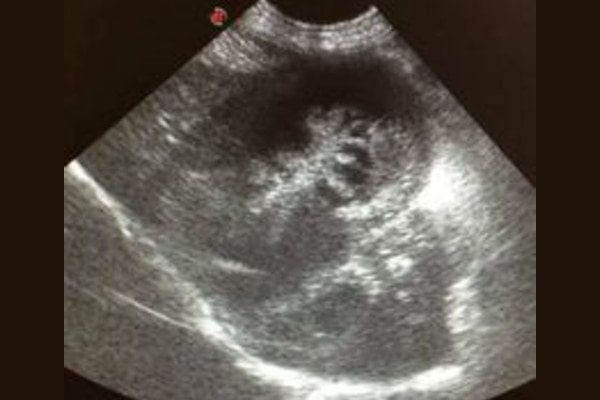
If your vet suspects a gallbladder mucocele or other problem with the internal organs, he or she will probably recommend an abdominal ultrasound. This test allows the vet to assess the liver, contents of the gallbladder, and other abdominal organs. Typically, a normal gallbladder should be a black circle on ultrasound. However, if it looks like a sliced kiwi due to mucous accumulation, the dog probably has a gallbladder mucocele.
What is the treatment for a gallbladder mucocele?
In some milder cases, medical management can be successful. Your vet may recommend starting your dog on ursodiol, a medication that can sometimes improve the flow of bile out of the gallbladder. However, vets typically only try it for dogs who have not yet become extremely ill from the mucocele. A low-fat diet may also be beneficial. Generally speaking, medical management is usually reserved for dogs who are incidentally diagnosed with a gallbladder mucocele and are not clinically ill from it yet.
However, the best course of action for dogs who are showing symptoms at the time of diagnosis is emergency surgery to remove the gallbladder (i.e. cholecystectomy). If a mucocele is causing biliary obstruction, the risk is that if not removed, it may lead to gallbladder rupture. Gallbladder rupture can make the dog even sicker and is potentially fatal.
Gallbladder removal surgery
Gallbladder removal surgery is often rather involved. Your veterinarian may refer you to a specialty hospital for intensive care and the surgery. In addition to removing the gallbladder, the surgeon may take a sample of the liver or bile to send off for bacterial culture. The information gleaned from this may guide treatment and which antibiotics are more likely to be successful in battling infection.
Sometimes during surgery bile can leak into the abdomen. Alternatively, it may already have been present if there was a gallbladder rupture prior to surgery. Bile is very irritating and this can lead to an inflammatory condition called peritonitis. If this happens, the dog may need abdominal drains placed to manage peritonitis after surgery.
What is the prognosis for dogs with a gallbladder mucocele?
Unfortunately, gallbladder mucoceles do not always lead to a happy outcome. The mortality rate (i.e. death rate) for dogs undergoing gallbladder removal surgery for this condition can be as high as 20-25%. However, if surgery is successful, dogs can have a normal life expectancy. The earlier in the condition the dog has surgery, the higher the likelihood of a successful outcome.
The good news is that the gallbladder is not an essential organ so dogs can do fine without it. As mentioned earlier, the function of the gallbladder is to store bile. So after gallbladder removal, the bile just travels directly from the liver to the intestines as the liver produces it. Some dogs may require a special diet or lifelong medication, but their prognosis after surgery is good overall.
The veterinarian will closely monitor dogs undergoing medical treatment for a gallbladder mucocele. This will likely involve routine bloodwork and ultrasounds to ensure that the gallbladder does not become obstructed. If the dog does end up having a gallbladder blockage, there is a risk the gallbladder could rupture and/or the dog could need a cholecystectomy.
If you are interested in learning more about the outlook for the two options, a 2019 article in the Journal of Veterinary Internal Medicine compared the long-term survival of dogs treated for gallbladder mucocele by cholecystectomy, medical management, or both. The researchers determined that while surgery is the treatment of choice, medical management can be a good option for some dogs.
Back to Bijou
Despite being very sick when he was first diagnosed, Bijou is alive and well today. His dad took him to our local specialty hospital where a board-certified veterinary surgeon removed his gallbladder. Thankfully, it had not yet ruptured and his surgery was otherwise routine.
I recheck Bijou’s bloodwork every few months, keep him on a low fat diet, and he’s back to his old self.
If your dog isn’t feeling good, the best thing you can do for him or her is to head to the veterinarian. The sooner you get a diagnosis—be it a gallbladder mucocele or something else—the sooner you can start treatment and hopefully get your pup feeling better again.
I understand it can be scary and confusing sometimes to navigate health issues with a beloved furry family member, but just take it one step at a time. You and your veterinarian both have your dog’s best interests in mind. Work closely with your vet, and follow his or her recommendations.
Have you had a dog with a gallbladder mucocele?
Please share his or her story and any words of advice for other dog parents.


Our beloved Bentley, 13.5 years old, left us peacefully yesterday. Although he had had periods in his life with gastric issues, those had pretty much resolved over the last year or so. A couple of days ago, he refused breakfast and dinner, and asked to go outside several times during the night. In the morning, he was shaking and extremely lethargic. We had to be gone for the day, so we asked our vet clinic to take him for the day and fit him in where they could. Good thing. His liver values, which had been only slightly high over the past year, were through the roof. The vet kept him overnight, since the traveling radiologist happened to be in the area the next morning and they could do an ultrasound. Gallbladder mucocele, which they both expected to rupture in the next 72 hours, it was so extreme. Surgical options where we are near Seattle are few and far between, and at his age, the recovery was very iffy, with significant risks and pain for him to endure. We chose to avoid the risk of excruciating pain for him, and allowed him to leave us peacefully after many years of love and devotion. Thank you for the explanatory article. The only real risk he had was being a Cocker Spamiel.
Dear Margie,
I am so sorry for the recent loss of Bentley. As hard as it was to let him go, it definitely sounds like it was the right decision. What a blessing to have shared 13.5 years together. I hope the memories of all the good times will comfort your heart. Thank you for being willing to share your story with us. Bless you. ♥
Yes I may be facing this same decision. My 14 year old toy poodle Sparky is in an Emergency Vet clinic now that we took him to yesterday. Prior diagnosis of Mucocele on Denamarin since March doing well until yesterday when he was shaking, not eating or drinking. Ultrasound showed enlarged gallbladder and bloodwork increased liver values from 2 weeks ago. He is on IVs, antibiotics and pain meds now. Waiting to hear from doctor this morning. I wouldn’t consider surgery because of his age and he has pulmonary hypertension. 😢😭
Dear Leanora,
My heart aches for you knowing you faced this difficult situation with Sparky. I hope you were able to get the answers you needed to make the most loving decision for your sweet boy. Praying you have found peace and comfort. Bless you. ♥
My sweet 13-year-old boy just had his gallbladder removed not quite a month ago. He had blood and mucus in his stool for several months and the vets couldn’t figure out why. He was happy and acting normal otherwise. He had an ultrasound on a Wednesday and was diagnosed with colitis. On Thursday he couldn’t stop vomiting and got a fever at night. Friday morning at 5am, his body released mucus and stool was just falling out of him. He was extremely lethargic and could barely walk. I rushed him to the emergency vet. Unfortunately they didn’t see him immediately. After about an hour they told me that he had pancreatitis and were going to treat with subcutaneous fluids and send him home. 20 minutes later they came back in and told me I had to put him to sleep or have his gallbladder removed. They told me the mortality rate was 50% due to his age and the status of the rupture. Of course I still rushed him to the surgery center. Thankfully the surgery was successful, but he was in the ICU for a week after. He was on a feeding tube and IV the whole time and regurgitated anything he tried eating. His bilirubin levels kept going up. They were at 8.46 and they told me he may need to go through another surgery to insert a stent. They first tried prednisone and thankfully it worked. I was able to take him home on day 6, which was 3 weeks ago. His 2-week check showed bilirubin levels down to 0.7. He’s almost fully weaned off the prednisone, but his eating habits are still off. He doesn’t want to eat in the morning and is starving and eating anything in sight from about 2pm until his dinner at 8:00 (he’s fed 3X/day). I’m praying he’s okay, but paranoid that I’m potentially missing something now. Being a dog parent is so hard. How else can I help him? He eats homemade food – is there anything special I should be including in his diet? Fiber? Probiotics? I still have no idea if he actually has colitis either. =( Any help or advice is appreciated!!!
Hi Marie,
Wow, that sounds like such a scary experience for you and your senior boy. I am glad the surgery was successful and he is on the road to recovery. Since I haven’t been personally involved in your pup’s case, I can’t make specific recommendations about his diet and treatment. It would be a good idea to talk to your vet or a veterinary nutrition specialist about the diet recommendations for your dog’s specific situation. Also, if you have any concerns that something else may be wrong, don’t hesitate to get him examined right away. It never hurts to repeat some lab work or get a second opinion. I hope your sweet boy continues to thrive and live his best life. Wishing you both the best!
My 12 year old bichon / Shitzu male dog with Cushing’s had his gallbladder removed after discovering a mucocele during an ultrasound test. He had no symptoms and recovered quickly from the surgery. His Cushing’s symptoms completely disappeared after surgery and his blood tests show everything in normal range. I know this is a very unusual outcome, but I’m delighted and hope to get many more years of love and companionship with my pup.
Hi Henry,
Wow, what a blessing! I am so glad your little guy had a complete recovery and is back to living his best life. Enjoy this gift of extra time together for making memories.
My beloved border terrier Phinley (13.2) passed away on the 27th of April of a ruptured gallbladder due to a mucocele. She had diabetes mellitus for over a year and had insulin injections twice a day. Phinley’s glucose was heavily monitored, as was her diet (all meals were measured and on a prescription diet). She had regular visits with her internist vet, and a month prior had a full blood work up; which presented as normal. She did not have cushing’s. The evening before she passed she ate her dinner, had normal bowel movements, glucose normal, went for a walk, and presented normally. No jaundice was visible, no diarrhea, no swollen abdomen. She vomited a very small amount at 2:00 AM, yet nothing alarming and went back to sleep. At 5:00 AM she vomited a considerable amount and was rushed to the vet as she was having difficulty standing. They diagnosed an infection, high liver levels, and high white blood cells, Her gallbladder was thickened, yet they did not immediate see a mucocele yet suspected a serious issue w gallbladder. Unfortunately they could not perform surgery as her blood pressure was too low and unsteady, she was in shock, and diabetic. They did not feel she would survive surgery. They tried everything they could to save her, yet she passed away of a rupture within 17 hours of her initial symptoms.
Dear Beth,
I am deeply sorry for your tragic loss of Phinley. I can only imagine how devastating it must have been to see her decline so quickly and know that surgery was not an option. I pray with time your heart will heal and you will be comforted in the knowledge that you did everything you could for your sweet girl. I have no doubt she knew how much she was loved. Thank you for sharing your story with our readers as it may help someone in a similar situation. May Phinley’s memory be a blessing as you continue along life’s journey.
My 10 year old pug had gallbladder removed 15 days ago. He presents to the ER with vomiting and loss of appetite. Vitals were stable and blood work was all within normal ranges. I encouraged further testing which led to an ultrasound and a diagnosis of a gallbladder mucocele. My dog underwent emergency cholecystectomy that was successfully. 14 day post op blood work reveals normal pancreatic enzymes and mildly elevated alt enzymes and increased wbc and neutrophils. Dog has experienced occasional bloated post op and vomiting 2-3 times a week. Appetite is moderate. Fluid intake is moderate. Doing follow up ultrasound and blood work day 22 to hopefully determine the source of the occasional vomiting. Overall surgery saved his life however I am unsure if we are in the clear yet. Please advise any advice.
Hi Alisha,
I am glad you were able to get a diagnosis and pursue surgery so quickly. I understand your worry over the vomiting and occasional bloating. It sounds like your vet has a follow up plan in place and has been staying on top of things. My only recommendation is to make sure you are keeping your vet up to date on the symptoms you are seeing at home. Make sure they are aware of your concerns and any changes in your dog’s behavior and health. They may want to schedule a recheck before day 22 or they can let you know that what you are seeing is expected. I hope your boy continues to heal without complications. Praying for a full recovery and many happy days ahead.
my senior 11.5 Georgie a havanese bichon was diagnosed with high GTT levels possible block in the bile duct high cholesterol and hypothyroidism. she also has a stage 5 heart murmur we can’t afford surgery or even a ultrasound. she has always been a fussy eater but now even harder to feed , drinks alot of water and sleeps a lot. she keeps really looking at me
i love her and don’t want her gallbladder to rupture
and suffer. cant afford surgery and she has already had crystals twice so no surgery
thoughts of putting her down right away is killing me but to sue in peace is better then a painful one
Dear Susan,
My heart aches for you and the difficult situation you are in with Georgie. It does sound like she may be struggling and nearing the end of her life. Allowing her to find peace and rest might be the most loving choice if treatment isn’t an option at this time. I will attach links to other articles that may offer additional information. I hope you can find the answers you need to make the best decision for you and your sweet girl. Praying for clarity and comfort.
1. Signs Your Dog is Dying: A Caring Message to Bring You Peace
2. Dog Euthanasia: Knowing When to Say Goodbye
3. Preparing for Your Dog’s Euthanasia: 10 Thoughts for Peace
julie thankyou do ever much
it’s so hard but i have decided to have a party of her life and have friends and family have a chsnce to say goodbye
so hard when she looks at me with her big brown eyes i hope my other dog Rolly who passed away a year ago in Feb comes and meets her
Dear Susan,
A celebration of life party sounds wonderful. I pray it will be full of joy and happy memories. Thinking of you and your sweet girl. ♥
My 9 year old girl Olive is currently undergoing a gall bladder removal operation. The sweetest, most calm chihuahua you’ll ever meet. Unfortunately her gall bladder ruptured and I’m hoping for the best, but also preparing for the worst. This dog gave me unconditional love for 9 years, the least I can do is try. Amazing how fast this came on, as there were no signs of trouble at all. Please say a prayer for my girl 😢
Dear Ray,
My heart goes out to you with this traumatic situation your senior girl was in. How did the surgery go? I am thinking about you both and just praying Olive made it through the procedure and is recovering at home. Feel free to leave an update if you have a chance.
My dog Bruce is 16 years old and a pom/chihuahua. He acts very normal, great energy levels, and besides mild heart disease and a chronic cough, he is doing very well. He does not act sick or anything. One of his liver levels have been high for years and they has tested him for cushings disease about 3 or 4 years ago and it was negative (he has no symptoms of it). They did an abdominal ultrasound yesterday and discovered the really bad gall bladder. For now they prescribed him urdisol and will do another ultrasound in 2 months. Is this a safe course for now? I am hoping it helps but surgery may be inevitable but I am worried about putting him under at his age 🙁
Hi Dimitra,
I am glad you were able to get a diagnosis for Bruce and start treatment so quickly. It sounds like your vet has a solid plan in place for how to deal with your pup’s gall bladder issue. If you have any concerns, I recommend you talk to your vet and let them answer any additional questions you may have. You can also ask for a consult with veterinary internal medicine specialist in your area. They can give you a second opinion if needed and help to bring some extra comfort to a difficult situation. I hope your senior guy responds favorably to the ursodiol and can avoid surgery. Wishing you both the best. Keep us updated!
My dogs is 13.5 years has severe gallbladder disease as written about in the article. They want to do surgery but it costs $18,000. We’ve already spent $2000 on diagnostic. We are considering humane death.
Dear Evelyn,
I am so sorry you are facing this difficult decision for your dog. Humane euthanasia is a loving option and may be the best choice for your pup. I hope you are able to find the advice you need to be comfortable with whichever path you take. Wishing you strength and peace.
I had a sheltie many years ago who died in my arms from a ruptured gall bladder. She was 15 years old and was on medical management for her condition (her picture is shown on my website – the “Donate Care” page). I wish I had her gall bladder removed because it was a very painful death for her, and we couldn’t get her to the ER fast enough before she died. A few years ago I got two more shelties (brother and sister) and they BOTH have this condition! They are only 2 years old right now, and on medical management, however I am planning to have their gall bladders removed before they become a problem. I pray that they don’t have complications – this is very scary given the mortality rate. I am hoping because they don’t have a previous leak, and they are young and healthy, that they will bounce back.
Hi Laurie,
I am sorry for the tragic loss of your Sheltie girl. Saying goodbye is never easy, especially when things progress so quickly you don’t have time to process. I hope things go well for your young pups and you can avoid complications in the future. Thank you for sharing your story with our readers. Wishing you all the luck for happy days ahead.
My senior dog had a gallbladder mucocele and had to get her gallbladder removed (she actually had her surgery today!). She did not have any signs of it either. My vet wanted to check up on a lump my dog had on her liver to see if it had enlarged since the last time we checked. An ultrasound was done and the lump was not bigger but the vet saw that my dog’s gallbladder was inflamed. My dog had no symptoms. She would eat anything and everything. She might have been lethargic and I just thought of that as her being a senior. Other than that she had none of the symptoms listed in this article. So you always want to make sure to perform annual blood work on your senior dog.
Hi Vanessa,
What a blessing to have caught this issue on a routine screening before it became a dangerous problem. Yes, annual lab work can be such a life saver! Praying your sweet girl has a smooth recovery and is back to her happy self in no time. Thank you for sharing your story with us. Best wishes!
Our old girl “Spirit” who’s a yellow Labrador, was diagnosed with “sludge” in her gallbladder when she was 12 years old. Luckily it had not progressed too far and the vet prescribed Ursodial. She is doing very well and just had her 14th birthday, so we feel very blessed to still have out sweet girl. We have also bought toegrips for her, which help keep her from slipping on our tile floors, and we give her Dr. Buzby’s hip & joint supplement.
Hi Debbie,
I am so glad to hear Spirit is doing well and living her best life. Thank you for the kind words about ToeGrips and Encore Mobility! I really appreciate you taking the time to share your experience with our readers. Wishing you and your sweet girl the best. ♥
My 14 year old Bichon named Flash was diagnosed with a gall bladder mucocele in 2020. He had been throwing up, shaking, and wouldn’t eat or drink. Blood work showed extremely high liver enzyme levels and after ruling out other issues, an ultrasound was done, confirming the mucocele diagnosis. Flash was put on a very low fat diet, ursodiol, SamE supplements and more recently milk thistle. Flash turned 16 in September 2022 and is doing really well. He still has elevated liver enzymes but no clinical signs of illness. He was not a candidate for surgery due to his age, however we are so happy with his progress following the medicine and supplement routine. He also eats 3 small meals a day to help from overloading his system.
Hi Linda,
This makes my heart happy. What a blessing that Flash is doing so well and his mucocele has been able to be well managed with medications alone. Thank you for sharing your story with our readers. I know this will give hope to others in a similar situation. Praying your sweet boy will continue to thrive and have many happy days ahead. Bless you both. ♥