If your older dog is “lumpy and bumpy,” lipomas are a common culprit. But how do you know if a new lump is just a benign lipoma in dogs or a more dangerous mass? Help is here. Dr. Jennifer Shepherd (friend and colleague of Dr. Julie Buzby) shares the causes, diagnosis, and treatment for lipomas (fatty tumors) in dogs. Also, through images, pictures and video, you’ll know exactly what to expect if your veterinarian suggests a fine needle aspirate for your dog’s suspected lipoma.

A lump the size of a softball—Is it a dog lipoma?
Before we get into the causes, diagnosis, and treatment of lipoma in dogs, let’s meet a 12-year-old Pit Bull mix named Maggie. Until now, she had always been in good health.
However, over the last couple of weeks, this sweet senior dog seemed relentlessly plagued by a nagging cough. Maggie’s mom was worried not only about the cough, but also about the softball-sized lump on her beloved dog’s chest that she had discovered six months prior. It appeared to be growing.
Day after day, one thought cycled through the dog mom’s mind: Could the lump on her dog’s chest be pressing into the lungs and causing the cough? Even more fundamental—what was this mass?
My conscientious client scheduled a veterinary exam with me. As I examined my patient, it wasn’t hard to find the mass. It was almost five inches in diameter, soft, and located just under the skin on top of the muscle. Although I thought I knew what the mass was and was fairly confident it didn’t enter the chest, I ordered X-rays because I knew we needed to get to the bottom of this sweet dog’s cough and congestion.
Getting to the bottom of the mass on the dog’s chest
The X-rays confirmed my suspicions. The source of my patient’s cough was bronchitis. And while the mass was there, it was on the outside of the chest wall, growing away from the chest cavity. My client was visibly relieved.
Next, to put to rest my client’s fears, it was time to investigate my patient’s softball-sized growth.
In Maggie’s case, based on the shape and feel of the mass, I strongly suspected it was a lipoma (fatty tumor). But a physical exam alone simply is not enough to determine the identity of the mass.
I knew she needed a fine needle aspiration (i.e., extraction of cells using a small needle and examination under the microscope) of the mass to rule out a mast cell tumor, soft tissue sarcoma, or other concerning tumor types and to confirm a diagnosis of a lipoma.
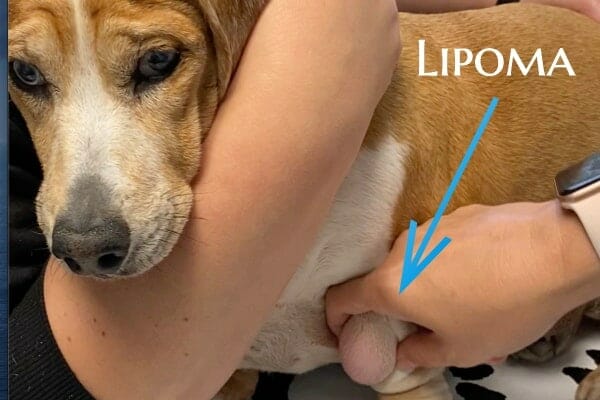
What is a lipoma in dogs?
A lipoma is a common benign (non-cancerous) tumor of adipocytes, which are fat cells. Lipomas usually have well-defined boundaries and typically do not invade the underlying tissue. They are commonly located on dogs just below the skin of the trunk and limbs of the dog’s body. However, in some cases, a dog may have a lipoma in the chest or abdominal cavity, or one may grow between the muscles of the leg.
Occasionally, a dog may have an infiltrative lipoma—one that invades muscle, bone, nerves, or other tissues. While benign, infiltrative lipomas do disrupt the adjacent tissues more than other lipoma types. They are especially problematic if they cause spinal cord compression or invade muscle tissue.
What causes lipomas in dogs?
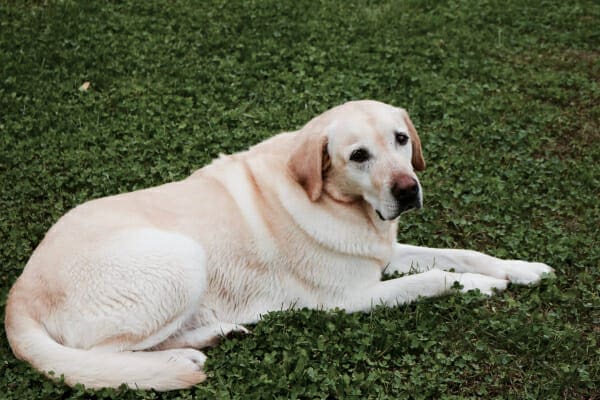
It is uncertain what causes lipomas. As with many conditions, the causes are often multifactorial, with environmental and genetic factors likely playing a role as risk factors. These fatty tumors are more common in senior dogs but can occur at any age. While any dog breed may have a lipoma, the following breeds are more likely to develop lipomas:
- Labrador Retrievers
- Beagles
- Doberman Pinschers
- Miniature Schnauzers
- Cocker Spaniels
- Weimaraners
- Dachshunds
How do you diagnose a lipoma?
A physical exam is not sufficient to diagnose a lipoma. This is a critical point that I can’t emphasize enough. Your dog needs a fine needle aspiration or biopsy of the lump to be able to definitively diagnose it as a lipoma.
Even a board-certified veterinary oncologist cannot diagnose a lipoma simply by looking and feeling. A fine needle aspiration is critical to rule out other below-the-skin tumors that can be of far greater concern, such as mast cell tumors in dogs and soft tissue sarcomas.
Fine needle aspiration
A fine needle aspiration (FNA) is a simple diagnostic test your vet can typically perform in the exam room on an alert and conscious dog. Although watching the FNA may be unsettling for owners since it involves a needle, most dogs remain calm and react to the procedure no more than they do when receiving a vaccine.
To perform a fine needle aspiration, your veterinarian:
- Inserts a needle into the mass
- Redirects it multiple times to gather cells
- Removes it with a sample of the tumor’s tissue
Watch a fine needle aspiration on a dog’s lipoma in this video…
As you can see in the next video, the vet will use an air-filled syringe to spray the collected material onto a slide, spread it out, and then examine it under the microscope.
Microscopic characteristics of lipoma in dogs
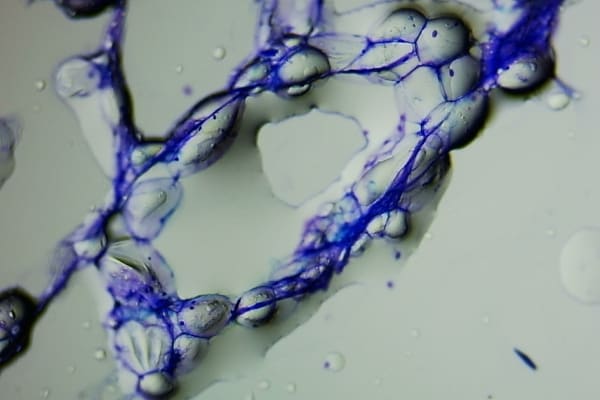
Because lipomas in dogs are mostly fat cells, the material on the slide often looks like oil. The image below shows how the lipoma aspirate looks when smeared on a slide.

Although it may be tempting to assume it is a lipoma based on the visual appearance of the material on the slide, a microscopic evaluation is still necessary. Other tumor types can occasionally have a “fatty appearance”, too.
When the vet stains and observes the material under the microscope, he or she will see adipocytes (fat cells) and sometimes red blood cells if the tumor is a benign lipoma. However, if he or she sees other cell types in addition to the adipocytes and red blood cells, this suggests the tumor is not in fact a lipoma and bears further investigation.
What is the treatment for lipomas in dogs?
Many pet owners find masses on their dogs and become concerned that their dog has cancer or that the mass is going to compress vital organs. But lipomas are often asymptomatic and usually do not cause any problems with a pet’s health. The exception to this would be infiltrative lipomas and those in the chest, abdomen, or between muscles.
Lipoma removal in dogs
In some cases, lipomas in dogs can grow large and, based on location, interfere with a dog’s mobility. For your dog’s comfort, it’s best to remove these lipomas surgically. It’s important to note that the surgical removal of one lipoma does not prevent another lipoma from developing in a different area.
If the lipoma is relatively large, your vet may need to temporarily place a drain in the surgical site. This can help prevent a seroma, which is a large pocket of fluid that fills the space where the mass used to be.
It is important to follow your vet’s instructions about incision care, exercise restriction, and use of an E-collar after lipoma removal. And if you have any concerns about how the incision looks or how your dog is acting, don’t hesitate to contact your vet.
Infiltrative lipomas in dogs—aggressive treatment approach
Infiltrative lipomas often require a more aggressive surgical approach and occasionally multiple surgeries or even a dog leg amputation. If the veterinarian is not able to remove the whole infiltrative lipoma, it is likely to recur. Radiation therapy (either on its own or combined with surgery) can also be effective in controlling these types of lipomas.
FAQs about lipomas in dogs
There are common questions and concerns that many pet parents have about lipomas. You may have some of the same questions. So, let’s get answers to some frequently asked questions about lipomas.
Q: Can you shrink a lipoma in dogs?
Unfortunately, at this point, surgery is really the only way to get rid of a lipoma. There are no commonly available or practical solutions to shrink a lipoma.
One small study of 15 dogs did indicate that injecting a steroid (triamcinolone acetonide) into the lipoma under ultrasound guidance could either shrink the tumor or cause it to regress completely. Unfortunately, some of these lipomas later recurred. A paper detailing the study entitled “Canine Lipomas Treated with Steroid Injections: Clinical Findings” is available if you want to read more about it. At this point, it is not a common procedure.
Previously, some vets tried injecting calcium chloride into subcutaneous (under the skin) lipomas. However, this method has fallen out of favor because it has the potential for complications such as necrosis (death) of the skin and irritation.
Q: Are lipomas in dogs dangerous? Harmful?
A: All lipomas are benign, and most are harmless—they don’t cause any symptoms. However, if they grow in the abdominal or chest cavity or the spinal canal, they can compress other organs and cause clinical abnormalities such as neurological issues in dogs.
Occasionally, dogs may develop an intermuscular lipoma—a lipoma that grows between muscle layers. This type of lipoma most commonly occurs in the back of the thigh and causes lameness or impedes movement.
Q: Do lipomas on dogs go away?
Generally, once a lipoma is present, it will typically either stay a similar size or, more often, continue to slowly grow larger over time. They don’t usually go away on their own.
Q: Can dog lipomas turn malignant?
Lipomas are common benign fatty tumors. They are not malignant and cannot become malignant. Since they are benign, they also can’t metastasize (spread) to other parts of the body. It is important to note that this doesn’t mean that the dog won’t get other lipomas. It simply means that any future lipomas did not come from the lipomas that were already present.
Lipomas should not be confused with liposarcomas, which are very rare, malignant tumors of fat cells. Unlike a lipoma, a liposarcoma is locally invasive and often spreads to other parts of the body. You do not have to worry about your dog’s lipoma turning into a liposarcoma, as they are completely different tumors.
Q: What should I do if I find a lump on my dog?
If you find a new lump on your dog or if you notice that an existing lump is growing rapidly, you should schedule an appointment with your veterinarian. He or she will most likely perform a fine needle aspiration (FNA) to determine if the mass is a lipoma or another tumor type. Once the tumor has been classified, your vet will explain whether or not your dog needs surgery to remove it.
If your dog has multiple masses, it’s helpful to have a “body map” showing the location and size of all the masses on your dog. This will allow you to determine if a mass is new or if an older mass has grown in size. Your veterinarian will likely keep a body map in your dog’s medical record. But you can also keep one in your dog’s health journal to note changes at home.
Q: My dog is covered in lipomas, and I just found another one. Does it need to be aspirated?
In short, yes. Let me explain my answer through the story of one of my canine patients.
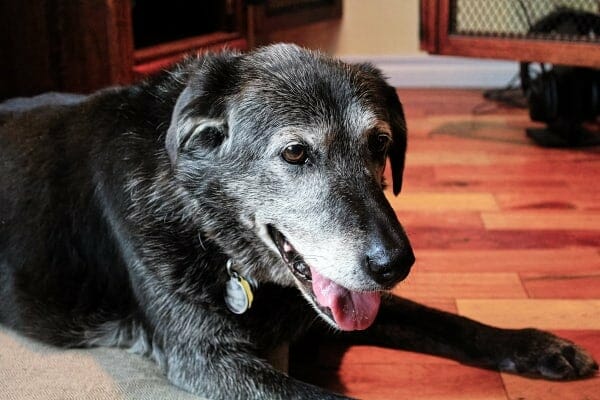
I had previously diagnosed Chloe, a 9-year-old black Labrador Retriever, with a handful of lipomas. When she came to the animal hospital for her annual exam, I found a quarter-sized mass in front of her shoulder. (This is one of the many reasons I cannot overstate the importance of taking your dog to the vet for wellness exams.)
Scanning her records from last year, I didn’t see a mass noted in this location. Although it felt like a lipoma, I wanted to be thorough.
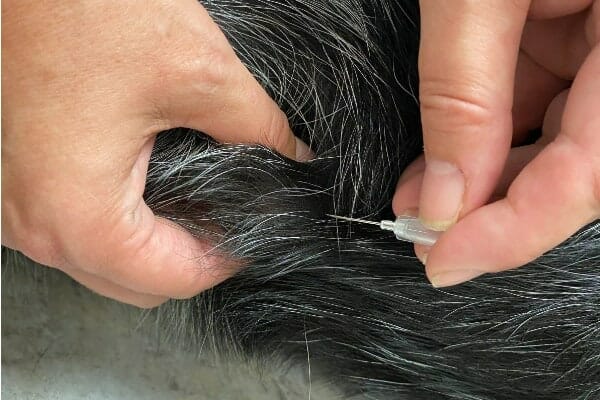
I performed a fine needle aspiration to collect a sample. The image below demonstrates this procedure.
After I smeared the sample on a slide, I saw the classic oily appearance with what appeared to be red blood cells mixed in. Upon examination under the microscope, however, the material that looked like blood was actually a mixture of red blood cells and neoplastic (cancerous) round cells.
My patient’s new mass was not a lipoma—it was a soft tissue sarcoma, which is a malignant (cancerous) tumor. I advised surgical removal at the next possible opportunity.
This story serves as a good reminder of the importance of having your vet aspirate every new lump. Even if the first dozen growths have been lipomas, you never know when the next lump will be something concerning, where early detection can make a huge difference in the outcome.
Since this is so important, I’ll say it one more time. If you find a new lump on your dog that your veterinarian hasn’t previously documented and tested, please make an appointment with your vet promptly.
Lipomas are common in senior dogs
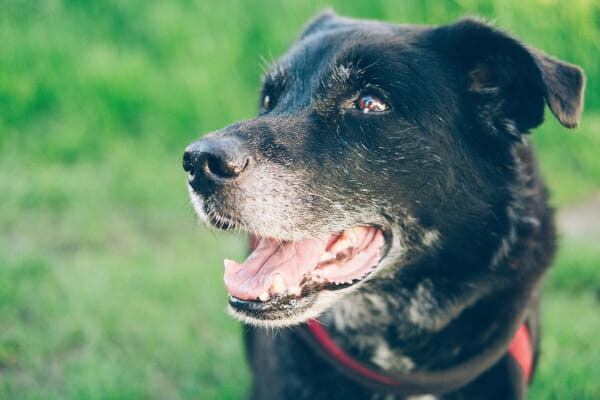
Lipomas are very common fatty tumors in senior dogs. Understandably, I have had numerous dog owners tell me that they are scared their “lumpy bumpy” older dogs are filled with cancer. Thankfully, more often than not, these masses are nothing more than harmless, benign lipomas and unlikely to cause any adverse health symptoms.
As always, though, make an appointment with your veterinarian any time you observe something new or “off” with your dog. Just like Maggie’s mom, it will help you put your worries to rest. Or perhaps, like Chloe’s story, it will allow for early diagnosis and treatment of genuine concerns. Either way, that vet visit and fine needle aspirate are critical.

P.S. Why lumps and bumps need to be checked by a vet
I can’t stress enough the importance of seeing your vet if you think your dog has a lipoma. In taking the videos for this blog post, Dr. Jennifer Shepherd did an actual fine needle aspiration (FNA) on one of her patients with what was assumed to be a lipoma so that we could share this procedure with our readers. Later, I received this message from Dr. Shepherd: “I may have saved a life thanks to you! I saw a dog today, and the owner said that the lumps had been looked at before. So, I assumed one was previously diagnosed as a lipoma. I decided to aspirate, just to make a video for you. Turns out it’s probably soft tissue sarcoma. I’m removing it on Wednesday.” Dr. Shepherd’s message reinforces the importance of getting your dog’s lumps and bumps checked. ~ Dr. Julie Buzby, integrative veterinarian
Have you ever found a lump in your senior dog? Was it a lipoma?
Share your experience in the comments below. Finding a lump can be scary—so let’s encourage and support one another.


My female German Shepherd turned 7 in June. She’s had a blackish callous the vet called her “lazy spot” on the back of her front left elbow. About a week and a half ago I noticed her licking it and that spot had swollen to a pink/red golf ball size. Last Saturday took her to the vet and she didn’t want to anger it with a needle punch and gave us an antibiotic Amoxicillin and Claviulate to take for 10 days along with a cone to keep her from licking on it. I can’t tell there’s a change it size as of yet. She didn’t mention and give me estimates for removing if necessary. But if it’s a limpoma and not cancerous I don’t want to cause it to spread. She is so miserable wearing the cone. Do you have a recommendation?
Hi Ricki,
I understand your concern for your girl with this worrisome spot on her elbow. Generally, lipomas do not get red and swollen so I would be very surprised if that is what this lesion turned out to be. If the antibiotic does not completely resolve this issue, I do think more investigation is warranted. Hoping things have improved and praying for a positive outcome for your sweet girl.
My 10 year old Chihuahua has a hard lump on top of his head. The vet said it is a bone growth. It does not seem to be causing him discomfort and I have been to the Vet’s twice.
Hi J’annine,
I am glad the vet does not seem to be concerned about the lump on your dog’s head. Hoping your boy remains happy and healthy for many years to come. Best wishes to you both!
My cousin lives on a farm and has 2 golden retrievers or Labradors.
He noticed the bump on on my dogs chest area
and asked me about it.I said what it was, and he said he drained it!? I can’t do that at all.But is that what you end up doing when you remove them?
Hi Layla,
No, the process of removing a mass is much more complicated than that. If the lump is not a mass, but a fluid filled cyst or cavity, then it may be drained (although these things sometimes refill and then have to be surgically removed anyway). But with a mass/tumor, we make an incision in the skin around the tumor and then carefully dissect the different tissues apart. We detach the mass from the underlying muscle or adjacent tissues and will ligate any larger blood vessels that could be a problem. Then when closing the incision, we suture together the correct tissue layers usually requiring a 2- or 3-layer closure. This of course is a very simplistic description, and we put a lot of thought into our incision placement, work hard to prevent unnecessary bleeding, did we get the proper margins if we are concerned this is a malignant tumor, and do we have enough skin to completely close the defect once the mass is removed. Hoping this helps explain the process a bit and offers a better understanding of a mass removal surgery. Thanks for asking!
Our 4. 1/2 yo Golden Retriever/Irish Setter mix was just diagnosed with a likely infiltrative lipoma. Surgery is scheduled for August 21. He seems to be on the younger side of dogs who have been diagnosed with it. Based on his age, is he likely to get more?
Hi Wendy,
I am sorry your young dog is facing this less common type of tumor. I understand your concern and think it is great you are trying to gather as much information as possible. Unfortunately, I am not sure if the age of onset plays a factor in recurrence with this type of tumor. The studies just haven’t been done, or we haven’t come across this specific bit of data while doing our research for the article. I do believe genetics can make a dog more susceptible to certain types of diseases and conditions. It may be your boy is predisposed to forming infiltrative lipomas. Hoping the surgery is successful and recovery is smooth. Feel free to keep us updated and wishing you both all the best.
My boy (amstaff x bull terrier) had a tiny lump on his side that grew and I then noticed one on his chest. The vet checked by drawing some liquid and confirmed that it wasn’t cancerous. However since then, there have been another 3 pop up and if i’m honest I really don’t like how quick they appear to grow. I will need to go and get the new ones checked.. Thank you for sharing your story.
Hi Bianca,
I am sorry your boy is dealing with all these new lumps that have appeared. I do think it would be wise to have them examined and checked. Hoping for clear answers and an easy solution. Best wishes to you and your sweet boy.
This was very informative & helpful.
My senior dog, she is around 18 & over the last year this spot keeps growing. She has no pain. Still walks around, she actually lays on it.
No vet will operate because of her age. I just don’t know what else they may be able to do for her.
Hi Kelcey,
I understand your concern for your senior girl with this large mass she is living with. Sometimes due to the size or location of a mass, it can make removal impossible or very risky. While age alone it not necessarily a reason to avoid anesthesia, age can cause other biological changes to take place that would cause a dog to be a poor anesthesia candidate. This is why I always recommend pre-anesthetic lab work to see how the internal organs are functioning prior to surgery. Without playing a personal role in your pup’s medical care, it is hard to offer suggestions or specific options. I hope you can find the best way to maintain her quality of life. Wishing you both many happy days ahead.
Hi Doctor
Our 16 year old poodle/shtz mix a what we believe is Lipoma soft ball size down penis area. Or doctor says that he is too old for surgery but it’s interfering with him going up steps..
Some are suggesting putting him down..but we just can’t..
Hi Jose,
I understand your concern for your pup and am sorry he is living with this large tumor. Even if making a choice about euthanasia is not urgent, it can still be a loving option if your boy is suffering and struggling daily. Here is a link to another article with more information on how to evaluate quality of life: Using a Quality of Life Scale for Dogs
Praying for clarity and strength as you navigate this emotional path. Bless you and your sweet boy.
my older female dog I just found one on her chest I hope it is not anything life threatening because this area i live in offers no affordable animal care.
Hi Roxanne,
I am sorry you are having a difficult time finding affordable veterinary care in your area. Praying that this new lump on your senior girl is nothing to worry about and hoping you can get her the medical attention she needs. ♥
This was very informative. Our small dog has a large lipoma sitting right next to her vulva. It began small as you indicated and has continued to grow; currently about the size of a golf ball.. Being that she is roughly 9 lbs, you can easily see it protruding as she walks. But it has not seemed to hinder her mobility. Our vet has advised against surgery, indicating that due to its location (so close to the vulva) it would not be safe for the incision and would likely get infected. However, I am of course nervous as it grows. I’m wondering is there a cap off – meaning does it reach a point and stop growing or will it just continue to grow always? I know if it does continues it will get to a point where mobility will be an issue for her back leg but right now she is okay… Thus what brought me to find this article as I continue to seek advice/guidance.
Hi Pash,
I am sorry your little pup is dealing with this worrisome mass near her vulva. While the location isn’t ideal for surgery, it still may be the best option. There is no limit to how big the mass will grow. You might want to talk to your vet about a referral to a specialist to get more information and see what treatment/surgery options are available. Hoping you can find the answers you need to make the best choice for you and your girl. Praying for clarity and many happy days ahead.
My senior rescue Portuguese Podengo had her first rabies vacine six weeks ago and her health has gone down hill rapidly. She has large lumps in her throat and shoulder and between her armpits. They are groing rapidly. She seems to get new ones almost every day and within days grow to the size of golf balls. We do not know her age but the vet guessed at about 12 or 14 years old. Her weight has dropped off her and she is feeling very poorly. She is going to the vets later on this morning and I fear we may not be bringing her home again with us. Is reactions to rabies injections at all common?
Dear Maggie,
I am sorry your senior girl is facing this scary situation. Without examining her myself, it is hard to make specific conclusions. From what you describe, I am suspicious the lumps could be enlarged lymph nodes. If this is the case, then cancer (lymphoma) would be a major concern. This is not a typical reaction to a rabies vaccine but because vaccines stimulate the immune system, it is possible to see strange symptoms in rare instances. I hope your vet was able to offer some answers and there is a clear plan for how to proceed. Praying for healing and a positive outcome for your sweet girl.
my 5 year old lab has a limpoma on top of his next he’s scheduled for removal in 3 days Friday he was running under the trees cut a small cut top of limpoma very minimal bleeding but later that night a small piece of tissue formed over the cut instead of a flat scab its a bubble type scab no drainage noted I clean it and apply basatration
Hi Dianne,
I am sorry your Lab has caused an injury at the site of the mass. From what you describe, it sounds like his body may be producing granulation tissue to fill in the defect. Hopefully this will not prevent the surgery from taking place as planned. Praying for a smooth procedure and an easy recovery for your boy. Best of luck to you both!
I have a 14 year old standard poodle. Yesterday in the after I discover that he had two lumps on either side of his neck. I live 175 miles from his vet. I decided to massage the lumps (which were not solid). I opened his mouth and massaged both sides of his gums.
He looked like he had the mumps and would not stop licking himself. I gave him water which he drank and kept massaging thru the night.
This morning the lumps had gone down substantially with one almost gone and he was no longer licking himself.
He ate breakfast and drank more water then went into the back yard where he did both numbers.
It is now midday and the lumps are almost gone and he no longer is licking himself.
Yay – problem solved!
Sometimes just common sense and patience will do the trick!
He has been a very healthy dog and seems to be fine.
Hi Rita,
I am glad the lumps have decreased in size and your pup seems to be feeling well. Of course, without examining your pup myself, it is hard to make specific conclusions. But I am concerned that the lumps you noticed may have been swollen lymph nodes. If this is the case, it would still be a good idea to have your boy evaluated by your vet. Reactive lymph nodes can rapidly change in size and just because they shrink doesn’t necessarily mean all is well. Wishing you and your sweet boy all the best. Keep up the good work!
What is the approx cost for this type of exam?
Jill
My terrier mix is 13 years old. I rescued her at 2 years old. After a few months, I noticed a small lipoma on her chest. It was aspirated, and growth was measured often. It is a lipoma. Now it is the size of a melon. It was left to grow larger at every measurement. Now she is too old for surgery. Should this have been dealt with when the lipoma was small, when surgery certainly was not as risky.?
Hi June,
I am sorry your senior girl is living with this large mass on her chest. It is always easier to remove lumps while they are small, but it is hard to predict how they will change over time. I understand your concern with anesthesia, but if removing the lipoma would offer her a better quality of life, I would not use age alone as a reason to forgo surgery. Here is a link to another article with more information: Is My Dog Too Old For Anesthesia?
Hoping you can get the answers you need to make the best choice for your pup.