Vestibular disease in dogs can look very scary. It is essentially dog vertigo. Most commonly seen in senior dogs, they can appear to go from perfectly healthy to completely off kilter in a moment, usually with no warning signs. Integrative veterinarian Dr. Julie Buzby shares her experience diagnosing old dog vestibular disease, and how dramatic symptoms don’t always mean a devastating prognosis.

Working as a veterinarian, my days are full of ups and downs. My passion for working with senior dogs means I deal with a lot of very serious health conditions in my patients.
Sometimes, however, dramatic clinical signs are not necessarily an indication of a severe underlying problem.
What is vestibular disease in dogs?
Vestibular disease in dogs is a problem affecting the vestibular system, the part of the nervous system responsible for balance and coordination. Symptoms can appear literally overnight and are often quite dramatic.
One of the most common types of this condition is idiopathic vestibular disease in dogs, also known as old dog vestibular disease.
Old dog vestibular disease
Idiopathic vestibular disease occurs most commonly in senior dogs, which is why it is sometimes called old dog vestibular disease. Sudden changes in coordination can be especially scary in older dogs, but fortunately this is one condition that looks worse than it is! Let me explain by introducing a senior dog with old dog vestibular disease.
Meet a senior dog with old dog vestibular disease
Lola, a 13-year-old Blue Heeler, arrived at my clinic with very serious symptoms. She was lovingly cradled in her dad’s arms with her head tilted distinctively. Her eyes were rapidly scrolling back and forth over and over again, like something you’d see in a Looney Tunes character.
Lola’s parents explained the events of the past few days and how suddenly Lola’s symptoms had developed with no apparent explanation. Now she could hardly stand up without falling to one side. At 13, they feared that their sick dog would not be going home with them that day.
I gently scooped Lola from her dad’s arms and performed a physical examination and then a neurologic examination. Despite initial fears that this appointment would end in euthanasia, I then knew I could offer Lola’s parents a glimmer of hope.
A surprising prognosis
Although we still needed to do some diagnostic testing to rule out more serious conditions, I was able to offer some hope that their senior dog would recover with minimal long term effects and possibly none.
Lola was suffering from old dog vestibular disease, or idiopathic vestibular disease. Idiopathic simply means the disease’s origin is unknown. We really don’t know for sure why it happens.
The key part of the syndrome’s long name is the word “vestibular.”
What is the vestibular system?
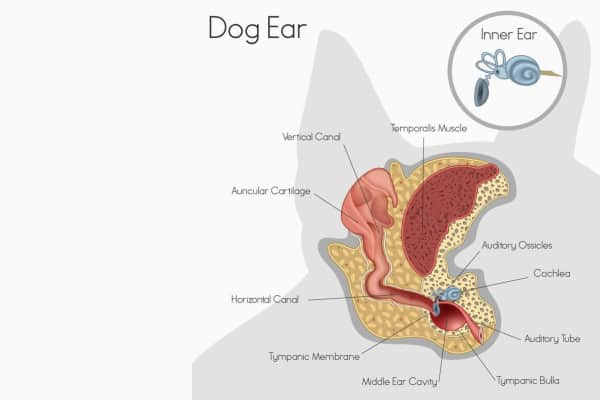
“Vestibular” refers to the vestibular system, which is a complex network of structures located in the dog’s inner ear and brain. The vestibular system perceives the body’s orientation with respect to the earth’s gravitational field and facilitates normal movement. The brain, eyes, and body use the information gathered by the vestibular apparatus to maintain proper posture and balance.
What are the symptoms of old dog vestibular disease?
Symptoms of old dog vestibular disease are mainly associated with coordination and balance. Onset of clinical signs can be quite sudden, literally overnight.
Because the vestibular system is in charge of balance, dogs with vestibular disease often experience dizziness and have difficulty walking in a straight line. If you’re thinking, “that sounds a lot like vertigo in humans,” you’re on the right track.
Old dog vestibular disease can be likened to vertigo in humans, and symptoms of dog vertigo are similar to symptoms of vertigo found in people.
In dogs, classic clinical signs of vestibular disease include:
- Abnormal posture, especially standing with legs spread wide: If they feel off balance, dogs may adopt a wide-based stance to keep from falling over.
- Head tilt: Looking a bit like an inquisitive expression, a head tilt is the most common symptom of vestibular disease in dogs.
- Impaired coordination: Think about trying to walk after spinning around in a desk chair; this is the degree of dizziness that can occur.
- Loss of balance: Dogs with vestibular disease may repeatedly fall over, even if they’re standing on a flat surface.
- Rapid eye movement when awake, called nystagmus: This uncontrollable repetitive eye movement can be side-to-side, up and down, or circular.
- Circling: Sometimes dogs will repetitively walk in circles. After all, it seems to them like the room is spinning!

What causes vestibular disease in old dogs?
By definition, the word “idiopathic” means we don’t truly know what causes old dog vestibular syndrome. It occurs for no apparent reason. It is truly a mystery!
Although it’s the most common form, idiopathic vestibular disease is not the only cause of vestibular disease in dogs. Additionally, vestibular disease can occur in younger dogs as well. Some other conditions can affect the vestibular system, and cause similar vestibular signs.
These conditions can include:
- Ear infections: Because the vestibular apparatus is in the ear, inflammation in the middle or inner ear (otitis media/interna) can cause problems with the vestibular system.
- Hypothyroidism in dogs: In rare cases, hypothyroid dogs can have abnormal blood flow or nerve function leading to symptoms of vestibular disease.
- Trauma: Physical damage to the vestibular apparatus can also impact its function.
- Tumors: Some tumors of the inner ear or brain can put pressure on the vestibular apparatus.
- Tickborne diseases: Certain tickborne diseases can affect the nervous system, including the vestibular system.
- Toxin or drug side effects: Drugs such as metronidazole can affect the vestibular system in rare cases.
Central vs. peripheral vestibular disease
Vestibular disease is a broad term that encompasses many different conditions. It can be broken down into central vestibular disease and peripheral vestibular disease. The central vestibular system includes the cerebellum and brain stem. The peripheral vestibular system is located in the inner ear. Both contribute to balance and coordination.
It’s important to note that idiopathic vestibular disease affects the peripheral vestibular system (inner ear) and not the central system (brain stem). Because of this, you shouldn’t see mental dullness or generalized weakness. If those are present, your veterinarian will likely be thinking about other causes for your dog’s clinical signs.
I expect my patients with old dog vestibular disease to maintain their overall strength and mentation even though their balance and equilibrium are terribly out of whack.
Old dog vestibular disease vs. stroke
The most common concern that my clients share with me when their dogs develop vestibular disease is this, “I think my dog had a stroke.” Indeed, with sudden onset of a head tilt, nystagmus, and lack of coordination, the comparison we could reasonably draw to human conditions is signs of a stroke.
Fortunately, strokes are much less common in dogs than in people. Age of onset of these signs is also significant, as canine strokes tend to happen in younger adult dogs. In a senior dog presenting with these clinical signs, idiopathic vestibular disease is much more likely than stroke.
What dogs are at risk for vestibular disease?
Idiopathic vestibular disease can happen in dogs of any breed, size, or gender. It is most common in senior dogs, and occurs more frequently in German Shepherds and Doberman Pinschers.
How is old dog vestibular disease diagnosed?
Idiopathic vestibular disease is a diagnosis of exclusion, meaning we diagnose it by ruling out other possibilities.
At your dog’s veterinary appointment, your veterinarian most likely will give your dog a thorough physical and neurologic examination, evaluate your dog’s medical history, and have routine bloodwork checked. This is usually enough to make a diagnosis of exclusion,
Sometimes things are not as clear cut, and it can be difficult to definitively rule out certain possible causes. Your vet may recommend referral to a veterinary neurologist for more advanced diagnostic tests.
Additional diagnostics may include MRI (magnetic resonance imaging) or CT (computed tomography) scan, or evaluation of cerebrospinal fluid (CSF) in rare cases.
Treatment for idiopathic vestibular disease in dogs
There is no direct treatment for idiopathic vestibular disease. Treatment can include outpatient or inpatient supportive care for the symptoms, lots of TLC, and sometimes alternative treatments like acupuncture for dogs.
I also make sure to prescribe anti-nausea medication (like Meclizine for dogs or Cerenia for dogs), even in dogs who are not vomiting. That unrelenting dizziness can cause debilitating nausea. (Having personally experienced a period of such dizzying vertigo that I couldn’t safely stand up, I’ve developed new sympathy for dogs with vestibular disease.)
Some patients with old dog vestibular disease are too dizzy or nauseous to eat or drink well, Supportive care in those cases may include IV fluids or nutritional support.
Most cases of idiopathic vestibular disease in dogs can be treated at home rather than in the hospital.

Home remedies for vertigo in dogs
If your veterinarian has diagnosed your dog with geriatric vestibular disease, you may be wondering what you can do at home for your dear dog. In addition to following your veterinarian’s treatment plan, you can make sure your canine companion is comfortable and safe. Here are several things to consider:
- Make sure you have soft, padded bedding for your dog to relax on.
- Keep your dog away from potential hazards like stairs or swimming pools.
- Some dogs with vestibular disease can have a hard time eating or drinking and may need their food bowls brought to them or even hand fed. (Need more tips? Check out my article on how to feed a dog with vestibular disease.)
- Using a sling or towel under your dog’s abdomen when he or she walks can prevent falling.
- Certain physical therapy exercises for dogs with vestibular disease may also help.
Additionally, dogs with vestibular disease have trouble rising and are unsteady on their feet. Our company’s signature product, Dr. Buzby’s ToeGrips® dog nail grips, can improve traction on slippery floors for these dogs and may also provide increased proprioceptive stimulus, improving the dog’s overall stability through neural pathways to the brain.

The main focus of home treatment for vestibular disease in dogs is to keep them safe. The sudden loss of balance and coordination can lead to falls without warning, so making sure they can’t fall down stairs, off furniture, into water, or other dangers is paramount.
Lots of therapeutic snuggles are also encouraged (if your dog enjoys them)!
Can old dog vestibular disease be prevented?
As the exact cause of idiopathic vestibular disease is unknown, we don’t have an effective way of preventing it. Old dogs develop this condition seemingly randomly, out of nowhere. The best thing you can do for your senior dog is to be aware of his or her overall health and notice any changes so they can be addressed quickly.
Vestibular disease in dogs: Life expectancy
Fortunately, despite the dramatic clinical signs, canine idiopathic vestibular disease has an excellent prognosis (prospect of recovery) and does not impact life expectancy. This non-painful condition is usually self-limiting, meaning it will resolve on its own, generally within one to two weeks. In fact, clinical signs that are improving within a few days also helps the veterinarian confidently diagnose vestibular disease..
In many cases the head tilt (a classic sign of old dog vestibular disease) does not go away. But this does not negatively impact a dog’s quality of life. Also, dogs who have recovered from idiopathic vestibular syndrome do not typically experience it again and go on to live out the rest of their days as if this scary episode never happened.
As a veterinarian, I often half-joke with my clients that the whole ordeal takes years off the parents’ lives, though!
Idiopathic vestibular disease FAQs
We’ve already covered the question I’m most frequently asked, “Did my dog have a stroke?” But there are some other questions pet owners commonly ask about old dog vestibular disease.
- Is vestibular disease in dogs fatal?
- No! Old dog vestibular disease is not life-threatening and generally resolves on its own.
- Can vestibular disease recur?
- While technically possible, it is extremely rare for a dog to experience idiopathic vestibular disease more than once. I have never seen it happen in the 25+ years I’ve been practicing!
- How long does vestibular disease in dogs last?
- It can vary, but old dog vestibular disease usually starts improving within a few days and resolves within 1-2 weeks. However, in some cases the head tilt does not go away. Fortunately, the head tilt does not impact quality of life.
A happy recovery from vestibular disease
To this day, Lola holds a special place in my heart. She was the high point of my first year as a veterinarian.
Don’t get me wrong. I was sad to see Lola and her owners endure a few tough days, but the outcome was far better than my clients’ initial expectations.
A few days after her initial examination, Lola strolled out of our hospital, tail happily wagging. A slight (and endearing, if truth be told) head tilt was all that remained as a reminder of her bout with vestibular disease. Lola and her family went on to share many, many more happy and healthy days together.
Knowledge is power
If your older dog experiences symptoms like Lola’s, get to the vet as soon as possible, but proceed with hope. Odds are, your dog can rebound and recover from what can be a dizzying, but not devastating, disease.
Has your dog experienced canine vestibular disease?
Share your story with us!
This post was originally published on ,August 3, 2023 and updated on October 5, 2026.


My little Molly is 15 years old, she is on medication for enlarged heart, fluid on the lungs and pain relief for her spine, she has just been diagnosed with doggy vertgoe and has been given 2 lots of medication to help with dizziness, she has the head tilt, rapid eye movement and is unsteady wen she walks, she has also started with incontinence, she has the added joy of caterrachs and a bit of doggy dimentia im just not sure how to help her anymore and it is heartbreaking, i have had her from 10 weeks old. She is a shih txu
Dear Cathryn,
I am sorry Molly is struggling and facing so many issues at once. I am not sure if there is anything more you can try or if she is nearing her final days. Here is a link to another article that may offer some guidance: Using a Quality of Life Scale for Dogs
Hoping you can get the advice you need to decide the best way to proceed. Praying for strength and clarity. Bless you and your senior girl.
Thank you for the information. My rescue Beagle, Lettie is probably only 7 or 8 but has had a tough life prior to getting adopted. She was a puppy mill momma and dropped on the streets after she was done having litters. I’ve had her almost a year now and she’s the sweetest, most gentle dog I’ve ever had.
She got her first vertigo attack while we were travelling, so I took her to an ER because I thought it was some kind of stroke. They were able to tell me some about doggy vertigo and at least give me information.
Lettie improved for about a week, then had a relapse of the symptoms. It’s been about a month now and she has good days and bad days. She’s still eating, drinking, and wants to go on walks but I can’t trust her around stairs. Also, while she wants to sit on the couch with us, she won’t jump down because it scares her. I often come home and she’s “stuck” on the couch waiting for me to pick her up and put her on the ground.
Overall, the head tilt is the most noticeable symptom and while it’s sad, it’s also pretty cute with her big beagle ears. I’m still hoping after more time passes, her balance and wobbles will improve.
Thanks for the thorough info and giving me hope that her symptoms may just take a bit longer than others.
Hi Jenn,
I am sorry Lettie is struggling with the effects of vestibular disease. She is a lucky girl to have you taking such good care of her and it is clear she is dearly loved. I hope she was able to continue to improve and regain her quality of life. Feel free to leave an update and let us know how things are going. Best wishes and take care!
Dr. Buzby,
Your wonderfully caring article and experienced suggestions are a great asset to all of us pet lovers. I have owned dogs for 40 years….5 of them have lived past 15 and we have been extremely fortunate to say the least. When I woke up 2 weeks ago to our 14 year old pit mix “Hagan” showing these awful signs, I truly thought she was having a stroke, and we were in big trouble. After no sleep that night (for either of us) and calling the vet the next morning, I was truly floored to hear the vet offer up the Vestibular disease diagnosis and hopeful prognosis. After doing the preverable Google search, I could not believe after all these years I had NEVER heard of this syndrome. …Anyway, 2 weeks later, Hagen is probably 85%…..still stumbles some, has the head tilt, and seems “embarrassed” when she falls, but she never lost her apetite and I guess the meclazine did the trick…..
** My question now is “what is the best long term prescription and suggestions for treatment’? The only real problem we see right now is that she has mulitple “beds” around the house and I have built “several” (six) :)) step levels for her to get on the couch and a few ottamans to look out the window, and get on the bed. She loves those. She knows right now that she is very “unstable” and won’t really try them. That may not ever come back and that’s perfectly fine ! (the vet said she had the best bloodwork for a 14 year old dog she had seen in a while, so maybe she will hang with us).
** I want to know what I might do @ night to keep her “calm” and let her sleep without drugging her too much to carry over to the next day ?? She is used to moving a few times in the night and now that is problematic due to her usually “climbing” up a few places. Is there a light sedative to give her or should I use partial meclazine pills, melatonin, or even benadryl, which we have used for her itching on occasion….Thanks again for the advice and article.
Curry
Hi Curry,
I am so glad Hagen is improving and has regained a good quality of life. I think melatonin may offer the effects you are looking for and it would be worth trying. But please talk to your vet about this before starting the supplement. When combined with certain medications, melatonin can cause a condition called serotonin syndrome. You would need your vet to look over Hagen’s medical details to ensure it is a good fit. Here is an article with more information: Marvelous Melatonin for Dogs
Hoping your sweet girl has many happy years ahead and I wish you both all the best!
Hi, thank you for the helpful information. My 13 year old cocker spaniel mix has officially hit all symptoms of vestibular disease as described by yourself and several other vets – he does not seem weak or disoriented still seems happy and nothing on him hurts. I’ve had him since he was two months old. He’s literally my firstborn son. However times are tough right now and I’m not sure I’ll be able to afford bloodwork at a vet around me that runs $500-$1000 so I’ve done a lot of research today on what to watch for and I did see were Benadryl could help with the symptoms. what could I do at home to treat him? And what should I be watching for as a sign that he definitely needs to go to the vet? Everything I’m reading says this clears up on its own however I’m wondering what kind of treatment would be given if he was taken to the vet and how I could mimic that at home. I’m not completely broke so I could afford some home remedies that I could grab at the store to make him comfortable but I know I can’t afford a several hundred dollar vet bill at the moment. However, I will forever regret it if I lose my baby because I couldn’t take him so any advice or treatment tips is greatly appreciated. 🙏💗
Dear Jennifer,
I am sorry your senior guy is suffering with the symptoms of vestibular disease. I understand how finances can sometimes limit our options even when we want to do what is best for a beloved pup. Your boy is lucky to have you advocating for his health and well-being. The medications that are usually prescribed for this condition focused on treating the side effects of nausea, dizziness, and sometimes inflammation. There are over the counter medications that could be used for dizziness and nausea, but you would need to contact your vet to get the appropriate dosage for your pup. If your dog’s condition begins to worsen instead of improving or staying the same, I would recommend you contact your vet right away. Also, seizures, trouble breathing, loss of appetite, dehydration, and loss of mobility would be signs to watch for that would indicate a vet visit was urgent. Here are links to other articles that may be helpful:
1. 10 Tips and Exercises for Dogs with Vestibular Disease
2. How to Feed A Dog With Vestibular Disease: A Comprehensive Guide
Hoping with time you will start to see some improvement. Praying your boy can make a full recovery and wishing you both many happy days ahead.
Our Sheltie was 15 years old when he ended up with vestibular disease. One day we just found him lying on the floor on his own urine with nystagmus. We think he had also fallen down the stairs trying to get outside. Of course, we thought it was a stroke. The vet ruled that out and told us it was idiopathic vestibular disease. His nystagmus did stop, but he never did recover from the circling and head tilt. He would walk around for hours in the middle of the night and one night, when he fell over, he scratched the floor until his paws were bloody. We ended up setting an alarm to check on him every couple of hours. This went on for 6 months and he finally declined so much that we had to put him down. It was devastating to have him go from a perfectly healthy, happy, playful 15 year old, to a shell of his former self. The disease is not always recoverable.
Dear Holly,
My heart goes out to you with the loss of your senior guy. I am so sorry he was not able to recover and that the neurological issues caused so much suffering. Without playing a personal role in your dog’s medical care, I can’t make specific conclusions. But I am a bit suspicious that there may have been a brain tumor contributing to these issues and this could be the reason why he was not able to recover as expected. I can only imagine how much you miss your Sheltie boy. What a blessing to have shared 15 years together! I hope as time passes your grief will fade and be replaced with peace. May his memory live on and be with you always. ♥
Hello Dr. Buzby,
I am the dad of Holly in your ITP thread. unfortunately I had to move over here for my little boy Joey. Joey is a 14 year old shitzu with his only issue being mostly blind out of one eye and can only see shapes in the other. He still goes on two walks a day. Plays with lambchop his toy. and runs around with his girlfriend next door. On Sunday after his walk he went to lay down. I heard a loud yelp. I went and saw him rolling like a crocodile. He couldn’t stand and his head was tilted to the side and looked so dizzy. I rushed him to the ER and they thought it was vestibular syndrome with no cause. They sent me home with bonine, enflofloxon. However you spell it. Trazadone and Prednisone. I’m extremely scared as he’s 14 and hard of eyesight. Were on day 3 barely and he still cannot stand. He is able to sit up and hold himself with his front legs. But is unsteady. I have been doing PT with him. I got him to use his back legs partially. He cannot fully extend them yet. But he didn’t fall. To me it seems very mild improvement. Thinking about Sunday his head was tilted toward the sky and he wobbled badly. His his doesn’t tilt to the sky but towards the left a little. That’s the side where his back leg doesn’t work as well. He eats and drinks fine. I hand feed him etc. He can’t go the bathroom outside yet and it upsets it. He crawled off his bed on to a pee pad and went. I told him it’s ok to pee as everything is water proof. I’m mentally sick thinking he won’t walk again and his life is coming to an end. Going from coming back from a 30min walk to not being able to walk 30min later is devastating. The ER said his eyes were moving side to side a little but a lot if he was upside down. On there report they said his eyes weren’t moving. I won’t be going back there. My regular vet saw no eye movement. She also thinks it’s vestibular syndrome. He passed all his cognitive tests and all his limbs gave responses. left side was slower. She did mention it’s a possibility he has another neurological issue but she doesn’t think so at this time. I think she thought by day 4 he might be able to stand on his own. I can tell you he wont be able to stand fully tomorrow. Just like with Holly, I’m having a very hard time with this. Is it unlikely he recovers? He’s such a sweet boy and I miss our walks and him barking on the window sill. Any guidance would be great.
Hi Randy,
Yes, I would recognize your name no matter what article it appeared under! I am so sorry Joey is still struggling. While most dogs do tend to recover after a few days, there are many that just need more time. There are many readers that have said it took their dogs weeks to show substantial improvement. Since it would take a great deal of advanced testing to truly rule out other neurological causes, I can’t be certain that there isn’t more going on here. But from what you learned from the ER and your own vet; I agree this sounds like vestibular disease which should give Joey a good prognosis. I know it is worrisome and heartbreaking to see him struggle with these severe symptoms, especially after all you have endured with Holly. I am hopeful this will turn out for the best and praying you will start to see improvement soon. As always, keep me updated and you know I’ll be keeping you and both of your pups in my thoughts.
Hello Dr. Buzby,
I’m happy to report my little boy recoverd. It took about a month and I would work on his walking with him daily. He recovered fully but maybe a little wobbly at times. It’s really hard to tell. He and Holly follow me around everywhere again. He no longer cries at night and doesn’t have to sleep on my chest while I hold him. It was getting a little hard on me as I have a herniated disk and arthritis in my back at 39. I’m not able to work out 5x a week anymore like I have the past 20 years. I’ll do anything for the dogs. After six shots in my spine I still picked up Holly and walked her around the block. She already went once by walking. She wanted to go again but her arthritis was bothering her.
Thank You for everything,
Randy, Holly, Joey.
Hi Randy,
I am so glad Joey is doing well and has made a full recovery! I was thinking about all of you this past week and hoping to get an update soon. Praying for your healing as well as continued health for both of your pups. Take care and keep up the good work!
Both dogs are doing ok. Holly goes for blood work tomorrow. unfortunately I have a very bad herniated disk in my back. I’m going to keep trying PT. I don’t want to be down in case the dogs need something. I’m trying the best I can to give them the best care. Joey will be 15 in three months. Time is going to fast. Stressful
I also started both dogs on Sensilife about a month ago.
Hi this message is for Randy. I’m going through the same with my 15 year old Yorkie as of 2/22/24. Did you give medicine to Joey? How long was your recovery with your pup? My dogs walking is improving, but her neck is still tilt to the left.
I’m sorry for just now seeing this. I don’t get alerts. Joey was on Bonine to help with him his vertigo. He was also on Trazadone at night for about 2-3 weeks. He would cry at night. Most of the time he slept on my chest and I put my arms around him. He’s fully back to normal now. The head tilt typically gets better but might not always go back to normal. Joey’s did. Every dog is different and Joey took about 5 weeks to really go back to normal normal. It was harder because he is 90% blind. I would do exercises with him. I would prop him up in his normal standing position while holding him and move is head slowly and gently left to straight to right. I would take his paws and start dragging them on the floor until his reflexes kicked in and he put his paw down. Never forceful.
Sierra my 13 year old Shepard mix had these symptoms yesterday morning while laying in bed with me after a completely normal morning routine and breakfast. Prior to she was a happy health 13 would walk 2 miles a day. I rushed her to the emergency vet thinking she had a stroke. The vet came back with the possible diagnosis of idiopathic vestibular syndrome. She said she couldn’t rule out tumor or stroke but if it is idiopathic it can resolve in a few days to weeks. If not, we will cross that bridge when we get there. We are almost at 24 hours she still eats and drinks intermittently but will not stand or walk and yet to void or have a BM. The vet told me keeping her sternal is helpful but I can’t get her in any other position besides her left side as she seems uncomfortable and disoriented on the right side. This has been the hardest 24 hrs with my girl as she’s breaking my heart watching her struggle. Is there anything else I can do for her to support her through this? I’m worried she’s going to get sore laying on one side and I also worry about her hind legs she has the typical shepherd rear end. Thank you for all this information you have already provided it helps ease my mind a little.
Hi Nick,
I am sorry Sierra is struggling with these severe symptoms. I understand why you are concerned and think it is good you are searching for advice. Did your vet prescribe any medications to help with the dizziness and nausea? If not that would be a good place to start. Also here are links to other articles with more information:
1. 10 Tips and Exercises for Dogs with Vestibular Disease
2. How to Feed A Dog With Vestibular Disease: A Comprehensive Guide
Try to make sure she is resting on a good soft and supportive bed. This will help to prevent pressure sores from forming. Ultimately, this is a bit of a waiting game. Hoping with time you will start to see some improvement and praying for a full recovery. You are doing a great job advocating for Sierra’s health and well-being. Keep up the good work!
Thank you, Yes her vet prescribed Meclizine and another drug for N/V. she gets them once a day luckily she still has an appetite so getting those to her was easy. Yeah the waiting and not knowing is hard. At night she’s in a dog bed with sides so she can’t fall out and an abundance of pillows, during the day she’s just in my bed with pillows while I lay with her.
Hi! My 13 year old spaniel mix female got a vestibular attack the other night. We went to the ER and they ruled out a seizure so we went to her primary the next day that said it was more than likely a vestibular episode. By this point she was a little wobbly but all other symptoms had gone away. She had another episode that night (last night) and it is still happening now (12:44 pm) I know it could last 72 hours with a 2 week recovery period but I have not read anything about it happening and going away and then happening again, any feedback is greatly appreciated. Thank you!
Hi Julia,
I am sorry your senior girl is dealing with these severe symptoms. While I have heard of dog’s having a second occurrence after recovering from the initial episode, I am not sure I know of one that occurred within such a short time span. It may be a good idea to talk with a specialist/veterinary neurologist. I would hate to think there could be something more serious at play and it just hasn’t been discovered yet. Wishing your sweet girl the best and praying for a full recovery.
My old dog had a vestibular attack in April. It was exactly like you described. We rushed to the emergency vet because we thought she was having a major seizure or stroke. She now has the endearing head tilt, and I call her my Wobbly Bobbly. She has to “get her legs” in the morning. Lately, she’s been a little pukey in the mornings. She vomited again this morning, which led me to the Google search that brought me here. Could the vomiting be associated with vestibular syndrome? She also has medullary washout, but her blood work just a few weeks ago showed her kidney levels in normal range.
Hi Emily,
I am sorry your girl is experiencing the symptoms of vestibular disease. Yes! Nausea is a very common side effect of the vertigo like issues they deal with. There are several medications that can really help with this particular problem. Make sure your vet is aware of the nausea/vomiting and ask about which treatments would work best for your pup’s specific medical needs. I will attach links to other articles with more information. Wishing you both the best and keep up the good work!
1. Meclizine for Dogs: Solutions for Motion Sickness or Vertigo
2. 10 Tips and Exercises for Dogs with Vestibular Disease
3. How to Feed A Dog With Vestibular Disease: A Comprehensive Guide
Hello, I have a Basenji that is 14 years old. He was diagnosed with idiopathic vestibular syndrome. He has the classic head tilt, you name it, but, there’s always a but, right? He had another episode after he got better from the first episode. The recovery from the first episode didn’t take that long, maybe 2 weeks and he vomited a lot the first night. Of course we ran to our vet or I did, he’s my baby, crying and screaming help me, help me or him and my vet, Dr. Kevin assured me he would not put him down, that he’s okay and to give him a lot of TlC. So, as you said the blood work was done, etc, which resulted in finding nothing. Fast forward and I see a neurologist for multiple sclerosis and I’m telling him the symptoms of my dog and he says it sounds like seizures to send him a video. Why, because it’s recurring, he has dogs, an avid dog lover. My vet on the other wants me to see a vet neurologist and my neurologist said don’t do it it’ll be a couple thousand $$ and my dog is 14 that’s not necessary at that age. He said he is no different than a pet neurologist, which I agree. Only difference is the pet one will do a scan, which will cost a fortune. My question is since you mentioned the idiopathic vestibular syndrome isn’t recurring is it likely my neurologist is correct?
Hi Desiree,
I am sorry your senior guy is having repeat issues with vestibular disease, and I understand why you are concerned. Most dogs do not experience recurring episodes of vestibular disease but that doesn’t mean it isn’t possible. I have talked with several people that unfortunately had their dog go through this more than once. While I can’t make specific conclusions without examining your pup myself, I can definitely say that what you are describing does not sound like any kind of seizure activity I have ever seen in a dog before. In fact, seizures have a preictal and post ictal phase (before and after) and then the dog should return to “normal” after the post ictal phase has ended. Seizures will not leave your pup recovering for weeks but instead should resolve after seconds or minutes. Your vet probably only recommended seeing a neurologist for a scan to rule out the possibility of a brain tumor or other defect. Vestibular disease should not give your dog a shortened life span or a poor prognosis, but a brain tumor certainly could. I hope this doesn’t come across harshly and I think your neurologist means well, but I think he is terribly off base. Pursuing a referral to a specialist is not required if that isn’t something that you are comfortable with. And if you do decide to go for the initial consultation, just be open with them and make your expectations and financial concerns clear. Here is a link to another article about seizures just in case you wanted some extra information: Old Dog Seizures: Everything You Need to Know to Help Your Dog
Hoping you can get the answers you need to be comfortable with how things are progressing. Wishing you the best of luck!
Hi. my dog is 11 years old and just out of the blue today started having a hard time walking, a head tilt, and off balance. She ate earlier in the day and even got up to drink, but by the end of the night she couldn’t even walk and would fall when she tried to walk. I am not sure if this is old dog vestibular disease or not even though all of her symptoms point to that. If it is this I would like some advice on how to help her or make her comfy. Really anything I can do to help her.
Thank you!
Hi Megan,
I am sorry your senior girl is struggling with these severe symptoms. There are things that can be done to help relieve some of the effects of vestibular disease but first you really need a diagnosis. Please make sure you have your pup evaluated by your vet. There are other issues that can present similarly but would need prompt medical attention to prevent further decline or progression of the disease. I will attach links with the information you are looking for about vestibular disease. Hoping your girl will start to improve and can make a full recovery!
1. How to Feed A Dog With Vestibular Disease: A Comprehensive Guide
2. 10 Tips and Exercises for Dogs with Vestibular Disease
3. Meclizine for Dogs: Solutions for Motion Sickness or Vertigo