Many orthopedic or neurologic conditions affecting dogs may worsen over time. Spinal stroke in dogs, also known as fibrocartilaginous embolism (FCE), is just the opposite. Often a side effect of strenuous play, this type of stroke requires an astute dog parent and prompt medical attention, but has the potential for a happy ending. Integrative veterinarian Dr. Julie Buzby shares what you need to know about spinal stroke in dogs: its symptoms, treatment, and prognosis.
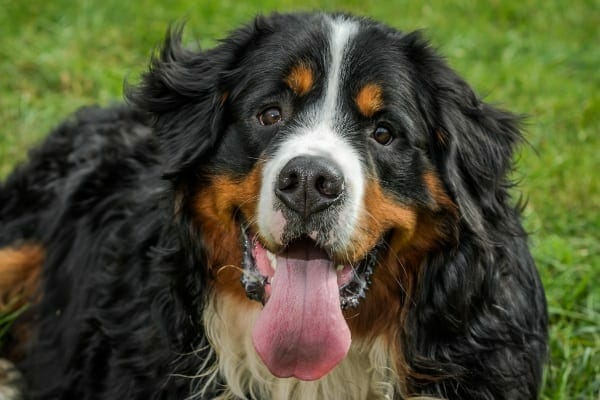
“I just don’t get it, doc. Jasper was fine this morning. Ate his breakfast like normal, went outside to play fetch, and now this.” Jasper’s distraught owner relayed his account of that morning’s events to me. Jasper, a five-year-old Bernese Mountain Dog, had been the picture of health.
But then—when he’d jumped to catch a tennis ball—he yelped and fell. He needed help getting up, and his dad knew immediately something was wrong and rushed him to the vet clinic.
Looking at Jasper sitting in my exam room, I wouldn’t have thought at first anything was wrong. He still had the same goofy, slightly drooly grin he always greeted me with. His eyes were bright, and he wasn’t whining or acting painful. But my initial neurologic examination made me very concerned. Jasper had a hard time rising in his hind end, and when he walked, his right hind leg knuckled and dragged behind.
“This looks serious,” I told his owner. “I’m glad you got him in so quickly. Let’s start with some tests.” Jasper’s bloodwork and X-rays were completely normal. He didn’t give me any signs of pain anywhere. This wasn’t an orthopedic injury; there was definitely something wrong with his nervous system. I advised his owner to take him to the local veterinary neurologist for an MRI. He did so right away.
Unfortunately, Jasper’s MRI confirmed my suspicion. Jasper had a fibrocartilaginous embolism (FCE), sometimes referred to as a spinal stroke.
Spinal anatomy in dogs
To get a better idea of what happens in a spinal stroke, first we need to review some anatomy. Dogs’ spinal cords are protected by a series of bones called vertebrae. Between each vertebra is a cartilaginous intervertebral disc. These discs are there to cushion the vertebrae and to allow the spine some flexibility and movement.
What is a spinal stroke or FCE?
Like other types of strokes, FCEs occur due to an obstruction in a blood vessel. But a spinal stroke in dogs is unique because material from an intervertebral disc—not a blood clot—clogs the blood vessel.
A spinal stroke in dogs occurs when a piece of a disc breaks off, enters the bloodstream, and blocks blood flow to a portion of the spinal cord. The location of the blood vessel that is obstructed determines which portion of the spinal cord is affected and therefore what clinical signs are noted.
Which dogs are most commonly affected?
Most dogs with this condition are relatively young (three to six years old) and healthy. FCE occurs more commonly in giant and large breed dogs and is typically associated with some sort of mild trauma or physical activity like playing fetch.
What are the signs of an FCE?
A spinal stroke results in a rapid onset of clinical signs—usually weakness or paralysis in one or both hind legs, although front legs also can be affected. Depending on where the FCE occurs, one side of the body may be affected more than the other. Although the initial injury causes discomfort, FCE does not result in long-term pain.
The following signs may be seen in dogs who have experienced a spinal stroke:
- Loss of coordination (ataxia).
- Characteristic knuckling gait where they are unable to right the paws. (See how to test for knuckling in dogs by watching this video: Knuckling in Dogs: How to Test A Dog for Conscious Proprioception.)
- Weakness in one or more limbs.
- Complete paralysis in one or more limbs.
- Signs that are more profound on one side of the body than the other.
Keep in mind that the signs may vary depending on the severity and location of the spinal stroke.
Is there hope for dogs who suffer a spinal stroke?
If your dog has suffered a spinal stroke, I want to offer you two pieces of good news that may give you some peace of mind.
- After the first 24 hours, the clinical signs associated with FCE typically won’t continue to progress. Things may look bad on day one, but remind yourself that you are seeing the worst of the worst. From here, your dog’s weakness or paralysis will either stay static or improve.
- Unlike some other conditions, a dog who had a spinal stroke is not at an increased risk for it happening again. Once you and your dog make it through this episode, you shouldn’t have to lose sleep over the potential of it reoccurring.
What is the treatment for a spinal stroke?
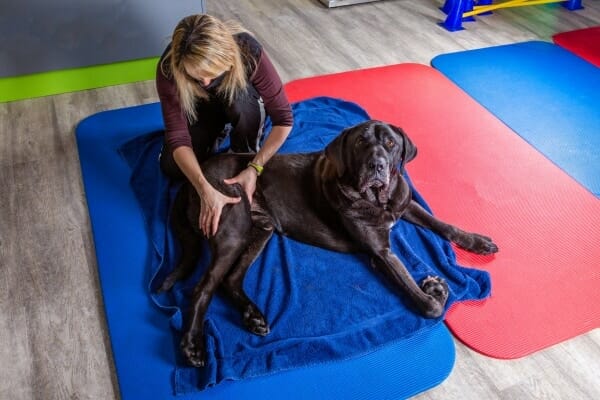
Unfortunately, there is no specific medical treatment that can reverse the effects of an FCE. However, that doesn’t mean that there isn’t hope. Supportive care and rehabilitation go a long way in helping these dogs regain strength.
If your dog has a spinal stroke, ask your veterinarian about rehabilitation options. Many general veterinary practitioners offer some degree of rehab services, or they may refer you to a veterinarian who specializes in physical therapy and rehabilitation. Also, the American Association of Rehabilitation Veterinarians maintains a searchable database to help you find a rehabilitation professional.
Underwater treadmills assist with walking and build strength
An underwater treadmill is a wonderful tool for dogs who have suffered a spinal stroke. The buoyancy of the water allows the patient to go through the full range of motion required for normal walking without the added stress of full weight bearing. Moving through the water also gives the muscles some resistance to improve strength.
Think about the last time you tried to walk in the swimming pool. The water made you feel lighter but it was harder to walk. The same goes for dogs on an underwater treadmill.
Laser therapy reduces inflammation
Laser therapy for dogs can also be very helpful in reducing inflammation and improving blood flow. This is beneficial as the body heals from the spinal stroke.
Ultimately, every case is different, so work with your veterinarian to find the recovery plan best suited for your dog.
What is the prognosis for FCE?
An individual dog’s prognosis after a spinal stroke varies depending on where the FCE occurs, which parts of the body are affected, the severity of the initial signs, and how quickly treatment is initiated.
The goal of rehabilitation and supportive care is to regain as much function as possible. In many patients, improvement occurs in as little as three to four months. Some dogs make almost a complete recovery. You’d never know anything ever happened, except for a shuffling gait now and then. Many dogs go on to live otherwise normal lives.

Challenges of caring for a paralyzed dog
Other dogs, unfortunately, must deal with long-term issues related to their paralysis. They may need ongoing therapy to assist with movement and strength. Because they may not be able to reposition themselves well, they are also prone to secondary issues such as skin infections or bedsores.
Paralyzed dogs could have difficulty urinating and defecating, and may rely on their owners to express their bladders. This can lead to other issues such as frequent urinary tract infections in dogs. Dogs with more severe paralysis will need frequent follow-up visits with their veterinarian as well as diligent at home care to stay on top of their recovery.
Additional ways to assist your dog’s recovery
Depending on your dog’s specific needs, your veterinarian may discuss slings or harnesses to help with support and movement.
Traction is also key in getting around on hard flooring, so Dr. Buzby’s ToeGrips® dog nail grips can be immensely helpful for dogs recovering from FCE.
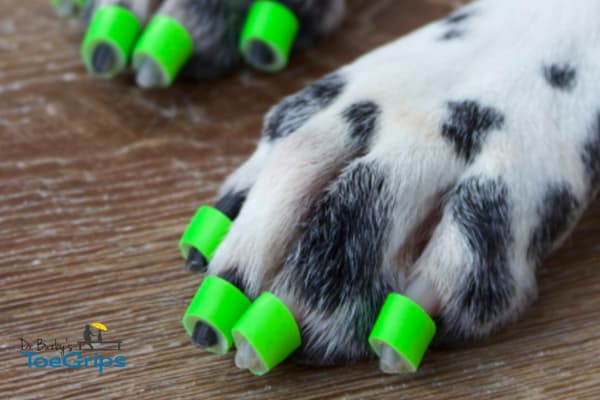
In addition, ToeGrips may also enhance conscious proprioception—the body’s ability to sense the position of the limbs and placement of the paws. Dogs who are recovering from a spinal stroke need to have their ToeGrips glued on because dragging/scuffing the paws will tug the grips off the nails. Here is a short video to explain how, when, and why I recommend this…
Back to Jasper
I am happy to report that Jasper is doing well. After working with the neurologist to diagnose his FCE, we collaborated with a veterinary rehabilitation facility to tailor a treatment plan to Jasper’s needs.
Compared to some, his condition was relatively mild, affecting only his right hind limb. We used a combination of medication, an underwater treadmill, laser therapy, and range of motion exercises at home.
Now Jasper gets around without much help and still chases his tennis ball after breakfast every morning. He hasn’t let FCE slow him down one bit, or put a damper on his love of life!
If your dog has suffered a spinal stroke, don’t lose hope—even if the prognosis seems bleak at first. Work with your veterinarian or rehabilitation professional to develop a plan, and take it one day at a time.

Has your dog had a spinal stroke?
Please share your story below. We can all support each other.


we had our 16 yr old chow /lab mix suffered a stroke, his head is now tilted to the left ,he has twitchy eyebrows and he has a hard time staying upright due to that his hind legs are 95 percent not working , this happened so.suddenly, we dis not know what was going.on when we took.him out to.pee,because he was all wobbly and panting a lot and was up for most of the night .
now here’s the thing , there is no way we can get him in a vehicle because he weighs in at 150lbs ,yes he’ s a bit overweight and he bites us whenever we try to help him up so the process of getting him to a vet is pretty much impossible.at the moment . does anyone have any tips what we can do for him , ive looked up telemedicine in our area and I cant find anything , and the vets ive looked at are pretty much money hungry and besides we live on dissabilty cheques which are not very enough to live on ,
Dear John,
I am sorry your senior guy is experiencing these worrisome neurological issues. From what you describe, this may not be a stroke but rather vestibular disease. Of course, without being able to examine him myself I can’t say for sure. I will attach links to other articles with more information. I understand your concern about your financial limits but please don’t assume the vets in your area are money hungry. Unfortunately, medical care is expensive (for animals and humans) and the cost of running a clinic can be astronomical. I hope you can find a way to get your boy the care he needs. Praying for healing and a positive outcome.
1. Vestibular Disease in Dogs: Doggy Vertigo
2. 10 Tips and Exercises for Dogs with Vestibular Disease
3. How to Feed A Dog With Vestibular Disease: A Comprehensive Guide
4. Neurological Issues in Dogs: Symptoms and 11 Common Neurological Disorders
Hi there, my girl, Sadi, who is now 9 years old.
Back 4 years ago, Sadi suffered, which took some time to figure out, suffered FCE.
Sadi is a Border Collie Mix, full of spunk and always on the go, lol. Then,, while playing fetch, Sadi jumped up, caught the ball, then landed on her butt. Omg, what a huge yelp of pain!!!!!!
I ran to Sadi, picked her up and carried her up into the house.
When we got there, I put her down. Tried to see what happened as the screams stopped outside. Poor Sadi, could only use her front paws, paralyzed with the back two legs. I was terrified and heartbroken 💔
I rushed Sadi to her vet. The took her, then eventually came back to me saying Sadi had to get to the 24 emergency hospital in Toronto, Ontario, Canada). While on IV.
They were so busy, it took a few days to do a MRI., so Sadi had to stay in the hospital. They finally were able to go out to go potty, a few days later, by using a sling that they put under her lower stomach, and the vet assistant would hold her up. It would hold Sadi’s back legs up and that’s how Sadi learned to go potty. For a week or so after,Sadi would only drag her legs. Still so determined not to give up!!!!!!!!!!!!!
Finally, after the 5th or 6th day, Sadi had an MRI. It showed FCE and one more thing. I can’t remember the second.
As soon as they released Sadi out, I followed up on physiotherapy immediately.
Sadi did this for 12 weeks and gradually started to walk again.
Sadi never fully recovered, yet the recovery was at 80-90%
Still to this day, Sadi has ok days-then not so ok days. Sadi will limp, pulls to the opposite side, and her right side, the worst, Sadi has a hard time scratching her right side. Lifting her leg part way and no more, no scratches 🙁
I know it’s late, but can Sadi still have another stroke in her spine?
Obviously she’ll never be 100%
Is Sadi in Pain??????? Dogs cannot talk, so, with her bad days, what is she going through since?
Sadi, so active, never wants to stop, her OCD, lol
Hi Sandra,
I am sorry Sadi endured this tragic injury to her spine. What a blessing she has made such huge improvements to her mobility over the past few years. There is no way to know whether another FCE will occur, but it is possible. I am not sure if there are published statistics on the frequency of recurrence with this type of stroke. I can tell you that the neurological weakness caused by a FCE is non-painful. If you think Sadi is in pain, she may need to be evaluated for arthritis or other joint issues. Thank you for sharing her story with us. Wishing you both continued success and many happy days ahead.
My 6 year old GSD was fine in the morning a week ago and by lunch was completely lethargic and depressed. took him to a vet we thought it was a gut issue as he had no visible pain so did blood test which was negative for anything.
I noticed his walk was funny but thought it was because he had tummy ache.
few days after max could not even rise it took all his might bless him and his legs are all bendy and walking funny, he was also knuckling so we booked him in for another vet check. Vet thinks it’s a progressive neurological condition due he’s a German shepherd but he’s only 6 and I believe he has the spinal stroke condition which my vet never even mentioned. He has been given pain medication and I can see this has helped. Max is now happy in himself although the leg issue hasn’t gone. if it was the progressive deterioration the meds wouldn’t have helped. Have X-Ray on Tuesday to rule out any other conditions but I don’t have money for MRI.
Its sad seeing my max like this but presently he is happy and hopefully will heal in time, compared to how he was a few days ago where he couldn’t stand or move he comes leaps and bounds. Is it worth investing in a dog wheel chair?
Hi Rebecca,
I am sorry Max is dealing with these ongoing issues with his mobility. Without examining him myself, it is hard to offer specific conclusions and recommendations. But I can say that spinal strokes do not progress and worsen after the first 24 hours. So, the fact that a few days after the initial symptoms appeared Max “could not even rise” makes me feel fairly certain that whatever you are dealing with is not a spinal stroke. There are so many other possible causes that need to be ruled out, including what your vet was suspicious of (degenerative myelopathy). It is ok if you decide to forgo testing and want to focus on comfort care. A cart or wheels may be helpful if Max’s condition continues to decline. I am hoping you can find the best way to support your pup and allow him to continue to enjoying life. Wishing you both all the best and feel free to keep us updated on how things go.
unfortunate truth about this type of injury, our boxer Benny was the joy of our lives and one morning after jumping down off our bed he became paralyzed first in one hind leg then the other, It happened on a holiday weekend with no local vet support available we did our best to care for him the. best we could, knowing that come .Monday we would be forced to do the unthinkable, have him put down…you see most people don’t have thousands of dollars they can spend on tests, surgeries, or rehabilitation, let alone be able to miss work In order to care for his needs long term, or the physical strength to lift him over and over again. The feeling of hopelessness is horrible, sad, and unbearable when you have to look in those loving brown eyes and know what your going to have to do, so come this Monday ( tommorow) Benny and I will make the visit to our family vet where we will have to say our goodbyes. I hope the good Lord has a place in heaven for our loving animal freinds so we can run and play with them again one day.
Dear Tod,
I am so sorry Benny has sustained this devastating injury. I am glad you planned to take him to your vet. It is quite possible this is from a ruptured disk in his spine (IVDD) and not actually a stroke. If Benny is experiencing IVDD then it can sometimes resolve with strict rest and anti-inflammatory medications. Here is a link to an article with more information: IVDD in Dogs: Why it Happens
What did you find out at the vet appointment? If you did have to say goodbye, I hope Benny’s passing was smooth and peaceful. Praying for comfort and peace. Bless you.
I have tears in my eyes reading some of these comments – so sorry for your loss and so grateful that so many dogs are recovering – I have a 9 year old Whippet who we think had FCE – this is what the vet said but it was very mild and he didnt have a scan at all – he was doing really well and walking further each day – being a whippet he tried to run whenever he could – but just recently (the FCE happened while he was running around 4 weeks ago now). He has gotten much worse – he still has the same range of movement and can walk fine just a little limp (he cannot trot but skips) but when is cocks his leg he gets a sudden sharp pain – i feel it must feel like someone has hit him on the back as he jumps away and turns around – this has caused him not to want to go out at all and he avoids walking near the park where it has happened on a few occasions – he seems to be getting depressed as well now – he does jump up on the sofa to sleep and goes down 4 steps when going into the garden but he rests most of the day – do you think this could be something other than a FCE? Thanks
Hi Jane,
I am sorry your pup is in so much pain. Without examining him myself, it is hard to make specific conclusions and recommendations. While FCE is still a possibility, I am also suspicious about a spinal issue such as intervertebral disk disease (IVDD). Has your vet done any x-rays? I think this is going to require additional testing to try and make a diagnosis. Hoping you can partner with your vet to get the answers you need. Praying for healing for your sweet boy and wishing you both nothing but the best.
5 weeks ago I thought I might lose my dog. My 7 year old sweet shepherd mix was playing in the yard when she let out a sudden, blood curdling cry. We found her in the yard trying to move by dragging herself. I knew right away, her back legs were paralyzed. But why? What was happening? We rushed her to the emergency vet which was a painful,almost hour away drive. An MRI told us that she experienced a spinal stroke. The diagnosis made my heart drop. But then the neurologist explained that with time, she could regain some and possibly all function. It was a tough first week. She couldn’t move or walk or even wag her tail. She was incontinent of bowel and had trouble starting a urine stream. She was depressed and refused to drink for a day and I became very concerned. But still, we kept on. I put water in her food because she did not refuse to eat. We took her outside with a sling every few hours to promote elimination. We turned and repositioned her around the clock every 4 hours no matter day or night. We performed passive range of motion exercises four times a day. Then, after about two weeks, one of her legs began to move. Gradually she needed less and less assistance to move. And then she got her spunk back. She was able to stand with some assistance, and make walking motions with one foot. I am happy to say that after 5 weeks, our girl is now able to get up, stand, and walk! She’s a bit clumsy and one leg has some work to do still but we are confident that she will be back to normal after another month or two. It’s been such a joy to watch her quickly progress and nothing was better then the first time she was able to wag her tail again. I hope our story brings other pet parents hope and comfort during a scary, unpredictable time.
Hi Christianna,
This is such a heartwarming story! I am so glad your girl is improving and finding joy in her days. Thank you for sharing your experience with us and offering this hope to others. Wishing you continued success and many happy years ahead. Bless you and your sweet girl! ♥
Hi.
Yesterday whilst playing ball in the field my staffy cross screamed like I’d never heard before. Rolling around on her back. When I rushed over to her I could see her back leg was not right. I rushed her to the vets thinking she had broken her leg to discover it was either FCE or something to do with a disc in her back. Totally frantic with worry and also worry of how I’m going to afford the treatment, I went home with her and some pain relief and researched FCE. Which I 99% believe this is what has happened. Today she has been moving around either dragging her back leg, knuckling or I have noticed she has put some weight on her leg. I carried her into the garden and she went off on her own for the toilet. She’s very sad and doesn’t like to move much as it is exhausting for her however I feel this is massive improvement in just a day.
After reading some of these comments I feel her symptoms arnt as severe as some. Does what Iv described sound like good progress or maybe just a stubborn dog that refuses to give up
Hi Aimee,
I am sorry your girl experienced this worrisome injury. I understand your concern and think it is good you are closely monitoring her condition. From what you describe, it does sound like she is making some progress. Stubbornness can be a very helpful survival tool. 🙂 Hoping for continued healing and praying for a full recovery for your sweet girl. ♥
It is 1 am and I am desperate for hope for my 6 year old shih tze, Louie, who had a trauma 12 days ago but seemed fine this morning and then started to throw micro emboli. He squealed in pain and then was unable to move his rear legs and right front. I took him to the vet. but after 2 hours no progress so brought him home. after 12 hours he could sit up. I am going to follow your treatment plan, include prayer. and keep your story close to my heart. Thank you for sharing this story of joy.
Dear Cindy,
My heart goes out to you as you face this emotional situation with Louie. I understand your concern and can only imagine how worried you must be. Don’t forget you can always ask for a consultation with a specialist if needed. Praying for healing and comfort for your sweet boy. Bless you both. ♥
About 4 wks ago, my 5 yr old Dogue de Bordeaux started urinating in the house- which is abnormal. That went on for about a week and then he started walking in circles, constantly. He was either laying down or walking in circles, if he was awake. He also walked out into a field behind the house (which he’s never done) and acted like he didn’t know how to get back or respond to me calling him. Took him to the vet, they took him back for an X-ray and urine sample. Came back and said,his urine has blood in it. (I got him when he was 6 wks old and noticed it then. Took him to the vet, they said he appears healthy and it’s possible something internal didn’t form right at birth. Basically didn’t find anything wrong. Fast forward 5 years later, he still pees blood.) The vet also did an X-ray and said, he has a semi enlarged prostate and some inflammation or arthritis? in the spine but neurologically he’s fine. She said he most likely has an infection, like prostatitis, and gave him antibiotics and pain medicine. Since then, he has still been going to the bathroom in house, circling… Now he has trouble just walking, without tripping or running into things. He will walk into a corner in the house and act like he doesn’t know how to get out, or back up. He has no energy and generally just acts like he doesn’t know what planet he’s on. He still eats and drinks like normal (which is a lot) but he has definitely lost weight. He gotten worse and worse since this first began and I don’t have money right now to take him back to the vet. Don’t know what to do for him right now
Dear Lindsay,
I understand your concern for your big guy and agree this sounds worrisome. Without being able to examine him myself, I can’t make specific conclusions or recommendations. I am wondering if the urine problem and strange behaviors are actually related or if the timing could be merely a coincidence. The circling and confusion definitely sound like a neurological issue. I hate to mention the “C” word, but I do think cancer (such as a brain tumor) needs to be ruled out. It may also be a good idea to talk to your vet about more rare conditions such as tick-borne diseases. Hoping you can find a way to get him the medical attention he needs and praying for clear answers. Feel free to leave an update if you have a chance. Bless you and your sweet boy.
This is a wonderful story with a terrific outcome. Thank you so much for sharing.
We were very fortunate in that our 5 year old boston terrier cross who suffered a mild spinal stroke last week is already starting to move around. She is still unable to navigate stairs or jump on her favourite couch and has a very bad limp and poor balance, but she is in much less pain and starting to get her personality back. She was our fastest dog, super agile and playful before PCE struck, but we remain hopeful for a full recovery and are so grateful it was not more severe. Thoughts and prayers with everyone who may not be as fortunate.
Hi Eloise,
I am sorry your girl experienced this painful episode but so glad to hear she is making steady improvements. Thank you for offering sympathy and encouragement to others. Praying for healing and wishing your sweet girl the best of luck!
It happened with our 5-1/2 yr old German Shepherd. She was playing and just collapsed. We went to the vet immediately and they told us about spinal stroke. So we got her home and carried her 96 lbs into the house. After about a week she developed a bad utility with a lot of bleeding. We took her back to the vet and they got it stopped with antibiotics, we left her there for two days and then took her home.
So Sunday morning, two weeks later I got out of bed and went to see her. We had her in the living room on a tarp with a pee pad. I went to sponge bath her and while wiping between her butt and pee pee, and a hole opened up and about a pint of infectious fluid poured out of her.
The vet met us at their office and said the muscle down to her knee and across her back was all neurotic, dead meat. We looked up at the vet and said she has to go doesn’t she, They said yes, no hope for her, so i held her as she went to sleep. Ill never forget the look in her big brown eyes as she looked at me as the drugs to put her down were administered.
Our lives are forever changed,I loved Sandy like a child. She was more than a dog, she was my companion. Its been weeks and I cry as I write this. I pray that none of you has to ever go through this,
Dear David,
My heart breaks for you as you grieve the loss of Sandy. It is clear she was a big part of your life and offered so much happiness and joy to your family. I know you would have done anything to give her more time, but you made the only choice you could to offer relief and peace. I am certain your presence during her final moments was a comfort and she knew how much you loved her. I hope with time your heart will begin to heal. May her memory be with you always and continue to be a blessing in your life. ♥
I’m in the UK, my Frenchie x pug ( 2 at the time) had a spinal stroke in 2019, he had a scan and hydrotherapy and was fine, maybe a little weaker in his hind quarters but otherwise fine. Then almost exactly 12 months later he had another, this time he recovered, mostly but was particularly weaker on his left back leg. And now (2024) he’s had a 3rd. My pet insurance won’t pay for treatment as they say its a reoccurring incident. So I’m trying to treat him with medication from the vet. I’m concerned this time more damage has been done, as he seems incontinent. But due to extremely limited finances I’m just praying that he pulls through this time too.
Dear Abbie,
My heart goes out to you as you face this emotional situation with your boy. I am sorry he is struggling and getting the care he needs is proving to be very difficult. I wish there was more that I could do to help, but please know you are in my thoughts. I am praying his body will heal and he can make a full recovery once again. Your pup is very lucky to have you taking such good care of him and advocating for his health and well-being. Keep up the good work and give your sweet boy a hug for me. ♥
Our 16 week old Great Dane, Dice, panicked on Thursday morning and couldn’t get up. he wasn’t injured in that moment. he did fall a week prior and was a bit clumsy. He’s been in the ER for over 4 days now and the neurologist isn’t really sure yet what exactly happened but FCE is one of the potentials. He has feeling but unable to move his rear hind leg. his front right leg is weak and his right eye dropped badly. we are devasted and battling fighting for him and not knowing if he will improve. Hes super frustrated and wasn’t in pain after the first 24 hours. he is not attempting to put weight on any of his legs which is odd because it’s only the back right one that he can’t use. He lays in his enclosure and cries. His blood work was all healthy as was his X-ray and spinal tap. MRI showed some bright spots and grey. not major but has stumped his medical team.
Dear Julie,
My heart aches for you as you watch your puppy struggle with these neurological issues. I am so sorry for all you both have endured. Praying the medical team will make a breakthrough and find a clear path forward with treatment. Hoping your sweet boy can keep fighting. Feel free to leave an update as things progress. Bless you both. ♥