Understanding dog toenail anatomy is critical for being able to successfully cut your dog’s nails. It also can be helpful for learning how to apply ToeGrips or recognizing when something is wrong with your dog’s nails. Integrative veterinarian Dr. Julie Buzby is here to help with an informative look at dog toenail anatomy.
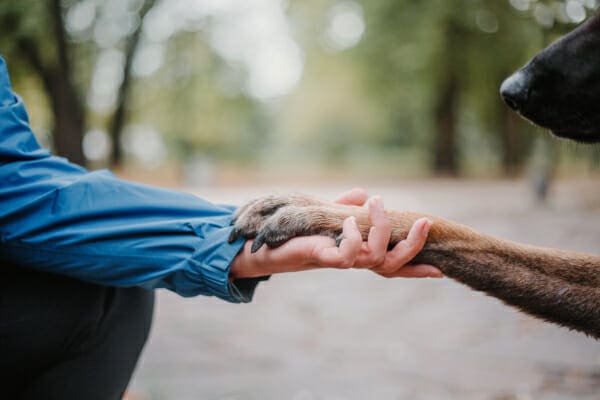
Yesterday, I had a client come into the veterinary office for a demonstration on how to trim his dog’s nails and apply Dr. Buzby’s ToeGrips® dog nail grips. His dog Sophie, an 8-year-old German Shepherd, was with him. Unfortunately, like many German Shepherds, Sophie was diagnosed with hip dysplasia in dogs last year.
Understandably, my client was very worried about accidentally cutting Sophie’s nails too short and making them bleed. Or, accidentally putting the ToeGrips in a spot that they didn’t fully help Sophie. My wonderful veterinary nurses gave him a quick tutorial in dog toenail anatomy. Then they demonstrated trimming nails and applying ToeGrips. This made him feel much more comfortable.
If like my client, you are feeling a bit unsure about trimming your dog’s nails or understanding where to apply ToeGrips, this article is a great place to start. Let’s dive in!
Toenail location
When you pick up your dog’s foot, the first thing you will probably notice is that he or she has multiple toenails. Each one is associated with a paw pad. In some very furry breeds, you may need to part or trim the hair on the paw in order to be able to see the individual nails. Make sure you are careful not trim too close to the skin, though.
When you are looking at the bottom of the paw, you will see that there are four nails. In a normal paw, the nails should point forward toward the head. They also curve slightly toward the paw pad associated with each nail. Because every dog has at least four nails, he or she also has at least four smaller paw pads plus the large paw pad in the middle.
Dewclaws
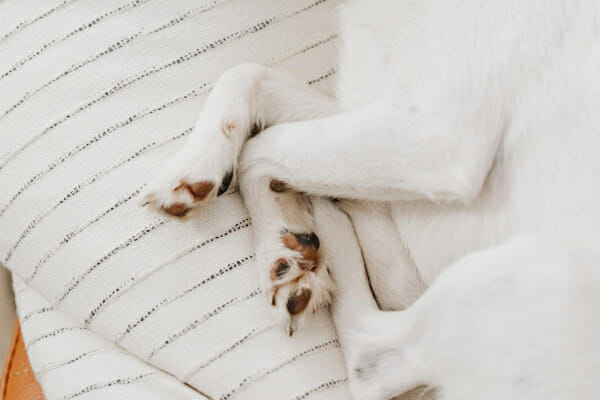
Additionally, some dogs have a fifth nail. This nail, the dewclaw, is located a little past the “wrist” of your dog’s paw. Depending on the dog, dewclaws can be located on the front legs, back legs, or both. Some breeds of dogs like the Great Pyrenees may even have double dewclaws (i.e. two declaws per foot).
If your dog has dewclaws, it is important to pay attention to them. Dewclaws can be one of the most common nails to get snagged on things and broken. They also are the easiest to miss when trimming nails. This is because they are further up your dog’s leg and can be hidden in fur.
Dewclaws are either “floppy” or “attached.” This describes how closely associated the nail is to your dog’s “wrist.” Out of the two types, floppy dewclaws are the most likely to be snagged or broken because they are only attached by skin. Attached dewclaws, on the other hand, have a bony attachment.
Dog toenail anatomy
In some ways, your four-legged friend has nails that are very similar to human nails. Keratin, nerves, and blood vessels make up dog toenails just like our nails. However, unlike in people, a dog’s toenails are positioned on the tip of the last bone of each of his or her toes. This means that the nail actually attaches to the toe bone. In people, our nails sit on top of our finger rather than being connected to the bone directly.
Dog toenails attach to the paw at the nail bed and are horn shaped. They start out rounder and wider at the nail bed. As you move down the nail, the tip gets narrower and more pointed. Nails come in different colors as well. Some dogs have a white nail with a triangular pink portion inside. However, other dogs have black nails that don’t allow you to see the inside of the nail at all.
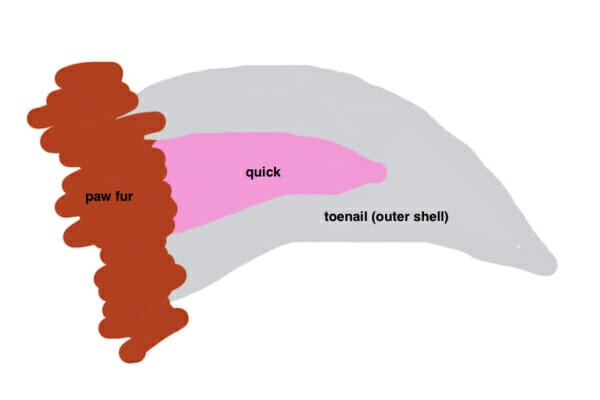
Two distinct portions make up each toenail—the hard outer shell (i.e. toenail) and the soft quick inside the nail.
The outer toenail
A substance called keratin makes up the hard outside of the toenail. You can think of it as a hollow shell. One of the toenail’s purposes is to protect the quick inside. It also helps with digging, gripping bones, or traction when walking or running. (Remember this traction part because it comes into play when we talk about ToeGrips.) This part doesn’t have any nerves so cutting it should not be painful to your dog. You can compare it to the hard part of your fingernail or toenail that you can cut without pain.
The quick
Have you every bent a nail back, had one rip off very short, or accidently poked something under your nail? It hurts, doesn’t it! That is because you got into the quick of your nail. Just like your quick, the quick of a dog’s nail is where all the blood supply and nerves are located. It is the part of the nail that has feeling and can be very sensitive. The quick also provides nutrition to the nail. A healthy quick is necessary for a healthy toenail.
In dogs with white nails, the quick is the pink triangle you can see inside of the nail when you are looking from the side or top of the nail. Usually, you can’t see the quick very easily in dogs with dark colored nails. However, if you look at the underside of the nail, you may be able to see a softer, more “crumbly” part of the nail that looks different from the outer shell. That is the quick you are seeing.
Ideal toenail length
When a dog’s nails grow, it is usually the outer shell that grows. However, over time, the quick can grow as well. When the quick starts getting long, you have to use extra caution when trimming your dog’s toenails. Otherwise you may accidently cut the quick. This can be painful for your dog and also causes bleeding.
Ideally, a dog’s toenails should not touch the ground when he or she is standing still. The nail may touch the ground when a dog walks because the tendons and ligaments in your dog’s foot contract and relax with each step to change the position of the toes.
If you notice that the nails are curling inward or to the side, this is a good indicator that they might need trimmed. Nails that are too long can be at increased risk for injury and can also make walking harder. Long toenails change the mechanics of the foot which can cause pain. Plus, they don’t grip the ground well. This makes things even more difficult for our senior dogs who may already have a hard time getting traction. For these reasons, long toenails are more than just an aesthetic issue.

Trimming toenails
Many dog parents are nervous about trimming their dog’s nails because they don’t want to cut them too short. However, with a bit of practice and the right tools, you can learn to confidently trim your dog’s nails. Remember what you have learned about nail anatomy and follow these steps to get started off on the right foot:
1. Gather your supplies
Having the right tools is so important to nail-trimming success. I have found that the best dog nail clippers are the large orange-handled scissors style ones made by Miller’s Forge. They are the ones I have been using for over 20 years in practice and the ones I would recommend to anyone, no matter the size of your dog.
You also will need something to stop the bleeding if you clipped your dog’s toenail too short. You can find styptic powder at most pet health stores and online retailers. Alternatively, white flour or cornstarch work in a pinch.
If you would prefer to get all your supplies at once, you may want to purchase my dog nail trimming kit. It contains a bottle of styptic powder, the recommended Miller’s Forge clippers, and a quick reference guide to nail trimming. The kit also comes in a handy bag that helps you keep all your nail trimming supplies in one place.
As much as possible, nail trimming should be an enjoyable experience for your dog. This means you may want to have some yummy treats or toys on hand to periodically give to your dog during the nail trim. Sometimes it is helpful to enlist the help of a second person to steady and reassure your dog and/or give him or her treats while you trim the nails.
If your dog is particularly fearful of nail trims, you may want to check out this video on training a dog to enjoy toenail trims by the famous veterinary behaviorist, Dr. Sophia Yin.
2. Locate the quick
This is probably one of the hardest but most important parts of nail trimming, especially if your dog has dark nails. You are looking for the pink triangle in light nails or the softer underside of dark nails. If you are unsure of what you are looking for, you may want to schedule a demonstration with your veterinarian.
3. Trim off small amounts at a time
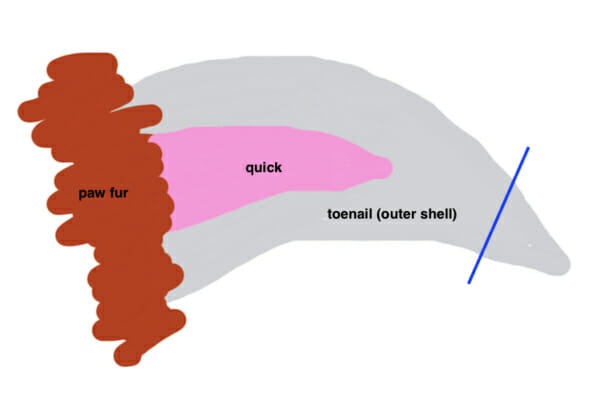
Take only the tip off with each cut. It is much better to gradually take slivers off as you go than it is to take off a large amount at once and regret it because the nail was cut too short. The best way to make sure you are only taking small amounts is to cut at an angle. The picture below has a blue line indicating the appropriate angle.
4. Stop cutting when you get close to the quick
As you are trimming small bits off the tip of the nail, keep an eye out for the area I call the “pre-quick.” It is a small black or pink dot on the cut surface of the nail. Think of it as your stop sign. Once you hit that spot, you are done cutting the nail. If you continue to trim, you will probably get into the quick.

5. Make nail trimming part of your regular routine
When you are starting out, you may only be able to cut a few nails at a time before you and your dog are ready for a break. Just jot down which ones you clipped and then start with different nails at the next trimming session. Over time, your dog will get used to the idea and you can trim all the nails in one session.
Also, some dogs with long nails also have long quicks. This means you may not initially be able to trim the nails as short as you would like. But as you continue to regularly trim your dog’s nails, the quicks will recede some and you will be able to get them shorter.
If you make nail trimming a normal part of your dog’s healthcare routine, his or her nails can stay short and healthy. Plus, it will soon seem like no big deal to you or your dog to trim the nails.
6. Use your resources well
This is just a quick overview of nail trimming. However, there are many resources that can help provide more direction and detail including these three:
- My nail trimming class, Nail Trimming Without Fear
- Your veterinarian, veterinary nurse, or groomer
- My blogs 7 Tips for Successful Dog Nail Trims and How to Clip Dog Nails: Turning Scary Task into Success!
Understanding dog toenail anatomy to get the most out of ToeGrips
Now that you have a good idea of how to trim your dog’s nails, there is another toenail anatomy-related subject I want to discuss. It is how you can properly use ToeGrips to complement the normal function of your dog’s nails and give some added traction.
If you have spent any time navigating our website, you have seen that I am very passionate about senior dog health and improving quality of life during the senior years. This is why I started this company with ToeGrips as our foundational product. (To learn more about how I was first introduced to the idea of ToeGrips, read the story of ToeGrips.)
As mentioned above, dogs use their toenails like cleats to grip the ground. However, this doesn’t work as well on hard or slippery surfaces, especially if the dog also has other mobility concerns. This is where ToeGrips come in. They help improve traction for dogs who have a hard time walking due to arthritis, previous injury, or advanced age. However, in order for ToeGrips® to be effective, you need to use the right size and place them on the nail properly—hence the importance of understanding toenail anatomy.
Get the right size
The first important piece to using ToeGrips is selecting the correct size for your dog’s nails. ToeGrips that are too large may slip off the nail or slide up into the nail bed. And as you can imagine, ones that are too small will not fit onto the nail correctly.
You can read the instructions on how to measure your dog’s nails for ToeGrips using a piece of string or floss or you can learn how to do it by watching the video below.
Our customer care team is also happy to help with sizing questions or concerns.
Ensure the ToeGrips are positioned correctly on the nail
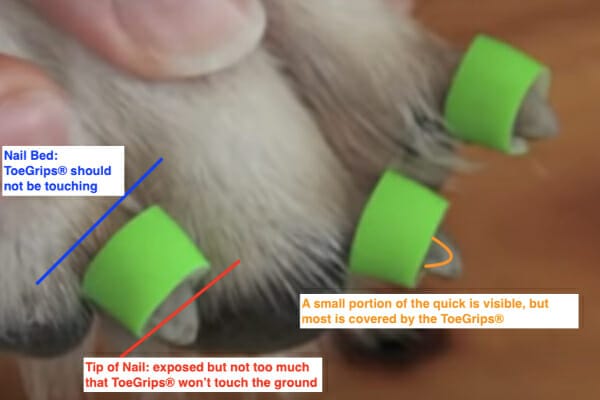
When you apply ToeGrips, they should fit securely around the toenail, but expose the tip of the nail. Depending on the length of your dog’s quick, most of the quick should not be visible once the ToeGrips are in place. In order for the ToeGrips to be effective, they should make contact with the floor when your dog is standing still. This creates the GripZoneTM, which is what helps them provide traction for your dog. If the ToeGrips are not contacting the floor, double check the size, position, or if your dog’s nails need trimmed.
It is also important that the ToeGrips are not be touching the nail bed (i.e. where the toenail attaches to the paw.) Frequently inspect your dog’s ToeGrips to ensure they haven’t worked their way up the nail over time. Having the ToeGrips in the proper zone on the nail helps ensure that they reach their full potential to help your dog.
To learn more about ToeGrips application, safety, and other related topics, check out the ToeGrips FAQs on our website or talk to a customer care member. Your veterinarian also can be a good resource if he or she is familiar with using ToeGrips.
Problems to look for in nails
Finally, I want to mention how to recognize potential problems with your dog’s toenails. Since you now understand what a normal toenail should look like, this should make it easier to identify some common issues associated with dog toenails. Here is a brief list of some things to look for:
- Nails that are too long and curling into the pad.
- Broken nails—either attached to the quick or missing completely. Broken nails may bleed and are often quite painful.
- Your dog excessively chewing at his or her nails.
- Toes that are swollen around the nail bed.
- Discoloration of the nails.
- Extremely brittle nails.
- Nails where the outer shell is sloughing off.
However, this is not an exhaustive list of all the problems that can arise. If you see some of these signs or you have any questions or concerns about your dog’s nails, please seek veterinary care for your dog.
Tip-toeing into the future
Things involving your dog’s toenails can be scary! I get it. But I hope that by reading this article you will feel a bit more confident trimming your dog’s nails, applying ToeGrips, and monitoring for any toenail issues.
As always, your veterinarian is a great resource for any nail trimming or medical questions. And our customer care team is ready to help ensure you and your dog have the best possible experience with ToeGrips. You can use your understanding of dog toenail anatomy to take care of your dog’s nails! And your dog will be happier and healthier for it.
What are your questions about dog toenail anatomy?
Please comment below.


My dog was recently playing ball. Threw it and he came back limping and it was bleeding it was on his right foot and the furthest toenail on the right. It seems like he tore the outer nail loose from the foot. Will it just grow back or should I seek a vet?
Hi Mark,
I am sorry your dog has experienced this painful injury to his toe. The nail should grow back but it still may need some treatment from your vet. It is hard to know if you need to make an appointment or not without being able to examine your pup myself, so to err on the side of caution, I would advise you to call your vet and let them decide if a visit is needed. Here is an article that may offer some helpful information: Help! My Dog Ripped a Nail Off!
Wishing your boy all the best of luck!
My dog had a bad experience at two groomers when a puppy. As a consequence there was a long period when she did not get her nails cut. However, for the last 12 months or more, she has been having them trimmed every 2 or 3 weeks in the hope the quick will recede, but, this isn’t happening. When she goes back to the groomer, they can only cut off what has grown since they last saw her. The quick is still long. Is this peculiar to her or does it take a long time? It’s very frustrating as they need to be a little shorter than they are.
Hi Jill,
I am sorry you are fighting this ongoing battle with your dog’s toenails. Unfortunately, what you describe is quite common. Sometimes there is no good way to resolve this issue. One thing you can try is taking daily walks on a rough surface such as concrete. This can sometimes slowly wear the nails back and encourage the quick to recede. If your pup will allow you to handle her feet at home, you can also try one of the dog specific Dremel/nail grinders to slowly work the nail length back. You are doing all the right things, and I applaud you for advocating for your girl’s well-being. Wishing you both all the best of luck and keep up the good work!
My 6 yo mid-size dog has one toenail broken by accident. The lower half of the toenail is lost and quick is exposed. She seems to be bothered by pain or at least discomfort and occasionally licks the finger. We spray alcohol for disinfection and put Vaseline for protection, but we don’t see any evidence of infection. She looks a little less energetic but still enjoys exercise walking and dashing.
What can we do we do for helping her feel less uncomfortable and heal quickly?
Hi hiro,
I am sorry your pup has broken her toenail. If she is exhibiting signs of pain, then I would highly recommend you contact your vet. Applying alcohol to the exposed quick is probably very painful as the tissue is sensitive. Your vet can give you an appropriate topical to use if one is needed and prescribe something to relieve any discomfort. I am hopeful you can partner with your vet to get this resolved quickly. Wishing your sweet girl all the best!
My dog has a few toenails where there is no gap between the pad and the nail. Typically if you look at the underside of the nail, it extends off the paw in a bit of an arch shape. With a few of hers, it is flush with the pad with no gap. Should I try to file the underside to try to create a gap? They are thicker than her other nails, so when trimming I only cut the length so that she doesn’t make contact with the nail onto the floor.
Hi Tammy,
I understand your concern for your pup. I am glad you are reaching out for advice, but without examining her myself it is hard to offer specific recommendations. I am not sure if the nails are overgrown or if they naturally grow at an odd angle. It may be best to have your vet take a look and offer some suggestions as to how to keep them maintained. I am hopeful there is an easy solution. Take care and keep up the good work!
My chiweenie has extremely long nails with very long quicks. We do keep them trimmed as best as possible, we just have to do it more often. He is definitely a tip-tap on our floors though. Those long daschund nails are no joke. Would these still be a good option for him?
Hi Tiffany,
I would love to try and offer advice, but I am not exactly sure what you are asking about. Are you wondering about the orange handled nail trimmers mentioned in the article, or ToeGrips? If you are curious about ToeGrips please don’t hesitate to reach out to our expert customer care team at: [email protected]
They can answer any questions and help with sizing. But yes, the nails do have to be trimmed fairly short to allow proper application and placement of ToeGrips to be effective. Wishing you and your sweet boy all the best!
Hi there.
My 4 yr old cockapoo was born with very very short nails. They have been
Clipped or ground several times with no problem.
I noticed today that one foot her quick is right at the end on all toes. No
Bleeding, no apparent discomfort. She even went on her usual mile morning walk. I’m concerned that her nails just don’t grow much past the quick.
They haven’t been clipped for 10 mths now. I watch them closely. I wash her
Feet with warm water after her walks. Not because of this issue but because her feet get very wet and dirty. She doesn’t chew her feet. Can I maybe put clear nail polish on them to maybe help the nail be protected in hopes they
Will grow at least past the quick. No infection or health issues. Thanks so much
Hi Penne,
I understand your concern for your pup, but honestly, this situation sounds ideal. The nails don’t need to grow past the quick and keeping them short will prevent all sorts of potential injuries. As long as the quicks are not prone to bleeding, I would not worry about your girl’s nails staying short. I wish I could achieve this with the nail trims I perform! Best wishes to you both and give your sweet girl a hug for me. ♥
Hello,
My almost 10yr old German Shepherd lost a nail about 3 months ago. the quick was exposed and it took about a month for her to recover. she ended up needing antibiotics at the end of the month because she had developed an infection in all 4 of her paws.
Last night, I found one of her nails on the floor. I checked her feet but the quick wasn’t exposed. is it possible for new nail growth to occur underneath her original claws?
Hi Piper,
What a strange situation! I guess anything is possible, but I have never seen a toenail grow quite like what you are describing. It may be a good idea to have your vet take a look at your Shepherd’s feet just to err on the side of caution. Hoping all is well and wishing your girl many happy years ahead.
Something very similar just happened to me and my dog! He has a (non-functional) hind dewclaw that was getting extremely long and curling toward his ankle, and I was worried about what to do, because he has extreme anxiety surrounding nail trims which in recent times have made them impossible for me. (Luckily, all of his other nails stay short, because he gets a lot of exercise on rough surfaces.) Then one night a few days ago, I glanced at his dewclaw (which had been extremely long and curling just the day before) and it was mysteriously suddenly a perfect-length (and healthy and intact) nail. The only thing I could think of in terms of the explanation was that—like you said—a complete new nail had formed “inside” his old and overgrown nail, and then the old nail was dropped or “shed off,” revealing the new shortened nail below. I didn’t know this could happen but I thought it was pretty cool. I wondered if it could be some natural mechanism occurring in animals with dewclaws for dealing with these nails, since they don’t get as much traction/wear as other nails and can become quite long over time.