Knuckling in dogs can signal a variety of conditions. A number of neurologic and musculoskeletal issues can cause dogs to drag one or more of their paws as they stand or walk. Integrative veterinarian Dr. Julie Buzby discusses some of the reasons a dog may start knuckling on a front or back leg and shares some advice about caring for affected dogs.
Lameness or trouble walking is one of the most common reasons for dogs to see their veterinarians. When I see these patients in practice, most of them are limping or seem painful. Some dogs make it obvious which leg is affected. They might put a little bit of weight on the leg or none at all.
However, limping is distinguishable from knuckling, where the dog is not positioning one or more of their paws correctly on the ground when they stand or walk. Generally this sign leads to different diagnostic tests and treatment options than limping caused by pain or injury. Let’s take a look at some common causes of knuckling in dogs, and what we can do to help our furry friends.
A case of a knuckling dog
Marie was a seven-year-old German Shepherd dog who presented to my clinic for limping on her right hind leg. Marie’s mom was very concerned about her normally active pup on this particular day.
On physical exam, my German Shepherd patient seemed normal except for mild limping on the right hind limb whenever she took a step forward. It seemed like she was dropping her hip as she stepped. However, her hips flexed and extended well during my orthopedic evaluation.
After gathering more information, I recommended X-rays. Thankfully, I didn’t see anything out of the ordinary. I didn’t notice any signs of hip dysplasia in dogs or bone tumors. Her knees were also healthy so a torn ACL in dogs seemed less likely. I recommended an anti-inflammatory medication for Marie and talked to her mom about restricting exercise for a week or two to help facilitate healing.
Unfortunately, my patient wasn’t any better at her recheck. In fact she was worse. She was still limping on the right hind limb but also seemed to be losing feeling in her leg. Her right rear paw was now knuckling and she was starting to show similar signs on the left hind leg. She was also wobbling when she walked. Marie’s mom mentioned that Marie seemed a little more lethargic. The big question in my mind was, “What is causing the knuckling and rapid progression of signs?”
What is knuckling in dogs?
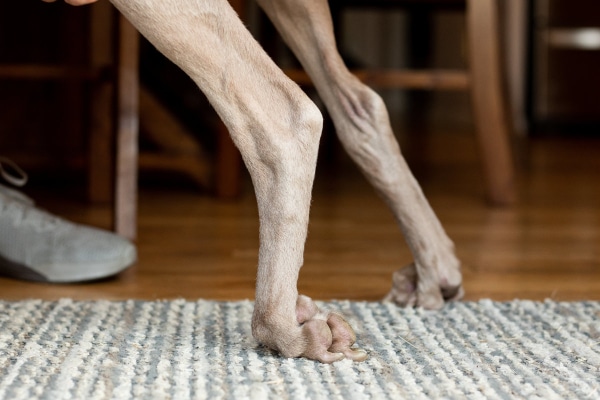
When a dog’s foot rolls under as he or she stands or walks, this is referred to as knuckling. Because the dog may end up dragging the foot, paw knuckling can cause physical injury to the top or sides of the foot. This is due to the dog standing on the top of their paw rather than on the paw pad.
Overall, knuckling is far less common in dogs than true limping, but it is still important to recognize.
What are the signs of knuckling in dogs?
Of course, knuckling itself is a symptom of another issue, but what are some secondary signs of knuckling?
Early signs of knuckling
Sometimes knuckling starts subtly or intermittently. A dog may miss a step here or there, but a majority of the time has proper paw placement. Early signs of knuckling may include:
- Frayed toenail tips
- Occasional dragging of one or more paws, or abnormal gait
- Difficulty rising
- Weakness in one or more legs
Other symptoms of knuckling
Many of the causes of knuckling are progressive, so you may notice some of these early signs are followed by other symptoms of knuckling, such as:
- Consistently uncoordinated gait
- Sores on the tops or sides of the paw(s)
- Scuffed toenails
- Difficulty gaining traction on slippery surfaces such as hard floors
If you notice any of these signs, pay close attention to how your dog places his or her paws down when walking or standing. If they’re bearing weight on the tops of their paws rather than the paw pads, it’s time for a vet appointment.
Why might a dog knuckle?
In some cases, paw knuckling occurs due to a problem with the dog’s nervous system. Normally, signals are sent through the nerves in the leg to the spinal cord and brain. This input is used to determine the position of the dog’s foot—is it upside down, right side up, being held up, etc. The term conscious proprioception describes the nervous system’s coordination of signals to identify the position of a dog’s limb.
In a healthy dog, if they place their paw down in an abnormal position, those neural pathways will send a message to the brain and the dog will quickly correct the position. If something interrupts the signaling pathway, the dog will not know where the limb is in space or how it is positioned. This causes proprioceptive deficits, such as:
- Knuckling
- Abnormal paw positioning when standing
- Paw dragging when walking
- An uneven gait (a dog that is wobbly and off balance)
Alternatively, a knuckling dog may have a normal neurologic system but their ligaments, tendons, or muscles are weak and cannot support their weight. Knuckling in puppies, for example, may be caused by nutritional issues or congenital problems. Frail senior dogs may also walk on the top of their paws occasionally due to weakness.
Now that we have discussed some general reasons a dog may knuckle, let’s move on to some of the specific conditions that may cause knuckling in dogs..
What causes knuckling in dogs?
Knuckling in dogs can most commonly be caused by neurological disorders such as:
- IVDD
- Degenerative myelopathy
- Spinal stroke
- Genetics
- Poor nutrition
- Injury or trauma
- Neoplasia (cancer)
- Obesity
If your dog is walking on the top of one or more paws, consult your vet to determine what may be going on. Let’s take a closer look at some of the more common causes of dog knuckling.
Neurological conditions causing paw knuckling
1. Spinal stroke (Fibrocartilaginous embolism or FCE)
Many individual bones known as vertebrae surround and protect the spinal cord. Cartilaginous discs sit between the vertebrae to act as shock absorbers and to give the dog’s back and neck the ability to flex, extend, and move side to side. These discs are great when they are healthy but can create quite a problem if they rupture.
Sometimes a small piece of a ruptured disc enters the blood stream and obstructs one of the small vessels that supplies blood to a certain part of the spinal cord. This is known as a fibrocartilaginous embolism (FCE) or spinal stroke in dogs. FCEs are more common in young giant and large breed dogs. However, they may also occur in some small breed dogs, especially Shelties and Schnauzers.
Affected dogs may suddenly cry out when running, jumping, or playing then immediately become weak or paralyzed. They may knuckle on one or more limbs, have an uncoordinated gait, and sometimes be unable to walk at all. After the initial moment of pain, dogs with an FCE are generally non-painful. This is one of the things that may make a vet suspicious of an FCE (rather than a different, more painful cause of spinal cord trauma) during the physical exam.
Your veterinarian may recommend X-rays, which are usually normal in cases of FCE, but can rule out other conditions with similar signs. Definitive diagnosis requires an MRI. This usually means referral to a veterinary neurology specialist.
Unfortunately, there is no definitive treatment for FCE except for supportive care and time. Some dogs may recover over several days to weeks but others may remain permanently paralyzed.
2. Intervertebral disc disease (IVDD)
In addition to causing a FCE, those discs can also contribute to intervertebral disc disease( IVDD) in dogs, which is divided into two types:
- Type I IVDD: The disc acutely ruptures into the spinal canal
- Type II IVDD: The disc degenerates over time and begins to bulge
Both of these situations put pressure on the spinal cord, which sits just above the disc. While IVDD can occur anywhere in the spine, it happens most often in the cervical (i.e. neck) or thoracolumbar area (i.e. mid-back near the junction of the last rib and the first few lumbar vertebrae).

Affected dogs may become weak or paralyzed in their rear limbs (if the problem is in the thoracolumbar region) or all four limbs (if the problem is in the neck). They are often painful in their back or neck and may knuckle or drag their feet. Severely affected dogs may be paralyzed and in some cases are unable to urinate on their own.
If your dog develops signs of IVDD, your veterinarian may recommend X-rays to look for signs of a ruptured or mineralized disc. Sometimes, a veterinary neurologist may inject dye around the spinal cord then take an X-ray (a test known as a myelogram) or use an MRI or CT to find the area(s) of compression.
IVDD treatment
Some dogs with IVDD can recover without surgery after strict rest, medications and supportive care (more on that later). However, others will need IVDD surgery for dogs to remove the ruptured portion of the disc and take pressure off the spinal cord. For a paralyzed dog, emergency back or neck surgery gives the best chances of walking again. Without surgery, paralysis may be permanent. Sometimes even after surgery, some degree of weakness or paralysis may persist with severe spinal cord injuries.
3. Degenerative Myelopathy
Degenerative myelopathy in dogs is a chronic disease of the spinal cord that causes progressive paralysis. It can start out looking like arthritis or hip dysplasia, which makes it difficult to diagnose right away. Dogs may initially just be limping on one of their hind limbs but otherwise appear normal.
However, as this spinal condition progresses, it affects the other hind leg and causes a dog to be weak, have a wobbly gait, and knuckle on one or both rear legs. Eventually, the dog becomes completely paralyzed and unable to control his or her bowels or bladder.
Degenerative myelopathy affects middle-aged and older dogs. It is most common in German Shepherds, Huskies, Retrievers, and Corgis. The exact cause of degenerative myelopathy is unknown. However, a mutated gene known as SOD-1 puts dogs at high risk for developing degenerative myelopathy.
There is no definitive test for degenerative myelopathy. Blood testing can look for the presence of the mutated gene. The presence of the gene plus signs consistent with degenerative myelopathy make it the most likely diagnosis.
Unfortunately, clinical signs can progress over the span of a few weeks to several months in most cases. The overall prognosis is poor because there is no cure. Therapy with aminocaproic acid, n-acetylcysteine, prednisone for dogs, and vitamin supplements may possibly help slow the progression of degenerative myelopathy, but none of those are curative.
Remember our friend Marie the German Shepherd? Unfortunately, she ended up having degenerative myelopathy. We submitted a blood sample for gene testing, and it came back positive for the SOD-1 mutation. Marie’s mom made sure to keep her comfortable and spoiled for the following two months of her dear dog’s life.
4. Wobbler Syndrome
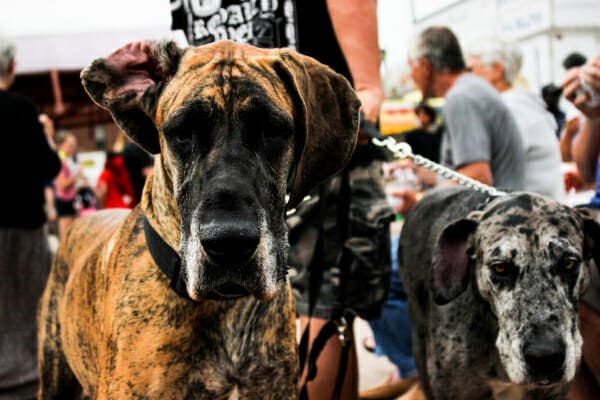
This condition gets its name from the wobbly gait that most affected dogs exhibit. The exact cause is still undetermined, but it is possible that it may have a genetic basis since it is most common in Great Danes and Dobermans.
Dogs with wobbler syndrome typically have spinal cord compression in their neck from either an abnormally narrow spinal canal plus intervertebral disc herniation, or from a narrowed spinal canal due to changes to the surrounding bone. In addition to compressing the spinal cord, these changes may also put pressure on the nerves as they exit the spinal cord.
Dogs with wobblers tend to have an unsteady gait which is more pronounced in the rear legs. They may also knuckle their paws, have difficulty getting up, or appear weak. Nerve damage and compression can cause significant pain and affected dogs may walk with their heads lowered. Signs tend to show up in Great Danes around the age of three years and Dobermans around six years on average.
If your vet suspects your dog may have wobbler syndrome he or she will most likely start by taking X-rays to look for any bone changes or signs of other conditions. Then he or she may refer you to a veterinary neurologist for advanced imaging such as a myelogram, CT, or MRI.
Some dogs with wobblers will do well with medications, supportive care, and lifestyle changes such as avoiding leashes that go around the neck. Other dogs may benefit from surgery. A study in the Journal of the American Veterinary Medical Association demonstrated that the average survival time for dogs with wobblers is approximately four years regardless of whether they had medical or surgical management.
Other causes of knuckling in dogs
1. Carpal flexural deformity
Carpal flexural deformity is a bit different than the other conditions discussed because it doesn’t come from a problem with the nervous system. The exact cause is unknown. However, researchers believe it may result from some combination of genetic predisposition plus nutritional factors in rapidly growing puppies. A diet with excess protein and few other core elements like carbohydrates can cause painful growth spurts that contribute to this condition.
Carpal flexural deformity mostly affects large and giant breed puppies, usually younger than four months of age. As the name indicates, it affects the puppy’s carpus (i.e. wrist—the joint on the front leg between the elbow and the foot). The puppy may have hyperextension, hyperflexion or general laxity (i.e. looseness) of the carpus. Additionally, the carpus could be bowed inward (i.e. varus deformity) or outward (i.e. valgus deformity). This combination of changes may cause front paw knuckling.
The good news is that most affected dogs improve within one to three weeks of diagnosis. Sometimes a diet change (i.e. to a balanced or energy restricted diet) and/or soft splints to support the legs may be beneficial during the recovery period.
2. Trauma or injury
If a dog has a paw pad injury, they may not want to bear weight directly on that foot. Sometimes this can cause limping or completely holding up one paw, but sometimes it can present as knuckling on one or more paws. Some injuries that may cause this include:
- Thorns or sharp objects embedded in paw pads
- Burned paw pads from standing on hot surfaces
- Insect bite or sting
- Broken toenail
If your dog is suddenly knuckling, especially if it’s only on one paw, check the paw for any obvious injuries.
3. Neoplasia
Unfortunately, cancer is almost always on the list of differential diagnoses. Tumors can grow on nerves, bones, or muscles and can cause weakness or loss of proprioception. While it’s not as common as some of the other neurological conditions discussed above, it is a possible cause of knuckling in dogs.
How to treat knuckling in dogs
As you can see, there are many reasons a dog may be knuckling. Some may resolve with supportive care and time while others may require surgery. And still others may never completely resolve. There are many ways you can support your dog after he or she is diagnosed with a condition that causes knuckling.

1. Give the gift of traction
Dogs with neurologic conditions or other issues causing knuckling often have a hard time gaining traction when standing or walking. Without the paw pad making contact with the ground, dogs may slip or feel unsteady on their feet.
My signature product, Dr. Buzby’s ToeGrips® dog nail grips, can work wonders for dogs who have an unsteady gait and are knuckling, prone to slipping, or weak. They can help your dog regain traction and walk with confidence on slippery floors that otherwise might pose a mobility problem.
Plus, ToeGrips somehow seem to provide feedback to the brain and spinal cord to help enhance a dog’s conscious proprioception. If you remember from the beginning, conscious proprioception is the nervous system’s way of telling where a dog’s limbs are in space. Dogs who are knuckling usually do so because they have altered conscious proprioception. ToeGrips may help them by reminding the dog’s brain to pick up the paws, thus improving the dog’s gait.
ToeGrips not only help these dogs with stability and confidence, they can also serve to take the brunt of chronic trauma to the nails from dragging. Over time, if the dog’s conscious proprioception does not improve, the nails can start to wear in a funny pattern or even wear back to bloody “stumps.” ToeGrips, when glued in place, can protect the nail from this demise.
For dogs who are scuffing or dragging their feet, we recommend an alternative application method—affixing ToeGrips to the nails with super glue. This is not necessary for most dogs, but for dogs who drag/scuff their paws, that altered gait tends to tug the ToeGrips off the nails. Super Glue is the simple solution to keep the ToeGrips securely in position. I demonstrate application of ToeGrips using glue in this video:
2. Reduce inflammation and pain
Some conditions such as IVDD and wobbler syndrome may cause considerable pain and inflammation. Thus, your vet may prescribe medications such as non-steroidal anti-inflammatories (NSAIDs), tramadol for dogs, gabapentin for dogs, steroids like prednisone, or other medications.
Always give all medications as directed and notify your vet immediately if you notice any concerning side effects. Don’t abruptly stop any medications without first consulting your vet. Never decide to give your dog your own pain medications as human pain-relievers like Advil can be toxic for dogs.
Some dogs may also benefit from laser therapy for dogs, which has several benefits including:
- Pain relief
- Improved healing
- Decreased swelling and inflammation
3. Help your dog get up and walk
Some dogs who are knuckling may also be weak or paralyzed, making it difficult for them to stand up or move from place to place. Two of my favorite mobility aids are the GingerLead® Support and Rehabilitation Harness, and the Help ‘Em Up® Mobility Harness. Both products can help save your back and are much more comfortable for you and your dog than using a towel as a sling (although that does work in a pinch).
Permanently paralyzed or significantly weak dogs may also do well with a wheelchair in some situations. Your vet can recommend some good companies to purchase a wheelchair from. Alternatively, there are plans online for making a doggy wheelchair. Always ensure the wheelchair fits your dog well (which is where purchasing it through a reputable company with good customer support can help) and check your dog frequently for any rub sores.
4. Find a rehab vet
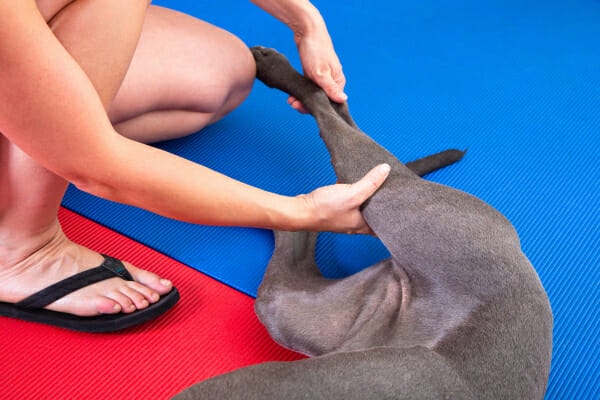
One of the best ways to help knuckling in dogs is to visit a rehab vet. In many situations, dogs can benefit from physical therapy just like people do. You may be able to find a veterinary professional who specializes in rehabilitation and physical therapy in your area. Alternatively, some general practice vets also provide rehab services.
A rehab vet can evaluate your dog and help design an exercise program specifically for him or her. They will most likely do some exercises with your dog and teach you how to do the exercises at home too. Some rehab vets may also have an underwater treadmill or a hydrotherapy pool. Both of these can be very beneficial as the buoyancy of the water will help support your dog. Plus, many dogs quite enjoy their time in the water!
5. Protect your dog’s feet
If your dog is dragging his or her feet or knuckling, sometimes the tops or side of the feet may get scraped up. This can be exacerbated if a dog walks on more abrasive surfaces like concrete. To protect your dog’s feet, try to stick to soft surfaces like grass while outside.
If your dog requires hind end support for walking, try to hold him or her in a position where the rear paws aren’t dragging but the dog can still attempt to walk to build strength (if appropriate).
For a short-term solution, you may be able to wrap your dog’s sore paw to prevent it from getting worse. Placing a piece of gauze and then gently wrapping the paw with Coban or Vet Wrap can act as a Band-Aid for urgent situations. If employing this method, you must be sure the wrap is not too tight, as it can act as a compression bandage, and it should not stay on for longer than a few hours.
Another alternative to cover your dog’s paws for short periods of time is PawZ Boots. They are thin (think latex balloon) so they don’t pose as big of a tripping hazard as bigger bulky booties but still offer some protection. I always caution owners to read the instructions carefully when using PawZ, because they do have the potential to effect obstruct circulation to the paw and are not intended to be left on continuously.
Diagnosis of knuckling in dogs
Unfortunately, there is no singular dog knuckling test. The causes are so varied, and so are the diagnostics. A thorough orthopedic and neurologic exam is a great place to start, and then your vet will have a better idea of what the most likely differentials are.
Your vet may then recommend diagnostic tests such as:
- X-rays
- MRI
- CT scan
- Myelogram
- Blood tests
Some of these tests can be performed at a general practice, but some may require referral to a specialist. Your vet will be your best guide to determine which test(s) will give you the most valuable information to reach a diagnosis.
If you notice knuckling, contact your vet
The most important thing you can do for your dog is to stay in close contact with your vet and any specialists you are working with. Since there are a variety of causes of knuckling with different outlooks and treatments, the first step is to get a diagnosis as soon as possible.
Once you know what you are dealing with, ask all your questions and do your research (using reputable sources) to find out as much as possible about your dog’s condition and how you can help. And of course, keep loving on your dog and treasure the time you have together. Have confidence that you can tackle whatever is in front of you.

Have you noticed your dog knuckling?
What was the cause and how did you help your pup? Please comment below.


I have a 9 year old American Bulldog that just underwent bilateral CBLO surgery. for ACL tears. He now has some knuckling of both surgical hind legs. Do you happen to know how long this can be expected and when should I seek additional help since for now he is only on range of motion exercises?
Hi Mattie,
Another comment about this same thing was received from Mayte. I responded to the comment yesterday so I hope you will see that too. My response was this:
“Hi Mayte,
I am sorry your boy is having some issues since his CBLO surgery a week ago. I am not used to seeing knuckling after this type of procedure and think you should get this evaluated by your vet. This may not be anything to worry about, but without examining your boy myself, I can’t make specific conclusions. I’d rather err on the side of caution and get things checked out. You are doing a great job with the rehab therapies you are using at home. Wishing your pup all the best of luck at making a full recovery. Keep up the good work!”
I think it would be best to contact your vet for a recheck evaluation. Hoping you can get the answers you need to find a clear path forward. Best wishes to you all!
My dog is 15, she is a Norwegian Buhund and weighs about 17.5-18 kg. She started limping a bit for a few years, typically at the end of a walk, the vet thought it was arthritis and she does to glucosamine daily. She was running/trotting on the weekend and everything seemed fine then all of a sudden she started limping quite a bit. She seems to have trouble putting weight on her right front leg and when standing keeps adjusting it. Sometimes it seems like the leg is giving out on her. I bought her some braces to help support the leg and she seems find to wear them, helps with the limp but occasionally she is dragging the paw on that right leg. Her annual checkup is in a few weeks and it’s difficult to get an appointment prior to that. She’s not crying or whining and doesn’t seem to be any pain and she comes to me when it’s walk time. We’ve taken several days off from walking and have only gone on very short, very slow saunters. I’m wondering if there’s anything else I can do to help her until we get to see the vet, and not cause any further problems. Thanks
Hi Christine,
I understand your concern for your senior girl with this lameness she has developed. Without knowing the cause, it is hard to make recommendations on how to help. Your best bet is to try to get the appointment with your as soon as possible. From what you describe, I am suspicious about a neurological issue. It may be a good idea to ask about a consultation with a specialist. Hoping you were able to get some answers and restore your girl’s quality of life. Feel free to leave an update and let us know how things are going. Wishing you both the best of luck!
My sweet baby is a 4 month old, 50lbs American Bulldog. He has been very happy and active since joining our family at 8 wks old. I first noticed a bloody toe on his front paw at 11 wks. Within two months, he has continued to scuff both front paws to the point of filed down, torn nails. He has seen multiple vets, a neurologist, and had blood and fecal tests, without any diagnosis. He does not appear to be in pain but does seem to have trouble standing in the mornings and when tired. He plays, runs, jumps and is very strong, but trips over his flipped front paws and sometimes leans on one or both knuckles. Fetch often includes some rolling forward when he lowers his head to grab his ball. At times, he wets himself when he cannot stand quickly. He slides all over wooden/tile floors and falls as his limbs lose grip and he slides to his chest. Would nail grips help bring awareness to flip his paws back over and help reduce nail damage? Do you have advice on a brace to reduce damage to the knuckle portion of his legs from putting weight on it? Is there a supplement to help support his quickly growing body and ease any additional damage to his nails? Could there be a nutritional concern tied to his difficulty walking? Thank you!
Hi Nicole,
I am so sorry your little puppy is having mobility issues. I am not sure that ToeGrips would be a good fit for your boy. They are generally not intended for dogs who are running and very active as they would probably not stay on for long. Also, while they can help to improve proprioception (how your brain knows where your feet are placed), they will not prevent knuckling from occurring. To find the best solution it would help to have a diagnosis. I see you mentioned you have been to multiple vets and even a specialist. Goodness, this is such a tough case! Like your vet, I am suspicious about a neurological cause, but this could also be a severe case of laxity in the tendons and connective tissue. I would also lean toward this being a genetic problem and would not be surprised if other puppies in the litter were affected as well. It might be a good idea to reach out to a veterinary rehabilitation professional. They will know of ways to try and strengthen the connective tissues and joints in the affected areas. Supplements can offer benefits too. I would talk to your vet about which one would be best fit for your little guy. I am not sure how this would work on such a small puppy, but there are companies who make supports for dogs to help prevent knuckling. Walkin’ Pets is just one I am familiar with. Here is a link to their site: https://www.handicappedpets.com/blog/dog-dragging-its-paws/
Hoping you can find a way to offer your sweet boy a long and happy life. Wishing you both nothing but the best. Bless you!
Hi Nicole. Our 4 month old boy is exhibiting the same symptoms you have described above, drags front paws on walks, nails filed down (sometimes bloody after walks), urinates when he has trouble standing or off balance. We were wondering if there is an update to your story? How is your pup doing now he is a bit older? What did you find to work best to aid him in his journey? Thank you for your original post and I look forward to hearing from you.
Hi there, my 11 year old dog has had a emergency slenectomy. He lost 1500mls of blood so we are super lucky to have him here with us even if we only have 2-3 months with him . 💔 on day 2 -3 we finally had him up walking just to the toilet outside with support but he was knuckling his back legs, walking on top of toes ( as they are just folding under ) so walking on joints. When we pinch between back toes there isn’t any drawback 😭 which makes me super worried .. we have ordered some boots to cover his feet when out toileting but don’t know how we go about recovery … he’s already on carperve 100mg , gaba 400mg … we wanted to be able to do shirts walks and beach visits with him with knly having a couple of months left x . we are really unsure of next step . .
Dear Emma,
I am so sorry your senior boy is having this mobility issue on top of recovering from a major surgery. If there is no drawback or response to pain in the rear limbs, this could be a very serious situation. Please contact your vet and get this evaluated as soon as possible. Hoping this will not force you into making a quality-of-life decision sooner than you had planned. Praying for comfort and healing.
My 14 year old standard poodle has been scuffing his back feet when he walks and sometimes tripping on his front legs and sometimes dragging his back feet and knuckling after lifting his leg to pee. He’s always been a super trim dog although we free feed him and he gets lots of high quality treats and people food (he loves raw vegetables). Last week I noticed his back foot was bloody after our walk. I examined his foot and one toenail is worn down to the quick. I wrapped his foot with some gauze and a little poly spirit and then put vet wrap on. I left this for 24 hours and we had 4 days with no walks. This morning when I walked him I wrapped his back paws in vet wrap. He didn’t seem to mind this. He still scuffed his feet and wore a couple holes through the vet wrap but I had only put two layers in him. I’m thinking tomorrow I will try putting gauze or a cotton pad around his foot before wrapping with vet wrap. I’ve noticed he seems to have some sarcopenia in his bum and thighs. Is using the wrap prophylactically ok and is there anything I can do to help him regain or at least maintain what muscle he has?
Hi Tina,
I just responded to the comment you left on the Dogs and Cold Weather article. Forgive me for not seeing this one sooner! Using vet wrap is fine as long as it isn’t applied too tightly and isn’t left on after the walk is finished. Maybe boots would be worth a try? There are definitely exercises and therapies that can help try to regain lost muscle mass or at least slow the rate of loss/help maintain. To know which treatments would be the best fit for your boy’s specific needs I highly recommend you contact a veterinary rehabilitation professional. Vets trained in rehabilitation and physical therapy have MANY options at their disposal to offer the greatest benefit. They can assign some at home exercises that compliment what they will do in-clinic. And they can discuss supplements and alternative therapies! Your senior guy is lucky to have you advocating for his health and well-being. Take care and best wishes!
Hi. My dog, Baby, was recently diagnosed with MEU. She has been on medication (prednisone and Atopica) for 3 days. Her main symptom is problems walking, dragging paws and nails. I just bought your product, and I hope it helps. Our house is one floor, no stairs, and we have covered it in rugs and yoga mats to prevent any accidents. I saw the video of using super glue in some cases. I am guessing Baby is one of those cases. How long will they stay in place? What happens when the nails start growing? Do I have to remove them at some point? Thank you!
Hi Diana,
I am glad you decided to give ToeGrips a try! It does sound like Baby may benefit from having the ToeGrips glued on. Please reach out to our customer care team at [email protected] or you can text them at (843)781-7430. This way we can give you the personal individualized attention you need and ensure you are satisfied with your product. Best wishes to you and Baby!
My poor girl is 13-1/2 years old. She had ACL surgery 2 years ago but it never totally fixed the problem. She’s been on Meloxydil since for pain, although she never acts like she is in pain, except get grumpy when the cat jumps on her to play. (She used to play with the cat).
I have the vet continue to examine her since her surgery but things have gotten drastically worse. I thought maybe knee is busted again. She used to hold up the foot on the affected leg, now it drags. Her foot is knuckling and she doesn’t seem to have control of that leg much of the time. Last night and this morning we had to carry her outside to potty. She couldn’t even hold herself to squat. :(. I have palpated her leg, hip, low back and foot. She doesn’t react at all. I tried tickling her foot. Nothing. Normally she will pull her foot a bit because it tickles. Like when I trim the fur there. I have given her several light therapy sessions at home and she used to get them at the vet.
We had an appointment scheduled for next week but I called the vet and they are able to fit us in tomorrow. We are quite worried that she is becoming paralysed.
Hi Wendy,
I understand your concern for your senior girl and this new issue she is having with her leg. It sounds like something neurological is happening instead of just complications with her chronic knee pain. I am glad you had an appointment scheduled with your vet. What did you find out? Hoping you were able to get the answers needed to restore your sweet girl’s quality of life. Feel free to leave an update if you get a chance.
Hi, my beautiful dog has lost sensation on his back feet, what can I do to help him get it back.
he injured himself from a jump, I have taken him to a vet and his now on pain and anti-inflammatory medication.
Can I don’t at home to help him.
Hi Amber,
I am sorry your pup has suffered a back injury. There are exercises and therapies that can help restore the proprioception to his back legs. The most important thing is to make sure your dog has healed enough to do these exercises safely. The last thing you want to do is rush into exercises that could potentially make things worse. I highly recommend you discuss the option of physical therapy with your vet. They can let you know what is appropriate for the stage of recovery your dog has reached. I am hopeful your sweet boy can make a full recovery. Praying for healing.
Do I need to purchase a pair of knuckling brace, when getting my Dachshund from knuckling recouping from IVDD post 5 weeks…
Hi Ernest,
I understand your concern with the knuckling after an IVDD episode. This is usually the last symptom to resolve and sometimes it never completely goes away. Since I haven’t examined your pup myself, I can’t say for sure if a brace would be helpful in this specific situation. I recommend you talk to your vet or a veterinary rehabilitation professional and get their expert opinion. A rehab/physical therapy vet may have other ideas about therapies or treatments that would help with your dog’s recovery. Best wishes and good luck!
Our 12 year old Shih Tzu has recently been showing signs of knuckling in his right rear leg. Both his back legs almost look like the joints aren’t connected by ligaments and they aren’t supporting his weight. We live in a multi level house, and have started carrying him down the steps as he tumbled down on the last few steps a couple of times. On our last vet visit for his rabies vaccination, we shared our concerns and they gave us some tablets for his joints. He doesn’t seem to be improving and I think it’s getting worse. My husband has expressed concern that they would recommend putting him to sleep, but he doesn’t seem to be in any pain. He is blind and almost deaf, but seems content to sit on our laps and go on rides in the car. What’s the next step?
Hi Jan,
You are right to be concerned about your senior dog’s mobility issues. I recommend you talk to your vet and let them know how this problem has progressed. They may need to do some testing to determine if this is just due to arthritis or if there is also a neurological cause. You can also request a referral to a veterinary neurologist to get an expert opinion on your pup’s case. From what you have described, I wouldn’t think euthanasia would be needed at this point. I hope you can find the answers you need to make the best decisions for your sweet boy’s health and wellbeing. Best wishes and good luck!