If your senior dog has recently faced canine vestibular disease, you may be eager to learn tips and exercises for dogs to make the road to recovery a smooth one. As a follow-up to her article on vestibular disease in older dogs, Dr. Julie Buzby welcomes Dr. Susan Davis, internationally recognized physical therapist for animals, to share her expertise. Dr. Davis draws from her 30+ years of experience to give you these 10 at-home tips and exercises for dogs recovering from vestibular disease.
As a proactive pet parent, you want your senior dog to be active and alert for as long as possible — playing, exercising, and joining in family activities.
But what if your dog suddenly begins to lose balance and body control? Having a pet who was fine one minute and dizzy the next can be distressing. What you thought would be a typical day soon fades into a worrisome and mysterious nightmare as your dog weaves and wobbles while navigating to the dog food dish, bumps into walls, and stumbles and falls just walking across the room — all while holding its head with a puzzling tilt while the eyes dart side to side.
What in the world is happening?
Vestibular disease in dogs
It’s quite likely that your dog’s vestibular system — responsible for helping maintain balance — is not working properly. As Dr. Buzby explained in her first blog post, Old Dog Vestibular Disease, canine vestibular disease is very similar to vertigo in humans.

Symptoms include:
- ataxia (staggering and stumbling)
- nausea
- vomiting
- nystagmus (back and forth eye movements)
- falling to one side
- a distinctive head tilt
Causes of vestibular disease in dogs
Vestibular disease is broken down into two categories — central vestibular disease and peripheral vestibular disease—because the vestibular system is divided into two parts. The peripheral portion includes structures of the inner ear plus one of the cranial nerves. The central portion includes the brainstem and the nerves which project from it.
Within those two classifications, there are a variety of causes. A visit to your veterinarian will help identify which one your dog is experiencing.
Central vestibular disease in dogs
This type of vestibular disease can be caused by inflammation, blood clot(s), infection, toxins, tumors, or head trauma. Central vestibular disease is the less common of the two types.
Peripheral vestibular disease in dogs
Although trauma, toxins, and tumors in this location can also cause vestibular signs, the most commonly diagnosed causes of peripheral vestibular disease in dogs are middle or inner ear infections and idiopathic vestibular disease.
Idiopathic vestibular disease is also called old dog or geriatric vestibular disease because it affects senior dogs. The term “idiopathic” means that we don’t know why it occurs. Thankfully, it is associated with a good prognosis because it responds well to treatment (including TLC and tincture of time) and often resolves completely within a few days or weeks.
Now that you understand more about the causes of vestibular disease in dogs, let’s talk about how you know for sure if your dog has vestibular disease. Then we can dive into some tips and exercises for dogs with vestibular disease to help get your dog on the fast track to recovery.
Diagnosis of vestibular disease in dogs
The best way to help your dog is by knowing what you are dealing with, so even if you are pretty sure your dog has vestibular disease, a trip to the veterinarian’s office is essential. Your veterinarian will examine your dog and possibly perform a test or two to gather more information before reaching a diagnosis and formulating a treatment plan.
Dr. Julie Buzby loves to recall cases where she has ruled out other more serious causes via a thorough history and neurological examination, and gets to gleefully assure the owner that although their dog’s signs are unsettling, the situation is not dire. Such was her experience when she diagnosed her beloved patient, Lola, with old dog vestibular disease in part one of this series.
Recovery from vestibular disease in dogs
Recovery from vestibular disease in dogs involves a combination of rest, medication, and home treatment. Make sure to follow your veterinarian’s instructions and administer any medications as prescribed. As part of your dog’s treatment for vestibular disease, your veterinarian may recommend physical therapy.
For your dog’s safety, ensure your dog is healthy enough for exercises
Infection or inflammation must be under control and no longer in an active state when initiating therapy exercises. Your dog may still be on medication when you begin, which is perfectly fine, as long as there is definite improvement and the condition is beginning to resolve. Otherwise, there is a risk of the condition worsening. Check with your veterinarian if you are not sure when to start exercises.
Consult a professional for help with exercises
If you are unsure about any exercise or procedure, consult with a physical therapist for animals or veterinarian specializing in rehabilitation. You may be able to have an in-person visit or confer with them via a telehealth appointment. They can walk you through the process to ensure you’re performing the exercise correctly.
If your dog seems uncomfortable or resists your efforts, do not continue that exercise without seeking guidance from a professional.
10 tips and exercises for dogs with vestibular disease
Your dear dog is home, taking medication, and slowly recovering from this dizzying condition. Encourage your dog’s recovery with these 10 tips and exercises.
1. Consider how you can assist with everyday activities.
When dogs are able to perform everyday activities (albeit with a little help from their owners), they retain dignity and quality of life. Simple ways you can help your dog include:
- elevating food and water bowls
- placing food and water bowls against a wall so they stay put if your dog sways or loses balance
- using a sling or harness to assist with standing and walking.

If you would like specific recommendations for products that can help your dog, please see Dr. Buzby’s favorite things for senior dogs.
2. Limit movement to a safe area.
Limit your dog’s space to move. A small room, a crate, or a section of a room partitioned off with stacked pillows or cushions will work. Keep your dog away from hazards such as stairs, furniture, and electrical cords. Make sure to clear away any objects that might cause stumbling or tripping.
3. Offer (literal) support for sleep and rest.
Grab a towel and tightly roll it up. Position it under your dog’s neck during sleep. Also, place cushions around the body for extra support and comfort. Do not force this if your dog finds that other positions seem to be more comfortable.
If your dog is unable to rise without assistance:
- reposition your dog every four to six hours to help prevent pressure sores from forming
- use soft bedding
- promptly change bedding if it becomes soiled with urine or feces.
4. Cover hard-surface floors and turn on the lights.
Floor surfaces should be non-slip, otherwise use ToeGrips® dog nail grips, yoga mats, rugs, or carpet runners with smooth edges to keep your dog from slipping. Place the mats or rugs so that your dog will have a continuous path over the hard surfaces. I do not recommend socks or booties for vestibular disease as they prevent the paw pads and nails from sensing the floor and gripping it properly.
Also, keep your dog’s area well lit for maximum vision. This helps your dog move around with more confidence and reduces the chances of bumping into walls or furniture.

5. Provide stability for walking and moving.
Using a lightly-weighted jacket or vest designed especially for dogs may provide an added sense of stability for walking and moving. Allow your dog to move about for a few minutes at a time with the weighted vest. The amount of weight placed on the dog should be light in comparison to their body size. Do not use a weight that is too heavy and causes your dog to strain or struggle.
In chronic cases of vestibular disease, using a wheeled cart with outriggers to prevent toppling may be a great way to let your dog move around on its own.
6. Avoid water therapy.
Water therapy is amazing for canine arthritis and taking pressure off joints, but when your dog has vestibular disease, it needs joint pressure and the sensation of bearing weight on the ground. Water therapy can confuse the sensory system and provide too much motion, making it difficult for the dog to control its movement, or can lead to dizziness, nausea, and vomiting.
7. The stand-and-rock weight-shifting exercise
If vestibular disease hindered your dog’s ability to stand, help it relearn with the stand-and-rock weight-shifting exercise.
First, holding your dog close to you for support, help it stand. Next, place your hands and arms around the body and rhythmically rock your dog back and forth then from side to side. Do this for one minute in each direction, twice per day.
8. Core exercises to improve abdominal strength.
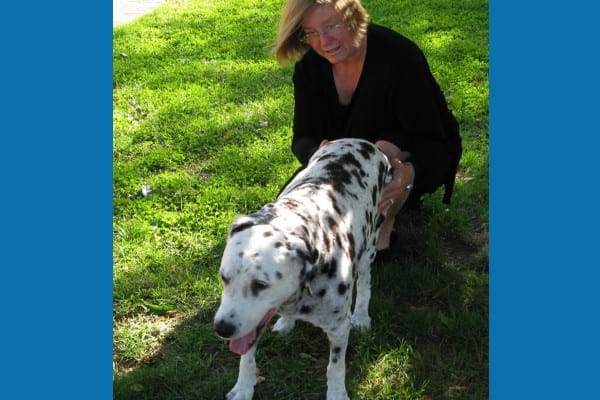
While your dog is in a standing position, use your fingers to tickle the belly. This will cause your dog to tighten its abdominal muscles.
Another technique uses a small treat to encourage your dog to bring its head and neck to the left, then to the right while the body remains still. Repeat this six times to each side, two to three times per day.
9. A standing balance exercise
If your dog cannot stand (or stay standing), use your hands, a sling, or a stack of pillows underneath the belly for extra support.
Start with two to three minutes of standing and progress to five. As your dog’s standing improves, remove your hands, pillows, or slings and see if your dog can stay balanced. Keep your hands close by, as if spotting your kids during gymnastics, so you can steady or catch your dog when needed. Try to maintain soft eye contact during all balance exercises as visual stimulation helps your dog control body movement. Some dogs perceive direct eye contact (staring) as a threat, so be aware of how your dog is reacting and modify your plan accordingly.
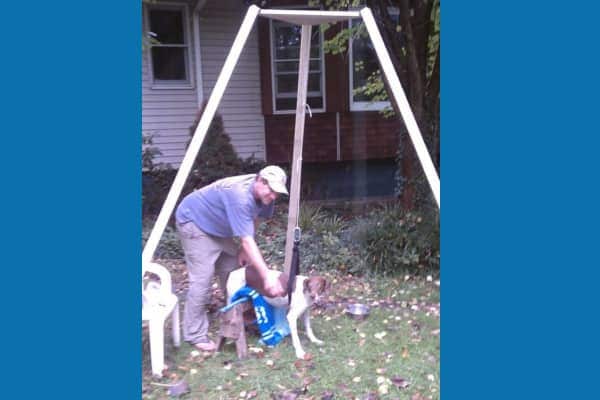
If you’re handy around the house, you may want to consider building a simple structure to support your dog’s trunk while it’s relearning to balance. One senior dog owner, Tom, built a wooden standing frame with sling suspensions and a padded sawhorse for his dog, Abby.
10. The tail-pull exercise
The tail pull is a technique I use to promote balance during walking. Stand behind your dog and hold the tail at the base (near the rump, and not near the tip). Use a firm grasp (but without squeezing the tail) and encourage your dog to walk while you hold the tail — almost like a rudder steering a ship. Do not try to pull the tail to either side, but merely straight back toward you. This will stimulate the dog to move forward.
With knowledge, you can help your dog
It’s difficult to watch your dog stagger about with canine vestibular disease, but there are many things you can do to help your dog recover — the first of which is to visit your veterinarian. Then, under the guidance of a veterinarian or a physical therapist for animals, consider using some or all of these 10 tips and exercises for dogs with vestibular disease to help your dog put this dizzying diagnosis in the past.

Do you have an experience with canine vestibular disease?
Please share in the comments below — your story and input is invaluable!


This article and peoples experience is so helpful! My 13yo Lab was diagnosed with idiopathic vestibular 1 week ago. She has improved much in that week but still has problems standing without support after a couple minutes, walking without the staggering and navigating the house and yard without needing constant reassurance and support. I have been looking for information to help assist with her gaining her ability and confidence in walking/standing and I hope these exercises help. She was an active dog prior to this with walking 3-4 miles a day and having fun with her one year old sister so she is missing these things in her life.
Thanks!
Hi Laura,
I am glad you found the article to be helpful. I hope with some time your sweet girl’s vestibular disease will resolve. You may want to seek out the help of a vet that specializes in rehabilitation. They may have some other ideas of exercises or treatments to help restore your dog’s quality of life. Good luck and best wishes as you navigate this new path together.
My dog who is 16 1/2 yrs old, she just got diagnosed with Vestibular Disease. She has been having eating issues with this, and she had to be put on Meclizine and Cerenia for the nausea. They told me that it is almost the same thing as vertigo in people. I took physical therapy and did head movements exercises they taught me, I been doing them the last 3 days with my dog. I already see some improvements. Anyone else know some good exercise to help her improve?
Dear Melissa,
Thank you for sharing your experience. That’s great that you are already seeing improvements. If anyone has exercises for you to add that is great, but I would recommend running it by your PT first. It’s great that you are in expert hands! It sounds like your dog is moving in the right direction though and we wish you continued improvement.
I am feeling so discouraged, I am not new taking caring of a dog with vestibular problems my 17 year old healer had it pretty bad the last 3 years of her life. Now my 9 yr old lab is having same issues the first episode 2 weeks ago lasted a couple of hours had a couple of more short episodes took her in the vet she didn’t really care to hear what I thought was going on after a 400.00 visit labs/stomach xray she said she didn’t think it was vestibular problems and sent me home with no answers no treatment prior to the problems she has been having pretty bad allergies her ear was bothering shaking her head drooping one ear her eyes had gunk nose was dripping I explained this and she still didn’t really care to listen she said her ears looked clear even though they really couldn’t see the middle ear. I begged her to atleast treat it like a ear infection and she gave me a round of steroids. Everything was clearing up I had my normal dog back until 2 days ago and no more steroids. She is having a episode that doesn’t want go away. I called and the vet returned my call with the doctor said you could try seizure medication. At this point going with my better judgement and knowing that this was not seizures. I took her back in. Frustrated. Just wanting someone to listen to me. I waited for the main doctor avoiding the one that has been treating us. He saw her and new immediately this was vestibular he said this is caused by strokes. Really no treatment. Gave me meclizine. Said it should improve with time. I have been trying to educate myself more and it seems like stroke causing this is more rare than other issues but what do I know? I’m not a vet. With her previous issues with the onset of bad allergies and and messing with that ear that is now drooped so bad obviously the tell tell sign of vestibular with the head tilt that direction and eye movement. I don’t really understand why the vet wouldn’t atleast try a round of antibiotics? Should I call them back? At this point I’m 500.00 in after my second visit. I can’t keep going and not getting answers or treatment. I know they don’t have a magic ball I get it. But would a round of antibiotics hurt? Just to try. SOMETHING. Thanks for any help.
Hi Kim,
So sorry to hear that your sweet lab is struggling with vestibular disease. I can understand your frustration and discouragement because we love our dogs dearly and want to be able to help them feel better as soon as possible. Since I can’t examine your dog (and especially her ears), I can’t say for sure if a round of antibiotics would be the right solution for her or not. Some dogs do have vestibular signs from an inner/middle ear infection where antibiotics would be a good choice. However, other dogs can have the “old dog vestibular disease” version which happens for an unknown reason. In that case, the antibiotics wouldn’t change the outcome of the disease. Vets (and human doctors) try to prescribe antibiotics judiciously (i.e. in situations where it is clear they are needed) to decrease the risk of development of antibiotic resistance. That could be the reason the vet decided not to go with antibiotics, but I wasn’t there so I can’t say for sure. I know it is difficult to keep doing tests, seeing different vets, and spending money without specific answers, but unfortunately sometimes that is the way things go with medicine (human or animal). That doesn’t make it any easier though! You could always consider seeking a third opinion with a different general practice vet or with a veterinary specialist, but I would encourage you to keep the line of communication open with your vet because often we are able to learn and better help our patients from the advantage of hindsight and response to treatment. I hope you are able to find the answers you are looking for and that your sweet girl feels better soon.
Hi, hope you dog is doing much better.
I understand your what you are going through. I am also dealing with my 10 year old Maltese having Vestibular Syndrome.
Our little guy ended up spending the last couple of days at our local animal hospital receiving IV with antibiotics and steroids.
He’s now home and will continue on antibiotics (Amoxicillin 125 mg) for 14 days, just in case he’s got a middle ear infection (I understand the whole not wanting to give out antibiotics but in this case our Maltese could not function) along with a 2 week Prednisolone Tab. 5mg.
I can see such a huge improvement.
Praying after all his medication is gone he continues to improve and your baby also is doing much better.
My 17 yr old jrt has been diagnosed with old dog vestibular disease. Unfortunately he is slso blind and deaf. He is otherwise a fit little fellow but he cries when he is still. He constantly pads around just aimlessly walking/stumbling from room to room until eventually is tired and thats when he starts crying. I slept next to his bed last night with my hand on him. Trying to reassure him. He is on enalapril and galliprant and has just been orescribed gabapentin. Im not sure im doing the right thing by him anymore.
Dear Colette,
It is clear that your dear old guy is very loved. It was so sweet (and a good idea) to sleep next to him and provide him that touch and comfort. What a lucky guy to have someone like you who goes above and beyond for him.
Old dog vestibular disease is disorienting for any dog, but probably especially so for one that is deaf and blind. The good news is that symptoms do often improve dramatically in a few days for many dogs. Hopefully that will be the case for him.
It is great that you are aware of wanting to do the right thing by him. Sometimes it can be hard to know what that is. You could consider using a quality of life assessment tool, such as the one found near the end of my article Signs Your Dog is Dying: A Caring Message to Bring You Peace (Not that I am saying your dog is dying—that just happens to be the title of the article that contains the assessment tool). Some people also make that decision when they feel his “bad days” outnumber his “good days.” It may also be beneficial to make a recheck appointment with your vet in a few days so you can see what sort of progress your dog has made, get an idea of how likely it will be that things will improve for him, and discuss his quality of life further. You are in our thoughts as you travel this difficult road with him. ❤
My English Springer Spaniel was diagnosed with vestibular disease about 4 weeks ago. She completely recovered at exactly 3 weeks. 5 days later it came back and the vet says this isn’t typical. He says if it’s going to happen again it usually doesn’t happen this soon. He said it usually takes at least a year to return. In the meantime she was also diagnosed with Cushings and started the meds for that the same day vestibular returned. This time seems much harder to support her when going out to urinate. She really wants to keep circling. I just ordered something to help me walk her and support her. What are your thoughts?
Hi Myra,
Having your dog have two episodes of vestibular disease so close together is understandably worrisome. Some dogs to tend to have another episode of vestibular disease. However, it may be a good idea to talk to your veterinarian about a referral to a veterinary neurologist. Hopefully your pup does just have the misfortune of having two episodes very close together, but getting a neurologist involved may give you some more definitive answers about what is going on and what else you can do to help your pup. I often recommend ToeGrips for dogs with vestibular disease because they seem to give dogs a better sense of where their feet are in space as well as better traction. Both of these benefits can help with mobility. It is great that you have ordered a support harness for her as well. I hope you are able to find some answers and help for her!
Our tiny yorkie at 20 months was diagnosed today with vestibular disease. He was checked for ear infection, thyroid problems, liver shunt, diabetes, other infections and there was no cause found. The vet started him on antibiotics just in case there was an infection on the inside of his eardrum where she was unable to see, even though there was no raised white cell count in his bloodwork.
I’m concerned because I have read all the articles I could get my hands on about this disorder and I have found none with a dog this young. He is very tiny only four pounds but he was a very active and energetic dog before this, and now he just wants to be next to us on the sofa and seems like he’s unhappy. We want him to rest as much as possible to overcome the problem but seeing him this way is scary. Will he get back his spunk? If it isn’t fixed by the antibiotics and we need to go to a neurologist what would they want to do? We love this baby and his litter mate sister, and worry that there could be something serious wrong so it will also affect her badly. These are the most close set of siblings we have encountered in our years of owning dogs. They curl together to sleep, they are rarely separated and she was so worried when he became ill. Today she was visibly upset when the vet was examining him. We have had dogs live as long as 20 yrs old, and it’s extremely hard when the time comes they have to leave us, but twenty months is far too young and it’s unthinkable! Is there a way to tell if the disease was from injury or toxin rather then from a tumor or something that is not fixable?
Hi Gloria,
I understand your concern for your tiny little guy. It sounds like your vet is staying on top of things and has a good plan in place. Without knowing the exact cause of the vestibular disease, I really can’t say if things will return to normal or not. If the antibiotics don’t fix things, having your boy examined by a neurologist would be my recommendation as well. They will probably start with a physical exam and may recommend a higher form of imaging, such as CT or MRI, to rule out a tumor or other abnormality that could be difficult to see with x-rays or ultrasound. Once the testing is completed, the specialist will have more information and may be able to tell you an exact diagnosis. Don’t forget that sometimes despite our best efforts we never find out the underlying cause for vestibular disease. I hope your little man will be restored to his healthy normal self very soon. Please keep us updated if you have the chance!
I have similar situation, I have a chiawa mix 9 pounds 7 years old had ear infections treated got sick right after 2days on 3rd days vet said she is having vestibular disease. Now all her ears infection treatment done but her head still tilled right side so she can’t not do half of things she used to does. So I am thinking Banfield veteran did treatment for ear infection made my pet get vestibular disease because I took her Banfield vet for comprehensive exams 01/27/2023 right after vet put ear drops it happened..some veterinarians help me my dog Bambi get back to normal please
Hi Jenny,
I understand your concern for your little pup and this vestibular issue she is dealing with. Unfortunately, since I haven’t examined your dog myself, I can’t make specific conclusions or recommendations about her medical treatment. Make sure your vet is aware of this ongoing issue and be honest about your concerns and expectations. It might be a good idea to take her for a second opinion at a different veterinary clinic if you feel you need more information. I am hopeful you will find the best way to restore your pup’s quality of life. Wishing you both the best of luck for a full recovery.
I have a 11/12 year old GSD who just recently was diagnosed with vestibular disease. We think it is a middle ear infection. However, she cannot get up on her own at all. I made a mobile doggie gurney to help us get in and out of the house to go potty. But now when she sees it she has severe anxiety and won’t let me help her on it. She will start to urinate as soon as I attempt to assist her. Which previously she was holding until we were outside. I was wondering if there was anyone here who could recommend a good doggie diaper for a large (125lb) dog? I’m a getting discouraged as it looked like she was making progress even was letting me help her stand and walk by supporting her tilt side. But now anytime I try to help her she just gets super anxious and flustered and releases her bladder immediately. She is on predisone and an antibiotic. Any suggestions would
Be greatly appreciated.
Hi Frank,
Sorry to hear that your sweet GSD has a potential middle ear infection and is having so much trouble getting up on her own. There are a few things that I can suggest that might help:
1) It is possible that rather than urinating simply because she is anxious, she may have a urinary tract infection. A UTI would not be uncommon in a dog who has been “down” for a period of time. Prednisone also tends to make dogs drink more and urinate more, so so she may also be producing more urine and having trouble holding it.
2) You could consider trying a Help Em Up Harness. It goes around your dog’s body and helps you lift her into a standing position and then keep her supported. This could be an option if she has some ability to support some of her weight once you get her standing but isn’t going to be very practical if you are supporting all 125 lbs of her.
3) If it has been several days since the diagnosis and you are not seeing any signs of improvement, you may also want to schedule a recheck with the vet. Typically many dogs with vestibular syndrome tend to make pretty significant improvements after about 72 hours or so, but that can definitely vary a bit depending on the dog.
4) while I don’t have any personal experience using them for my dogs or patients, it does look like Amazon (and probably other retailers) does sell diapers made specifically for dogs. Alternatively, you could probably cut a hole for her tail in a pair of Depends (or other similar products made for incontinence in adults) and use that as a diaper for her. You could also consider putting puppy pee pads underneath her hind end while she is laying down. These could soak up some urine too (although they may or may not be able to hold the full volume in her bladder).
I hope that some of these suggestions are helpful and your pup is on the mend soon!❤
Posted as an admin on behalf of Jordan:
Hello,
My dog, a 12 year old American Eskimo has been exhibiting those symptoms for the past few years, however, it may only happen 2-3 times a month, and it only lasts for 2-3 minutes and then he is perfectly normal again. When it starts, his head tilts severely and he just lays down. If he tries to walk he stumbles around, and arches his back, along with his severely tilted head. All the research I’ve done, his symptoms line up perfectly with what is written about Idiopathic Vestibular Disease, except one thing…as I mentioned, the symptoms only last a few minutes, and everything I’ve read talks about how symptoms will normally last days. Is it possible for the symptoms to only last for a few minutes?
Hi Jordan,
Sorry to hear that your American Eskimo is having some strange symptoms. Typically true idiopathic vestibular disease symptoms don’t just last for a few minutes (but that doesn’t mean there is no way it is vestibular disease because dogs don’t always read the book!) Since his episodes are a bit different than usually seen with vestibular disease, I would recommend taking a video of an episode to show to the vet and then making an appointment with your vet for an examination. This way you can make sure that the vet doesn’t think it is a short partial seizure, brief episode of pain, or other problem. Another good option would be to talk to your vet about a referral to a veterinary neurologist. This sounds like a bit of an odd set of symptoms, which is where a specialist’s expertise and access to advanced diagnostics can really come in handy. I hope you are able to get to the bottom of this soon! ❤
I have a 14 year old lab. A week ago she likes like she was having a, seizure. We took her to the vet hospital and she was diagnosed with vestibular disease. It has been a week, tomorrow, she cannot get up. She’ll fall right back down if we lift her. She just started to drink water from her bowl, we had to syringe feed her and give her wetted down dog food. She doesn’t eat much. Should we make her stand up? Do we need to have an MRI of her brain or does it take this long for her to get back to herself?
Dear Margot,
So sorry to hear that your lab is struggling with vestibular disease and still cannot stand up. Most dogs do show pretty significant improvement in the first 3-5 days, but not all dogs read the book. Since you are approaching a week of no improvement, I would recommend checking in with your veterinary clinic. They may want to see her back for a recheck, or perhaps suggest that you go forward with an MRI if they feel like she isn’t improving as fast as they would have expected for old dog vestibular disease. I do also have an article on how to feed a dog with vestibular disease that you might find helpful (How to Feed A Dog With Vestibular Disease: A Comprehensive Guide). I hope that the recheck or MRI give you some specific answers and she is on the road to recovery soon!
Hello, I’m curious if Jordan ever figured out what this was? My dog is having the exact same symptoms. My vet thinks its vestibular, but her episodes are also weeks and in some cases months apart and last maybe 2 to 3 minutes, I thought she was having mini strokes perhaps and I want to get her an MRI but my vet wants me to keep her on bendadryl for 6 weeks after a week of prednisone. This started about 10-12 weeks ago.
Hi Ryan,
I am sorry your dog is having these strange symptoms. I am afraid I have not received an update or any further communication from Jordan since the original post back in 2021. Just as I mentioned to him, I am suspicious your pup may be having mild seizures or is facing some other neurological problem. If you are ready to investigate further, you can request a referral to a neurologist at any time. Hoping you can get the answers you need and find a way to keep these worrisome episodes from continuing. Feel free to keep us updated on how things are going!
Just got a diagnosis of old dog vestibular disease today, and asked for nausea meds because she was vomiting. But not offered any other supportive therapy or testing??
Should thyroid panel be done now or if not gone in three days?? And what would dose of Meclizine be for a 51 pound dog??
Thank you.
Hi Cynthia,
Sorry to hear that your sweet pup was recently diagnosed with old dog vestibular disease. I can’t examine your dog or know her history, so I can’t say for sure when the appropriate time would be to do additional testing in her particular case. However, if you feel like you would like to do a thyroid panel or other testing sooner rather than later, it is not wrong to request that testing from your vet now or seek a second opinion for another vet or vet specialist.
As far as the Meclizine dosing goes, I am going to refer you back to your vet as I have made it a policy not to give out dosing information on the internet. A quick phone call to your vets office should be able to give you the answer you are looking for.
I hope that your pup shows some improvement soon, and if not that you are able to get to the bottom of what is going on quickly and easily! ❤
I have two “sisters” both 13 years old. My tripod developed Vestibular in March and after about 2 weeks recovered at home. She was treated with Prednisone, Meclizine and alot if TLC. It was very difficult as she it has one back leg. However, almost two weeks after she recovered she developed it again. This second time even worse and more meds and more if me researching I asked veterinarian to do lab work for hypothyroidism. Labs abnormal so we start on thyroid on top of meclizine. It’s been over a month and she still has prominent head tilt and difficulty walking ( three legs). Stands more and after massages and CBD oil this time seems to be helping. However, we are now May and now her “sister” developed it. Labs all normal and not once but twice as well a week apart. I am beyond clueless as I am thinking it has to be environmental. Have you ever seen this? My vet is stomped as well I think at this point. Can it be related to possibly allergens?
Hi Ruth,
It is definitely a bit puzzling that both of your dogs developed vestibular disease at different times over the past few months and I can understand why you are confused and trying to look for answers. Unfortunately, without full history, examinations, and lab results, I don’t have an easy explanation for you either. And even if I did have all those things, I’m sure I’d be confounded too.
You had asked about allergens. If both dogs had allergies and developed an internal/middle ear infection as a result of the allergies, they could both have vestibular signs, but that is an unlikely scenario. Given their age, as I’m sure you know, we tend to think about idiopathic vestibular syndrome, which can reoccur. But still…there are a lot of oddities here in the timing. I do think it’s worth considering having them evaluated by a veterinary neurologist to try to get to the bottom of this.
One thing I wanted to note is that depending on what thyroid test was run, dogs can show a low thyroid value but not be truly hypothyroid. They can be “sick euthyroid” rather than true hypothyroid. However the only way to say for sure would be to perform a full thyroid panel. I touch on that in this article: Hypothyroidism in Dogs: The Ultimate Guide to Understanding Canine Hypothyroidism
I’m sorry that I can’t give you a more definitive answer, but I do hope that both of your girls stay healthy and happy from here on out. ❤
My 15 year old Lhasa had an episode of older dog vestibular syndrome with head tilt to right, difficulty standing and nausea. The vet kept her a day, hydrated her and gave her anti nausea meds. When I picked her up he gave me anti-nausea meds to continue giving to her.
I made a sling out of a cloth grocery bag by cutting the sides out. That way I could place it under her and hold the hand loops to help her walk when she was ready. It was a great way to exercise her and encourage her to walk straight.
Another exercise I added was a procedure of laying her on the bed and putting her on her right side for 45 seconds, then her back for 45 seconds, then her left side for 45 seconds, then her tummy for 45 seconds. I then proceeded to give her a gentle full body massage for a few minutes. I did this two to three times daily for about a month. With these aids, she recovered without any wobble or head tilt.
I also brought her up on the couch and let her lay in the direction of her head tilt against the cushions and hand fed her and held her water bowl for her.
When she was able to walk by herself, I put her food near her bed in the living room.
I hope these tips that helped my dog might help someone else’s..
Maureen,
Thanks for the fabulous tips! I’m so glad your Lhasa recovered well from her episode of old dog vestibular syndrome. ❤
Question- I’m just trying to figure out what could’ve happened. 13yo mini schnauzer had idiopathic vestibular episode on Tuessday. Went to emerg vet on Wednesday for tests and fluids. Came home Thursday, ate and drank and no problem with eating drinking until Saturday night he wouldn’t eat. in the middle of the night became restless and had multiple episodes of blood stool. He was clearly not going to make it and we ultimately had to put him down Sunday. I’m a RN and have gone through everything trying to figure out what happened. Our family is heartbroken and I just keep saying he was old and had too much against him to pull through. As a medical professional I’m trying to find an answer.
Hi Sherri,
I am so sorry you had to say goodbye to your Schnauzer in such a tragic way. Losing a dog is never easy, but especially when it happens quickly without time to really process things. Since I didn’t examine your dog myself and don’t know what tests were performed, it’s hard to make guesses as to what might have happened. I am a little suspicious about DIC (disseminated intravascular coagulation) and cancer is always a possibility. Ultimately, I feel like you made the right decision to give him peace and rest and alleviate his suffering. I have no doubt he knew how much he was loved and pray his memory will continue to be a blessing to you and your family. ♥