If your senior dog has recently faced canine vestibular disease, you may be eager to learn tips and exercises for dogs to make the road to recovery a smooth one. As a follow-up to her article on vestibular disease in older dogs, Dr. Julie Buzby welcomes Dr. Susan Davis, internationally recognized physical therapist for animals, to share her expertise. Dr. Davis draws from her 30+ years of experience to give you these 10 at-home tips and exercises for dogs recovering from vestibular disease.
As a proactive pet parent, you want your senior dog to be active and alert for as long as possible — playing, exercising, and joining in family activities.
But what if your dog suddenly begins to lose balance and body control? Having a pet who was fine one minute and dizzy the next can be distressing. What you thought would be a typical day soon fades into a worrisome and mysterious nightmare as your dog weaves and wobbles while navigating to the dog food dish, bumps into walls, and stumbles and falls just walking across the room — all while holding its head with a puzzling tilt while the eyes dart side to side.
What in the world is happening?
Vestibular disease in dogs
It’s quite likely that your dog’s vestibular system — responsible for helping maintain balance — is not working properly. As Dr. Buzby explained in her first blog post, Old Dog Vestibular Disease, canine vestibular disease is very similar to vertigo in humans.
Symptoms include:
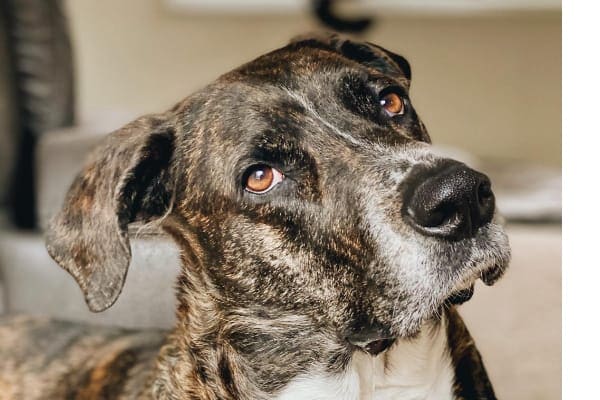
- ataxia (staggering and stumbling)
- nausea
- vomiting
- nystagmus (back and forth eye movements)
- falling to one side
- a distinctive head tilt
Causes of vestibular disease in dogs
Vestibular disease is broken down into two categories — central vestibular disease and peripheral vestibular disease—because the vestibular system is divided into two parts. The peripheral portion includes structures of the inner ear plus one of the cranial nerves. The central portion includes the brainstem and the nerves which project from it.
Within those two classifications, there are a variety of causes. A visit to your veterinarian will help identify which one your dog is experiencing.
Central vestibular disease in dogs
This type of vestibular disease can be caused by inflammation, blood clot(s), infection, toxins, tumors, or head trauma. Central vestibular disease is the less common of the two types.
Peripheral vestibular disease in dogs
Although trauma, toxins, and tumors in this location can also cause vestibular signs, the most commonly diagnosed causes of peripheral vestibular disease in dogs are middle or inner ear infections and idiopathic vestibular disease.
Idiopathic vestibular disease is also called old dog or geriatric vestibular disease because it affects senior dogs. The term “idiopathic” means that we don’t know why it occurs. Thankfully, it is associated with a good prognosis because it responds well to treatment (including TLC and tincture of time) and often resolves completely within a few days or weeks.
Now that you understand more about the causes of vestibular disease in dogs, let’s talk about how you know for sure if your dog has vestibular disease. Then we can dive into some tips and exercises for dogs with vestibular disease to help get your dog on the fast track to recovery.
Diagnosis of vestibular disease in dogs
The best way to help your dog is by knowing what you are dealing with, so even if you are pretty sure your dog has vestibular disease, a trip to the veterinarian’s office is essential. Your veterinarian will examine your dog and possibly perform a test or two to gather more information before reaching a diagnosis and formulating a treatment plan.
Dr. Julie Buzby loves to recall cases where she has ruled out other more serious causes via a thorough history and neurological examination, and gets to gleefully assure the owner that although their dog’s signs are unsettling, the situation is not dire. Such was her experience when she diagnosed her beloved patient, Lola, with old dog vestibular disease in part one of this series.
Recovery from vestibular disease in dogs
Recovery from vestibular disease in dogs involves a combination of rest, medication, and home treatment. Make sure to follow your veterinarian’s instructions and administer any medications as prescribed. As part of your dog’s treatment for vestibular disease, your veterinarian may recommend physical therapy.
For your dog’s safety, ensure your dog is healthy enough for exercises
Infection or inflammation must be under control and no longer in an active state when initiating therapy exercises. Your dog may still be on medication when you begin, which is perfectly fine, as long as there is definite improvement and the condition is beginning to resolve. Otherwise, there is a risk of the condition worsening. Check with your veterinarian if you are not sure when to start exercises.
Consult a professional for help with exercises
If you are unsure about any exercise or procedure, consult with a physical therapist for animals or veterinarian specializing in rehabilitation. You may be able to have an in-person visit or confer with them via a telehealth appointment. They can walk you through the process to ensure you’re performing the exercise correctly.
If your dog seems uncomfortable or resists your efforts, do not continue that exercise without seeking guidance from a professional.
10 tips and exercises for dogs with vestibular disease
Your dear dog is home, taking medication, and slowly recovering from this dizzying condition. Encourage your dog’s recovery with these 10 tips and exercises.
1. Consider how you can assist with everyday activities.
When dogs are able to perform everyday activities (albeit with a little help from their owners), they retain dignity and quality of life. Simple ways you can help your dog include:
- elevating food and water bowls
- placing food and water bowls against a wall so they stay put if your dog sways or loses balance
- using a sling or harness to assist with standing and walking.

If you would like specific recommendations for products that can help your dog, please see Dr. Buzby’s favorite things for senior dogs.
2. Limit movement to a safe area.
Limit your dog’s space to move. A small room, a crate, or a section of a room partitioned off with stacked pillows or cushions will work. Keep your dog away from hazards such as stairs, furniture, and electrical cords. Make sure to clear away any objects that might cause stumbling or tripping.
3. Offer (literal) support for sleep and rest.
Grab a towel and tightly roll it up. Position it under your dog’s neck during sleep. Also, place cushions around the body for extra support and comfort. Do not force this if your dog finds that other positions seem to be more comfortable.
If your dog is unable to rise without assistance:
- reposition your dog every four to six hours to help prevent pressure sores from forming
- use soft bedding
- promptly change bedding if it becomes soiled with urine or feces.
4. Cover hard-surface floors and turn on the lights.
Floor surfaces should be non-slip, otherwise use ToeGrips® dog nail grips, yoga mats, rugs, or carpet runners with smooth edges to keep your dog from slipping. Place the mats or rugs so that your dog will have a continuous path over the hard surfaces. I do not recommend socks or booties for vestibular disease as they prevent the paw pads and nails from sensing the floor and gripping it properly.
Also, keep your dog’s area well lit for maximum vision. This helps your dog move around with more confidence and reduces the chances of bumping into walls or furniture.

5. Provide stability for walking and moving.
Using a lightly-weighted jacket or vest designed especially for dogs may provide an added sense of stability for walking and moving. Allow your dog to move about for a few minutes at a time with the weighted vest. The amount of weight placed on the dog should be light in comparison to their body size. Do not use a weight that is too heavy and causes your dog to strain or struggle.
In chronic cases of vestibular disease, using a wheeled cart with outriggers to prevent toppling may be a great way to let your dog move around on its own.
6. Avoid water therapy.
Water therapy is amazing for canine arthritis and taking pressure off joints, but when your dog has vestibular disease, it needs joint pressure and the sensation of bearing weight on the ground. Water therapy can confuse the sensory system and provide too much motion, making it difficult for the dog to control its movement, or can lead to dizziness, nausea, and vomiting.
7. The stand-and-rock weight-shifting exercise
If vestibular disease hindered your dog’s ability to stand, help it relearn with the stand-and-rock weight-shifting exercise.
First, holding your dog close to you for support, help it stand. Next, place your hands and arms around the body and rhythmically rock your dog back and forth then from side to side. Do this for one minute in each direction, twice per day.
8. Core exercises to improve abdominal strength.
While your dog is in a standing position, use your fingers to tickle the belly. This will cause your dog to tighten its abdominal muscles.
Another technique uses a small treat to encourage your dog to bring its head and neck to the left, then to the right while the body remains still. Repeat this six times to each side, two to three times per day.
9. A standing balance exercise
If your dog cannot stand (or stay standing), use your hands, a sling, or a stack of pillows underneath the belly for extra support.
Start with two to three minutes of standing and progress to five. As your dog’s standing improves, remove your hands, pillows, or slings and see if your dog can stay balanced. Keep your hands close by, as if spotting your kids during gymnastics, so you can steady or catch your dog when needed. Try to maintain soft eye contact during all balance exercises as visual stimulation helps your dog control body movement. Some dogs perceive direct eye contact (staring) as a threat, so be aware of how your dog is reacting and modify your plan accordingly.
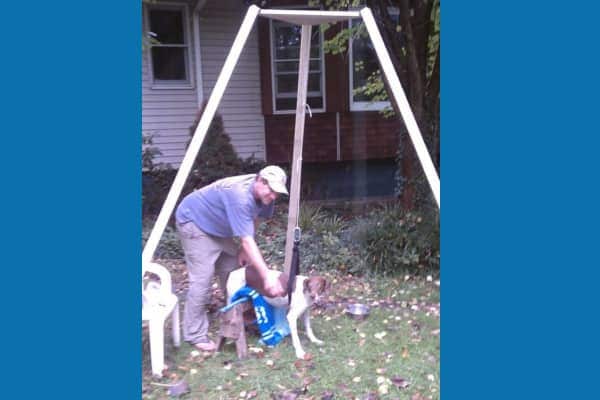
If you’re handy around the house, you may want to consider building a simple structure to support your dog’s trunk while it’s relearning to balance. One senior dog owner, Tom, built a wooden standing frame with sling suspensions and a padded sawhorse for his dog, Abby.
10. The tail-pull exercise
The tail pull is a technique I use to promote balance during walking. Stand behind your dog and hold the tail at the base (near the rump, and not near the tip). Use a firm grasp (but without squeezing the tail) and encourage your dog to walk while you hold the tail — almost like a rudder steering a ship. Do not try to pull the tail to either side, but merely straight back toward you. This will stimulate the dog to move forward.
With knowledge, you can help your dog
It’s difficult to watch your dog stagger about with canine vestibular disease, but there are many things you can do to help your dog recover — the first of which is to visit your veterinarian. Then, under the guidance of a veterinarian or a physical therapist for animals, consider using some or all of these 10 tips and exercises for dogs with vestibular disease to help your dog put this dizzying diagnosis in the past.

Do you have an experience with canine vestibular disease?
Please share in the comments below — your story and input is invaluable!


Bobo, a 14-15 year old cocker spaniel has been suffering from vet diagnosed vestibular disease. It’s been lasting for weeks. His classic symptoms include:
unstable, falling, head tilt, occasional vomiting, sleeping a lot, decreased appetite, walking in circles.
Plus, he’s deaf and very nearly blind.
Vet has detected a bacterial ear infection. Very waxy and smelly. He’s flushed the ear, prescribed a steroid, anti biotics, and various ear cleaning solutions with only limited success. Some bacteria are still seen under a microscope and the ear remains infected, overly waxy and smelly.
I’m beyond frustrated. Any suggestions?
Thanks.
Joel
Hi Joel,
I understand your concern for Bobo and these worrisome problems he is facing. Chronic ear infections can be extremely difficult to resolve, even with the best veterinary care. It may be the right time to schedule a consult with a veterinary dermatologist. They have lots of experience with complicated cases like Bobo and can let you know if other treatments or possibly surgery should be considered. I am hopeful that if the ear infections can be cleared then the vestibular disease may resolve as well. Praying your sweet boy can get some relief and will have a positive outcome. Feel free to leave an update as you navigate this tough path.
My pit bull terrier mix was diagnosed with idiopathic vestibular disease a few days ago. She started having trouble walking a little bit on Wednesday and by Thursday she was swaying from side to side and couldn’t keep her balance. The vet said she would get better in like 2 days or so but she isn’t improving too much. She is eating and drinking some but not that much. I’m worried that might put her down.
Hi Collin,
I am sorry your girl is struggling from the side effects of vestibular disease. Your vet is correct that most dogs recover within a few days, but this is not always the case for every dog. Unfortunately, it can take months for some to return to normal, and in a few cases a head tilt can persist permanently. The decrease in appetite is probably due to her being nauseous and dizzy. Here are links to other articles that may offer additional information:
1. How to Feed A Dog With Vestibular Disease: A Comprehensive Guide
2. Old Dog Vestibular Disease: A True Story About Doggy Vertigo
Please let your vet know that your pup is still struggling. They may be able to give her medications to help with the nausea and there are options to help treat the dizziness as well. You always have the option of scheduling a consult with a veterinary neurologist as well to make sure there are no other issues complicating the vestibular disease that need to be addressed. I hope you can find the answers you need to help restore your sweet girl’s quality of life. She is lucky to have you advocating for her health and wellbeing. Wishing you both the best and praying for a complete recovery.
I have an 11 yr old gusky/lab mix who started displaying some symptoms tonight. She’s really unsteady and leans to the side, lethargic, and she flinches with any movements near her. Could this be idiopathic vestibular syndrome?? I’m very worried 😟
Hi Jennifer,
From what you are describing, it is possible your senior girl is dealing with vestibular disease. Since I have not examined her myself, I can’t make specific conclusions or recommendations. I do think she should be evaluated by your vet as soon as possible. In order for the vestibular disease to be considered “idiopathic” (unknown cause), you would have to have testing done to rule out common causes first. I hope your pup is feeling better and you have found some answers as to why she was showing these worrisome symptoms. Feel free to leave an update if you get a chance.
My 15 yr old Labrador was just diagnosed with vestibular disease 3 days ago. As an acupuncture student and herbalist, this “doggie vertigo” could be due to Liver Wind/Damp Heat in the meridians, which causes the loss of balance. Since I’m not licensed yet, she’s scheduled to meet with her acupuncture vet next week to help drain the wind/damp from her meridians. But in the meantime, Im using a tuning fork (frequency therapy) on acupuncture point “Pericardium 6” just below her wrist to help lessen the effect of dizziness as well as using it behind her ears and on top of head (point DU-20). Chinese herbal therapy can also assist with this vestibular disease. I’m waiting for my acupuncture vet to recommend a formula, but I know Bu Yang Huan Wu can help with the disease.
Hi Zoe,
Thank you for sharing your perspective and ideas with us. We so often forget that eastern medicine can play such a valuable role in the health and wellbeing of our pets. I hope your Lab will start improving and make a full recovery. Best wishes to you both!
Zoe,
I read your post about your Lab with vestibular disease. Did you find an herbal mix that helped? My Lab/Aussie Mix has been suffering through his second flare-up for over a week. He will not eat yet and probably won’t until he is less dizzy. If you saw any improvement, please let me know!
My 14 year young Dachshund just got diagnosed with Vestibular Disease. I feel partly responsible to how far it has gotten. First he is a Dachshund and thought in the beginning it was minor IVDD so would have him quiet down from jumping down off of things. Then his ears were dirty which seemed to look like mites to me so I myself would try to clean however the right side seemed to be bothering him he would lay flat when I was rubbing that side and always want his nose itched. I did at home remedies because I could not afford a vet or find one more holistic approach. I know still needs meds for certain things. I did have to take him to the vet $$$$ and lots of meds. (which I can find over the counter) and he is so bad of course the right side he has total paralysis. He can not walk at all will not pick himself up at all his neck is stuck to the “Right” side.
My concern is that I did tell the Doctor I was strapped for $$ which he should have cut down on the meds and let me buy them over the counter for $5 instead of charging what he did. I did no tests he new right away. He said he did check the ears, but never washed or flushed his ears out and that is the ear that was bothering him the most. Gave me ear drops Synotic and dosed him up with Autoimmune injections, ….
My question should i go to another vet and have them recheck his ears I am concerned that his inner ear may have been compromised. I would like to treat the issue if that was it and get on the road to recovery.
This breaks my heart seeing him like this….Thank God he is finally eating and drinking and his eyes are not rapidly moving ….
Please give me your thoughts I know that you can’t see his ears
Thank you this article is thankfully helpful and thank you for your help
Tracy
My name is Tracy Monte
Hi Tracy,
I am sorry your Dachshund boy is having so many issues. Since I was not present for his appointment and exam, it is difficult to make conclusions and recommendations about this particular case. I will say that although ear mites can be found in adult dogs, it is much more common in young puppies. Usually when an adult dog is having trouble with their ears it is due to bacteria, yeast, or both. An ear cleaning and flushing is not always necessary but if performed in a clinic it would need to be charged for and raise the total for your bill. This may be why your vet did not flush the ears. You are correct that some medications that are used in veterinary medicine are the same ones that can be purchased at a human pharmacy, but this is not always the case. I am sure if you told your vet you would like written scripts for all the medications, they would have been glad to provide you with them. Never be afraid to make your wishes known and voice your concerns. I am assuming the “autoimmune injection” was a steroid? This would have helped with the inflammation in the ears and may possibly have helped with the vestibular disease. You are always welcome to seek a second opinion and sometimes it is good to get a fresh perspective. Just know that if the vet is concerned about an inner ear problem, it will require x-rays or possibly a CT or MRI to make this diagnosis. I hope you can find the answers you need to make the best decisions for you and your senior pup. Praying he is on the road to recovery soon. Best wishes to you both.
My 12 year old lab has been diagnosed with this he started improving three days after, wanting some food. I hand fed him and took water to his bed. I have elevated his water bowl and feeding bowl as this has helped. He still is wobbling a bit . He just goes in and out the garden as I’ve tried just to do a very small walk but he’s panting alot. He does pant after moving from room to room but it soon settles . Is this normal ? It’s been seven days now and he is making such progress. He’s finished his antibiotics but still on prednidale tabs. My vet has also prescribed vivitonin twice a day ?
My nerves are shot at just hoping he’s not going to relapse as the vet did explain it could happen again 😞
Hi Tracey,
I am glad to hear your Lab is making some progress and is on the path to recovery. I understand your worry about a possible relapse but try to be patient and give it some more time. Since I haven’t examined your dog myself, I can’t make specific conclusions, but the increased panting can be a side effect of the prednisone. It would be a good idea to keep in touch with your vet during this healing process and update them on any concerns, symptoms, and progress. Praying your sweet boy makes a full recovery and his symptoms completely resolve. Feel free to leave another update if you have a chance.
Hi …. my collie cross gsd has just been diagnosed with Geriatric Vestibular Syndrome and is improving now. We are on holiday and it happened when we arrived on Saturday. We are going home by car on Friday, will he be alright to travel by car, by then? Or will this stimulate another episode? Is there anything i can do for the journey? Thank you.
Hi Sonia,
It can be difficult to narrow down a specific cause for vestibular disease and the car ride may not be associated with the onset. Since I haven’t personally examined your dog, it is hard to make conclusions or recommendations. I would not think the car ride home on Friday would cause a problem, but recommend you call your vet and discuss your concerns just in case. They may want to prescribe a motion sickness medication as a precaution. I hope your travels go smoothly and your pup makes it home without any further issues. Best wishes!
I have an 8 yr young, female English Springer Spaniel who has contracted vestibular disease. I will not tell you the nightmare experience we had with the vet’s office, but will tell you the positives of a more natural way I found to assist my pet with vestibular disease.
I began with a chiropractor who is certified/licensed in chiropractic for pets. After treatments, I ice behind her neck for 15 mins.
I put her on an all raw diet with added CBD oil. I perform cold laser therapy on the back of her neck, daily. She is also on a turmeric/curcumin chew. We practice exercises to get her to bend her neck to the left, and we take an ever lengthening daily walk.
In the evening, right before bed, I give her a calming chew (valerian and melatonin). All of this has shown tremendous improvement in every aspect of her physicality and behavior. It’s taken a few months, but it was well worth waiting for!
Just as it is in the human body, inflammation is deadly in our pets’ bodies as well. And since this vestibular disease is inflammation based, we must do everything in our power to reduce that inflammation!!
I hope my writing this offers an alternative approach in dealing with vestibular disease in your precious pet:-)
Hi Bonnie,
Thank you for sharing your experience with our readers. I am happy to hear your girl is recovering and feeling much better! Wishing you both the best for many happy years together in the future.
My 13 year old girl was diagnosed with Idiopathic Vestibular Disease a little over a month ago. She fully recovered after 2 weeks without medication.. She’s currently experiencing her 2nd episode. Not nearly as bad and not as scary. My question is why so soon and is there anything I can do to help prevent recurring episodes?
Hi Lana,
I understand your concern with these vestibular episodes and your senior girl. The term idiopathic means the cause is not known and unfortunately, without knowing the cause there is no way to predict how things will develop in the future. It might be a good idea to pursue an evaluation by a veterinary neurologist to see if a definitive diagnosis can be made. They can also advise you on any treatments that might help prevent future issues. I hope you find the answers you are looking for. Best wishes!
Hi Bonnie –
I am looking for more of Homeapathic for sure. Tight funds but would pay to know he will get better. He has started walking again a little but his neck and probably dizziness still keeps him thoroughly to do a lot of things. I have him on cooked turkey/some sardines/vitamin c. He does eat and drink for the most part but now really lethargic. Although walking does tire him out and stresses him. I do give him CBD as needed and digestzen oil on belly for naseau. I do message his neck every chance I get. Today he has slept A LOT AND NOT MOVING TO WAKE UP. This has only been day 5 today I know it will take some time, I just want to know that I am not just feeding and hydrating him but knowing I am heping with inflammation that probably caused this.
Thank you for any insight I did read your post and all GREAT options to pharma !
Tracy Monte
[email protected]
My 12 year old Sheltie was diagnosed with vestibular disease in February 2021. She recovered after about four days. She was on anti-nausea meds. She was free of symptoms for about 5 months. Her second attack was much worse but I decided it may be the medicines. She was so miserable she just whimpered and cried for two days. The vet added motion sickness meds to the anti-nausea meds. I decided to treat any episodes without medicine and the “spells” have been short and not as disruptive. She is currently having a “spell” and we are working through the symptoms – off balance, occasional fall, low appetite, slow plodding walk, refusal to use stairs etc. Tonight she wandered out of the yard and seemed disoriented. She never leaves the backyard and if the gate is left open she comes to the front porch. Is disorientation typical with a vestibular attack?
Hi Sharon,
I am sorry your Sheltie has been struggling with these episodes so frequently over the past year. Her case does sound different and maybe a bit complicated. It might be a good idea to consider a referral to a veterinary neurologist. They have access to testing and medications that may not be available in general practice. Since I haven’t examined your girl myself, it is difficult to make specific conclusions. I am suspicious that your dog may be showing signs of dementia/cognitive dysfunction that may or may not be associated with her neurologic episodes. I will attach a link to another article that has additional information. At the very least, I would recommend talking to your vet and letting them know about this new development with disorientation. I hope you find the answers you are looking for and applaud you for being an advocate for your senior girl. Best wishes!
Canine Cognitive Dysfunction in Dogs: Signs, Symptoms, Solutions
My gsd has been diagnosed and still at the hospital its been 36 hours and no change, what is everyone experience as to once the dizziness subsides i hears anywhere from 24- 72 hours you should see some improvement? she is still too dizzy to get up and walk on her own. She is 9 years old. The vet has her on IV fluid and anti nausea meds. She is eating and drinking on her own.
Hi Esther,
I am sorry your girl is having such a difficult time. While some patients show mild improvement in the first 72 hours, it is common for complete recovery to take several days to weeks. I will attach links to other articles that may offer additional information. I hope your girl will continue to heal and come home soon. I wish you both the best!
1. Old Dog Vestibular Disease: A True Story About Doggy Vertigo
2. How to Feed A Dog With Vestibular Disease: A Comprehensive Guide
My 13 yo dog was diagnosed with vestibular disease last week. She is slowly improving every day although she continues to have spontaneous episodes of trembling and panting uncontrollably. She won’t eat or drink during these ‘attacks’ they last between 1-3 hours!! Then she gets tired and passes out for a few hours. Not sure what is causing the attacks, if it’s over stimulation or muscle spasms from trying to initiate movement? Wondering if any other dogs get similar episodes with this disorder?
Hi Deendawg,
I am glad to hear your girl is making steady improvements despite these trembling and panting episodes. Since I haven’t examined her myself, it is hard to say for sure what the possible causes could be. It does make me wonder about anxiety and stress. Have you talked to your vet about these worrisome symptoms? If not, I recommend having a conversation about your concerns with your vet. It might be a good idea to get one of these episodes on video so they can see what is happening. Your vet may be able to prescribe a medication to help keep your girl calm and allow her to relax. I hope you can find a way to restore your senior pup’s quality of life and allow her to live her life to the fullest. I wish you both the best. ♥
Is there anything like this in puppies I have a five month old great Dane Shepherd i’ve talked to her vet and he told me they were partial seizures and very common in puppies well I’ve looked into and read almost everything I can find about partial seizures and a lot of other things and nothing fits quite right with how she’s acting I just stumbled upon this and it’s word for word exactly how I would explain her behavior.
I would really love any feed back so I can look into every possibility and ask as many questions with her vet as I possibly can I’m lost I’m scared and my heart breaks a little bit each time she has an episode
Hi Britnay,
I am sorry your puppy is struggling with neurological issues. I understand your concern and am glad you are being such an amazing advocate for your sweet girl. Since I haven’t examined her myself, it is hard to make specific conclusions and recommendations. It is never a bad idea to get a second opinion or seek the advice of a veterinary neurologist. They may need to do some higher-level testing that isn’t available in a general practice setting. I hope you can find some answers about your pup and help restore her quality of life. Good luck as you navigate this unknown path. ♥
My dog was just diagnosed with this. She also has episodes of panting. Not as long as your dog and she will eat. My doctor recommended Trazodone. Normally an antidepressant used for insomnia in humans. Used as an anxiety medication in canines in very low dose. Also started her on Galliprant for underlying arthritis. I ordered a harness so I can start helping my dog walk. If you can’t get your dog to eat or drink at all, I would bring her in. May need IV fluids and maybe something for nausea.