If your senior dog has recently faced canine vestibular disease, you may be eager to learn tips and exercises for dogs to make the road to recovery a smooth one. As a follow-up to her article on vestibular disease in older dogs, Dr. Julie Buzby welcomes Dr. Susan Davis, internationally recognized physical therapist for animals, to share her expertise. Dr. Davis draws from her 30+ years of experience to give you these 10 at-home tips and exercises for dogs recovering from vestibular disease.
As a proactive pet parent, you want your senior dog to be active and alert for as long as possible — playing, exercising, and joining in family activities.
But what if your dog suddenly begins to lose balance and body control? Having a pet who was fine one minute and dizzy the next can be distressing. What you thought would be a typical day soon fades into a worrisome and mysterious nightmare as your dog weaves and wobbles while navigating to the dog food dish, bumps into walls, and stumbles and falls just walking across the room — all while holding its head with a puzzling tilt while the eyes dart side to side.
What in the world is happening?
Vestibular disease in dogs
It’s quite likely that your dog’s vestibular system — responsible for helping maintain balance — is not working properly. As Dr. Buzby explained in her first blog post, Old Dog Vestibular Disease, canine vestibular disease is very similar to vertigo in humans.
Symptoms include:
- ataxia (staggering and stumbling)
- nausea
- vomiting
- nystagmus (back and forth eye movements)
- falling to one side
- a distinctive head tilt
Causes of vestibular disease in dogs
Vestibular disease is broken down into two categories — central vestibular disease and peripheral vestibular disease—because the vestibular system is divided into two parts. The peripheral portion includes structures of the inner ear plus one of the cranial nerves. The central portion includes the brainstem and the nerves which project from it.
Within those two classifications, there are a variety of causes. A visit to your veterinarian will help identify which one your dog is experiencing.
Central vestibular disease in dogs
This type of vestibular disease can be caused by inflammation, blood clot(s), infection, toxins, tumors, or head trauma. Central vestibular disease is the less common of the two types.
Peripheral vestibular disease in dogs
Although trauma, toxins, and tumors in this location can also cause vestibular signs, the most commonly diagnosed causes of peripheral vestibular disease in dogs are middle or inner ear infections and idiopathic vestibular disease.
Idiopathic vestibular disease is also called old dog or geriatric vestibular disease because it affects senior dogs. The term “idiopathic” means that we don’t know why it occurs. Thankfully, it is associated with a good prognosis because it responds well to treatment (including TLC and tincture of time) and often resolves completely within a few days or weeks.
Now that you understand more about the causes of vestibular disease in dogs, let’s talk about how you know for sure if your dog has vestibular disease. Then we can dive into some tips and exercises for dogs with vestibular disease to help get your dog on the fast track to recovery.
Diagnosis of vestibular disease in dogs
The best way to help your dog is by knowing what you are dealing with, so even if you are pretty sure your dog has vestibular disease, a trip to the veterinarian’s office is essential. Your veterinarian will examine your dog and possibly perform a test or two to gather more information before reaching a diagnosis and formulating a treatment plan.
Dr. Julie Buzby loves to recall cases where she has ruled out other more serious causes via a thorough history and neurological examination, and gets to gleefully assure the owner that although their dog’s signs are unsettling, the situation is not dire. Such was her experience when she diagnosed her beloved patient, Lola, with old dog vestibular disease in part one of this series.
Recovery from vestibular disease in dogs
Recovery from vestibular disease in dogs involves a combination of rest, medication, and home treatment. Make sure to follow your veterinarian’s instructions and administer any medications as prescribed. As part of your dog’s treatment for vestibular disease, your veterinarian may recommend physical therapy.
For your dog’s safety, ensure your dog is healthy enough for exercises
Infection or inflammation must be under control and no longer in an active state when initiating therapy exercises. Your dog may still be on medication when you begin, which is perfectly fine, as long as there is definite improvement and the condition is beginning to resolve. Otherwise, there is a risk of the condition worsening. Check with your veterinarian if you are not sure when to start exercises.
Consult a professional for help with exercises
If you are unsure about any exercise or procedure, consult with a physical therapist for animals or veterinarian specializing in rehabilitation. You may be able to have an in-person visit or confer with them via a telehealth appointment. They can walk you through the process to ensure you’re performing the exercise correctly.
If your dog seems uncomfortable or resists your efforts, do not continue that exercise without seeking guidance from a professional.
10 tips and exercises for dogs with vestibular disease
Your dear dog is home, taking medication, and slowly recovering from this dizzying condition. Encourage your dog’s recovery with these 10 tips and exercises.
1. Consider how you can assist with everyday activities.
When dogs are able to perform everyday activities (albeit with a little help from their owners), they retain dignity and quality of life. Simple ways you can help your dog include:
- elevating food and water bowls
- placing food and water bowls against a wall so they stay put if your dog sways or loses balance
- using a sling or harness to assist with standing and walking.

If you would like specific recommendations for products that can help your dog, please see Dr. Buzby’s favorite things for senior dogs.
2. Limit movement to a safe area.
Limit your dog’s space to move. A small room, a crate, or a section of a room partitioned off with stacked pillows or cushions will work. Keep your dog away from hazards such as stairs, furniture, and electrical cords. Make sure to clear away any objects that might cause stumbling or tripping.
3. Offer (literal) support for sleep and rest.
Grab a towel and tightly roll it up. Position it under your dog’s neck during sleep. Also, place cushions around the body for extra support and comfort. Do not force this if your dog finds that other positions seem to be more comfortable.
If your dog is unable to rise without assistance:
- reposition your dog every four to six hours to help prevent pressure sores from forming
- use soft bedding
- promptly change bedding if it becomes soiled with urine or feces.
4. Cover hard-surface floors and turn on the lights.
Floor surfaces should be non-slip, otherwise use ToeGrips® dog nail grips, yoga mats, rugs, or carpet runners with smooth edges to keep your dog from slipping. Place the mats or rugs so that your dog will have a continuous path over the hard surfaces. I do not recommend socks or booties for vestibular disease as they prevent the paw pads and nails from sensing the floor and gripping it properly.
Also, keep your dog’s area well lit for maximum vision. This helps your dog move around with more confidence and reduces the chances of bumping into walls or furniture.

5. Provide stability for walking and moving.
Using a lightly-weighted jacket or vest designed especially for dogs may provide an added sense of stability for walking and moving. Allow your dog to move about for a few minutes at a time with the weighted vest. The amount of weight placed on the dog should be light in comparison to their body size. Do not use a weight that is too heavy and causes your dog to strain or struggle.
In chronic cases of vestibular disease, using a wheeled cart with outriggers to prevent toppling may be a great way to let your dog move around on its own.
6. Avoid water therapy.
Water therapy is amazing for canine arthritis and taking pressure off joints, but when your dog has vestibular disease, it needs joint pressure and the sensation of bearing weight on the ground. Water therapy can confuse the sensory system and provide too much motion, making it difficult for the dog to control its movement, or can lead to dizziness, nausea, and vomiting.
7. The stand-and-rock weight-shifting exercise
If vestibular disease hindered your dog’s ability to stand, help it relearn with the stand-and-rock weight-shifting exercise.
First, holding your dog close to you for support, help it stand. Next, place your hands and arms around the body and rhythmically rock your dog back and forth then from side to side. Do this for one minute in each direction, twice per day.
8. Core exercises to improve abdominal strength.
While your dog is in a standing position, use your fingers to tickle the belly. This will cause your dog to tighten its abdominal muscles.
Another technique uses a small treat to encourage your dog to bring its head and neck to the left, then to the right while the body remains still. Repeat this six times to each side, two to three times per day.
9. A standing balance exercise
If your dog cannot stand (or stay standing), use your hands, a sling, or a stack of pillows underneath the belly for extra support.
Start with two to three minutes of standing and progress to five. As your dog’s standing improves, remove your hands, pillows, or slings and see if your dog can stay balanced. Keep your hands close by, as if spotting your kids during gymnastics, so you can steady or catch your dog when needed. Try to maintain soft eye contact during all balance exercises as visual stimulation helps your dog control body movement. Some dogs perceive direct eye contact (staring) as a threat, so be aware of how your dog is reacting and modify your plan accordingly.
If you’re handy around the house, you may want to consider building a simple structure to support your dog’s trunk while it’s relearning to balance. One senior dog owner, Tom, built a wooden standing frame with sling suspensions and a padded sawhorse for his dog, Abby.
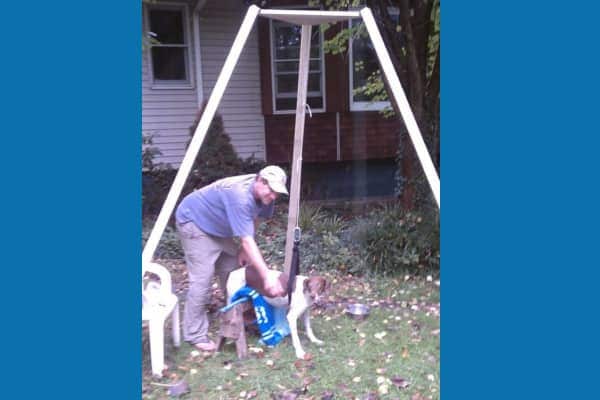
10. The tail-pull exercise
The tail pull is a technique I use to promote balance during walking. Stand behind your dog and hold the tail at the base (near the rump, and not near the tip). Use a firm grasp (but without squeezing the tail) and encourage your dog to walk while you hold the tail — almost like a rudder steering a ship. Do not try to pull the tail to either side, but merely straight back toward you. This will stimulate the dog to move forward.
With knowledge, you can help your dog
It’s difficult to watch your dog stagger about with canine vestibular disease, but there are many things you can do to help your dog recover — the first of which is to visit your veterinarian. Then, under the guidance of a veterinarian or a physical therapist for animals, consider using some or all of these 10 tips and exercises for dogs with vestibular disease to help your dog put this dizzying diagnosis in the past.

Do you have an experience with canine vestibular disease?
Please share in the comments below — your story and input is invaluable!


My 14 year old 3 legged black lab Dakota has recently had an episode that I think it vestibular disease. She looks to be drunk where she’s not standing very well and shaky and when I looked closer at her I did notice a nystagmus as well as not being interested in food. She didn’t have a head tilt and as far as I’ve been able to tell no ear infection, and no vomiting. The nystagmus lasted 3 days and she’s now getting up more but very shaky and wobbly. This is the second time it has happened but before it only lasted a day (and no nystagmus) and then she was back to normal. I saw someone else comment about little growths on their dog and she has has several almost like small warts pop up over the last year but my vet said they were just fatty growths nothing to be worried about. Are they related and is there anything I can do or give her to help her recover faster and is this something that will continue to happen?
Hi Jaimee,
I am sorry your senior girl is dealing with another vestibular episode. I would not think the growths you have noticed on her skin would be related to these issues but without examining her myself I can’t say for sure. Due to the presence of nystagmus, it makes me suspicious about a possible brain tumor. Of course, nystagmus is not a definitive sign of a tumor, but something your vet might want to investigate a bit further. There is no way to know if other episodes will occur in the future, but with your girl’s history I’d say it is a good possibility. Recovery is different for each dog and for each individual episode. How is Dakota feeling today? Praying all is well and hoping she is on the road to recovery. Feel free to leave an update if you have a chance.
I took my dog to the vet and she has nustagmus and was stumbling.. the first three days she did not get up. she ate and drank her food and we put pillows around her. the fourth day she just got up walk down the hall and to the office to see my husband. I was shocked even though she was stumbling she was still walking. the first two days she did not sleep. Today we allowed her to walk around in the yard without the straps that we usually hold her stable she did a few stumblings but she did pretty good. Sheena is on her 6th day of old dog syndrome. She is on an antibiotic and an ear drop solution plus motion sickness and a pill for nausea. She is going on 14 and is a berger Blanc swisse. it scared us in the beginning and took her to a dog emergency room but all her vitals were good. I don’t know how long her recovery will be but thank goodness I see improvement. her nustagmus is gone. her eyes are holding straight.
Hi Nancy,
It sounds like you had a difficult few days at first, but I’m so glad to hear that your dog is improving after her episode of vestibular disease (i.e. old dog syndrome). Hopefully she has made a full recovery and is back to being her old self again!
I read tumeric is good to reduce fatty tumors and so I give my 13 year old that.
And I found homeopathic Cocculus. please research. My dog is having this now and
am researching everything, has been to the vet and diagnosed with this.
I also massaged around her nceck and ears and that seemed to help with her standing.
HI Margot
I was wondering if you could please update me on your labs prognosis. I have a 7 year old lab who has drop jaw. He can’t close his mouth but in conjunction with this appears off balance. I was told by my vet to put him down today but I am not about to do this. Today is Day11 since the trigeminal neuropathy presented. I would be interested to know how quickly your lab improved.
Hi Rebecca,
I am sorry your dog is suffering from this neurologic condition. Vestibular disease and trigeminal neuropathy are two different conditions, but it is possible both could be caused by some other primary issue. Since I haven’t examined your dog myself, it is hard to make specific recommendations. With that being said, it would be a good idea to schedule a consult with a neurologist. From my experience and research, most cases of trigeminal neuropathy resolve within a few weeks as the nerve inflammation decreases, or the damage heals. This may require anti-inflammatories or even antibiotics depending on the root cause. Whenever euthanasia is brought up as an option, it is never a bad idea to gather as much information and advice as possible. It isn’t wrong to want a second opinion to make sure you are choosing what is best for you and your sweet boy. Feel free to leave an update if you have a chance. Praying for a full recovery and many happy days ahead.
All is this sounds so much like what we’re going through. The difference is that my Hannah is a Deerhead Chihuahua (10 lbs) and she is only 7.
For her breed isn’t this just middle-age?
I’ll be scheduling an appointment with a neurologist now since she has had 2 episodes in 3 days.
Up till now she has only displayed very mild symptoms that only lasted about a minute twice in the year since I adopted her.
Hi Pam,
I am sorry your little girl is having these issues. I am glad you are planning to have her evaluated by a neurologist. Without examining her myself, I can’t say for sure, but what you describe makes me suspicious about seizure activity instead of a vestibular episode. Praying you get some answers soon. Wishing you and Hannah the best.
On October 7, 2022 my 13+ year old, diabetic Husky mix (female/spayed) went into PVD. Labs were mostly unremarkable although her monocytes were ever so slightly elevated. Her symptoms were the classic ataxia and head tilt to the left without nystagmus. Although my vet didn’t find obvious signs of an ear infection – no gunk or odor, he didn’t rule out an inner ear infection as a possible cause. He administered a half dose of Cortisone and Baytril. Yes, the Cortisone made her blood glucose sky rocket to 600. I’ve increased her insulin accordingly and she’s down to blood glucose readings of generally less than 250.
Then, on October 27 she had a seizure (blood glucose was 257 (yes, I test a lot). The seizure was short, less than two minutes, loss of bladder control, I administered phenobarbital (I have another dog who has a seizure disorder) under my vet’s advice and she hasn’t had any additional seizures.
My concern at this point is that even though she has greatly improved – head tilt is gone, doesn’t fall like she had been, her hind end is still rather weak. It’s worse when she first wakes up. I’ve purchased a ramp to avoid having to walk her down four stairs to go outside and also purchased a tactical harness with hand loops on the back to help support her.
She’s still a happy dog but I want to know if after nearly five week is further recovery to be expected or do I need to resign myself to the possibility that she may not. I would like to incorporate the balance exercises you described and I want to continue her very short walks, but I don’t want to frustrate her by asking too much if she’s already at her (new) best. Any advice you could offer is greatly appreciated.
Hi Joyce,
I am sorry your senior girl is having so many issues lately and still struggling with the effects of vestibular disease. Without examining your dog myself, I can’t say for sure if you should expect further improvement in her condition or if she has in fact plateaued. I have seen other dogs continue to make slow progress over the course of months. I am a bit concerned about her neurologic issues and the sudden occurrence of a seizure. It might be a good idea to schedule a consult with a neurologist and rule out the possibility of a brain lesion. No matter what the cause, I think physical therapy/rehabilitation could be a great addition to what you are already doing at home. Take it slow and continue to give your girl time to adjust. You are doing a wonderful job. Keep up the good work!
Thank you so much for sharing all this information! I have a 12-year old whippet-pit mix (we think!) named Lili who has always been so active and loves her walks. Unfortunately, she suddenly developed all these signs about 4 weeks ago, and somewhat subtle in the beginning, with pretty quick progression to more severe. I took her to the vet last week (3 weeks into it), who did the IV fluids, DEXAmethasone, neuro check, ear check, and sent home on prednisone taper. It’s been a week, she hasn’t really improved at all, and perhaps slightly progressed more. Classic left-sided head tilt, ear straight up, falling off to her left when she’s in slow movements or holding still (pottying/pooping/eating/drinking/standing). When she goes faster, trotting after something she’s interested in, she seems to go pretty straight without leg weakness, but when slow her back left leg/hip seems to give out. She’s eating well, especially when I help scoop it for her, as she’s not as coordinated at it and hangs out in the left side of the bowl, and drinking the same way, but drinking. She’s still primarily happy and sweet, but I can tell she’s confused about what’s happening with her and perhaps slightly scared (she tends to be stressed anyway, as a whippet). The more I read here, the more it sounds still like vestibular syndrome, but the fact that it’s been 4 weeks with only progression and not improvement makes me wonder. I’m a physician myself, so I’m trying to observe all the neurological signs that would help differentiate where a lesion is, but dogs and people are different, for sure! She also rubs her face a lot, like something is irritating her in her face or head somewhere, even though otoscopic exam seemed good. The vet I took her to won’t be back until next week to update, and we live on the rural Big Island of Hawai’i, so I don’t even know if there is a neurology vet here.
Any technical pearls you may be able to share that could help further determine if this is central or peripheral, old dog vestibular or probably not, or what else I can do for her? She seems almost scared to go out for a walk now, so we haven’t for couple of weeks, and the car did seem to make it worse, along with exertion. Thank you again for helping us all…
Hi Doede,
I am sorry your senior girl is struggling with the symptoms of vestibular disease. I am glad you had her evaluated by your vet and they were able to start treatment with steroids. It does concern me a bit that the symptoms are worsening instead of improving after 4 weeks. It may be that Lili just needs more time and will start to feel better with a few more weeks. With that being said, I think it is still a good idea to have her rechecked by your vet and find out if there is a neurologist on the island. I did some research and found one in Honolulu, but I realize that is probably out of reach. From what you are describing with the head tilt and falling over to one side, I would definitely localize this to be a central issue. Most of the time I diagnose old dog vestibular disease, but if this continues to progress, then I would want to rule out a mass. I will attach links to the other two articles we have written on this topic in case there is additional information that could be helpful. I hope your sweet girl’s symptoms will start to resolve and she can make a full recovery. Wishing you both the best.
1. Vestibular Disease in Dogs: A True Story About Doggy Vertigo
2. How to Feed A Dog With Vestibular Disease: A Comprehensive Guide
Thank you for your suggestions! Yes, I took her to her other vet/hospital in town last Tuesday. They were great, and trying also to pinpoint something. Mass is definitely big possibility. Another round of (longer) steroids, plus clindamycin to treat any infection possibility. Did x-rays of whole spine, and not higher than a VD cervical, but probably couldn’t see much in skull x-ray (unless calcification?), and all looked good except some aging DDD. Only little signs of improving change, but back legs are not able to walk, although she pushes well with them in the bed/floor. 3/4 paws still proprioception issues. I got a “mobility harness” for back legs (I wish I would’ve purchased one for front and back), which is not her favorite, but helps! If she gets “going”, and I have her back legs supported, she can get a little ways, but when she stops, topples over. Other functions still working! Never had visible nystagmus before, but now her head “bobs” back and forth like she’s experiencing that, but would she with central? I brought up rat lungworm, since we have slugs in our yard. Steroids supposedly would have worked better if so, but wondering if worth anti-parasitic. No, trip to Honolulu with her would not be feasible, but if the neurologist would do “telemedicine”, I’d be all in! I just want to know what’s best to actually help her. She had a little hope it seems, when I loaded her up in the car and took her for ride, then a 2-minute “walk” at a park! That’s been her favorite thing! Thank you again.
Hi Doede,
I am glad this recent vet visit provided some other treatments to try. I know you still don’t have a clear diagnosis, but I feel like this additional testing has helped to rule out many things. I think it would be a great idea to contact the neurologist in Honolulu and see if telemedicine is an option! I am still holding on to hope that your girl can improve her quality of life. It makes my heart happy to know she was able to spend some time at the park. ♥ Keep the updates coming! Bless you both.
Well, after prayerful consideration, and a dream seeing her running “on the other side of the fence”, and seeing that she’s needing to run again, I believe it’s time to let her go. Scheduled to do this afternoon here at home. Thank you again for walking me through this, and I’m blessed and thankful to have found you as a genuine resource! As a primary care osteopathic family physician, I now find veterinary neurology quite fascinating! Career change??
Dear Doede,
My heart aches for you and this difficult decision you have had to make for your sweet girl. I know you will miss her terribly but what a blessing to be able to give her peace and rest. Thank you for letting me know. I will miss our conversations. Keep in touch and should you decide to switch teams to veterinary medicine I’ll cheer you on the whole way!
Thank you!! :). (I still have a 13-year old Pomeranian, Vashti, hanging in there with me!)
Hello! My 14 yr old husky started showing symptoms last Monday with his balance. Tuesday came and he didn’t have much of an appetite and I noticed the head tilt and his balance was way off. Wednesday early morning we took a trip to the emergency vet where he was diagnosed with vestibular syndrome. Vet gave him Meclizine and said 5-6 days he should be better. By the end of Wednesday he began to drink and eat more than he has the last couple days before. I seen improvement in him with the eating and drinking and going potty as well as not seeming as lethargic as he was. I started taking him outside once a day to try to have him go potty and give him some exercise by leashing him and doing small walks with my guidance around the yard. My question is am I doing too much by trying to have him walk a little once a day? His balance is still off but he can walk a little with some guidance from the harness. He knows when i come home and leash him up it’s time to go outside for a little bit. He purposely will then sprawl himself out telling me he doesn’t want to go. Should I not force him? Also today is the last day of the meds the vet prescribed. Should I ask for a refill or ask about getting prescribed a different medication? I’d hate to pull the trigger so quick and assume it’s something worse when really he may just need a couple more days of treatment…
Hi Jacob,
I understand your concern for your Husky, and you are doing a great job of advocating for his health and wellbeing. I think it is great that you are getting him up and outside for a bit each day. Even if he is dizzy, it will help retrain his muscles and nerves and make adjusting to this easier. It might be a good idea to get a refill of the medication. Make sure your vet stays informed of your dog’s progress or lack thereof. Each dog is different and yours may just need some more time. If you reach a point where your vet is concerned about the progression of healing, you can schedule a consult with a veterinary neurologist for more advice and treatment options. I hope your sweet boy’s symptoms will resolve soon and he can make a full recovery. Wishing you both the best and feel free to leave an update any time you like.
Hi. My golden retriever will turn 14 on 9/24! She experienced her first bout of vestibular disease two days before Xmas. It was awful and with a dog that size, it was challenging with her not being able to really walk for a few days. She got better and better & within three weeks, she was close to “normal” but then it happened again the beginning of August. I know it is idiopathic. The first time it just so happened that I had taken her to get groomed that day (at a place she’d never been). The second time she had gone to the vet for a heartworm check (in order to get a scrip for the heart worm pills refilled). Since her first bout, she had been in the car to go to the vet another time and was fine. My point is, do you think a car ride would bring it on (i.e.. similar to humans and motion sickness which often results in vertigo)? She rode in the car many times over the years and I guess it might have made her anxious but I’m not sure! The longest she was in the car would have been maybe 2.5 hours but she usually would be breath heavily the whole time! At any rate, I know stress can bring on the Vestibular Disease. Would you say that I am onto something or do you think it’s purely a coincidence? I want to continue to go to my vet vs. going w/ a mobile vet but I hesitate to put her in the car b/c I am afraid of another onset.. In conclusion, A) do you think I am overthinking it and B) have you seen more that two bouts of vestibular disease in dogs? Luckily, the second bout was not as bad as the first one.
Hi Mindy,
I am sorry your big girl has had a repeat episode of vestibular disease. I have definitely seen dogs go through this more than two times. I do think you may be onto something with the car rides acting as a possible trigger. It would be a good idea to talk to your vet about your concerns and let them know this possible correlation. They may be able to recommend a medication like Dramamine that could be given prior to future car rides to try and prevent another episode from occurring. There is no guarantee this would work, but it might be worth a try.
What a great honor and service this page is! Labor Day weekend, and our 13+ year old rescue girl (McNabb/Border Collie mix) has been exhibiting signs of congestive heart failure, growths along her gumline, small surface tumors and “soft” growths under her skin. Yesterday she was coming out of several days of coughing/sleeping/resting/low activity/off her feed and last night the head tilting, nystagmus, falling, weakness, no appetite, little urine output (carrying her outside – she squats a bit, carry her back inside). We did have to put down a lovely dog several years back that seemed to have idiopathic Vestibular disease – treated – and within 3-4 days became aggressive to us and unable to control. Vet said with that symptom, diagnosed as a tumor, and not something she would recover from with Rx. We want this girl comfortable, safe, not alone….not sure when is the time to put her down. Her eyes are not looking “inward”, but she is not herself, and starving. We live in a rural area of SW Idaho, not many options for weekend consults.
Hi Jeri/George,
I am sorry your senior girl is struggling with vestibular signs on top of her other health issues. Of course, it would happen on a holiday weekend. I recommend you call your vet as soon as it is possible (Tuesday?). But in the meantime, focus on supportive care. Here is a link to another article that may offer additional help and information: How to Feed A Dog With Vestibular Disease: A Comprehensive Guide
As long as you can keep your girl hydrated and comfortably resting, you can discuss other details with your vet once the clinic is open again. You may have to offer water by oral syringe if nothing else works. If her condition deteriorates rapidly, you may not have a choice but to see if you can find a mobile vet that can perform euthanasia. I will attach links to other articles about how to know when it’s time to say goodbye. I pray your sweet girl can hold on a bit longer. Bless you both.
1. Dog Euthanasia: Knowing When to Say Goodbye
2. Preparing for Your Dog’s Euthanasia: 10 Thoughts for Peace
3. Signs Your Dog is Dying: A Caring Message to Bring You Peace
Just got home from the emergency vet. My 12.5 year old chocolate lab had what I thought was a seizure today, turns out it was a vestibular episode. Very scary! He’s home now, very confused and disoriented. He can’t walk just yet, so I’m unsure how to help him go potty, even with a sling. Very disheartening. Hoping we can figure that out soon and the meds kick in swiftly. Hate to see him dizzy, but as labs do, his tail is still wagging. Side note, I also happen to be in SW Idaho! Though in an urban area with quick access to help. Hopefully you can find a mobile solution soon for your girl. My thoughts are with you!
Hi,
Dog just had surgery for bladder stones. She is a 13 year old heeler. I noticed her hind legs were a bit wobbly, but the vet said it was probably the pain medication she was on. After surgery in recovery she was unable to stand and could not tell up from down. She is staying there for the remainder of the week. They are giving her a strong steroid twice a day which they said seems to be working as long as she is on the steroid. When it wears off she is back to incoherent and not able to walk.
I am not sure if the vestibular was there before the surgery and it was mild so that I did not notice or if something happened during surgery. I am very concerned since it is so bad. I am hopeful that she will recover. We were still going on walks prior and while she was a little wobbly, which again we thought was pain medicine for the bladder stones, but no other symptoms. .
Hi Yvette,
I am sorry your senior girl is struggling with these vestibular like issues since her bladder surgery. You are right that this may have been an issue prior to her procedure but has become more noticeable since the anesthesia. This definitely could be a side effect of pain medication and if so, it should resolve over the next few days to weeks as her body adjusts to the medicine. If you aren’t seeing the progress that would be expected, it might be a good idea to schedule a consult with a veterinary neurologist or an internal medicine specialist. I hope the steroids and rest will help these worrisome issues resolve quickly. Praying for a positive outcome. Feel free to leave an update if you have a chance.
Our 14.5 year old Golden Retriever was just diagnosed with vestibular and it is so scary to watch her.It hit her so suddenly and she is so confused. Our vet gave us some medication for the dizziness. She is not as bad as some as she can walk and she is happy to be cuddled and shows it but you can see she is confused. She tends to sleep all the time and her hearing and sight seem effected but I am so grateful to have a supportive vet who is encouraging and compassionate. This is such a scary experience but we do what needs to be done for our fur babies.
Dear Ellen,
I understand your concern and worry about your senior girl and the side effects of vestibular disease. I am glad you have a supportive vet and are working together to help your pup through this healing process. I hope your sweet girl will continue to improve and make a full recovery. Thank you for sharing your story with our readers. Best wishes to you both!
My 13 year-old terrier mix was diagnosed with vestibular disease last week. The medication for dizziness/nausea helped greatly and he was back to himself within a week, but once the meds ran out, he quickly deteriorated to his original state. His vet has put him back on the original medication along with an antibiotic for a potential inner-ear infection. He is improving but still unable to walk on his own. The vet had also wanted to put him on prednisone but I requested we hold off until we see the results of the antibiotic. Since we haven’t seen much improvement with the antibiotic after 2 days, is it typical to add prednisone? We were originally fearful of giving him too much at once. Thank you!
Hi Danielle,
I am sorry you are in such a difficult situation with your senior guy. It is puzzling to me that the symptoms resolved completely with the medication on the first round but that with the second round you have not seen the same results. Since I have not personally examined your dog, I can’t make specific conclusions about his medications. I can see how the addition of a powerful anti-inflammatory like prednisone might help with vestibular disease or other potential causes of these neurologic symptoms. It might be a good idea to schedule a consult with a veterinary neurologist. They may have additional testing or treatments to recommend that might not be readily available in general practice. I am hopeful you will see improvement soon and praying your pup will make a full recovery. Feel free to leave an update if you have a chance.
My 14 yo Australian shepherd suffered a bout starting July 10. We put her on prednisone for a few days and I think it really helped. One month plus and she is walking on her own, climbing the stairs but still pretty subdued. Some days her head tilt is back. She is definitely weaker and slips a bit and needs help going down the stairs. But she is alert and we have her eating well. I am very happy with her progress seeing how I thought it might be the end a month ago.
Hi Pam,
Thank you for sharing your experience with us. I am hoping it will be an encouragement to others in a similar situation. I am happy to hear your senior girl responded so well to the prednisone and has shown great strides with her recovery. I hope she will continue to improve with time. Praying for many happy days ahead for you both!
My 12 year old lab mix had her 1st attack of vestibular disease a few months ago and it scared me to death.She struggled to get on her feet and they kept slipping out from under her.Then she starts shaking all over.Shaking lasts maybe 5 or 6 minutes before it goes away.This really scares her so I sit with her and comfort her with massages on her chest and wait it out.She used to sleep in my bed but have since moved her to floor for safety sake.Vet never gave her meds to take.This is not going away like I read it is. I wish it would cause it scares us both and I never know when it’s going to hit.i love her so.
Hi Lindy,
I understand your concern about these worrisome symptoms in your senior girl. Since I haven’t personally examined your dog, I can’t make specific conclusions. But I am slightly suspicious that what you are describing could be seizure activity. Is there any way you can get one of these episodes on video to share with your vet? It might be a good idea to schedule a consult with a veterinary neurologist. If this does turn out to be seizures instead of vestibular disease, there are medications that could make a big difference in your pup’s quality of life. Wishing you both the best and good luck!