If your dog recently started taking gabapentin and you are wondering about the gabapentin side effects in dogs, this article is for you. Integrative veterinarian Dr. Julie Buzby discusses what side effects to watch for, and how those side effects can be minimized or managed. Plus, she answers seven gabapentin FAQs.
Anytime you start giving your dog a new medication like gabapentin, the potential for side effects can weigh on your mind. Then when you notice something different about your dog, it’s normal to wonder:
Is that a side effect of the gabapentin?
Or is it just a fluke that this change occurred around the time my dog started taking the gabapentin?
That’s why I want to clear up any misconceptions about the side effects of gabapentin for dogs and discuss what to do if you notice them.
What is gabapentin?
Gabapentin is a medication that is FDA-approved for use in humans. Like many medications in the veterinary world, vets use gabapentin “off-label” in dogs.
Vets most commonly prescribe gabapentin to treat chronic pain in dogs (especially neuropathic pain—pain that arises from nerve damage or dysfunction). They may recommend it by itself or in combination with another pain medication.
(However, in the interest of being transparent, you should know that the veterinary literature supporting gabapentin’s use as a pain medication is sparse. Some studies indicate it may be effective while other studies did not find that it significantly decreased pain. Still, my experience as a veterinarian prescribing it for my canine patients has made me a believer in its usefulness and efficacy.)
In addition to helping control pain, gabapentin can also be used in veterinary medicine to treat seizures in dogs (usually in conjunction with other anti-convulsant medications). Plus, it may help decrease anxiety in dogs.
(To learn more about the uses of gabapentin, check out my other article on gabapentin for dogs.)
What are the gabapentin side effects in dogs?
One of the benefits of gabapentin is that many dogs experience no side effects or only mild transient side effects. The three most common potential side effects listed in the drug handbooks (and corroborated by my personal experience) are sedation, loss of coordination, and GI upset. Let’s take a look at each side effect in more detail.
Sedation and drowsiness
Especially at first, gabapentin can cause your dog to be a bit more sedate and sleepy than normal. You may notice that he or she isn’t as excited as usual about a walk or playing. Or your dog may elect to keep snoozing in the bed rather than getting up and interacting with you. And your dog’s reaction time might be a bit slower than usual or he or she may seem like a lethargic dog.
Sedation is even more common in dogs who are also on other medications that cause sedation, such as:
- Antihistamines (e.g. Benadryl for dogs)
- Opioids (e.g. tramadol for dogs)
- CBD supplements for dogs
What to do if your dog is too sedate or sleepy
If you notice that your dog is a bit drowsier or more sedate than normal, don’t panic. Instead, ask yourself how significant the change is. If your dog is just slightly more subdued, all you may need to do is give him or her a few days to adjust to the gabapentin. Usually, that’s all it takes for your dog to get back to normal levels of wakefulness and energy.
Alternatively, if your dog seems more significantly sedate, please check in with your veterinarian. Sometimes your vet will suggest giving the gabapentin only at bedtime for a few days to give your dog time to adjust to it. That way, the sedation is happening when your dog is sleeping anyway. Then, once your dog adjusts, you can go back to the typical every 8 to 12 hour dosing.
Or, in other situations, the vet may recommend decreasing to a lower dose of gabapentin initially. And then you can gradually increase back to the full dose after your dog has adjusted to the gabapentin.
Both approaches (giving every 24 hours at bedtime or using a lower dose) do have the disadvantage of not providing as much pain control at first. But once you get your dog back up to the full dose for a few days, you should have a better idea of how well the gabapentin is working.
Ataxia, loss of coordination, or unsteady gait
Sometimes, gabapentin can also cause a dog to have an unsteady gait or loss of coordination. The veterinary term for this is “ataxia.” You may notice that your dog is wobbly and off balance or your dog’s back legs are collapsing. Dogs who first start taking gabapentin might have more trouble navigating stairs or jumping on or off furniture. Or dogs might occasionally stumble or even fall over when walking.
What to do if your dog is wobbly or uncoordinated
It can certainly be distressing if your dog can’t walk or is unsteady. So the best thing you can do if you notice ataxia is to check with your vet.
Chances are good that it could be from the gabapentin, especially if your dog wasn’t having any issues with an unsteady or uncoordinated gait before starting the gabapentin. But if your dog was experiencing some ataxia before the gabapentin, or has a history of neurological diseases such as IVDD in dogs, it is also possible that worsening of your dog’s condition, not the gabapentin, is to blame for the ataxia.
Since your vet knows your dog’s history, he or she is the best person to advise you in these situations. The vet may recommend giving it a few days. Or he or she may suggest lowering the dose or only giving gabapentin at night, like we discussed in the sedation section. But if there is concern that your dog’s condition could be worsening, the vet may recommend a recheck exam.
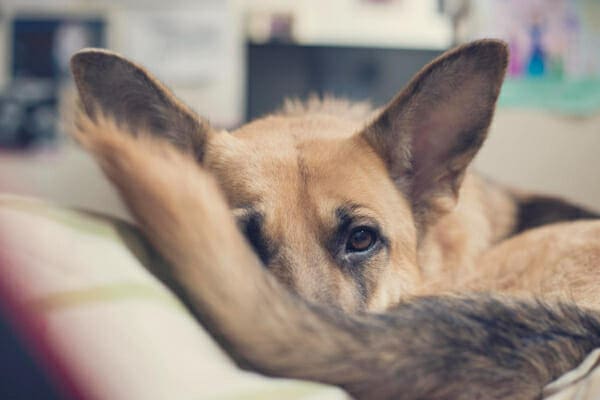
Sedation is commonly seen with dogs starting on gabapentin. Discuss with your vet if it is too excessive.
Gastrointestinal upset (vomiting, diarrhea or lack of appetite)
Just like many other medications, gabapentin can occasionally cause some GI upset. Your dog may have a decreased appetite for a few days, or he or she might experience mild vomiting or diarrhea.
What do to if your dog has GI upset
Depending on the severity of the GI upset, you may be able to manage it by giving the gabapentin with a meal. Or you could try feeding a bland diet for dogs and waiting a few days to see if the GI upset subsides. But if the vomiting or diarrhea is severe, or if your dog isn’t eating, it is best to check in with your vet. He or she may want you bring your dog in for an exam to ensure something else isn’t causing these symptoms.
Less common side effects of gabapentin in dogs
While they don’t tend to show up in the drug handbooks, there are some other side effects that are debatably associated with gabapentin use in dogs.
Increased appetite and weight gain
Anecdotally, it seems like the occasional dog on gabapentin will have an increased appetite. The dog may be counter-surfing, begging for food, or eating more. As a result of the increased caloric intake, the dog can gain weight.
By monitoring your dog’s body condition score (BCS) and taking steps to help your dog lose weight (if necessary) you can combat weight gain and increased appetite. But if you have concerns, it doesn’t hurt to reach out to your vet.
Agitation or behavioral changes
Some veterinarians have noticed that rarely a dog on gabapentin seems to have a paradoxical reaction. In other words, they get agitated or excited rather than sedate. Or the dog might experience behavior changes. Studies have reported this sort of reaction in children who take gabapentin. Therefore, it is possible that agitation and behavior changes could be associated with gabapentin use in dogs too. But the link isn’t clear at this point.
If your dog’s behavior changes suddenly, reach out to your vet for guidance. He or she can advise you on the best course of action.
Changes in urination
Gabapentin might slightly increase urine retention in dogs, but this hasn’t been well studied at this point. Occasionally, it also seems that urinary incontinence in dogs has improved on gabapentin. But it is unclear if this can be attributed to gabapentin or other factors.
If you are worried about changes in your dog’s urination volume or frequency, contact your veterinarian for advice. Since many factors can influence urination, the gabapentin may or may not have anything to do with what you are noticing.
Signs of an allergic reaction (hives or difficulty breathing)
Allergic reactions to gabapentin are possible, just like with any other drug. Dogs who are having an allergic reaction to gabapentin may have hives, swelling, or difficulty breathing. Severe allergic reactions can be life-threatening, so you should make an emergency vet visit ASAP if you notice these symptoms.
How long do the side effects of gabapentin usually last in dogs?
The good news is that, with the exception of allergic reactions, which aren’t really side effects anyway, the side effects we discussed above are generally mild and short-lived. This is true in part because gabapentin has a short half-life.
The half-life is the time it takes for the body to metabolize (i.e. break down) and excrete (i.e. eliminate from the body) half of the dose of medication. It helps give an indication of how long we can expect the effects of the medication to last.
For medications with long half-lives (meaning they remain active in the body for a long time after each dose), side effects may be more concerning. This is because it takes longer for the medication to wear off.
Gabapentin, however, is not one of those drugs. It has a short half-life (3.3 to 3.4 hours in a study of the pharmacokinetics of oral gabapentin in Greyhound dogs). This means the body has broken down and eliminated half of the dose in about 3.5 hours. So the good news is that any side effects should wear off fairly quickly.
Plus, the average dog’s body adjusts to gabapentin after being on it for several days. Therefore, typically, in a week or so, the dog will no longer get significantly sedate or ataxic on gabapentin.
Do I need to stop giving my dog gabapentin if I notice side effects?
Even knowing gabapentin’s side effects are mild and usually subside quickly, I understand that it can be concerning to see your dog wobbling around the house or acting sedate. As discussed, the best thing you can do is contact your vet if you think you might be seeing side effects of gabapentin in your dog. Your vet can provide reassurance and advice on how to proceed.
Occasionally, there are situations where the severity of the side effects may prompt your vet to switch your dog to a different medication. Thankfully, this is fairly uncommon. Most of the time, the strategies we talked about will be enough to get your dog through the initial side effects.
Side effects of stopping gabapentin in dogs
It is important to note that if your vet does want to take your dog off gabapentin, he or she may recommend gradually decreasing the dose rather than stopping cold turkey. Rapidly stopping gabapentin can cause increased seizure activity if your dog is taking gabapentin as an anti-seizure medication. And abruptly withdrawing gabapentin can also cause rebound pain in dogs who are using it for pain control.
Thus, it is best to consult your vet before you stop giving your dog the gabapentin. This is especially true if your dog has been on it awhile, has a history of seizures, or has significant pain. The exception to this would be if your dog is having an allergic reaction, where continuing to give gabapentin could be life-threatening.
What are the symptoms of a gabapentin overdose in dogs?
While we are on the topic of side effects, I also wanted to briefly talk about gabapentin overdoses. Thankfully, because gabapentin has a wide margin of safety and a wide therapeutic range, true overdoses are uncommon. In reported cases of accidental overdose, most of the time the dog showed a more severe versions of the side effects we already discussed.
Overall, the signs of a gabapentin overdose were mostly ataxia (i.e. a wobbly or unsteady gait), sedation or drowsiness, and vomiting. Since there is so much overlap between the expected side effects and the signs of an overdose, the best course of action is to talk to your veterinarian or a pet poison control center (e.g. ASCPA Animal Poison Control Center) if you are concerned. They can advise you about the safest way to proceed for your dog.

7 Gabapentin FAQs
Now that you hopefully have a better understanding of the gabapentin side effects in dogs, I want to address a few other gabapentin frequently asked questions I tend to get from my clients.
FAQ #1: What is the dose of gabapentin for dogs?
As mentioned, gabapentin has a wide therapeutic range. This means vets can safely prescribe it at a wide range of doses for the same size dog. It’s available in 100 mg, 300 mg, and 400 mg capsules and 300 mg, 600 mg, and 800 mg tablets. Plus, it comes in a liquid formulation that vets sometimes use for very small dogs.
As a word of caution, the liquid form of gabapentin often prescribed for humans (trade name Neurontin®), can contain xylitol. This is an artificial sweetener commonly found in human medications, sugar-free gum, and many other products. Unfortunately, xylitol is toxic to dogs.
When vets prescribe liquid gabapentin for dogs, they must check with the pharmacist to ensure the product the pharmacy carries does not contain xylitol. If the human pharmacy doesn’t have a xylitol-free formulation available, your vet may need to order one from a compounding pharmacy.
Typically, dogs take gabapentin every 8 to 12 hours for best efficacy. But sometimes your vet may start out with once-a-day dosing at bedtime until your dog gets used to the medication.
The dose of gabapentin that your dog will take depends on his or her size and the severity of the pain, anxiety, or seizures. Your veterinarian will decide on the best starting dose for your dog. And then he or she will make adjustments along the way based on how your dog responds.
FAQ #2: How does the body get rid of gabapentin?
Like many medications, gabapentin is excreted primarily by the kidneys via the urine. Because of this, sometimes vets need to make dose adjustments in cases of severe kidney failure in dogs. This may involve prescribing a lower dose of gabapentin for that dog compared to a dog of the same size who has healthy kidneys.
However, unlike many medications, the liver only slightly metabolizes gabapentin. Therefore, dogs with liver disease in dogs may not need significant dose adjustments.
FAQ #3: Are there situations where gabapentin could hurt my dog?
As we have discussed, gabapentin is overall a very safe medication. Vets do, however, try to avoid using it in pregnant dogs unless absolutely necessary. This is primarily out of an abundance of caution since, like many medications, the effects of gabapentin on the fetus have not been fully characterized in dogs.
Also, as already mentioned, your vet may also need to adjust the dose for dogs with kidney dysfunction.
Remember too that liquid gabapentin can contain the artificial sweetener, xylitol. Unfortunately, xylitol toxicity in dogs can be fatal in some cases. So it is very important to ensure your dog’s gabapentin does not contain xylitol.
FAQ#4: Are there any long-term side effects of gabapentin for dogs?
Dogs may be prescribed gabapentin long-term for pain control or seizures. But thankfully at this point, it does not appear that there are any concerns with using gabapentin for weeks, months, or even years. Overall, gabapentin seems to be less hard on the body than some other pain medications like non-steroidal anti-inflammatories (NSAIDs).
It is possible that over time a dog may develop a tolerance to gabapentin and require higher doses. However, this has not yet been conclusively demonstrated to be the case.
FAQ #5: How do gabapentin’s side effects compare to non-steroidal anti-inflammatory drugs (NSAIDs)?
Vets commonly prescribe NSAIDs when they notice signs a dog is in pain. So, it would make sense to compare the side effects of NSAIDS (e.g. carprofen for dogs) to gabapentin since both are used as pain relievers.
NSAIDs are popular because they’re very effective at decreasing pain and inflammation. And they can also relieve arthritis pain in dogs to dramatically improve quality of life. However, the side effects of NSAIDs include vomiting, diarrhea, bloody stool, GI ulcers, and lack of appetite.
Additionally, NSAIDs can negatively impact kidney function. Thus, vets must use them sparingly in dogs with kidney issues. Since many dogs who need daily medication to manage joint pain are seniors, this population is also more likely to have pre-existing kidney disease.
Gabapentin is an attractive alternative for pain management in these dogs. Although dogs with kidney disease may need a lower dose due to slower excretion, gabapentin does not seem to have adverse effects on the kidneys like NSAIDs do.
One of the drawbacks to gabapentin as a pain medication, however, is that it does not have anti-inflammatory effects like NSAIDs do. This may make it less effective for conditions where inflammation is contributing to the degree of pain.
FAQ #6: How do gabapentin’s side effects compare to those of trazodone for dogs?
Trazodone for dogs is a popular anti-anxiety medication. And gabapentin also has some use in controlling anxiety. Therefore, it also makes sense to compare the side effects of trazodone vs gabapentin.
Interestingly, they have several side effects in common. Both can cause some sedation and GI upset. Plus, trazodone can cause agitation, aggression, and increased appetite, which debatably also occur with gabapentin.
One of the big differences, though, is the fact that administering trazodone with many other anti-anxiety or anti-depressant medications runs the risk of the dog developing a dangerous condition called serotonin syndrome. And there is a list of other medications that trazodone doesn’t interact well with. However, gabapentin can safely be combined with trazodone and most other medications.
At the end of the day, though, the vet will select the medication that best fits the particular situation. There are a variety of potential anxiety-reducing medications. So the goal is to find the one or ones that work best for your dog.
FAQ # 7: How do the side effects of tramadol and gabapentin compare?
Another medication that gabapentin sometimes gets compared with is tramadol for dogs. Tramadol is an oral opioid medication, which means it provides pain relief. But like gabapentin, it does not have anti-inflammatory properties.
Vets sometimes use tramadol and gabapentin together. Or they may combine either one with an NSAID to provide better pain control.
When looking at side effects in dogs, the list for tramadol includes sedation, GI upset, constipation, panting, and dilated pupils. As is the case for gabapentin, these tramadol side effects are uncommon and tend to be mild.
Both tramadol and gabapentin lack enough evidence in the literature to prove their efficacy. But I do believe that they do a great job of helping decrease pain in dogs, especially when combined with another pain reliever. It is up to your vet to decide if gabapentin, tramadol, or both, is right for your dog.
Don’t let the concern about side effects of gabapentin keep you (and your dog) down
We all want what is best for our dogs and hate to see them experience any medication side effects. But the good news is that, as far as side effects go, gabapentin’s really aren’t so bad. They are unlikely to be harmful and usually go away within a week or so.
That doesn’t mean that it isn’t concerning to see your dog acting wobbly or sleepy. But it does mean that you can take some comfort in knowing that these side effects are par for the course and pretty easy to manage.
If your dog is experiencing side effects from gabapentin, please talk to your vet. Don’t let the short-term side effects make you think you should throw in the towel on gabapentin. Often the long term benefits that your dog will reap from being on gabapentin will far eclipse the stress and worry about the side effects. In the end, gabapentin may give your dog more good days, which is always a win in my book!


My 12 year old pug has been on Gabapentin, 100mg, twice a day, for several months. It has made a world of difference in her mobility. She has pretty significant arthritis in her right hip, and she has pulmonary hypertension. Gabapentin has really improved her quality of life.
Hi Julia,
I am glad to hear that Gabapentin has improved the quality of life for your sweet girl! Best wishes for many more happy days together.
My 16yr old Pug mix has been on Gabapentin for a little over a month. Vet prescribed 100mg every 12 hours. First time I gave it to him, could barely stand all day. Mentioned this to her, she said give him 50mg in the AM and 100mg before bed, tried this and he was still having issues. I spoke to her again and she said to lower the dosage again. He’s been taking 25mg every 12 hours for the past couple days and seems even worse! He also started on Selegiline a couple days ago for his CCD. I’m at a loss. I don’t feel comfortable leaving him home alone even for short periods. He falls over and then needs help getting up. He’s been struggling so hard to get up he’s pooped a couple times.
Hi Jamie,
I am sorry your dog doesn’t seem to be tolerating the Gabapentin well. While this medication works great for most dogs, your boy may not be a good candidate for Gabapentin. It is also possible there could be an underlying condition that has not been diagnosed yet that is contributing to your dog’s symptoms. I recommend having an honest conversation with your vet to address your concerns. Also, you could reach out to a holistic vet to see if they have any recommendations on supplements that may be of benefit. I hope you can find the answers you are looking for and restore your dog’s quality of life. Best wishes to you and your pup.
Hi my Dogue de Bordeaux Boris has just started taking gabapentin, he has DM and is bladder and bowel incontinent, he was constantly scratching himself raw on his side’s and underneath, as though the nerves in his saddle area were firing off wrong, I have started him off on a very low dose of just 300mg at bedtime, it’s day 3and the scratching has almost stopped, he is sedated and does have some increase in back feet swaying and knuckling, but I am going to give him at least 2weeks to get used to it and see what happens.
Dear Julie,
Thank for reading and commenting. It sounds like your veterinarian has Boris on a good plan! I hope he has continued improvement in symptoms. Bless you both!
My dog has been on gabapentin 200 mg bd , has developed severe ataxia to the point she can’t even stand up , absolutely heartbreaking, rang vet was told to just give 300 mg od pre bed , woke this morning changed dose last night she is worse , just waiting for callback from vet ,will not use again , feel so guilty putting her through this …
Hi Diane,
So sorry to hear that your dog has gotten so ataxic on the gabapentin. You definitely did the right thing by talking to the vet about these side effects. I hope they were able to get back to you today so that you can have a bit more peace of mind about the outlook going forward. I know it is hard to see your pup struggling but I hope that in time you can release yourself from the guilt you are feeling. There was no way you could have known that she would get this ataxic, and the vet couldn’t have known either. You started her on the gabapentin in hopes it would make her more comfortable and have done everything right with following up with your vet when she started developing the ataxia. Hang in there!
Hi my 13 yes cocker spaniel had siezure on Friday morning she had reaction to other suezure meds bromide so moved to gabapentin
She is a lot calmer but wobbly gait refusing use her legs and sleepy she will be on 3 tablets 100 mg each as a loading dose which the vet would taper it down as we progress further
She still at the clinic under observation
Hello!
I am sorry that your dog didn’t respond well to the first seizure meds and I hope that gabapentin does the trick for her. It can be so scary to watch a beloved dog have a seizure. I’m glad that she is being monitored closely by your vet for now. Hopefully she is able to come home to you soon and the gabapentin continues to control her seizures well.
We haven’t had a good experience with gabapentin at all. Our 12 year old staff cros rodijan ridgeback. He has suffered from fatty lumps most his life, we have had some of the worst removed over the years. He currently has 3 under his front right leg that now cause him issues walking or standing for long times. Our vet put him on 300mg twice a day. We gave him him 3 doses (Thurs eve, Fri morning, and Fri eve) and he quickly suffered from severe ataxia and was wobling around and falling over on Friday, by Saturday He couldn’t walk more than 3 steps on his own without collapsing. Me and my partner had to carry him out to the toilet and try and support him with a towel making a sling underneath him. We decided to stop the gabapentin on Saturday so he had his last dose on Friday nite its now Sunday morning and we are still at the same point of him being able to take a few steps on his own then collapsing.
Hi James,
Sorry to hear that your dog is having trouble walking and hasn’t made much improvement after stopping the gabapentin. It is a bit concerning to me that he still hasn’t changed much even after several days off the gabapentin, so I would recommend checking in with your vet if you haven’t already. It is possible that he could have something else going on besides just gabapentin side effects, and the best way to determine that would be an exam with your vet. I hope you are able to get to the bottom of his issues and get him back to walking normally again soon!
Hello Dr. Buzby,
My 160 lb 8 year old Great Dane had an emergency trip to our vet this week, 5 days ago and was diagnosed with degenerative arthritis in her hip and spine area. She was put on Gabapentin, Rimadly and Dasuquin. This morning I noticed that the very large skin tag my Dane has that dangles on her chest and is usually very flat and light pink with blue veins is extremely swollen and bleeding. She also has a small growth on he face that is also bleeding today. I have been texting with my vet and sent pictures and she said this should not be a side effect of any of the drugs. But when I looked up the side effects in humans, the less common side effect of the drug Gabapentin is unusual bleeding. She (my Vet) has decided to go ahead and remove the skin tag next week but I’d like to know your thoughts and if you have seen this before. This blog was very helpful because we have had a little bit of loopiness and getting confused which way to go to get back in the house, which I thought was more of a pain issue.
Thank you for your help!
Hi Doris,
Sorry to hear that your dog had to take an ER trip recently and was diagnosed with arthritis. It sounds like the vet did a great job of hitting her pain from multiple angles with the different medications. I haven’t had any dogs experience unusual bleeding with gabapentin either and couldn’t find any reports of it in the drug handbook or on some of my veterinary message boards. Sometimes NSAIDs like rimadyl can change the way platelets clump together, but again we don’t tend to see abnormal bleeding with it in most cases either. I could see your dog getting one of the skin tags caught on something or rubbing it and causing it to bleed but it does seem a bit odd that both were affected. It is possible that your vet may want to check some clotting information on your dog prior to surgery, especially if you happen to notice any bruising or abnormal bleeding elsewhere. Best of luck to you and your giant sweet pup!
As a side note, we do have a wide variety or articles on arthritis that you might find helpful:
8 Ways to Help a Senior Dog with Arthritis at Home
How to Relieve Arthritis Pain in Dogs: The Ultimate Guide
Is It Canine Arthritis or Aging? Learn 7 Signs of Arthritis in Dogs
She would also be a great candidate for ToeGrips. They could help her gain more traction and walk confidently, which is huge for dogs with arthritis! Our customer care team would be happy to talk to you more about them and help you ensure you get the right size for her. You can also learn more about ToeGrips here: https://toegrips.com/what-are-toegrips/
We have been using gabapentin for 7 months for bulging disc in my 13.5 yr yellow lab. She also has arthritis. She does have heavy panting for at least 1-2 hours of dose. Like she is fighting the medication or scared of the feeling… if this makes sense. She needs support when this is happening, petting or just to be near. We had to adjust dosing and time to match our daily routine. This way we could still have walks and car rides.
Leesa and Mahi
Hello Leesa and Mahi,
Thanks for sharing your lab’s experience with gabapentin. I am glad you were able to figure out a way to support her and make the necessary adjustments so she could benefit from the pain-relieving properties of gabapentin and still be able to do her walks and car rides.
Hi,
The same thing – panting and almost like anxiety happens to my 13 year old after giving the Gabapentin dose. It lasts for about an hour, and does seem like he’s fighting the effects of the medicine. . It does help with pain, but I hate seeing him like this.
Vicki
My senior dog has mammary cancer. She has had several surgeries to remove tumors from mammary cancer over 8 years, but unfortunately this time she isn’t a good candidate for another surgery. Her vet put her on gabapentin for the pain caused by her tumors and it has been great for pain control. I watched her turn from a scared pup that would hide and cry to a pup that was acting much younger than her age, happy, and you couldn’t tell she has cancer! She takes Gabapentin twice a day (1mL liquid 2 times a day). She sleeps really well on it and she does get wobbly on her feet from time to time even after being on it since Feb 2020. I was hoping that side effects would be short lived, but here it is Sept 2021 and it is still happening. I’m thinking about reaching out to her vet for advice and thoughts when I go pick up her Gabapentin again soon.
Hi Jennifer,
I am very glad to hear that the gabapentin is working so well for your sweet pup! It is fantastic that she is acting like a happy young pup and her pain is well controlled. I would definitely suggest following up with your vet like you said as it is possible that your dog is intermittently getting wobbly for a reason unrelated to the gabapentin rather than as a gabapentin side effect. Having her evaluated could potentially put your mind at ease about what is causing her to be wobbly sometimes. Thanks for sharing your pup’s gabapentin story with us!
BRAVO! Thank you Dr. B, this so clearly explains everything that we would like pet parents to know about Gabapentin for their Tripawd. I particularly appreciate how you mention the wide range of dosages available to work with when it comes to solving a problem like phantom leg pain. We will be sure to share this with the Tripawds community!
As for side effects of Gabapentin with our Wyatt Ray, none whatsoever. He was 85 pounds, taking 400 mg 3x daily and it really helped him out during his last couple of years.
Hi Rene,
So glad to hear that you found the article helpful and think it will be good for the Tripawds community too! Thank you for all you do to help support Tripawds and their parents!
Gabapentin really is a fantastic tool in our “pain control toolbox” for many dogs. I’m so happy to hear that Wyatt Ray did so well on gabapentin during his last few years! ❤
Thank you for the fantastic run-down of benefits and dosing of this drug. My 10-year old lab has a hip injury and arthrosis. He is taking this med with tramadol and Rimadryl and is quite sedated. Vet says that he will re-dose next week (after Rex has had some time to rest and move about signficantly less). It is 9 days past initial injury date and Rex has yet to put weight on his paw. Hopefully, physical therapy at the beginning of Sept. will render p0sitive results.
Hi Kathleen,
Sorry to hear that your lab hurt his hip. It sounds like your vet is doing a great job of using a combination of medications to attack pain and inflammation from multiple angles. Hopefully Rex will start walking on that leg soon. I’m glad you have a recheck scheduled for next week and think that physical therapy is a great idea too! Best of luck to both of you!❤