A luxating patella in dogs (i.e. a kneecap that slips out of place) has the potential to limit your dog’s mobility and cause pain over time. Integrative veterinarian Dr. Julie Buzby explains why patellar luxation occurs, the grades of patellar luxation, and how best to help and support your dog with a luxating patella.

Do you ever watch your dog while he or she walks? For some of us, it’s interesting to think about the science behind how our four-legged friends move from place to place. Slightly more weight is placed on the forelimbs compared to the hind limbs, but in general, all four limbs are used for things like walking, running, and playing.
But what if your canine companion suddenly picks up one of the hind limbs for a few steps then puts it back down again? At first you may wonder if he or she could have stepped in something. But could it be a sign of a bigger issue with the leg like a luxating patella?
- What is a luxating patella in dogs?
- What causes a luxating patella?
- What are the types and grades of luxating patella in dogs?
- What are the signs of a luxating patella?
- How does the vet diagnose a luxating patella?
- What is the treatment for a luxating patella?
- Luxating patella dog surgery
- Talk to your veterinarian about luxating patella options for your dog
- Does your dog have a luxating patella?
What is a luxating patella in dogs?
As the name might imply, a patellar luxation occurs when the dog’s patella (i.e. kneecap) moves (i.e. luxates) out of its normal anatomical position. Once the patella luxates, the hind limb cannot fully extend. This most commonly results in your dog holding the leg up while the knee is in a flexed position. If the patella pops back into position, the dog can begin to use the leg more normally again.
The patella can slide medially (going toward the inner surface of the leg) or laterally (going toward the outer surface of the leg). Luxating patella can affect one or both knees in dogs. It is also one of the most common orthopedic conditions in veterinary medicine.
To further understand how luxating patella affects a dog’s mobility, let’s review the anatomy of a dog’s knee.
Dog knee anatomy
The knee joint (i.e. stifle joint) is the space between the femur (i.e. thigh bone) and the tibia (i.e. shin bone). There are several important ligaments that help to keep the bones lined up with one another when your dog walks.
One such ligament is called the cranial cruciate ligament. This firm band of connective tissue starts at the back of the femur, crosses the joint, and attaches to the front of the tibia. It is the ligament that is affected by a torn ACL in dogs. There are also three fibrous sacs called joint capsules that enclose the stifle joint for protection.

The patella is located inside of the large tendon that comes down from the quadriceps muscles. These are the big muscle bodies that surround the femur, making up a large portion of your dog’s thigh. The quadriceps muscles help extend your dog’s hind limb, making the leg perfectly straight. Then, when the muscles relax again, the knee can bend.
When a normal dog’s hind limb is fully extended, the patella rests in the trochlear groove. This is a small notch within the part of the femur that is closest to the knee. As the limb flexes, the patella will slide in a downward direction. Because the patella is inside of the patellar tendon, it should stay on track as your dog’s knee continuously flexes and extends.
However, in the case of a luxating patella, the kneecap will deviate from its normal up-and-down pathway by popping out of the trochlear groove. This tends to occur when:
- The trochlear groove is shallow
- The femur and/or tibia are rotated or bowed abnormally (i.e. malformed)
- Soft tissues (i.e. cruciate ligaments or joint capsules) surrounding the patella are abnormal
- Quadriceps muscles are too tight or patellar tendon is too loose
What causes a luxating patella?
Most likely, multiple factors contribute to the anatomical changes listed above that allow the patella to luxate. They may include:
- Traumatic injury (i.e. falling or being hit by a car)
- Genetic predisposition in certain breeds—which is why dogs with luxating patellae should not be bred
- Bone conformation abnormalities that develop as a dog grows
When a luxating patella occurs, it is important to think of it not as a solitary disorder that occurs in a vacuum. Rather, it probably comes from other musculoskeletal problems that affect the alignment of the hind limb. Some of these include hip dysplasia in dogs, angular limb deformities, and disorders of the quadriceps muscles. Conversely, bone changes and painful osteoarthritis in dogs can come from weight-bearing stresses as a result of the patella luxating all the time.
What are the predisposing factors?
While any dog can have a luxating patella, there are some identifiable risk factors. One of them is breed. Medial luxating patellae (i.e. where the kneecap deviates inward) are very common in toy breed and small breed dogs. These include Yorkshire Terriers, Boston Terriers, Pomeranians, Chihuahuas, and Miniature Poodles.

Lateral luxating patella seems to occur more frequently in senior small breeds or young, large breed dogs. Breeds predisposed to a lateral luxating patella include Chinese Shar Peis, Flat-Coated Retrievers, Great Pyrenees, and Akitas.
Another predisposing factor is having luxating patella in one leg. As it turns out, there is a 50% chance that the opposite knee will have the same problem.
Your dog’s body condition score (BCS) and diet as a growing puppy are also important factors. Being overweight as a puppy applies extra stress to bones and joints, which can predispose a dog to orthopedic issues. Also, if your puppy’s diet does not provide the correct levels of vitamins and minerals for bone growth, this can lead to limb malformations that can increase the risk of a luxating patella.
What are the types and grades of luxating patella in dogs?
Approximately 75% of dogs with a luxating patella will have a medial patellar luxation. The remaining 25% of dogs will have a lateral patellar luxation. In some cases of lateral luxation, the dog may also have a ruptured cranial cruciate ligament.
During a physical examination, your veterinarian will grade your pup’s luxating patella based on the location of the patella when the leg is at full extension. There are four grades of luxating patella, and they are as follows:
- Grade I—The patella is in a normal position. The vet can luxate it but it returns to the correct position as soon as the vet releases it.
- Grade II—As the knee flexes and extends, the patella will pop in and out of position. The vet can luxate the patella and then manipulate the limb to get the patella to return to the trochlear groove.
- Grade III—The patella is out most of the time. The vet can move it back into position but it pops out again immediately.
- Grade IV—The patella is permanently out of position and the vet cannot push it back in place again.
What are the signs of a luxating patella?
As you can imagine based on the different grades of luxating patella, the signs can be variable. Sometimes, dogs with a Grade I luxation are initially asymptomatic. Alternatively, it is fairly common for dogs with a Grade I or II medial patellar luxation to suddenly skip or walk on three legs when the kneecap luxates. After a moment, they may resume a normal stance if the patella pops back into place. This can occur intermittently or continuously. It may also be temporarily worsened if your pup jumps up on something and lands wrong.

Initially, lower-grade luxating patellae may not be very painful, but they can lead to painful health problems over time. Puppies with severe medial patellar luxations (Grade III or IV) tend to develop a bow-legged stance due to the abnormal forces across the stifle joint. The resulting joint instability contributes to cartilage damage and the development of osteoarthritis early in life. These dogs tend to be consistently, rather than intermittently, lame.
Dogs with lateral patellar luxations often have more trouble moving around than those with medial luxations. They may also have a knock-kneed stance (i.e. knees deviate inward).
If you are wondering “Why is my dog limping?” or you have any concerns with your dog’s gait or stance, please make an appointment with your veterinarian.
How does the vet diagnose a luxating patella?
At the appointment, your vet will probably start by getting a history from you, watching your dog walk, and performing an orthopedic exam (including manipulating the patellae). Your veterinarian will diagnose and grade the luxating patella based on the instability or movability of your dog’s kneecap.
Higher-grade luxating patellae are generally easier to palpate on exam. But it is possible to detect Grade I or II luxations as well. In some cases, your vet may recommend light sedation for your dog in order to perform a more thorough orthopedic examination.
Typically, your vet will primarily use the orthopedic exam to diagnose your dog’s luxating patella. However, there are cases where he or she may recommend advanced imaging. Your vet may use X-rays to evaluate the bones that make up the stifle joint. Or, he or she may recommend a CT scan to assess the soft tissues within the joint.
If your dog is going to undergo surgical correction of the luxating patella or will be on pain medications long term, your vet may also recommend additional diagnostics such as blood work and urinalysis. These tests help ensure your dog is healthy and able to tolerate the medication or procedure.

What is the treatment for a luxating patella?
As alluded to, there are several treatment options available for dogs diagnosed with luxating patellae. Many of these options are dependent upon the grade of luxating patella and how often you are noticing clinical signs. For example, dogs with Grade I and II luxating patella may respond to conservative treatments. However, dogs with Grade III and IV luxating patella (or significantly painful dogs with a Grade II luxation) may require surgery. But they can still benefit from some of the medical treatment modalities too.
Non-surgical options for patella luxation
Some of the medical options for managing patellar luxations include:
Pain medication
Most vets will prescribe an anti-inflammatory medication for pain control. Non-steroidal anti-inflammatories (NSAIDs) such as carprofen and firocoxib can help with pain by reducing inflammation of the soft tissues surrounding the patella. If your dog has liver disease in dogs, kidney disease, or another reason that NSAIDs may be contraindicated, your vet may end up recommending other pain medications such as tramadol for dogs or gabapentin for dogs. However, these medications may not be as effective as NSAIDs.

Luxating patella dog supplements
Your dog could also benefit from joint supplements for dogs. My personal favorite is Dr. Buzby’s Encore Mobility™ hip and joint supplement. It combines the unique benefits of green lipped mussel for dogs and New Zealand deer antler velvet for dogs. Together, these ingredients can help reduce inflammation, provide joint building blocks, and improve your dog’s comfort.
Save 10% on Encore Mobility™ Joint Supplement for Dogs
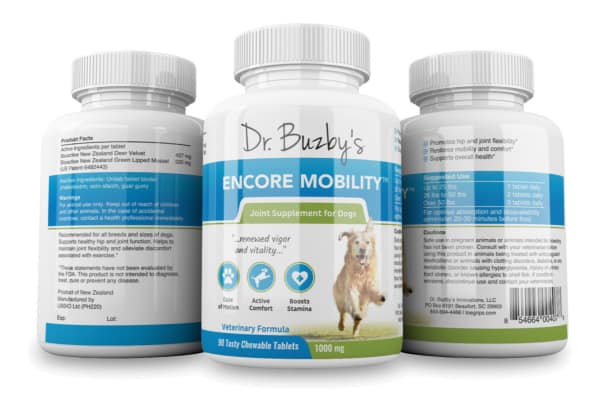
Give your dog more good days.
Use promo code HAPPY to save 10% on Encore Mobility.
Luxating patella dog braces
There is limited information on the benefits of dog knee braces for luxating patellae. Since cruciate ligament tears can occur in patients with luxating patellae, dog knee braces may potentially decrease the risk by supporting the limb and keeping the femur and tibia in alignment. The efficacy of dog ACL braces (for after a tear has already occurred) is controversial, so please consult with your veterinarian before deciding to order one.
ToeGrips for dogs
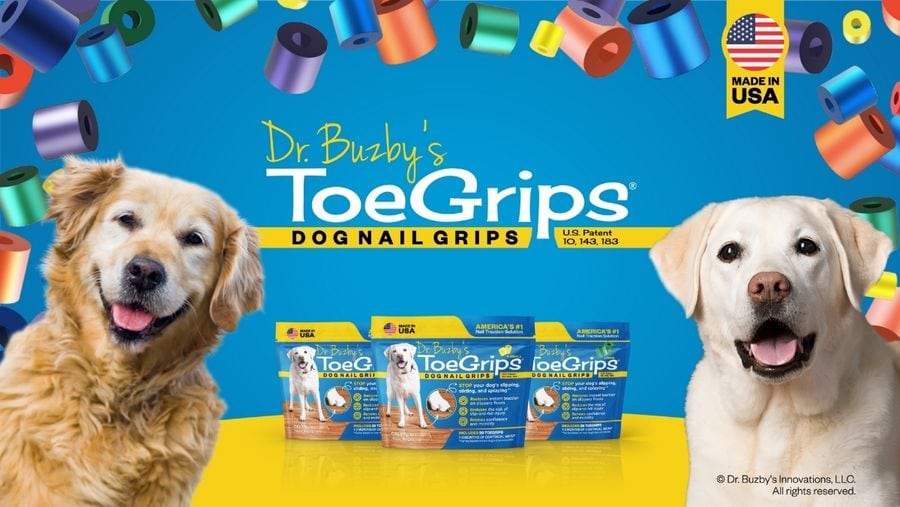
I recommend Dr. Buzby’s ToeGrips® dog nail grips for many of my patients with luxating patellae. Any time a dog has an orthopedic issue, it changes the limb mechanics. This can make it difficult for the dog to navigate on slick surfaces.

ToeGrips can be a game-changer for dogs who are struggling to get traction. Additionally, the extra security that ToeGrips provide allows a dog to walk more confidently and decreases the risk of becoming injured by slipping and falling.
Weight management
If your dog is overweight, your vet may make some recommendations to help your dog lose weight. Excess bodyweight puts more stress on the joints which leads to more pain. When a dog gets back to an ideal body condition score, he or she is often able to move around more comfortably.
Regular low-impact exercise—Should you walk a dog with luxating patella?
If you are wondering, “Should you walk a dog with luxating patella?” the short answer is “Yes!” Dogs with a luxating patella can greatly benefit from walks. Since weight management is a big part of the non-surgical treatment of luxating patellae, daily walks can help burn excess calories. However, it is possible to overdo it on the exercise. Running and jumping can accelerate the wear-and-tear on the cartilage that covers the ends of bone, thus speeding up the development of arthritis.
Even if you pursue surgical treatment for your four-legged companion, walking will be an important part of his or her recovery. In the initial two weeks of healing, your vet surgeon may limit your dog’s walking habits. Once two weeks have passed and adequate healing is confirmed, the doctor may tell you to gradually increase activity. This is because thigh muscles tend to atrophy (i.e. shrivel) if full weight is not placed on the limb (think about how astronauts living on the International Space Station have to exercise daily to prevent muscle weakening).
Additional therapy modalities
There may be other treatment modalities that your vet will recommend such as:
- Luxating patella dog massage — deep tissue massage may help with muscle contracture and lymphatic massage is useful to help reduce inflammation after surgery
- Physical therapy — to ease muscle tenseness, build muscle, and improve mobility
- Acupuncture — for pain relief
- Laser therapy for dogs — to reduce pain and inflammation
- Underwater treadmill for dogs — to help with weight loss and build muscle strength
- PEMF therapy for dogs (pulsed electromagnetic field therapy) — for pain relief
Luxating patella dog surgery
Dogs with a Grade III or Grade IV luxating patellae often need surgery to keep them comfortable and mobile. Additionally, while early intervention with medical management may help prevent a Grade II luxation from worsening, it isn’t always successful. Sometimes, the trochlear groove may wear down over time, causing the luxation to progress to a Grade III. Or a dog may become significantly painful even with a Grade II luxation. In those cases, it may be time to consider surgical correction.
Some general practice vets may be able to perform luxating patella surgery. However, because knee surgery is not a common procedure, your vet may refer you to a small animal orthopedist who is boarded through the American College of Veterinary Surgeons (ACVS).
There are several different surgical techniques that the surgeon may use for dogs with luxating patellae. The technique selection will depend on the severity of the luxation, your dog’s size, and if there is additional structural damage inside the knee. If both knees require surgery, the surgeon may choose to correct both at the same time if the patient is young. For older dogs or for those with other health issues, the surgeon may choose to separate the procedures by eight weeks or more.

Lateral imbrication surgery
For mild cases, the surgeon may recommend a lateral imbrication (i.e. lateral reinforcement). This is a simpler technique where the vet will tuck or tighten the joint capsule surrounding the patella on one side to prevent the patella from luxating. In some cases, the vet will also loosen the capsule on the other side so the patella doesn’t get pulled to that side.
Trochelar modification surgery
Another option is to deepen the trochlear groove so that the patella can stay within the groove instead of luxating. In order to keep cartilage safe during surgery, the surgeon will remove a slice of bone from underneath the cartilage. Then he or she will put the cartilaginous part back into place. This preserves the cartilage’s ability to help the ends of the bone glide over each other and absorb shock when the dog moves.
Tibial crest transposition
Dogs with a bow-legged stance may need a tibial crest transposition or tibial tuberosity transposition (TTT). This procedure involves removing the tibial crest (i.e. tibial tuberosity) where the patellar ligament attaches and then pinning it back in a new position to correct the abnormal forces across the joint.
Ridgestop™ implant
In some cases, the surgeon may select a newer technique which involves the use of a Ridgestop™ implant. The procedure involves using a small curvy metal plate to increase the height of the trochlear groove ridges. This keeps the patella from slipping out of place.
Dogs may require a combination of these approaches as well, and this is not an exhaustive list of surgical options. The best way to know what sort of surgery is right for your dog would be to consult with a board-certified veterinary surgeon.
To learn a bit more about some of the surgical options and the decision making process you can also refer to this article from Vet Times, Canine Patellar Luxation Part 2: Treatments and Outcomes.
Luxating patella surgery recovery
For the average luxating patella dog, surgery recovery can take six to eight weeks. This can sometimes be shorter if the surgeon used the lateral imbrication technique. On the other hand, recovery can also take longer than eight weeks if the dog needs physical therapy.

As a general rule of thumb, a dog should be able to bear weight on the limb after two weeks. If he or she is still not using the limb properly after one month, physical therapy may be a good idea. However, this can vary between procedures. It’s wise to ask your surgeon what to expect in your dog’s particular case.
Initially, strict crate rest or confinement to a large pen is necessary following surgery. Your dog’s surgeon may also use a cast or bandage material to protect the surgery site and prevent excess movements.
After the first two weeks, light walking may be acceptable, but dogs should not be permitted to walk off-leash. Running and jumping are also prohibited. Again, please follow your surgeon’s instructions about exercise as they will be tailored to your dog’s exact situation.
When proper surgical aftercare is used, the success rate of luxating patella surgery in dogs is quite good. According to the ACVS, more than 90% of dog owners are happy with their pup’s mobility post-surgery. This percentage decreases slightly for large breed dogs, usually because they are more likely to have lameness that is multifactorial. For most dogs, the chances of an infection are quite low, and the odds of implant failures or recurrence of joint instability are lower still.
Talk to your veterinarian about luxating patella options for your dog
The good news is that, as you can see, there are many options available to help a dog with a luxating patella. It doesn’t have to spell the end of your dog’s ability to participate in activities, especially for dogs with a Grade I or II luxation. Even if your dog has a higher grade luxation, there are a wide range of surgical options which are generally quite successful.
If you see your dog limping or walking “funny,” be sure to bring it up to your veterinarian as soon as you can. Prompt identification of luxating patellae can lead to faster treatment. Plus, early intervention may help prevent future joint pain. Together, you and your vet can do everything possible to set your dog up for minimal pain and maximal enjoyment of life.
Does your dog have a luxating patella?
Please share your experiences below.


Hi Dr. Buzby,
My 6year and 8month old Bishon boy has a medial patella luxation in his left leg and a lateral luxation in his right leg, both legs are grade two. I gave him many joint supplements such as msm, green lipped mussel, egg shell membrane powder, collegen, and have tried accupuncture, physical therapy, and Chinese medicine, but it didn’t seem to help him much. He has no symptoms of pain but I am worried that he might develop arthritis as his age grows. How can I help his condition to get better and should I consider surgery?
Hi Chrissa,
I understand your concern for your pup and think it is great you are reaching out for advice. All of the things you have already incorporated in your dog’s treatment plan sound amazing. You are doing such a great job. Just know that supplements and physical therapy all help to keep inflammation decreased and increase the health of the affected joint. They cannot “fix” the problem. The only way to correct the issue of a luxating patella is with surgery. Since your pup has no symptoms of pain and seems to be doing well, surgery may not be warranted at this time. I highly recommend you schedule a consult with your vet or the surgeon that would be doing the procedure and get their expert opinion on your dog’s case. Unfortunately, a luxating patella will predispose your boy to forming arthritis in his knee joints at some point in life, but surgery carries this same risk as well. The best way to keep arthritis at bay for as long as possible is to use the supplements and therapies you have already initiated. Wishing you and your sweet boy nothing but the best. Keep up the good work!
hello doctor. my dog Dino is a large lab pit mix.has luxatimg patella surgery in right leg appx year ago,now a small piece of bone floating around is causing him pain. in leg already operated on. also he has started to limp on what was good leg now. is surgery only option ? he is not even 2 years old and I am so sad to put him through 2 more additional surgeries. will he be able to have normal conformable active life??
Hi Julie,
I understand your concern for Dino and am so sorry he is having these complications. Unfortunately, without personally examining him, I can’t make specific conclusions or recommendations. Since Dino’s case seems to be very complex, it may be best to ask for a consultation with an orthopedic specialist. They can give you all the details about treatment options and the prognosis associated with each one. Hoping you can find the answers you need to make the best choices for you and your boy. Wishing you both nothing but the best!
I have a 10month old lab who went into season and then began limping. Not knowing if it was pain related to abdomen or relaxed joints from the hormone I watched and waited and she’s been confined to a small indoor space anyway. After 2 weeks the intermittent limp hadn’t improved and took her to the vet and they said she has grade 3 patella location. No imaging yet. My dog has never had an injury and has never been walked or run hard because as a big breed dog I was waiting until she grew before strenuous activity. I’m kind of devastated and not sure how we ended up here
Hi Fiona,
I am sorry your pup is facing this difficult diagnosis and I understand your concern. This condition does not have to be proceeded by an injury or over activity. This can be something genetic that was passed down from the parents. I am certain you have not done anything wrong, and your sweet girl will get the best of care. Hoping you can partner together with your vet to find a clear path forward that will offer your pup the best quality of life. Wishing you both many happy years ahead.
Hello Doctor,
Our boy, (labrador retriever), had a patella luxation surgery – Grade 3 in oct 2021. He has recovered very well and has been walking and running around.. We currently live in El Paso Tx and considering a move to another city. later this year. His ortho had indicated to us during a follow up visit in 2021, that if we move to a colder city we may have to be consider his knee issue. he still has metal plate and may be screws in. Question is, will he have to go through another procedure or do you think he will have health issues due to cold weather.
Hi Subu,
I understand your concern for your boy and think it is great you are taking his health into consideration while contemplating a move. It is true that very cold temperatures can sometimes cause pain in joints that have metal implants. Think about the metal becoming cold and then causing a change in temperature to the surrounding tissues. Also, just like in people, changes in weather can cause discomfort in arthritic joints or areas of a previous injury/surgery. I am not sure what area you are looking at for your new home. But even if the climate is very cold, there are many things you can do to help prevent this from becoming a major problem. You can utilize wraps, leg warmers, etc. and the use of a good joint supplement can be a big help. Hoping you can make a decision that is best for everyone involved. Wishing you and your sweet boy a bright and happy future.
Good day,
My 1-year-old teacup miniature schnauzer recently had surgery for her bilateral MPL. I am wondering, what is the best way to help support her for potty time? She has been home less than 24 hours, but he’s yet to eliminate in any form. I’ve tried using potty pads instead of outside with a leash with no success. Any suggestion to help support out encourage her to potty,
Thanks!
Hi Lynn,
You can try using a small towel or other soft item to sling under her belly to help support her weight. There are several companies that make hip support harnesses specifically for dogs. One that I have had great success with is the Help ‘Em Up Harness brand. You may not want to invest in a harness if you think your pup will only need help for a short period of time. How are things today? Hoping all is well and your sweet girl is making a full recovery. Wishing you the best of luck.
Hello, I have a 2 y/o that we adopted last May. I took her to the vet today for eye infection meds and the vet also diagnosed a luxated patella and it was added to her medical record so we cannot get her on insurance now. We cannot afford $1000-5000 surgery. She is a high energy chihuahua and loves to play. So it will be hard to us to keep her from playing. Any suggestions?
Hi Tiffanie,
I am sorry your little pup is having knee issues. If surgical correction is not an option, then you can always try medical management. I recommend starting with a high-quality joint supplement to help protect the joint and keep it as healthy as possible. There are also numerous ways to decrease pain and inflammation (as things progress) without medications. Here is a link to another article with additional information: Natural Pain Relief for Dogs: 13 Methods
It is always a good idea to be honest with your vet and discuss your concerns. They can let you know which treatment will be of most benefit for your dog’s specific situation. In the meantime, if you know surgery is being recommended, you can start saving and possibly make it an option in the near future. Best wishes and good luck!
HI,
We have a 13 y/o old adorable and sweet maltese dog. He was diagnosed to have heart problem and patellar Luxation grade 3 and 4 on hind legs. We see that he is having challenge with the patellar condition, there are times that when he walks he would hop from behind on the next step. We are giving him from time to time pain medication but due to medications for the heart we try not to give him so not interfere the treatment. And the his doctor did not recommend surgery anymore due to age. I have been searching and looking how to help manage discomfort for his luxation but most I see is for lower grades. May I ask if you have recommendations as to pain and discomfort management for grade 3 and 4? It’s heart breaking to see him change and fighting.
Hi RSB,
I understand your concern for your senior pup and his knee pain. I am sorry his heart condition prevents him from being an ideal surgical candidate. Unfortunately, the recommendations for reducing pain and inflammation are the same no matter what grade of luxation your dog is experiencing. There is only so much medications can do. Here is a link to another article with additional information and other ways of treating pain you may not have considered: Natural Pain Relief for Dogs: 13 Methods
I hope you can find the best way to help your little dog and give him some relief. Wishing you the best of luck.
just was reading your comment I also have a Chihuahua 11 years and afraid of doing surgery at her age have you thought about getting a vet to help size your dog with a brace that would help support your dog’s legs I’m thinking of trying that if I can get fitted right to be able to support the legs to help
We just discovered that our 2-year-old toy pomeranian must get luxating patella surgery. I am so nervous because my husband and I work full time and we are unsure if we will get any time off from work to help her on her recovery journey. We also have limited family members that stay close to us which can actually help with the recovery process as well. My question is, how will this situation influence our pup’s recovery process? I am so scared that she won’t recover properly. Any advice regarding the recovery process and what will be best for our pup will be much appreciated.
Hi Shannon,
I understand your concern with the recovery process while you are away from your pup during the day. Try not to worry too much about the “what ifs” as this is completely doable! You may have a couple hard weeks, but things will get easier as each day goes by. In general, while you are away, make sure your girl is in a small space where she will spend most of her time resting. The most important thing is to keep her from too much activity until it is the appropriate time to start increasing her movement. So, if she can sleep in a crate while you are away, this would be ideal. Then when you are home you can start to do her exercises or stretching as prescribed by the surgeon.
Hi Dr.Buzby,
I rescued a street dog I found in July. He is roughly 2 years old. When I found him he was limping back and forth on one side. Once I brought him back to the states, I was told its luxating patella, He was malnourished and underweight. After 3 months he became a different dog. I havent seen any limping anymore. He has a funny walk and hops like a bunny whenever hes out and about and he stretches his back legs I’m assuming to keep his knees in place. I got him evaluated by an orthopedic surgeon who recommended surgery one leg at a time. Said both legs have the luxating patella but one is worse than the other and it could eventually lead to arthritis, Ive having his surgery tomorrow and am concerned for the recovery. He slips on any hard floors and now tries to avoid any area that isnt carpeted. Do you recommend toe grips for him? Also he jumps when he walks even on a leash its just a happy walk where he hops every step of the way and am unsure how to calm him down during the recovery. Any advice?
Hi Ella,
I am sorry your pup is struggling with a luxating patella in both knees. What a blessing you found him and were able to give him a new start in life. I definitely think ToeGrips could help give your boy the traction he desperately needs when walking on slick surfaces. If you decide to give them a try, please let me know what you think! As far as the jumping while he walks, I imagine he will probably be less willing to try this after surgery just due to the challenges of the recovery process. Slow controlled walks on a leash are best and if you think you will need something to help keep your boy a bit sedated just ask your vet. I hope the surgery went well and things are progressing smoothly. Feel free to leave an update if you have a chance.
Hello Dr Buzby,
My 2 year old 10 lb terrier mix had grade 3 luxating patella in both knees and was limping/waddling along. I had both knees done at once (easier to handle than I expected) and was ultra vigilant in recovery and PT. He appears to be walking and running perfectly, but when I pick him up I would always feel a clicking, I thought it was in his hips. They checked everything and found nothing. But it became much more constant so at his annual checkup I had them focus on this and they found one of his knees still has a grade 1 /2 luxating patella. Since this seems to have become more noticeable in 6 short months, and we are fairly active (walk 3 miles a day, occasional hikes, lots of fetch and were planning on doing agility classes for fun until this latest diagnosis) I’m wondering about what the future looks like. At grade 1 or 2 I don’t think I would consider surgery again, but will this get worse? Vet s ays it pops out once every 5 manipulation.. Is this potential for future arthritis? SHOULD I be considering a second surgery now or in the future and is that even done?
Hi Mia,
I am sorry your young pup has had so many issues with his knees. Without examining your dog myself, I can’t make specific conclusions or recommendations. Any abnormal movement of a bone or joint will contribute to arthritis formation in the future. You may be able to prevent some arthritis with the help of supplements, exercise, and other treatments such as laser therapy. There is no way to know for sure how these knee problems will progress or if it will progress at all. My best recommendation is to have your boy evaluated by the surgeon who did the initial surgeries. They can let you know if an additional surgery is recommended or what to watch for as a sign of needed intervention in the future. Some dogs do require more than one surgery in their lifetime. I hope this helps a bit and may give you some guidance as you discuss your concerns with your vet. Wishing you the best of luck for a positive outcome and a full recovery for your little guy.
Hi Dr. Buzby
Thank you for sharing your knowledge and responding to comments above. I have an 11lb, 4 year old Bichon/poodle mix, who has stage 3 and 2 Luxation. I saw an orthopedic surgeon and the recommendation is surgery and I will proceed with it since she has developed arthritis on right knee. My question is, should I do both legs at the same time? The surgeon recommended doing right leg that is stage 3 but to wait a bit for the left leg (he said it might not even need surgery, it is waiting game) My concern is that I don’t want her to be “under anesthetics” another time and recovery is long, it will be so hard on her body. What are your recommendations?
I would greatly appreciate your response.
Hi Elly,
I understand what a difficult decision this must be. I am glad you have talked with the specialist and received their expert opinion. If both knees were severely affected, then I would lean more toward having both fixed at the same time. Since only one knee is a high grade, and the surgeon thinks the other may not need surgery, I would go with their advice and only fix the worst one. Also, I highly recommend you look into getting your girl started with a veterinary rehabilitation professional. They will be able to monitor her progress during recovery to make sure things are healing on schedule. A rehab vet can also give you exercises to do at home or recommend therapies to make sure the other knee stays healthy for as long as possible. I hope your dog’s surgery will be successful and she will make a full recovery. Best wishes to you both.