Spondylosis in dogs is a common condition often seen in older pets. Integrative veterinarian Dr. Julie Buzby describes risk factors, symptoms, diagnosis, and treatment options for spondylosis in dogs. By knowing what to watch for and what to do if spondylosis develops, you will help your senior dog continue to thrive.
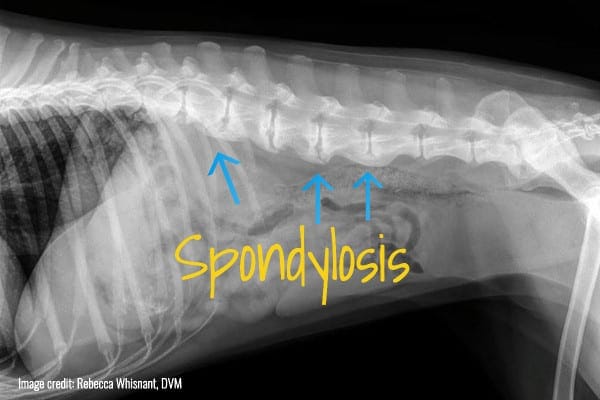
If your dog has been diagnosed with spondylosis, you may be wondering what the future holds. Although X-rays may look dramatic and scary, this condition affects a lot of my senior patients. In this article, we’ll explore what spondylosis is, as well as its causes, symptoms, and risk factors. We’ll also take a look at how vets diagnose this condition, and explore treatment options that have the potential to make a big difference in your dog’s quality of life.
What is spondylosis in dogs?
Spondylosis (spondylosis deformans) is a degenerative condition that affects a dog’s vertebrae—the bones that make up the spinal column and protect the spinal cord. A dog with spondylosis deformans develops bone spurs, also called osteophytes, on the edges of the vertebrae. In some cases, spondylosis is considered a normal part of aging for older dogs.
Dogs with spondylosis often do not show any obvious outward symptoms at all. However, I do believe dogs sometimes display subtle signs of pain and “restriction” of movement related to spondylosis.
How does spondylosis occur?
In order to better understand how spondylosis in dogs occurs, it helps to know a little bit about the anatomy of a dog’s spine.
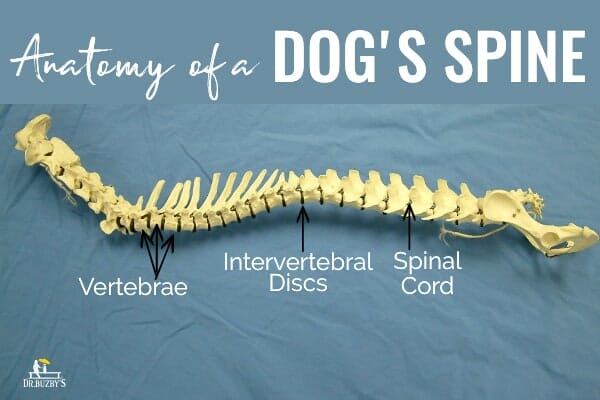
Just like in humans, your dog’s spinal cord is a large bundle of nerves that connects to the base of the brain and runs down the neck and back. The spinal cord has nerve roots that send signals from the brain to the rest of the body. Without the spinal cord, dogs wouldn’t be able to walk or perform their everyday tasks.
Bony vertebrae encase the spinal cord to protect this essential part of the nervous system. Spaces between the vertebrae, which help maintain the back’s flexibility, are cushioned by intervertebral discs—small, soft pads that act as shock absorbers for the spine.
Knowing how to keep your dog’s spine healthy can prolong his or her ability to live and move comfortably.
What causes spondylosis in dogs?
For the most part, the cause of spondylosis in dogs is simply a result of normal wear and tear on the ligaments that connect the intervertebral discs to the ends of the vertebrae. As stress and strain cause microtears in the fibers that make up those ligaments, the body tries to compensate by laying down new bone (bone spurs) on the ends of the vertebrae.
Bridging spondylosis in dogs
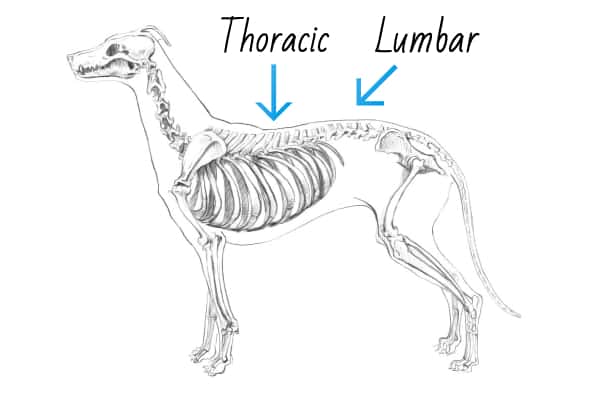
As this condition progresses, bony spurs of spondylosis deformans can grow large enough that they touch neighboring spurs and form a “bridge” between vertebrae. This is known as bridging spondylosis. These bony bridges typically form along the thoracolumbar spine, most commonly in the lumbar spine over the lower back.
What are the risk factors for spondylosis in dogs?
Spondylosis can affect any middle-aged to older dog. Generally, in most dogs, changes may occur by age 10. Although it was previously thought to be more prevalent in large breed dogs, spondylosis can develop in any breed. As explained in an article from the National Library of Medicine (NIH), it is commonly seen in Boxers, which suggests there may be a genetic predisposition.
Any physical insult to the joints of the spine increases the risk of developing spondylosis. For example, if a dog suffers a traumatic injury that compresses the intervertebral disc spaces, the resulting joint instability predisposes bone spur development in this area.
Similarly, a dog with intervertebral disc disease is likely to develop spondylosis in the affected area since the diseased discs impact stability in those joints.
Essentially, spondylosis is the body’s attempt to protect the weakened joint or joints of the spine by laying down extra bone to stabilize them.
What are the symptoms of spondylosis in senior dogs?
As mentioned above, in most cases, dogs with spondylosis don’t show any outward symptoms. The classic changes in the backbone that we see with spondylosis are not usually responsible for evident pain or lameness. Rather, the condition is most often found incidentally while diagnosing another health condition.
The unique X-ray (radiograph) below perfectly illustrates how spondylosis in dogs is often diagnosed. My colleague, Dr. Jaime Wright Carroll, saw this patient not for back problems, but for gastrointestinal distress.
Abdominal X-rays revealed Dr. Carroll’s patient not only had gastric dilatation and volvulus (GDV), also known as bloat in dogs, but also had two unexpected incidental findings.
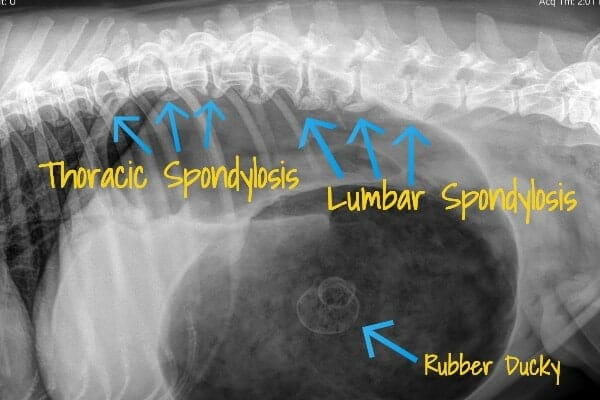
Along with bloat, Dr. Carroll found spondylosis deformans in the dog’s spine. If you look closely at the X-ray above, you’ll see the telltale bone spur “bridges.” She also found a surprise foreign body in the dog’s stomach—a rubber ducky! This pup headed in for emergency surgery to address the GDV and remove the ducky ASAP.
3 symptoms of spondylosis in dogs
Your dog may or may not display symptoms from this “remodeling” of the vertebrae. Severe changes of the vertebrae can potentially put pressure on the spinal canal, resulting in back pain.
Here are three signs of spondylosis to watch for on behalf of your senior dog:
1. Changes in walk
Instead of smoothly swaying from side to side, you may see your dog’s back stiffen and fail to move freely. A stiff gait is not just a sign of leg pain, but can be a common symptom of a sore back. Your vet will perform a physical exam to localize pain if your dog has changes in gait.
2. Change in movement
Your dog’s back may seem rigid, and they may avoid ambitious movements like jumping up or rolling over. You may notice your dog reluctant to turn his head from side to side, or having difficulty maneuvering to reach certain parts of the body.
3. Change in comfort level
If your dog’s bone spur grows large enough to pinch the delicate nerve roots along the spinal cord, he may show signs of pain in dogs and be very sensitive to touch along his back. Some dogs will whine, yelp, or even snap if painful areas of the back are touched.
How does a vet diagnose spondylosis in senior dogs?
Vets use X-rays of the spine to diagnose spondylosis deformans in dogs since the distinctive bone spurs of spondylosis generally show up readily on X-rays. If your vet suspects damage to the spinal cord or inflammation of the nerves, he or she may also recommend advanced imaging. Magnetic resonance imaging (MRI) or CT scan can rule out other issues and ensure appropriate treatment.
The X-ray below confirms a diagnosis of spondylosis for this dog.
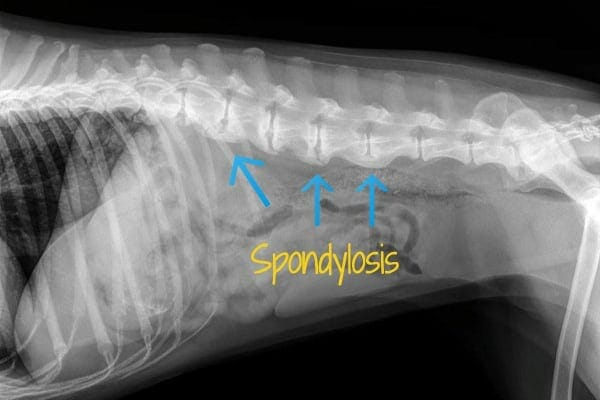
Photo credit: Rebecca Whisnant, DVM
How do you treat spondylosis in dogs?
If your dog has spondylosis but isn’t experiencing pain or discomfort, he or she may not need treatment right away—or ever! But you and your vet may want to discuss adding a joint supplement for dogs to protect those joints from further degeneration.
1. Supplements to help slow the development of spondylosis
Ingredients like glucosamine and chondroitin help keep canine joints flexible and healthy. Therefore, supplements may be helpful in slowing the development of spondylosis.
If you’re trying to find the best supplement for joint pain in dogs, my go-to product recommendation for protecting the health of the joints between the vertebrae is Encore Mobility™ with green lipped mussel and New Zealand deer velvet.
In very rare cases, surgery may be necessary to remove spurs that are causing spinal cord compression. In this unlikely scenario, your vet will likely refer you to a veterinary neurologist or surgeon.
If your senior dog is experiencing back pain, spondylosis is unlikely to be the underlying cause. Anything’s possible, but there’s a laundry list of conditions that I’d be concerned about before pinning the pain on spondylosis.
2. Medications for pain relief
Whatever the root cause, back pain can often be helped with pain medications. Non-steroidal anti-inflammatory medications (NSAIDs) can reduce inflammation in and around the joints. Other medications such as gabapentin for dogs help relieve nerve pain, which is especially helpful if back pain is caused by pressure on the spinal cord or nerve roots.
3. Physical therapy and acupuncture
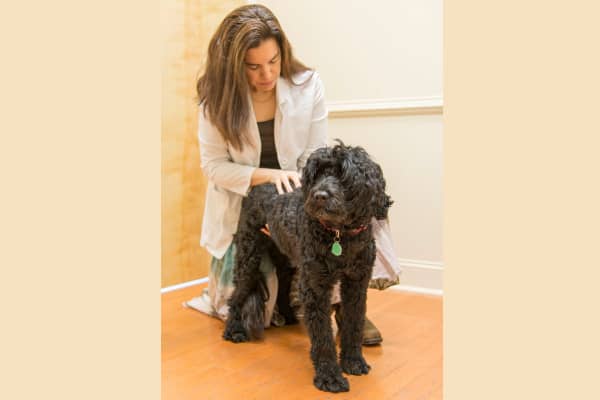
Veterinary acupuncture for dogs, animal chiropractic, and physical therapy are highly effective methods for mitigating pain and improving mobility for dogs with back pain.
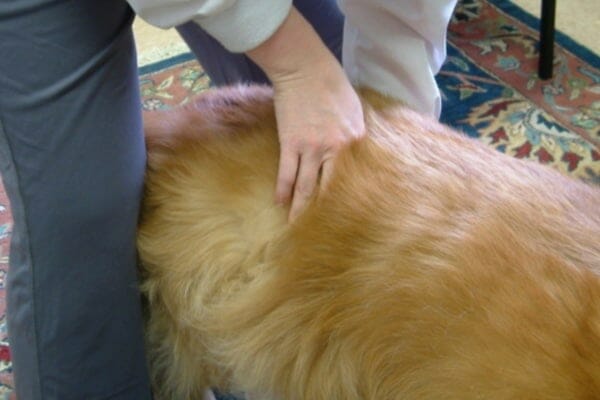
Some veterinary rehabilitation clinics have special tools like underwater treadmills for dogs to help maintain range of motion and muscle mass in dogs with low impact exercise.
4. Weight loss (if indicated)
If your dog is overweight, this is the #1 thing you must address to protect your dog’s spine. Your veterinarian can advise how much weight your dog should lose and can help you formulate a personalized diet plan. Lower calorie foods and controlled exercise can facilitate weight loss.
If you’re unsure whether your dog is overweight, you’ll want to “find your dog’s number” on our canine body condition score chart.
Since present-day pups live longer than their predecessors, they’re more susceptible to joint damage and inflammation over time. Joint inflammation is commonly known as arthritis in dogs. Spondylosis has been likened to arthritis in the spine. However, unlike arthritis, there is not an inflammatory component with the bony changes. This is a blessing because inflammation means hurting.
What is the prognosis for dogs with spondylosis?
Generally speaking, spondylosis itself does not usually impact a dog’s quality of life. Unfortunately, without surgical intervention (which is usually not needed), we cannot reverse spondylosis. Our focus is generally managing spinal health through joint supplements, exercise, and weight control to slow the progression and try to prevent or delay the onset of painful arthritis.
A common disease in senior dogs
Although it is quite common, we generally do not even know that most senior dogs have spondylosis. It is most often diagnosed incidentally, when we take X-rays of the chest or abdomen for a different reason. Because it is not an inflammatory condition, veterinarians generally believe spondylosis deformans is not painful in dogs. However, being aware of symptoms of back pain in dogs can help you identify subtle signs that may indicate your dog has some pain.
Your veterinarian will have your dog’s back on this one (pun fully intended!). Even if your dog’s spondylosis diagnosis is an incidental finding not associated with back problems, ask your vet how you can be more intentional and proactive in maintaining mobility. Your dog will thank you for it!
Has spondylosis affected your senior dog?
Share the subtle signs you first noticed that led you to seek help from your veterinarian. How is your four-legged friend doing today?



My 3.5 year old Scott’s American Bulldog and APBT mix was just diagnosed with relatively severe lumbar spondylosis yesterday.
She’s been taking joint supplements for the last 2 years because I thought she had bad hips, which helped significantly with any signs of pain or discomfort she had been having.
She was morbidly obese at 120lbs before she was a year old from her previous owner that fed her bacon grease everyday. She is now 74lbs.
She was just started on an anti inflammatory medication to see if there is a change in her mobility. We are working closely with our new vet to decide our next steps.
I’m so happy I was able to find this article to learn a bit more about what is going on with her. It has also helped to ease my nerves. Knowing she can continue on with a relatively normal life.
Hi Hunter,
I am glad to hear you have a good partnership with your vet and are working toward a solution for your sweet girl. Thank you for sharing your story with our readers. It puts a smile on my face to know the article has been helpful for you and has eased your worries. I hope the new medication will be a game changer for your pup and allow her to live her life to the fullest. She is lucky to have you in her life and act as her advocate. Wishing you both many happy years together in the future!
My 13.5 year old German Shepard boxer boy was diagnosed with this about 2-3years ago and has been receiving steroid shots every month for about a year.. I am seeing him get stiffer and harder to walk. I noticed his back looking crooked when he walks. He needs assistance into the truck. He is also taking Tramadol 150mg . My beagle recently passed and I’m seeing my GS declining more. I am concerned he is in a lot of pain and the meds aren’t helping as much. Last night he wouldn’t take the meds. ( I wrapped them in turkey slices) Do I still keep finding therapies or do I look at saying goodbye? I do not want him to suffer in pain— but if there’s something that can help him more than the steroid shot and tramadol….
Hi Sandra,
I am sorry your Shepherd boy is struggling with back pain. I applaud you for advocating for him and being sensitive to his quality of life. I recommend you talk to a veterinary rehabilitation specialist or integrative vet in your area. They may be able to offer different treatment options such as laser therapy, different supplements, acupuncture, or even chiropractic adjustments. Also, make sure your vet knows the current medications don’t seem to be helping as much anymore. There are many pain medications and anti-inflammatory choices that can be tried and even added on to your dog’s current medications. With all that being said, you know your pup better than anyone and if you think it might be time to let go, it is always better to say goodbye one day too early rather than one day too late. I hope you can find the answers you need to make the best decision for you and your sweet boy. Wishing you the best as you navigate this difficult path.
Thank you for this article. My son’s 15 y.o. Lab mix suddenly couldn’t jump up on our bed and then refused to try after 2 failed attempts. He also refused extra chances to go out during the day which was not like him and when he did go out, he didn’t even try to chase the squirrels. We took him in and had a full blood panel and x-rays done since since the physical exam didn’t show anything other than a minor pain response to abdominal palpitations. All tests came back excellent, but the doctor found he had 2 of these bony bridges. He just got his first doses of Gabapentin and rimadyl. We are just hoping it helps.
Hi Lori,
I am so glad you had your son’s dog examined by your vet and they were able to make a diagnosis. I pray the pain medications will help and allow him to continue living his best life. You may also want to consider talking to an integrative veterinarian or one that specializes in rehabilitation. They might have access to different treatments or supplements that could make a big difference for your dog. Good luck and wishing you both the best!
Hello Dr. Julie,
My 13 yrs old rescued female dog is currently suffering from spondylosis, but why is even more serious is that she suffers from pancreatitis too.. the things that wouldn’t allow me to give her many medications; supplements or pain killers…
I tried canydril and she was in Swedish pain in the stomach that I couldn’t go on with it…
She is currently receiving two doses of gaptin 300 per day .. at the beginning it stopped the pain, but seems by time things get worse and that was why I tried canydril but it gave her horrible pain (though is is a non steroid medicine)
I am currently so confused and feeing awe full I can’t help her with her pain…
Any suggestions please for some medicine who would help with spondylosis and still be easily digested with a dog with pancreatitis?
Appreciate your reply…
Many thanks,
Nermine.
Hi Nermine,
I am sorry your dog is suffering and painful. I can hear the concern and worry in your words you typed. I recommend you contact a holistic or integrative veterinarian in your area, as they have access to many herbal supplements that could benefit your girl. Also, a vet that practices rehabilitation and physical therapy has many options to help reduce pain and inflammation without medications such as: laser therapy, acupuncture, chiropractic adjustments, massage, etc. I hope you can find a treatment that will give your dog back her quality of life. My thoughts are with you as you navigate this difficult journey.
Thank you Doctor for your warm reply… I just contacted a place where they offer physiotherapy for dogs and will be in touch with the vet soon… there are not too many places here that offer such services.. but hopefully that place can help.. I just lost 2 seniors last July with similar cases but with no pancreatitis so I was able to give proper medication… but my girl’s case is a bit more complicated as you see.. spondylosis is even causing her urinary incontinence…… I will try to find a holistic place who can help though I am in doubt I ll be able to find that..
anyways, many thanks again for your prompt reply and concern.. ❤️
Hi Nermine,
Do you mind me asking how your girl went with physiotherapy treatment rather than medication? My 5 year old boxer has just been diagnosed with quite severe spondylosis but he also has a history of pancreatitis. He’s been fairly asymptomatic but has historically demonstrated that he has a high pain threshold. I’m specifically interested in your case as your girl suffers from both conditions, same as my boy. If you see this, I’d be so grateful to hear from you.
My 12 year old corgi, Atlas first started showing signs around April/May of this year 2021), mostly having a more drunken walk. Got her x-rayed and it showed she has 4 bony spurs along her lower vertebrae that are close to fusing. We got her started on Gallaprant, giving her massages and at home PT in hopes to help keep muscle retention in her rear legs as well as acupuncture. Over the next several months it slowly got worse, she now drags her right hind quarter and is slowly starting to lose strength in her left hind quarter. She is still such a happy dog, and doesn’t seem to notice her disabilities which is good. See what the future hold. We may end up getting an MRI to see if there is anything else that might be contributing to all of this.
Hi Cassidy,
Thank you for reaching out to me about Atlas. I feel like you are correct in thinking there may be something else going on. It is rare for spondylosis to cause symptoms, and when it does, it is usually a stiff back instead of a drunken gait. I am suspicious there may be something neurological happening with Atlas. Here is a link to another article that may provide some insight: Are Your Dear Old Dog’s Back Legs Collapsing? 6 Reasons Why Since I have not examined her myself, I can’t make any specific recommendations. It would be a good idea to update your vet on these new symptoms. You may also want to seek out the services of a local veterinary neurologist. I hope you can get some answers to what is causing your sweet girl to struggle so much. Best wishes to you both and keep us updated!
I adopted a mixed breed dog that I learned through DNA testing was half pomeranian and half Jack Russell who was the love of my life that was always a very healthy dog with a weight issue as he loved to eat but hated to move. None of my other dogs had a weight issue. He was diagnosed with a heart murmur at around age 8 and started daily medication for it at around age 12 where I was warned it would extend his life “another 14 months” beyond his normal lifespan. I was so focused on his heart health that I didnt focus on fact he was walking with much stiffer gait over a period of just a few weeks and was arching his back and having difficulty defecating. It still looked like just the aches and pains of old age that my other senior dogs were already experiencing so I just took him on shorter walks and changed his diet. Then everything came crashing down after less than two weeks in this condition he coudlnt walk at all but wasnt paralyzed so I rushed him to vet and he was diagnosed with this condition and I was sent home with morphine and told to keep giving him his regular meds. The first two days on morphine worked great but on third day he was still paralyzed from back down and thrashing about I put him to bed next to me that night and he died in his sleep.
I realize now that he was SIXTEEN years old so I think he didnt want to fight this and was just ready to let himself go. And more importantly he didnt want to be in pain. So I have come to terms with it but wanted to warn everyone if your dog shows any signs of this disease move quickly to see a vet and act on it otherwise it can escalate very quickly.
I also realized as proud dog parent that for a dog it is quality of life that matters most not quantity so while it would have been nice for me to have him around at least a little longer that wouldnt have been fair to him. And it had to be all about him and not me.
Hi Tony,
So sorry for the loss of your dear dog. It is always difficult to lose a beloved companion. Thanks for sharing his story, both to remember him and to help other dog parents in a similar situation. It sounds like you took great care of him and I agree completely that quality, not quantity, of life should be the focus. I hope that the wonderful memories you made together over the years can help bring some comfort in this difficult time. ❤
Our 13 year old GSD started having issues with her forelegs in winter about 3 years ago. (limping when walking outdoors, then licking when inside). We changed her food to healthy mobility, and added a glucosamine supplement. This seemed to clear that up. About 2 years ago, we noticed a limp on the right rear. At one point, she refused to stand. The vet diagnosed hip dysplasia, and prescribed meloxicam. The effects were almost miraculous. This spring, March 2021, we noticed that she was stumbling in the back legs, with a wild swing in her hips. The toenails on her back feet were almost worn completely off. The vet took one of her hind feet and set it down upside down, and Gracie didn’t correct it. This indicated to the vet that there were spinal issues. Gabapentin was prescribed. This seems to really help the stumbling, and the hip sway went away. We also worked on her weight, taking off about 5 lbs – to what her vet says is a perfect weight. Last week, she started passing blood in her urine, and the stumbling became worse (even weak on the front legs), so we became concerned that possibly there may be a cancer at work. We also wanted to KNOW if there was anything we could do, treatment-wise – maybe spinal fusion. So, a urine test and several x-rays later we know she has a UTI, and bridging spondylosis – on every vertebra in her spine. The hip dysplasia is not bad at all in the right side, and there is none on the left. Now we know. We will treat the UTI and see if that was causing the weakness, She still eats well, is playful, sometimes runs, loves hanging around with us. The next, and possibly final, step will be prednisone.
Hi Janet,
Thanks for sharing your pup’s story. Sorry to hear that she has been facing so many mobility issues over the past few years and has recently been diagnosed with a UTI and bridging spondylosis. Hopefully the UTI clears up soon and was the culprit for the increased weakness. And if not, I hope you are able to find a combination of medications and therapies that will help her maintain as much mobility as possible. She would also be a good candidate for ToeGrips because they could help her get a better grip on slippery surfaces and also protect her nails from wearing down quite so much. If she is dragging her feet, you would want to apply the ToeGrips with superglue to keep them from getting tugged off. The instructions are in this video: How to apply ToeGrips with glue. Best of luck to you and your sweet pup!
Help!!! On Saturday I left my 12 y/o pit bull here in the house for 1 1/2 he was fine. When I returned he was “broke down in his back end.” He can’t put weight on his back legs. I have Tramadol for my back pain and started him on it 3 times a day. On Monday he was seen by our vet who diagnosed him with Spondylosis, gave him Carprofen 1xdaily & said there is nothing else she can do. Today, Thursday he is worse….dragging his back legs like he has no control of them. Sunday he seemed better with the Tramadol. He was able to bare some weight and walk, wanting to go outside and play with his ball. This morning it is heartbreaking to watch him falling down and drag his back legs. Is there anything else we can do? Will he ever be able to walk somewhat normal? The thought of putting him down is unbearable to me. Is there any hope?
Hi Cathy,
So sorry to hear about your pup’s sudden issues with his back legs. It is so heartbreaking to watch a beloved dog struggle like that. Without being able to examine him and see the X-rays, I can’t say for sure what the outlook will be for him or what the best therapies would be. However, I can tell you that there are a multitude of different management options that could potentially be helpful such as laser therapy, acupuncture, rehabilitation therapy, or some medication modifications. Since it seems like he is worse this morning, I would recommend trying to get a second opinion, either from a different general practice vet or a specialty (neuro, ortho or rehab) vet. This isn’t in any way to say that your current vet didn’t do a good job or was wrong. It is just a matter of different vets having access to different tools in their treatment toolbox. I hope you are able to find some answers and solutions for your sweet boy!
My 6 year old female pug all of a sudden couldn’t stand up and could barely walk . I thought she had a stroke . I took her to my vet and they kept her over night for observation. They said she had an arthritic bulge on her lower spine that was causing the issue. They put her on Gabapentin carprophen and a once a day chewable for healthy joint repair . They had also gave her a lazer treatment and recommended 5 more treatments . I take her out every 2 to 3 hours during the day to go potty she is able to stumble around and pee and poo on her own but she is carried everywhere else Sje sleeps solid thru out the night She has never acted like she was on any pain and has never cried when picking her up she just acts confused and looks sad Which is heartbreaking because she is normally a happy and loving girl to everyone Its been 2 weeks now and I don’t see any improvement Is there anything else that I can do for her?
Hi Carina,
So sorry to hear about your pug’s difficulty walking and standing. That would be quite heartbreaking to watch. It sounds like your vet did a great job coming up with the initial plan but your dog unfortunately hasn’t responded to it as well as expected. Since it has been two weeks with no improvement, I would recommend either making an appointment with your vet for a recheck or considering an appointment with a veterinary neurologist. Sometimes it can be beneficial to enlist the help of a specialist such as a veterinary neurologist in the cases that aren’t progressing as expected since they have the ability to do advanced diagnostics (MRI, CT, etc) that a general practice vet doesn’t have access too and also have the benefit of seeing a huge number of cases like your dog’s. Best of luck to you and your pup!
Help, my 10 yr old OES has spondylosis, living on carprophen, cant control her BM, or walk stairs is there any hope. Vet suggested stem cell therapy.
Hi Judy,
So sorry to hear that your OES is struggling with spondylosis. I don’t have any personal experience with stem cell therapy for any of my patients and overall it tends to be one of those therapies that sometimes but not always has good results and requires careful patient selection. It is possible that your pup might benefit from the addition of a second pain medication such as gabapentin or tramadol, so this is something you could ask your vet about. I would also recommend starting her on a joint supplement such as Encore Mobility and looking into rehabilitation therapy (doggie PT), acupuncture, chiropractic, or laser therapy as additional ways to reduce pain, maintain mobility and support her overall health. I hope you are able to find a combination of things that can help your sweet pup feel and move a bit better.❤
My dog golden retriever 8 years ,2 weeks ago she can’t walk on her 2 back leg i went to the vet and told that she has spondylosis and gave her medicine but till now i didn’t see any progress
The therapy can help her ????
Hi Sylvie,
Sorry to hear that your golden is having difficulty walking on her rear legs. Since you haven’t seen her make any progress so far I would recommend doing a recheck with your vet and/or asking your vet if he or she thinks it might be beneficial for your dog to have an appointment with a specialist (rehab, orthopedics, or maybe neurology). There are a wide array of different therapies that can be beneficial, but there isn’t necessarily a “one size fits all” plan. Some dogs respond better to certain things than others (acupuncture, chiropractic, laser therapy, different pain meds, joint supplements, physical therapy, surgery, etc). I hope you are able to find a combination of things that will help your pup!