Spondylosis in dogs is a common condition often seen in older pets. Integrative veterinarian Dr. Julie Buzby describes risk factors, symptoms, diagnosis, and treatment options for spondylosis in dogs. By knowing what to watch for and what to do if spondylosis develops, you will help your senior dog continue to thrive.
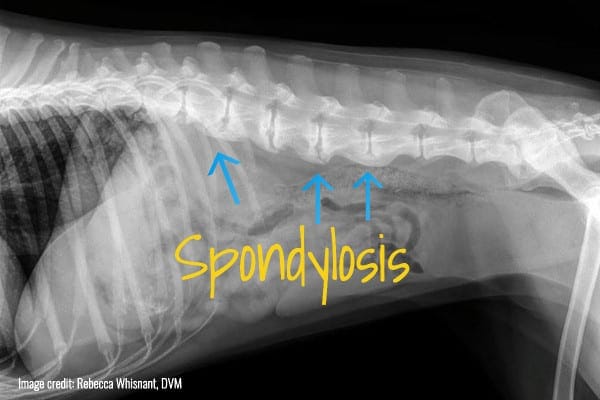
If your dog has been diagnosed with spondylosis, you may be wondering what the future holds. Although X-rays may look dramatic and scary, this condition affects a lot of my senior patients. In this article, we’ll explore what spondylosis is, as well as its causes, symptoms, and risk factors. We’ll also take a look at how vets diagnose this condition, and explore treatment options that have the potential to make a big difference in your dog’s quality of life.
What is spondylosis in dogs?
Spondylosis (spondylosis deformans) is a degenerative condition that affects a dog’s vertebrae—the bones that make up the spinal column and protect the spinal cord. A dog with spondylosis deformans develops bone spurs, also called osteophytes, on the edges of the vertebrae. In some cases, spondylosis is considered a normal part of aging for older dogs.
Dogs with spondylosis often do not show any obvious outward symptoms at all. However, I do believe dogs sometimes display subtle signs of pain and “restriction” of movement related to spondylosis.
How does spondylosis occur?
In order to better understand how spondylosis in dogs occurs, it helps to know a little bit about the anatomy of a dog’s spine.
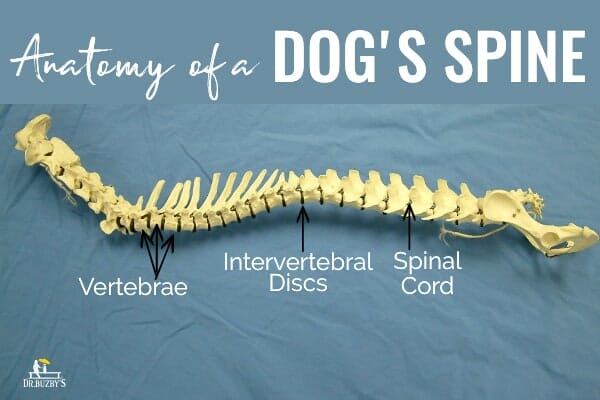
Just like in humans, your dog’s spinal cord is a large bundle of nerves that connects to the base of the brain and runs down the neck and back. The spinal cord has nerve roots that send signals from the brain to the rest of the body. Without the spinal cord, dogs wouldn’t be able to walk or perform their everyday tasks.
Bony vertebrae encase the spinal cord to protect this essential part of the nervous system. Spaces between the vertebrae, which help maintain the back’s flexibility, are cushioned by intervertebral discs—small, soft pads that act as shock absorbers for the spine.
Knowing how to keep your dog’s spine healthy can prolong his or her ability to live and move comfortably.
What causes spondylosis in dogs?
For the most part, the cause of spondylosis in dogs is simply a result of normal wear and tear on the ligaments that connect the intervertebral discs to the ends of the vertebrae. As stress and strain cause microtears in the fibers that make up those ligaments, the body tries to compensate by laying down new bone (bone spurs) on the ends of the vertebrae.
Bridging spondylosis in dogs
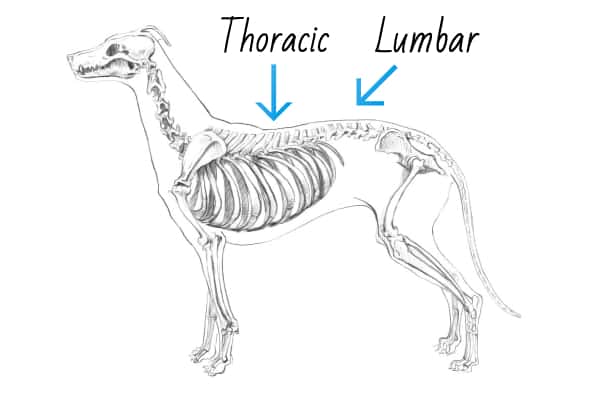
As this condition progresses, bony spurs of spondylosis deformans can grow large enough that they touch neighboring spurs and form a “bridge” between vertebrae. This is known as bridging spondylosis. These bony bridges typically form along the thoracolumbar spine, most commonly in the lumbar spine over the lower back.
What are the risk factors for spondylosis in dogs?
Spondylosis can affect any middle-aged to older dog. Generally, in most dogs, changes may occur by age 10. Although it was previously thought to be more prevalent in large breed dogs, spondylosis can develop in any breed. As explained in an article from the National Library of Medicine (NIH), it is commonly seen in Boxers, which suggests there may be a genetic predisposition.
Any physical insult to the joints of the spine increases the risk of developing spondylosis. For example, if a dog suffers a traumatic injury that compresses the intervertebral disc spaces, the resulting joint instability predisposes bone spur development in this area.
Similarly, a dog with intervertebral disc disease is likely to develop spondylosis in the affected area since the diseased discs impact stability in those joints.
Essentially, spondylosis is the body’s attempt to protect the weakened joint or joints of the spine by laying down extra bone to stabilize them.
What are the symptoms of spondylosis in senior dogs?
As mentioned above, in most cases, dogs with spondylosis don’t show any outward symptoms. The classic changes in the backbone that we see with spondylosis are not usually responsible for evident pain or lameness. Rather, the condition is most often found incidentally while diagnosing another health condition.
The unique X-ray (radiograph) below perfectly illustrates how spondylosis in dogs is often diagnosed. My colleague, Dr. Jaime Wright Carroll, saw this patient not for back problems, but for gastrointestinal distress.
Abdominal X-rays revealed Dr. Carroll’s patient not only had gastric dilatation and volvulus (GDV), also known as bloat in dogs, but also had two unexpected incidental findings.
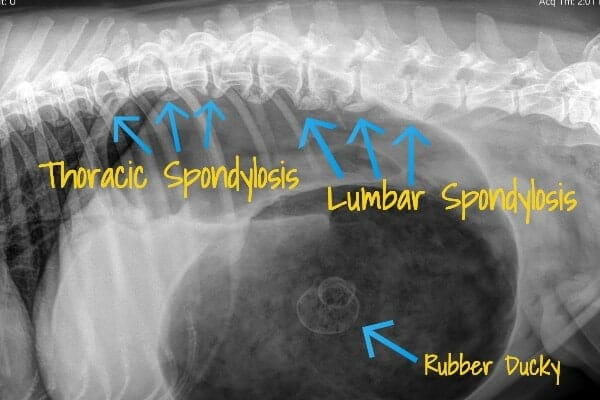
Along with bloat, Dr. Carroll found spondylosis deformans in the dog’s spine. If you look closely at the X-ray above, you’ll see the telltale bone spur “bridges.” She also found a surprise foreign body in the dog’s stomach—a rubber ducky! This pup headed in for emergency surgery to address the GDV and remove the ducky ASAP.
3 symptoms of spondylosis in dogs
Your dog may or may not display symptoms from this “remodeling” of the vertebrae. Severe changes of the vertebrae can potentially put pressure on the spinal canal, resulting in back pain.
Here are three signs of spondylosis to watch for on behalf of your senior dog:
1. Changes in walk
Instead of smoothly swaying from side to side, you may see your dog’s back stiffen and fail to move freely. A stiff gait is not just a sign of leg pain, but can be a common symptom of a sore back. Your vet will perform a physical exam to localize pain if your dog has changes in gait.
2. Change in movement
Your dog’s back may seem rigid, and they may avoid ambitious movements like jumping up or rolling over. You may notice your dog reluctant to turn his head from side to side, or having difficulty maneuvering to reach certain parts of the body.
3. Change in comfort level
If your dog’s bone spur grows large enough to pinch the delicate nerve roots along the spinal cord, he may show signs of pain in dogs and be very sensitive to touch along his back. Some dogs will whine, yelp, or even snap if painful areas of the back are touched.
How does a vet diagnose spondylosis in senior dogs?
Vets use X-rays of the spine to diagnose spondylosis deformans in dogs since the distinctive bone spurs of spondylosis generally show up readily on X-rays. If your vet suspects damage to the spinal cord or inflammation of the nerves, he or she may also recommend advanced imaging. Magnetic resonance imaging (MRI) or CT scan can rule out other issues and ensure appropriate treatment.
The X-ray below confirms a diagnosis of spondylosis for this dog.
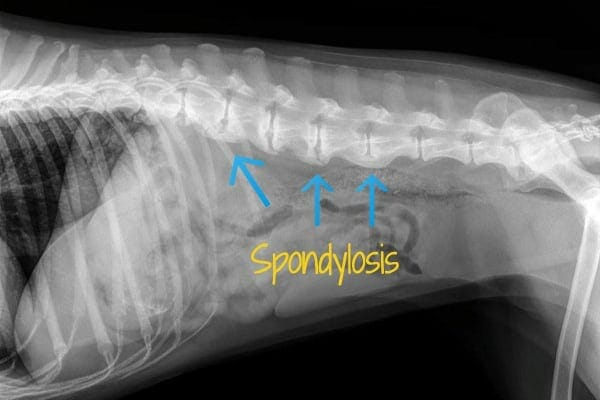
Photo credit: Rebecca Whisnant, DVM
How do you treat spondylosis in dogs?
If your dog has spondylosis but isn’t experiencing pain or discomfort, he or she may not need treatment right away—or ever! But you and your vet may want to discuss adding a joint supplement for dogs to protect those joints from further degeneration.
1. Supplements to help slow the development of spondylosis
Ingredients like glucosamine and chondroitin help keep canine joints flexible and healthy. Therefore, supplements may be helpful in slowing the development of spondylosis.
If you’re trying to find the best supplement for joint pain in dogs, my go-to product recommendation for protecting the health of the joints between the vertebrae is Encore Mobility™ with green lipped mussel and New Zealand deer velvet.
In very rare cases, surgery may be necessary to remove spurs that are causing spinal cord compression. In this unlikely scenario, your vet will likely refer you to a veterinary neurologist or surgeon.
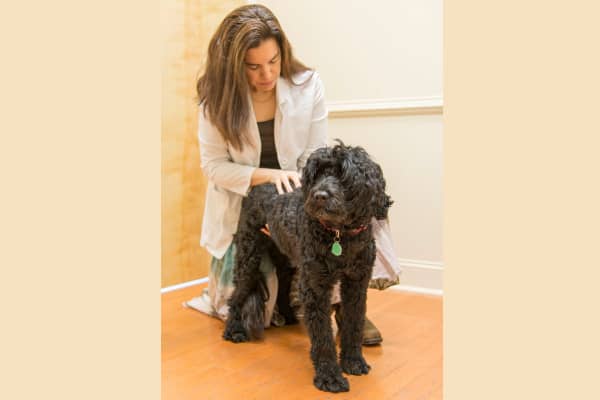
If your senior dog is experiencing back pain, spondylosis is unlikely to be the underlying cause. Anything’s possible, but there’s a laundry list of conditions that I’d be concerned about before pinning the pain on spondylosis.
2. Medications for pain relief
Whatever the root cause, back pain can often be helped with pain medications. Non-steroidal anti-inflammatory medications (NSAIDs) can reduce inflammation in and around the joints. Other medications such as gabapentin for dogs help relieve nerve pain, which is especially helpful if back pain is caused by pressure on the spinal cord or nerve roots.
3. Physical therapy and acupuncture
Veterinary acupuncture for dogs, animal chiropractic, and physical therapy are highly effective methods for mitigating pain and improving mobility for dogs with back pain.
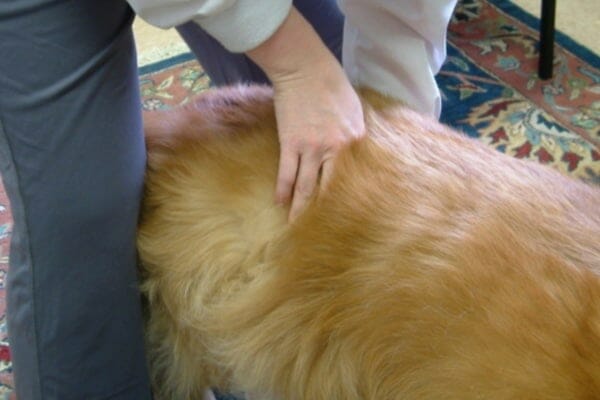
Some veterinary rehabilitation clinics have special tools like underwater treadmills for dogs to help maintain range of motion and muscle mass in dogs with low impact exercise.
4. Weight loss (if indicated)
If your dog is overweight, this is the #1 thing you must address to protect your dog’s spine. Your veterinarian can advise how much weight your dog should lose and can help you formulate a personalized diet plan. Lower calorie foods and controlled exercise can facilitate weight loss.
If you’re unsure whether your dog is overweight, you’ll want to “find your dog’s number” on our canine body condition score chart.
Since present-day pups live longer than their predecessors, they’re more susceptible to joint damage and inflammation over time. Joint inflammation is commonly known as arthritis in dogs. Spondylosis has been likened to arthritis in the spine. However, unlike arthritis, there is not an inflammatory component with the bony changes. This is a blessing because inflammation means hurting.
What is the prognosis for dogs with spondylosis?
Generally speaking, spondylosis itself does not usually impact a dog’s quality of life. Unfortunately, without surgical intervention (which is usually not needed), we cannot reverse spondylosis. Our focus is generally managing spinal health through joint supplements, exercise, and weight control to slow the progression and try to prevent or delay the onset of painful arthritis.
A common disease in senior dogs
Although it is quite common, we generally do not even know that most senior dogs have spondylosis. It is most often diagnosed incidentally, when we take X-rays of the chest or abdomen for a different reason. Because it is not an inflammatory condition, veterinarians generally believe spondylosis deformans is not painful in dogs. However, being aware of symptoms of back pain in dogs can help you identify subtle signs that may indicate your dog has some pain.
Your veterinarian will have your dog’s back on this one (pun fully intended!). Even if your dog’s spondylosis diagnosis is an incidental finding not associated with back problems, ask your vet how you can be more intentional and proactive in maintaining mobility. Your dog will thank you for it!
Has spondylosis affected your senior dog?
Share the subtle signs you first noticed that led you to seek help from your veterinarian. How is your four-legged friend doing today?



My vet noticed spondylosis in my female samoyed when she was 5. She is now 8 and was showing signs of discomfort-yiping when touched, hesitating before jumping on the bed. I took her in for X-rays. He said it looked like the spine of a 12 yr. He has her on gabapentin, tramadol, and rimadyl. Is that a lot? She loves doing Rally obedience (lots of sits and some downs). And LOVES herding. It breaks my heart to think she can’t do these anymore. What is safe to do with her?
Hi Tana,
I am sorry your girl is having these back issues at such a young age. In general, walking and running shouldn’t cause a big issue but I would recommend discontinuing any high impact activities. I strongly encourage you to find a veterinary rehabilitation professional in your area to partner with. They could be very valuable in helping to keep your dog’s pain and inflammation at a minimum and add years of good quality to her life. Wishing you both the best of luck!
Thank you for your very informative article! I recently went to the vet with concerns that my Boxer Sophie (who ho just turned 3 ) might have pyometra. Luckily it was not pyo but a slight uti. However while looking for pyo in x-ray they found she had severe bridging spondylosis. Most of the literature I have found refers to this as an old dog disease. Can you point me towards information about the disease and treatment of it in young dogs? She is not over weight and is very active running and jumping on our farm. I am spaying her in a couple of weeks as I fear that this could be genetic and I do not want to risk passing this issue on. I have started giving her joint power ( green lipped muscles) and i think she is having an allergic reaction to it as she has now started itching horribly. I just want to find what will help give her the best quality of life.
Hi Dana,
I am sorry Sophie has developed spondylosis at such a young age. I understand your concern and applaud you for taking such a proactive stance in searching for answers. I am not aware of any differences in treatment for this condition that would vairy with age of onset. To my knowledge, the presence of spondylosis is always due to joint instability. I would recommend you find a good joint supplement that she tolerates and doesn’t cause an allergic reaction. Also, this would be a good time to team up with a veterinary rehabilitation professional. They can follow Sophie’s condition as she advances in age and give you exercise and therapy recommendations to offer the most benefit at each stage of life. Wishing you both all the best. Give your sweet girl a hug for me and keep up the good work!
Hi Dr Buzby,
My incredible boy Spook, Spook the Great Dane, Life Matters Suicide Prevention Ambassador. https://www.facebook.com/profile.php?id=100083023166622
Has just today been diagnosed with Spondylosis via x-ray. You information has really helped me understand what we are dealing with.
Thank you.
Colleen
Hi Colleen,
Spook seems like such an amazing boy! Thank you for the positive feedback about the article. Hoping you can find the best way to keep your big guy pain free. Best wishes!
My 15 year old shih has just been diagnosed with spondylosis after a routine exam as I said his back legs are started to drop and he occasionally loses his balance. My dog is fine atm , eating fine and running round after his toy. The vet has prescribed Tralieve 20mg, onsior 10mg and gabapentin 50mg is this a lot of drugs ?
Hi Jennifer,
I understand your concern for your senior pup and these medications he has been prescribed. Since I have not personally been a part of your dog’s medical care, I can’t make specific conclusions about his medication regimen or dosages. I can say that when dealing with severe pain my own patients, I have prescribed these exact medications in combination with each other with great success. How is your boy feeling today? Hoping all is well and wishing you the best.
Hello and thank you for sharing this information on spondylosis. My 14 yr ShihTzu who has Cushing’s started having some stability issues about 3 months ago. In the last few weeks it has gotten progressively worse. Our vet did some x-rays and found she has spondylosis. It has severely affected her mobility. Prednisone was given and we are hoping this will offer some improvement. She does not appear to be in pain. but her activity level, appetite and overall demeanor has gone down. Due to her age, we are not in favor of any surgery. Would be interested to hear your thoughts.
Hi KC,
I am sorry your senior pup is struggling with mobility issues. This is a very common issue in senior dogs and luckily there are many treatment options! There are several pain medications that can be used that don’t have the same side effects as can be seen with prednisone. You can discuss these options with your vet and can make a decision about which is best to use long term. Also, I highly recommend you talk with a holistic vet or one that practices alternative medicine. A veterinary rehabilitation professional could also be of great service in this case! Things to consider include acupuncture, PEMF, supplements (like Encore Mobility) or herbs, physical therapy, laser therapy, etc. Here is a link to another article with more information: Natural Pain Relief for Dogs: 13 Methods
Best wishes and good luck!
Our 12 year old Shih Tzu, Leo, was just diagnosed today. We started noticing he was having trouble going down steps and when he fell down the last three stairs, we began to carry him. Then we noticed he was walking like his joints weren’t connected at the hip or knees, his trot was wobbly and he would tilt when standing still. Next came knuckling where he was dragging his right foot. When we took him in for rabies vaccine, we asked them to watch him walk and they gave us joint supplements. Finally, when he couldn’t get up on the first step because his back legs couldn’t lift him, and he could barely hold himself off the ground to go poop, we decided it was more than just joints. Today, the x-rays showed bone spurs and the vet said his brain didn’t tell him his foot was upside down. Prednisone was prescribed and hopefully, he will improve.
Hi Jan,
I am sorry your little guy is having mobility issues and struggling with arthritis. I am glad your vet was able to get some answers and start treatment with the prednisone. I hope you will see a big improvement in your dog’s comfort level with this medication. Don’t forget you can always talk to a neurologist if you need more information or therapy options. Here is a link to an article with additional info on prednisone: Prednisone for Dogs: 10 FAQs Answered
Best wishes for healing and many happy days ahead.
My boy Shiloh may have this. I spoke to the Vet Assistant this morning and was told there was bridging along his spinal column. Right now my 100 lb German Shepherd mix cannot walk by himself. He’s just laying on his bed waiting till I can get him in to his appointment tomorrow morning.
The Vet Assistant indicated that he may need to be put down. I’m devastated and my wife is in bed crying her eyes out. Is there any hope for Shiloh?
Hi Scott,
I am so sorry Shiloh is struggling and in such bad shape. I hope the appointment at your vet this morning was helpful and addressed your concerns. It might be a good idea to have a consult with a veterinary neurologist. I am not used to seeing spondylosis cause a complete loss of mobility in dogs, although I guess it is possible. What did you find out? Feel free to leave an update if you have time. Praying Shiloh is ok and that you will be able to find a treatment to restore his quality of life. ♥
Jackson is a very large Husky/GSD. He slipped and fell on a wet deck while racing around a corner and fractured his pelvis about 1 1/2 years ago. That happened right after his second ACL surgery. While recovering from that, about 6 months later, he was diagnosed with spondylosis when he started carrying his hind right leg. He was put on Galliprant once a day and 300 mg gabapentin twice a day. He also started cold laser therapy once a week. His limp never completely goes away but gets a little better at times,depending on his activity. He mostly lies down all day, and has gained weight, his vet recommending I limit his food now. I just ordered a bottle of your Encore Mobility. I am going to start using heat and massage on him. Would muscle relaxants help? Is there anything else I can do? Would a consult with a veterinary neurologist be helpful?
Hi Ellen,
I am sorry your big guy is having so many issues with arthritis pain. It sounds like you are doing a great job keeping up with his treatments and advocating for his wellbeing. If your boy is overweight, then weight loss will be the biggest game changer for his situation. Studies have shown that weight loss can do more to reduce pain levels associated with osteoarthritis than even prescribing opioids. With that being said, it is never a bad idea to have him evaluated by a neurologist. They may have ideas about therapies that are not commonly used in general practice. Maybe acupuncture would be worth a try? I hope you can find the answers you need to give your sweet boy the best quality of life. Let me know what you think about the Encore Mobility after he has been taking it for a few weeks! Best wishes to you both.
My 5yr old blue cattle x staffy has just had his first “bridge” show up on an xray on his last lumbar vertebrae. He showed signs of acute pain (not jumping up on to the couch /bed / car etc & getting stuck and whimpering when weight was on hind legs while trying to climb up) at easter and was given a course of non steroidal anti inflammatories. This eased his pain significantly & he was no longer whimpering and back to jumping up on the couch etc. However as the weeks passed I noticed that Hank no longer jumps to catch a ball with all 4 legs off the ground (previously he would jump up to 4ft into the air and sometimes flip if the ball bounced high enough) he also no longer gives hugs when I come home, he won’t spend more than 3 sec on his hind legs instead he sits and waits for pats (good behaviour but not typical for him). Took Hank to the vet today & she noticed that his hips were a bit stiff for a dig his age took an xray & here we are. Im so fortunate to have a patient & pro active vet. We now have answers & know how to manage Hank’s comfort levels & I know what what activities to avoid so we don’t aggravate his spine. Alway trust your instincts when it comes to “minor” behaviour changes in your pets.
Hi Melinda,
I am so glad you have such an amazing partnership with your veterinarian. Hank is lucky to have the both of you advocating for his health and wellbeing. I am glad you received a positive prognosis and have a treatment plan in place to keep him comfortable and active. Wishing you both the best for many happy years to come.
My female 13 year old cocker spaniel has an enlarged heart and is being treated for that. Her spine down her back and tail are very visible from the outside looking at her. She shakes when having a bowel movement and whimpers . She falls easily and doesn’t jump up to get on the furniture anymore. I’m going to call for a vet appointment tomorrow but I am wondering if you’ve ever saw these symptoms before?
Hi Melissa,
I am glad you are planning to have your senior girl examined by your vet. Unfortunately, yes, these symptoms are all too common in senior dogs. Most are related to arthritis and loss of lean muscle mass. A neurological issue could also play a role which is why an exam is so important. I am hopeful that your vet will be able to find a treatment to relieve your girl’s pain and help restore her quality of life. Wishing you both the best and good luck!