A torn ACL in dogs (technically called a CCL or cranial cruciate ligament) is a common condition. However, that doesn’t make it less scary when it’s your dog who is limping. Integrative veterinarian Dr. Julie Buzby shares symptoms, causes, surgical treatment options, and post-operative recovery for ACL injuries. Learn the facts in this comprehensive guide that includes images of dog ACL X-rays and video of a veterinarian checking the health of a dog’s CCL.
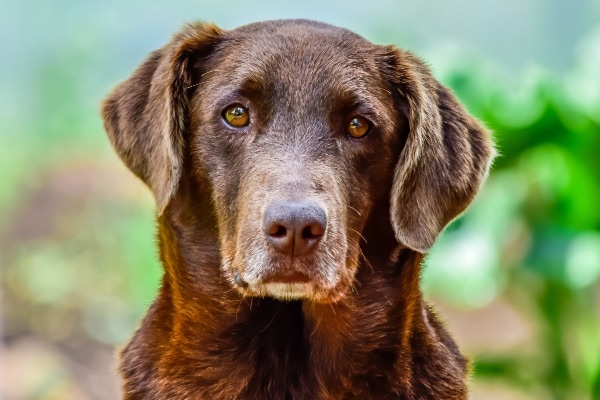
- Bailey, a Labrador Retriever dog with a torn ACL
- What is a torn ACL in dogs?
- What causes a torn ACL in dogs?
- Which dog breeds are at increased risk for an ACL injury?
- What are the symptoms of a torn ACL in dogs?
- How is a torn ACL in dogs diagnosed by your veterinarian?
- What are the treatment options for a torn ACL in dogs?
- Surgical options for repairing a dog's ACL
- Recovery and caring for your dog following ACL surgery
- The rest of Bailey's story
- Can ACL tears be prevented?
- Speak with your veterinarian about treatment options for ACL injuries in dogs
Bailey, a Labrador Retriever dog with a torn ACL
First, to understand how a torn ACL in dogs may happen, let’s meet my veterinary patient, Bailey. This 13-year-old, rotund Labrador Retriever preferred couch dwelling to outdoor adventures. One day, Bailey hopped down from the couch, walked a few steps, and then stopped. Randy, his pet parent, noticed that Bailey was favoring his left hind leg. In fact, he held it dangling in the air. He’d favored it very slightly in years past. But now, Bailey wouldn’t touch the back paw to the ground. That’s why his doting dad brought him to my veterinary office.
A veterinary exam and a diagnosis of CCL
After a complete head-to-tail physical exam and listening to my client’s story, I suspected a torn cruciate ligament. When I’d examined my patient’s left rear leg, the dog’s left knee was thickened and very firm. I suspected that the sweet dog had lived with a partial tear for years, and the tear had now become complete.
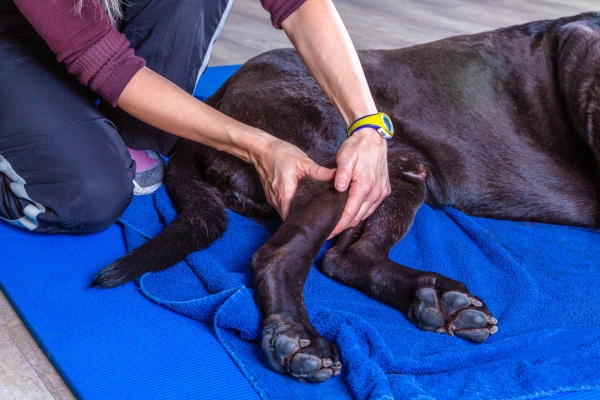
Next, with Bailey on his side enjoying a tasty peanut butter distraction, I placed one hand on the dog’s stifle and the other on the bottom of his foot, flexing his hock and knee. I checked for abnormal movement.
Bailey was fairly relaxed, but when I attempted to maneuver his knee, he lifted his head to inspect my work, indicating discomfort. I was not surprised. It is challenging to assess cranial drawer in an awake dog who is painful. X-rays would be needed to confirm my physical exam findings.
I shared my suspicion of a torn cruciate ligament (commonly called a torn ACL in dogs) with my client, and gave him a detailed explanation like the one below.
What is a torn ACL in dogs?
You’re probably familiar with the term ACL from witnessing a player injured in a football or soccer game. But what is a torn ACL?
ACL stands for anterior cruciate ligament, and it is an important stabilizing structure in the human knee. Dogs have a very similar ligament, technically called the cranial cruciate ligament (CCL). Even though “anterior” and “cranial” are basically synonyms, the term is different between humans and dogs. Both indicate a location closer to the head. But “anterior” is used in humans and “cranial” refers to the same direction/position in animals.
Because most people are familiar with the term ACL and they have similar meanings, ACL is often used more than CCL. With this in mind, I’ll use the terms “anterior cruciate ligament in dogs” or “ACL in dogs” and “cranial cruciate ligament in dogs” or “CCL in dogs” interchangeably throughout this article.
Understanding the cranial cruciate ligament
While you have probably heard of an ACL before, you might not fully understand what this important ligament does.
A dog’s cranial cruciate ligament has three critical functions:
- Preventing the tibia from thrusting forward in relation to the femur.
- Preventing the dog’s knee from hyperextending.
- Preventing the tibia from rotating internally.
What causes a torn ACL in dogs?
In humans, tearing an ACL is generally associated with trauma—like the sports scenario I mentioned above. This is usually not the case in our canine companions.
In dogs, the CCL tends to weaken over time. As this ligament weakens, it wears down and becomes more fragile. As this happens, the CCL becomes more susceptible to tearing. Unfortunately, we don’t fully understand why.
Current research focuses on whether early spay and neuter could predispose to this. The role of hormones in the development and health of ligaments is poorly understood in dogs, as is the risk of taking those hormones away at a young age. We do know that hormones are important for growth and regulating many parts of the body. We also suspect that hormones can play a role in human ACL tears, so it’s natural to conclude that they would for dogs, too.
A review of over one million dogs from the 1960s to 2000 showed that spaying or neutering increased the risk of suffering a torn ACL in dogs. Also, females were slightly more likely than males to tear an ACL. (The gender distribution holds true for humans, too.)
Additionally, we know that age and being overweight can be factors that contribute to the wearing of the ligament over time. This is partly due to the fact that bearing extra weight adds to the normal “wear” that the ligament encounters.
All of these factors indicate that—just like with many other injuries—the cause of a torn ACL in dogs is multifaceted. Therefore, if your dog experiences trauma to the knee (like slipping on the hardwood floor or ice), the trauma could be the final straw to cause a tear.
Which dog breeds are at increased risk for an ACL injury?
As more research is being done, we are learning that genetics play a role in CCL tears in dogs. While I’ve diagnosed a torn ACL in dogs of all sizes and shapes (and even cats), large breed dogs older than four years of age are most often affected.
The following breeds appear to be at increased risk for ACL injury:
- Labrador Retriever
- Golden Retriever
- Neapolitan Mastiff
- Newfoundland
- Akita
- St. Bernard
- Rottweiler
- Chesapeake Bay Retriever
- American Staffordshire Terrier
Since Labrador Retrievers are the most common breed affected, there is a new genetic test for Labradors to help detect if your dog is at risk of developing a torn ACL. Right now, this test is only available for purebred Labs. Hopefully, as research improves, it will become available for other breeds of dogs, too.

What are the symptoms of a torn ACL in dogs?
Now that we have talked about what causes a CCL tear, let’s discuss what symptoms you might observe as a pet parent of a dog with a torn CCL.
Just like in humans, an ACL tear is painful for your dog. Therefore, dogs try to protect their injured leg by not using it. Especially in dogs with a sudden acute injury, limping is the most common and easiest sign for owners to notice.
In addition to limping, other symptoms of a torn ACL in dogs include:
- Difficulty standing up from a sitting position
- Trouble jumping onto furniture or into the car
- Decreased walking/activity/play behavior
- Toe touching
- Stiffness
- Muscle loss around the knee or whole leg
- Swelling near the knee
- Increased licking of the knee/leg (can be a sign your dog is in pain)
- Decreased range of motion for the knee
- A “popping” sound or movement when walking or moving the knee
If you have noticed any of these symptoms in your dog, please schedule an appointment with your veterinarian. CCL tears are very painful and shouldn’t be ignored.
How is a torn ACL in dogs diagnosed by your veterinarian?
The diagnosis of a torn ACL in dogs is made based on several things.
First, your veterinarian will get your dog’s “history,” meaning back story. Often, dogs with complete cruciate tears will have a history of mild lameness and stiffness that comes and goes in a hind leg.
Some dogs may have previously been treated with a combination of non-steroidal anti-inflammatory medications, joint supplements for dogs, physical therapy, acupuncture, and/or laser therapy. This is because chronic inflammation and cruciate degeneration often happen over time. Eventually, a complete tear occurs.
After getting a thorough history of your dog, the physical exam is next. Your vet may include a gaiting exam, so he or she can watch your dog walk. If the lameness is not super obvious, I take my patients out to the parking lot and ask the owners to pretend like they are in the ring at Westminster, so I can watch the dog travel at a walk and a trot.
Your vet will observe your dog for signs of a torn ACL
Finally, a thorough orthopedic exam of the leg(s) and pelvis will be done. The following findings increase the suspicion for a torn ACL in dogs:
- Decreased comfortable range of motion in the affected (injured) leg.
- Decreased thigh muscle circumference in the affected leg (due to disuse/favoring the leg). We call this muscle atrophy.
- An awkward sitting posture in which the painful leg is held out to the side or the dog refuses to sit squarely.
- The presence of a medial buttress, which is a thickening on the medial (inner) surface of the leg indicating long-standing inflammation. This bony remodeling occurs in a knee with a chronic cruciate problem creating inflammation over time.
- A positive cranial drawer test. This test is best accomplished with sedation because pain can make it difficult to perform with accurate results. The dog will be placed in lateral recumbency (lying on his or her side). One hand should be placed on the patella (kneecap) and the other on the tibia. With pressure, the joint should feel tight and stable. If there is significant movement of the tibia forward in relation to the patella, this is considered a positive cranial drawer sign. (It mimics a drawer opening from a dresser).
- Tibial thrust also can be checked under sedation. One hand is placed over the stifle, and the foot is flexed with the other hand. If there is strong movement of the dog’s tibia forward in relation to the patella, this is considered positive.
I mention the details of the last two signs of a torn ACL in dogs, not to teach you how to perform them or expect you to fully understand them. (Please do not try this on your own dog at home. Like I mentioned, this can be extremely painful for your dog.) Rather, the details illustrate that the best way to diagnose a torn ACL in dogs is through a hands-on exam and diagnostic manipulation by your veterinarian.
Watch the video below of a cranial drawer and tibial thrust performed by a veterinarian…
Can an X-ray show a torn ACL in a dog?
X-rays can help rule out other conditions and support the physical exam findings. If your vet is going to palpate the knee and take X-rays, he or she will probably sedate your dog for these procedures. Even in the calmest dogs, sedation is important to help relieve pain. It’s hard (and unkind) to torque a painful dog’s leg into the perfect position for an X-ray while the dog is fully conscious.
To take X-rays and palpate the dog’s knee, your vet will give your dog an IV sedative and pain reliever. Once your dog is sedated and relaxed, your vet’s assistants will position your dog. Now, your vet will be better able to palpate your dog’s leg and feel a positive cranial drawer sign.
As I’ve already mentioned, this positive test is enough to diagnose a torn ACL. However, I have personally misdiagnosed a dog with a ruptured ACL, who actually had bone cancer, and I know colleagues who have done the same.
This is why X-rays can be very helpful. While a vet might not always be able to see the torn CCL on X-rays, they can make sure that there are no other conditions (like bone cancer) causing the same symptoms.
Key point: Radiographs (X-rays) help support the torn ACL diagnosis and rule out other conditions that can cause the same symptoms.
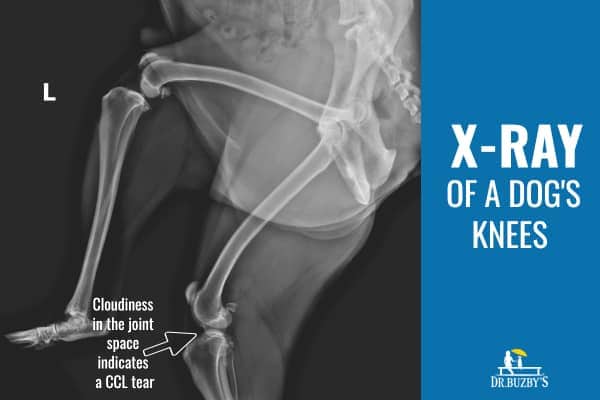
Additionally, veterinarians often try to position both knees on at least one X-ray image. By doing so, the dog’s two legs can be compared. This makes it easier to spot abnormalities in your dog’s knees. The X-ray below is a good example of this…
Also, X-rays can also be beneficial for treatment planning, especially if your veterinarian recommends surgery for your dog.
What are the treatment options for a torn ACL in dogs?
Unfortunately, treatment for a torn ACL is not cut and dry. As you can see from the list below, the number of treatment options are through the roof. Your veterinarian will be your best guide in developing a plan based on your dog’s specific condition. He or she may talk with you about some of these treatment options:
- Five different surgery options (explained below)
- Supplements
- Medications
- Physical therapy
- Rehabilitation
- Acupuncture for dogs
- Laser treatment
- Dog ACL braces (In general, I don’t recommend braces).
Also, treatment options will vary depending on the size of dog and the type of tear (partial versus complete). Next, let’s discuss the differences between a partial and a complete tear.
ACL in dogs: Partial tear versus complete tear
As the cranial cruciate ligament begins to wear down and become more delicate, the ligament continues to deteriorate and the risk for a tear increases.
When your dog runs, walks, jumps, or slips on his or her back legs, weight is put on the ligament. Eventually, it will tear due to these forces. If it tears incompletely, this is called a partial tear. But over time, the tear could continue through the whole ligament. It is now a complete tear, or a rupture.
Additionally, once a dog has a CCL tear in one knee, there is a 25-50% chance that the other knee will tear in the next 12 to 16 months.
Dog ACL tear conservative treatment
In small dogs (less than 15 kg or 33 pounds) who have a comparably small amount of mass to move around, conservative treatment with rest and pain management may be an acceptable approach. Unfortunately, no studies exist that compare this option to others, so it remains up for debate.
In one older study from 1984, less than 20% of dogs over 15 kg had an acceptable outcome when employing conservative management. As a result, surgery is the treatment of choice for most larger dogs.
But which surgery? If you put 10 veterinary orthopedic surgeons in a room, you’ll likely get 11 different opinions! Let’s review five surgical treatment options.
Surgical options for repairing a dog’s ACL
There are several surgical options available for repairing a torn ACL in dogs. Despite what you may read on the internet, none of these is the perfect surgery. (If there were one perfect treatment option, we wouldn’t have several surgical options to choose from.)
Treatment should be tailored to your dog. It is dependent on breed, size, and lifestyle. A large, athletic dog that competes in agility will need a different approach than a couch potato Pug that goes on walks twice a day!
Your veterinarian may discuss one or more of the following surgical treatment options with you:
1. TPLO (tibial plateau leveling osteotomy)
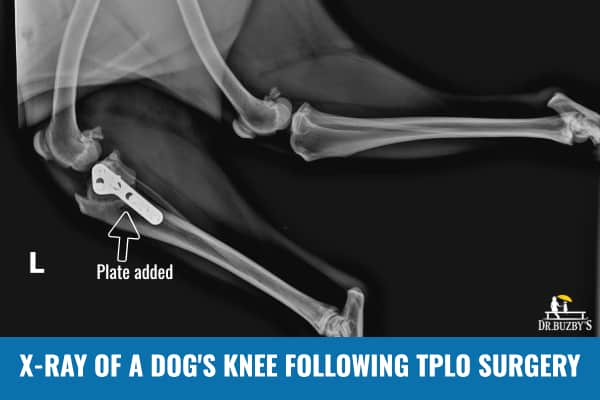
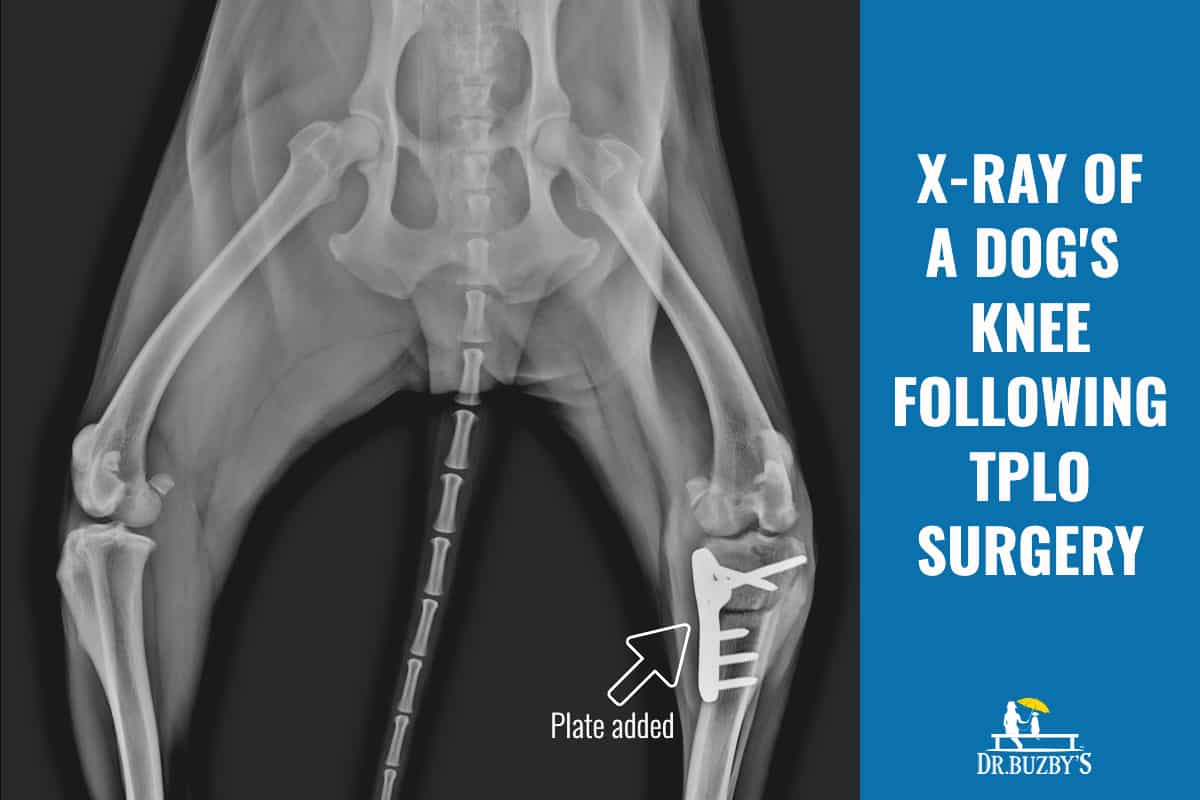
As a veterinary student, I was taught about the tibial plateau leveling osteotomy procedure, which is commonly called TPLO surgery for dogs. In this common procedure, a piece of the tibia is cut, rotated to a specific angle, and reattached with a plate and screws. This changes the dynamics of the knee so that when weight is borne, the tibia doesn’t thrust forward, inherently making the knee more stable.
The X-rays below show a dog’s knee with a plate implanted during a TPLO surgery…
2. TTA (tibial tuberosity advancement)
Like TPLO surgery, TTA surgery involves removing and reattaching a piece (called the tuberosity) of the dog’s tibia in a different orientation. This increases stability in the knee joint, which is lacking the cruciate ligament.
3. aCBLO (anatomic cora-based leveling osteotomy)
As the name indicates, this is another osteotomy (bone cutting) procedure which uses another approach to reduce instability in the dog’s knee.
4. Tightrope® (lateral fabella suture)
Developed as an alternative to the TPLO and TTA, which cut and rearrange the dog’s tibia, this technique uses an implant to create stability.
5. Simitri Stable in Stride
In 2016, the Journal of Veterinary published a study on a very promising new procedure called the Simitri Stable in Stride—an implant placed in the knee that stabilizes the joint. While early results are promising, wide use of this procedure is not common.
Recovery and caring for your dog following ACL surgery
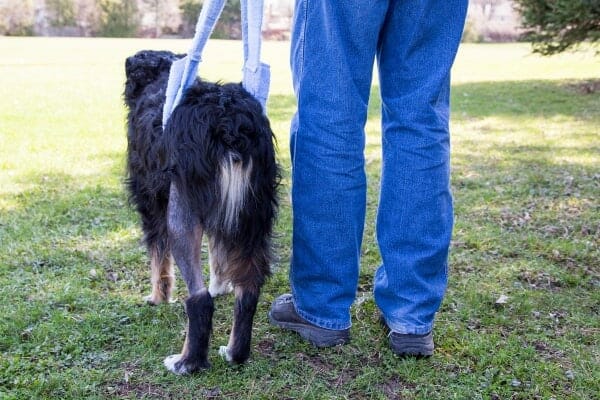
Following surgery, it’s important to follow your veterinarian’s aftercare instructions closely. Your vet may recommend six to eight weeks of strict rest post-operatively for your dog. Also, you may expect to limit your dog’s activity to short leash walks outside to use the bathroom. Your vet may also give strict orders to avoid water activities and getting your dog wet. This would include no bathing, grooming appointments, or swimming.
Post-surgical complications
There are two most common post-surgery complications of stifle repair: infection and re-injury. But the good news is that they are both avoidable.
Infection of the incision
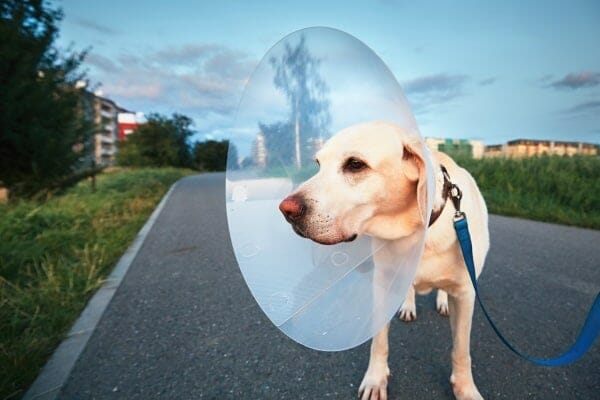
An infection is usually due to a dog chewing and licking at the incision. To avoid this, monitor your canine companion closely and be sure to keep a cone (or E-collar) on him or her.
Re-injury due to too much activity during recovery
Repairs made via surgery can fail or be re-injured if a dog is allowed to be active too soon after surgery. One of my dearest patients had this experience. Though her intentions were pure, the dog’s parent only half-heartedly restricted her activity post TPLO surgery and the plate shifted. The dog spent the rest of her life challenged by this, but her story has a happy ending. You can read it in my article, A Foreshadowed Hope.
How to avoid re-injury
After your dog has made it through surgery and post-op recovery, it is important to avoid a re-injury of the knee. So even after surgery, follow-up visits are necessary to ensure that everything is healing appropriately.
In addition to regular checks by your veterinarian, I often recommend ToeGrips® dog nail grips as an adjunctive therapy for my CCL patients. The non-slip grips fit on a dog’s toenails to reduce slip-and-fall injuries by improving traction on hardwood floors. For one account of how ToeGrips helped a senior dog who suffered a cruciate ligament injury, read ToeGrips for Older Dogs: Bigsby’s Story.
Pain medications and supplements following surgery for a torn ACL in dogs
Another way to avoid complications, is through proper pain management. Post-operative pain medications usually include a non-steroidal anti-inflammatory, like carprofen or deracoxib, as well as gabapentin for dogs and/or tramadol for dogs. It’s important to follow your veterinarian’s instructions to diligently manage pain medication.
Your vet may also discuss adjunctive modalities like laser therapy and acupuncture. Also, in my experience, joint supplements for dogs such as New Zealand deer velvet, glucosamine/chondroitin, and green lipped mussel for dogs are also valuable (although data is lacking on these therapies).
Personally, I recommend Dr. Buzby’s Encore Mobility™ hip and joint supplement for dogs to my clients. With New Zealand deer velvet and green-lipped mussel, it helps maintain and support healthy cartilage and joints. Not only is this vital to the health of the damaged joint, but also it’s vital to the joints of the other hind leg which is compensating.
Save 10% on Encore Mobility™ Joint Supplement for Dogs
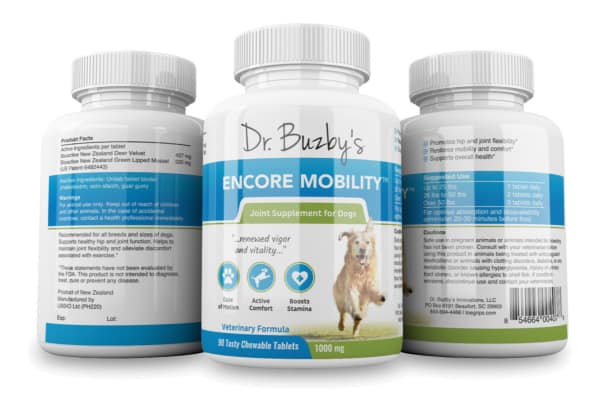
Give your dog more good days.
Use promo code HAPPY to save 10% on Encore Mobility.
Physical therapy following CCL surgery in dogs
In human medicine, it is assumed that rehab or physical therapy will be a part of the recovery process following surgery. Veterinary rehabilitation for dogs is one of the fastest-growing aspects of veterinary medicine. It is now recommended by many veterinary orthopedic surgeons after the initial healing period.
Doggie physical therapy can speed up recovery by building muscle tone and improving strength and balance. There are many different exercises that can be used including some techniques that you can do at home or even the use of an underwater treadmill for dogs.
To learn if rehab is available in your area, you can search the American Association of Rehabilitation Veterinarians’ list of certified rehabilitation practitioners by state.
The rest of Bailey’s story
You may be wondering what happened to my veterinary patient Bailey. X-rays of Bailey’s knees showed cloudiness in the joint space and the tibia looked displaced. In comparison, Bailey’s right knee looked normal. Everything pointed to an ACL tear.
I relayed this information to my client. We had some decisions to make. His senior dog was 13, and surgery in older dogs is no small undertaking.
But, without surgery, Bailey’s body would start to scar over the tear and stabilize the joint by laying down extra bone. He would eventually be able to use the leg again, though it would always be his “Achilles heel,” prone to reinjury. Also, eventually signs of canine arthritis would set in, causing chronic pain and lessening his quality of life.
On top of that, often when one cruciate tears, the other usually follows within a one-year period. If that happened, Bailey would have two bum hind legs. So, the best option was surgery.
My client decided to take Bailey to a board-certified orthopedic surgeon for a consultation and surgery. Bailey’s surgeon elected to repair his cruciate rupture with TPLO surgery, which was a huge success!
This was in large part due to the dedication of Randy. He followed post-op instructions to the letter, including strict rest for six weeks and constant Elizabethan collar wearing. His diligence played a critical role in his dog’s success.
Can ACL tears be prevented?
Finally, one of the hazards of being a conscientious pet parent is a propensity toward “dog parent guilt.” When I diagnosed Bailey, my client wanted to know if he’d inadvertently contributed to the injury or could have prevented it. You may have the same question.
Cranial cruciate ruptures aren’t well understood. The causes are multifactorial, as mentioned above. But one risk factor is known and within your control—obesity in dogs!
In one study, obesity quadrupled the risk of a cranial cruciate tear. Keeping dogs slim and fit is certainly helpful in not only preventing cruciate tears but also in preventing many other disease processes. To learn more about keeping your dog fit, please learn how to assess your dog’s canine body condition score.
Speak with your veterinarian about treatment options for ACL injuries in dogs
As a veterinarian who has practiced for over 25 years, I have seen hundreds upon hundreds of partial and complete ACL tears in dogs. If your dog has been diagnosed with a torn ACL, I want you to know you’re not alone. This is a very common condition in dogs. Thankfully, it’s one for which excellent treatment options exist. Your dog can recover from this injury and go on to lead a happy, active life —running on all four paws.
What questions do you have about a torn ACL in dogs?
Please comment below. We can all learn from each other.


Hi, my 4yr old American PitBull terrior was recently diagnosed with a torn ccl. X rays didn’t reveal but the physical manipulation revealed the tibia moving forward. Our dog unfortunately had been suffering off and on for over a year. Our vet previously failed to diagnose him when in a check up and he wasn’t limping at the time. Our dog is getting more wary of the vet and people he don’t see often as he gets older. He is very active and energetic. Hard to stop him running and jumping. He loves to play rough with the neighbors dog. So we are trying to keep his activity low with meds etc. We have appointment with an orthopedic vet next month. But with covid they take the dog from the parking lot. I don’t know how thats going to work out. And if we do the operation (which we can’t afford) I don’t know if we can keep him off furniture, running to the door and windows, etc. Do you think we should consider a custom brace? I think it might be more manageable for my wife as I’m away at work weekly and she stays home. The dog is quite a handful. 60lbs of pure energetic muscle. Really don’t know what to do because there is so much pros and cons on all treatment options
Hi Thomas, You bring up a lot of great points. I can tell you for sure that I think surgery is the best treatment option for long term success–maximum healing with minimal lameness, but I understand that it’s expensive and may not be possible. With your dog being so active, it’s certainly reasonable to ask the surgeon about oral medications which will help relax him so that he can recover without anxiety or crazy activity. I would also recommend calling your regular vet before the appointment with the specialist. It’s possible that they can prescribe something “to take the edge off” for the appointment with the specialist so that it will go better for all involved. If you do go the brace route, I’d recommend making sure you are working with a vet-recommended, reputable company.
My mini Aussie just had a totally torn CCL on the left rear. I had surgery. She was just 2 weeks out when Vet Tech dropped her and she tore the other CCL in right leg? I have a sling as technically she has no back legs. Is there anything I can do , I am so afraid the unhealed leg will have issues. I take her out on leash with the sling to help support the back legs. I hope she will get use to this, but even this scares me. My dog is super intelligent and loving and its just the two of us.. Please give me your best advice???
Hello Cindy, I’m so sorry to hear that you and your dog have been through all of this! My best advice is to go back to your veterinarian (or ideally, veterinary surgeon) to discuss what you can do, and what you can expect. The sling is a great idea! I love the GingerLead harness and/or the Help Em Up Harness. Please talk to your vet/surgeon about the best way to handle her, the need for future surgery, and appropriate amount of exercise. All my best, Dr. Julie
Dr. Buzby,
I have a 15 year old yorkie that tore her CCL over the weekend. Not really sure how as she doesn’t move around much. Guessing it’s due to her age. She is in CHF and Kidney failure so surgery is not an option, nor NSAIDs. Currently giving pain medication but I was wondering if you had any other suggestions? I just ordered the toe grips for her. She has a lot of arthritis in her back already and has trouble standing. She’s also blind. Shes still a fiesty old gal with lots of life left in her spirit. I’m open to any recommendations you have.
Thanks,
Ashley
Hi Ashley,
So sorry to hear about your Yorkie’s health problems and recent CCL tear. It sounds like she is quite the overcomer and still loving life despite some setbacks, which is fantastic. I am so glad that you are trying out ToeGrips for her and would love to hear how she does with them. We have noticed that many blind dogs become much more confident once they are wearing their ToeGrips so I am hopeful that they will not only help her be more mobile but also more sure of herself. I would also encourage you to put her on Encore Mobility, my deer velvet and green-lipped mussel supplement, because it is safe for dogs with chronic kidney failure and CHF, and could potentially further improve her comfort and mobility. Give your sweet old gal a snuggle for us and let us know if there is anything else we can do to help!
Hello, I’ve read your entire website and am so confused on what to do. I have an 8-year-old mix, we think St. Bernard and boxer, Finn is a big boy weighing in at 82 lbs, but he is lean and quick. He loves to run and I have 2 other dogs. I am most worried about how I will keep him from running (I live on 4 acres) and inside while his brother and sister are allowed outside free. I just don’t know if I can keep him down, he has 3 big cousins as well who visit almost every weekend and we have 6 dogs on the farm. But your website has basically made me feel that a brace is not the answer. My vet told me I have 2 choices, surgery or no surgery but after what I’ve read, I don’t know how I could not have the surgery. But the recovery seems impossible, I also work full time so throw that into the mix. This is hard and gut-wrenching.
Hi Carol,
Being the caretaker and decision maker can be very difficult and you bring up some valid concerns about managing Finn’s recovery. It is clear that you care very much for him and want to do whatever is best for him. He sounds like a great dog, and with 4 acres to run on and lots of doggie friends, he is living the good life! There are no perfect or clear-cut answers to this dilemma, but I do agree with you that surgery would be ideal if there was a way to ensure he was able to remain calm and quiet in the recovery period. Could he go on a “doggie vacation” to a friend or family member’s house where there are not other dogs to play with or land to run on? If he likes food or treats, puzzle toys can be a great way to wear him out mentally while he is recovering physically. Your veterinarian may also be able to recommend some calming medications or supplements and can help you with other practical aspects of his recovery if you do decide to go forward with surgery. Hugs to you and Finn as you struggle with this difficult decision.
Hello!
We have a 22 month old Cattle dog-Shepard mix ( 45 pound) with a partial CCL tear since last week. She is dramatically improved with only a slight limp already….Is this possible with CCL tears? I asked the vet if they would do an arthroscopic eval prior to the actual osteotomy and he said more likely the surgeon would just confirm the diagnosis when he opens the knee in surgery… We do not have an appointment with the surgeon; he is hired by our vet to come to his office to do the procedure. Just worried that she may not actually have a tear!
Thank you very much
Angela
She is scheduled for a TPLO in 3 days.
Hello Angela,
Is her dramatic improvement associated with drugs? Ie. Is she on medications? If so, it may just be “masking” the lameness. I think it’s worth allaying your fears before the day of surgery. I’d suggest reaching out to your veterinarian to ask about a recheck exam. Most likely it’s still the CCL and she’s doing well because it’s just a partial tear, but I don’t know without an exam. However, IF the diagnosis is correct (which I’m guessing it is) then I do think the TPLO surgery is the ideal plan! My best to you both!
My dog had surgery for a torn acl. The surgeon, as part of her treatment, has recommended a post surgery X-Ray. I am concerned since it requires her to be put under anastesia again. What would be the purpose of doing another X-Ray and if there is something that doesn’t look right what would be the done.
Thank you
Hello Jane, are you sure it requires anesthesia for the post-op x-ray? I would ask for clarification on that. But, in general, my advice would be to follow the recommendations of the surgeon. Hopefully it’s all good news! 🙂
Can a injured ACL heal on its own with rest and limited \ controlled activity ?
Hi Janice,
This is a good question and one that we commonly get asked. The answer depends a bit on how you would define “heal”. The ligament cannot repair itself once torn, but scar tissue will form around the joint over time and lend stability to the joint. Thus dogs who have a torn ACL but do not have ACL surgery may be able to use the leg again in time, but that leg will always be weaker and prone to reinjury. These dogs will also have more arthritis in that joint compared to those who had a surgical repair, so surgery is still the preferred option for the best chance at long term functionality and comfort.
Dr. Buzby,
Our 3 yr old GSD has been limping for at least a couple of months on her rt. back leg. She is not bearing weight on it when she is standing, but if she sees a rabbit or other little creature in her yard, she runs out the back door like it isn’t bothering her at all. In the evening, you can really see the limping worsen. Our vet pushed on her knee area and she whimpered a little during the visit and thus the vet said that she suspected a torn meniscus. She also gave us the names of 2 orthopedic vets that do that type of surgery. She said to contact them about what XRay views they needed. I’m confused because all the articles that I have read online mention Xrays and the “drawer test” to diagnosis these serious ligament injuries, but those have not been done yet by our vet. What Xray views do you recommend for diagnosis?
Hi Janine, A torn meniscus and a torn ACL are in the same area anatomically but they are 2 different things. I’m guessing your vet has already done the drawer test and just didn’t mention it. Because this has been going on for months, I would strongly recommend getting to the orthopedic specialist asap. The longer it goes, the more severe the secondary arthritic changes will be to that knee (and the more risk of injury to the other knee) . There are 2 routine views we do of knees, but the evaluation by the specialist will be the critical piece and I’m sure they can just do the xrays there, if they need them, during your appointment. Hope this helps! Please get to the specialist asap. ♥️
Hello my dog is 11 years old the vet took xrays and said that she tore her ACL and to wait two weeks and see if she improves. He recommended surgery but another vet told me to wait 2 to 3 months but I dont want her to damage the other leg instead. I have read your blog about dog braces and I was wondering if you feel like that would be a better option?
Hello Jocelyn, I think it’s important to note that if you get 100 vets in a room and ask their opinion on how to treat something, you may get 105 opinions! 🙂 So here’s mine: IF we are sure there is an ACL tear (which I would diagnose more from manual manipulation than xrays), then 100% I recommend surgery as the treatment of choice. I would not wait around for weeks to see how it goes UNLESS we weren’t sure of the diagnosis…because if it were a less serious soft tissue injury, it would likely heal or begin healing in that time. I think waiting 2-3 months is not responsible if we know it’s an ACL tear. Your dog will be doing much much better in 2-3 months, don’t get me wrong, but there will be permanent damage done to that knee in that time AND, you’re right, major stress placed on the opposite knee. I’d get a 3rd opinion with an orthopedic surgeon at this point. ♥️
Our 1w5 lb 9 year old vet did not recommend surgery die to her age and size and that her ATL is stretched and not torn
We have 13 stairs to our primary living area in our home and are looking for a platform/chair lift, a brace, and long term rest. Sh is used to walking, but we’ve limited for the past 3 months to 20 minutes (not now, just potty trips) She is of course the love of our life and want to do the right option, but we love on a small Oceanside community on WA and do not have therapy choices. She’s on supplements, vitamins, I make her food, Rimadyl 2 x’s day, but her first does it Gabapentin made her vomit
Do agree to not have surgery? She’s a laid back quiet girl, so she’s easy to rest.
Hi Alison,
These decisions are always so difficult to make, especially with a dog that is clearly so dear to your heart. The good news is that if I am reading the first part of your post correctly, your dog is small (15 lbs?), which should work in her favor. CCL damage is much easier to manage in a small dog than a large one because the CCL doesn’t have to support nearly as much weight. It also helps that she is naturally laid back and quiet so she can tolerate rest well and hopefully allow some scar tissue to stabilize her knee without surgery. You could consider ordering some ToeGrips to give her some added traction. I also highly recommend Encore Mobility, a green-lipped mussel and deer velvet supplement, which has worked wonders with many of my patients with orthopedic problems. If you feel like she is not getting around well or is in pain, I urge you to make a follow-up appointment with your veterinarian so the plan can be modified or surgery can be considered.
My vet has examined our 6yo lab Golden mix and determined she had a soft tissue injury, not related to the knee. She prescribed limited movement and ice on the fore hock. How soon can we expect her to get relief from her discomfort?
Hello Pamela, I’m certainly happy it’s just a soft tissue injury and not a ligament tear. HUGELY different healing times and prognosis. I would expect, if the diagnosis is correct, that she’d be doing much better in 1-2 weeks, depending on the severity of the injury. Hopefully by now you’re already seeing that you’re moving in the right direction.