Diabetes insipidus in dogs is a rare condition which may cause excessive thirst and urination. Integrative veterinarian Dr. Julie Buzby explains what it is, signs to watch for, diagnosis, and treatment so you will know how to help and support your beloved pup.

You’ve probably heard of the term diabetes before. When diabetes is mentioned in conversation or in a television commercial, it often conjures thoughts about blood sugar, A1C, or a kindly mustachioed gentleman telling you where you can get your diabetes testing supplies.
However, not all cases of diabetes are the same. Everything listed above relates to diabetes mellitus, the more common and familiar condition that leads to increased blood sugar. So, when you hear people talking about “diabetes,” likely they are referring to diabetes mellitus. You can find more information about diabetes mellitus in my guide to diabetes in dogs.
But did you know there is also another form of diabetes called diabetes insipidus? It affects both dogs and people but has very little to do with blood sugar. Read on to learn more about this distinct type of diabetes.
What is diabetes insipidus in dogs?
Diabetes insipidus is a rare disorder involving antidiuretic hormone (ADH). Affected dogs will either stop producing sufficient ADH or their body will stop responding to ADH. This is a hormone that helps maintain water balance in the body by controlling how much water is lost in the urine. When ADH is released, the body conserves water, producing more concentrated urine.
However, because dogs with diabetes insipidus don’t make or can’t respond to ADH, they lose too much water in their urine. And they cannot conserve water or concentrate their urine appropriately.
Types of diabetes insipidus in dogs
There are two types of diabetes insipidus in dogs.
Central diabetes insipidus (CDI) is when the body is partially or completely deficient in the production and release of ADH. CDI tends to be an acquired disorder.
In nephrogenic diabetes insipidus (NDI), the kidneys do not respond to ADH, no matter how much is present in the body. NDI may be either an acquired or congenital (i.e. present from birth) problem. (As a side note, breeders should not breed dogs with congenital NDI because they could pass it on to the offspring.)
How does ADH affect the body?
Before we can discuss diabetes insipidus in more detail, let’s take a closer look at ADH. As mentioned, ADH helps to regulate water balance in the body. In short, ADH decreases the total amount of water lost through the kidneys, resulting in more concentrated urine. Its function is actually right in its name—anti-diuretic hormone. A diuretic is something that increases water loss, creating large amounts of dilute urine. So a hormone that is “antidiuretic” would have the opposite effect.
ADH comes from the pituitary gland
ADH is a product of the endocrine system. This network of multiple internal organs regulates the body’s metabolism, reproductive system, growth, and other biological processes. The pituitary gland is one of the most important elements of the endocrine system. It is a tiny, bean-shaped gland in the center of the brain that releases various hormones. These hormones are chemical messengers for different parts of the body.

The pituitary gland will release ADH when the water content of the blood is low. It does the same if the concentration of substances, such as salt or glucose, in the blood is too high. These are both situations where the body needs to hold onto water to restore fluid balance in the blood. Additionally, the pituitary may excrete ADH in response to anxiety, pain, or when certain drugs such as phenobarbital are present in the body.
ADH works on the kidneys
ADH binds to cell receptors in the tubules of the kidney. The job of those cells is to filter blood and reabsorb water. The kidneys do need to lose some amount of water to produce urine since it is a liquid. However, the presence of ADH causes special proteins called aquaporins to act like channels that transport water back into the kidney tissues. A healthy kidney cell receptor always responds to ADH in this manner.
What are the causes of diabetes insipidus?
When dogs have nephrogenic diabetes insipidus (NDI), they have normal levels of ADH in their body. However, the portion of the kidneys that concentrates urine cannot respond to ADH. As a result, the urine is dilute. Congenital NDI, where a dog is born with poorly functioning or absent ADH receptors, is extremely rare. Instead, the acquired version of NDI is the more likely culprit. Any of the following can cause NDI:
- Use of steroid (i.e. prednisone for dogs) or diuretic medications
- Infections (e.g. pyelonephritis in dogs or pyometra in dogs) or sepsis (injures the receptors that bind ADH in kidney tissue)
- Cushing’s disease in dogs (may also affect the release or function of ADH)
- Addison’s disease in dogs (causes low sodium in blood which decreases ability to concentrate urine)
- Diets that are deficient in protein
- Electrolyte disturbances—low potassium or hypercalcemia in dogs (elevated calcium) interfere with ADH receptors
- Kidney failure in dogs or liver disease in dogs
Dogs with central diabetes insipidus (CDI) have insufficient amounts of ADH. This results in dilute urine because the kidneys cannot reabsorb water. Since ADH is made and produced at the base of the brain, dogs with head trauma can develop diabetes insipidus. Similarly, dogs with blood clots in the brain and brain tumors in dogs (especially pituitary tumors) can eventually show signs of CDI.
And even though congenital CDI is rare, it is likely that puppies with poor brain development may be born with a malfunctioning pituitary gland.
What are the symptoms of diabetes insipidus in dogs?
As you can imagine based on the function of ADH, increased thirst in dogs and excessive urination are the most common signs of diabetes insipidus. We will look at those two symptoms in more detail soon, but first, it is important to understand the list of symptoms as a whole.
Overall, the symptoms of diabetes insipidus in dogs include:
- Significant increase in water consumption—It may feel like you are filling the water bowl every time you turn around or your dog is constantly drinking water. His or her thirst may seem insatiable.
- Significant increase in urine volume—Your dog may be asking to go outside more frequently and then will urinate for a much longer time than normal.
- Dilute urine—The stream of urine may look almost clear rather than yellowish.
- Accidents in the house or urinary incontinence in dogs—Due to the massive amount of urine he or she is producing, your dog may have accidents in the house if he or she can’t hold it anymore. Or your dog may dribble urine when resting or sleeping because the bladder is so full.
- Lack of appetite—Your dog may not be eating as well as usual.
- Weight loss—Sometimes you may notice your dog getting a bit thinner.
- Being a lethargic dog—Your dog may want to lay around or sleep rather than participating in his or her normal activities.
- Dehydrated appearance—Despite drinking a lot, your dog’s gums may be a bit dry or sticky or his or her eyes may appear slightly sunken. These are signs of dehydration.
Increased thirst and urination
Since increased thirst and urination are the primary signs of diabetes insipidus, let’s take a closer look at what this really means.
Dogs may vary a bit in how much they drink and urinate on any given day. In general, a dog who is consistently drinking more than 90 to 100 milliliters per kilogram of body weight per day is drinking too much. Similarly, a dog whose urination output is more than 50 milliliters per kilogram of body weight is urinating too much.
So as an example, if your dog weighs about 50 pounds, and he or she drinks more than two liters in a day or urinates more than one liter in a day, this may be cause for concern.
It doesn’t automatically mean your dog has diabetes insipidus, though. Many conditions can cause polyuria (i.e. increased urination) and polydipsia (i.e. increased drinking).
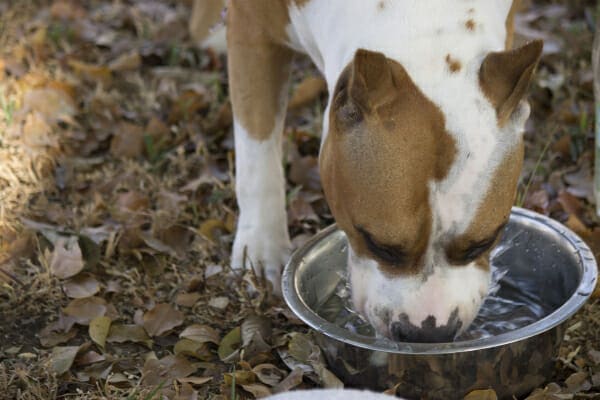
Safety note: If your dog does have polyuria and polydipsia, it is important to avoid limiting access to water. If water is only provided in small amounts, it can lead to elevated sodium levels in the blood (i.e. hypernatremia in dogs). This salt toxicity can cause neurologic signs such as depression, stumbling when walking, or may even lead to a coma.
How is diabetes insipidus diagnosed?
To reach a diagnosis of diabetes insipidus, your veterinarian may recommend several tests. Some of them can help rule out other conditions with similar symptoms. Others are useful for confirming the dog has diabetes insipidus.
Blood tests and urinalysis
Often, the vet will start with blood tests for dogs such as a complete blood cell count, blood chemistry, and electrolyte measurement. Plus, he or she may recommend a urinalysis.
Your vet may also want to submit a urine culture if he or she suspects a UTI in dogs. Or sometimes your dog may need specialized blood tests to confirm a diagnosis of Cushing’s disease or Addison’s disease.
Urine specific gravity
Your vet will also look at your dog’s urine specific gravity, which is part of a complete urinalysis. Also known as “spec grav” or USG, urine specific gravity measures the concentration of particles in urine.
Water has a specific gravity of 1.000. The higher the number, the more concentrated the urine ( i.e. 1.040 is more concentrated than 1.025). Normal urine concentrations are usually around 1.035 or higher while USGs below 1.012 are pretty dilute. Any USG below 1.008 is highly suggestive of diabetes insipidus.
Since concentrations can vary throughout the day, it is always best to use the first urine sample of the day when evaluating USG. Samples collected in the middle or end of the day are almost always more dilute. Your vet may recommend repeating a USG with first morning urine to make sure that the reading is accurate.
Modified water deprivation test
Veterinarians used to perform the modified water deprivation test to help diagnose diabetes insipidus. The test involves a gradual reduction of water intake over a four day time period. Then water is withheld and the veterinary team carefully monitors USG, hydration status, body weight, and other parameters.
If the dog demonstrates he or she can concentrate the urine to a USG of 1.030 or higher, this rules out diabetes insipidus. If not, diabetes insipidus is likely.
However, this test has fallen out of favor with some vets. Limiting the water intake of a dog with CDI or NDI can cause terrible neurologic signs due to rising levels of sodium in the blood.
Desmopressin trial
Some veterinarians will skip the water deprivation test and go straight to treating with a medication called desmopressin, which mimics the actions of ADH.
With a desmopressin trial, the dog parent measures water intake for three days to establish a baseline. The dog parent will also collect urine at the same time every day. Then the dog will start receiving desmopressin. The dog parents will continue to measure water intake and collect urine samples. The veterinarian will analyze the USG, and sodium, glucose, and urea concentrations in the urine.
Patients with CDI usually show dramatic improvement in water consumption and urine concentration. However, since NDI patients have problems with the ADH receptor function, desmopressin won’t help.
What is the treatment for diabetes insipidus?
After reaching a diagnosis, your vet will develop a treatment plan based on the type of diabetes insipidus your dog has and your dog’s symptom severeity.
Treatment for nephrogenic diabetes insipidus (NDI)
There is no definitive treatment for congenital NDI. Treatment for acquired NDI focuses on addressing the underlying cause. For example, if the vet treats a kidney infection quickly and aggressively, the kidney tissue can become healthy again and may start responding to ADH.
Most NDI patients may not respond to therapy. But thiazide diuretic medications such as hydrochlorothiazide or chlorothiazide may help decrease urine amounts. It sounds counterintuitive to treat diabetes insipidus with a diuretic. However, it is effective in some cases because it helps the kidneys retain more water independent of the action of ADH.
Treatment for central diabetes insipidus (CDI)
Dogs with partial CDI (i.e. lower ADH production than normal) may make enough ADH that they do not need specific treatment. Having some ADH may make their clinical symptoms more manageable compared to dogs with complete CDI.
Otherwise, the main treatment of CDI is desmopressin acetate, a synthetic version of ADH. It is available in a liquid form which you can put into your dog’s nostrils or under his or her eyelids. Oral tablets are also available if these methods prove difficult to pursue long term. Most dogs respond well to this therapy.
Note: It is not required you treat CDI. Some dogs can do fine without treatment as long as they always have free access to water and can get outside to urinate (or use a pee pad or litter box) whenever they need to.
Low sodium diet and unrestricted water access
Additionally, as part of the treatment of diabetes insipidus (NDI or CDI), it is important to feed a low-sodium diet and to avoid treats that provide excess salt like rawhide treats.
It is also extremely important that no one withholds water from your dog. This could be very dangerous for your canine companion.
What is the life expectancy for dogs with diabetes insipidus?
If your dog’s NDI is the reversible type, it should not significantly impact your dog’s life expectancy. However, dogs with irreversible NDI often have a worse outlook than dogs with CDI. This is because NDI is more difficult to treat since these dogs don’t respond to desmopressin. The underlying cause of the NDI can also impact life expectancy. Some of the conditions on the list are more treatable than others.
While CDI is typically not reversible, these dogs may still have a good prognosis with desmopressin therapy and other management options. The exception to this is dogs who have CDI due to a pituitary tumor.
No matter whether your dog has NDI or CDI, you can help him or her by always providing access to fresh water. You should also give him or her lots of chances to go outside to urinate. Monitor your pup closely, paying special attention to water intake, and ensure that you report any changes to your vet promptly.
Sometimes dog parents may wonder about the connection between diabetes mellitus and other conditions like Cushing’s disease or diabetes mellitus. If this sounds like you, keep reading to find out the answers.
Diabetes insipidus and Cushing’s disease in dogs
Dogs with Cushing’s disease (i.e. an over production of steroid hormones) can present with symptoms that are very similar to diabetes insipidus. This includes an increase in thirst and an increase in urination. Some dogs with these symptoms just have Cushing’s disease.
However, it is possible for diabetes insipidus to occur secondary to Cushing’s disease. The elevated levels of steroids can interfere with the release of ADH from the pituitary gland. Also, excess steroids in the blood can interfere with how ADH binds at the receptors in the kidneys.
The good news is that getting a dog’s Cushing’s disease under control may help improve the signs associated with diabetes insipidus.
Diabetes insipidus vs. diabetes mellitus
On the other hand, diabetes insipidus and diabetes mellitus are two unrelated conditions that are unlikely to happen at the same time. They primarily share the first name “diabetes” and the common clinical signs of increased thirst and urination.
Diabetes mellitus (diabetes in dogs) occurs when the dog’s body either doesn’t make enough insulin or doesn’t respond correctly to insulin. This causes abnormally high levels of glucose (i.e. sugar) in the dog’s blood because insulin’s job is to cause the cells to take up glucose from the blood. It is still an endocrine disease, but the deficiency is in a different hormone with a different function.
Interestingly, the names for the two types of diabetes came from how the urine tastes (not that I am advocating you taste your dog’s urine). The term mellitus comes from the Latin word for “sweet.” This makes sense since dogs with diabetes mellitus typically have elevated levels of glucose (i.e. sugar) in their blood or urine.
The term insipidus is the Latin word for “tasteless” or insipid. Because the urine of dogs with ADH is very dilute, it is practically like water, which doesn’t have much of a taste.
Final thoughts on diabetes insipidus in dogs
Diabetes insipidus can be an incredibly frustrating illness for everyone. It is hard to watch your furry friend do nothing but drink and drink! If you notice these signs, ensure you get your pup to his or her vet. If you have time before the appointment, try to determine how much your dog is drinking. And consider bringing a first morning urine sample in to the appointment so your vet can check the USG.
Finally, and I can’t stress this enough, ensure your dog has free access to water all the time.
Together, you and your vet can get to the bottom of the increased thirst and urination. If the answer is diabetes insipidus, hopefully some medications and/or management changes can help get your dog’s face out of the water dish and back into enjoying time with you! But even if your dog doesn’t respond well to treatment, you can still make some good memories together.
Do you have a dog with diabetes insipidus?
Please comment below.


My 6 year old dog was recently diagnosed with diabetes insipidus & placed on desmopressin after spending the night at the hospital for dehydration.. She appeared to be fine, although lethargic, the first day back. By the second day she was refusing to get up without us lifting her to a standing position, refusing to eat & drink water. Fearing dehydration again we returned to the ER. After having an MRI, a pituitary mass was confirmed. The neurologist recommends radiation which is in the range of $10-12K & cannot say if it will extend her life or increase her quality of life. If left untreated, without radiation, do u think steroids can help with her discomfort? I just do not want her to suffer and am taking her to a holistic/ herbal vet to explore alternative options. Just wondering what your opinion is. Thank u.
Hi Laura,
I am so sorry your pup is dealing with this tragic disease. Without examining her myself, I can’t say for sure if steroids would be of any help. I think it is wonderful you are taking your pup to a holistic vet. I am hopeful they will have some great ideas about how to best restore your sweet girl’s quality of life. Praying for a positive outcome. Feel free to leave an update if you have a chance.
We adopted a 10 yr old male chihuahua from a shelter 5 wks ago. Initial testing two days ago indicates diabetes insipidus. A water deprivation test is scheduled for next week. They will keep him from 8:00;am until their office closes. I can’t bear to think of his being in that much discomfort for that long. Why can’t we just try the Desmopressin instead? Note: We have four other rescues. Which makes measuring water intake and collecting urine output from one dog nearly impossible. . Thank you.
Mary Visco
Hi Mary,
I understand your concern for your sweet boy and his scheduled testing. Without having a personal role in your dog’s medical care, it is hard to say for sure why certain decisions are being made. You always have the choice to decline recommendations for treatments and testing. Sometimes getting a second opinion can be helpful as well. How did things go? Were your dog’s results conclusive? Hoping all is well and you have a clear path forward. Feel free to leave an update if you have a chance.
Our 11-year-old Chihuahua was diagnosed with Diabetes about 4 months ago. His blood sugar was over 500, probably for a while. In the previous months his liver was 3 times bigger than it should have been, for which he takes Denamarin daily. His liver shrank, but then the diabetes was discovered. He was doing okay other than developing cataracts which seemed to get worse overnight. He was on 4 units of insulin, but after a curve the amount was reduced to 3 units. He weighs 7.4 pounds now but was 2 pounds heavier at the time of diagnosis. A day and a half later his blood sugar was found to be low, 59 at the vet office. 2 doses later his glucose urine test remained low. I called the vet & was told to decrease his insulin to 2 units. A few hours after eating and his insulin dose last night his blood sugar was low again. Does it take time for the insulin dose to regulate for more stable readings? I gave him two mini milk bones & a drip of honey. This morning two hours after breakfast a urine strip test revealed approximately 350-375, If the low blood sugar continues to happen & I decide to lower his dose to 1 unit, am I jumping the gun? Does it take time or is it a clean slate with each dose. The learning curve is real!
Hi Lisa,
I understand your concern with these low blood sugar episodes in your senior boy. Diabetes is such a tough disease and getting it well-regulated can be tricky and take some time. Without examining your dog myself, I can’t make specific recommendations on how to adjust his insulin dosage. In general, it is much more dangerous for blood sugar to be too low rather than too high. It would be best to discuss these issues with your vet and have them guide you through the dosage change. If you are in a situation where you cannot talk to your vet, I think it is best to err on the side of caution and give less insulin. Giving less will prevent a hypoglycemic crisis. You can always give more insulin if needed, but if you give too much there is no way to take it back. I hope that makes sense. How is your little guy today? Hoping all is well and this will work itself out quickly. Wishing you both the best of luck!
I recently adopted a puppy that we now know has diabetes insipitus. He is not responding to the medication and his symptoms are the same. I’m heartbroken because he is an amazing dog but with two young children I just don’t think I can give him the care he needs. I’m struggling over here.
Hi Christina,
I am sorry your puppy has received such a difficult diagnosis. I understand the burden this must have placed on your shoulders, and it may be time to make some tough decisions. To find out if this pup has a chance to recover from his condition, he may need to see an internal medicine specialist. It would not be wrong to rehome him or find a rescue to take him if this is too much for your family to endure. Also, if he truly cannot respond to treatment, euthanasia may be the most loving option and the only way to prevent unnecessary suffering. My heart goes out to you during this difficult time. Bless you and your family.
Hi Dr. Buzby,
Our 10 year old Australian Cattle Dog was officially diagnosed with CNDI at 9 weeks of age and has been on hydrochlorothiazide ever since. We have been extremely lucky and every year when we take him for his annual vet appointment his lab results have been great. We are vigilant with his low sodium diet and access to water. Recently he has developed cataracts and subsequent visual impairment. A few days ago he stumbled and fell in our pool, which he has always spent a lot of time in and can easily navigate to the exits, however in the tumble he lifted a nail from the nail bed. We took him to his vet and he was put on antibiotics and tramadol for the pain. We had tramadol in the house as he has previously taken it for a leg injury, as in true cattle dog fashion not even injury has ever slowed him down, so the night prior to the appointment with his vet we gave him a dose at his previously prescribed dose. That evening he has 2 accidents in the house, which hasn’t happened in several years. He then also had an accident at the vets office, which I didn’t think much of at the time as he is a big nervous baby at the vets office, but since then the symptoms have worsened. His polyuria and polydipsia are the worst I have seen since before his diagnosis. I found on article online in humans that showed some correlation between tramadol and NDI. We have called the vet and he has an appointment Monday morning when they open and we are just watching him closely, ensuring his access to water, encouraging food despite his lack of interest, and have stopped the tramadol. Have you seen this kind of an interaction with NDI and tramadol before? If so could his current age be why he is having issues with it this time when he had previously taken it with no problems?
Hi Megan,
Wow, your boy is definitely a unique and complicated case. I have never personally seen an adverse interaction between tramadol and hydrochlorothiazide. Like you, I did some research and found it mentioned a couple times in human medicine but did not find any reference to it in veterinary medicine literature. With that being said, it makes me highly suspicious, and I am glad you have an appointment to have your dog evaluated by your vet. I hope your senior guy is feeling better and stable. Praying you received good news from your vet and are able to find a treatment that works well for your sweet boy. Feel free to leave an update if you have time. Best wishes!
Hi Dr Buzby, I just wanted to give you an update on Leo. After stopping the tramadol he returned to his normal self within 48 hours and his labs all are returning to his baseline as well.
Hi Megan,
Thank you so much for the update. I have had my eyes opened from your experience and will carry it with me as I continue to practice veterinary medicine! I am glad Leo is feeling better and his lab results are improving. I really appreciate you taking time to help us all learn something that could be very valuable for other dogs in the future.
Is there any chance that Optimmune could cause DI?
Hi Wendy,
I am not aware of any issues with Optimmune causing Diabetes Insipidus. Just to be sure I did some extra research, and I did not find any cases mentioned in the literature or research articles.
My 10 year old dog has recently developed excessive thirst and urination problems. All bloodwork was fine except for a slightly elevated Alkaline Phosphatase. Very low SG of about 1.004, I think. Vet did dexamethasone test which ruled out Cushings. We just started measuring water intake and it is alarming. He is drinking 20 cups of water in a 24 hour period. Vet thinks maybe he is reacting to the death of his sister 3 months ago since they were litter mates and always had been together but has mentioned desmopressin as a possible treatment. Any thoughts on what to do would be appreciated!
Hi Mary,
I am sorry you lost your girl pup 3 months ago and now your boy is struggling so much. Since I haven’t examined him personally, I can’t make specific recommendations. It does sound like he is a complicated case, and it could take some time and extra tests to get answers. It might be a good idea to get a referral to a veterinary internal medicine specialist. Many times, they have access to testing and treatments that could be cost prohibitive in a general practice setting. I hope you can find the help your sweet boy needs. Best wishes for happy days ahead to keep making memories together.
Hi Dr. Buzby,
I am fostering a dog (they think between 4-6 yrs old) who is blind and began the desmopressin drops today. His USG was 1.002 today before the drops and 2 hours later it is up to 1.012. Could he be blind because of DI or are the 2 unrelated? Could being blind have caused the DI (head trauma from walking into things)? Is there a way to rule out a tumor without a scan?
Thank you SO much for any info./advice 🙂
Tara
Hi Tara,
These are all good questions! To my knowledge, DI does not cause blindness. That being said, if there is a tumor or previous head trauma that caused the DI it may have caused the blindness as well. I wouldn’t think your dog would bump into things with enough force to cause the level of trauma needed to induce DI. Usually, the force needed to cause this level of head trauma would require a major event such as being hit by a car. The only way to definitely rule out a tumor is with advanced imaging techniques such as MRI, CT, or possibly x-rays. I hope your foster boy continues to respond to the desmopressin. Best wishes to you and keep us updated!
If my dog is on Desmopressin tablets for Diabetes Insipidus and has been taking tablets 2 times a day and now I just spotted light blood in her urine does that mean the UTI or whatever is over riding the Desmopressin tablets? She has been peeing a lot today even while taking the Desmopressin tablets.
Hi Vanessa,
I am glad you caught these changes early and recommend you call your vet and let them know about the blood. Without a urinalysis or some lab work, it is hard to say for certain what the cause of your dog’s increased urination could be. A UTI is possible! I hope you find the answers you are looking for. Good luck to you and your sweet girl.
Our lab is 8 years old and we have been treating him with desmopressin since about 4 months of age. He has always drank a lot of water and peed a LOT. Never killed the grass.
We were told last week that he has kidney failure even though he is acting the same as always.. The vet said his creatinine level was 4.4 . Trying to find out if dogs with NDI would have high creatinine levels. Wondering if the desmopressin has not been helping and he has always had NDI and not CDI. Maybe this kidney thing is new and I am just in denial?
Any suggestions for testing, treatment?
Hi Mary,
These are great questions. I am glad to hear your Lab has done so well with the desmopressin for the past 8 years! The fact that your dog responded to the desmopressin confirms CDI. NDI causes the kidneys to stop responding to anti-diuretic hormone (ADH) and desmopressin mimics ADH. Dogs with CDI do not produce enough ADH on their own, which is why supplementation with desmopressin corrects the problem. Unfortunately, NDI does not cause high creatinine levels. I am afraid it does sound like he may have a new kidney issue. The good news is there are medication options to help with kidney function depending on what stage of kidney failure your boy is experiencing. Since I haven’t personally examined your dog, I really can’t make specific recommendations. It sounds like your vet has done a great job staying on top of things. I think it would be a good idea to talk to your vet about your concerns and see what plan you can come up with together. I hope you can find a treatment option that is a perfect fit for you and your Lab. Best wishes as you navigate this new journey!
My dog was tentatively diagnosed with cmvi in mid 2019, after abdominal surgery which revealed 2 adrenal nasses, that were presumed to be benign adenomas after a year & 1/2. However, almost immediately following surgery to remove a ruptured liver tumor with hemoabdomen, where the gall bladder & spleen were also removed with approx. 3 liver lobes, in aboutv1 month, my dog began to show classic signs of Cushings Disease/syndrome-while still in the hospital after surgery, for that week, she was consuming huge amounts of water, with polyuria, and to avoid a feeding tube, I was allowed in to coax her to eat, and she gradually began eating a little can food. The polyphagia onset was about a month after surgery. Fast forward to her 6 month checkups, and the 3rd year residents & faculty/staff vets all postulated diabetes insipidus from cystocentesis, and after 1st urine in the a.m.’s, her urine was consistently dilute, and for just shy of three full years, she woke me every hour and 1/2 to 2 hours to go out. The Covid shut down in my area, caused all of the reachable teaching hospitals to shut down between March & September of 2020. She was due for 6 month checkup when everything shut down except for emergencies, andcso in the meantime, I discovered an endocrine department a little further away, and they chose to repeat a third test to rule out Cushings after a negative ACTH, and a negative Dezamethasone Suppression Test, by repeating another DST & a UCCR, which was apparently prompting the endocrinologist to repeat a UCCR, even though she knew & I understood that test was not meant to be a stand alone test to confirm Cushings.
The adrenal tumors were very visible, & being measured for any signs of a cancer spread.
In October of ’20, she was moved to stage III cmvi, and prescribed pimobendan (which she did not tolerate). I began to see what I now know was signs of belowcaverage oxygenation in April of ’21, and her chart said to return her for echo in April or sooner for another echo. They were overbooked, and did not put her on the schedule until April. Her stamina gradually began to plunge, and her heart had become more enlarged from 10/20 to 6/’21. We were awaiting insurance reimbursement to do another workup, she began to have many changes & was suffering – the private urgent care vet took all of my resources to put her in an oxygen tent, do abdominal u/s, and chest X-Rays for two overnights. The 1st overnight doc thought shecwas showing signs of chf, so he treated her with Lasix, and the second day, the cardiologist from the University called and said he agreed that there was no chf yet, but that her heart had enlarged per above, and that the IM doctor also ruled out chf the second day, same private facility. Since my dog did not tolerate pimobendan, and the Lasix RX was not given, nor the other RX drugs used in canine chf, and Ibwas continuing to see urine so clear that it had the appearance of tap H2O, from May ’19, until I lost my beloved pet at age 14, 3 months later. She never got treated, nor the PU/PD further investigated. I had been very diligent about trying to make up for the time we lost during Covid shutdowns, and scheduling delays, but needed to be reimbursed before we could further pursue the Cushings syndrome, & possible relationship to suspected diabetes insipidus at a different teaching hospital, and imagine that the Covid shutdown backed ne into a terrible time crunch, along with a difference of opinion between the endocrinology group. No one stopped saying that any neoplasm may be playing a role, as to why she continued to be mildly anemic her last 2 years, approx., but when she tragically passed, I felt to have closure, that I needed a Necropsy. No cancer, cause of death right ventricular failure, and notable, “punctate nodules” throughout the surface of the mucosal membranes of the bladder.
I had so nany questions about how they would put her on meds. for heart failure, which she slid right into in June ’21, and do a trial of desmopressin, or the other ways to test for
CDI/NDI, (since specific gravity varies) and why the endocrine dept. said if it was Cushings, it would be pituitary dependent when she had bilateral adrenal tumors (to which pathologist attributed in the affirmative, the probable increased cortisol and corticosteroid production). I have been absolutely devastated, and my head was in a frenzy trying to figure out her advanced chf &/or enlarged heart, signs I f hypoxia, and letdown of how all these variables could or would be addressed; whenever I look up the term “punctate nodules on the bladder, surface of mucosae”, bladder cancer & cystitis, chronic units, and reading about the urine cultures, possible cystoscopy, and other things that need to be pursued to prevent dehydration & loss of electrolyte balance. Another non-practicing vet/endocrinologist wrote a three part article to help vets confirm Cushings, which is very clear that itbis highly unlikely that dogs with adenomas or other adrenal nasses, will result in a positive LDDS test, and it is very, very frustrating to watch my dog decline without any treatment, for chest pain or discomfort, bladder pain or discomfort, and elevated BP with no med. to empirically treat her Cushings syndrome, andcall the $$$ I spent to try and help her get the right treatment & still she suffered, and Ibwas unable to even give her death with dignity and/or know when to say when, with a humane euthanasia. If you would be able to to speak hypothetically to this, and what type of thorough diagnostic & treatment approaches would be appropriate in say, another living dog, to try and accomplish some plan to relieve the dog’s suffering, I would so appreciate it. I need to find closure – my dogvlived to 14, an Aussie/BC mix, that was with me from 10 weeks to 14 years. Thank you kindly for any feedback. With a pharmacy background, I was wondering if these conditions could have even been treated with recommended meds., concomitantly, without inducing an untimely death. Please know I am not passing judgment in the big picture, just that I invested in humane treatment & diagnostics to provide relief for my beloved pet, and it continued to elude us. Thank You
Dear Aileen,
It sounds like you have been through a very difficult journey over the last couple of years. I am sorry you lost your sweet girl in such a tragic way. Her case sounds very complicated and involved. Since I never had the opportunity to examine your dog myself, it is difficult to make conclusions or recommendations and sort out all the variables. I feel it is safe to say you did everything you could, and I am sure your girl knew how much she was loved. Try not to carry around the burden of all the “what ifs”. I pray with time your heart will heal. May her memory be a blessing.