Diabetes insipidus in dogs is a rare condition which may cause excessive thirst and urination. Integrative veterinarian Dr. Julie Buzby explains what it is, signs to watch for, diagnosis, and treatment so you will know how to help and support your beloved pup.

You’ve probably heard of the term diabetes before. When diabetes is mentioned in conversation or in a television commercial, it often conjures thoughts about blood sugar, A1C, or a kindly mustachioed gentleman telling you where you can get your diabetes testing supplies.
However, not all cases of diabetes are the same. Everything listed above relates to diabetes mellitus, the more common and familiar condition that leads to increased blood sugar. So, when you hear people talking about “diabetes,” likely they are referring to diabetes mellitus. You can find more information about diabetes mellitus in my guide to diabetes in dogs.
But did you know there is also another form of diabetes called diabetes insipidus? It affects both dogs and people but has very little to do with blood sugar. Read on to learn more about this distinct type of diabetes.
What is diabetes insipidus in dogs?
Diabetes insipidus is a rare disorder involving antidiuretic hormone (ADH). Affected dogs will either stop producing sufficient ADH or their body will stop responding to ADH. This is a hormone that helps maintain water balance in the body by controlling how much water is lost in the urine. When ADH is released, the body conserves water, producing more concentrated urine.
However, because dogs with diabetes insipidus don’t make or can’t respond to ADH, they lose too much water in their urine. And they cannot conserve water or concentrate their urine appropriately.
Types of diabetes insipidus in dogs
There are two types of diabetes insipidus in dogs.
Central diabetes insipidus (CDI) is when the body is partially or completely deficient in the production and release of ADH. CDI tends to be an acquired disorder.
In nephrogenic diabetes insipidus (NDI), the kidneys do not respond to ADH, no matter how much is present in the body. NDI may be either an acquired or congenital (i.e. present from birth) problem. (As a side note, breeders should not breed dogs with congenital NDI because they could pass it on to the offspring.)
How does ADH affect the body?
Before we can discuss diabetes insipidus in more detail, let’s take a closer look at ADH. As mentioned, ADH helps to regulate water balance in the body. In short, ADH decreases the total amount of water lost through the kidneys, resulting in more concentrated urine. Its function is actually right in its name—anti-diuretic hormone. A diuretic is something that increases water loss, creating large amounts of dilute urine. So a hormone that is “antidiuretic” would have the opposite effect.
ADH comes from the pituitary gland
ADH is a product of the endocrine system. This network of multiple internal organs regulates the body’s metabolism, reproductive system, growth, and other biological processes. The pituitary gland is one of the most important elements of the endocrine system. It is a tiny, bean-shaped gland in the center of the brain that releases various hormones. These hormones are chemical messengers for different parts of the body.

The pituitary gland will release ADH when the water content of the blood is low. It does the same if the concentration of substances, such as salt or glucose, in the blood is too high. These are both situations where the body needs to hold onto water to restore fluid balance in the blood. Additionally, the pituitary may excrete ADH in response to anxiety, pain, or when certain drugs such as phenobarbital are present in the body.
ADH works on the kidneys
ADH binds to cell receptors in the tubules of the kidney. The job of those cells is to filter blood and reabsorb water. The kidneys do need to lose some amount of water to produce urine since it is a liquid. However, the presence of ADH causes special proteins called aquaporins to act like channels that transport water back into the kidney tissues. A healthy kidney cell receptor always responds to ADH in this manner.
What are the causes of diabetes insipidus?
When dogs have nephrogenic diabetes insipidus (NDI), they have normal levels of ADH in their body. However, the portion of the kidneys that concentrates urine cannot respond to ADH. As a result, the urine is dilute. Congenital NDI, where a dog is born with poorly functioning or absent ADH receptors, is extremely rare. Instead, the acquired version of NDI is the more likely culprit. Any of the following can cause NDI:
- Use of steroid (i.e. prednisone for dogs) or diuretic medications
- Infections (e.g. pyelonephritis in dogs or pyometra in dogs) or sepsis (injures the receptors that bind ADH in kidney tissue)
- Cushing’s disease in dogs (may also affect the release or function of ADH)
- Addison’s disease in dogs (causes low sodium in blood which decreases ability to concentrate urine)
- Diets that are deficient in protein
- Electrolyte disturbances—low potassium or hypercalcemia in dogs (elevated calcium) interfere with ADH receptors
- Kidney failure in dogs or liver disease in dogs
Dogs with central diabetes insipidus (CDI) have insufficient amounts of ADH. This results in dilute urine because the kidneys cannot reabsorb water. Since ADH is made and produced at the base of the brain, dogs with head trauma can develop diabetes insipidus. Similarly, dogs with blood clots in the brain and brain tumors in dogs (especially pituitary tumors) can eventually show signs of CDI.
And even though congenital CDI is rare, it is likely that puppies with poor brain development may be born with a malfunctioning pituitary gland.
What are the symptoms of diabetes insipidus in dogs?
As you can imagine based on the function of ADH, increased thirst in dogs and excessive urination are the most common signs of diabetes insipidus. We will look at those two symptoms in more detail soon, but first, it is important to understand the list of symptoms as a whole.
Overall, the symptoms of diabetes insipidus in dogs include:
- Significant increase in water consumption—It may feel like you are filling the water bowl every time you turn around or your dog is constantly drinking water. His or her thirst may seem insatiable.
- Significant increase in urine volume—Your dog may be asking to go outside more frequently and then will urinate for a much longer time than normal.
- Dilute urine—The stream of urine may look almost clear rather than yellowish.
- Accidents in the house or urinary incontinence in dogs—Due to the massive amount of urine he or she is producing, your dog may have accidents in the house if he or she can’t hold it anymore. Or your dog may dribble urine when resting or sleeping because the bladder is so full.
- Lack of appetite—Your dog may not be eating as well as usual.
- Weight loss—Sometimes you may notice your dog getting a bit thinner.
- Being a lethargic dog—Your dog may want to lay around or sleep rather than participating in his or her normal activities.
- Dehydrated appearance—Despite drinking a lot, your dog’s gums may be a bit dry or sticky or his or her eyes may appear slightly sunken. These are signs of dehydration.
Increased thirst and urination
Since increased thirst and urination are the primary signs of diabetes insipidus, let’s take a closer look at what this really means.
Dogs may vary a bit in how much they drink and urinate on any given day. In general, a dog who is consistently drinking more than 90 to 100 milliliters per kilogram of body weight per day is drinking too much. Similarly, a dog whose urination output is more than 50 milliliters per kilogram of body weight is urinating too much.
So as an example, if your dog weighs about 50 pounds, and he or she drinks more than two liters in a day or urinates more than one liter in a day, this may be cause for concern.
It doesn’t automatically mean your dog has diabetes insipidus, though. Many conditions can cause polyuria (i.e. increased urination) and polydipsia (i.e. increased drinking).
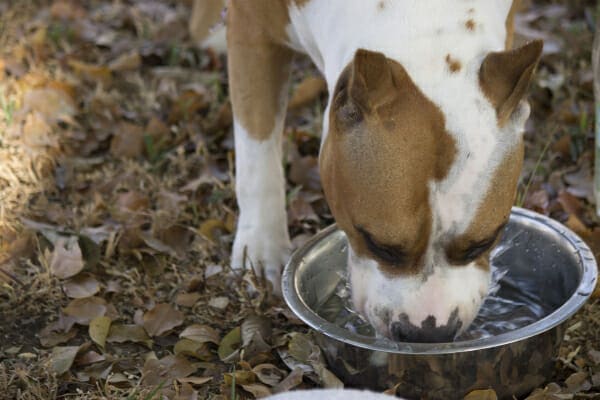
Safety note: If your dog does have polyuria and polydipsia, it is important to avoid limiting access to water. If water is only provided in small amounts, it can lead to elevated sodium levels in the blood (i.e. hypernatremia in dogs). This salt toxicity can cause neurologic signs such as depression, stumbling when walking, or may even lead to a coma.
How is diabetes insipidus diagnosed?
To reach a diagnosis of diabetes insipidus, your veterinarian may recommend several tests. Some of them can help rule out other conditions with similar symptoms. Others are useful for confirming the dog has diabetes insipidus.
Blood tests and urinalysis
Often, the vet will start with blood tests for dogs such as a complete blood cell count, blood chemistry, and electrolyte measurement. Plus, he or she may recommend a urinalysis.
Your vet may also want to submit a urine culture if he or she suspects a UTI in dogs. Or sometimes your dog may need specialized blood tests to confirm a diagnosis of Cushing’s disease or Addison’s disease.
Urine specific gravity
Your vet will also look at your dog’s urine specific gravity, which is part of a complete urinalysis. Also known as “spec grav” or USG, urine specific gravity measures the concentration of particles in urine.
Water has a specific gravity of 1.000. The higher the number, the more concentrated the urine ( i.e. 1.040 is more concentrated than 1.025). Normal urine concentrations are usually around 1.035 or higher while USGs below 1.012 are pretty dilute. Any USG below 1.008 is highly suggestive of diabetes insipidus.
Since concentrations can vary throughout the day, it is always best to use the first urine sample of the day when evaluating USG. Samples collected in the middle or end of the day are almost always more dilute. Your vet may recommend repeating a USG with first morning urine to make sure that the reading is accurate.
Modified water deprivation test
Veterinarians used to perform the modified water deprivation test to help diagnose diabetes insipidus. The test involves a gradual reduction of water intake over a four day time period. Then water is withheld and the veterinary team carefully monitors USG, hydration status, body weight, and other parameters.
If the dog demonstrates he or she can concentrate the urine to a USG of 1.030 or higher, this rules out diabetes insipidus. If not, diabetes insipidus is likely.
However, this test has fallen out of favor with some vets. Limiting the water intake of a dog with CDI or NDI can cause terrible neurologic signs due to rising levels of sodium in the blood.
Desmopressin trial
Some veterinarians will skip the water deprivation test and go straight to treating with a medication called desmopressin, which mimics the actions of ADH.
With a desmopressin trial, the dog parent measures water intake for three days to establish a baseline. The dog parent will also collect urine at the same time every day. Then the dog will start receiving desmopressin. The dog parents will continue to measure water intake and collect urine samples. The veterinarian will analyze the USG, and sodium, glucose, and urea concentrations in the urine.
Patients with CDI usually show dramatic improvement in water consumption and urine concentration. However, since NDI patients have problems with the ADH receptor function, desmopressin won’t help.
What is the treatment for diabetes insipidus?
After reaching a diagnosis, your vet will develop a treatment plan based on the type of diabetes insipidus your dog has and your dog’s symptom severeity.
Treatment for nephrogenic diabetes insipidus (NDI)
There is no definitive treatment for congenital NDI. Treatment for acquired NDI focuses on addressing the underlying cause. For example, if the vet treats a kidney infection quickly and aggressively, the kidney tissue can become healthy again and may start responding to ADH.
Most NDI patients may not respond to therapy. But thiazide diuretic medications such as hydrochlorothiazide or chlorothiazide may help decrease urine amounts. It sounds counterintuitive to treat diabetes insipidus with a diuretic. However, it is effective in some cases because it helps the kidneys retain more water independent of the action of ADH.
Treatment for central diabetes insipidus (CDI)
Dogs with partial CDI (i.e. lower ADH production than normal) may make enough ADH that they do not need specific treatment. Having some ADH may make their clinical symptoms more manageable compared to dogs with complete CDI.
Otherwise, the main treatment of CDI is desmopressin acetate, a synthetic version of ADH. It is available in a liquid form which you can put into your dog’s nostrils or under his or her eyelids. Oral tablets are also available if these methods prove difficult to pursue long term. Most dogs respond well to this therapy.
Note: It is not required you treat CDI. Some dogs can do fine without treatment as long as they always have free access to water and can get outside to urinate (or use a pee pad or litter box) whenever they need to.
Low sodium diet and unrestricted water access
Additionally, as part of the treatment of diabetes insipidus (NDI or CDI), it is important to feed a low-sodium diet and to avoid treats that provide excess salt like rawhide treats.
It is also extremely important that no one withholds water from your dog. This could be very dangerous for your canine companion.
What is the life expectancy for dogs with diabetes insipidus?
If your dog’s NDI is the reversible type, it should not significantly impact your dog’s life expectancy. However, dogs with irreversible NDI often have a worse outlook than dogs with CDI. This is because NDI is more difficult to treat since these dogs don’t respond to desmopressin. The underlying cause of the NDI can also impact life expectancy. Some of the conditions on the list are more treatable than others.
While CDI is typically not reversible, these dogs may still have a good prognosis with desmopressin therapy and other management options. The exception to this is dogs who have CDI due to a pituitary tumor.
No matter whether your dog has NDI or CDI, you can help him or her by always providing access to fresh water. You should also give him or her lots of chances to go outside to urinate. Monitor your pup closely, paying special attention to water intake, and ensure that you report any changes to your vet promptly.
Sometimes dog parents may wonder about the connection between diabetes mellitus and other conditions like Cushing’s disease or diabetes mellitus. If this sounds like you, keep reading to find out the answers.
Diabetes insipidus and Cushing’s disease in dogs
Dogs with Cushing’s disease (i.e. an over production of steroid hormones) can present with symptoms that are very similar to diabetes insipidus. This includes an increase in thirst and an increase in urination. Some dogs with these symptoms just have Cushing’s disease.
However, it is possible for diabetes insipidus to occur secondary to Cushing’s disease. The elevated levels of steroids can interfere with the release of ADH from the pituitary gland. Also, excess steroids in the blood can interfere with how ADH binds at the receptors in the kidneys.
The good news is that getting a dog’s Cushing’s disease under control may help improve the signs associated with diabetes insipidus.
Diabetes insipidus vs. diabetes mellitus
On the other hand, diabetes insipidus and diabetes mellitus are two unrelated conditions that are unlikely to happen at the same time. They primarily share the first name “diabetes” and the common clinical signs of increased thirst and urination.
Diabetes mellitus (diabetes in dogs) occurs when the dog’s body either doesn’t make enough insulin or doesn’t respond correctly to insulin. This causes abnormally high levels of glucose (i.e. sugar) in the dog’s blood because insulin’s job is to cause the cells to take up glucose from the blood. It is still an endocrine disease, but the deficiency is in a different hormone with a different function.
Interestingly, the names for the two types of diabetes came from how the urine tastes (not that I am advocating you taste your dog’s urine). The term mellitus comes from the Latin word for “sweet.” This makes sense since dogs with diabetes mellitus typically have elevated levels of glucose (i.e. sugar) in their blood or urine.
The term insipidus is the Latin word for “tasteless” or insipid. Because the urine of dogs with ADH is very dilute, it is practically like water, which doesn’t have much of a taste.
Final thoughts on diabetes insipidus in dogs
Diabetes insipidus can be an incredibly frustrating illness for everyone. It is hard to watch your furry friend do nothing but drink and drink! If you notice these signs, ensure you get your pup to his or her vet. If you have time before the appointment, try to determine how much your dog is drinking. And consider bringing a first morning urine sample in to the appointment so your vet can check the USG.
Finally, and I can’t stress this enough, ensure your dog has free access to water all the time.
Together, you and your vet can get to the bottom of the increased thirst and urination. If the answer is diabetes insipidus, hopefully some medications and/or management changes can help get your dog’s face out of the water dish and back into enjoying time with you! But even if your dog doesn’t respond well to treatment, you can still make some good memories together.
Do you have a dog with diabetes insipidus?
Please comment below.


Hi,
Our 5 year old dog has always drunk and peed so much. After tests vet suspects DI.
We don’t mind taking him out to pee and giving him water. What if we weren’t to give him medication? Would our dog’s health worsen or lead to complications? Dog doesn’t seem to suffer at all ATM. Also wondering about life expectancy with DI if left untreated.
Thanks so much!
Hi Carla,
I honestly wasn’t sure how to answer these questions, so I did a bit of research. It seems as though dogs with DI can do fairly well without treatment as long as they have unlimited access to water. The biggest risk is that they drink so much water they start to suppress their appetite and then end up losing weight. So as long as your boy can keep up with his food intake, he should be ok. I did not see any information on how this would affect life expectancy. Hopefully that means your pup has many happy years ahead. Thank you for bringing up these great questions. Best wishes and good luck!
i have a 3.5yr old labrador who until 4 months ago was healthy, fit and athletic. However in the autumn his appetite suddenly increased, he put on weight and became very lethargic. Our vet carried out a full blood test and upon receipt of results stated he had hypothyroidism. He was prescribed thyforon.
A few days after starting on the thyforon his thirst and need to pee suddenly increased. Our vet said this was normal ie thyforon can increase thirst. Unfortunately this continued for a number of days and a number of phone calls from me to my vet before another vet at the clinic asked to see him. He said to stop the thyforon as he believed the hypothyroidism was a secondary condition. He suspected diabetes insipidus. Further blood tests were carried out – plus urine culture tests, adrenal/kidney scan, water deprivation test and desmopressin test. Both Cushings and Addison’s were ruled out. The scan was normal and there were no indicators of other conditions. It was concluded he has central DI and has been on desmopressin tablets since. This instantly resolved the thirst and need to pee symptoms. However he is not the same dog out on a walk. His energy levels although improved from what they were from when he first became poorly are nowhere near what they used to be. He’s no longer interested in playing with other dogs and will only occasionally chase after his ball. Could he still have secondary hypothyroidism or is this how dogs diagnosed with central DI are? Thank you for any advice you may have.
Hi Anita,
I understand your concern for your young Lab. I am sorry he is having these ongoing issues with lethargy despite treatment for the DI. I would suspect this is still related to his diagnosis but without playing a personal role in his medical care, I can’t make specific conclusions. To be honest I do not have much personal experience with DI as it is somewhat rare. It is common for some endocrine diseases (such as DI) to cause the thyroid level to appear abnormal on lab work even though there is not an issue with the thyroid itself. Some medications can cause this as well. If the DI is causing your dog’s thyroid to appear decreased, then I would suspect it to remain this way. Decreases in thyroid levels secondary to a disease or medication do not need to be treated with thyroid supplementation. It sounds like your vet is on the right track, especially since you have seen an improvement in your boy’s symptoms since starting the desmopressin. Hoping he will continue to improve and praying for a full happy life for your sweet boy. Best wishes and take care!
My 11 year old golden was diagnosed with CDI in April of 2023 (when he was 10). The Desmopressin worked amazingly on him. Two months after we started the Desmopressin though, I started seeing signs of depression and lethargy but exams were normal. Fast forward to Feb 2024 he has progressively gotten more and more lethargic and depressed, and is now showing cognitive issues such as neurological tremors and disorientation, walking close to the wall. His physical exams, X-rays and US are all normal. We are wondering if it could be the Desmopressin that has caused this in him, as the timing matches up. Our other concern is that we misdiagnosed him and the Desmopressin is just masking the symptoms while some other condition is continuing to affect him without treatment. Can Desmopressin cause these symptoms? And does Desmopressin only work for dogs with CDI or is it possible that it would work well on the PU/PD symptoms even if he did not actually have DI?
Hi Ellen,
I am sorry your senior guy is experiencing these worrisome symptoms. I have never seen Desmopressin cause these types of issues and I could not find any reference to a similar situation when doing some quick research after reading your comment. Since the Desmopressin initially worked so well, I am almost certain your vet made the correct diagnosis and would not be concerned about other causes for the PU/PD. I am suspicious that what you are describing may be symptoms of dementia or cognitive dysfunction and that the timing of onset was coincidentally close to when the CDI diagnosis was made, but not necessarily related. I will attach links to other articles with more information and great advice from other readers. Hoping you can find the answers you need to ensure your boy remains happy and comfortable for as long as possible. Best wishes to you both!
1. Signs of Dementia in Dogs: Stages, Symptoms & Treatment
2. Canine Cognitive Dysfunction in Dogs: Signs, Symptoms, Solutions
My 2yr old dog just finished with her 3rd uti in less than a year. She has a recessed vulva and vet recommended the area be cleaned daily. This last uti, her urine results came back with very low sug and her vulva area is clean. He says possible DI, but she has no symptoms of DI, would it still be possible? Also, before her 1st uti diagnosis, she absolutely stopped drinking water. I can get her to drink it, but she needs some other liquid in it in order to drink it, so it’s never plain. Vet is stumped, I’m confused and I don’t know how to get her to drink it alone. I have tried several water fountains, several water bowls, even placing them in different rooms of my house and she looks at water like it’s contaminated.
Hi Sherri,
I understand why this situation has you worried and confused. Without examining your dog, myself, it is hard to make specific conclusions, but this does not sound like diabetes insipidus to me. It is possible your dog could have DI as not all go by the textbook as far as their symptoms and how the disease manifests itself. This may be a good time to consider a referral to an internal medicine specialist. Hoping you can get some answers and find the best way to restore your sweet girl’s quality of life. Feel free to leave an update as things progress.
My dog has been diagnosis of Diabetes Insipdius. Now I need to find the right Dog Food for her and can’t find any solutions. Other than no more kibble use canned foods. My Vet has not gotten back to me yet for this issue, but I am wondering what everyone else found that was a good choice.
Hi CC,
I am not aware of any specific dietary requirements other than to limit sodium intake. The use of canned food is helpful due to the higher water content. It makes getting extra fluids into them a bit easier to help deal with the extreme loss with urinating so frequently.
Hello CC Seerup,
My dog was also diagnosed with Diabetes Insipidus, and our vet contacted Iams Proactive Health MiniChunks Small Kibble Adult Chicken & Whole Grain Dry Dog Food and confirmed it was low sodium. We were told to watch out for the treats, as those tend to be high in sodium.
My 6-8 year old rescue dog underwent anesthesia for a routine dental cleaning. No reported complications. She came out the same day and was desperate for water and peeing excessively. We’ve been monitoring her over the last month and went straight to desmo pills 3x a day. She is acting normal after only 1 day on the medication and her peeing and interest in water is also back to normal. Wondering if we should do a (costly) MRI to find out if it is a pituitary gland tumor/issue. She also had a very short seizure/fainting episode on a walk the same day we started the desmo. Curiously, this has happened twice in the past. All three of these episodes were linked to her getting worked up in reacting to another dog. She rouses quickly in all cases and is not visibly disoriented. She does not have coordination problems or other neurological signs. We’re unsure of what a sensible next step would be, and can’t figure out the best course of action for her.
Hi Lilly,
That does sound like a very puzzling situation. It is hard to know which direction you should go with diagnostics and treatment with so many strange issues happening at once. Have you thought about scheduling a consultation with an internal medicine specialist? Or maybe even a neurologist? I hope you can get some answers quickly and ensure your sweet girl remains happy and has a good quality of life. Wishing you the best of luck and praying for a positive outcome.
We are pretty sure our dog has DI, Urine specific gravity has been abnormal, she drinks constantly. It’s confusing to her vet since she is 10 years old, the vet wanted to do scans but it is very expensive. We finally talked her into the desmopressin trial. Is the normal dose 0.1mg BID? Thank you
Hi Amanda,
That is the dosage that is mentioned in the veterinary drug resources I have on hand. Here is a link to a trusted website that also mentions this exact amount (under the paragraph titled “Diagnosis of Diabetes Insipidus in Animals”): https://www.merckvetmanual.com/endocrine-system/the-pituitary-gland/diabetes-insipidus-in-animals
Hi, my 20 mo old male cockapoo was just diagnosed with CDI. We went trough all the various tests of blood and urine and tests for Cushings and other diseases before a desmopressin trial. The results were almost instantaneous. Within hours he became indifferent to water urination became normal in volume, frequency and specific gravity. The onset of the disease was very perplexing because the polyuria and polydipsia were his only symptoms. He is very active, happy and healthy otherwise with no signs of any issues in bloodwork.. We are very happy that the desmopressin works so well and that he is no longer struggling with the constant thirst and peeing but are wondering how far to go in trying to determine what may have caused the low or non production of vasopressin in the first place. Further testing for pituitary tumors,etc are very expensive and if that is the issue his prognosis would be quite poor anyway. Should we be happy with diagnosis and solution we have found or continue searching for the root cause? From what I understand a very high percentage of dogs with CDI are classified as idiopathic.
Any advice ?
Thanks
Hi Carl,
I am sorry your young dog has received this difficult diagnosis. But what a blessing he responded so well to the desmopressin! Honestly, I am not sure there is a right or wrong answer when it comes to investigating this further. There is a chance you could spend a lot of time and money on testing and end up at exactly this same point. It might be a good idea to talk to an internal medicine specialist just to get their expert opinion. I hope your pup will continue to thrive and live a long happy life. Wishing you both the best and keep up the good work!
My 6 yr old mixed breed male developed I assume cdi was treated with desmopressin drops slight bump in his urine specific gravity took him to an internist vet no improvement after months of treating him for cdi. He was a rescue and when he was a pup had many gi issues which lead to aspiration pneumonia. He drinks gallons of water and has to urinate volumes every couple of hrs . The internist told me basically it entails how much I am able to tolerate letting him out every 2 hrs every day. It is quite stressful to see him drink so much water then have to pee and the cycle repeats. Any suggestions his specific gravity 1.000 very low as you can see. He has been at the vet for 2 days. Thank you so much.
Hi Kathy,
I am sorry you are in this extreme situation with your dog. If there is nothing else your vet can do medically to treat these symptoms, then I am afraid it is up to you to decide what you can live with. Are there ways you can make life easier for you and your dog? Could you put in a doggie door so your pup can go out as often as needed without you having to do the work? Would diapers be a tool that could help reduce accidents in the house? You have tried medications but what about a consultation with a holistic vet? Maybe things like herbal therapy and acupuncture would be worth a try? I pray you can get the answers you need to make the best choices for you and your sweet boy. Wishing you strength and clarity. Bless you both.
Hello Dr.Buzby – we rescued a puppy at 8 weeks that had been hit by a car. He has now been diagnosed with diabetes insipidus and gets desmopressin eye drops twice daily at 8:00am and 6:00pm. There is definite improvement, however, beginning about 4:00pm daily the frequent urination returns every 15-30 minutes (but not excessive thirst). Any suggestions? I have discussed this with our vet and she thinks it’s behavioral. I disagree because it’s the only time he potties inside and once he gets the evening drop it stops.
Hi Lani,
That is so strange! Sometimes it can be very hard to distinguish medical issues from behavioral. But I agree, it makes me suspicious it could be related to the timing of the medication since it happens with such consistency. I recommend talking to your vet about playing around with the timing of the desmopressin drops a bit. Maybe do the morning drops at 9:00 for a few days and see if things change? As always, please get your vet’s approval before making adjustments to your dog’s treatment regimen. The last thing we would want to do is accidentally cause unnecessary negative side effects. It may also be a good idea to have a phone consultation with an internal medicine specialist. Hoping you can get to the bottom of this troublesome issue. Wishing you the best of luck!