There are a variety of different kinds of dog mouth cancer, as well as some masses or swellings in the mouth that are, thankfully, not cancerous. Integrative veterinarian Dr. Julie Buzby provides information about the most common types of masses in a dog’s mouth and discusses the symptoms, diagnosis, treatment, and prognosis for dog mouth cancer.
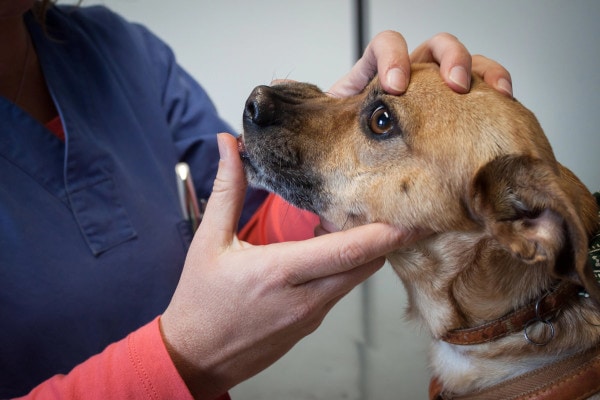
When you think about the various types of tumors that dogs can get, skin masses or splenic masses may come to mind first. But did you know that tumors in a dog’s mouth are the fourth most common tumor type in dogs and account for 6-7% of all dog tumors?
As such, it is important that dog parents are well informed about oral masses, including dog mouth cancer.
What is mouth cancer in dogs?
In dogs, mouth cancer occurs when there is uncontrolled growth of abnormal cells in the oral cavity (i.e. mouth). The end result is formation of a mass, which can damage the tissue in the area or spread to other places in the body.
Usually, oral cancer originates from gingival tissue (i.e. gums) and other structures in the mouth (e.g. palate, cheeks, lips, or tongue). However, the exact cause isn’t well understood. Some research suggests there may be environmental and genetic factors that come into play. For example, certain dog breeds may be at higher risk for developing oral cancers.
At-risk dog breeds include:
- Akitas
- Boxers
- German Shepherds
- Golden Retrievers
- Cocker Spaniels
- Collies
- Miniature Poodles
- Weimaraners
- Scottish Terriers
Generally, mouth cancer is most likely to occur in middle-aged to older dogs. But it is possible for younger dogs to develop oral cancer too.
What are the symptoms of dog mouth cancer?
The potentially good thing about mouth cancer is that you can see most of your dog’s mouth. This means that if you routinely examine your dog’s mouth as part of a weekly five-minute dog wellness scan, you may be able to catch a mass while it is small, and before it starts to cause any clinical signs.
Alternatively, the first thing you may notice is some of the symptoms of dog mouth cancer.
Growth in the mouth
In the early stages of dog mouth cancer, you may just see a small bump on the gums, palate, cheeks, lips, or tongue, or an area of red gums in dogs. But as the tumor continues to grow, it will usually become easier and easier to notice. Depending on the tumor type (which we will get to soon), the tumor may be smooth or bumpy, ulcerated or intact, and black or pink to red. And it might be almost anywhere in the dog’s mouth.
Excessive drooling
Especially when eating, your dog may drool excessively. This is the case because the mass can interfere with eating, swallowing, and other normal mouth movements.
Bloody saliva or bleeding from the mouth
If the mass is ulcerated, breaks open, or the dog accidentally bites the mass when chewing, it may begin to bleed. This may cause your dog to drip blood from his or her mouth or have blood-tinged drool.
Dropping food or chewing abnormally
Eventually, the tumor may make it hard for your dog to pick up or chew his or her food. As a result, you may notice your dog dropping food or moving his or her head around abnormally when chewing.
Difficulty swallowing
Especially if the tumor involves the back of the throat or is large, you may notice your dog coughing and gagging when attempting to swallow. Or the dog may make gulping sounds or toss his or her head around when swallowing.
Facial swelling or deformity
Depending on the type of tumor, you may also notice that one area of your dog’s face or jaw looks swollen or misshapen. This may be due to the effects of the mass on the bone and soft tissue in the region. Some types of cancer can be quite destructive and invasive.
Bad breath
Bad breath in dogs can also occur due to the effects of the tumor.
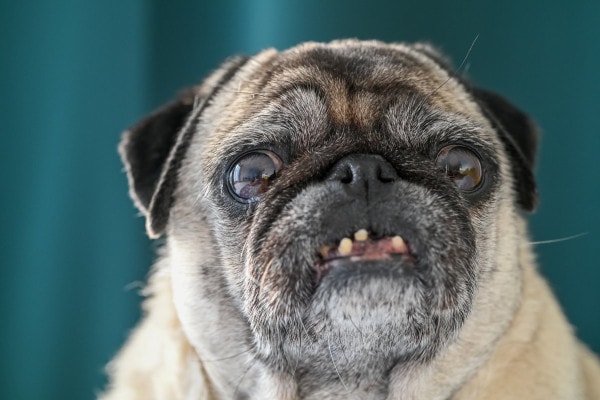
Loose teeth
Mouth cancer can destroy the tooth roots, as well as displacing the teeth. This means that the dog’s teeth may be crooked and/or loose around the mass. As a result, you might notice the dog losing teeth.
Swollen lymph nodes
Sometimes the dog’s lymph nodes (especially the submandibular lymph nodes under the chin) may become enlarged. This can happen if the mouth cancer spreads to the lymph nodes. But swollen lymph nodes can also simply be a reaction to the inflammation in the mouth due to the tumor.
Weight loss
If it goes on long enough, oral cancer in dogs can cause the dog to lose weight from an inability to eat and the toll that cancer takes on the body.
Pawing at the face
Due to pain, inflammation, or abnormal sensations, dogs with mouth cancer may paw at their mouth or rub their face against the ground.
What are the symptoms of oral masses that are not cancerous?
While we are mostly discussing cancer, it is important to know that there is some overlap between the symptoms of cancerous and non-cancerous masses, and some areas where they differ.
Dogs with benign masses will still have an obvious mass, and it may displace the teeth. But the teeth are usually firmly rooted, not loose like with cancerous masses. And unless the mass gets big enough that the dog is biting it, most dogs with benign masses don’t have oral bleeding or bloody saliva. They are also less likely to have bad breath, difficulty chewing or swallowing, weight loss, or some of the other more severe symptoms that accompany mouth cancer (but those symptoms can eventually occur if the mass gets big enough).
Now that you have an idea of what symptoms to watch for, let’s take a closer look at the types of oral masses, starting with the various mouth cancers.
What are the different types of oral cancer in dogs?
There are a number of different cells and tissues in a dog’s mouth the tumor can originate from, so there are several different types of mouth cancer in dogs. The three most common types of oral cancer in dogs are melanoma, squamous cell carcinoma, and fibrosarcoma.
Oral melanoma in dogs
The most common type of dog mouth cancer is oral melanoma, which almost always behaves malignantly (in other locations, melanoma sometimes has benign behavior). Also known as melanosarcoma, oral melanoma in dogs originates from pigment cells (melanocytes). Unfortunately, oral melanoma is the type of mouth cancer with the highest potential to spread to other areas, typically the lungs and lymph nodes.
Oral melanomas may look like round raised nodules with black pigment, but the amelanotic type can occur without pigment. Often the surface of the mass is ulcerated, and the tumor itself is friable (i.e. easily tears or starts bleeding). The mass may be on the dog’s gums, inner lips or cheeks, tongue, or palate.
Usually, oral melanoma occurs in dogs who are 10 years of age or older, but younger dogs can also be affected. And it tends to be more common in dogs with increased oral pigmentation.
Squamous cell carcinoma
The second most common type of oral cancer in dogs is squamous cell carcinoma (SCC). Most commonly, the tumor is found on the gingival tissue. However, it can occur on the tonsils or the tongue.
The tumor appearance can be variable. Some SCCs have lots of little bumps that look like cauliflower. But others may be an ulcerated mass or look like a non-healing ulcer within the mouth. Squamous cell carcinomas are commonly quite locally invasive. Tonsillar SCCs are much more likely to metastasize than SCCs on the gums, but all types have the potential to spread to the lungs or lymph nodes in the area.
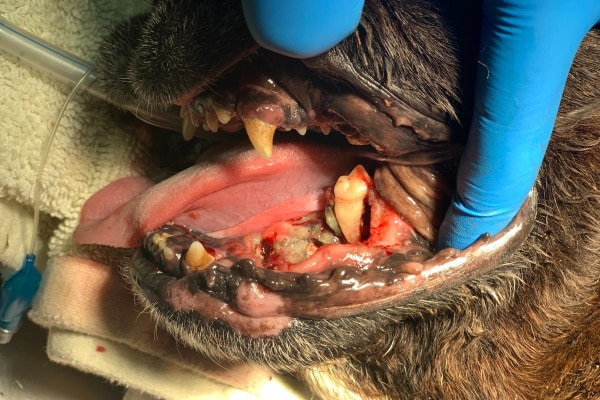
SCC of the gingival is more common in middle aged dogs (7-9 years old). But tonsillar SCC occurs most frequently in older (10-12 year old) male dogs.
Fibrosarcoma
The third most common type of oral cancer in dogs is fibrosarcoma. These tumors come from the fibrous tissue in the gums, palate, inner cheek or lip, or bone around the teeth. Generally, fibrosarcomas are smooth, pinkish red oral masses. While they are locally aggressive, they can also spread to the lungs or lymph nodes.
Typically, fibrosarcomas tend to occur in middle-aged medium-to-large breed male dogs. However, they can occur in younger dogs, and tend to be more aggressive in that population.
Other cancers in a dog’s mouth
Additionally, dogs can develop the following types of malignant oral cancer:
- Osteosarcoma in dogs—Bone cancer in the mouth, which may cause a hard swelling of the upper or lower jaw plus a mass within the mouth
- Osteochondrosarcoma—Cancer that originates from cartilaginous structures and mostly affect large breeds
- Mast cell tumor in dogs—Usually originates from the skin but can sometimes occur in the mouth
- Hemangiosarcoma—Blood vessel cancer that many occur in or below the tongue
What are some non-cancerous masses in a dog’s mouth?
Up to this point, we have been talking about cancer. But thankfully, not all oral growths and swellings are malignant. There are also a variety of benign tumors, swellings, or cystic lesions that can occur in a dog’s mouth.
Some of the more common benign oral swellings or masses include:
Epulides (i.e. benign tumors from the periodontal ligament)
The term “epulis” (plural: epulides) has historically been used to refer to various benign tumors that come from the periodontal ligament (i.e. the ligament that anchors the teeth in place). However, these tumors may go by a variety of other names as well. The main types of epulides are:
- Peripheral odontogenic fibroma (fibromatous or ossifying epulides)—Pink, smooth non-ulcerated masses that appear on the gums. Dogs may have a single mass or multiple masses.
- Acanthomatous ameloblastoma (acanthomatous epulis)—Ulcerated mass with a rough surface that often occurs near the incisors or canines and can be confused with a squamous cell carcinoma.
Overall, epulides seem to be more common in brachycephalic dogs (e.g. Boxers or Bulldogs), Golden Retrievers, and Shetland Sheepdogs. Most affected dogs are middle-aged or older.
Other benign tumors
While less common than epulides, dogs can also develop the following benign oral tumors:
- Papilloma—Wart-like growths caused by a virus that typically affect dogs less than 2 years of age
- Osteoma—Slow-growing, bony oral masses that originate from the hard palate
- Plasmacytoma—Usually a gingival mass that looks like an epulis
- Hemangioma—Rare blood vessel tumor that can originate from any oral soft tissue structure (e.g., tongue, gums)
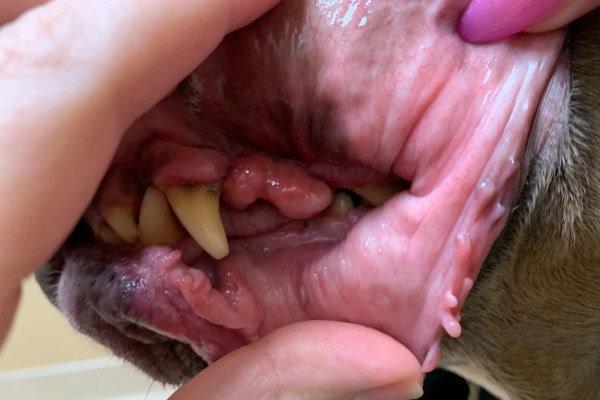
Gingival hyperplasia
Some dogs, especially Boxers and Bulldogs, can also develop an overgrowth of normal gum tissue around the teeth. This is known as gingival hyperplasia. While it isn’t a true tumor, the excessive amounts of gum tissue can still cause issues by trapping bacteria and debris. This predisposes the dog to dental disease in dogs.
Dentigerous cyst
Unerupted or impacted teeth have the potential to form a swelling known as a dentigerous cyst. These are fluid-filled cavities that develop around the tooth. Dentigerous cysts can expand, putting pressure on sensitive tissues and pushing neighboring teeth away from their normal location. Most dentigerous cysts occur in the jaw and, if left untreated, can cause jaw bones to fracture.
Oral abscess
Abscesses are cyst-like pockets of pus and fluid that develop as a result of trapped infection. When in a dog’s skin, these can stretch and become large swellings. But there isn’t a lot of stretchy tissue in a dog’s mouth. So in the case of a dog tooth root abscess, the swelling tends to move up and out toward facial skin. Many tooth root abscesses affect teeth in the upper part of the mouth, causing noticeable swelling beneath the eye. These abscesses can sometimes break open and bleed.
How is mouth cancer diagnosed in dogs?
Should you notice anything abnormal about your dog’s mouth or any potential symptoms of an oral tumor, the best thing you can do is schedule an appointment with your veterinarian.
Please do not assume that a lump in your dog’s mouth is no big deal just because it doesn’t quite match the description of the common types of cancer or your dog doesn’t seem bothered by it. And likewise, it is important to take any symptoms seriously. Mouth cancer, dental disease, and other dental conditions can be painful and require veterinary attention.
Physical exam and oral exam
During the examination, the veterinarian will look your dog over from head to tail, paying special attention to your dog’s lips, cheeks, tongue, gums, teeth, and palate. Additionally, he or she may recommend an oral exam under anesthesia. This allows the vet to get a better look at the structures in the mouth, including some that are harder to assess in an awake dog such as the underside of the tongue or the tonsils.
Fine needle aspiration (FNA)
While your dog is anesthetized, the veterinarian can also perform a fine needle aspiration (FNA) of the mass. As the name indicates, an FNA involves using a small needle to obtain cells from the mass and then examining them under the microscope. Sometimes this can provide a diagnosis. But in other cases, the mass may be too firm or the cells may not come out of the mass and into the needle very easily, making the FNA non-diagnostic.
Biopsy
Alternatively, the vet may decide to do an incisional biopsy of the mass. This involves taking a small section of tissue from the tumor and submitting it to a veterinary pathologist. Additionally, the vet may submit the entire mass to the pathologist after removing it. Biopsy (i.e. histopathology) is the gold standard diagnostic for mouth cancer since it provides the most definitive answers as to the tumor type.
X-rays
Finally, the veterinarian may also obtain X-rays of the teeth and jaw while the dog is under anesthesia. This allows him or her to assess how the tumor is affecting the bone and teeth in the region.
Additionally, if the vet suspects the mass is cancerous, he or she may take X-rays of the dog’s chest to look for metastasis to the lungs.
Advanced imaging
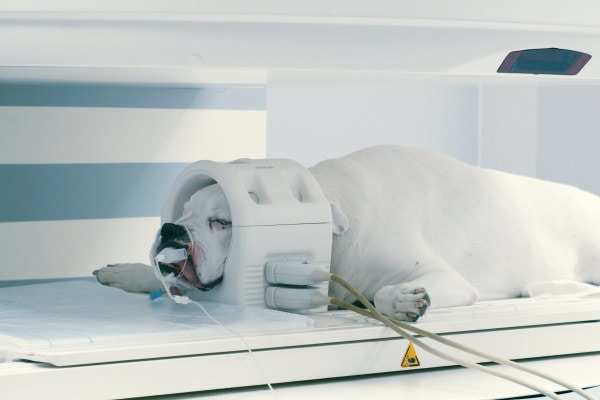
In some situations, the vet may also refer your dog for a CT scan. This can be a good way to further evaluate the tumor and look for evidence of spread to other locations.
Lymph node aspirates
Since mouth cancer sometimes spreads to the lymph nodes, the vet may recommend performing an FNA of the lymph nodes around the head and neck. This can provide valuable information for staging mouth cancer.
How is mouth cancer staged?
Based on the results of the diagnostics, the veterinarian can classify the dog’s mouth cancer into one of four stages:
- Stage I: Mass is less than 20 mm and does not involve the bone
- Stage II: Mass is 20-40 mm and does not involve the bone
- Stage III: Mass is over 40 mm, does not involve the bone, and has not metastasized OR a mass of any size that does involve the bone or has spread to the lymph node(s) on the side of the tumor
- Stage IV: Mass of any size that has spread to the lungs (or other distant sites) or has spread to lymph node(s) on both side of the body
The stage of mouth cancer will help guide the treatment, as well as influence the prognosis.
What is the treatment for dog mouth cancer?
Treatment will depend on the type of mass or swelling present. For non-cancerous swellings like dentigerous cysts, the entire affected tooth must be extracted, and then the lining of the cyst must be removed. This type of surgery is curative, and no further action is required other than to follow up with dental X-rays in about six months. And similarly, extracting the offending tooth will resolve a dog tooth root abscess.
Surgery
However, true oral masses may require surgical excision, even if they are benign. Sometimes the veterinarian, veterinary dentist, or veterinary surgeon can simply remove the mass. But in other situations, especially with aggressive oral cancer, the surgeon may need to remove a portion of the upper or lower jaw or tongue in order have the best chances of getting all of the cancer cells. While your vet may be comfortable with a simple benign oral mass removal, more complicated procedures often involve finding a veterinary specialist near you, usually a dentist or surgeon.
Radiation therapy
If it isn’t possible to remove the whole tumor, the vet or veterinary oncologist may recommend radiation therapy to kill the remaining cancer cells. Or in some cases, the oncologist may use radiation to shrink the tumor prior to surgery. Additionally, radiation is an option for some types of tumors that are unresectable (i.e. cannot be surgically removed). Some tumors are more responsive to radiation than others, so your veterinary oncologist will let you know what is right for your dog.
Chemotherapy
Most of the time, oral tumors in dogs don’t respond well to chemotherapy, so it isn’t a first choice for treatment. However, there may occasionally be situations where the veterinary oncologist recommends it as an adjunctive therapy.
Immunotherapy for oral melanoma
If your dog has oral melanoma, another potential treatment option is the oral melanoma vaccine for dogs (ONCEPT®). The vaccination causes the immune system to target and kill the cancerous melanoma cells. Typically, vets use the melanoma vaccine to address any remaining melanoma cells after surgically removing the visible tumor.
Natural treatments
While there are no natural treatments for oral cancer in dogs, natural anti-inflammatories and antioxidants like omega-3 fatty acids for dogs and vitamin A can provide some health benefits to cancer patients. Another supplement, turmeric, has been shown to have anti-cancer properties in lab settings, and it can reduce inflammation in dogs.
Supportive care
Dogs with mouth cancer may have trouble eating, so some may require a feeding tube for nutrition. Additionally, since oral tumors can be very painful, it is important to provide good pain control in the form of pain medication and alternative therapies such as acupuncture for dogs.
If you feel like your dog is painful or isn’t eating enough, please don’t hesitate to reach out to your vet. While comfort measures don’t treat the cancer itself, they are essential for maintaining your dog’s quality of life.
What is the prognosis for dogs with mouth tumors?
As you can imagine, the outlook varies significantly depending on what type of oral mass the dog has, the size and location of the mass, the stage of the cancer (if it is cancer), and the treatment plan.

Dogs with dentigerous cysts or abscesses tend to have a great prognosis with treatment. And dogs with benign growths also have good surgical prognoses. However, without surgery, they may only live for a few years before the cancer makes eating impossible.
On the other hand, oral cancer tends to carry a poorer prognosis. Since melanoma, squamous cell carcinoma, and fibrosarcoma are the most common types of mouth cancer, we will take a look at those.
Life expectancy for oral melanoma
Overall the prognosis for dogs with melanoma is poor, but the published survival times can vary significantly. One study reported that without treatment, dogs with oral melanoma only survive for an average of 65 days.
However, with aggressive surgical removal and sometimes adjunctive therapy, a Journal of the American Veterinary Medical Association article reported an average progression-free interval of 508 days and an average survival time of 723 days for dogs with oral melanoma. Yet a different study reported a median survival time of 206 days with surgery.
Life expectancy for oral squamous cell carcinoma in dogs
For SCC, the survival times and prognosis for dogs vary based on the location.
- Mandibular (lower jaw) SCC—Average survival time of 19-43 months with 1-year survival rate of 88-100%, 2-year survival rate of 79%, and 3-year survival rate of 58% with surgery alone.
- Maxillary (upper jaw) SCC—Average of 10-39 months survival time with maxillectomy (i.e. removal of a portion of the upper jaw).
- Tonsillar SCC—Average survival time of 243 days with 1-year survival rate of 40% and 2-year survival rate of 20%.
Life expectancy for oral fibrosarcoma in dogs
According to one study, when treated with surgery, the average survival time for dogs with fibrosarcoma was 743 days. Depending on the study, the chances of the tumor recurring varied between 24.1% and 54.2%.
Ask your vet what to expect for your dog
While it is possible to look at the survival times and recurrence rates in studies, each dog’s situation is unique. So the best way to get an idea of what to expect for your dog is to consult with your vet, veterinary dentist, or veterinary oncologist. Since they are familiar with your dog’s case and treatment plan, they are the best people to help you understand the outlook for your dog’s situation.
Additionally, as your dog enters the final stages of mouth cancer, your vet can help walk you through how best to keep your dog comfortable and give you advice about when to put down a dog with mouth cancer. Often the primary tumor, rather than metastasis tends to be what ultimately kills dogs with oral cancer. They will get to the point where they can’t eat, the tumor is bleeding frequently, or they are in significant pain and their quality of life is low. That’s when the kindest thing may be to set them free.
Partner with your vet and advocate for your dog
Facing a diagnosis of mouth cancer (or a mouth tumor in general) can be scary and overwhelming. Please remember to take it one day at a time and to work closely with your vet. He or she (as well as any specialists your vet may refer your dog to) are a wealth of information. They can help guide you through the diagnostic and treatment process and address any issues or questions that arise along the way.
Keep in mind too that you know your dog well, and you are his or her advocate. So if you feel like your dog is painful or isn’t doing well, please speak up. There may be things that the vet can do to help improve your dog’s quality of life. By sharing what you are seeing at home and any concerns you have, your vet can best help you and your dog.
Has your dog been diagnosed with mouth cancer?
Please share his or her story below.


My 7 yr old Parti Yorki ( recessive gene Yorkshire Terrier) was just diagnosed with
squamous cell cancer, I have been researching everything I can find on it. they found it under his tongue when they were removing loose teeth, it’s 8 cm long, looks like red cabbage ,
He is 7 pounds, little guy and he is very stoic and would never show any pain, (he had a severe eye infection a few months back, he hid that so long his eye looked like raw meat, before he came and got in my face to show me, I was able to treat it and it healed perfectly fine with a small cataract). I had no idea he had a problem with his mouth either, he was eating fine and drinking and giving me licks like always, I am just heartbroken, I love this little guy so much. This is a shock, and I’m not sure what to do. He is still eating and going outside doing his Normal life stuff, I plan to make sure he is happy and loved and content at all times, and Pray to God to help him, God Bless the small creatures that he has given us to love. And grieve when they are gone.
Dear Lee,
I am so sorry your little pup has received this difficult diagnosis. Dogs are great at hiding discomfort, and most cancers don’t cause symptoms until they are very advanced. Please don’t let guilt have any part of this situation. I know you will do anything you can to keep him happy and comfortable for as long as possible. Praying for strength and peace as you navigate this emotional path. Bless you and your sweet boy. ♥
What about Sublingual Granuloma (gum chewers syndrome), couldn’t this also mimic SCC? I have a girl who’s lingual frenulum shows signs of irritation and overgrowth on both sides, it’s not hard feels like gum tissue and you can pinch under it. She’s 4 years old but I didn’t see mention of it in this article? She has a bigger one on one side and a smaller one on the other, both similar places on back teeth area.
Hi Mimi,
Yes, while granulomas can look like a tumor, they are not actually considered a “mass”. Since this article was focusing on cancerous tumors, we did not include an exhaustive list of other oral diseases and conditions. Thank you for mentioning this topic and bringing it to our attention. Hoping your girl doesn’t experience any negative side effects from these growths in her mouth. Wishing you both the best of luck!
I’m reading all these comments after the fact unfortunately. During a procedure to remove lumps off her gums and some dead teeth.
my 8 year old boxer was diagnosed with a walnut size tumor and an open ulcer, biopsy showed Squamous cell carcinoma After She had tons of bloody days, and a horrible unbearable stentch. I decided against surgery, and started pain meds. My vet never suggested a referral to an oncologist, and suggested immediate euthenization. I chose pain therapy . After 3 months one side of her face has noticeably increased swelling every few days. Then a green discharge from her nose. sometimes I can get her medication down, sometimes she skips it , same with her food. I feel my vets only advise is to put her down so I was reluctant to ask her opinion unfortunately. Like maybe an antibiotic would have cleared the mucus. I read 3 to 5 months was the life span in her situation (its been 3 since the biopsy) and even though she still romped around the yard I feared if the tumor was spreading to her snout she would suffocate. So out of that fear I chose to put her down, while she was mostly happy and intermittently eating. I’m extremely huanted my my decision as I play it over and over in my head that I ended her life prematurely. That I should have taken her to an oncologist for a second opinion. I know it’s too late know but the should have could haves are killing me.
Dear Patty,
I am so sorry for the loss of your beloved Boxer. It is easy to ponder all the “what ifs” while grieving but please don’t let guilt weigh heavily on you. It is ok to let go before all joy is lost and the only thing that remains is pain. I would rather say goodbye one day too early than one day too late and allow unnecessary suffering. If I had been in your situation, I would have made the same loving choice to offer peace. We often put the majority of our focus on ensuring our dogs have a good life, but a peaceful goodbye is just as important. I hope with time the grief will fade, and your heart can begin to heal. May the memory of your sweet girl stay with you always and continue to be a blessing in your life. ♥
Grieving the Loss of a Dog After Euthanasia (& Finding Peace)
My sweet boy is a 10 year old corgi/shepard mutt mix. In October we went for his yearly check up, everything was great. Two weeks later I felt a lump in his neck that was kind of hard. Went to the vet the next day where the notice something on one of his teeth. It looked just like another tooth but to be sure he had a teeth cleaning and biopsy a few days later. He was diagnosed with oral melanoma. The vet put in a referral for an oncologist and so we’ve just been waiting. The tumor started out to be the size of a tooth and is growing so quickly. I swear it looks better each day. He’s drinking plenty of water and eating is becoming hit or miss due to the size. He’s been drooling and breath is awful but today it’s been pretty bloody, and I know it’s because of the tumor tissue and what not.
My husband and I have already said we can’t imagine putting him through the surgery to remove part of his jaw, but we are open to hearing what the oncologist has to say.
It feels so defeating and heartbreaking because other than this, he is completely healthy and so happy and sweet; and we caught it so early but we’ve had to wait for the oncologist and it’s growing so fast. I hate seeming him trying to act normal but look so sad. Impossible, heartbreaking decisions
Dear Ashley,
My heart aches for you as you face this difficult diagnosis in your senior pup. I know your mind is running with all the “what ifs” and I hope the oncologist will be able to help you make a definitive plan for how to proceed. It is ok to choose palliative care with a focus on quality of life (instead of quantity). Don’t hesitate to ask for contact info for house call hospice veterinarians in your area. You deserve to have the resources and care in place to ensure these last days with your boy are as stress free as possible. Try to make the most of the time you are gifted and take this one day at a time. I will attach links to other articles with more information and great comments from other readers as well. Praying for strength and comfort as you navigate this emotional path. Bless you and your sweet boy. ♥
1. Using a Quality of Life Scale for Dogs
2. Dog Hospice Care Can Bring Peace and Dignity to Your Dog’s Final Days
3. Signs A Dog is Dying of Cancer (Plus Advice for 8 Common Cancers)
4. Preparing for Your Dog’s Euthanasia: 10 Thoughts for Peace
Hi! I have a 16 year old English cocker spaniel. For the past year and a half she has had a horrible odor to her saliva. It was diagnosed as a stomach issue. But the smell has gotten worse. It is clear and sticky. She rubs her chin after eating after meals which she never did. She also can’t shake her head. She dreams to want to but holds off like in pain. Major sensitivity to her entire face. When bathing her she likes us scratching her ear on the outside side but doesn’t want her face touched at all. With age she has lost hearing and some sight. I don’t have money to get her accurately diagnosed but I am now feeling like her quality of life is horrible yet she eats well. There have been times when she won’t it but still eat pretty regularly and drink water as more often. Her bowl movements are normal but she doesn’t ask to go every time. Any advice is appreciated.
Dear Ivan,
I am sorry your senior girl is not doing well, and her condition seems to be getting worse. I wish I could offer some great advice but unfortunately, without being able to examine her myself I can’t give specific recommendations. I understand you have financial limitations but the only way to know what your options are would be to allow your vet to do an evaluation. They can perform a quality-of-life exam and let you know if there is an easy solution to help improve your girl’s situation or if saying goodbye is the most loving option. I hope you can get the answers you need to find a clear path forward. Praying for clarity and strength as you navigate this emotional path. ♥
My little Nina is 10 years old and was diagnosed with grade 2 squamous cell carcinoma in the upper part of her mouth, where the x-rays no longer show bone. All her upper teeth were removed, and the cancer has spread to the areas near her eye and has already engulfed her entire nose, making it difficult for her to breathe. She is on strong pain medication. I opted for palliative care because she is growing very quickly. Surgery would require reshaping her snout and entire upper jaw, which would destroy her ability to eat, as she would no longer be able to chew. Chemotherapy and radiation would only slow the growth (maybe). I can’t afford it, and I don’t want to see her suffer. She still wags her tail, eats a lot, and still barks at the neighbors. I know it’s cruel to wait for her to show signs of worsening to end her suffering, but I want to enjoy her joy. As soon as I feel or notice any change, I won’t prolong her pain any longer. I feel it more than the loss of a family member. She is my refuge, and I cry every day. 🙁 Brazilian
Dear Jhessica,
My heart goes out to you as you face this difficult situation with Nina. I am glad you are closely monitoring her quality of life and will offer her peace and rest when the time is right. I can only imagine how emotional it must be to walk this path. Praying for your strength and comfort for you both. Bless you and your sweet girl. ♥
My rescue girl was diagnosed with osteosarcoma of her jaw. I’m completely heartbroken. I don’t want to put her through surgeries and chemo at 13 years old but I’m not ready to put her down either. I don’t want to be selfish and keep her here for me. I want to do what’s best for her. I hope I will know when the time comes to make the worst (for me) but best (for her) decision ever. It’s becoming difficult for her to eat. Her vet did say to give her whatever she wants to eat. It’s all soft and homemade. It becomes hard to even think of letting her go when she still rolls on her back wanting belly rubs or rolls around in the grass, squashing a bug 😅. Then she looks miserable 😪. I pray we do right by her. She’s my girl.
Dear Marcy,
My heart goes out to you as you prepare to spend these final days with your beloved girl. You may want to consider reaching out to a vet that specializes in hospice and in home care to help guide you through this emotional season. Try not to dwell on the “what ifs” and make the most of the time you are gifted. Praying for comfort and peace for you and your pup. ♥
My dog Rory is a Basenji/Chow mix and was diagnosed with lower jaw cancer in June 2024. When her vet explained the surgery I automatically said absolutely not. Removing her jaw was too traumatizing and didn’t want to put her through it at her age, 12. I was told she probably wouldn’t survive the summer. She has had cancer two other times with poor prognosis’s over the years and she’s beat it every time. She’s my miracle dog. It’s almost a year later and her tumor has finally started to grow and it’s happening faster and getting larger under her jaw. Eating is her favorite thing to do and shes still eating with enthusiasm. No blood when she eats, she lets me scratch and rub her jaw. No crying and yelping either. She’s only on soft food and treats. Like several others have mentioned the smell has gotten so bad, and I feel awful even saying that. But it really is terrible. She’s on pain meds an anti-inflammatory and seems to be doing ok, but I know she has a very high threshold for pain. Thank you for the other’s comments and replies, they’ve definitely helped. I just watch her like a hawk now for changes because I never want to keep her here for me. I’m my opinion it’s the most selfish thing you can do to a pet. Anyway I just wanted to say thank you, this site was what I needed read today.
Dear Kelli,
My heart goes out to you as Rory nears her final days. What a blessing she has been happy and feeling good for the past year since her diagnosis. Praying for strength and clarity as you face the emotional days ahead. Bless you and your sweet girl. ♥
This is extremely hard for me and my family. Our dog Pooch is 15 years old he is a Jack Russell Terrier Mixed with other breeds. Unfortunately, he has a mouth tumor that took over 3 of his adult teeth that had to be removed during a dental cleaning. The tumor went away at that time now its 2025 the tumor comes back at full speed. He is our very first dog to ever love it’s going to be extremely hard for us if we have to put him down. We thought yesterday May 17 2025 was going to be his last day due to the fact he let out a loud howl that scared us, but now today May 18 2025 he’s having one of his good days.
Dear Aysha,
My heart goes out to you as you prepare to spend these final days with your beloved Pooch. Try to enjoy the time you are gifted and ensure he is comfortable and happy. When the time is right, I hope his passing is peaceful and smooth. Praying for strength as you navigate this unknown path. Bless you and your family. ♥
my baby is going through the same thing. His is starting to bleed often though. Prayers for your fur baby. This is my first baby too
Dear Kristy,
My heart aches for you as you face this situation with your pup. Wishing you both comfort and peace. ♥
I sadly had to put my dog to sleep last week due to a large tumor in his mouth which was pushing out his front teeth.
He was a 14.5 years old Golden Retriever, and at first his only real symptoms were extremely bad breath and weightloss, but he seemed otherwise energetic, happy and healthy.
I took him to the vet for the breath and weightloss, and she said he had paradontosis. He had had decreased appetite, but was eating well again, so she figured it had either been due to passing toothache or a stomach bug. She said his heart and lungs sounded strong and healthy. I called a local vet dentist afterwards and made an appointment to see if he could handle anaesthesia at his age, so we could fix his teeth, even though my own vet didn’t think it was worth it at his age.
Four days later, my boy seemed to be more tired and in some pain from his teeth. He wouldn’t really let me check his mouth, which was unusual, but I could see that it seemed like his front teeth were sort of pointing forward instead of just down, and there seemed to be a sort of gray matter on his front gums. I am not sure about the matter, but his teeth definitely looked normal just a day earlier. The dentist couldn’t see us until two days later, and my boy was still eating and begging for treats, (short) walks and pets, so I thought it would be ok to wait.
The morning before the dentist, he seemed to be very affected by the pain. He still wanted pets and treats, but he seemed miserable, and at one point I even thought to myself that he was asking me for peace.
At the dentist, they took one look at his mouth and said that he had a massive tumor in his pallet, his jaw and on his gums, and that it was pushing out his teeth. The only treatment would be amputation of most of the jaw, but it had probably already spread elsewhere. I decided it was kindest and most loving to put my beloved dog to sleep, and a day later I said goodbye to him in his favorite spot in our garden.
I am absolutely heartbroken even though I know it was the right thing to do. I just can’t believe that it could grow so fast that a week before he was put to sleep neither a vet nor myself could even see the tumor. I have no idea what kind it was, or where it might have spread. I feel really guilty about that now, but I couldn’t stand to see him in pain any longer.
I have also felt really guilty about not having him castrated two years ago, when we found a tumor in one of his testicles. I wanted to, but the vet convinced me at the time that the risks of putting a senior dog under anaesthesia outweighed the benefits of removing the tumor. “If it was something harmful that was going to kill him, it would have done so already” were her exact words. That remained her stance throughout every health check since.
Now I am wondering if the tumor in his mouth is a result of the tumor in his testicle spreading. I know that there is no way of knowing for certain now, but is it a possibility? I feel so betrayed by my regular vet, and I want to find a new one for my other dog. But perhaps it is not even possible for testicular cancer to spread to the mouth like that? I am unsure of what to do now. I al just so heartbroken.
Dear Matilda,
My heart aches for you with the loss of your beloved boy. It is normal to ponder all the “what ifs” while grieving, but please don’t let guilt have any part in this. As soon as you realized there was an issue, you acted quickly. And you made the loving choice to allow your own heart to break in order to spare your sweet boy from unnecessary suffering. I am sorry you have lost confidence in your vet and understand how it can be hard to move forward. You deserve to partner with someone you can trust and feel comfortable with. With that being said, I have never heard of a case where testicular cancer ended up metastasizing to the mouth. It can however spread to other internal organs (spleen, liver, lungs, etc.) and even the bones. But metastasis of testicular cancer is rare and in up to 95% of cases it can be cured with castration alone. It is hard for me to make assumptions about a case that I was not personally involved with, but I can say that I probably would have given you the same advice to forgo the castration and just focus on quality of life. I hope with time your heart can begin to heal, and you can find peace. May the memory of your sweet boy stay with you and continue to be a blessing in your life.