Realizing “My dog is wobbly and off balance” can be disconcerting for even the most seasoned dog parent. Integrative veterinarian, Dr. Julie Buzby, dives deep into the heart of your dog’s nervous system to explain the “why” behind the loss of balance and seven conditions that could be the culprit.

What should you do if your dog is staggering around like he or she spent a bit too much time on a merry-go-round? The answer—take a calming breath, then call your vet. Let him or her know, “My dog is wobbly and off balance.”
I understand how unnerving it can be to watch your beloved dog lose balance and even stumble around. I’ve witnessed these signs in my own canine patients, and I’ve felt my clients’ concerns along with them.
That’s why I want to share seven reasons a dog may be wobbly and off balance. But first, let’s dive into some nervous system anatomy so we can better understand what’s going on with a wobbly dog.
Ataxia in dogs: an uncoordinated gait
When I see a dog who is wobbly and off balance, I think of the word ataxia. This is the medical term for an uncoordinated gait. Ataxia is classified based on which structure in the nervous system is affected—the cerebellum, the spinal cord, or the vestibular system.
Cerebellar ataxia in dogs
The cerebellum is the small part of the brain that sort of looks like a walnut. It sits just behind the cerebrum (large portion of the brain responsible for learning and memory).
The cerebellum plays a role in balance, posture, and coordination of voluntary movements. Thus, damage to the cerebellum impairs these functions.
Signs of cerebellar ataxia in dogs may include:
- Exaggerated high stepping gait.
- Tremors that occur when trying to initiate voluntary movement.
- Wide based stance in the rear legs.
- Head and body tremors.
Spinal ataxia (proprioceptive ataxia) in dogs
The spinal cord transmits information between the body and the brain. One of its many uses is proprioception—the ability of the body to sense and change how the limbs are positioned. Sensory receptors in the limbs send information up the nerves to the spinal cord. One of two things happen with this information.
One option is that the signal causes an immediate reaction, known as a reflex. This is what occurs when you touch a hot stove and rapidly jerk your hand away. The body acts before you are even conscious of what happened.
The other option is that the information continues up the spinal cord to the brain. The brainstem, cerebellum, and cerebrum process that information then send signals back to the limbs via the spinal cord.
Testing conscious proprioception in dogs
Vets may evaluate part of this system by flipping a dog’s foot over. Now the top of the foot is against the floor. In a normal dog, the sensory receptors send a message up the nerve to the spinal cord that says, “My foot is upside down.”
The signal goes up the spinal cord, through the brainstem and to the cerebrum. The cerebrum says, “Hmm…that isn’t right. I need to fix the position of the foot.” So a signal is sent back down to the foot to tell the dog’s muscles, “Flip the foot back so the paw pad is against the ground.”
You can watch me perform this test in this video, Knuckling in Dogs: How to Test a Dog for Conscious Proprioception.

When the spinal cord is damaged, signals can’t get to or from the brain. The portion of the spinal cord in front of the damaged area will function normally. However, communication is slowed or cut off to the body parts behind the damaged area. This means the dog will not flip the foot over or will do so slowly.
Signs of spinal cord problems
Dogs who have spinal ataxia may also:
- Sway or wobble back and forth.
- Stand with the limbs positioned abnormally (i.e. crossed or splayed out).
- Swing the limbs out widely or cross them when walking.
- Be unable to move the affected limbs.
Vestibular ataxia in dogs
The vestibular system is made up of the inner ear, vestibulocochlear nerve, brainstem, and cerebellum. The inner ear is located within the skull and contains fluid-filled semi-circular loops. These loops run in different directions such as horizontally and vertically, almost like the tracks of a rollercoaster.
Hair cells inside the ducts are displaced when the fluid moves relative to the body’s position (e.g., standing up or lying down). This creates a signal that travels through the vestibular branch of the vestibulocochlear nerve to the brainstem.

Nerve signals may stop at the brainstem or proceed to the cerebellum. The brainstem controls things that dogs do without being consciously aware of them, in this case stance and posture. The cerebellum, as discussed above, regulates voluntary muscle movements to help a dog balance.
Signs of vestibular syndrome in dogs
Damage to any of these components will cause a dizzy dog who may:
- Appear wobbly and off balance as though drunk.
- Drool excessively.
- Stumble when walking.
- Exhibit rapid involuntary eye movements (nystagmus).
- Have a head tilt.
- Repeatedly circle in place, which looks like walking in circles.

Why is my dog wobbly and off balance? 7 common culprits
Now that you understand the different types of ataxia, we can start to address the seven reasons why a dog is wobbly and off balance.
1. Ear infections in dogs
Before we start talking about ear infections in dogs, we need to review some ear anatomy.
The external ear is the portion that you would see if you peered into your dog’s ear. It is L shaped, and ends at the eardrum (i.e. tympanic membrane). The middle ear is an open space immediately behind the ear drum. Just above this space are the the small bony structures that make up the inner ear.
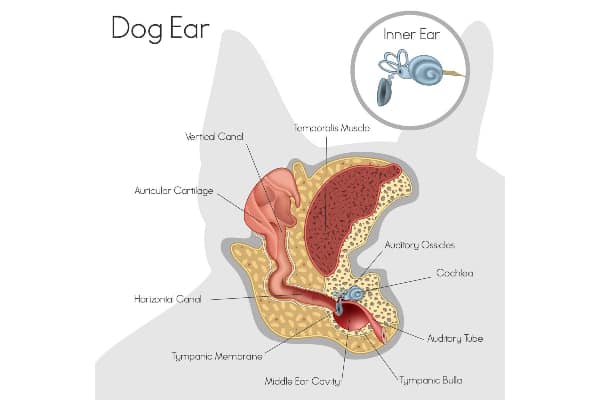
Remember how we talked about the role of the inner ear and vestibulocochlear nerve in the vestibular system? It makes sense then that infection or inflammation in the middle or inner ear could keep those structures from functioning correctly. The end result? A dog who is wobbly and off balance.
In this case, we are talking about vestibular ataxia caused by peripheral vestibular disease. The term peripheral denotes the problem lies with the inner ear and/or nerve. This is in contrast to central vestibular disease where the brainstem and brain are affected (more on that later).
Dogs with peripheral vestibular disease usually have horizontal nystagmus. This means their eyes move rapidly from side to side. They are usually awake, aware, and acting like themselves. We refer to this as having normal mentation.
If present, head tilt and circling are usually towards the abnormal ear. For example, if the left ear is affected, the head tilt and circling are to the left. You may also notice any of the other signs listed above for vestibular syndrome.
Causes of ear infections in dogs
Otitis interna (inner ear infections) and otitis media (middle ear infections) can be caused by:
- Bacteria such as Staphylococcus, Streptococcus, Proteus, Pseudomonas, Enterococcus spp., and E. coli.
- Fungi
- Foreign bodies
- Cancer
- Bloodborne spread of infections from other locations
- Trauma
Sometimes, external ear infections can extend into the middle and inner ear. In those cases, affected dogs will also show signs of external ear infections. These include debris in the ear canal, head shaking, or ear scratching. Other times, the external ear canal will be completely normal.

2. Brain conditions in dogs
A variety of conditions can affect the brain or brainstem, causing central vestibular disease. Affected dogs tend to have vertical nystagmus (eyes moving up and down) rather than horizontal.
In addition to the other symptoms of vestibular syndrome listed previously, they may have impaired or dull mentation. This means they are slow to process information or respond to stimuli, are unaware of their surroundings or are not acting like themselves. Seizures may also occur.
Infection, inflammation, or brain tumors (tumors of the brain or brainstem) are the most common reasons for a dog to develop central vestibular syndrome signs. Infections may be caused by bacteria, fungi, viruses, or protozoa. Many of these same causes can also affect the cerebellum, causing cerebellar ataxia.
3. Old dog vestibular disease
Sometimes a dog will be wobbly and off balance and show other vestibular signs that are not related to hypothyroidism in dogs, tick-borne diseases in dogs, or any of the other causes discussed above. We call this idiopathic vestibular disease. The other name for it is old dog vestibular disease because it happens more commonly in older dogs.
In fact, it also happens to be the most common cause of vestibular disease overall. The good news is that signs often resolve over a period of a few days with supportive therapy. So if there is a “good” type of vestibular syndrome, it is this one.
To learn more about old dog vestibular disease, please refer to my article, Old Dog Vestibular Disease: A True Story About Doggy Vertigo. Also, if your dog has been diagnosed with any of the causes of vestibular disease, you might find these 10 Tips and Exercises for Dogs with Vestibular Disease helpful.
4. Stroke
While strokes are less common in dogs than in humans, they do still happen occasionally. Strokes occur when blood flow to the brain is disrupted due bleeding or an obstruction in a vessel. Without the oxygen, glucose (fuel for the brain), and other blood components, the brain doesn’t function correctly. As a result, a dog may be wobbly and disoriented or show other vestibular syndrome signs.

You can read my article, Dog Stroke Symptoms & Treatments in Senior Dogs to find out more.
5. Spinal cord conditions
Anything that damaged or disrupts the spinal cord can cause spinal ataxia. This is the case in IVDD (intervertebral disc disease) in dogs. In this condition, disc material leaves its normal position between two vertebrae (bones in the spine) and starts to press on the spinal cord.
When the spinal cord is compressed, nerve signals have trouble moving past the affected area. In some cases, a vet may recommend IVDD surgery for dogs. Other times, non-surgical IVDD recovery in dogs is possible.
Spinal stroke in dogs is another condition that may cause a dog to be wobbly and off balance. The other name for this condition, fibrocartilaginous embolism (FCE), gives a clue about how it occurs.
A piece of intervertebral disc material (a fibrocartilaginous substance) breaks off and blocks one of the blood vessels that nourishes the spinal cord. When blood supply is obstructed (i.e. an embolism occurs), the portion of the spinal cord supplied by that vessel is damaged.
6. Trauma
Some ataxic or disoriented dogs have external injuries that might point to a known or suspected traumatic event as the cause of the signs. The brain and spinal cord can be damaged by :
- Motor vehicle accidents.
- Falls from a great height.
- Crush injuries.
- Gunshot wounds, bites, or other penetrating injury.
- Blows from an object, animal, or person.
- Violent shaking.

Head trauma causes damage to the neurons and bleeding and swelling in the brain. If there is swelling in other parts of the body, it isn’t as big of a deal. For example, a leg has space to expand outward when it swells. Not so much with the brain since the skull is a fixed size.
As the brain swells and blood builds up around the brain, the pressure in the skull (intracranial pressure) increases, compressing the brain tissue. This makes it harder to get the blood through the vessels in the brain.
Without the blood supplying needed nutrients and oxygen, brain function declines and the dog may become depressed or disoriented. Cerebellar and/or vestibular ataxia will also occur if either of those systems are damaged.
Spinal cord trauma will cause spinal ataxia since the neurons are damaged by the initial injury and the body’s response to the injury. In severe cases, the dog may even be paralyzed.
7. Toxins
Lastly, a variety of toxic substances can cause a dog to be wobbly and off balance. They may also cause other neurologic signs like seizures or tremors, as well as heart, lung, kidney, liver, or gastrointestinal signs.

Toxins to suspect include:
- Metaldehyde (a component of slug bait).
- Mycotoxins (toxic substances produced by fungi found on moldy food or trash).
- Cannabis (marijuana).
- Permethrin (insecticide found in powders, sprays, bait stations, and some flea treatments).
- Ivermectin (anti-parasitic drug that can be toxic at higher doses, but is typically safe at the dose used as a preventative for heartworm disease in dogs).
- High doses of drugs such as aminoglycoside antibiotics and metronidazole.
Other toxins not on this list are also capable of causing neurologic signs and some intoxications may be fatal. Anytime you suspect your dog may have ingested a toxic substance, immediately contact your veterinarian or the ASPCA Animal Poison Control Center. (Please note, there is a consultation fee charged for the ASPCA’s services.)
Enlist the help of your vet
If you notice your dog is wobbly and off balance, call your vet right away. You may have a suspicion about which of these seven conditions is the culprit. However, your vet is the best person to help reach a diagnosis and formulate a treatment plan.
The outlook for these diseases can vary, but starting appropriate treatment right away typically can give your canine companion the best chance at recovery.

Has your dog ever been wobbly and off balance?
Feel free to share your dog’s story. We can all learn from each other.


hi our dogs had a fight and this is the second time our female are off balance and shaking for at least 5 minutes after the fight is this a seizure or just the adrenalin, im very worried
Hi Sanett,
I am sorry your dogs keep having issues with fighting each other. Without being able to witness this odd behavior myself, it is hard to make specific conclusions. If you can catch one of these episodes on video it could be very helpful in making a diagnosis. Hoping you can partner with your vet to ensure both dogs are healthy and find a way to maintain the peace in your home.
I have a 5 year old jack russel. He was laying at the end of the bed and all of a sudden started moving around under the covers and fell off the bed. He tried walking around and was too disoriented to walk straight so I had him lay down while I got dressed to take him to a vet. He then wandered toward his kennel and threw up and within 15-30 seconds he was jumping up and down and just fine again. I took him out on a walk but I’m still pretty scared of what that could have been. I can’t really afford an expensive veterinary visit right now to tell the truth, but I’m wondering what I should do?
Hi Anthony,
I understand your concern for your pup after witnessing him have such a strange episode. I wish I could offer some advice but unfortunately, without being able to examine him myself, it is hard to make specific recommendations. The only way to rule out some of the more serious potential causes is to have your vet to a thorough evaluation. Also, if your boy does experience this same behavior again, it could be extremely helpful to catch it on video. Hoping all is well and praying for a positive outcome for your pup.
My dog had severe diarrhea and then was wobbly. Could this be just because he has nothing in his stomach?
Hi Miriam,
I understand your concern for your dog. I would not think an empty stomach could cause wobbling and would definitely be looking into other causes. Dehydration can show up as weakness and lead to wobbling. Please make sure your vet is aware of this episode and they can let you know if an exam is needed. Hoping your pup is doing better and wishing you all the best.
My dog who is part Jack Russell does the same thing. Has vertigo, wobbles around tries to get to the door. I help her outside, usually pees/ poops and sometimes throws up and always licks her mouth. Then is completely fine. She is only 5 so it’s not an old age thing. My vet has no answers.
Hi Nancy,
I am sorry your pup is experiencing these strange episodes. Hoping she can maintain a good quality of life despite her puzzling symptoms. Thank you for sharing your experience with us. Wishing you both all the best for many happy years ahead.
I went to someones house yesterday & she said her dog has the wobblys. I felt so bad for this poor dog that apparently has been like that for two years. They said it was common in the breed of dog. but she lives there in the corner of her kitchen unable to get up or walk without help, She tries to get up but falls over & can’t get up. The owner said she is not in pain, I just can’t imagine that poor dog having to lay there like that day after day with that being her only life for the past two years, She does not get any real exercise. She is taken from the corner & helped out to go to the bathroom a couple times a day & that is all. That is no life for that poor baby.. She is a large pit bull type but I can’t remember what she said the mix was (russell something maybe) I can;t be sure) but it was known for these type of problems. Is there aanything at all that can help this poor girl.. She just loves people but never gets to see anyone except for a couple cats that stop to visit her occasionally. My heart just breaks for her. I wish I could do something for her..
Dear Susan,
I understand your heartbreak and concern for this poor pup. There may be something that would help, but without being able to personally examine her, it is hard to offer specific recommendations. Just because a condition is common doesn’t mean it should be allowed to persist. I wonder if the vet is aware of the current situation or what their advice would be for this dog. I am sorry I can’t be of more help. Thank you for speaking out and I wish you all the best. ♥
Our 12 year old yorkie has been experiencing drunkenness, wabbling and falling over for several weeks now. Before this started we got a cat who terrorizes her, tackling her while she walks etc. Then the Yorkie would be asleep and we thought she was having seizures. She’d be like running, growling and thrashing around. I chalked it up to having nightmares because of the cat. Those episodes finally did taper off. Then shortly after we started noticing wobbly walking, trouble going up steps, falling over, often when walking her rear legs want to pass the front which leads to falling over. Seems week legged, especially the rear legs. When she is on a slick floor, her feet slide out from under her, about like Bambi on ice. She’s in really good spirits, eats like crazy and doesn’t seem to be in any pain., but I have to help her constantly.
We did take her to the vet, when this first started, he said it was mostly something with her left rear leg. He first prescribed a steroid which done nothing, we took her back, then he prescribed an anti inflammatory which also did nothing. After finishing those, So far we haven’t taken her back to the vet yet. I suspected inner ear, but he didn’t think that was an issue.
A week ago I started her on a drop of oil of oregano per day in her morning food, then a pinch of turmeric powder in later feedings. The last 3 days I’ve been mixing a boiled egg in her food, also
Trying to make her do more walking. None of this has seemed to help either. I’ve kinda lost confidence in our vet, so we really don’t know where to turn next.
Hi Jeff,
I am sorry your little pup is experiencing these worrisome issues with her mobility. From what you have described, I too am at a loss as to what could be the cause and would have tried the same medications as what your vet previously prescribed. This may be neurologic in nature and could take some very advanced imaging and testing to get a definitive answer. You can talk to your vet about a consultation with a specialist and see what they would recommend. Some of your girl’s symptoms might also be dementia related. Here are a couple articles with more information:
1. Canine Cognitive Dysfunction Checklist: Could Your Dog Have Dementia?
2. Signs of Dementia in Dogs: Stages, Symptoms & Treatment
Hoping for answers and a clear path forward. Praying for healing and improved quality of life for your sweet girl.
Hi Dr Buzby,
We have a 12 year old French Bulldog that has been diagnosed with a degenerate back/spinal issue. She has had a gradual decline with her mobility and overall use of her back legs. She has a raised spine/ vertebrates on the lower third of her back. She took a tumble off of the bed last week and now has trouble with her balance and walking on the wood floors. She paces at night and initially after the fall was going in circles but going in circles has seemed to stop. Her front legs are spread out when she walks and has limited used of her back legs often kicking backwards when she initially tries to walk. We knew her back issue would continue to progress but the fall seems to have accelerated the issue. We plan on getting her to the vet after the weekend and any advice would be helpful.
Hi Todd & Courtney,
I am sorry your senior girl has experienced this worrisome setback with her mobility. From what you describe, I am very concerned about her condition. Circling makes me suspect a brain injury (which would need to be addressed right away) or possible vestibular disease. I am glad you are planning to have her evaluated by your vet, but I’m not sure I would wait till after the weekend. Hoping all is well and your pup has made a full recovery. Feel free to leave an update and let us know how things are going if you have a chance.
I have a 10-month-old Great Dane mix that gets all wobbly and off balance whenever he gets too excited. it has only happened a few times but I’m concerned what it might be?
Hi Vanessa,
I am sorry your puppy is experiencing these episodes of wobbling and instability. Without examining him myself, it is hard to offer specific advice. Due to his breed, I would want to rule out Wobblers syndrome. Here is a link to an article with more information from a reliable source (Veterinary Partner/Veterinary Information Network): https://veterinarypartner.vin.com/default.aspx?pid=19239&catId=102899&Id=10944486
It would also be a good idea to have him evaluated by your vet in case there is something else contributing to this issue. Hoping for answers and praying your boy has many happy years ahead.
can I please send you a video of my dog I am really worried thank you
Hi Tammy,
I am sorry you are facing a difficult situation with your pup. I would love to help, but without personally examining your dog, I can’t offer specific conclusions or recommendations. If you are truly concerned, the best way to get immediate and proper care is to have your dog examined by your vet. Hoping for clear answers and an easy solution. Wishing you all the best.
My 18 month pure breed 68 lb Chesapeake Bay retriever has had the wobblies 3-4 times in one year. Possibly due to ear infections, an active digger. Or the vet thinks she may have eaten a toxin like marijuana on our twice a day walks. Comes on quickly, disappears within 20 hours. May vomit. Dilated eyes, lethargic, low blood pressure and elevated temperature. What do you think?
Hi Ginny,
Wow, that is very strange! It does sound like what we see with marijuana toxicosis, but honestly, without examining your pup myself, I can’t make specific conclusions. If you are still wanting some answers to this puzzling situation, it may be best to ask for a consultation with a neurology specialist. Hoping your girl can continue living her best life despite these worrisome episodes. Wishing you both many happy years ahead.
I have a 15 year old husky who has become very unstable, stumbles, doesn’t want to be petted and paces a lot. Is this just old dog symptoms?
Hi Nancy,
I understand your concern for your Husky and think it is good you are reaching out for advice. Unfortunately, without examining your boy myself it is hard to make specific conclusions. If your pup has not had a good thorough exam by your vet lately, that would be a good place to start. Not wanting to be petted could be a sign of pain. Dementia is common in senior dogs and can often cause them to pace and wander and also lose interest in family and friends. Stumbling and weakness can be symptoms of MANY things such as arthritis or neurological issues. Ultimately, you’ll have to let your vet evaluate your boy and start to rule out some of the possible causes. They can offer guidance and hopefully find a way to relieve some of these worrisome symptoms. Wishing you all the best of luck!
My 9 year old lab mix had a 45 minute seizure 35 days ago. He had a 108 fever. We live far from the closest ER vet and it was 1am at night so it took a long time to get medical attention. He has epilepsy, but his longest seizure before that was approximately 4 minutes.
He was in the animal hospital for 3 days. When he came home he couldn’t walk at all. He has been gradually getting better, but still can’t get up by himself and needs help walking. His front seems completely recovered. Initially his Neurologist thought it was the affects of the hospital medicine and he would recover quickly, but that isn’t the case.
He is currently doing doggy rehab, but we don’t have a proper diagnosis.
Dear Matthew,
My heart goes out to you as you face this unknown issue with your senior Lab. I can only imagine how scary things were that night! I am glad you are seeing some slow improvements but understand your ongoing concern. Praying for answers and healing for your sweet boy. Bless you both. ♥
OMG thank you so much for this very detailed and well written article. We have a 9 month old puppy named Piper we adopted from a rescue, so we have no idea as to the exact breed or medical history. We adopted her at about 8 weeks old, and she started going to the vet shortly thereafter. We opted to put her on heart-worm preventative medication Heartgard. Looking back on it the symptoms started occurring around the same time. We thought she was just going through a clumsy phase as she had grown quite a bit very quickly. But as her symptoms got worse we took her to the vet and they offered no insights or suggestions, they were “stumped”. Her symptoms include the tilting of her head, poor coordination or balance, constantly circling to the left, she always walks to the extreme left of door ways, paths, etc. Oh and she is very itchy. Everything we were reading online was referring to Old dog vestibular disease, which is obviously not the case, or ear infections which we had already ruled out, or a more serious brain disability or injury. We have been stuck and feeling helpless until I came across your article today. We now believe it’s possible Piper may have the MDR1 gene as has long collie like hair and is exhibiting a lot of the same symptoms, and could be brought on by the Heartguard medication we have been giving to her. This is the first glimmer of hope in treating her and hopefully getting her back to normal. We have ordered a DNA test and obviously will stop giving her the Heartguard until we get the results. Thanks again for taking the time to post such a detail oriented article.
Hi Jeff,
Wow what a crazy turn of events! I am so glad you were able to find the information you needed to continue to advocate for your pup. Hoping you can get the DNA test results quickly and begin to turn things around for your girl. Thank you for the positive feedback about the article! Wishing you all the best and keep up the good work.
Hello. My 4 yr old male neutered Amstaff has been having hind end wobbly issues. When he gets up from laying or to turn right or left he loses balance. He shakes his head a couple times a day. other than that he goes for walks daily, runs through the yard, eats, poops, pees normal. He has been on Rimadyl and Cosequin for 2 weeks for a previous luxated patella which is fine now but it was a just in case from the vet. Vet said he doesn’t have blink responses and I believe he sees just fine. He can see a bunny in the yard an acre away. I had a full senior blood panel done today. He also has what I call bad dreams where he trembles and his eyes roll back and bounce in his sleep. I was thinking he had Vertigo but she doesn’t feel the same. Any thoughts? Thank you
Hi Julie,
I am sorry your boy is experiencing all of these worrisome symptoms. From what you described, I too was suspicious about an ear infection or vestibular disease (aka vertigo), but the loss of blink response has me worried about a central brain issue. This may be time to think about a referral to a veterinary neurologist. It also concerns me that your pup is dealing with this at such a young age. Hoping you can find the answers you need to navigate this difficult path. Wishing you strength and clarity and praying for a positive outcome.
my 9 year old male yorkie .All of a sudden twitches and loses balance.Then he is ok.He has blood tests which were normal.what else could it be.im so worried.
Hi Joanne,
I am sorry your senior pup is experiencing these worrisome episodes. Without examining him myself, I can’t make specific conclusions. From what you describe, seizure activity would be near the top of my list. Older dogs can develop seizures for many different reasons, but it is not uncommon for their blood work to look completely normal despite these events. Hoping your vet can find some answers and offer a clear path forward with treatment. Wishing you all the best and praying for a positive outcome for your sweet boy.
My two year old Australian shepherd was fine 3 weeks ago but then I noticed he started to have a head tilt and was unsteady. I thought it was vestibular syndrome. He didn’t get any better after a week so I took him to the vet. They put him on 20 mg of steroids a day. At the vet I also noticed he had muscle atrophy on his left side which is also the side of his body that is unsteady. I tried the steroids for 5 days and didn’t see a difference for the better. He actually seemed worse. I went to another vet and they increased his steroids to 60 mg a day and put him on an antibiotic. He’s still very weak and unsteady. He still eats and drinks a ton of water because of the steroids. What else can I do? They said the next step was a ct scan which would be $3500. Any suggestions? I’m so sad.
Hi Amy,
I am sorry your young dog is exhibiting these worrisome symptoms. I wish I could offer advice, but unfortunately, without examining your pup myself, it is hard to make specific conclusions and recommendations. It may be time to ask for a referral to a veterinary neurologist. They will be able to offer details on testing and treatment and ensure you can make a well-informed decision. Hoping things have improved and praying for a full recovery for your sweet boy.