Hemangiosarcoma in dogs, an aggressive cancer of the spleen, liver, or heart that arises from blood vessels, is a heartbreaking diagnosis for any dog parent to face. Integrative veterinarian Dr. Julie Buzby welcomes friend and fellow veterinarian, Dr. Erica Irish, to share her story of loving her senior dog through a canine hemangiosarcoma diagnosis. Along the way, Dr. Irish will teach you about the symptoms, diagnosis, treatment, and prognosis for dogs with hemangiosarcoma.
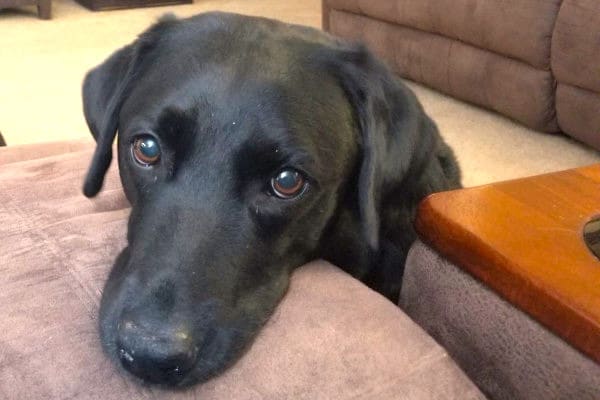
Lulu was a special little lady, a 10-year-old black Labrador Retriever. She was what I would call my “heart dog” — a dog with whom your connection is so special and strong that it forever leaves an imprint on your heart.
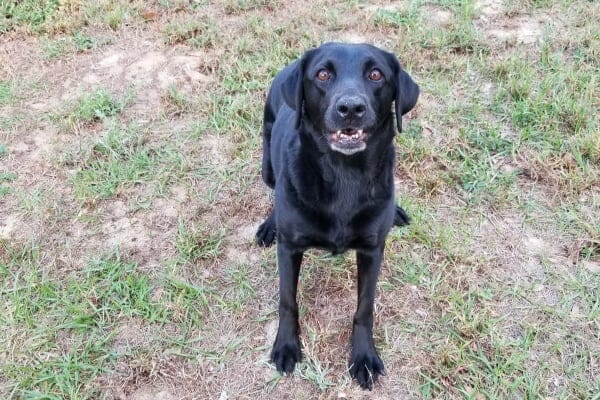
I adopted Lulu when she was only a year old. I had never owned a Labrador Retriever before, and I was so nervous. “They’re way too active,” I thought to myself. “I don’t think I can keep up with one!”
After adopting her, I realized I was completely wrong. I am 100% a Lab person. In fact, I don’t think I could go through life without one.
Lulu was always game for any activity, whether a walk to the dog park, a game of fetch, or a trip to the kitchen for a snack. She slept at the foot of my bed every night, was always in a good mood, and was by far the most well-behaved of all my dogs.
Although she was a healthy and lively girl, I knew from vet school that hemangiosarcomas were common in Labrador Retrievers. In fact, there were days when I would come across information about hemangiosarcoma in dogs and immediately think of Lulu.
Wishfully, I’d look right into her eyes and say, “Don’t you dare even think about getting one of those!”
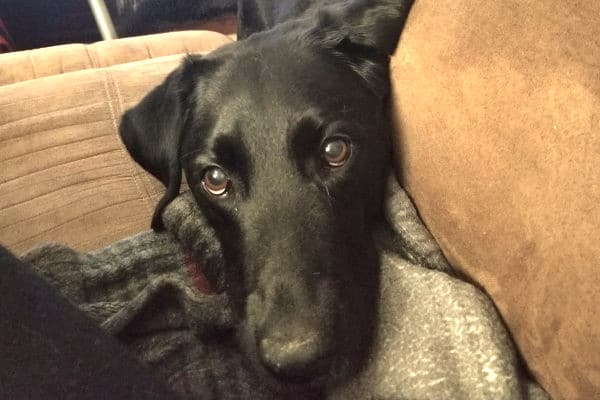
My heart dog’s hemangiosarcoma diagnosis
On the evening of September 4, 2019, Lulu was eating her dinner just like she did every night. Suddenly, she stopped halfway through her meal. Any Labrador Retriever owner will tell you this is highly unusual behavior!
She seemed to be okay as I patted her head and checked her for any obvious problems. She even gladly accepted one of her favorite treats. Unsure what was going on, I made a mental note to watch her closely for the next several days. Clarity would come way sooner than I expected.
The next morning, she didn’t want to eat anything. She was lethargic, sluggish, and tired. I had a sinking feeling that something serious was going on.

Since hemangiosarcoma in dogs causes blood loss and, therefore, pale gums, I moved toward Lulu to check her gums. My heart dropped. Her gums were pale. I loaded my beloved dog into the car and took her to work with me that day, readying myself for whatever news the day would hold.
Little did I know, surgery to remove a bleeding hemangiosarcoma in her spleen was in the very near future.
What are hemangiosarcomas in dogs?
Hemangiosarcomas are malignant tumors originating in the blood vessels of a dog’s liver, heart, and spleen. Scientists don’t know what causes these tumors to form. But they do know that certain dog breeds, including the Golden Retriever, German Shepherd, and Labrador Retriever, have a genetic predisposition to them.
Sadly, hemangiosarcomas are highly invasive. And the primary tumor can quickly spread to other parts of the body. Hemangiosarcomas on the skin are also possible, but they have a significantly lower chance of moving elsewhere in the body (metastasizing) and rupturing.
What are the symptoms of a hemangiosarcoma in dogs?
A dog’s symptoms will depend on the affected organ and whether tumor cells have expanded to other parts of the body.
Symptoms of hemangiosarcoma of the heart
Hemangiosarcomas of the heart tend to cause symptoms related to right-sided congestive heart failure in dogs and/or tumor rupture. Some potential clinical signs of a cardiac hemangiosarcoma include:
- Weakness or collapse—If the tumor ruptures or prevents blood from effectively circulating, the dog may seem weak or collapse and be unable to get up again.
- Exercise intolerance—When walking or playing, your dog may seem to get tired faster than normal.
- Coughing or difficulty breathing—You may hear your dog coughing or notice your dog breathing fast or breathing hard.
- Enlarged abdomen—Fluid build-up in the abdomen (ascites) from right-sided heart failure may give your dog a pot-bellied dog appearance.
- Lethargy—A lethargic dog may be lying around or sleeping more than normal or not be interested in daily activities.
- Sudden death—A ruptured cardiac hemangiosarcoma can cause your dog to unexpectedly die.
Symptoms of a hemangiosarcoma in the liver or spleen
Hemangiosarcomas in the liver or spleen also have the potential to spontaneously rupture and bleed. Before that, the dog may be asymptomatic or only have mild non-specific signs. Possible symptoms of a liver or spleen hemangiosarcoma include:
- Lack of appetite—Your dog may not want to eat anything, have a poor appetite, or only want to eat treats.
- Excessive panting—Even in a cool environment and without any exercise or excitement, your dog might be panting more than usual.
- Appearing weak—Dogs with a ruptured hemangiosarcoma may walk a short distance, then lie down or have trembling legs that look like they are going to give out.
- Collapse—With significant blood loss, the dog may be unable to stand.
- Pale gums—If you lift your dog’s lip, his or her gums might be a pale pink to white color rather than a nice bubble gum pink.
- Abdominal distension—A large tumor or a significant amount of blood filling the abdomen may make your dog’s belly look bigger than normal.
- Weight loss—Your dog’s body condition score (BCS) might drop even though you haven’t changed his or her food or exercise level.
- Lower activity level—Dogs with hemangiosarcoma may seem to be moving slowly or getting tired more quickly than normal.
- Death—Sadly, tumor rupture and subsequent bleeding into the abdomen from a liver or splenic hemangiosarcoma can lead to death.
Keep in mind, these are not hard and fast divisions. There can be some crossover of symptoms from one type of tumor to another, especially if the tumor ruptures. Plus, some of these symptoms can accompany other conditions.
How do you diagnose hemangiosarcoma in dogs?
Diagnosing hemangiosarcoma in dogs begins with a thorough physical exam by your veterinarian. If a tumor of the liver or spleen is large enough, your veterinarian may be able to feel it while palpating your dog’s abdomen. Your vet may suspect a cardiac tumor by listening to the heartbeat through the chest cavity.
An ultrasound of the heart or abdomen is one of the best ways to confirm these kinds of tumors. But because hemangiosarcomas appear quickly, routine screenings for detection in the early stages are often cost-prohibitive. Other diagnostic tests may hint at the condition, but by themselves are inconclusive.
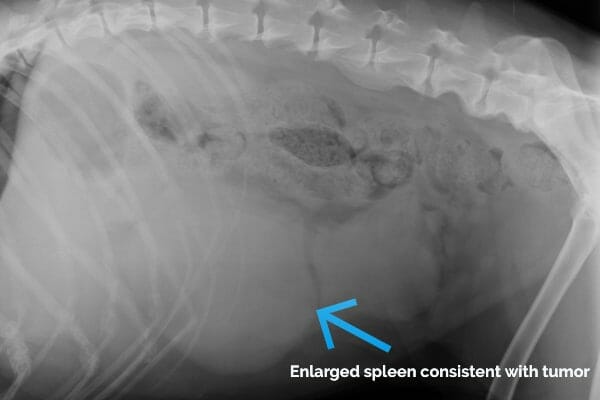
For example, blood tests for dogs may indicate mild to severe anemia in dogs (low red blood cell count). And X-rays might show an abnormal heart, enlarged liver, or enlarged spleen. However, that doesn’t automatically equal a cancer diagnosis. Additionally, some tumors are too small to recognize and go undetected until a dog presents with life-threatening symptoms.
How do you treat hemangiosarcoma in dogs?
Dogs diagnosed with a tumor that is suspected to be a hemangiosarcoma have several treatment options. Your vet will be able to explain each option and provide realistic expectations to help you decide what is best for your dog.
1. Surgery
After a tumor is found, your vet may suggest surgical removal, preferably before the hemangiosarcoma ruptures. If the tumor is in the spleen, your vet will remove the entire spleen (perform a splenectomy in dogs) and submit it to a laboratory to reach a final diagnosis.
It is important to send the tumor to the laboratory because not all tumors are cancerous. Hemangiosarcoma in a dog is a malignant (cancerous) tumor. But there’s always the chance the dog’s enlarged spleen is due to a benign tumor or process, which are “good” diagnoses.
It’s important to note that tumors on the liver and the heart are more difficult to remove surgically. So are hemangiosarcoma tumors that have spread to other body parts like the lungs, kidneys, brain, and spinal cord.
2. Chemotherapy
Chemotherapy is recommended in cases where the tumor cannot be treated with surgery. Dogs with severe anemia will need blood transfusion(s), and all hemangiosarcoma patients need to avoid blood-thinning medications. Long-term, twice-daily use of a unique herbal supplement known as Yunnan Baiyao for dogs may help prevent further bleeding.
What is the prognosis for dogs with hemangiosarcoma?
When determining the outcome for cancer in dogs, veterinarians look at the median survival time (MST). According to the National Cancer Institute, MST is the “length of time from either the date of diagnosis or the start of treatment for a disease, such as cancer, that half of the patients in a group of patients diagnosed with the disease are still alive.” In other words, MST represents how long patients (or our beloved dogs) survive with a disease after a certain treatment.
I’m sad to share that dogs with hemangiosarcoma who undergo both surgery and chemotherapy have a MST of six to nine months, while those who undergo surgery alone have a MST of two months. Overall, only 29% of dogs diagnosed with hemangiosarcoma survive one year. How long a particular dog survives also depends in part on whether the tumor had already metastasized (spread) at the time of diagnosis.
Loving—and losing—my beloved dog
After running a few tests on Lulu that September day, I discovered she was actively bleeding in her abdominal cavity, increasing the odds of a hemangiosarcoma. Because she was severely anemic, surgery was extremely risky. Humane canine euthanasia would have been a loving and logical choice, but I chose surgery to give my heart dog one last fighting chance.
A wonderful colleague started a blood transfusion for Lulu and performed her surgery. She found a large tumor on the spleen, the source of the bleeding. At the time, we didn’t know if it was a hemangiosarcoma, but because there were also abnormal lesions on the liver, it was likely that the tumor was malignant, and the cancer had already spread. We submitted her spleen to the pathology lab for testing. A week later, the lab results confirmed her hemangiosarcoma.
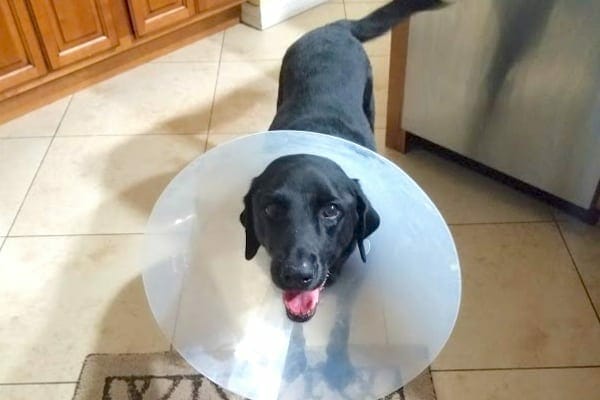
Post-surgery, I chose to forego chemotherapy and focus on Lulu’s quality of life. Just like before, I gave her plenty of tasty treats, loads of attention, and gentle games of fetch with her almost every night.
Three weeks after surgery, over the course of several days, she grew increasingly tired, lethargic, and uninterested in her food. My family and I knew it was time. We decided to say goodbye to our beloved dog.
Parting thoughts on hemangiosarcoma in dogs
Hemangiosarcoma tumors are among the worst types of cancer in dogs. They are difficult to detect on wellness exams and may only become obvious when your dog is in an emergency situation. Hemangiosarcomas usually have a guarded to poor prognosis because they spread quickly or abruptly rupture without any trauma, and the average survival time is low.
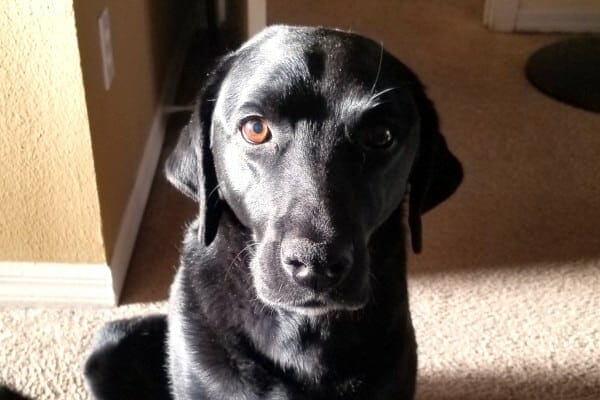
By sharing Lulu’s story, I hope you are now better equipped to recognize the signs and seek immediate medical treatment if you find yourself in a similar situation with your beloved canine companion.
While I do miss her dearly, I was happy Lulu could pass peacefully while my family said their goodbyes. She’s left nothing behind but treasured memories and tremendous love for all things Labrador.
Additional resources for facing the loss of your dog
If you’re making the difficult decision to say goodbye to your beloved dog, you may find comfort and answers in these resources:
- The companion article to this one that I also wrote: When To Euthanize A Dog With Hemangiosarcoma: A Vet’s Guidance
- Dr. Buzby’s complimentary ebook: Saying Goodbye to Your Dog: Counsel, Care & Comfort for the Journey
- Preparing for your Dog’s Euthanasia: 10 Thoughts for Peace
- Grieving the Loss of a Dog After Euthanasia
- Pet Loss Support: Groups & Resources for Comfort
- Helping a Child Through the Loss of a Pet
- In-Home Dog Euthanasia: Heartfelt Answers to 12 FAQs
- Dog Memorial Ideas: 10 Ways to Honor Your Dog’s Legacy
Has a diagnosis of canine hemangiosarcoma touched your life?
Share your experience below. Our community is here to offer you comfort and support during this difficult time.
This post was originally published on February 8, 2021. It has been updated to include more information on the signs of hemangiosarcoma in dogs.


Hi
Im in tears reading your story, i lost my beloved Monti November 12th 2021 he was a rescued dog.
Your story is exactly the same as my dog, seeing the picture with the cone
Reminded me that you went through the same situation, because we loved him so much and gave him alot of treats and take usual walks, and play with him.
My condolences for dear Lulu, and Just wanted to say to all dog owners you are not alone, there are more like you, Just like i read from a post let the time pass and youll learn to live again, maybe something is missing but if you have memories with you, it will be alive forever within you.
Dear Andres,
Thank you for the kind words. I am sorry your heart is aching for your sweet boy Monti. You are right to say that a piece is missing from our lives after we say goodbye to a beloved dog. I hope that with time your heart will heal and find peace. May Monti’s memory continue to be a blessing.
Dr. Buzby, if I may, I have a very important question that is leaving a heavy weight on my mind as to could I/ should I have helped my baby when I thought he had an injury and didn’t start doubling his Yunnan Bayeo. I lost my heart dog Moki, a Doberman/Belgian Melanois pup on 3 Sep @ 17:57. @ 17:55 I had no idea this was going to happen. He was a Hemophiliac type A and only 3 yrs and 10 months old. Early last year, when we almost lost him, Texas A&M surely saved his life and at the same time we were told he had either a splenic tumor or a dried up Hematoma at the spleen. Throughout the year we had X-rays done and sonograms to stay informed if it was growing. He also had several transfusions at different time when he was bleeding but it was always controlled and brought his clotting time at a normal level. In August, when fostering a puppy, he came running up to me happy as always but ran into the lead I was holding the puppy on. It caught him square in the chest. I did watch for several days but saw no increased swelling to indicate he was bleeding internally. I should mention that he had been on a daily regime of Yunnan, blood support, joint support, pred, and supplements and was well cared for as the ER vets told us constantly when he came for a blood transfusion due to swelling mostly in his legs. Several times they suggested that as he was incurably ill we should humanly euthanize him. We refused as he enjoyed his life to the fullest. Loved being in the pool with his pappa and just being loved on, although he was never allowed to play with the rest of the pack and lived his own life with us.
On 2 Sept he wasn’t eating and lethargic, I thought nothing of it because there were days like this and he would be ok the next day, no swollen belly, nothing. On the evening of the 3rd right after his pappa gave him his meds, he lost his footing in his hind legs and went down. We picked him up laid him on his bed and I straightened him out. I looked at his face and it was distorted in agony, I had never seen him like this and he was cramping up his front paws as if he was in a horrible pain. Then I screamed for my husband that he was dying, I just knew it, and he was gone. Then I noticed on his chest a bruise, Dark purple and blue, I immediately remembered he had run into the lead 10 days ago but never saw any indication.. Later I read I could have increased his Yunnan by more than doubling it had I suspected he was bleeding but I didn’t..
My question, did this indicate a tumor that bled out quickly, or did the run in with the lead cause a bled but only slowly due to the Yunnan he was taking and I should have increased it? I have a heavy weight resting on me, I miss him unbelievable and my grieving is indescribable.
Thank you for your thoughts,
Dear Wilhelmina,
I’m so sorry to hear of your loss. It is never easy losing a dog, especially a heart dog. Moki was lucky to have been so loved. As for your question, without a LOT more information it would be impossible to say. If you had given him double, the outcome might still have been exactly the same. We really don’t know what happened and I know Moki would not want you living with that guilt. I sincerely don’t think it is yours to carry. I would like to include a link to our free ebook on saying goodbye: https://shop.toegrips.com/products/saying-goodbye-to-your-dog
I hope you are able to find peace and let this heavy weight go. Let Moki’s memories be a blessing.
Dear Dr;
So sorry for your loss. I am beating myself up at the loss of my Cassie, a great pyrenees lab mix. I lost my husband and she has been my rock. She began pacing and staring at walls one night after a visit to vet for anal sac extraction. We all thought she was sore from that and vet put her on an anti-inflammatory, she got better but I thought her belly looked full a couple weeks later and that is when the spleen tumor and hemo belly were found on xray. She had her spleen removed but multiple tumors were on her liver with one that had a clot. She did great after surgery but pathology came back as cancer. I was told at best 1 to 3 months and no chemo would help. My anguish is this, A week later I got a weird vibe from her, nothing specific but I gave her a yunnan baiyou capsule because I was uncomfortable. The next day I had promised her a walk but when she got up she wouldnt eat. She seemd ok otherwise and we went for our walk on a beautiful sunny day and took many pictures. She slept the rest of the afternoon and very late that night when I took her out she didnt make it to the grass to pee and went in the driveway. I knew we had problems as she was the best girl. She wouldnt go up the steps to get back in our house and layed in the sunroom. Her belly was pulling in and out like cramps at some points but then would stop for a long time. I gave her a yunnan baiyou capsule again and called the emergency vet as it was midnight on a sunday. I wanted to know if I should give her the emergency red pill since I just gave her the capsule and what they would do If i brought her in. I knew I would not put her through surgery given she just had a major one and her life expectancy didnt warrant her going through that hell. They said the doc wasnt available and couldnt answer my questions. I in fact i called them again with no help. Ididnt want to do more harm than good and was not sure in fact it was a bleed so I was afraid to give the red pill. SInce I couldnt go in with her at this hospital due to covid and how cold they were I decided to try to make it till morning to go to our regula r vet. They had told me the surgery team wasnt in that night and I just had visions of her laying in that place being poked and proded and stuck in a kennel alone. She made it but in the morning her gums were white and she tried standing andher back legs went out from under her.But all through this she visibly looked great. She is a 100 pd girl so we put her on a bedspread and went to vet who said our only choice was the emergency hospital for blood and they would have to do exploratory surgery to stop the bleed or let her go. My vet felt letting her go was the answer and I didnt want to put her through hell.. Im devastated and can hardly go on. She was my everything and I feel as though I let her down but not giving her that red pill that I since found out I could have. Her surgeon feels it would not have saved her anyway but i am being tormented by this. I wanted to do the best I could for her as she has done for me. Any thoughts? Im in anguish.
Dear Lynette,
Thank you for sharing your story of Cassie with us. My heart breaks for you. It sounds like she was a very special girl. I know it can be so easy to get caught up in the “what ifs” but I think you made the right decisions for her, and you knew when it was the right time to say goodbye. She was very lucky to have had you as her family. I’m so glad that you got to have that special walk on a beautiful day and take pictures. That is a memory you can treasure, along with the many other wonderful memories you made before. I understand how difficult it would be to not know if you should have given her the red pill, but I agree with your surgeon. I don’t think it would have made much of a difference in the outcome. Unfortunately, with several masses on her liver, it was probably just a matter of time before one of them ruptured and bled significantly. But still, the splenectomy surgery gave her another great week with you and the chance to have that last memorable walk. So in my opinion, you did do the best you could for her at each step. I hope that in time the guilt and grief will ease a little and you can find a measure of comfort.
I would like to include a link to my ebook, Saying Goodbye (). I have made it free for everyone to read and I hope that it helps you as your grieve this loss. Click the link, place it in your cart and check out.
My dogs was just Diagnosed with this same cancer. She is 14 and not a big dog. They don’t want to do a biopsy because she’s too old? So it is not not sure. So after several days of not eating or drinking she is starting to come around and looks much better. I have been taking her to the lake and spending time with her while my other 3 stay home. I feel like I cannot have her put down if they can’t say for sure she has it?
Hi Paula,
So sorry to hear that your pup may have hemangiosarcoma. I understand how hard it is to not know for sure what is going on. If knowing with certainty that she has hemangiosarcoma would help you feel more peace with enjoying her last few days or weeks and then making the decision to say goodbye, there is nothing wrong with seeking a second option with another vet and/or asking for a referral to a veterinary oncologist. I am glad that you are able to have some special one-on-one time with her at the lake regardless of what the outcome ends up being and I hope that you are able to find the answers you are seeking. Sending hugs as you navigate this difficult path. ❤
Our sweet lab mix Molly (age 6-7ish) was just diagnosed with a very large abdominal tumor two days ago after taking her in for some urinary incontinence and a brief period of lethargy, anorexia and presumed belly pain a week prior that had self-resolved. They are most concerned about it being a splenic tumor, and likely a hemangiosarcoma, but she currently does not have signs of acute bleeding and was not anemic on her labs. They do think that the episode last week of not eating might have been associated with a small rupture and bleed that eventually got walled off and contained on its own. We’re taking her today for more comprehensive imaging before deciding on surgery vs. keeping her comfortable until the time comes when it’s too much. These are never easy decisions–we just want to do what’s best for Molly.
Hi Danielle,
So sorry to hear about your sweet Molly’s potential splenic tumor. It is always devastating to get this kind of news. I am glad to hear that you are doing some comprehensive imaging today that will hopefully give you more information about the tumor. If this does end up being a splenic tumor, you may find this article helpful: Splenic Masses in Dogs: Types, Diagnosis, Treatment, and Prognosis. It has some good statistics and information that could be beneficial as you navigate this difficult time. Fingers crossed that it is a benign mass such as a hemangioma! ❤
Imaging last week showed that it indeed was coming from her spleen and no obvious signs of metastasis in her belly. She had a chest x-ray that was negative for lung metastasis. They also looked at her heart with ultrasound and it all looked normal. We decided to go ahead with surgery this past Friday–she’s post-op day 6 now and has been home for 5 days. She had a 7 lb 5 ounce tumor coming off her spleen (our vet sent us pictures at our request and its crazy how big it was!!!). The entire tumor was removed as well as her spleen and she is doing quite well post-op–eating great, better energy, being her sassy self again. We’re awaiting pathology results still, but keeping our fingers crossed it will be benign!
Hi Danielle!
Thanks so much for the update on your sweet girl!!! I’m so glad that she is doing so well post-op. It sounds like you made a good decision to go ahead with surgery. That is a huge tumor! As strange as it sounds, that may be a good thing because anecdotally (and in some studies) it seems like the ones that have time to get that big without a life-threatening bleed or obvious spread to other sites are more likely to be benign. If you think about it, please update us when you get the pathology report. Fingers crossed for good news!
Hi there ! Took a while for me to get back in touch, but Molly is doing GREAT! I’ve been crazy busy in the last two months–I’m a pediatric resident applying/interviewing for pulmonology fellowship programs right now. Anyway, we got the tumor pathology report back a while ago and all cuts were consistent with a benign myelolipoma! Your thoughts on the growth of the tumor were right, and that’s what our veterinarian had thought going into surgery too. She’s been doing so amazing since surgery though… we even got her out hiking a little. Her belly is all healed up and she’s a happy (and sassy) girl!
Hi Danielle,
Yay! I am so excited to hear the good news from Molly’s pathology report! Thank you for the update. I am glad she is able to get out hiking again and doing things that make her happy. Enjoy making memories together and good luck on obtaining your fellowship!
This is almost the same thing that happened to my sweet Coby last week. He had internal bleeding and was a step away from dying so we went ahead with emergency surgery after he got a blood transfusion. They removed the spleen with the huge tumor but also found 3 tumors in his liver and only 1 could be removed. The other 2 had signs of bleeding as welll and they did what they could to stabilize them. We took him home with us after he spent 1 day at the hospital recovering, the vet told us it was best to spend as much time with him because he didn’t have much left and we just stayed by his side for the next 36 hours. We had to make the difficult decision to let him go, even though we didn’t have the biopsy results the vet told us it was extremely likely it was hemangiosarcoma (now we have the results and it was that). I feel so guilty for having put him in the stress of surgery but we were told there was no way of knowing what he had without it (and I guess hindsight is always 20/20). And then having to say good bye only after a couple of days after surgery made me feel guilty as well. However, we knew that the other tumors would rupture any second and there was nothing else they could do for him when that happened. We decided we couldn’t let him go through everything again and we had to let him go. It has been the hardest thing…. Now that I have been sharing my story to family and friends, a lot of them have heard or gone through similar things. It seems this type of cancer is almost an epidemic, is there an agency or organization looking into this? What can we do to raise awareness and promote research? Thanks for this post, it makes me a little bit more comfortable with the choice that we made.
Hi Ariane,
What a difficult few days. I’m so sorry for the loss of your sweet Coby. I understand how easy it is to second guess the decisions we make, but please don’t feel guilty for choosing to pursue surgery for him. Like you said, you didn’t know for sure that it would be hemangiosarcoma or that there would already be tumors on his liver that could not be removed. I hope that in time you will be able to find comfort in knowing you made the decision in the heat of the moment that you thought was going to be best for him.
There are several organizations (AKC Canine Health Foundation, Morris Animal Foundation and others) as well as many veterinary colleges (University of Minnesota, Cornell University, Tufts, and others) that have conducted or are conducted research on canine hemangiosarcoma. If one of those organization’s studies or mission statements really resonates with you, you could always consider making a donation to that vet school or organization in Coby’s name to help fund continued research. Additionally, telling Coby’s story, just like you have been, is another great way to raise awareness. It is such a devastating disease and like you, I hope that as researchers continue to learn more about it, they will continue to make advances in diagnosis and treatment as well.
So sorry again for the loss of your sweet boy. I’m sure his passing left a huge hole in your heart and your life. ❤
Two days ago, my lab Boomer Was diagnosed with this cancer-it was in his heart (right chamber I believe). Euthanizing was the only option since his chest was full of blood and breathing was a chore. It was a very difficult decision because the day before he was running around with the family. This cancer is so unfair because we weren’t given the option to try to save him and we were given no notice. It saddens me to think about how his last hours were spent in the car as we rushed him to different facilities for second and third opinions. We just couldn’t accept the truth. I hope that more research is conducted so that in the future, more dogs have a fighting chance.
Hi Lori,
So sorry for the loss of Boomer. It is so difficult when a dog is healthy and happy one moment and so very sick the next moment. Like you said, hemangiosarcoma is terrible in that most of the time there are no warning signs before the tumor begins to bleed profusely. I am confident that Boomer knew how much you loved him and had a wonderful life with you. Please don’t feel guilty about how the last few hours were spent. You were trying to pursue all options for him and doing what you thought was best. Sending hugs as you mourn this loss. ❤
What a beautiful but sad story. Lulu was certainly a lovely dog and was given a wonderfully caring family. My thoughts are with the family on the loss of their beautiful pet.
Rosemary, thanks for your kind words and condolences. ❤
So sorry for your loss!
We lost our Chica (Dane/Lab mix) to this suddenly as her tumor had burst and she was failing quickly. She was going for wellness checkups twice yearly including full lab work and had been a very healthy 11 year-old prior to this. I had never heard of Hemangiosarcoma tumors before her health crisis and have always wondered what we could have done to prevent what happened to her. Thank you for your article which helps explain the cancer and how suddenly things can change.
Hi Marcy,
I’m so sorry for the loss of your sweet girl Chica. It is always hard to lose a beloved pet, especially when it is sudden and unexpected. It sounds like you did everything right for her. Please rest assured that there is absolutely nothing you could have done to prevent her from developing a hemangiosarcoma or to keep the tumor from rupturing. I’m glad the article was able to give you some closure and I hope you find comfort in the wonderful memories you made with Chica. ❤
Thk you for sharing Lulu life story. I was glad she spent her living years with a loving family. Yes, I still miss her. Like I miss my Smoochie, and Kayla, and Jackie.
Hi Mirta,
My sympathies on the loss of your beloved Smoochie, Kayla, and Jackie. Our pets leave their pawprints in our hearts and lives forever and their absence can be so difficult. ❤
13 year old Lucy the black lab’s problems (who looks a lot like Lulu) began going off her food on April 10th 2025, together with having diarrhea every time she needed to poo.
Her appetite began to deteriorate & like Lulu, she totally refused all food, including her beloved fish, except treats.
But the trouble was that the treats made her diarrhea worse but she simply refused to eat her prescription diet.
During the following 2 months we’d taken Lucy to the vets 14 times and they all claimed it was gastrointestinal but it wasn’t quite sitting right with me.
O.n the 15th vet appointment they decided to do a fast ultrasound scan and told us the dreaded news that she can see a large mass on her spleen.
I began investigating splenic tumours and thought it would be a haemangiosarcoma but lived in hope that it wasn’t.
Due to the chance of rupture, it needed to come out.
We then booked her in for an in-depth ultrasound and x-ray with a view to going straight into surgery.
They then rang to say that they’d performed the U.S/X-ray and couldn’t find any further nodules anywhere, including within her lymph nodes.
We requested that they operate.
After the operation they rang to say that it was successful and that 2 large tumours were on her spleen which were pressed against her stomach, hence her lack of appetite.
She said that she’d send them off to histology and ring us in around a week with the results.
Suffice to say that 17 days ago, we received the results that it is a haemangiosarcoma.
We were absolutely devastated.
3 days ago they performed another fast scan U.S to check for free fluid and fortunately they couldn’t find any.
She’s been absolutely fine up until a few days ago in terms of her appetite but unfortunately it is beginning to deteriorate the same way and her poos aren’t as healthy looking.
I suspect that we will have slightly longer with Lucy than Lulu post-splenectomy because they haven’t found any evidence of spread and as I understand it Lulu ‘s had already metacised to her liver.
We aren’t opting for chemotherapy and we’ll just enjoy the last few days, weeks or months with her, however long we have left but the minute that we know that she is beginning to suffer, we’ll have to say goodbye, despite this being extremely painful for us.
Lucy’s very lucky because she’s old for a Labrador and will be 13 and a half on 16th July 2025.if she makes it that far.
Labradors are such beautiful dogs and I can understand how you got so attached to Lulu and I’m sorry that she departed your life and this world a few years too early.
Dear Amy,
My heart goes out to you as you spend these final days with your beloved Lucy. Try to make the most of the time you are gifted and look for joy in unexpected moments together. Praying for comfort and peace for everyone involved. Bless you and your sweet girl. ♥