Spondylosis in dogs is a common condition often seen in older pets. Integrative veterinarian Dr. Julie Buzby describes risk factors, symptoms, diagnosis, and treatment options for spondylosis in dogs. By knowing what to watch for and what to do if spondylosis develops, you will help your senior dog continue to thrive.
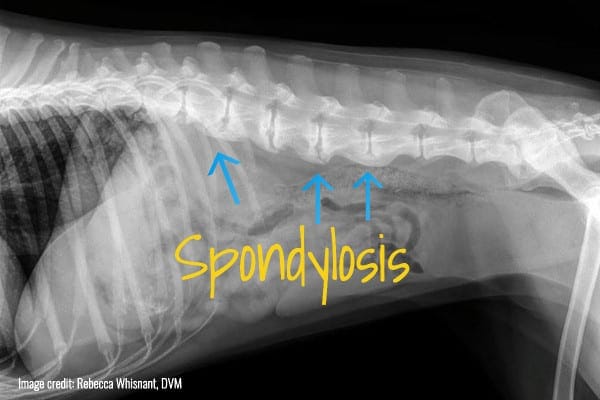
If your dog has been diagnosed with spondylosis, you may be wondering what the future holds. Although X-rays may look dramatic and scary, this condition affects a lot of my senior patients. In this article, we’ll explore what spondylosis is, as well as its causes, symptoms, and risk factors. We’ll also take a look at how vets diagnose this condition, and explore treatment options that have the potential to make a big difference in your dog’s quality of life.
What is spondylosis in dogs?
Spondylosis (spondylosis deformans) is a degenerative condition that affects a dog’s vertebrae—the bones that make up the spinal column and protect the spinal cord. A dog with spondylosis deformans develops bone spurs, also called osteophytes, on the edges of the vertebrae. In some cases, spondylosis is considered a normal part of aging for older dogs.
Dogs with spondylosis often do not show any obvious outward symptoms at all. However, I do believe dogs sometimes display subtle signs of pain and “restriction” of movement related to spondylosis.
How does spondylosis occur?
In order to better understand how spondylosis in dogs occurs, it helps to know a little bit about the anatomy of a dog’s spine.
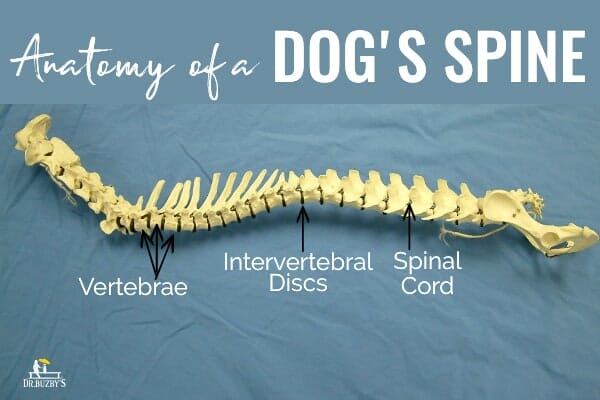
Just like in humans, your dog’s spinal cord is a large bundle of nerves that connects to the base of the brain and runs down the neck and back. The spinal cord has nerve roots that send signals from the brain to the rest of the body. Without the spinal cord, dogs wouldn’t be able to walk or perform their everyday tasks.
Bony vertebrae encase the spinal cord to protect this essential part of the nervous system. Spaces between the vertebrae, which help maintain the back’s flexibility, are cushioned by intervertebral discs—small, soft pads that act as shock absorbers for the spine.
Knowing how to keep your dog’s spine healthy can prolong his or her ability to live and move comfortably.
What causes spondylosis in dogs?
For the most part, the cause of spondylosis in dogs is simply a result of normal wear and tear on the ligaments that connect the intervertebral discs to the ends of the vertebrae. As stress and strain cause microtears in the fibers that make up those ligaments, the body tries to compensate by laying down new bone (bone spurs) on the ends of the vertebrae.
Bridging spondylosis in dogs
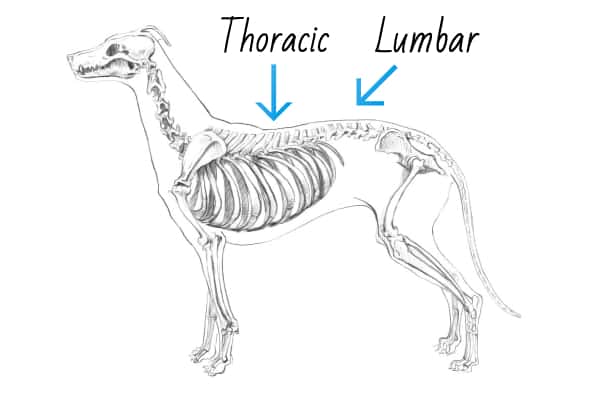
As this condition progresses, bony spurs of spondylosis deformans can grow large enough that they touch neighboring spurs and form a “bridge” between vertebrae. This is known as bridging spondylosis. These bony bridges typically form along the thoracolumbar spine, most commonly in the lumbar spine over the lower back.
What are the risk factors for spondylosis in dogs?
Spondylosis can affect any middle-aged to older dog. Generally, in most dogs, changes may occur by age 10. Although it was previously thought to be more prevalent in large breed dogs, spondylosis can develop in any breed. As explained in an article from the National Library of Medicine (NIH), it is commonly seen in Boxers, which suggests there may be a genetic predisposition.
Any physical insult to the joints of the spine increases the risk of developing spondylosis. For example, if a dog suffers a traumatic injury that compresses the intervertebral disc spaces, the resulting joint instability predisposes bone spur development in this area.
Similarly, a dog with intervertebral disc disease is likely to develop spondylosis in the affected area since the diseased discs impact stability in those joints.
Essentially, spondylosis is the body’s attempt to protect the weakened joint or joints of the spine by laying down extra bone to stabilize them.
What are the symptoms of spondylosis in senior dogs?
As mentioned above, in most cases, dogs with spondylosis don’t show any outward symptoms. The classic changes in the backbone that we see with spondylosis are not usually responsible for evident pain or lameness. Rather, the condition is most often found incidentally while diagnosing another health condition.
The unique X-ray (radiograph) below perfectly illustrates how spondylosis in dogs is often diagnosed. My colleague, Dr. Jaime Wright Carroll, saw this patient not for back problems, but for gastrointestinal distress.
Abdominal X-rays revealed Dr. Carroll’s patient not only had gastric dilatation and volvulus (GDV), also known as bloat in dogs, but also had two unexpected incidental findings.
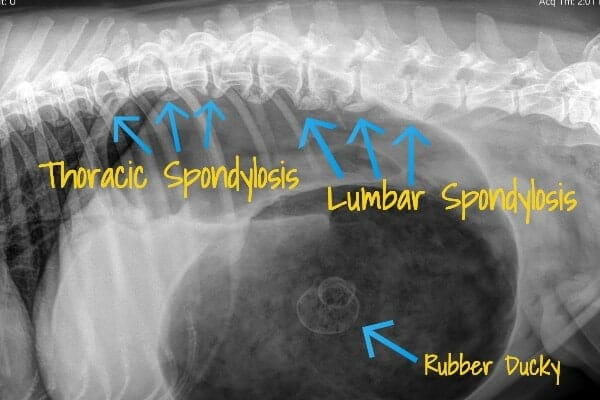
Along with bloat, Dr. Carroll found spondylosis deformans in the dog’s spine. If you look closely at the X-ray above, you’ll see the telltale bone spur “bridges.” She also found a surprise foreign body in the dog’s stomach—a rubber ducky! This pup headed in for emergency surgery to address the GDV and remove the ducky ASAP.
3 symptoms of spondylosis in dogs
Your dog may or may not display symptoms from this “remodeling” of the vertebrae. Severe changes of the vertebrae can potentially put pressure on the spinal canal, resulting in back pain.
Here are three signs of spondylosis to watch for on behalf of your senior dog:
1. Changes in walk
Instead of smoothly swaying from side to side, you may see your dog’s back stiffen and fail to move freely. A stiff gait is not just a sign of leg pain, but can be a common symptom of a sore back. Your vet will perform a physical exam to localize pain if your dog has changes in gait.
2. Change in movement
Your dog’s back may seem rigid, and they may avoid ambitious movements like jumping up or rolling over. You may notice your dog reluctant to turn his head from side to side, or having difficulty maneuvering to reach certain parts of the body.
3. Change in comfort level
If your dog’s bone spur grows large enough to pinch the delicate nerve roots along the spinal cord, he may show signs of pain in dogs and be very sensitive to touch along his back. Some dogs will whine, yelp, or even snap if painful areas of the back are touched.
How does a vet diagnose spondylosis in senior dogs?
Vets use X-rays of the spine to diagnose spondylosis deformans in dogs since the distinctive bone spurs of spondylosis generally show up readily on X-rays. If your vet suspects damage to the spinal cord or inflammation of the nerves, he or she may also recommend advanced imaging. Magnetic resonance imaging (MRI) or CT scan can rule out other issues and ensure appropriate treatment.
The X-ray below confirms a diagnosis of spondylosis for this dog.
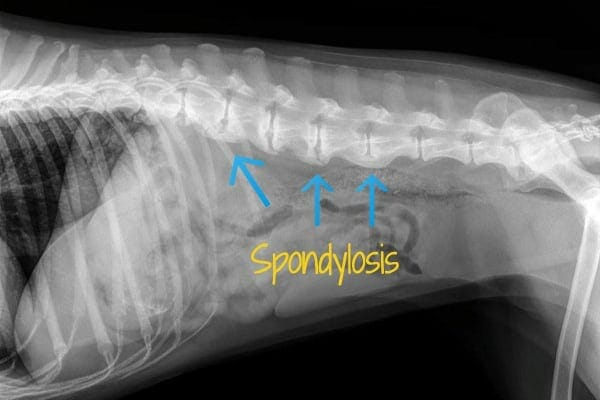
Photo credit: Rebecca Whisnant, DVM
How do you treat spondylosis in dogs?
If your dog has spondylosis but isn’t experiencing pain or discomfort, he or she may not need treatment right away—or ever! But you and your vet may want to discuss adding a joint supplement for dogs to protect those joints from further degeneration.
1. Supplements to help slow the development of spondylosis
Ingredients like glucosamine and chondroitin help keep canine joints flexible and healthy. Therefore, supplements may be helpful in slowing the development of spondylosis.
If you’re trying to find the best supplement for joint pain in dogs, my go-to product recommendation for protecting the health of the joints between the vertebrae is Encore Mobility™ with green lipped mussel and New Zealand deer velvet.
In very rare cases, surgery may be necessary to remove spurs that are causing spinal cord compression. In this unlikely scenario, your vet will likely refer you to a veterinary neurologist or surgeon.
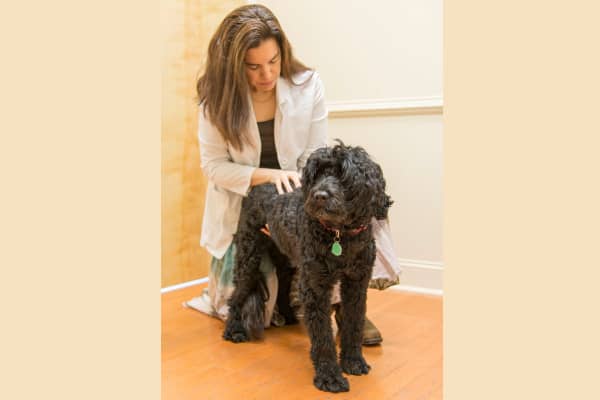
If your senior dog is experiencing back pain, spondylosis is unlikely to be the underlying cause. Anything’s possible, but there’s a laundry list of conditions that I’d be concerned about before pinning the pain on spondylosis.
2. Medications for pain relief
Whatever the root cause, back pain can often be helped with pain medications. Non-steroidal anti-inflammatory medications (NSAIDs) can reduce inflammation in and around the joints. Other medications such as gabapentin for dogs help relieve nerve pain, which is especially helpful if back pain is caused by pressure on the spinal cord or nerve roots.
3. Physical therapy and acupuncture
Veterinary acupuncture for dogs, animal chiropractic, and physical therapy are highly effective methods for mitigating pain and improving mobility for dogs with back pain.
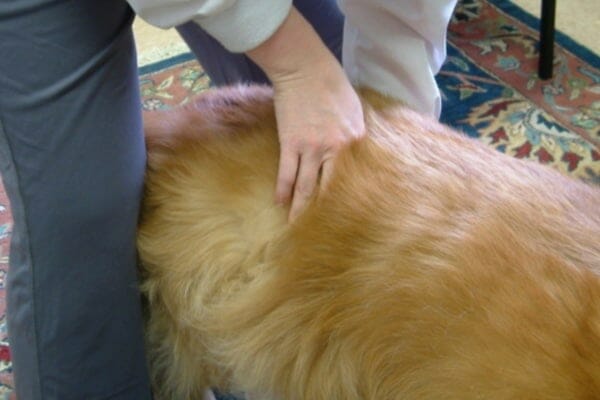
Some veterinary rehabilitation clinics have special tools like underwater treadmills for dogs to help maintain range of motion and muscle mass in dogs with low impact exercise.
4. Weight loss (if indicated)
If your dog is overweight, this is the #1 thing you must address to protect your dog’s spine. Your veterinarian can advise how much weight your dog should lose and can help you formulate a personalized diet plan. Lower calorie foods and controlled exercise can facilitate weight loss.
If you’re unsure whether your dog is overweight, you’ll want to “find your dog’s number” on our canine body condition score chart.
Since present-day pups live longer than their predecessors, they’re more susceptible to joint damage and inflammation over time. Joint inflammation is commonly known as arthritis in dogs. Spondylosis has been likened to arthritis in the spine. However, unlike arthritis, there is not an inflammatory component with the bony changes. This is a blessing because inflammation means hurting.
What is the prognosis for dogs with spondylosis?
Generally speaking, spondylosis itself does not usually impact a dog’s quality of life. Unfortunately, without surgical intervention (which is usually not needed), we cannot reverse spondylosis. Our focus is generally managing spinal health through joint supplements, exercise, and weight control to slow the progression and try to prevent or delay the onset of painful arthritis.
A common disease in senior dogs
Although it is quite common, we generally do not even know that most senior dogs have spondylosis. It is most often diagnosed incidentally, when we take X-rays of the chest or abdomen for a different reason. Because it is not an inflammatory condition, veterinarians generally believe spondylosis deformans is not painful in dogs. However, being aware of symptoms of back pain in dogs can help you identify subtle signs that may indicate your dog has some pain.
Your veterinarian will have your dog’s back on this one (pun fully intended!). Even if your dog’s spondylosis diagnosis is an incidental finding not associated with back problems, ask your vet how you can be more intentional and proactive in maintaining mobility. Your dog will thank you for it!
Has spondylosis affected your senior dog?
Share the subtle signs you first noticed that led you to seek help from your veterinarian. How is your four-legged friend doing today?



My almost 10 year old boxer was diagnosed with severe spondylosis deformans causing nerve compression and knuckling of her back right leg. She was slowing down a little, but the severity of symptoms came on very quickly and she quickly could not stand from a laying position, difficulty walking, incontinence, and significant muscle atrophy in her right back leg. We attempted a high dose of IV steroids over 3 days while monitored at the vet and continued high dose of steroids at home in conjunction with gabapentin. Unfortunately, the high dose of steroids had to be titrated quickly due to an ulcer developing. We did see improvement in her mobility and incontinence, but the nerve was clearly still compressed and her right foot still knuckling over. We consulted a neurologist and were hopeful it might be IVDD that could be helped with surgery, but confirmed with an MRI the spondylosis was causing compression of the right L6 spinal nerve. That said, I have hopeful news for others dealing with similar issues. The neurologist administered a steroid epidural after the MRI and my boxer responded positively and immediately to the steroid. That day, and now a week later, her back leg has stopped knuckling. She is regaining muscle in the affected back leg and she is able to walk again and even tries to hop, jump, wiggle, as she did before symptoms. (We are working on still keeping her calm and limiting her movement.). We are going back for a second steroid epidural 2 weeks following the first injection and then a month following the second injection. The side effects of the steroid epidural were much more benign than oral steroids as well. In reading about spondylosis, I had not heard of this option and wanted to share its benefits with other readers. Unfortunately, as boxer owners, this is something common to the breed, despite all efforts to keep our boxer at a healthy weight and minimize jumping and activities that would cause micro-injuries to her spine.
Hi Katie,
I am sorry your senior girl has been through much over the past few months. What a blessing the epidural offer such amazing benefits without the nasty side effects normally seen with steroid treatment. Thank you for sharing this wonderful information with us as I am certain this will be extremely helpful for others. Wishing your sweet girl all the best for continued improvements and many happy days ahead!
My almost 11 y/o boxer was diagnosed with spondylosis in October. X-ray already showed multiple sits of bridging. I am concerned there is more going on. He is on gabapentin and Rimadyl for the pain. His back end sags to almost the floor when he stands or his legs spread out to the sides. This has gotten worse since October. I have also notice that he seems like he cannot find us at times. Lastly, he becomes very anxious in the evenings. Any suggestions would be appreciated.
Hi Daneen,
I understand your concern for your Boxer and think it is good you are searching for advice. Many of the symptoms you describe sound like early stages of dementia/cognitive dysfunction which is very common in senior dogs. I will attach links with more information and options for pain control. Hoping you can find the best way to offer your pup relief. Best wishes to you and your sweet boy.
1. Signs of Dementia in Dogs: Stages, Symptoms & Treatment
2. How to Relieve Arthritis Pain in Dogs: The Ultimate Guide
3. Natural Pain Relief for Dogs: 17 Methods from a Vet
4. Amantadine for Dogs: Everything You Need To Know
5. CBD Oil for Dogs: Facts, Benefits, Concerns [2024]
Hello, thanks for your article. My dog (whippet) is only one year old and has just been diagnosed with spondylosis (routine X-rays to check his legs and because he has slight tremors in the front legs at times). You talk more about old dogs. Given that my puppy might still be growing and things are changing in his body, can I still do something to reverse the deformation or avoid worsening? Vet said it’s probably congenital, and also I know that my puppy had bad nutrition. At 2 months old, he came with rickets (that are gone since).
It’s an energetic breed, so I can’t stop a whippet puppy from running and sprinting.
Thank you
Hi Christine,
I am so sorry your young pup is already developing spondylosis on his spine. While this site is geared toward senior dogs, much of the information pertains to these same diseases and conditions in dogs of any age. The section that discusses treatment options has recommendations that work for any age. Also, the paragraph just below that discusses prognosis holds true for young dogs as well. Ultimately, there is no way to reverse the damage that has already been done, but you can try to slow the progression. Medications, supplements, and therapies that aim to reduce inflammation and strengthen muscles to help stabilize the spine will be your main focus. Hoping you can find what works best for your pup. Wishing you and your sweet boy many happy years ahead.
Hi! Thank you for posting information on spondylitis, I have a 13 year old German shepherd who within a matter of weeks stopped walking altogether. We took him to the vet and they said it was spondylitis, however he doesn’t seem to feel his back legs anymore. They prescribed us Dexamethasone, Gabapentin and Antinol+ however I’ve seen no improvement in him, in fact he’s been doing worse and now can’t even sit himself up so he’s just lying on his side. He also seems to be in a lot of pain but keeps eating and drinking water fine. Are there any recommendations as to other things we can try? Or if it’s even spondylitis?
Hi Paloma,
My heart goes out to you as you face this worrisome situation with your Shepherd. I understand your concern and do think there may be something else going on here. While a bad case of spondylitis is still a possibility, with this breed, I am always suspicious of Degenerative Myelopathy. Here is a link to another article with more information: Degenerative Myelopathy in Dogs: Stages, Symptoms, Care
I highly recommend you talk to your vet about more in-depth testing or even ask about a referral to a specialist if needed. Your boy is lucky to have you advocating for his health and well-being. Praying there is a way to offer him relief and comfort. Bless you both. ♥
Thank you for this information. Our 10 year old mixed breed dog – Lab, shepherd, pit mix has been experiencing regurgitation and vomiting the past year or so off and on.
Most recently over the past week she has continued on a daily basis to regurgitate/vomit her morning meal along with her dinner. Talked to her Veterinarian who prescribed a daily antacid which didn’t seem to make a difference with Continued gastric distress.
(Still very active and alert though having difficulty jumping into the car or bed where in the past she flew through the air like a reindeer.)
In to the Vet’s office we went with blood work and X-rays taken. Blood work for kidney, liver, electrolytes all WNL as well as cancer screen markers. She did lose 8 lbs since her last visit a couple of months ago
70lbs down to 62lbs.
X-ray showed Spondylosis which is causing bloat/ gastric distress. Added a different antacid so we are hoping for the best.
Hi Ann,
I’m glad to hear that your dog’s blood work, X-rays, and cancer screening were normal!
As a point of interest, do you think she is vomiting or regurgitating or both? Typically regurgitation is passive (i.e. no retching or abdominal contractions) and the food is undigested. And vomiting is an active process with retching/heaving and the food may be digested or contain bile. It is helpful to distinguish between them because the causes of vomiting are different than the causes of regurgitation. If it is regurgitation, it may be worth screening for megaesophagus or other esophageal issues if the vet has not already done that. Here is an article on megaesophagus if you want to learn more: Megaesophagus in Dogs: Causes, Symptoms, Treatment
Fingers crossed the new antacid will do the trick so that she can keep food down and get some weight back on (or at least stop losing weight). If it doesn’t, please check back in with your vet!
My Labrador had the same symptoms. Omeprazole, famotidine nothing helped. A gastric bx showed h pylori. Once the h pylori was treated we never had a problem again.
Hi Joanne,
Thats very interesting. Thanks for sharing!
Hi there,
I lost my beautiful Pekingese-Pomeranian mix last week on his 4th birthday. We had to put him to sleep due to severe pain. The veterinarians in Iran told me that he had IVDD disease. The X-ray showed disc herniation between the L2 and L3 vertebrae. The vet prescribed prednisolone but didn’t mention that he must be kept in a cage. My dog was able to walk again, but it got worse. Now I have some questions for you:
About a year and a half ago, my dog fell from a height of one meter on the ground while being held by my friend but there were no issues at that time. After being sterilized about 8 months ago, his weight increased by 1.5 kg. He loved jumping, running, and spinning quickly. For the past few months, he had been rubbing his back against surfaces, which I now realize was due to lower back pain. When I lifted him vertically, he moved his neck from left to right. Twice, I lifted him by his collar fear of attacking other dogs. I don’t know how much this affected his illness. It only took four days from the onset of pain from the paralysis of the hind legs. Now that two weeks have passed since his death, I am despondent and blame myself for what happened to him.
Dear Shahram,
I am sorry for the loss of your young dog. Unfortunately, without having played a personal role in his medical care, it is hard to offer specific conclusions. I am not sure you can blame his injury on one of these incidents. I suspect he was genetically at a higher risk for IVDD and no matter what kinds of activities he took part in, this was likely to happen. I hope with time the grief will fade and your heart can begin to heal. Please don’t let guilt weigh you down. Wishing you comfort and peace as you continue life’s journey.
I just found out my 9 yr old labradoodle has spondylosis. He has always been extremely active but I’ve noticed him slowing down some over the past couple of years. Several months ago I noticed sometimes when he got up for a split second he seemed stiff. Regular check up he thought maybe early signs of arthritis then 2 weeks later one day he had a hard time getting up. Once up no problems. Took him back and vet is very money conscious so said take gabapentin and galliprant. Seemed better but slid in the house and back to hard getting up. Took him today to see vets partner and they did blood work and xrays and found the spondylosis. Blood work was excellent which is good. Gave him more of both meds and Librela injection. I just hope he is able to play some and do some of the things he loves, maybe not huge runs but small running. Makes me so very sad. I’m glad I found this site as it has helped me to have hope that we can manage this and he will feel better and be able to enjoy life.
Hi Juanelle,
I am sorry your senior guy has been living with pain and discomfort. What a blessing your vet was able to make a diagnosis and offer some new treatments to try and make your boy more comfortable. Hoping he responds well to the Librela and can regain his quality of life. Best wishes to you both and keep up the good work!
I adopted a Rottweiler when she was about 6 years old. The next year she started whining after walks so had x-rays done and she had a couple vertebrae fused. She’s been on carpofen for 3 years, so trying something different to prevent ulcers and kidney damage. It worked great, but causes her some GI issues. Hopefully the gallipentin will work just as well.
Hi Kay,
I am sorry your Rottweiler has issues with back pain but am glad you were able to pinpoint the cause. Hoping the Galliprant will offer some relief. Wishing you all the best and keep up the good work!
My 7 year old Rottweiler was just diagnosed with spondylosis. From the X – Ray they also noticed he has an enlarged heart. My VET has given us medications the enlarged heart, and some pain relief but he said that my dogs kidneys were at a level that cannot tolerate the recommended pain meds. There was also some evidence of arthritis but not severe. My Rottie is still mobile but struggles to jump up or do heavy activity. Is there alternative treatments or home things I can do to improve his quality of life. I just know it’s not his time to go yet. It’s definitely not
Hi Naapopye,
I am sorry your Rottweiler is having issues with chronic pain. There are definitely other ways to offer relief other than medications. Supplements can be of great benefit and are generally very safe. There are also alternative therapies you can try such as laser therapy, acupuncture, PEMF, and physical therapy. I will attach links to other articles with more detailed information. Hoping you can find a way to ensure your boy is happy and comfortable. Wishing you all the best of luck for many years to come!
1. Natural Pain Relief for Dogs: 13 Methods
2. Dog Arthritis Treatment: 8 Ways to Help a Senior Dog at Home
3. How to Relieve Arthritis Pain in Dogs: The Ultimate Guide
4. CBD Oil for Dogs: Facts, Benefits, Concerns [2024]
From my understanding, Galliprant doesn’t affect they kidneys. That is what my vet just prescribed my Rottweiler and the carpofen is causing GI issues. Not sure how well it will work yet.
My 10 year old German Shepherd has been diagnosed with spondylosis as an apparent side-effect of reactivity, as in some pain, to abdominal manipulation by two different vets over a 6-month period, although no apparent reason for it. An X-ray pointed out the lumbar bone spurs and an ultrasound showed no other issue to account for the pain reaction. She would happily chase balls and flyers and jump up for them, but for some time she has been unhappy about sitting straight and we had her on carprofen for that. We had been involved in AKC Rally, but have now stopped that. Our assumption is that the abdominal manipulation must bother her muscles. I had tried chiropractic and acupuncture without success. Laser treatments make her feel better, but are only temporary and pretty expensive. She has been on Cosequin for some years and my vet suggested I switch to Dayquin as being stronger. She is also on 7 grams on MYOS daily, which is a muscle supplement. She is a member of the Dog Aging Project (google it) and in the TRIAD test (Test of Rapamycin In Aging Dogs).
Hi Gillian,
I am sorry your senior Shepherd is struggling with back pain. She is very lucky to have you taking such good care of her and advocating for her health and well-being. I have heard of the Dog Aging Project and think it is great your girl is taking part in this and other research. Thank you for sharing your experience. Best wishes to you and yours!