If it seems like every time you turn around (or try to fall asleep) your dog keeps licking the base of their tail, this article is for you. In it, integrative veterinarian Dr. Julie Buzby discusses the top nine reasons a dog may incessantly lick the base of the tail. Plus, she explains how you and your vet can work together to help your dog feel comfortable again.
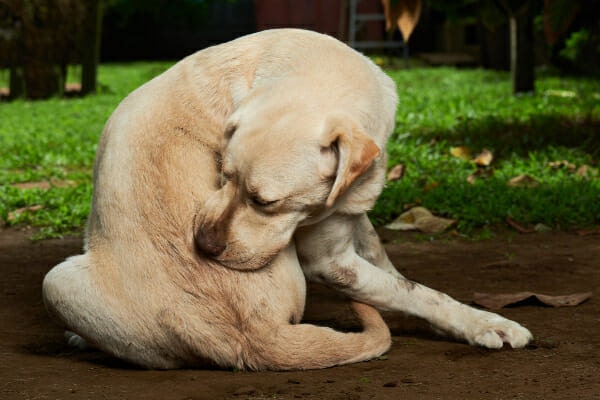
Have you ever been lying in bed trying to sleep, when your dog starts licking or chewing non-stop? That repetitive sound can suddenly seem so loud that all you can do is focus on it. How could you possibly sleep when your dog is so busy licking him or herself bald?
Meet Luke, a dog who couldn’t stop licking his tail
This is the exact reason that Luke, a 7-year-old German Shorthair Pointer, was brought in for an exam. His mom couldn’t believe how many hours a day Luke could focus on licking the base of his tail. She and her husband kept joking that Luke’s tongue would fall off before he would stop licking.
Since Luke and his family are avid hikers, his mom usually maintained a very strict schedule of applying flea and tick medication every month. However, they missed a dose that month due to Luke being with a pet sitter while they were on vacation. Luke’s mom was now worried that his incessant licking and chewing was a sign that he had fleas.
As I watched Luke while his mom was talking, it was obvious that Luke was very interested in the base of his tail. Normally, when he came in for an exam, he was busy sniffing the whole exam room for cookies. Not today. I assured his mom that we would look closely for fleas in Luke’s hair. In addition, I told her that I was going to do a thorough exam since there were several other reasons Luke could be licking so much.
9 reasons a dog keeps licking the base of the tail
Let’s take a look at the top nine reasons why a dog may be licking and chewing the base of the tail.
1. Fleas and flea allergic dermatitis
For many dog parents, when their beloved dog begins licking, chewing, or scratching, the first concern is fleas. No one wants to have fleas on their dog or in their home.
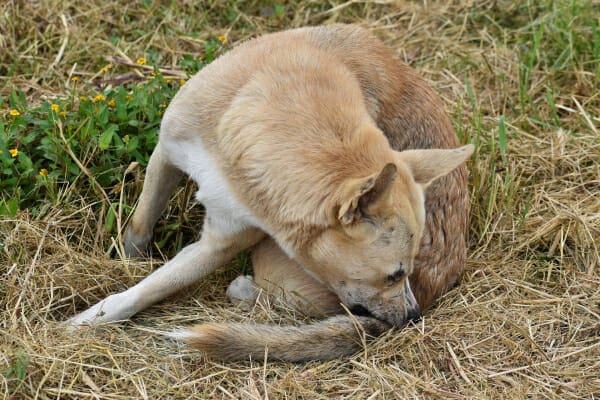
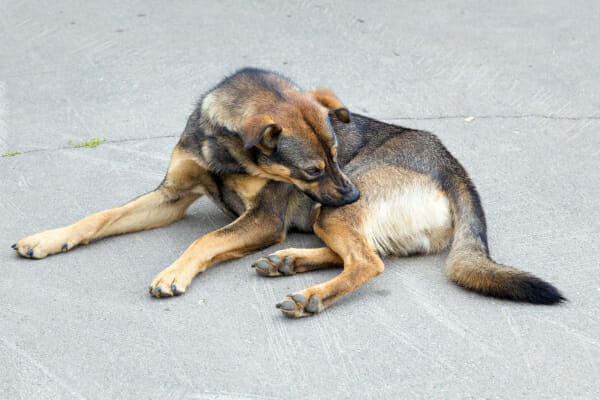
If fleas are present, the first sign is usually persistent licking, chewing, and scratching in the main areas where fleas like to reside. The most common spot is the base of the tail. Also, fleas frequently like to spend time around the neck and shoulder blades. However, they may be anywhere on the dog’s body, including the face and back.
Dogs and cats who have a larger infestation or a sensitivity to flea saliva (i.e. flea allergy) can have additional signs as well. Flea allergic dermatitis (FAD) is the term for the changes that occur as a result of a flea saliva allergy. Affected dogs may:
- Be intensely itchy
- Lose hair at the base of the tail or other areas
- Have red patches on their skin
- Have multiple, small scabs from the flea bites
Additionally, dogs who have a bad case of FAD can be prone to secondary skin infections.
Diagnosis of fleas
Fleas can sometimes be difficult to see with the naked eye. However, it may be worth seeing if you can spot any on your dog. They look like small, brown wingless insects which can jump quite far. Additionally, you can look for “flea dirt” (i.e. flea feces). It appears as black-brown specs or “dandruff” in the areas that fleas like to live. Another way to look for fleas is to buy a flea comb. Run the flea comb through your dog’s coat then examine it for the presence of fleas or flea dirt.
If you suspect that your dog has fleas like my veterinary client did, please consult your veterinarian. Sometimes, fleas can be very obvious during a physical exam without additional diagnostics. However, especially in very mild cases or very hairy dogs, fleas may not be as obvious. Your veterinarian may recommend additional tests such as a skin scrape to look for other parasites that could cause itching or skin changes. They also might perform blood work to look for anemia secondary to the fleas biting and feeding off of your dog.
Treatment of fleas
Thankfully, in most cases, if the vet diagnoses your dog with fleas, there are various treatment options that are readily available. At the very least, your veterinarian will recommend treating with flea prevention. Depending on your vet’s recommendation, this might be a chewable treat, liquid, collar, or topical medication that is applied directly to your dog’s skin.
Please note that your veterinarian’s office is the best place to get flea medications. Over-the-counter products may be ineffective or sometimes even dangerous.
Additionally, your vet may recommend bathing your dog and brushing him or her with a flea comb. If your vet uses a topical product to treat the fleas, ensure you ask him or her how long to wait to give your dog a bath.
Sometimes your veterinarian may recommend other medications like a dewormer since fleas can transmit tapeworms. Dogs with FAD also may need antibiotics for a secondary skin infection or allergy medicine for dogs to help relieve some of the allergic response.
Unfortunately, 95% of the flea population lives in the environment as eggs, larvae, and pupae (i.e. immature flea life) forms. Only 5% of the population will be on your dog as adult fleas. This means that addressing the immature fleas in the environment is very important. Vacuuming your house and furniture multiple times a day and washing all bedding in hot water can be helpful. In some cases, you may also need to flea bomb the house or use an environmental spray.
Be patient as it can take a lot of time and work to get rid of fleas completely.
2. Anal gland problems
What if, not only is your dog constantly licking his or her hind end, but also scooting it on the floor? Another reason for a dog licking the base of the tail is that his or her anal glands are full.
The anal sacs (i.e. anal glands) are two small scent glands that are located just below and on both sides of the anus. They contain a very strong fishy-smelling liquid or paste that helps dogs mark their territory. Most dogs empty them naturally when having a bowel movement. However, some dogs need help expressing them.
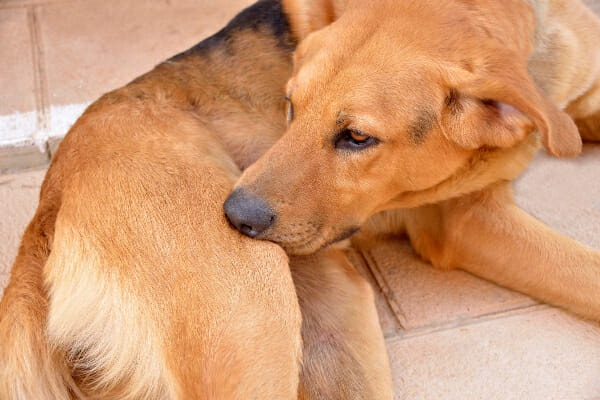
Signs that your dog’s anal glands might be full include:
- Licking the hind end
- Biting at the base of tail
- Scooting on the ground
- Straining to defecate
- A fishy odor coming from the rear end
If not addressed promptly, some dogs will get impacted or infected anal glands. When this happens, there might be small amounts of bright, red blood in the stool. You also could notice swelling or an open wound in the four o’clock and eight o’clock positions in relation to your dog’s anus.
Diagnosis and treatment of anal gland issues
If you notice any of the signs above, you should seek treatment for your dog with your veterinarian. Impacted or ruptured anal glands can be very uncomfortable and painful for your dog. And if there is an infection, the longer it goes untreated, the worse it can get.
When you take your dog to the veterinarian, he or she will probably perform a physical exam and a rectal exam. During the rectal exam, the vet can check and express your dog’s anal glands.
Depending on what your veterinarian suspects is going on, he or she may perform some additional tests. The vet might recommend treatment such as anti-inflammatories, antibiotics, warm compresses, or adding fiber such as canned pumpkin for dogs to the diet.
3. Food or environmental allergies
Another common reason why your dog may be persistently licking or biting at the base of the tail is allergies. Dogs get allergies just like we do, which are usually food or environment-related.
Food allergies are more likely to occur year-round or when diet is suddenly changed. On the other hand, environmental allergies tend to occur during specific seasons. This isn’t always the case, though. Just like in people, dogs can be allergic to multiple foods or multiple pollens, grasses, dusts, etc. in the environment. Also, dogs can have both food and environmental allergies.
Regardless of the allergy, your dog will likely be scratching, licking, or biting the base of his or her tail or other parts of the body. Dogs with allergies can also develop red, irritated skin. Some dogs may even suffer from otitis in dogs (i.e. ear infections).
There can be slightly differing symptoms between food and environmental allergies. Dogs with food allergies could experience vomiting and diarrhea in addition to skin problems. Dogs with environmental allergies are more likely to experience sneezing, coughing, watery eyes, and increased shedding.
If your veterinarian diagnoses your dog with allergies, he or she will discuss the management options such as special foods, supplements, allergy shots, or medications. While allergies can’t be cured, the good news is that working with your vet to create a specialized plan for your dog can help him or her feel much better.
4. Contact dermatitis
Have you ever walked through a patch of weeds and noticed that within a few minutes your legs were itchy? This can happen to dogs too, and it is called contact dermatitis.
Contact dermatitis is similar to allergies but is a more localized response. It occurs when something irritating touches the skin. The irritating substance could be grasses, plants, carpet, soaps/shampoos, etc. As a result of the irritant, a local allergic reaction occurs.
This usually results in red, itchy skin and possibly hives. Contact dermatitis can occur anywhere on the dog’s body, but is most likely on the abdomen, feet, or around the tail and rear end. If a dog’s face comes in contact with the irritant, his or her eyes may be red and watery as well.
If you suspect your dog has contact dermatitis, you should wipe the irritated area with a warm, wet washcloth or give your dog a bath with a mild shampoo. You should also consult with your veterinarian. If the bath helps, your veterinarian may not do any diagnostics or treatment at that time. Otherwise, he or she will probably recommend diagnostic tests and treatments very similar to those mentioned above for allergies. Of course, you will also want to try to avoid contact with things your dog is sensitive to in the future if possible.
Contact dermatitis and food or environmental allergies can both result in something called a hot spot as well. Hot spots are painful areas of red, irritated skin and often can develop secondary infections. They can also ooze moisture, pus, or blood. Typically, they start in a very localized area where your dog is excessively licking and chewing. However, they can spread if ignored. If you notice a hot spot, please make an appointment with your vet promptly.
5. Internal parasites
Not only could your dog be licking and chewing at the base of the tail due to external skin problems, but there could be an internal cause as well. One reason might be that your dog has internal parasites, more specifically worms. The most common worms of concern are roundworms and tapeworms in dogs.
Roundworms are usually passed from mother dogs to their puppies or acquired when dogs ingest wildlife or feces of other animals. Tapeworms, on the other hand, are passed to dogs through ingesting fleas or consuming an infected prey species such as rabbits. If your dog is excessively licking and chewing at the base of the tail and diagnosed with fleas, it is likely that your veterinarian will want to check for tapeworms as well.
The most common sign that your dog has worms is the presence of worms in your dog’s feces. Roundworms will look like spaghetti noodles. Tapeworms look more like pieces of rice. Often your dog will act like his or her rear end is itchy. This might mean that your dog scoots on the floor or is non-stop licking and chewing at his or her tail and hind end. Dogs with worms may experience vomiting, diarrhea, and weight loss.
If you see worms in your dog’s feces, be sure to pick up the poop immediately to avoid other animals or children coming into contact with the worms. You should bring a fresh fecal sample to your veterinarian so they can test it for worms and other parasites. This will help the veterinarian determine what medication to give your dog. It is likely that your dog will be given a dewormer. If your veterinarian suspects tapeworms and fleas, your dog may also be treated for fleas as described above.
6. Hormone imbalances
Another internal cause of excessive tail licking is medical issues caused by hormone imbalances. When you hear the word ‘hormone” you might tend to associate it first with sex hormones, However, hormones are responsible for many other functions in your dog’s body. Some of them play a role in maintaining healthy skin and hair coat.
As a result, dogs with hormone-related conditions like Cushing’s disease in dogs, diabetes mellitus, and hypothyroidism in dogs may suffer from skin or coat problems like rough, patchy coats or bald spots. When the coat isn’t healthy, it can become itchy and irritating for dogs. The skin might also become thickened, rough, and possibly pigmented. Depending on what hormonal disease your dog has, there might be other clinical signs including:
- Decreased energy (a lethargic dog)
- Increased or decreased appetite
- Vomiting
- Diarrhea
- Increased thirst in dogs
- Increased urination
If you suspect that your dog has a hormone imbalance, you should consult with your veterinarian immediately. Certain hormone-related diseases can be life-threatening if ignored. It is very likely that your veterinarian will check blood work and a urine sample. Sometimes, X-rays or an ultrasound are needed as well. The exact treatment will depend on your dog’s diagnosis. Most likely though, it will involve a prescription medication and possibly a change in diet.
7. Pain
Excessive licking could be one of the signs your dog is in pain. This can be especially true in our beloved senior dogs.
Licking an area that hurts can be comforting to dogs. This is just like how you or I might massage an area on our bodies that hurts. Dogs also lick painful areas because their first instinct is to try to clean a “wound.” Dogs can’t always determine if the “wound” is external like a cut or internal like joint pain. Therefore, it is common that they will lick the painful area to try to clean and heal it.

An area could be painful due to skin disease or a hot spot as described above. In senior dogs, the area also might be painful due to osteoarthritis in dogs. If your dog is licking the base of the tail and hind end, it could indicate that he or she has arthritis in the lower spine (such as spondylosis in dogs), hips (possibly from hip dysplasia in dogs) or hind legs.
Diagnosis and treatment of pain
If your vet suspects arthritis or a bone problem, he or she will likely perform a thorough physical exam to assess your dog for lameness or decreased range of motion. The vet might also recommend X-rays to rule out broken bones or other bone abnormalities. Treatment will depend on the diagnosis that your veterinarian gives your dog.
If it is arthritis, your vet might discuss ways to relieve arthritis pain in dogs. This could include:
- Finding your dog’s body condition score and giving tips to help your dog lose weight
- Pain medications like NSAIDs, tramadol for dogs, gabapentin for dogs, or amantadine for dogs
- Omega-3 fatty acids for dogs (found in fish oil supplements)
- Joint supplements for dogs (including my favorite, Dr. Buzby’s Encore Mobility™ hip and joint supplement)
- Adequan for dogs
- Dr. Buzby’s ToeGrips® dog nail grips
- Ways to help your senior dog with arthritis at home
8. Behavioral problem or anxiety
Excessive licking can be a sign of a behavioral issue or anxiety problem as well. Some dogs will over groom themselves out of boredom. Initially, it starts out as a normal grooming behavior, but then it becomes a habit that the dog performs when there is no other stimulation. This is a similar to high energy dogs who destroy toys or furniture when they don’t get regular exercise and playtime.

Persistent licking can also be a sign of anxiety. With anxiety, dogs may lick so much that it causes harm to the skin and leads to possible infection. If your dog has anxiety, there could be other symptoms including:
- A dog who is panting and restless
- Decreased sleep
- Excessive whining or barking
- Pacing
- Destructive behaviors
- Eating too fast
- Fear of loud noise
Just like in humans, dog anxiety comes in many forms. Some cases of anxiety are more obvious than others and easier to diagnose. If you suspect your dog has anxiety, it can be helpful to video him or her doing the anxiety-related behaviors. Also, take note of what was going on in the house at the time.
Watching these videos will help your veterinarian understand what you are seeing at home when your dog is anxious. Some veterinarians will also use a questionnaire to help determine the specific type of anxiety your dog has.
Once your vet diagnoses your dog with anxiety, he or she may recommend medications or supplements to help manage the anxiety. Different exercise routines or games may be suggested as well. Remember, anxiety can be frustrating for you, your dog, and your veterinarian. This is another disease that may take time and trial and error to manage.
9. Grooming behavior
If your dog is licking the base of his or her tail but isn’t showing any other symptoms, it is possible that this is normal grooming behavior. Licking occasionally, or when the fur is dirty, is a normal way for dogs to keep their coat clean and shiny. However, dogs should not groom excessively to the point that they cause irritation or bald spots.

Luke’s reason for licking the base of his tail
After closely examining Luke and watching him lick the base of his tail during the exam, I determined that he did in fact have fleas. His mom agreed to a fecal test to rule out secondary tapeworms. Thankfully, he was tapeworm-free!
I sent Luke’s mom home with instructions regarding flea prevention and regular vacuuming of the house. She called me later that week saying Luke seemed more comfortable already.
Paying close attention to your dog’s behavior can help your veterinarian determine the cause of your dog’s constant licking. As I like to remind you, you are your dog’s biggest advocate and the one who knows him or her best. So if you suspect any of these nine reasons for licking the base of the tail, please contact your veterinarian. As always, your veterinarian is a wonderful resource for your dog’s health problems and truly wants your dog to be happy and healthy.
If your dog has ever licked the base of his or her tail, what was the reason?
Please comment below.


Help! My girl totally freaks out, intermittently and barks and growls and sometimes whines and then chases her rear then erratically licks her rear. I can’t determine if it’s her vulvar area or her anus. We have spent over $1,000 on tests, ultrasounds, urinalysis, fecal analysis….she is on Glandex to harden her stool because it was loose. She is on grain free diet and gets Cytopoint injections monthly. We are at our witts end!
Hi Gabrielle,
I am so sorry your pup is having these recurring issues. I can understand why you are frustrated after doing everything in your power to get some answers with no results. I am at a loss as well. Here are my random thoughts…. maybe it is time to try alternative therapies such as laser treatment or acupuncture? Also, you can always request a consultation with a specialist if needed. Praying you can find the answers you need to give your sweet girl some relief. Wishing you both the best.
It could be something simple. For example, Some dogs heavily overreact. I have seen them running around in a panic, screaming, just to find some hair in their poop kept the last bit from coming out and there is a little hanging off their butt.. My senior gets as panicky as her aged body allows, when she thinks she leaks a little pee. So depending on how often this happens.. It could be a mental issue, an overreaction to an itch in a certain spot…
A grain free diet has it’s pro’s and cons. To rule out any allergies, I would recommend a steady diet plan for 4 weeks to rule out any and all possible causes of allergies. Plans can be found online.
A quality CBD oil can bring great benefits. Takes a little research to separate the fake from the good and learn about/compare types and active ingredients.
Hi there
Our female dog Pachi has always had anal gland issues, our vet even taught us how to express them ourselves. So she often licks under her tail and sometimes will leak a bit but we know how to manage it. Recently she has started licking the top base of her tail instead of under. We’ve checked her glands and they seem empty but she hasn’t stopped obsessively licking. Could she be in pain like referred pain? She doesn’t respond when you touch the area and there’s no visible rash or mark.
Hi Skye,
I understand your concern for Pachi and this chronic licking issue. Yes, as the article mentioned, pain is a possibility. But when I see this in my own patients, I am always assuming there could be fleas present until proven otherwise. Is your pup on a monthly flea preventative? My best recommendation is to call your vet and let them know about this new development in your dog’s licking behavior. They can let you know if an exam is needed and will help figure out the best way to treat the problem. Hoping you can get to the bottom of this quickly and give Pachi some relief. Wishing you the best of luck!
Hi I have bichapoo she’s 1 and half year old now she is usually a bright and alert dog but i noticed she was biting/licking the end of her tail the past month and eventually she had slowed down the biting/licking her tailend and then it had started forming cyst like at the end and now she has constantly started biting & licking there again. How do I make it stop? I shaved the area to see if that would help but it hasn’t
Hi Toni,
I understand your concerns about your dog’s tail. You will need to have her examined by your vet to find out what treatment would be best. Without knowing the cause, there is no way to know what will fix this problem. I am hopeful that with the help of your vet, you can get your girl feeling her best again very soon.
Hoping you can help me please. My girl licks to the right of her bum and base of her tail on the inside. She will go a fare while not doing it, then out of nowhere she’ll start again and do it incessantly. When she does it I check to see if she has anything there, then I’ll give the area a wipe and spray with some anti itch stuff. I have spoken to the vet about it, more than once and just get told “it could be food or allergies, it’s hard to know”. I know it could be either of those things but it could also be something else and I don’t know why they won’t investigate. I have wondered if it’s due to her anxiety but there’s never an apparent reason, at the time she does it, for it to be anxiety. Having read your information, I’m wondering if it could be pain as she does have OA in the hind legs and maybe elsewhere without us knowing. How would you suggest I get my vet to actually bother about investigating the issue please? One other thing I’ve noticed, after she’s licked, is that she’ll then get up and drag her bum. When I check it, it looks as if it has a little liquid on it. It’s not smelly and she recently had her glands expressed.
Hi Shelley,
I understand your concern for your dog and this strange licking behavior. Since I haven’t examined your pup myself, it is difficult to make conclusions and recommendations. I suspect the reason your vet has not done more investigation is because, from what you are describing, there isn’t much to investigate. With no other symptoms or physical findings to go off of, it is hard to know where to start searching. I think you should have an honest conversation with your vet about your concerns and make it clear that you want some routine wellness testing done. They can run a comprehensive blood panel and even check urine to be complete. You can also request some x-rays to evaluate the spine near the tail to make sure there are no signs of arthritis that could cause pain in this area. I know you mentioned your dog recently had her anal glands expressed. If you hadn’t added this bit of info, I would be leaning toward an anal gland issue. So maybe this is still the problem? There is a possibility your dog’s glands are thickened or infected. Also, when expressing the glands, sometimes a bit of the material is left behind. It can be tricky to actually get the glands completely expressed. Some dogs need to have their anal glands flushed or try a course of antibiotics to see if the issue resolves. I hope this gives you some things to consider and a starting point for the conversation with your vet. Best wishes and good luck!
My dog will stop chewing base of tail he got open wounds what can I do to care for him at home. Please help.
Hi Loretta,
Without personally examining your dog, I can’t make specific recommendations. I would not want to advise you to put any kind of medication on the wounds without knowing how extensive they are. Your best option is to take your dog to the vet and let them evaluate the situation. The vet can clean the wounds and recommend treatment. I hope your pup will find some relief soon and make a full recovery. I wish you the best of luck.
My dig is a 10 year old spaniel and has for the las3 weeks started biting the base of his tail all the time and start licking the sofa incessantly. He has no other symptoms and not got fleas. Not sure what todo. Thanks Zara
Hi Zara,
I highly recommend you have your dog examined by your veterinarian. Since I haven’t seen your pup myself, it is difficult to make specific conclusions or recommendations. Your vet may want to check for other parasites or signs of infection. Your dog may also be dealing with anxiety that could be helped with mediation. Hoping you can find a solution that gives your guy some relief. Good luck!
My dog has started licking his tail about an inch or two before it connects to the body. When I touch and press on the part of tail where he’s licking, he gets very upset. If I touch on the other side, his affect doesn’t change. I don’t really see anything on that spot on his tail, but it obviously hurts him. This makes it unlike any of the conditions above, but right in/on the tail. What do you think?
Hi Bill,
It does concern me that when you touch the affected area it seems to be painful for your dog. I highly recommend you have him examined by your vet as soon as possible. They may want to take x-rays or have some other form of imaging performed to rule out infection or a possible tumor. I hope you get some answers and a diagnosis that will allow treatment and a favorable outcome. Best wishes to you and your pup.
Dr. Buzby,
I am praying you can help me. For the last year my pug, Rocky has been licking his paws but most upsetting is that he is scooting, but not on his bottom, but going from side to side like he is trying to bite something that is irritating his hind legs. I am on a fixed income but have been to three veterinarians who can’t solve this puzzle. Rocky has Hip Dysplasia and also has a plate in his life hind leg due to being hit by a car about thirteen years ago. He does not display pain when he is doing this but shows discomfort. I do have a video showing this and would like to send it in hopes it would shed some light on his problem. His bowels are normal and he doesnt have signs of worms. Looking forward to your input. TY
Hi Linda,
It does sound like there is something strange happening with Rocky that needs medical attention. Since I haven’t examined him myself, it is hard to make specific conclusions and recommendations. I am sorry you have been to three different veterinarians and still don’t have an answer for these puzzling symptoms. Anytime you are dealing with a complicated case, such as Rocky seems to be, it can take time and a great deal of testing to find answers. You may need to schedule a consult with a specialist or rule out a possible neurological issue. I highly recommend you have your vet review the video. They may want to try some pain medications just to see if it helps with the discomfort you are describing. Many times, a dog is actually painful, but the pain comes across to us as more of just a minor discomfort due to their amazing ability to hide signs of pain. I hope you are able to find the answers you need to help your sweet boy find some relief. Praying for a good outcome and wishing you both the best.
I have a 3 year old pit. She is normally so calm and collected but now the past week she is hyper and howling and licking her back side like she is having puppies. She has even went as far as digging herself a spot to have puppies like she did when she was pregnant. She has had 3 litters of puppies. There is no way she can be pregnant as all my male dogs have been fixed. What do you think could be the cause of this?
Hi Carmen,
The behavior you are describing does sound concerning. Since I haven’t examined your girl myself, I can’t make specific recommendations. I do think it would be best to have her examined by your vet. She may be painful or struggling with something like a urinary tract infection. If you can, I would get her seen as soon as possible!
My dog this this for years . Eventually I found a group that promoted less fat and protein in the diet . I tried a vegetarian kibble and that stopped the licking and pulling of fur . Then when I switched her to a fresh food diet, she didn’t have that behaviour unless she was eating meat . It took about a year before I could feed her two days of meat meals in a row and her not have that licking . We do suspect Cushings but she only has 2 of the symptoms .
Hi Cheryl,
I am glad you found a solution that works for you and your girl. Food allergies can be so difficult to diagnose! Thanks for sharing your experience.
My Beagle girl also does this and she does more often when she’s on heat. She’s 9 months old now and she’s on her first heat. Before she has her first heat she indeed cleaning herself by licking almost all over her body (including base of the tail, paws, hands, legs, etc.) but now she does it much longer esp. before we go to bed. I checked her fur everyday after walked, brushing her, cleaning her paws, etc. – no ticks nor fleas has found (i suspected this for the first time). She has no anal glands issue (sometimes she even shoot that little yellowish herself if she’s too excited when she meet her bestfriend). She’s on her 10 days of heat and so far no damages either on her skin or her fur. Maybe its because of her hormones so she’s cleaning herself longer? Is that safe to wait while keeping my eyes on her until her heat is over.? Thank you so much doc.
Hi VeeVanny,
I understand your concern with this increased licking. Since I haven’t examined your girl myself, it is hard to know if things will be ok for a few more days or if the issue should be addressed more quickly. My best advice is to call you vet and talk about your concerns. They may have options for treatments you can try at home while you are waiting to be seen in the clinic. I hope you can find a way to give your girl some relief. Best wishes and good luck!