Looking for a dog lymph node location chart? Asking yourself, “Should I be able to feel my dog’s lymph nodes?” and “Where are dog lymph nodes?” Curious why a dog might have swollen lymph nodes? If any of those sound like you, you found the right article! Integrative vet Dr. Julie Buzby answers all your dog lymph node questions. By the end of this article, you’ll know how to locate your dog’s lymph nodes and what to do if you suspect a problem.
If you’ve ever had a really bad cold or sinus infection, you may have experienced swollen glands around your throat. These glands, called lymph nodes, don’t just swell up as an annoyance. Lymph nodes are actually an integral part of your immune system, and the immune system of your canine companion too.
What are dog lymph nodes?
In some ways, lymph nodes are the military training ground for the immune system. Inside these small, bean-shaped organs, immune system “soldiers” (i.e. white blood cells called lymphocytes) await instructions to go to battle against infectious agents or other foreign materials that don’t belong in a dog’s body.
Your dog’s lymph nodes make up one segment of his or her lymphatic system, which is part of the immune system. The lymphatic system is one of the chief ways dogs can fight infections and remove cellular debris from their blood.
The other main components of the lymphatic system are:
- Other lymphoid organs/tissues—Bone marrow (a lymphoid tissue) and some lymphoid organs like the spleen and thymus are responsible for making lymphocytes.
- Lymphatic vessels—These thin-walled vessels are the “highway” of the lymphatic system. They carry lymphocytes around the body and bring lymph to and from the lymph nodes, which are situated strategically along the lymph vessels.
- Lymph—The fluid within the lymphatic vessels which is rich in lymphocytes. It may also contain foreign invaders or damaged cells from the tissues.
Let’s take a closer look at how the components of the lymphatic system work together.
The fluid from blood becomes lymph
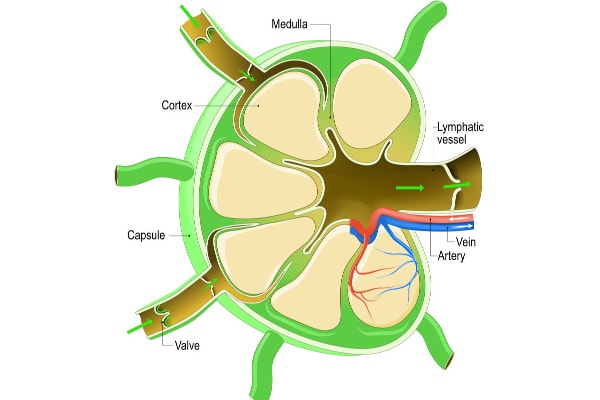
As blood flows through the blood vessels, some of the fluid component leaks into the surrounding tissues. This is an important way for the body to send nutrients to the cells within a tissue. Once this interstitial fluid (i.e. fluid in tissues) has distributed nutrients and picked up things like waste products, foreign invaders, and damaged cells, it drains into lymph vessels to create lymph fluid.
Lymph flows through a lymph node
With the help of muscle contractions, lymph can flow through lymphatic vessels and into the lymph node. Inside the lymph node, foreign invaders are filtered out and exposed to a variety of immune cells. This activates a cascade of highly complex events necessary to mount an immune response.
One result of the immune response is a change in lymphocyte numbers and distribution within the lymph node. This may cause the lymph node to swell significantly due to the increased cell numbers.
Lymph fluid re-enters the blood stream
Lymphocytes from the lymph node will enter the lymph, which flows out of the lymph node and travels to other areas of the body. Eventually the lymph will empty back into the veins of the circulatory system.
Where are dog lymph nodes located?
Lymph nodes are scattered throughout your dog’s body. Some lymph nodes are located deep inside the body, such as within the abdomen and along the intestinal tract, where you can’t feel or see them.
Lymph node locations you can feel
However, there are five sets of peripheral lymph nodes in dogs that are easy to feel. In some cases, you may be able to feel a hint of the nodes in their normal state (i.e., small). But it is much easier to detect enlarged lymph nodes.
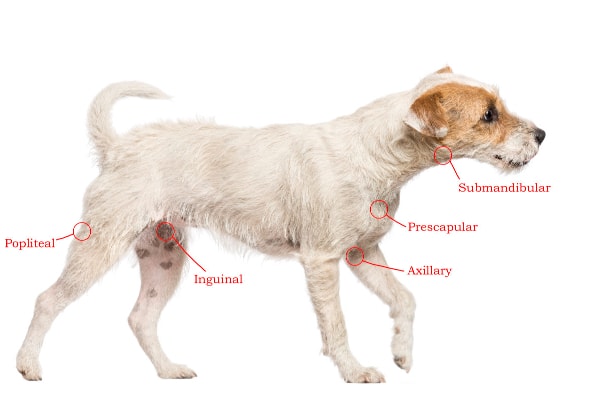
The following lymph node locations are the easiest to palpate (i.e. feel):
- Submandibular lymph nodes—located on either side of the lower jaw where it meets the neck
- Prescapular lymph nodes (i.e. superficial cervical lymph nodes)—found in front of the shoulder blade where the neck and shoulder meet
- Axillary lymph nodes—in the armpit
- Inguinal lymph nodes—located in the groin (inguinal) region
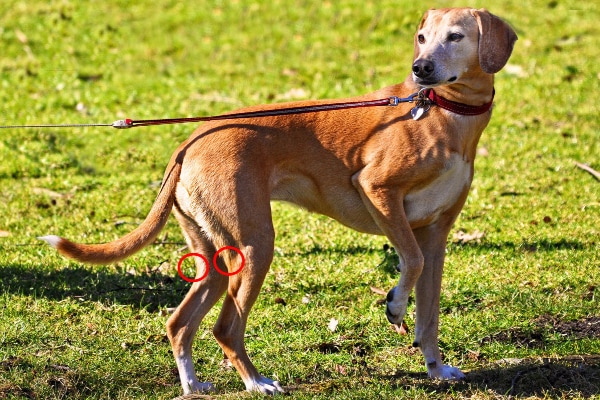
- Popliteal lymph nodes—found at the back of the stifle (i.e. knee)
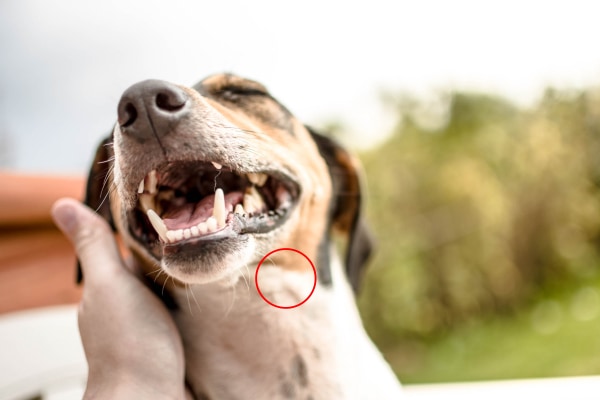
Out of these five sets, it is easiest for most people to detect the submandibular and popliteal lymph nodes. Especially if a dog is overweight or there are only mildly swollen lymph nodes, it may be a little trickier to locate the axillary and inguinal lymph nodes. The prescapular lymph nodes, located in front of the shoulders and near big neck muscle bodies, can also be a little trickier to detect if only slightly enlarged.
Dog lymph node location chart
Check out this handy dog lymph node location chart to help you visualize where your dog’s lymph nodes are. This may make it easy for you to find and palpate your dog’s lymph nodes.
How do I check my dog’s lymph nodes?
When I talk about palpating lymph nodes, what I mean is using your hands to feel the lymph node and check for any swelling. In order to do this, you need to know several things—where to find the lymph nodes (which we already discussed), how to palpate, and what a normal lymph node should feel like.
How do you palpate a lymph node?
In general, palpating involves running your hands along a particular area of the body in order to detect any deviation or swelling that wasn’t there before. You’ve probably already done this to your furry friend if you practice my tip-to-tail dog wellness scan.
Gently running your hands over your dog’s fur and skin while petting him or her can be a great way to look for things like insect bites, hives, cysts, and other skin lesions. Looking for swollen lymph nodes is really not all that different. It just means you need to feel specific places where lymph nodes are located. Sometimes it helps to gently grasp the deeper tissues in the region with your thumb and forefinger and feel for a round to oval structure.
How big should lymph nodes be in dogs?
In healthy dogs or cats, many times the lymph nodes are small enough that you barely feel them. And that is a good thing because lymph nodes should be pea sized in small dogs to grape sized in large dogs.
If the lymph nodes are swollen, they will typically be much more prominent. In some cases, a swollen lymph node (or lymph nodes) can become two, three, or even four-times their normal size. Those are much easier to feel, and you can often see them at that point too.
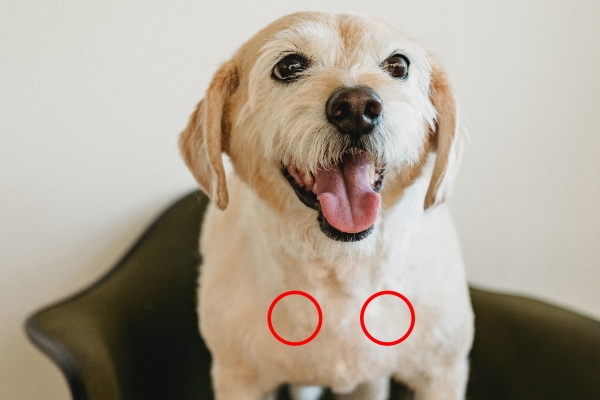
Try to get a good sense of what the lymph node locations normally feel like on your dog. Can you feel any sort of bump with gentle pressure? If so, how big is it and what does it feel like? You could also consider asking your veterinarian to help you properly locate and palpate your dog’s lymph nodes. That way you have a bit of muscle memory when you go to do it yourself.
Routinely palpating your dog’s lymph nodes yourself can come in handy because it makes it more likely you will catch enlargement when it is still mild.
Beware of lymph node lookalikes
I do want to mention one other thing to keep in mind. Sometimes a swollen lymph node can be easy to confuse with something else.
For example, the submandibular lymph nodes are located at the part of the dog’s neck that is near the jaw. However, salivary glands dwell in this area too, and they can feel just like enlarged submandibular lymph nodes. Or, if your dog has a lipoma in dogs or other mass right at the same spot where you would expect a lymph node, you might mistake one for the other.
If you find yourself unsure about what you are feeling or if you think your dog has a swollen lymph node at one of the locations, consult your veterinarian. There are many reasons a dog may have swollen lymph nodes—some of which are worse than others.
Before we get into the causes for swollen lymph nodes in dogs, let’s pause for a moment and define some terms. The medical word for enlarged lymph nodes is “lymphadenopathy” or “lymphadenomegaly.” However, sometimes vets may also use terms that describe the process leading to the lymphadenopathy. For example, the term “reactive lymphoid hyperplasia” denotes lymph node enlargement due to the increase in lymphocytes numbers as part of an immune reaction.
What causes swollen lymph nodes in dogs?
Now that we have the terms cleared up, let’s take a look a the two main reasons for enlarged lymph nodes—infection and cancer.
1. Swollen lymph nodes in dogs due to infection
As mentioned earlier, lymph nodes can become enlarged when lymphocytes interact with foreign materials. Bacterial infections and fungal infections in dogs can cause lymph nodes to enlarge in one part of the body or in several, depending on how widespread the infection may be. Also, tick-borne disease in dogs may cause widespread lymphadenpathy.
On the other hand, ear infections (i.e. otitis in dogs), dental disease in dogs, and upper respiratory infections may specifically lead to swollen submandibular lymph nodes. This is because those lymph nodes receive lymph from the head, which is where the infection is located.
Finally, allergic reactions, which are really a type of immune reaction, can also trigger lymphadenomegaly.
2. Lymph node cancer in dogs
Certain types of cancer can lead to lymph node enlargement. Lymphoma in dogs is a kind of cancer that can impact all parts of the lymphatic system. It may start out as enlarged lymph nodes in one part of the dog’s body. But, in more advanced stages, it can spread to other lymph nodes and/or lymphoid organs like the spleen. Basset Hounds, Boxers, Bulldogs, Bullmastiffs, and Golden Retrievers all have an increased risk for the development of lymphoma, primarily when they are middle-aged or older.
Other types of cancer such as mast cell tumors, melanomas, and adenocarcinomas may eventually metastasize (i.e. spread) to a lymph node or multiple lymph nodes. This would also cause lymph node enlargement.
What other symptoms may occur with swollen lymph nodes?
Based on the range of conditions that can cause lymphadenopathy, it makes sense that dogs with swollen lymph nodes can experience a variety of other symptoms.
For example, a dog with an upper respiratory infection might also be coughing or sneezing. Pain while eating, foul breath, or older dogs losing teeth are all signs of dental disease. Other infections could cause a fever or a lethargic dog. Dogs with tick-borne diseases like Lyme disease in dogs may experience mobility issues and lameness in multiple limbs.
And sometimes there aren’t any other symptoms right away. That tends to be the case with lymphoma where the swollen lymph nodes are the first sign of a problem.
If you believe your dog has a swollen lymph node, please schedule an appointment with you vet. As mentioned above, there are many reasons your dog may have a swollen lymph node(s), and some are more serious than others.
What can you expect at the vet appointment?
At the appointment, your veterinarian will take your dog’s other symptoms, history, and the results of the physical exam into consideration when creating a diagnostic plan. This plan could run the gamut from blood work and urine testing to imaging like X-rays or ultrasound.
Generally your vet will perform a fine needle aspirate test on one or more of the enlarged lymph nodes. This is a test where the vet uses a needle and syringe to collect cells from the lymph node. Then, the vet views the cells under the microscope to gain more information about what is going on.
Sometimes, the vet will be able to visualize an infectious agent like bacteria in the lymph node aspirate. Other times, seeing an abundance of big, blue-stained immature lymphocytes (i.e. lymphoblasts) can point to a diagnosis of lymphoma in dogs.
Alternatively, the vet may discover cells from other types of cancer that have made it to a particular lymph node. For example, oral melanoma can make pigmented cells appear in the lymph node aspirate.
If your veterinarian is not sure about the contents of the lymph node aspirate, he or she can submit the microscope slides to a pathologist for further insight. If a fine needle aspirate is insufficient for obtaining a diagnosis, your vet (or the veterinary pathologist) may recommend a biopsy of the lymph node.

What are the treatment options for swollen lymph nodes in dogs?
Once your vet has determined the cause of the enlarged lymph nodes, he or she can make a treatment plan. If a fine needle aspirate confirms reactive hyperplasia, treatment centers around addressing the source of the infection.
This may involve performing a dental procedure to clean your dog’s teeth and extract any diseased ones. Or it may mean treating an infection with antibiotics or antifungals. It may take a few days or weeks for the lymph nodes to return to normal size after the infection is gone.
Cancer patients may have any number of treatments depending on the type and stage of their cancer. With lymphoma, some dog parents elect to treat with prednisone for dogs while others pursue chemotherapy with a veterinary oncologist. While lymphoma is not completely curable, chemo can put lymphoma into remission for a period of time.
Whatever the diagnosis, you can count on your veterinarian to walk through it with you. He or she is a valuable asset and—just like you—has your dog’s best interest in mind.
What can I do for my dog with swollen lymph nodes?
It’s important to point out that there are no home remedies for dogs with swollen lymph nodes. As a dedicated dog parent, the best thing you can do is to seek treatment by a veterinarian if you suspect a problem.
There are, however, some things you can do to reduce your dog’s chances of having swollen lymph nodes from an infection.
- Remember to keep your dog up-to-date on vaccinations for infectious diseases. Vaccinations for upper respiratory conditions like kennel cough and tick-borne diseases like Lyme disease are particularly important.
- Use flea, tick, and heartworm prevention all year round. Diseases carried by tick bites can cause swollen lymph nodes.
- Work with your vet to develop an at-home daily dental hygiene routine for your dog. There are many good dental products on the market. But brushing your dog’s teeth is still the best way to ward off dental disease. This is important because, as we discussed, bad teeth in dogs can cause swollen lymph nodes.
- Choose safe chew toys for your dog to help prevent fractured teeth.
- Make notes about your furry friend’s travel history. (There are places where fungal infections may be more common.)
- If your dog is susceptible to allergies, ask your vet about allergy medicines for dogs.
Finally, I would urge you to incorporate lymph node palpation into your dog’s health routine. Learning to locate your dog’s lymph nodes and familiarizing yourself with what those areas feel like can be a great tool for finding swollen lymph nodes rapidly. In turn, this means that your vet can start treatment sooner.
Become a lymph node locating pro
With practice, it can become easier to know the locations of the peripheral lymph nodes. The dog lymph node location chart included in this article is a great starting point. However, if you are struggling to find your dog’s lymph nodes, don’t feel bad. I want you to understand that even a skilled hand can sometimes miss something so tiny!
Also, keep in mind that even if you do become proficient at finding your dog’s lymph nodes, this isn’t a substitution for routine physical exams with your dog’s vet. His or her trained fingers may notice a swollen lymph node that escaped your detection. Plus, wellness exams can also be a great way to screen for any other health issues. So be sure to schedule an examination for your sweet senior dog at least twice a year.
And, as always, if you have any concerns with your dog’s health or think you may have found an enlarged lymph node, please talk to your veterinarian.
What questions do you have about dog lymph nodes?
Please comment below.


My dog is an 8 year old Labrador Retriever. I was recently diagnosed with mast cell tumor below my right ankle and confirmed inguinal lymph node metastases. In the process of surgically removing it, an attempt was made to remove the popliteal lymph nodes, but the popliteal lymph nodes did not exist. Are there cases where popliteal lymph nodes are congenitally absent in large dogs?
Hi Young,
That is very strange! While I have never heard of a similar situation before that doesn’t mean it isn’t possible. Genetics can be complicated, and a tiny genetic abnormality can definitely cause just about any issue or condition you can come up with. I don’t think there is a predisposition for absent popliteal lymph nodes in large breed dogs, but I also haven’t researched to be sure. Praying for healing and wishing you both nothing but the best.
My Ginger has lymphoma being treated with steroids at this point. What do you suggest to keep her comfortable. Absolutely don’t want her to be suffering. It’s such a hard decision.
Hi Donna,
I am sorry your girl has received this difficult diagnosis. I am glad you are advocating for her well-being and paying such close attention to her quality of life. The steroids will play a big role in her comfort level as they will help to shrink the lymph nodes and suppress the progression for a while. Pain medications can also help, but we can’t be sure for how long. Praying you will know when it is time to say goodbye and you are able to offer Ginger a peaceful passing. Wishing you peace. Bless you both.
Hi my dog was diagnosed with vestibular disease due to an ear infection. She had the balance issues head tilt drooping fir the mouth and the eye flickering. After antibiotics it seemed to clear but still the balance was not quite right.. The vet prescribed me drops fir her ears but because she is such a difficult dog to deal with I’m sure she never even got a third of it. I handed a sample in from her ear and still she had a yeast and bacteria infection.. She’s now got slowen nodes under her jaw so was put on oral antibiotics for five days she’s finished that but another sample has came back that she still has a bacteria infection. Would this be the reason fir her nodes to be swollen. I’m so worried… She’s going in fir an ear flush and bloods on Wednesday. Thanks you
Hi Marion,
I understand your concern for your pup with this ongoing issue with ear infections. Infected ears can definitely cause the submandibular (under the jaw) lymph nodes to become reactive and enlarged. I would also recommend you have your vet do a good oral exam to make sure your girl doesn’t have any tooth issues that could be contributing. Blood work is a great place to start when dealing with unknown lymph node issues. What did you find out? How was the visit with your vet? Hoping you were able to get the answers needed to make a plan for how to proceed. Feel free to leave an update if you have a chance!
my two year old dashhound was around 5 dogs that were unhealthy never treated for parasites and the grounds have parvo,I came obsessed with treating her,she has had ever shot known,last one being a year long dose for heart worms I swear think she has worms in her throat her hole body at the vet every month due to my fear but the vet just shrugs me off I love her so much but internet has filled me full of fear and I’m afraid I’m over doding her with shots please help me to know if after all her shots could she have parasites,thank. you Gloria
Hi Gloria,
I am sorry you are experiencing so much anxiety over your dog’s health. While vaccines can prevent diseases caused by viruses, they do not protect against parasites. There is a yearly heart worm preventative that can be given by injection (I assume this is what your pup has received), but it does not help with the wide range of intestinal parasites. This is why I am a big fan of the monthly oral prevention as it deworms for intestinal parasites when given each month. It is recommended to deworm your pup at least twice yearly if she is not taking a monthly preventative. The bottom line is parasites are normally present in the soil outside and there will always be a risk of your dog picking something up when they are out using the bathroom or playing. The best thing you can do is deworm monthly and just monitor for any signs of diarrhea or GI issues. As long as your girl is on a good prevention regimen, you shouldn’t have to worry. Try to quit searching the internet and trust the expert advice and guidance of your vet. They care about your dog’s health and will let you know if anything else needs to be done. Wishing you all the best and give your sweet girl a hug for me!
hi there. my dog has been diagnosed with immuno neutrophylic lymphadenitis after having a FNA when a large lump was found. he is on anti biotics and I’m having to get steroids on Tuesday…is this cancer?? also his eyes are affected.. is thus related?
Hi Julie,
I am sorry your pup has received this difficult diagnosis. What you describe is not a cancerous process but rather a condition that occurs when the body’s immune system overreacts and causes inflammation and reactive lymph nodes. Without playing a personal role in your dog’s medical care, it is hard to make specific conclusions. But since the immune system can have an effect on any part of the body and the lymphatic system is very extensive, it is not unheard of for other areas to be affected. I hope the steroids will be able to get things under control and provide your boy some relief. Praying for healing and a full recovery.
I have a nine year old Dutch Shepherd. He became very lethargic, barely wanted to move. Hesitated on going down steps. Lost all alertness—he notices everything, and barks at all things that get near the house. He is an inside dog. For two days he never barked. He is on flea and tick medication.
I took him to the vet. Blood and urine analysis was done. Slight fever, Swollen knee lymph glands, slighly low platlette count, slightly high white blood count. All the markers for tick borne disease and is being treated accordingly. Two tablets twice a day of doxycycline hyclate total of 112 to be given.
He was better the very next day and for several days, each day was better. He did bark at the mailman, just one bark and it sounded hoarse. In two days bark was cleared up but it has been two weeks and he is still not very alert. Still sleeps a lot, lymph nodes are still swollen. Seems to be muscle wasting in the hindquarters. He eats and drinks well.
Is this something that will take along time or should I be worried that something other than tick borne disease is the problem, and if so what. Will he possible need another round of antibiotics. I still have almost two weeks to go on this round.
Hi Susam,
I understand your concern for your senior guy as he continues to fight this difficult disease. It is possible there could be something contributing to his condition, but without playing a personal role in his medical care it is hard for me to offer specific conclusions and recommendations. Please make sure your vet is aware of any lingering concerns you have. Tick diseases do sometimes take a long time to treat. There are also cases where the infection is not resolved but goes into remission and can re-emerge at a later date and need to be treated again. I hope with time and persistence your boy will make a full recovery. Praying for healing and wishing you all the best of luck.
Hi we found a stray puppy that was pretty sick with fleas and worms. We are nursing it back to health but on the first day its face swelled up pretty bad. The vet thought it was a reaction to a bee sting and told us to give him Benadryl which we have been doing. The issue is last night it seemed to decrease significantly but this morning it’s back again. The swelling seems.to be concentrated under his chin and at his throat. Puppy doesn’t seem to be older then 3 months based on its teeth. There are little fire ants in its environment occasionally but it’s no different then when where we found him. Could this be associated with teething or something else affecting his lymph nodes? thank you!
Hi Amy,
I am sorry your little puppy is dealing with this strange condition. Without examining him myself it is hard to make specific conclusions and recommendations. With that being said, I am suspicious of puppy strangles. Luckily it isn’t contagious but is a serious condition that needs to be addressed quickly. Please make sure your vet is aware that the swelling returned despite treating with Benadryl. They will likely need to do some testing and investigation to determine the best treatment moving forward. Praying for answers and a positive outcome. Feel free to leave an update and let us know how things are going.
Good morning, I own a boxer (10yrs old) he has come into contact with the small golf size ball on his neck right behind his jaw. It gets swollen from time to time like right now it’s about as big as a grapefruit and has reached a bit to his other side making his one side extra droopy and his jowl hanging super low and drooling. This has been the largest yet when it swells up. Could this possibly be a lymph node? It lasts for a couple days then goes back down to a golf ball size but not fully away. His appetite gets a little less when it’s enlarged but we are still drinking water. He still wags his stub.
Hi Brittany,
Goodness, this sounds very concerning. I am sorry your senior guy is dealing with this ongoing swelling near his jaw. Without examining him myself I can’t make specific conclusions, but I am not sure I have ever seen a lymph node reach grapefruit size. I definitely think this needs to be evaluated by your vet right away. Of course, cancer is a major concern especially with his breed. Hoping you can get some answers quickly and ensure your boy gets the care he needs. Praying for a favorable outcome!
hi, my dog was bitten by a tick 6 days ago, i removed it. now she has a lump under her neck above her shoulder blades- i think this is a swollen lymph node however i am not an expert on dog anatomy so i may be wrong. i want to take her to the vets however my father is saying to wait a few days to see what happens, i am worried about her will she be okay for a few days? my father also unknown to me hasn’t been giving them monthly flea and tick treatments so does this mean she is more vulnerable to infections? she is a 9 year old mini schnauzer if that means anything too
Hi Isobel,
I am sorry your pup has this new lump on her neck. It is possible this could be a swollen or reactive lymph node. Without examining your dog myself, it is hard to know if this needs to be addressed right away of if it can wait for a few days. I like to play things safe and think it would be best to go ahead and contact your vet. If you girl is not currently getting her monthly flea/tick prevention, she is at a higher risk of getting parasites and being exposed to the diseases they carry (some of which are contagious to humans). I hope you can find a way to get your dog the care she needs. Wishing you all the best of luck. Thank you for advocating for your sweet girl!
Hi,
i have noticed that my 8 year old femlae beagle(over weight) has 2 lymph nodes behind her jaw on both sides and one on wach shoulder. They arecabout half the size of a grape. She still is her normal self and dosent have any pain. Should i be concerned?
Hi Richard,
I am glad you have detected these swollen lymph nodes on your pup and are reaching out for advice. I do think this could be cause for concern and recommend you schedule an appointment with your vet very soon. While this may be nothing to worry about, I like to err on the side of caution and would rather go ahead and rule out any potential serious issues. Hoping for favorable results and wishing your sweet girl all the best.
I just adopted a hound mix from the local shelter. She had her first round of vaccines and a dewormer. I took her to the vet for round 2 of vaccines and a wellness check. The vet found right inguinal lymph node swelling, but didn’t seem too concerned. I have lost 2 dogs to Lymphoma and 1 to a Sarcoma. The pup is about 3 months old now and due for round 3 of her vaccines in 2 more weeks. Is it likely that a pup this young could have lymphoma? She was a litter brought into the shelter w no background info. She isn’t showing any outward symptoms of disease except she appears underweight to me, but again, her beginning was most likely full of neglect. She eats well, drinks well and plays well. Any thoughts? Thanks in advance.
Hi Dianne,
I am so sorry for all the loss you have endured. I understand your concern for your new pup and think it is great you are searching for answers. While I would not expect to find lymphoma in a dog this young, I guess it is possible. I would be much more suspicious that these lymph nodes have become irritated, maybe even reactive due to the vaccines given. I would not be too worried at this point but do think it is best to keep a close watch on things. Also, if your pup has not had any routine lab work, it may be helpful to get a baseline and see what her blood counts look like at this time. Hoping for a quick resolution for your sweet girl and wishing you all the best.
my dogs lymph nodes are swollen masses however a fine needle aspiration was done with no finding of cancer or infection. what else could be the cause of the inflammation of the lymph nodes.
Hi Jessica,
I am sorry your dog’s lymph nodes are swollen and the cause has not been determined. It is possible for them to become enlarged just from inflammation. While a fine needle aspirate is a great first step, it isn’t always diagnostic and sometimes a biopsy is required to get a definitive diagnosis. I would recommend you talk to your vet about a consultation with an internal medicine specialist. They may have some good advice on how to proceed with testing and treatment as they have tons of experience dealing with complicated cases. Hoping you can find the answers you need and wishing you all the best!