Looking for a dog lymph node location chart? Asking yourself, “Should I be able to feel my dog’s lymph nodes?” and “Where are dog lymph nodes?” Curious why a dog might have swollen lymph nodes? If any of those sound like you, you found the right article! Integrative vet Dr. Julie Buzby answers all your dog lymph node questions. By the end of this article, you’ll know how to locate your dog’s lymph nodes and what to do if you suspect a problem.
If you’ve ever had a really bad cold or sinus infection, you may have experienced swollen glands around your throat. These glands, called lymph nodes, don’t just swell up as an annoyance. Lymph nodes are actually an integral part of your immune system, and the immune system of your canine companion too.
What are dog lymph nodes?
In some ways, lymph nodes are the military training ground for the immune system. Inside these small, bean-shaped organs, immune system “soldiers” (i.e. white blood cells called lymphocytes) await instructions to go to battle against infectious agents or other foreign materials that don’t belong in a dog’s body.
Your dog’s lymph nodes make up one segment of his or her lymphatic system, which is part of the immune system. The lymphatic system is one of the chief ways dogs can fight infections and remove cellular debris from their blood.
The other main components of the lymphatic system are:
- Other lymphoid organs/tissues—Bone marrow (a lymphoid tissue) and some lymphoid organs like the spleen and thymus are responsible for making lymphocytes.
- Lymphatic vessels—These thin-walled vessels are the “highway” of the lymphatic system. They carry lymphocytes around the body and bring lymph to and from the lymph nodes, which are situated strategically along the lymph vessels.
- Lymph—The fluid within the lymphatic vessels which is rich in lymphocytes. It may also contain foreign invaders or damaged cells from the tissues.
Let’s take a closer look at how the components of the lymphatic system work together.
The fluid from blood becomes lymph
As blood flows through the blood vessels, some of the fluid component leaks into the surrounding tissues. This is an important way for the body to send nutrients to the cells within a tissue. Once this interstitial fluid (i.e. fluid in tissues) has distributed nutrients and picked up things like waste products, foreign invaders, and damaged cells, it drains into lymph vessels to create lymph fluid.
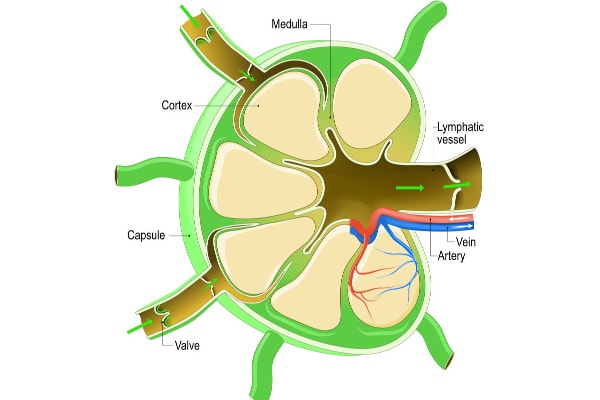
Lymph flows through a lymph node
With the help of muscle contractions, lymph can flow through lymphatic vessels and into the lymph node. Inside the lymph node, foreign invaders are filtered out and exposed to a variety of immune cells. This activates a cascade of highly complex events necessary to mount an immune response.
One result of the immune response is a change in lymphocyte numbers and distribution within the lymph node. This may cause the lymph node to swell significantly due to the increased cell numbers.
Lymph fluid re-enters the blood stream
Lymphocytes from the lymph node will enter the lymph, which flows out of the lymph node and travels to other areas of the body. Eventually the lymph will empty back into the veins of the circulatory system.
Where are dog lymph nodes located?
Lymph nodes are scattered throughout your dog’s body. Some lymph nodes are located deep inside the body, such as within the abdomen and along the intestinal tract, where you can’t feel or see them.
Lymph node locations you can feel
However, there are five sets of peripheral lymph nodes in dogs that are easy to feel. In some cases, you may be able to feel a hint of the nodes in their normal state (i.e., small). But it is much easier to detect enlarged lymph nodes.
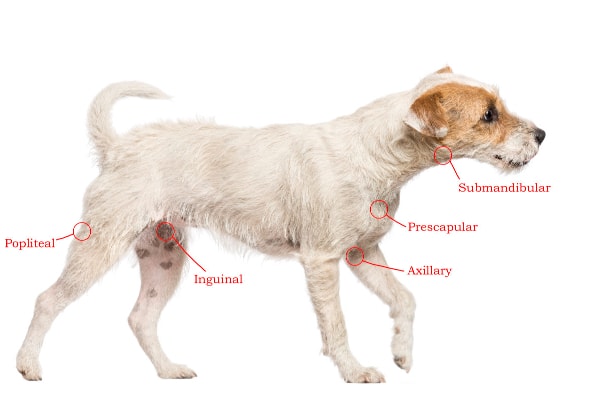
The following lymph node locations are the easiest to palpate (i.e. feel):
- Submandibular lymph nodes—located on either side of the lower jaw where it meets the neck
- Prescapular lymph nodes (i.e. superficial cervical lymph nodes)—found in front of the shoulder blade where the neck and shoulder meet
- Axillary lymph nodes—in the armpit
- Inguinal lymph nodes—located in the groin (inguinal) region
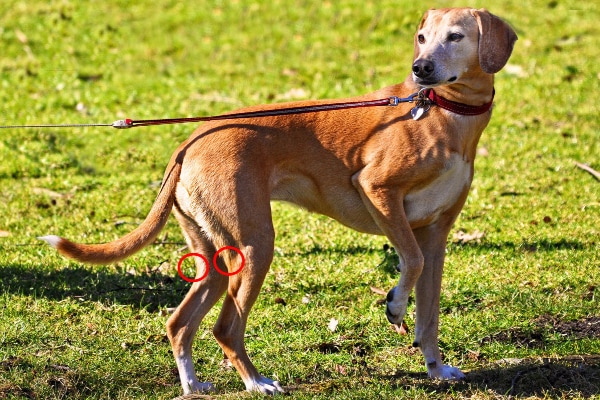
- Popliteal lymph nodes—found at the back of the stifle (i.e. knee)
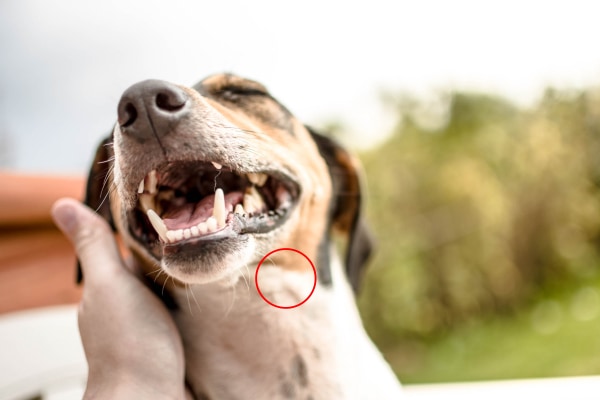
Out of these five sets, it is easiest for most people to detect the submandibular and popliteal lymph nodes. Especially if a dog is overweight or there are only mildly swollen lymph nodes, it may be a little trickier to locate the axillary and inguinal lymph nodes. The prescapular lymph nodes, located in front of the shoulders and near big neck muscle bodies, can also be a little trickier to detect if only slightly enlarged.
Dog lymph node location chart
Check out this handy dog lymph node location chart to help you visualize where your dog’s lymph nodes are. This may make it easy for you to find and palpate your dog’s lymph nodes.
How do I check my dog’s lymph nodes?
When I talk about palpating lymph nodes, what I mean is using your hands to feel the lymph node and check for any swelling. In order to do this, you need to know several things—where to find the lymph nodes (which we already discussed), how to palpate, and what a normal lymph node should feel like.
How do you palpate a lymph node?
In general, palpating involves running your hands along a particular area of the body in order to detect any deviation or swelling that wasn’t there before. You’ve probably already done this to your furry friend if you practice my tip-to-tail dog wellness scan.
Gently running your hands over your dog’s fur and skin while petting him or her can be a great way to look for things like insect bites, hives, cysts, and other skin lesions. Looking for swollen lymph nodes is really not all that different. It just means you need to feel specific places where lymph nodes are located. Sometimes it helps to gently grasp the deeper tissues in the region with your thumb and forefinger and feel for a round to oval structure.
How big should lymph nodes be in dogs?
In healthy dogs or cats, many times the lymph nodes are small enough that you barely feel them. And that is a good thing because lymph nodes should be pea sized in small dogs to grape sized in large dogs.
If the lymph nodes are swollen, they will typically be much more prominent. In some cases, a swollen lymph node (or lymph nodes) can become two, three, or even four-times their normal size. Those are much easier to feel, and you can often see them at that point too.
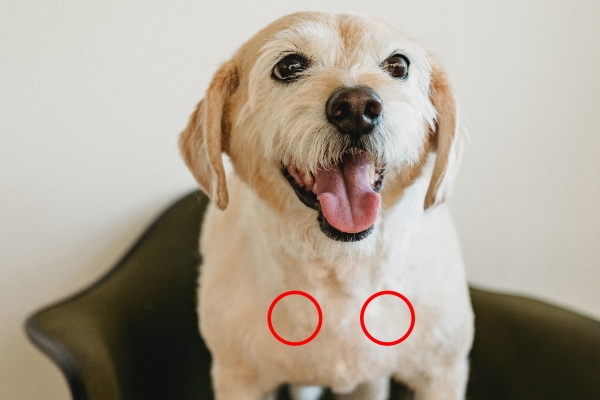
Try to get a good sense of what the lymph node locations normally feel like on your dog. Can you feel any sort of bump with gentle pressure? If so, how big is it and what does it feel like? You could also consider asking your veterinarian to help you properly locate and palpate your dog’s lymph nodes. That way you have a bit of muscle memory when you go to do it yourself.
Routinely palpating your dog’s lymph nodes yourself can come in handy because it makes it more likely you will catch enlargement when it is still mild.
Beware of lymph node lookalikes
I do want to mention one other thing to keep in mind. Sometimes a swollen lymph node can be easy to confuse with something else.
For example, the submandibular lymph nodes are located at the part of the dog’s neck that is near the jaw. However, salivary glands dwell in this area too, and they can feel just like enlarged submandibular lymph nodes. Or, if your dog has a lipoma in dogs or other mass right at the same spot where you would expect a lymph node, you might mistake one for the other.
If you find yourself unsure about what you are feeling or if you think your dog has a swollen lymph node at one of the locations, consult your veterinarian. There are many reasons a dog may have swollen lymph nodes—some of which are worse than others.
Before we get into the causes for swollen lymph nodes in dogs, let’s pause for a moment and define some terms. The medical word for enlarged lymph nodes is “lymphadenopathy” or “lymphadenomegaly.” However, sometimes vets may also use terms that describe the process leading to the lymphadenopathy. For example, the term “reactive lymphoid hyperplasia” denotes lymph node enlargement due to the increase in lymphocytes numbers as part of an immune reaction.
What causes swollen lymph nodes in dogs?
Now that we have the terms cleared up, let’s take a look a the two main reasons for enlarged lymph nodes—infection and cancer.
1. Swollen lymph nodes in dogs due to infection
As mentioned earlier, lymph nodes can become enlarged when lymphocytes interact with foreign materials. Bacterial infections and fungal infections in dogs can cause lymph nodes to enlarge in one part of the body or in several, depending on how widespread the infection may be. Also, tick-borne disease in dogs may cause widespread lymphadenpathy.
On the other hand, ear infections (i.e. otitis in dogs), dental disease in dogs, and upper respiratory infections may specifically lead to swollen submandibular lymph nodes. This is because those lymph nodes receive lymph from the head, which is where the infection is located.
Finally, allergic reactions, which are really a type of immune reaction, can also trigger lymphadenomegaly.
2. Lymph node cancer in dogs
Certain types of cancer can lead to lymph node enlargement. Lymphoma in dogs is a kind of cancer that can impact all parts of the lymphatic system. It may start out as enlarged lymph nodes in one part of the dog’s body. But, in more advanced stages, it can spread to other lymph nodes and/or lymphoid organs like the spleen. Basset Hounds, Boxers, Bulldogs, Bullmastiffs, and Golden Retrievers all have an increased risk for the development of lymphoma, primarily when they are middle-aged or older.
Other types of cancer such as mast cell tumors, melanomas, and adenocarcinomas may eventually metastasize (i.e. spread) to a lymph node or multiple lymph nodes. This would also cause lymph node enlargement.
What other symptoms may occur with swollen lymph nodes?
Based on the range of conditions that can cause lymphadenopathy, it makes sense that dogs with swollen lymph nodes can experience a variety of other symptoms.
For example, a dog with an upper respiratory infection might also be coughing or sneezing. Pain while eating, foul breath, or older dogs losing teeth are all signs of dental disease. Other infections could cause a fever or a lethargic dog. Dogs with tick-borne diseases like Lyme disease in dogs may experience mobility issues and lameness in multiple limbs.
And sometimes there aren’t any other symptoms right away. That tends to be the case with lymphoma where the swollen lymph nodes are the first sign of a problem.
If you believe your dog has a swollen lymph node, please schedule an appointment with you vet. As mentioned above, there are many reasons your dog may have a swollen lymph node(s), and some are more serious than others.
What can you expect at the vet appointment?
At the appointment, your veterinarian will take your dog’s other symptoms, history, and the results of the physical exam into consideration when creating a diagnostic plan. This plan could run the gamut from blood work and urine testing to imaging like X-rays or ultrasound.
Generally your vet will perform a fine needle aspirate test on one or more of the enlarged lymph nodes. This is a test where the vet uses a needle and syringe to collect cells from the lymph node. Then, the vet views the cells under the microscope to gain more information about what is going on.
Sometimes, the vet will be able to visualize an infectious agent like bacteria in the lymph node aspirate. Other times, seeing an abundance of big, blue-stained immature lymphocytes (i.e. lymphoblasts) can point to a diagnosis of lymphoma in dogs.
Alternatively, the vet may discover cells from other types of cancer that have made it to a particular lymph node. For example, oral melanoma can make pigmented cells appear in the lymph node aspirate.
If your veterinarian is not sure about the contents of the lymph node aspirate, he or she can submit the microscope slides to a pathologist for further insight. If a fine needle aspirate is insufficient for obtaining a diagnosis, your vet (or the veterinary pathologist) may recommend a biopsy of the lymph node.

What are the treatment options for swollen lymph nodes in dogs?
Once your vet has determined the cause of the enlarged lymph nodes, he or she can make a treatment plan. If a fine needle aspirate confirms reactive hyperplasia, treatment centers around addressing the source of the infection.
This may involve performing a dental procedure to clean your dog’s teeth and extract any diseased ones. Or it may mean treating an infection with antibiotics or antifungals. It may take a few days or weeks for the lymph nodes to return to normal size after the infection is gone.
Cancer patients may have any number of treatments depending on the type and stage of their cancer. With lymphoma, some dog parents elect to treat with prednisone for dogs while others pursue chemotherapy with a veterinary oncologist. While lymphoma is not completely curable, chemo can put lymphoma into remission for a period of time.
Whatever the diagnosis, you can count on your veterinarian to walk through it with you. He or she is a valuable asset and—just like you—has your dog’s best interest in mind.
What can I do for my dog with swollen lymph nodes?
It’s important to point out that there are no home remedies for dogs with swollen lymph nodes. As a dedicated dog parent, the best thing you can do is to seek treatment by a veterinarian if you suspect a problem.
There are, however, some things you can do to reduce your dog’s chances of having swollen lymph nodes from an infection.
- Remember to keep your dog up-to-date on vaccinations for infectious diseases. Vaccinations for upper respiratory conditions like kennel cough and tick-borne diseases like Lyme disease are particularly important.
- Use flea, tick, and heartworm prevention all year round. Diseases carried by tick bites can cause swollen lymph nodes.
- Work with your vet to develop an at-home daily dental hygiene routine for your dog. There are many good dental products on the market. But brushing your dog’s teeth is still the best way to ward off dental disease. This is important because, as we discussed, bad teeth in dogs can cause swollen lymph nodes.
- Choose safe chew toys for your dog to help prevent fractured teeth.
- Make notes about your furry friend’s travel history. (There are places where fungal infections may be more common.)
- If your dog is susceptible to allergies, ask your vet about allergy medicines for dogs.
Finally, I would urge you to incorporate lymph node palpation into your dog’s health routine. Learning to locate your dog’s lymph nodes and familiarizing yourself with what those areas feel like can be a great tool for finding swollen lymph nodes rapidly. In turn, this means that your vet can start treatment sooner.
Become a lymph node locating pro
With practice, it can become easier to know the locations of the peripheral lymph nodes. The dog lymph node location chart included in this article is a great starting point. However, if you are struggling to find your dog’s lymph nodes, don’t feel bad. I want you to understand that even a skilled hand can sometimes miss something so tiny!
Also, keep in mind that even if you do become proficient at finding your dog’s lymph nodes, this isn’t a substitution for routine physical exams with your dog’s vet. His or her trained fingers may notice a swollen lymph node that escaped your detection. Plus, wellness exams can also be a great way to screen for any other health issues. So be sure to schedule an examination for your sweet senior dog at least twice a year.
And, as always, if you have any concerns with your dog’s health or think you may have found an enlarged lymph node, please talk to your veterinarian.
What questions do you have about dog lymph nodes?
Please comment below.


This is a picture of a growth on his lower jaw? Is this a swollen lymph node and is it dangerous? What do you suggest I do? Sorry couldn’t send picture.
Hi John,
I encourage you to schedule an appointment with your vet to have your dog examined. They will be able to tell you if the growth is a lymph node or something else entirely. The only way to know if this is cause for concern is to first get a diagnosis.
Hello Dr. Buzby, About 4 weeks ago we noticed our 10 and half year old Rottie lab mix had a nodule under her jaw. After 3 physical exams, blood, urine and stool tests, two rounds of antibiotics she is only slightly better, but our Vet says all her tests are normal, but she still has a fever, and aspirations of the node didn’t reveal anything either. Today they sedated her and checked her teeth and there are no problems.there. Is there a specific test for Lymphoma? it’s so sad seeing her like this.
Thank you,
Dear Jennifer,
I am so sorry you are in this difficult situation with your senior girl. The only way to get a definitive diagnosis of lymphoma is to send either an aspirate sample or biopsy sample of a lymph node to a pathologist for review. Here is an article with more in-depth information: Lymphoma in Dogs: Signs, Treatment, Prognosis
Hoping you can get some answers soon and find the best way to ensure your girl remains happy and healthy for as long as possible. You are doing a great job advocating for her. Keep up the good work!
my sisters Chihuahua has a swollen face and chin like he has an allergic reaction or abscess tooth . I don’t know how to differ or diagnose it but she is out of town
Hi Jaime,
Please get your sister’s dog to a veterinarian right away! Any time there is facial swelling it needs to be evaluated immediately as this could turn into a life-threatening situation. Hoping all is well today and praying for you both!
Hi
Our 5 year old cockapoo is under checks now as her lymph nodes are all up and she has started snoring and gagging.
Eats well (as can be for a cockapoo) plays normal and is herself but they are not sure if cancer or injection.
Her bloods came back yesterday and her normal, I’m just trying to find any source or advise for some HOPE. We are beside ourselves at the moment and just thinking the worst. She did get bitten by a snake in may so I’m trying to think if it’s scar tissue i in her throat causing this or she’s eaten something and got stuck, would this show up on her bloods ?
We are currently waiting on her biopsy from her lymph nodes.
Also no cancer genetics are found in her family
Please any advise is welcome
X
Hi Amy,
I am so sorry your girl is having these severe issues. I understand your concern and wish I could be of more help. Unfortunately, without examining your pup myself, it is hard to make specific conclusions and recommendations. What did you find out from the lymph node biopsy? Hoping you were able to get some definitive answers and start the appropriate treatment. Wishing you all the best and feel free to leave an update if you have a chance.
Hi Dr. Buzby – my 4 year old Pom/poodle mix has developed very swollen submandibular lymph nodes recently. Test for lymphoma came back negative, and they are slightly smaller with over a week of antibiotic on board.. My concern is they want to put her under anesthesia to check her teeth, but she has no pain when I press/rub her jawline. She does yelp when picked up, however, with any pressure to her chest and shoulders…I can’t find any info. on why this would be, and my vet is pushing for dental work. Any insights I can consider and research? Thank you SO much! Ellen
Hi Ellen,
I am glad your dog does not have lymphoma and her lymph nodes seem to be responding to the antibiotics! Of course, without examining your dog myself I cannot make specific conclusions. The most common cause of swollen submandibular lymph nodes is dental disease. Dental disease does not usually cause pain along the jaw line until it is extremely advanced or is causing issues with the underlying bone of the jaw itself. If my own dog had these same symptoms I would be moving forward with a dental cleaning. You mentioned your pup cries out when picked up or pressure is applied to her shoulders. This could be a sign of pain along the spinal cord due to arthritis or a problem with a spinal disk. I will attach links to other articles with more information. I think it would be best to have a conversation with your vet and discuss your concerns and get answers for any lingering questions you may have. You want to feel comfortable with the decisions you are making for your sweet girl.
1. Dental Disease in Dogs: Why Prevention Is the Best Medicine
2. IVDD in Dogs: Why it Happens
3. Spondylosis in Dogs: What Your Dog Wants You to Know
hello my boy zues is an american pitbull he is just about 9 years old . we took Jim to the vet and did abounch of tests to see why his body was slower down, got really skinny, hard for him to eat and drink, peeing out the white foam , and pretty much what they said was the his lymph nodes were swallen and he was going to send out the sample that he took to the lab .so he prescribed us 4 types of medication and that was afew days ago . so now 3 days later today he hasn’t eaten anything but just alot of water . he hasn’t even gotten up all day but only to go pee . he has been in pain all day is there a possible miracle I can reverse his immune system by giving him a high dose of anti-biotic to fight off the disease or infection or whatever it is
Hi Tim,
I understand your concern for your boy, and I wish there was something I could do to help. Unfortunately, without knowing the cause of these issues, there is no way to know how to treat them. Was your vet able to get a definitive diagnosis? How are things today? Hoping you were able to get some answers and find the best way to restore your pup’s health and well-being. Wishing you both the best for many happy days ahead.
Dear Dr. Buzby,
Teddy, my 12 yr. old Maltese Cross, has developed a swelling on his left side of his neck and it is growing exponentially in the last couple of days. He was prescribed Metacam on July 24th and has been administered daily since then. He hurt is leg (cruciate ligament) is awaiting surgery. He stopped eating this morning which is most concerning in his case as he is diabetic and is administered 2 shots a day. He was diagnosed a year ago and has been doing very well.(besides his leg injury as he was a very active dog). This growth did not exist before starting the Metacam. I only noticed it yesterday. It’s much larger than then. I was not aware until today that 10 days is the maximum consumption as the Vet’s office refilled his prescription last Friday. I was most alarmed what I read about that medication this morning and would NEVER would have administered it at all. I fear he is having a toxic reaction (swelling). I called the Vet’s office immediately (9:30 a.m) as I had already given him is daily dosage. I informed them of his situation and the best they could do is see him at 3pm. but made sure they informed there would be $150.00 emergency charge (as if that would matter). Timing is of the essence and I fear irreparable liver and/or kidney damage may occur in the meantime. He’s one tough little critter and has demonstrated a high tolerance over the years.
All that to ask:
1. How long does it take Metacam to clear from his little body?
2. Will the swelling dissipate once the Metacam is completely void from his body, if he survives?
Needless to say, I have lost trust in this Vet completely for a multitude of reasons and would like to avoid him. I live in a very rural area and there is only one Vet in a 3 hour radius.
I would appreciate your take on the situation. Thank you from the bottom of my heart.
Sincerely,
K
Dear Katherine,
I am sorry Teddy is experiencing so many issues at once. I understand your concern and think it is good you are reaching out for advice. While Metacam may only be labeled for 10 days, it is commonly used long term for many patients with a very good margin of safety. Usually, the only reason there is a “limit” for medications is because the company that manufactures it has not paid to have long term studies performed so that the FDA will allow them to extend the length of treatment on the label. The growth you describe does have me concerned, but I honestly think the timing of when it appeared probably has nothing to do with the Metacam and was a complete coincidence. While the swelling could be a lymph node, I am also suspicious of a mass or tumor. Metacam is a good anti-inflammatory medication. So, the fact that there is swelling present in spite of giving the Metacam makes me worry a bit. I encourage you to have it evaluated by your vet right away. They should be able to take an aspirate and get an idea of what your boy is dealing with. Metacam clears the body fairly quickly and within 24 hours of discontinuing the medication it should be out of his system. I am sorry the relationship with your vet has been strained, but I am not sure I would have made any different choices if in the same situation. Hoping you can get the answers you need to ensure your boy has many happy days ahead. Praying for comfort and a clear path forward.
Hi. Just out of interest was it a biopsy that came back negative?
Our 4 year old black lab has enlarged neck lymph nodes. They are currently the size of a tennis ball. It was first treated with prednisone as puppy strangles. When that didn’t cure it we were sent to internal medicine. Every test comes back normal and all the vets seem to think it’s autoimmune. Nobody has an answer or further treatment. Nothing is working. Have you ever heard of or seen anything like this? What do we do?
Hi Katie,
That does sound very strange, and I too am at a loss as to what would be best. It is never wrong to reach out to other specialists or other specialty practices to see if you can find more information. Is there a University/Veterinary School in your area? Sometimes teaching hospitals have access to new information and technologies that can be hard to come by out in the “real world”. My best advice is to keep searching and advocating for your pup. He is lucky to have you on his side and you are doing a great job. Praying for answers and resolution for your Lab.
My 11 year male dog(Fred) has cancer. He also has a very swollen lymph node on the left side of his mouth. under his jaw . It gets big and then smaller. When it is big he sneezes and keeps doing so but the node seems to become smaller the more he sneezes. Is he sneezing out fluid from the node and is it cancerous to humans. How do I get the fluid he sneed ouy of my carpet.?
Hi Judy,
I understand your concern for your senior guy and this strange issue he is dealing with. Without examining Fred, myself, it is hard to make specific recommendations. I am a bit suspicious that the swelling under his jaw may not be a lymph node. It is possible it could be related to a salivary gland. I am not aware of any fluid that would come from your dog that could be cancerous to humans. To my knowledge, cancer is not contagious. As far as the carpet cleaning goes, I’m afraid that is completely out of my wheelhouse! I think it would be best to have your vet take a look at this swelling and give you their expert advice. Praying for good news and a positive outcome!
Hi I just read your note. My Pitt was just diagnosed with a mast cell tumor which must be removed and praying that will be the only thing needed. I have been doing some research on mast cells and their relation to lymph nodes and happened on your article. As I was reading it, it reminded me of my hairdresser’s dog. She has a- forgot the name but it is a dog that looks like the small collie – who was evaluated with nasal cancer 4 years ago. They could not remove the growth and she was given 3-6 months. That was 4 years back. During this type the tumor has grown into the top of her inside mouth. The reason I’m writing, she has told me numerous times that when the dog sneezes blood spirts out along with, I guess food left in that open site. She has said it is really annoying, but at times, wanes. She has also said that she has no carpeting because if she did it would be a blood bath. But every time I go, she says the dog is still doing well other than the sneezing with blood.
I don’t know if this is any help but when I saw your comments, it reminded me of her dog. I hope you have found out how you can help your pup!
Hi Marilyn,
Thank you for being willing to share your experience and the story of your hairdresser’s dog. I appreciate you offering support and empathy to others as they face difficult decisions about their dogs’ medical care. Hoping your Pitt’s surgery to remove the MCT will go smoothly and praying for favorable results from the pathologist. Here is a link to another article with more information in case you wanted to read more about mast cell tumors: Mast Cell Tumors in Dogs: Pictures, Prognosis, Diagnosis, Treatment
Best wishes and keep up the good work!
my pit bull Boston mix is almost 11 and has had some swollen limpnoids under his jaw all the sudden and slowed down so dramatically lately not eating a lot or anything his limpnoids behind his hind legs are now swollen. how ever this am the swelling had seemed to go down a lot but then he was shaking and acting weird went and got him some food and treats and took him out to go poop seemed to help a lot he actually ate his treats and got excited about them… I’m worried it’s lymphoma…. as it’s multiple limps. also belly seems a bit distended
Hello,
I’m sorry to hear that your dog’s lymph nodes are enlarged and his belly is distended. That is definitely concerning. I hope you were able to get him to the vet and find some answers. Please feel free to give us an update.
hello mam
our lab rottie 5years old has submandibular and prescapular lymps
recently he had sever tick bites and has bad breath I’m worried because is that a lymphoma or any infection.
Hi Vaishnavi,
I understand your concern for your pup with these enlarged lymph nodes. Unfortunately, there is no way to know why they are reacting without doing some testing and lab work. Tick borne disease, infection, dental disease, and cancer all definitely all possible causes that need to be ruled out. I encourage you to schedule an appointment with your vet to start the diagnostic process. Best wishes!
Hi our 12 year old staffordshire terrier/ labrador cross had very swollen lymph nodes. We took her to the vet and they tested her and informed us it is lymphoma. We started giving her omega 3 supplements to her diet (she is on a raw diet) and after a few days the lymph nodes are reducing in size. Is this a sign that she is fighting the lymphoma or is it a coincidence? Do the lymph nodes reduce in size and swell again as the lymphoma progresses or is it a good sign that they are reducing?
Hi Fith Fath,
I am sorry your senior girl has received this tragic diagnosis. It is definitely good that the size of the lymph nodes has decreased, but usually it is temporary. Even with chemotherapy, remission is only achieved for a while and at some point, the cancer comes back and progresses. Here is a link to another article with more information: Lymphoma in Dogs: Signs, Treatment, Prognosis
Hoping you can make the most of the time you have together. Bless you both.
My sons cavapoo ate something he shouldn’t have and they had to do surgery on Friday to remove it. It ended up being a foreign object that smelled like poo but had the consistency of clay. They have no idea what is was. While they were in there they noticed that three lymph nodes were swollen. They did a biopsy and called my son this morning. They said they saw some granular cells and wanted to send it to the pathologist for confirmation findings. My son is beside himself with worry. The dog isn’t even a year old yet. He will be 1 year old in April. Do you have any comments on whether this type of thing is usually cancer or not?
Hi Debbie,
I am sorry you and your son are facing this difficult situation with his dog. I really have no idea if these swollen lymph nodes are just reactive or if there is something more serious going on. Poodles are one of the breeds that have a higher risk of lymphoma. But usually when you mix breeds, the added genetics help to dilute out some of the risk factors for diseases normally seen in pure bred dogs. I hope this is the case with your son’s Cavapoo. How are things today? Have you received any answers from the pathology report? Hoping all is well and his pup has made a full recovery from the abdominal surgery. Feel free to leave an update if you have a chance.
We have an almost 3-year old neutered Golden Retriever, who has been very healthy since we got him at 9 weeks old.
Dusty has been followed, vaccinated, and well cared for by our local vet and us.
He is a very active,loving and intelligent boy. About 2 weeks ago my husband felt bilateral lumps in his neck.
During past 10 days our vet tech daughter also felt enlarged popliteal lymph nodes, finally taking him to our vet 4/21/23. All labs (CBC, chemistries, SDMA, SNAP Pro
Serologies were normal/negative.
A fine needle aspirate obtained and sent to MSU in Lansing, MI.
Awaiting cytology results, we understand our boy probably has a Lymphoma.
As senior citizens, we are extremely concerned. We do have pet insurance policy, but understand his quality of life May last only up to 12 months (ie with a CHOP protocol).
Isn’t this unusual for such a young Golden? We know Goldens have a 1 in 8 chance of getting a Lymphoma, but later in life (ie 6-10 yes).
Very worried pet parents,
Paul and Carol
Hi Carol,
I am so sorry your young pup is facing the possibility of such a tragic diagnosis. Unfortunately, we are starting to see cancer (especially lymphoma) earlier and earlier in the Golden breed. What did you find out from the cytology results? Praying for good news and for a diagnosis that can be easily managed with medical therapy. Feel free to leave an update if you have a chance.
Hi Dr B,
My boy Bruno, has been diagnosed with Lymphoma In September. He underwent chemotherapy with the CHOP protocol minus the Doxorubicin since he has a pre existing heart condition. He completed his chemo in early Feb. However since last ten days his lymph nodes are swollen once again and he is back on prednisone. His Dr will take a call tomorrow on restarting the chemo. I know you mentioned it’s best to trust the vet for treatment plans, however I am exploring alternatives and wanted to check if you could guide us how we could get in touch with the manufacturers of Tanovia, since that seems to be a new drug that could work for my boy.
A sincere appeal from a very desperate mother.
Hi Pooja,
I am sorry Bruno is experiencing a relapse of his lymphoma. I do not personally have any experience with Tanovia but it is an Elanco product. Your veterinary clinic should have an Elanco representative to whom your vet can reach out for more information. Here is a link to the Tanovia page on Elanco’s website: https://my.elanco.com/us/tanovea
If you scroll to the bottom of the page there is a “contact us” button you can click on. I hope this helps a bit. Praying you find the answers you need to help your sweet boy. Bless you both.