When a dog has a torn cruciate ligament and needs surgery such as a TPLO, recovery, and everything it entails, can feel daunting. To help address some of the concerns and questions that commonly arise during the recovery period, integrative veterinarian Dr. Julie Buzby has put together these TPLO recovery FAQs.
Over the years, I have fielded many questions from my readers and clients about recovery from a TPLO (or other similar surgery). It is stressful enough to find out that your dog has torn his or her cruciate ligament. And then you have to face the prospect of an expensive surgery with a long recovery period. This can be overwhelming, even for an experienced dog parent.
In an effort to help make the entire TPLO experience a bit smoother for dogs and their parents, I have compiled and answered the most common questions about TPLO recovery. Since having an appreciation for what the surgery entails and making preparations ahead of time are also critical to a successful recovery, I have included some questions on those topics as well as questions about the actual post-operative period.
The TPLO procedure
First, in order to understand how to help your dog recover from a TPLO, you need to know a bit about the surgery itself.
Q: Why might a dog need a TPLO?
A tibial plateau leveling osteotomy (TPLO) is one of several potential surgical procedures to repair a torn ACL in dogs. Other common options include the tibial tuberosity advancement (TTA) and extracapsular lateral suture stabilization (ELSS).
Q: Why is a torn cruciate ligament a problem for dogs?
Normally the cranial cruciate ligament (CCL) — the doggie equivalent of a human ACL—helps stabilize the knee. More specifically, it keeps the tibia (i.e. shin bone) from shifting forward relative to the femur (i.e. thigh bone).
When the CCL begins to tear, it doesn’t control movement between the femur and tibia well anymore. As a result, the end of the femur scrapes painfully against the back part of the top of the tibia. Practically speaking, this translates to the symptoms you see such as reluctance to move, difficulty changing from one position to another, and limping.
Q: What does TPLO surgery involve?
In order to provide stability to a knee with a torn CCL, a veterinarian, Dr. Barclay Slocum, developed TPLO surgery for dogs. During the procedure, the surgeon uses a specialized saw that makes a curved bone cut through the top part of the tibia. The bone cut is called an osteotomy.
Next, the surgeon manually rotates the separated piece of the tibia to change the angle at which the top of the tibia and bottom of the femur meet. This allows the femur to sit more squarely on top of the tibia instead of slipping off the back.
Finally, the veterinary surgeon will use a special metal plate and screws to attach the cut section of bone to the tibia in its new orientation. Eventually, the body will lay down new bone between the cut section and the rest of the tibia. But at first, that cut portion of the tibia is only being held in place by the TPLO plate and screws.
I mention this so you can understand the importance of following the orthopedic surgeon’s instructions about exercise restriction post-operatively. Letting your dog be too active during recovery can bend or break the TPLO plate, cause the screws to loosen, or hinder bone healing. All of these decrease the chances of a successful recovery.
Preparation for TPLO Recovery
Now that you understand how the TPLO procedure goes, I want to answer a few questions about preparation. What you do in the days or weeks leading up to surgery can also make a big difference in how easy your dog’s recovery is.
Q: How can I create the optimal recovery area for my dog?
When we are healing, we want a warm, soothing environment. Having a caregiver nearby that we can see and hear is comforting, too. The same goes for our dogs.
I recommend creating your dog’s “recovery space” in an area of the house where he or she normally hangs out. This is where his or her people are and where he or she feels comfortable. Being around you makes your dog feel more secure and it also makes it easier for you to keep an eye on him or her.
Your dog’s TPLO recovery area should be large enough for him or her to get up and take a few steps in any direction but not so large that he or she can run or jump. Including a dog bed can give your dog a nice cushy place to lay. However, you need to be careful with putting bulky comforters or blankets on the floor. They can bunch up and could cause your dog to trip and fall.
Some people set up a dog crate or small exercise pen to use for the recovery area. Others use furniture or baby gates to confine their dog to a small area. Whatever you choose, ensure that your dog doesn’t have access to anything to jump on. Also, keep other animals out of the recovery area so your dog isn’t tempted to play with them.
Q: Are there any products I can purchase to make TPLO recovery easier?
For the first few days post-surgery your dog may not be bearing much weight on the leg. Thankfully, there are a few products that can help him or her maintain good traction, feel supported when walking, and promote recovery.
ToeGrips
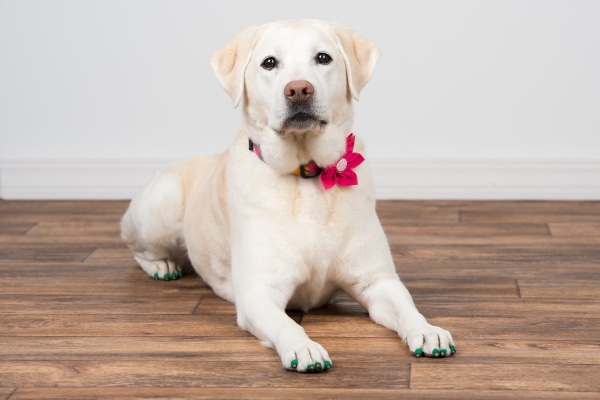
The first on my list of recommendations is our signature product, Dr. Buzby’s ToeGrips® dog nail grips. These little rubber rings go around a dog’s toenails to help give added traction on slippery floors. A better grip means your dog can walk with confidence. Plus, it helps prevent him or her from slipping and falling, which could injure the surgical leg.
Encore Mobility
Second is our other product, Dr. Buzby’s Encore Mobility™ hip and joint supplement. Encore Mobility combines the powers of green lipped mussel for dogs and New Zealand deer antler velvet for dogs. Together these superstar ingredients reduce inflammation and promote joint health—two things that are very good for post-op dogs.
Plus, because dogs who have an orthopedic injury are prone to developing osteoarthritis in dogs, using a joint supplement for dogs is a good long-term plan.
Slings and harnesses
If you or your vet suspect your dog will have a difficult time getting around after surgery, you may also want to consider buying or borrowing a sling. For the kind of help most dogs need, I would recommend the GingerLead® Support and Rehabilitation Harness or a similar “as needed” sling.
To use it, slip it under your dog’s belly close to the hind legs. Then gently pull upward to support some of the dog’s weight. The key phrase here is “some of your dog’s weight.” You still want the hind paws touching the ground and bearing weight.
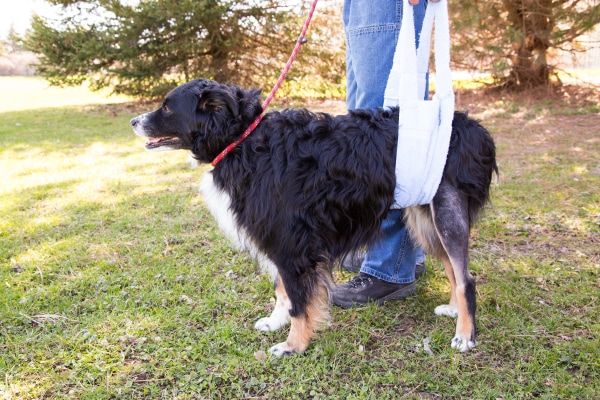
Alternatively, if your dog is having a hard time getting up from the floor, he or she might benefit from the Help ‘Em Up® Mobility Harness. This wearable harness has handles you can grab to help hoist your dog up off the floor.
If you do decide to get some sort of sling for TPLO recovery, I highly recommend you size it to your dog ahead of time and do some practice sessions. That way you aren’t fumbling with it when you need to use it to get your post-op dog up and moving. Plus, trying it out in short bursts prior to surgery can help you and your dog get comfortable with it.
Q: Is there any sort of training that is helpful prior to the surgery?
If your dog isn’t crate trained, I strongly recommend working on it before surgery. Your dog will need to be confined to a crate or small area, especially when you are gone. Attempting to escape from the crate or jump over a baby gate can cause serious injury to a recovering dog. So it is best if your dog can learn to see the crate (or another confinement area) as a relaxing, friendly, happy place.
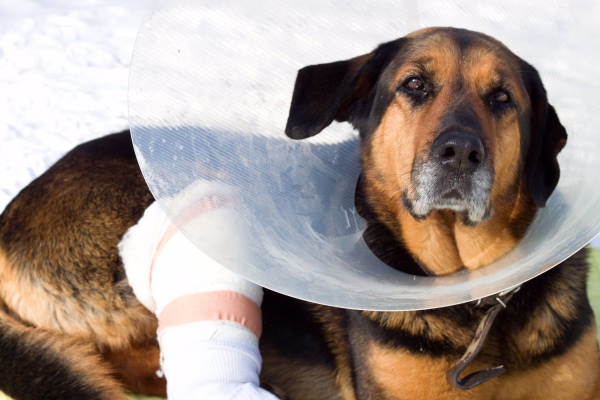
Getting your dog used to the E-collar ahead of time is also very helpful. I know no one likes the “cone of shame,” but it is a necessary evil. A dog’s natural response to a painful or irritated area like the incision is to lick. But this can introduce thousands of harmful bacteria into the incision and lead to post-op infections.
Start by doing several short (three to four minutes at a time) E-collar training sessions a day. Give lots of praise and some treats when your dog calmly tolerates wearing the E-collar. If your dog is particularly distressed about the idea, check out this low-stress handling article on teaching your dog to love the cone.
Q: What are some other useful house preparations?
You may want to try to take some steps to cut down on your dog accidentally running or jumping. For example, consider hanging a sign on your door that says “Do not knock or ring the doorbell.” You don’t want your dog leaping up and sprinting to the door every time you have a visitor or delivery person.
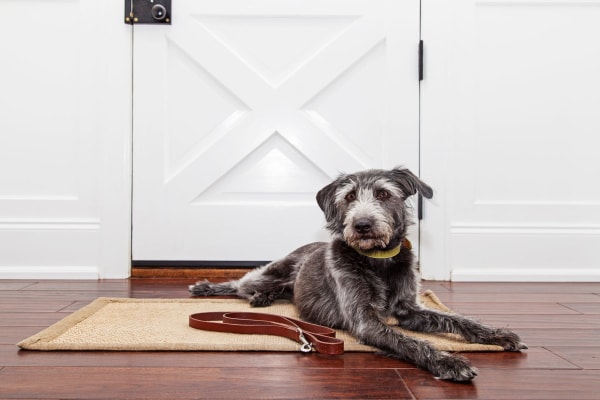
You could also consider keeping your dog’s collar and a four to six foot leash hanging by the door. That way, should you need to open the door, you can have your dog on a leash first. Even a painful post-op dog is capable of an adrenaline-fueled run out the door after a squirrel, another dog, etc. You don’t want to be frantically chasing your dog, hoping he or she isn’t going to damage the surgical leg.
Recovery after TPLO Surgery
Finally, we need to answer the questions that might arise after you bring your dog home from the hospital.
Q: Why is my dog trembling after TPLO surgery?
Just like us, dogs may tremble or shake when they are in pain. Other signs your dog is in pain include:
- Hiding or withdrawing from the family
- Hunching up and being unwilling to move
- Increased respiratory rate
- Grimacing or holding the ears back
- Whimpering or whining
If you are seeing signs of pain, please talk to your veterinarian. Let him or her know if your dog seems to be in pain constantly or if it tends to be around the time the next dose of non-steroidal anti-inflammatory or other pain medication is due. Your vet may be able to adjust your dog’s pain medication schedule. Plus, he or she could add in other medications such as tramadol for dogs or gabapentin for dogs.
Alternatively, it is possible that your dog is shaking because he or she has a full bladder or needs to defecate. Think about how it feels when you are desperate to find a bathroom. Perhaps your dog is feeling the same way. If you think your dog might need to go to the bathroom, try a short leash walk. Keep your dog on a short (four to six foot) leash right by your side and only stay out long enough for your dog to eliminate.
Finally, a dog may also shake because he or she is feeling a bit chilled. Cover him or her up with a blanket, ensure the ” TPLO recovery area” is not in a drafty area, and provide a nice warm dog bed to get him or her off the cold floor.
Careful with heat and fentanyl patches
A word of caution about warming your dog up. If your dog has a fentanyl patch for pain control, do not use a heating pad/blanket/bed or allow your dog lie in the sunshine or become overheated. The increased heat can cause your dog to absorb more fentanyl than normal, which can be dangerous.
Q: Is bruising after TPLO surgery normal?
You may notice that your dog starts out with some red bruising around and below the incision. Then it may change over time to purple or shades of yellowish-green. This is generally normal and simply a result of cutting into skin, muscle, and bone during surgery. However, if the bruised area is large, other areas of your dog start to develop bruises, or you have any concerns with how your dog’s leg looks, contact your veterinarian.
Q: Is swelling normal after TPLO surgery?
Moderate swelling can be normal in the first five to seven days after surgery. The orthopedic surgeon may recommend using an ice pack on the incision and around the joint several times a day. This can help reduce the normal post-op swelling.
However, there are a few types of swelling that are not normal.
Sometimes a dog will develop a seroma. This is a squishy pocket of fluid that often gets bigger for a few days then goes away on its own. It is not painful for the dog and the area should not be hot or red. Typically, treatment involves warm compresses. It is also a good idea to further restrict your dog’s activity as a seroma may mean he or she is too active.
An infected incision may be swollen, red, hot to the touch, and/or oozing pinkish red or yellow liquid. The dog is usually painful as well. This typically happens within the first two weeks after surgery.
Additionally, a dog can develop a joint or bone infection in the weeks or months after surgery. In this case, the dog may have seemed fine for a bit. And then suddenly he or she starts limping again plus has a swollen, hot, and painful knee.
If you think there is any chance your dog could have an infection, please contact your veterinarian promptly. Left untreated, infections can become quite serious. Sometimes they may even require removal of the TPLO plate and screws.
Finally, if your dog was sent home with a bandaged leg, keep a close eye on the toes. If you notice your dog’s toes looking swollen, if the toes feel cool, and/or the two center toes are splayed apart, this may mean the bandage is too tight. Contact your vet immediately for instructions.
Q: Is it normal for dogs to act lethargic after TPLO surgery?
Especially if a dog goes home the same day as the surgery, he or she may still be a bit drowsy from the anesthesia and other medications. Moving a large groggy dog yourself can be challenging. So you may want to take someone with you to your dog’s discharge appointment and/or have someone available once you get home to help you get your dog in and out of the car.
Also, some dogs may be sent home on gabapentin as one of the pain medications. A common but usually harmless gabapentin side effect is sleepiness and an unsteady gait. Thankfully, this often resolves in a few days, and there are dosing strategies to make it less profound. However, if it is becoming problematic, please contact your vet.
On the other hand, if your dog had been normal for a few days, weeks, or even months and then suddenly becomes a lethargic dog, make an appointment with your veterinarian. Sometimes lethargy and fever can go along with a joint or bone infection.
Q: Why is my dog walking slowly after TPLO surgery?
Your dog’s leg will be sore, so expect hesitant walking. Also, early in the recovery process your dog’s leg may be swollen and have a limited range of motion. This also contributes to slow walking.
Realistically, I would much rather have post-op patients walk slowly and carefully than charge around like crazy. The slower your dog walks, the more likely he or she is to attempt to bear weight on the leg, which is what we want. So slow and steady is a good thing!
Q: When will my dog stop limping after TPLO surgery?
Understandably, you are eager for your dog to be able to get back to using all four of his or her legs. The exact progression can vary from dog to dog, but this is approximately what we would expect:
- First 48-72 hours post-op—Your dog will probably be non-weight bearing right after surgery. Often he or she will start toe-touching and bearing a little weight on the leg after 48-72 hours.
- 10 to 14 days post-op— The dog will continue to bear more and more weight on the leg.
- 4 weeks post-op—Typically, your dog is consistently weight bearing on the leg but still limping.
- 8 to 12 weeks post-op—By now some dogs are normal at the walk. Others still show some degree of intermittent to consistent limping while walking.
- 6 months post-op—Most dogs should be walking and trotting normally (i.e. without limping).
Sometimes dog parents will notice that their pup will walk on all four limbs well when outside for a potty break and then hold the leg up again once back inside. This tends to be the case because when outside the dog is excited by all the signs, sounds, and things to sniff. He or she focuses more on the environment than on the sore leg so the limping disappears. Then when inside again where things are quiet and predictable, the dog is more focused on the leg and limps or holds it up again.
Exercise during recovery
To aid in your dog’s recovery and use of the leg, carefully follow the exercise instructions provided by your dog’s surgeon. In general, this will involve strict exercise restriction at first. Then you can gradually increase how much exercise your dog gets until he or she is back to normal activity levels. The surgeon may also give you a list of passive range of motion exercises for dogs or other ideas for helping your dog recovery physically.
Other recovery ideas include:
- Using an underwater treadmill for dogs to build muscle and stamina (as long as the incision is healed)
- Working with a rehabilitation professional to improve strength and mobility
- Acupuncture for dogs to provide pain relief
- Laser therapy for dogs to promote healing and relive pain
- PEMF therapy for dogs to aid in healing and reduce pain
Sometimes these therapeutic modalities can also be helpful prior to surgery. Talk to your vet about what would be right for your dog.
Q: How can I keep my dog entertained during TPLO recovery?
One of the biggest worries I hear from pet owners is how they are going to keep their dog from going crazy during the recovery period. I get it. For an active dog, weeks of exercise restriction sounds a lot like torture. And it can be logistically difficult if you have multiple dogs who normally play together to run off their energy.
It is possible though! There are ways to exercise and engage your dog’s brain so that he or she remains content with less physical exercise. And, while it may not be your favorite solution, your vet can also prescribe your dog some medications to help take the edge off if needed.
As difficult as it may be, carefully following the rules about exercise restrictions now will pay off big in the future. You only get one chance to help your dog’s TPLO heal correctly. And proper exercise restriction is one of the big things that can make or break TPLO recovery. It could be the difference between your dog getting full function of the leg back and always having residual problems.
So let’s talk about solutions. Here are some entertainment options.
1. Snuggles
Sometimes a dog just needs someone to be there with them. Try relaxing with your dog in the recovery area while reading a book or watching a show. Stroke your dog or scratch his or her favorite spot. Let your dog snuggle up to you. Or learn how to do doggie massage and try it out on your pup.
2. TV animals
Try turning on a video of dogs at the dog park, zoo animals, squirrels, or whatever else your dog may enjoy. As a word of caution, this one isn’t good for reactive dogs who would get worked up or start running around. However, it does work well for dogs who are interested in the world but calm about it.
3. Brain games
This is probably my favorite way to keep dogs occupied after TPLO surgery. Playing games that mentally stimulate dogs can be a very effective way of turning boredom around. The mental activity also tires dogs out, so don’t underestimate its magic.
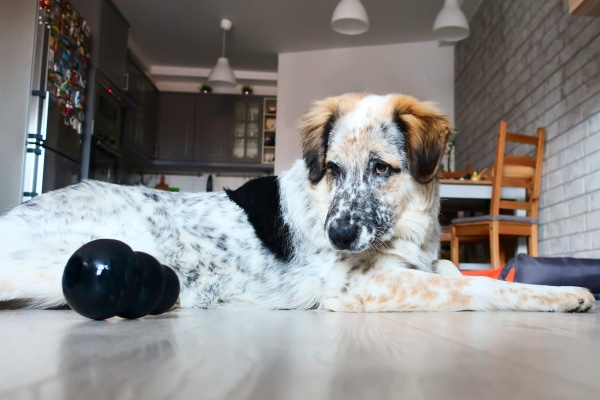
You can look up brain games for dogs online and find a plethora of ideas. But here are two fun tools to get you started:
- Snuffle mats—These fabric mats or balls have pockets, flaps, and tassels where you can hide small treats. Dogs must use their sense of smell and touch to locate and unbury their edible treasures.
- Kongs or lick mats—You can stuff various foods into the Kongs or smear them on the lick mats. Licking is calming, and these toys give your pup something to work on for awhile. To up the challenge level, you can freeze them after adding the food.
Put on your chef hat and get creative with the foods you use! Some fun fillings include:
- Peanut butter—ok for dogs in moderation as long as your dog isn’t prone to pancreatitis in dogs and you check the label to ensure it doesn’t contain xylitol, an artificial sweetener that is toxic for dogs
- Smooth style canned dog food
- Bits of kibble, meat or cheese
- Raw or cooked veggies—other than onions and garlic since they are toxic to dogs
- Fruit—beware of grapes, which are toxic to dogs, and blueberries which may stain your carpet
- Canned pumpkin for dogs
Watch your dog’s weight
A word of warning about using food in these brain games. Your dog will already be more sedentary during recovery, which lowers his or her caloric needs. Then, on top of that, you might be adding in extra treats. This combination is a recipe for weight gain if you continue to feed your dog the same amount of kibble as before surgery.
In order to account for the treat calories and your dog’s lower caloric needs, you will need to decrease your dog’s daily kibble allotment. Your veterinarian should be able to help you figure out how to make those adjustments.
Additionally, it is a good idea to learn how to find your dogs body condition score (BCS) so that you can keep an eye on your dog’s figure. If you determine that your dog is overweight, work with your veterinarian to help your dog lose weight. Not only do overweight dogs tend to have a shorter lifespan, but the excess weight also puts more strain on your dog’s joints. This isn’t good when your dog is trying to recover from knee surgery.
4. New tricks
Learning how to do new things can also help keep your dog from getting bored. You do have to be a bit careful with trick selection—no jumping through hoops or dancing on the back legs—but there are still plenty of options that don’t put strain on your dog’s leg.
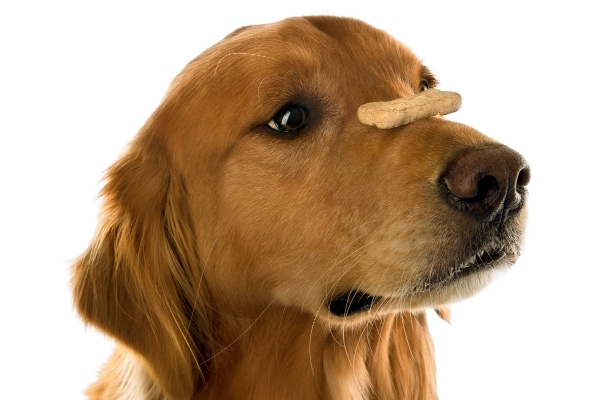
Maybe you want to teach your dog to balance treats on his or her nose. Or work on the “leave it” command. You can also teach your dog to figure out which of your hands holds a treat, have him or her learn to pick up toys and put them away, or work on barking and “whispering” on command. These are just a few ideas to get you started. The internet is full of fun ideas for dog tricks.
TPLO recovery doesn’t have to be a drag
I know that helping your dog recover from orthopedic surgery can be a bit daunting. But look for the silver lining. It can also be a great way to strengthen your bond with your dog. You get to explore new activities together like tricks and brain games. And you can slow down and spend more time just hanging out together.
I don’t want to make it sounds like it is all fun and games, though. As you learned from some of the FAQs, you do need to keep a close eye on your dog as he or she recovers. If you notice anything concerning, don’t hesitate to reach out to the orthopedic surgeon or your vet. They are there to help your dog have a successful recovery.
With some preparation ahead of time, careful adherence to the discharge instructions from the orthopedic surgeon, and a good measure of patience, I’m confident you and your dog can get through a TPLO recovery together.
What questions do you have about TPLO recovery that I haven’t answered here?
Please comment below so we can continue to grow our FAQ list.


Hello! Our dog Dakota got the TPLO surgery exactly 3 weeks ago. She had her 14-day post opp, it went well and she’s still on anti-inflammatory. She has been much slower to weight bear, and has only just started using her operated leg more on her own, a couple times a day when inside and during poop breaks. When we use the sling, she’ll walk on it more consistently and we try to do this every other day for 5 minutes. However, over the last 48 hours we’ve heard a consistent popping noise from the leg she was operated on when she walks with it. She doesn’t seem to be in pain, and we’ve seen improvement with her using her leg a little bit more, but the sound is so concerning 🙁 is this normal? She had a full cruciate tear and about two meniscus tears— she also has slight arthritis
Hi Stephanie,
I understand your concern for Dakota and this worrisome popping sound since her TPLO surgery. Unfortunately, without examining your dog myself, I can’t make specific conclusions about whether the noise is an issue or not. My best advice is to have the surgeon recheck your pup and evaluate the noise. They can let you know if this is normal or if more investigation is needed. Wishing you the best of luck and a speedy and full recovery for Dakota.
My 70 pound shepherd (5.5 yrs old) mix – Grizzly – had a TTA process done in March 2021 on his right knee and a TTA on his left knee in December of 2021. He seemed to have made a pretty strong recovery from both. Yet he came back from camp last week and he has been limping pretty noticeably on his right leg when he gets up or shortly after he wakes up. He looks like he is fine when he is walking. And he is stil mobile without a limp. Is it possible he hurt something else in there during his camp visit? Given the change from pre-camp to post-camp, it seems like he tweaked it pretty good. is there something else he could have torn?
Hi Don,
I understand your concern for Grizzly and this recent limping and pain. Without examining your dog myself, I can’t make specific conclusions. I highly recommend you schedule an appointment for your vet to evaluate Grizzly. It will take a thorough exam to determine the specific location of the pain. It could be the knee, hip, or ankle joint. It is also possible there could be a muscle strain or aggravated nerve. There is a small chance that the hardware from the previous knee surgery could have shifted and be causing a problem, but this is much less likely. Once you figure out what is causing the pain, your vet can determine the best course of treatment. I am hopeful your big guy can find some relief and get back to living his best life soon. Best wishes and good luck!
Hi Dr. Buzby,
Our lab mix had bilateral TPLO surgery 9 months ago and still seems to be struggling to scratch her ears. Is this lack of ROM normal this far out from surgery?
Thank you,
Danielle
Hi Danielle,
I am glad you are reaching out about this concern with your dog’s recovery from TPLO surgery. Range of motion takes a lot of stretching and exercises to be restored to 100%. Not all dogs achieve this goal after surgery. Each case is different and the goals for the recovery period can vairy greatly between dogs. For some, the goal may be to simply walk and run without pain and for others it may be to compete in athletic challenges. I highly recommend you contact a veterinary rehabilitation professional and have them evaluate your pup. They can let you know if the range of motion your dog displays is “normal” or if some physical therapy would be a good idea. They can also help set reasonable goals and follow up to make sure your girl is meeting all the milestones as expected. Best wishes and good luck!
Hello 🙂 How long after TPLO surgery can my Golden run and play ‘zoomies’ with other dogs? Luna is 2 and it’s been almost a year since she’s had her surgery. It was very successful but we’ve just been overly cautious about her running with other dogs due to the fast change of direction that can happen when they play. Thanks so much.
Hi Nikki,
I am glad you are reaching out about how to transition your pup back to “normal” activity after surgery. Without examining your dog myself, I can’t give you directions on what is best. Each dog is different and may have different recommendations based on specifics that only the surgeon would know. At this point, the surgical site should be completely healed. With that being said, certain surgical procedures come with lifelong changes that have to be made post-op to prevent reinjury. It would be best to discuss this concern with your vet, the surgeon, or a veterinary rehabilitation professional. They can let you know based on your dog’s pre- and post-op condition what activity would be acceptable or what should be avoided. I hope Luna continues to enjoy life and has many happy years ahead. Best wishes and good luck!
Hi. My Female Lab tore her Tplo 3 weeks ago, She came down with a UTIi because she held her urine in. would walk to go outside. We treated her for that, then had the surgery done.
We are almost 2 weeks post op. She is walking and going outside, but she stands and walks around to urinate. She will not squat. She is also dribbling urine on our way outside. Is this normal?
Hi Dawn,
I am sorry your girl tore her cruciate ligament and had to have TPLO surgery. Without examining your dog, myself, I can’t tell if this urine dribbling is normal or not. The dribbling could be a sign of another UTI. It could also be due to a very full bladder, and she just can’t hold it well, so it starts to leak as she heads outside. It would be best to have her examined by your vet. They can even get a urine sample to evaluate just to rule out the possibility of a UTI. Hoping all is well and you can get some answers quickly. Best wishes!
My dog had a TPLO on 11/7 so she is about 2.5 weeks out. Her recovery seems to be going fairly well. She walked out of the vet office the day after surgery using the leg just fine. However, I have noticed that her surgery leg tends to push outward at the knee a bit when she puts too much weight on it. Her vet said that this is normal during the early stages of recovery but I just wanted to get your opinion on it.
Her knee is also still pretty bulky which I am assuming is normal at this stage. I think I probably just worry too much and wanted a second opinion.
Hi Harley,
I understand your concern for your dog and think it is great you are monitoring her recovery so closely. It is normal for the knee to still have some swelling at this point and could be the cause of the bulkiness you describe. As for the joint pushing outward, if the surgeon has evaluated the knee and said it looks normal then I would be inclined to go with their assessment. Once the cruciate ligament has ruptured, there is nothing left to keep the femur from sliding on top of the tibia. A TPLO surgery changes the angle of the joint so that the sliding motion of the bones is not as prevalent, but there is still no ligament present to connect the two bones as the cruciate ligament did originally. So, some outward movement of the femur may still be possible even once a full recovery has taken place. It will be up to your vet to determine if the degree of movement present in your dog’s knee joint is “normal” or if some investigation should take place. Keep up the good work and I am confident your pup will be back to normal in no time.
Our dog had a TPLO on his right knee a little over a year ago. Because of his age, we waited about a year before having the other knee done (it blew a week after his first surgery). I was concerned and wanted to be sure he was strong enough to have the second one done . He is a large dog (132#) and is 10.5 years old. His surgery was about 2 weeks ago and the first 4 days he seemed to have what I referred to as drop foot in both hind legs. He appeared to have no strength in either leg and it was difficult to get him up and moving, we used both a harness and a sling to get him up. He allowed me to do the passive range of motion to his knee, but did not seem to have much feeling. In the last week he has started planting his post surgical foot on the ground and 90% of the time plants his surgical foot correctly. He moves slow so I do not have to worry about him chasing his siblings, but wondering if this is normal or do we now have to watch for spinal issues? I did call his vet but was told to just watch him.
Hi Geri,
I understand your concern about this new rear limb weakness in your dog after just having surgery a couple weeks ago. Since I haven’t examined him myself, I can’t make specific conclusions. With that being said, limb weakness/neurological issues can be a temporary side effect of some pain medications commonly used for orthopedic surgery patients. Is your pup taking Gabapentin by any chance? You are doing the right things by keeping your vet informed and monitoring your dog closely at home. If at any point you think his condition is worsening or you see new symptoms emerging, don’t hesitate to call your vet and ask for a follow up exam. I am hopeful that with more time your senior guy will be able to make a full recovery. Wishing you both the best of luck.
Hi,
our dog had TTA surgery 4 weeks ago. She seems to be doing well overal and is bearing weight on the leg and is able to do a slow 10 mins walk twice a day (as recommended by our vet). I am just concerned that we struggle to do any of the daily PROM exercises due to her being a grumpy old thing and growling at us when we move her leg. (this behaviour is pretty typical of her even before the surgery so we don’t think it’s all pain related)
Do you know how much this is likely to affect her recovery? Can the leg still recover OK without doing these exercises?
Thank you
Hi Jen,
I am glad your dog’s surgery was successful and she seems to be healing well. I completely understand what a challenge it can be to live with a grumpy old senior pup. Haha! The leg can definitely still recover without the exercises being done. The problem is, with normal walking, the joints only use a small portion of their possible range of motion. The passive range of motion exercises are made to gently push the joints past where your dog is accustomed to herself to make sure she doesn’t lose the full use of her knee/hip/etc. I’m sure you’ve heard the saying “if you don’t use it, you lose it”. So, the knee can definitely heal without the exercises, but she may have only partial mobility of the joint once she is fully recovered. I hope you can find a way to work in a few exercises periodically without too much fuss. Wishing you all the best of luck!
Question: What percentage of large dogs require long term antiinflammatories for arthritis within 1-2 years after TPLO? We have a 5 yo 95# cane corso with a partial ccl tear..
Hi Katherine,
I am not sure there is specific data to answer your question. With that being said, large breed dogs are at a higher risk for arthritis due to the increased weight on their joints. Also, they tend to have shorter life spans and therefore have senior dog issues earlier in life. Any time a joint experiences trauma (like a CCL tear or rupture) the damage to the joint starts the process of arthritis development. So, no matter what surgical technique/procedure is performed, you are almost guaranteed to have arthritis form in the joint earlier than what would have happened prior to the injury.
Hi Dr. Buzby!
Sorry for posting again. I can’t seem to find my comment from 2 days ago so thought I’d post it again.
So my dog Benji got his TPLO surgery on June 10, 2022, for his left knee, and not even a week later, his right knee gave out as well, unfortunately. I limited his activity by quite a bit as he was starting to put more of his weight on his left knee. I’m happy to say that he has been doing really well since his surgery! His left knee has healed up and his right knee hasn’t been acting up. He walks with his right leg sticking out a little bit but overall, no issues. I am planning to get the surgery done for his right knee next year. He has been back to jumping and playing normally, yet I do limit this activity still. So, 3 days ago, I had taken my eyes off him for a few minutes while he was playing and when I called him, he came back with him not being able to put any weight on his left leg and when he did try to walk on it, it would make a popping sound from time to time. I hate seeing him like this and I blame myself for this happening, but he was doing so well for the longest time and it’s been 5 months since he had gotten the surgery done. I’m waiting to see if this issue goes away, but if it doesn’t go away in a couple more days, I will be taking him to the vet. Does this mean he’ll have to get surgery done on the same knee? It was a very stressful time for him and my family and I hope it doesn’t lead to this. Thank you for your time.
– Jessica
Hi Jessica,
I am sorry I am just now responding. Your other comment came through just fine. I have just been away from answering comments for the last few days. You are right to be concerned about your dog limping on his left leg again. This is not typical for 5 months post TPLO. I would think your pup should have returned to mostly normal function by now. I highly recommend you have him evaluated by your vet as soon as possible. They may need to take x-rays to make sure all the original orthopedic hardware hasn’t shifted or become compromised. Many times, a popping or clicking sound in the knee can be an indication of a torn meniscus (cartilage that cushions the knee joint). This is an important issue that needs to be ruled out. I hope you can find some answers for this acute lameness your dog is struggling with. Praying for good news and a positive outcome.
Hi there – I would appreciate some advice. My French Mastiff (60kg) 4 year old female had TPLO surgery 3 months ago – she had a slow recovery but back to personality and weigh bareing in the house and grass. However in the past month I have seen no improvements in her walking on the leg when on pavement. She runs and walks perfectly on grass and on our wooden floors but not the pavement. The vet did an X-ray and said she is healing well but I am not confident – I feel like she should be walking on it on pavement if she is on grass or pavement. Have you heard of any other cases like this? Really want my baby back to walking properly!
Hi Melissa,
I understand your concern for your big girl with this strange issue when walking on pavement. I have not heard of this particular problem before and am not sure what the cause would be. This would be a great question for a rehab vet. They may be able to narrow down the issue and offer exercises or therapies to help restore normal function. Praying for clear answers and an easy solution. Wishing you and your sweet girl all the best.
Hello
My dog had left TPLO October 13, 2022. She has been doing great but now is limping on the rear right leg, almost toe touch weight bearing only. I am not sure I can put her through another TPLO as she had a really tough time including gastroenteritis from the NSAIDs, pain meds, and was not eating or drinking well. Our vet said her right knee does have some degenerative changes and will likely require a TPLO on that knee as well 🙁
Is there anything I could do now to try to preserve the knee and avoid future surgery?
Appreciate any recommendations 🙂 Ty. Jennifer
Hi Jennifer,
I am so sorry your girl is having issues with her right knee just weeks after surgery on the left. Statistically, most dogs will rupture the cruciate ligament in the other knee within a year of surgery on the first knee. The cruciate ligaments are affected by degenerative changes, and both are usually near the same degree of tearing. I am not sure if there is anything that can be done to avoid another surgery. Since I haven’t examined your dog myself, I can’t make specific conclusions or recommendations. Your best bet is to schedule a consult with an orthopedic specialist and possibly a veterinary rehabilitation professional and get their expert opinions and advice. I hope you can find the answers you need to make the best choice for your sweet girl. Wishing your pup a speedy recovery and happy days ahead.
Thank you so much. I have read that sometimes braces can be used in lieu of surgery. Have your heard about any success with this modality? I am hoping it is not a full tear as she is demonstrating some weight bearing…..just trying to avoid surgery if possible 🙁
Hi Jennifer,
Yes, sometimes braces can be useful. I will say that I tend to recommend them in very few cases. Most dogs benefit more from surgery or physical therapy. But your pup may be a good candidate for a brace. This is a great question for a rehab vet! Also, here is a link to another article all about braces for dogs: The Dog ACL Brace: 5 Surprising Answers to the Question “To Brace or Not to Brace”
Best wishes!
Hi Jennifer,
My dog just tore both CCL’s a week apart his surgery was October 26th and we could only get one done at a time. For the leg that couldn’t get done we invested in a really good brace (Balto Ligatek), you can also get fully custom braces but they’re far more expensive. We have been using it for 6 weeks and he’s already showing signs of improvement and is not limping on it at all even though that leg is now bearing most of his weight while his TPLO heals. We have also made a lot of changes to our home to make it easier for him to get around. We built ramps on the stairs he needs to use to outside, and took the bed frame out from under our mattress so he can just walk off and on, But because he needs to use the leg that still has the torn CCL to stand up he only wears the brace when he goes outside for his 5 minute bathroom breaks as the brace restricts his knee from bending too much so it makes standing or getting harder. Our vet said that he may not need the second surgery because of the brace and how well he’s responding to it once his other heals so we thought there was no harm in trying.
Hi Alicia,
Thank you so much for sharing your experience with our readers. I am sure this will be a ray of hope for Jennifer and others in a similar situation. I pray your boy will continue to heal and have many happy days ahead. Best wishes to you both!
My dog had TPLO Surgery about a year ago. We followed all of our vet’s recovery instructions and she is now running and walking with no limp whatsoever. However, her leg does tremble often during and after exercise… The vet said that this would resolve as she regained muscle and got strength back in the leg but it has not resolved at all. What are your thoughts on this? Should we do physical therapy with her?
Hi Stephanie,
I am glad your dog’s surgery was successful and she has returned to normal function! Since I haven’t examined your pup myself, it is hard to make specific conclusions about why her leg trembles during and after exercise. Maybe it is a lingering issue with the nerve function to the affected muscles? Physical therapy is always a great option. I recommend you schedule a consult with a veterinary rehabilitation professional. They can evaluate your dog and let you know if there are exercises or therapies that could help with her specific issue. Make sure you are honest about your concerns. You’ll have to partner with the specialist to decide what the goal of therapy will be. Is the end goal to make the trembling go away? Or make sure your girl is pain free and has full function? Feel free to leave an update as things progress. Best wishes and good luck!