Signs of dementia in dogs can be distressing to notice. After all, we want our grey-muzzled companions to be mentally sharp and happy for as long as possible in their golden years. Integrative veterinarian Dr. Julie Buzby takes an in-depth look at the five common signs of doggie dementia and explains how to help your dog with dementia keep living the good life.
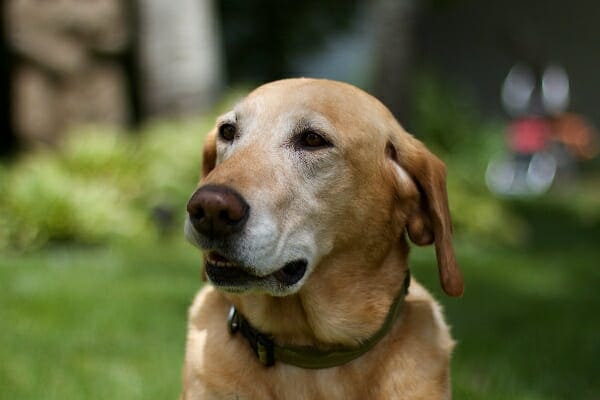
Recently, a longtime friend and client brought in his 10-year-old black Labrador Retriever, Dixie. I had known her since she was about three months old. Dixie pranced into the vet clinic with the same happy attitude that she is known for.
However, Dixie’s dad looked very concerned. As I asked what was going on, my client started describing some changes he had noticed at home recently. His dear Labrador Retriever was no longer sleeping through the night. She was also barking more than normal and had started to show some aggression towards her “brother,” a small Terrier mix. It was very obvious that something was changing with his beloved dog.
Finally, he looked up at me and said, “My dog is doing things I never would have expected from her. Can dogs become senile?” I looked back at him and told him, “Yes, unfortunately, dogs can develop dementia.”
I went on to explain to my client that our canine companions are living longer than they used to because of the wonderful care they receive at home and from their veterinarian. This is great news because it means we get more time with our dogs. However, it also means that an increasing number of dogs are living long enough to develop dog dementia—also called Canine Cognitive Dysfunction in Dogs (CCD) or Cognitive Dysfunction Syndrome (CDS).
What is dementia in dogs?
Dementia occurs in senior dogs as they age. Their brain undergoes changes that are very similar to what doctors see in human Alzheimer’s disease or dementia patients. In fact, a 2019 article published in Frontiers in Neuroscience compared canine cognitive dysfunction and Alzheimer’s disease in detail. These brain changes can affect a dog’s memory, behavior, sleep patterns, activity, and appetite.
In recent studies, it has been estimated that approximately 28% of senior dogs develop CCD by 11 to 12 years old. When dogs reach the ages of 15 to 16 years, it is estimated that approximately 68% have doggie dementia.
What are the signs of dementia in dogs?
The first signs of canine dementia may be difficult for you to recognize. Early signs of cognitive decline are sometimes very subtle. That’s why it is important that dog parents know what to look for.
Dog dementia symptoms are grouped into three stages—mild, moderate, and severe. There are typical patterns that appear within each stage. However, it’s important to note that not every dog follows these exact patterns or stages.
So any of the signs described below could be seen at any time once dementia sets in.
3 stages of dog dementia
Stage one: Mild
In the early stage of dementia in dogs, signs tend to be more mild and easier to miss. You may notice changes in your dog’s sleep patterns and maybe mild changes in how your senior dog socializes with you or other pets.
Stage two: Moderate
The moderate stage is when signs may become more apparent to you. The most frequent sign of dog dementia at this stage is house soiling—even though your dog was previously house-trained.
Stage three: Severe
The last stage is severe symptoms. In this stage, the signs mentioned above tend to increase. Also, you may notice your dog starting to wander around the house throughout the night instead of sleeping. Your dog may begin to bark more at things that aren’t really there.
5 signs of dementia in dogs
Let’s explore the five signs of dog dementia in depth.
1. Disorientation
Some dogs with dementia seem to lose their sense of direction or may walk around appearing confused. Disorientation can be seen in a variety of ways in our senior dogs. Some dogs may walk up to furniture and appear unsure of how to go around it.
If you have ever seen the movie A Bug’s Life, the scene at the very beginning of the movie when the leaf falls and blocks the line of ants carrying food is similar to disorientation. That leaf falling blocks the path that the ants always take, and they become disoriented and need the other ants to lead them around the leaf back to the correct path.
Sometimes, as our senior dogs become disoriented, they might need help just like this to re-learn how to go around the couch or table to get where they want to go.
As our beloved companions age, they may also experience vision changes or cloudy eyes in dogs. Impaired vision can combine with mild dog senility to create more significant confusion and disorientation.
Other signs of disorientation include:
- Forgetting where the water bowl or doggy door are located even though they have always been in the same spot.
- Walking in circles as if stuck in that motion and don’t know how to stop.
- Getting stuck in a corner or standing with the head leaning on the wall like he or she doesn’t know what to do (head pressing).
- Standing at the wrong side of the door when it is opened.
If you begin to see your dog exhibiting any of these signs, but you are not sure if your dog is truly disoriented, take a video to show your vet. This will help you explain what you are seeing so your vet can figure out the best way to help your pup.

2. Changes in social behavior
One of the most common reasons dog parents bring their dog to the vet is social behavior changes at home. These changes may occur with the people living in the house or with other pets. As mentioned, doggie dementia affects our dogs’ memories. This means they may forget those that they live with or forget how they normally play with other dogs or cats.
Some dogs become less interested in playing with or receiving attention from their people. This may mean they no longer care when company comes over. They used to get excited or bark to greet guests, but now they don’t. Other dogs may become more needy and want extra attention.
Finally, the change that is usually the most concerning to owners, is sudden aggression toward people or animals. This was one of the big problems my client was seeing because Dixie was attacking her terrier “brother.”
If you begin to see changes in behavior at home, especially more aggressive behavior, please discuss it with your veterinarian immediately. While these changes may be related to dementia in dogs, it is important to make sure that there are no other health problems going on.
Arthritis in dogs or other causes of pain in dogs could also cause your senior dog to act differently. A painful dog is often more likely to growl or snap when painful parts (such as hips or back) are touched.
3. Changes in sleep patterns
In some cases, altered sleep patterns may be the first sign that you recognize in your furry friend because this interrupts your own sleep. Dogs with dementia often start waking up more in the middle of the night than they previously did. Dementia can be one of many causes of senior dog anxiety at night.

Your dog may do different things when he or she wakes up. Some may pace back and forth all night as if they are anxious about something. Other dogs may wake up barking as if someone knocked on the door or they saw a ghost. And others may wake up and decide they are starving and need to eat right then!
Some dog parents describe this stage as being similar to having a newborn baby at home. Or others may compare it to sundowning in humans with Alzheimer’s (which is why CCD is sometimes called sundowners in dogs). It is okay to be frustrated when this happens because it is exhausting for both you and your dog!
4. Accidents in the house
As canine cognitive dysfunction progresses, some senior dogs may forget the commands and tricks you previously taught them. When you say “sit,” “come,” or “stay” they may just look puzzled. Senile dogs may also forget all that hard work you put into house training. Inappropriate urination or defecation in the house may occur due to:
- Increased anxiety that occurs with dementia.
- Going outside and forgetting what they were supposed to be doing.
- Forgetting where the doggy door is or how to use it.
- Forgetting their body cues and not realizing they have to go until it’s an emergency or too late.
- Forgetting how to signal to you that they need to go out.
However, accidents in the house can happen for other reasons in senior dogs. Urinary incontinence in older dogs, Cushing’s disease in dogs, diabetes in dogs, administration of medications like prednisone for dogs, or urinary tract infections in dogs may also cause urinary accidents. It is important to discuss accidents and other signs with your veterinarian to ensure he or she has the needed information to make the right diagnostic and treatment plan.
5. Increased anxiety and changes in activity or appetite
As mentioned, doggie dementia may cause increases or decreases in activity. Increased activity usually presents as pacing or restless nights. On the other hand, dog parents may easily mistake decreased activity during the day for age-related slowing down. Dementia patients commonly want to sleep more during the day (more than the number of hours an old dog should sleep) or may not be as excited to play as they used to be.

Activity may also change because anxiety can become worse once dementia sets in. Sometimes, dogs can sense the changes happening. They are scared and confused because they don’t remember how to follow commands or they keep getting lost around the house.
In addition to confusion-based anxiety, some senior dogs with dementia may develop noise-based anxiety. This may include reacting to fireworks, thunder, or even small noises like car alarms or the stove beeping. Another common sign some owners notice is that their four-legged friend is more attached to them. This can be a result of separation anxiety.
Since activity can decrease and anxiety can increase, another sign is decreased eating and drinking. If your old dog is not eating well, CCD may be the cause. This may occur because dogs feel too tired or confused to get up and go to the bowl. Also, they could forget where the bowl is located or forget that they were hungry or thirsty.
How is doggie dementia diagnosed?
The most important diagnostic step is for dog parents to notice the signs at home. You spend the most time with your furry friend and you know him or her best. Dogs often tend to behave differently at the vet than they do at home, so your vet may not be able to see what you see.
It is important that you let your veterinarian know when your dog’s behavior is changing and you think something is wrong. If you are confused about what your senior dog is doing or don’t know how to describe it, pull out your smartphone. Pictures and videos can help your vet “see” what is happening.
Additionally, you could consider filling out a canine cognitive dysfunction checklist and bringing it to the vet appointment. This sort of tool can provide an overview of the symptoms your dog is exhibiting, which also helps with the diagnostic process.
Once you bring your dog to the vet, he or she will ask you to describe what is going on. Typically, your vet will also ask a variety of follow-up questions. Sometimes he or she may recommend different tests such as blood tests for dogs, X-rays, ultrasound, CT, or MRI. These tests can help rule out other health issues that could have similar signs.
These steps are important because there isn’t an easy “yes” or “no” test that can definitively say if your dog has dementia. Ultimately, your vet makes the diagnosis based on your observations after ruling out other conditions.

How are signs of dementia in dogs treated?
Unfortunately, there is no cure for doggy dementia. But we can treat some of the symptoms to improve quality of life. Your veterinarian may prescribe medications or supplements to help keep your dog comfortable and manage anxiety or disrupted sleep patterns.
Some of the more common may include:
- Melatonin for dogs, which may help restore normal sleep-wake cycles—As a word of caution, some formulations of melatonin, especially melatonin gummies, may contain the sugar substitute xylitol, which is toxic for dogs. Always check the label for xylitol (sometimes called birch sugar) before giving melatonin supplements to your dog.
- Anti-anxiety medications such as trazodone for dogs
- Anipryl® (Selegiline for dogs), a medication that affects signaling chemicals in the brain to manage the signs of dementia
- Omega-3 fatty acids for dogs
- S-adenosylmethionine (SAMe)
- Medium chain triglycerides (MCT oil for dogs), which provide easy-to-use energy for the dog’s brain and may help support and improve cognitive function in dogs with CCD. A great source of high quality MCT oil formulated for dogs is Dr. Buzby’s Brain Boost™ organic MCT oil for dogs.

There are a variety of medications, supplements, and diets that may help with dog dementia beyond the short list shown above. Your vet is the best person to decide which of these options are right for your dog, which is why they are not covered in more detail here.
Please keep in mind that senior dog supplements are not regulated by the FDA and some are more effective than others. I always advise talking to your veterinarian before beginning any OTC supplements for your dog.
Things you can do at home to help your dog’s memory
There are also activities you can do at home to help your dog’s memory. You may have heard human doctors recommend puzzles to Alzheimer’s patients. Puzzles can be good for dogs too! You can try different “thinking games” at home such as food puzzles (found online and at most pet stores).
Some owners play “watch the food” where they put a piece of food under a cup and leave two cups empty. Then they move the cups in a circle on the floor and the dog has to find the food. This is a great way to keep your senior dog mentally stimulated, and can also be a way to encourage them to eat.
For dogs with severe dementia symptoms, a consultation with a veterinary behaviorist may be helpful to develop strategies to help keep them comfortable and calm.
Back to my client, the lovable Labrador with dog dementia
Dixie’s relationships with her dad and “fur sibling” improved after starting anxiety medication and learning “thinking games.” She loves to play hide-and-seek with her dad. He told me that once he taught her this game, their relationship grew back to where it was and her activity level seemed to improve.
She still has some hard days, but she continues to love food and going on her walks. Her dad understands that just like with human Alzheimer’s or dementia, it can progress over time. And he knows that eventually he will have to face that dreaded decision of when to euthanize a dog with dementia. However, he is making the most of her golden years and plays an important role in helping her improve!
Hope for dogs who are showing signs of dementia
If your senior dog is showing some signs of dementia in dogs or if he or she has recently been diagnosed with CCD, it can be normal to feel scared or unsure of what is next. However, there are so many ways you can improve your dog’s quality of life.
Dementia doesn’t have to define the last chapters of your dog’s life. Be sure to ask your veterinarian any questions that you have and work with him or her to develop a plan for your dog. Together, you can help your senior dog have comfortable, happy golden years in spite of his or her doggie dementia diagnosis!

Does your dog have dementia?
Please comment below to share his or her story.


I’m very puzzled about what my 15 year old dog did today and wonder if dementia could be the cause. She has extensive spinal arthritis and hasn’t been able to run in years. She also limps due to a growth defect in her front leg that’s become very arthritic as well. I don’t leash her often because she walks right next to me in the neighborhood and stops constantly to smell things….Beagle mix. Today, we got to the sidewalk, strangely she started howling and then took off running at full speed. She hasn’t been able to run like that in years and even running after her at top speed, I wasn’t able to catch up. She ran our normal path and went right back home. She continued to sprint around inside the house after. Finally, she calmed down, panted a ton, then relaxed. A few hours later, she was in pain and had trouble walking because of all the running she did. I don’t know what to think about this, as it was so very unusual. She has become incontinent in the past few months and can no longer hear. She follows me around the house constantly, which is fairly new. She still eats well and loves a walk. I’m totally stumped at today’s behavior!
Hi Nicole,
Yikes! That is very strange. I agree with you that the behavior is puzzling but not sure it is something that is cause for concern. Your best bet is to contact your vet and discuss what you witnessed. They may want to do an exam or run some tests just to be sure nothing important has been missed. Hoping all is well today and your girl is back to her normal routine. Best wishes and good luck!
My small terrier mix will be 18 in two months. About 14 months ago Daisy started pacing at night, getting stuck in corners, and sleeping most of the day. I started her on Selegiline.. For 6 weeks with a 5 mg pill everyday there was no noticeable change. I still had pills left so I continued to give her one a day and after 8 weeks she suddenly seemed like her old self. We were able to sleep all night for first time in months, This continued for six months but now the dementia has progressed beyond what the medication could help. I’m thankful for the six wonderful months of having my Daisy back.
I am continuing the Selegeline but we are now taking it day by day and the dementia is getting worse. Soon I will have to make the heartbreaking decision. I wanted owners with dogs showing signs of dementia to know that it could possibly take 6-8 weeks for the Selegeline to help.
Hi Judy,
I am sorry Daisy is not doing well and her mental state is declining. What a blessing to have gained 6 extra quality months with her! Thank you for sharing your story. I am certain this will offer hope to others in a similar situation. Enjoy every moment and make the most of each day you are gifted. Best wishes and bless you both. ♥
My 13 yo Jack Russell mix is showing progressed doggie dementia. I love her so much and I don’t know if there’s a way to know if I should make the decision? She’s my best friend and I talk to her all the time! Any advice?
Hi Robin,
I understand what a difficult decision you are facing and wish I could make it easier for you. Here is a link to another article that will offer guidance and great advice from other readers as well: Dementia in Dogs: When to Euthanize Your Beloved Senior Dog
Praying for clarity and strength. Bless you and your sweet girl. ♥
My Rat Terrier, Maggie, is about to turn 14. We have been battling urinary incontinence for the last two years. Proin eliminated the issue but really changed her personality and made me notice the onset of the dementia. I am a licensed mental health therapist and licensed drug and alcohol counselor and became very curious about the active ingredient of Proin. Once I took I deep dive into that, I was sufficiently prepared for the withdrawal and temporary behavior problems of the trash panda that she became for the next few months. My vet then prescribed estrogen, but held off the incontinence for a short time before becoming ineffective. It also had a reverse effect on her behavior from the Proin where she became extra clingy and would often appear to actually be weeping. Happy to say we are managing the incontinence with just diapers overnight with this onesie like outfit (intended for post surgery) over it that helps the diaper stay on. Since she is a long dog, the size we have fits somewhat snug and this seems to actually help her have a little pressure overnight where she usually does not urinate. She doesn’t wear anything in the day and just gets many extra potty breaks since she is my coworker. This has made it so much easier to handle the dementia and loss of hearing, low vision, wandering, extra potty break reminding/attention that she requires. The ten $18 fashionable, soft and waterproof pet blankets from Costco that I have readily available to rotate in her spaces don’t hurt either. Thank you for your website and all your helpful information. I have never had a pet that has lived to such a healthy advanced age. I just want to do what is best for her and sometimes get a little overwhelmed and exhausted, but I remember how much I love “my son’s” dog. You vet people are pretty special to do what you do with the challenges you face and I hope you know that people like me that love our fur family appreciate it! Thank you for the extra time you spend responding to these comments with such care and compassion!
Hi DJ,
Maggie sounds like a very special little pup and she is lucky to have you taking such good care of her. I am glad the diapers are helping to make caregiving a little easier and what a great idea to utilize the onesie in this way! Thank you for all the kind words. I appreciate you taking the time to share your experience with us. Wishing you and your sweet girl many happy days ahead. Bless you both. ♥
holy cow, reading all these comments makes me feel….less alone? my 16yr old German shepherd/jack Russell mix was diagnosed just 1 day before i lost an incredibly important person to (human) dementia. at first it was just the lack of sleep/pacing at night/extreme panting. very few symptoms fit, and doctor did X-rays (for the panting) … while at the vet she went under a chair & couldn’t figure how to come out the other side…or back up…and vet said most likely dementia. within 6 months the dementia symptoms were like a checklist & she hit every one. she’s 1000% a different dog & I’m continually surprised (but I shouldn’t be I guess) at how closely doggie dementia mirrors that of human dementia. she’s deaf now, due to her age, and there are times when I’m so grateful because after a couple nights of no sleep (can’t let her hurt herself on accident or get stuck somewhere) and she snaps at me when I try to pet her & I yell at her. I immediately feel like the worst human on the planet because I know it’s not her fault 🙁 it’s been 1.5 years since her diagnosis & we use 1 gabapentin, ½ trazadone in the am, and 1 gabapentin, 1 trazadone, ½ galiprant (think that ones pain?) and 5mg melatonin at night & it took a lot of trial and error so she wasn’t weird or too doped up to find the right dosage for her. I have chronic pain issues so I know we all have bad days & she has them too, we are allowed to go up to 3 gabapentin and 2 whole traz if things get rough…or…if her once LOVED thing has to happen (a car ride! she HATES them now!) she used to be about 45lbs but has maintained 38 the last year or so (put in here for others who can adjust for their dog & ask vet about said meds). we just saw the vet yesterday & she said as long as the good days are more than the bad (so far they are) and it’s nothing more than I can handle….I told her this is my princess & there isn’t anything I wouldn’t do so nothing is “too much” when it comes to her…then told her when it’s time she needs to tell me, cuz she’s my princess & love is blind, ya know. she assured me now is not that time & when she goes back (7 weeks for nails & weight check) shell reassess if needed. … I don’t know where I was going with all this but no one will read this & I think I just needed to get it out. I feel guilty and sad & exhausted sometimes, then back to guilty when I realize it from her perspective! my loved one would get soooo angry & violent when they forgot a word for something & it would come out at us, but it was just their frustration because they have a sense of what’s happening I think, and I do think dogs are the same way. I dunno…I’m rambling now but I’m glad I found this site (pretty good info) and the comments on here definitely helped. thank you
Dear Krysi,
My heart goes out to you as you navigate this emotional path with your beloved pup. She is very lucky to have you advocating for her well-being and loving her every step of the way. Thank you for being willing to share your story with us. I am glad typing out your thoughts offered a release and hope you have been comforted by the comments of other readers as well. Praying for your strength and wishing you both peace. ♥
I had to put my sweet lab mix Harley down today and, even though she was 18 years old, it was a horrible decision to have to make. I adopted her when she was 14, so she’s been old since I’ve known her, and she had massive anxiety since the moment I met her. With medication and lifestyle adaptations, she was able to overcome it with to enjoy long walks and cuddles and travel. But in the past year, she started to show signs of advancing dementia. She’d go to the wrong side of the door, pace, pant, and become fearful at night. In the past couple months, she became suddenly terrified of the car and didn’t want to walk any more. The vet recommended I let her go. Part of me is glad we never got to the stage where she wouldn’t recognize me, but I also can’t help but wonder if I did the right thing for her.
Dear Bailey,
I am sorry for your loss of Harley. I understand the grief you are experiencing, and it is normal to ponder the “what ifs”. I have no doubt you made the most loving choice for your sweet girl and that she knew how much you cared about her. Try not to let the burden of guilt weigh you down. You did not make this decision in error but with the advice and guidance of your vet who had Harley’s best interest in mind. I hope with time you can look back on all the memories you shared, and they will be a source of joy in your life. Wishing you happier days ahead. Bless you. ♥
My terrier Paddy is 13 and 5 months old. He’s a lovely boy. For sometime now he has started barking early evening. He seems focused on the ceiling or corner of the wall. His bark pitch is high. It can last 10 minutes or 90. When he stops, it’s like nothing has happened. He has also started to want to sleep by me in bed. He usually sleeps in his bed on the floor next to the bed.
During the day, he often stares at me, and sometimes moans/whines. Recently he has had barking episodes during the day too.
The Vet gave him a full examination, and said he is going deaf, but otherwise healthy, and he could have doggie dementia. She recommended Zylkene a Calming Supplement for Dogs. We tried this and there was no change. She then prescribed Selegiline, which he has been taking for 3 weeks with no change. She has now taking him off these and prescribed diazepam to help him sleep at night (and us). He can only be on it for a short while, as it can harm the liver.
So we have no plan or guidance on what else we can try. I feel lost and don’t know how to help him 😞
Dear Caroline,
My heart aches for you as you face this difficult situation. I know you would do anything to help Paddy and it is clear he is dearly loved. Unfortunately, dementia is progressive and will reach a point where medicines and supplements just won’t help. You may be at that stage already. Please reach out to your vet and see if they are willing to do a quality-of-life evaluation for Paddy. Sometimes saying goodbye is the only way to offer freedom and relief. I truly believe mental disease causes as much suffering as physical disease. I would rather let go one day too early rather than one day too late and allow unnecessary struggling and pain. I will attach links to other articles with more information and great advice from our readers. Wishing you strength and comfort as you navigate this emotional path.
1. Using a Quality of Life Scale for Dogs
2. Dementia in Dogs: When to Euthanize Your Beloved Senior Dog
3. Sundowners in Dogs: A Veterinarian’s Guide
4. Preparing for Your Dog’s Euthanasia: 10 Thoughts for Peace
please ask your doctor about melatonin..it’s over the counter and a natural chemical bodies produce to sleep. my dog (38lbs) is on 5 mg. I was told to try lower dosage & just work up to 5 if needed…(she needed lol)
there’s also trazadone and gabapentin. think the trazadone is the anxiety one? gabapentin is nerve block so might be that one too. my dog is on both so hard to remember. they never mentioned only being able to take it for so long, so might be something to mention to your vet? even though melatonin is OTC I don’t recommend trying it without the vets concent, to make sure it won’t interfere with anything and to get proper dosage, but that has worked wonders & you don’t need a prescription for it if Dr thinks it’d be a good idea!
This article and reading all the comments has helped me so much during such a dark time. Its given me real solace realising that so many others have been in my shoes. Our loving boy Jay who was a Japanese Shiba Inu had been with us since he was 14 weeks old and we had to say goodbye this weekend at the age of 15. He was the most loving and loyal companinion I could have ever wished for., every day he would sit on the back of the sofa at exactly the same time waiting for my daughters to return from school. In the last two years it was clear to us his sight was going, his hearing and his character wasn’t 100% him. In the last month his pacing had become constant, getting stuck and walking into furniture, to the point he only slept once he had exhausted himself entirely. He had started soiling himself at night and sleeping in it, I would carry him to the garden but he would wander into things and not wee, only for me to carry him back inside and to wee in the house. He couldn’t see in the end or hear and his back legs would give way whilst he tried pacing.
I didn’t want to say goodbye, but I realised it was becuase of me, I knew his quality of life was non-existent, he was constantly confused, anxious and barely able to hold himself up. The Vet told me it was time, it broke my heart as he left this world in my arms but I know letting him continue was not the kind thing to do. I have had feelings of guilt and I miss him terribly but I know in my heart it was the only and right thing to do, he completed our family and gave us 15 years of love – saying goodbye was always going to be the hardest thing to do. Thank you for your article and thank you to all the comments which have helped me through this time.
Dear Luke,
My heart aches for you with the recent loss of Jay. It sounds like he was such an amazing pup. It is clear he was dearly loved by everyone in the family, and I am certain he knew. I am glad you were able to be with him during his final moments (I just read your other comment as well) and be a source of comfort as he passed peacefully. May his memory be a blessing in your life and stay with you always. ♥
Luke we are saying good my to our girl Evie tomorrow. She’s our nearly 17 year old Rat Terrier and so much of what you have written resonates. She lost her hearing, has the cloudy eyes and doesn’t seem to recognize us anymore at all. Just recently we began to find her having soiled her area and laying in it. She will make a circle outside then potty as soon as she gets in the house. We tried Denemairin and it worked for a time but it is no longer having an effect. For the past 3 days she has been semi awake barking in no direction. Tomorrow will be hard but I am glad I found this article.
Dear Shallyn,
I am so sorry for your loss of Evie. You did the only thing you could to give her freedom from suffering and offer her peace. I am certain she knew how much she was loved. Wishing you brighter days ahead and may her memory always bring you joy.
I’m reading your story Luke and crying because it’s the very same as mine 😢 Our beautiful 16 year old terrier Rex had to be put asleep last Saturday and I am devastated. I miss him so much and question my decision every day but I know it was the right thing to do for my poor boy. His dementia had gotten so bad that he would constantly keep circling even to the point that he walked side ways. It’s awful to see them like this and every day I hoped he would get better but he only got worse and I could see the sadness in his eyes. We had 16 wonderful years with our beautiful boy and we miss and love him so much. Thank you to everyone for all your stories reading them has helped me, xx
Dear Lorna,
I am so sorry for your loss of Rex. I know you would have done anything to give him more time. But what a blessing you were able to offer him a peaceful passing and spare him from unnecessary suffering. I hope with time your heart will begin to heal, and the grief will fade. May Rex’s memory stay with you always and bring you joy.
Nearly 30 years ago my 13 year old Lab/Pit Bull mix had dementia. He constantly paced with no apparent destination, a gate was left open and he got out and I’m sure wandered aimlessly until he apparently fell into a ditch where a kind lady rescued him and took him to our vets office. When we went to get get him he showed no recognition of us, no wagging tail and kisses, we were strangers to him. I knew it was time to let him go and it broke my heart, this brings tears even 30 years later.
Dear Terry,
I know the pain of watching a beloved pup suffer from dementia and I am sorry you have experienced it as well. We do the best we can to offer them a life of love and happiness. It sounds like your sweet boy was dearly loved and I am certain he knew. Wishing you peace and comfort.
My sweet Cam, 13 year old little terrier mix, started showing early signs of CCD (or as I call it Pawlzheimer’s) a couple of years ago. Her early symptoms were going to the wrong side of doors, getting lost in mirrors/ reflections, and no longer being safe at off-leash parks. For a long time her almost daily short walks would help alleviate most of her symptoms.
In the last year her symptoms increased dramatically. She used to love everybody, but pretty much just likes/ is aware of me now. She’s at her worst while sundowning when she isn’t soothed by me either. She would pace at night jumping up and down on the bed and going outside when she didn’t need to, but sometimes she’d fall down the stairs, so the vet prescribed Trazadone and then Gabapentin with it.
She’s too old to go on walks now, but I take her on stroller walks, and she is so happy and surprisingly quite alert while we wander the neighborhood or even light trails. She’s still thrilled to go camping too. (We go to the same place, and she is still familiar with our camper luckily.) The meds and her stroller strolls help immensely, and I’m grateful she learned how to use her bed stairs before she got too bad. She still uses her dog door during the day, but I help her at night and first thing in the morning, or else she’ll be lost in the yard or have an accident. She gently bites me when I get home, as her separation anxiety has gotten worse too. I only teach for an hour or two at a time, but she doesn’t seem to count my husband as a reassuring presence anymore. It’s crazy how similar sundowning is in humans and dogs, except I’ve never seen an old human with zoomies (another thing she will do when I get home), but I just block the stairs when that happens.
We had to put down our sweet Shepard Golden, Tarvos, last spring after a long battle with skin cancer when he couldn’t move well anymore, but he kept testing well on the quality of life scales for far longer than we thought he would prior to that. I was fortunate to be able to take care of his sores and give them both miles of extra walks and hours of cuddles, but man it’s hard, as my previous dogs just went downhill quickly.
I’m grateful for all of my time with Cam, and that she seems happy during the day and can now rest at night with her meds, but watching my two best friends have such rough times in the same year still breaks my heart. That got long, I guess I just needed to vent. I’ll try those chews mentioned too. Hugs to everybody watching their pups’ dispositions change. I highly recommend any strollering, walking or outdoor activity they can safely do with you.
Hi Meridith,
I am sorry for your loss of Tarvos but glad you were able to give him such a great quality of life after his diagnosis. My heart goes out to you as you navigate this emotional path with Cam. Thank you for sharing their stories with us. The suggestion of stroller walks and finding ways to keep allowing your girl to enjoy her favorite activities is wonderful. Cam is such a lucky pup! Best wishes to you both and give your sweet girl a hug for me. ♥
We rescued a 8/9 yr old bischon poodle mix 6 years ago that was abused. Wookiee never was a “cuddle” dog and had fear aggression and a startle reflex that resulted in a number of unexpected attacks (just moving on the sofa if he was beside you). We’ve worked through some issues, but now he is almost completely deaf, has very little sight, and after reading the article on cognitive decline, am certain he has doggie dementia. He gets trapped in the strangest places (the corner by the bathroom tub) – instead of going through the door, the corner of kitchen cabinets, trying to come in from outside by standing where the hinges are even when the door is open. He starts his house roaming in the evening. He forgets how to use steps (he’ll take a huge leap off the porch rather than going down 2 steps) and seems to forget how to go up steps and because he snaps if you try to pick him up – it has caused so much anxiety. Going out to do his “business” is nearly impossible – though I take him out everytime he gets up. I put pee pads down, but he goes all over the house multiple, multiple times a day. Just getting him in the car to take him to the vet or the one groomer that will groom/cut his hair is nerve wracking! He’s traveled with us in our motorhome since we got him, but now that he can’t go stairs, I’m trying to figure how we will manage. He is now in good physical health other than arthritis, and I feel like I’m letting him down to even think about euthanasia.
Dear Lori,
My heart goes out to you as you facet this emotional decision for Wookiee. I know you want to do what is best and would never choose euthanasia out of convenience. But that is not how I see your situation. From what you describe, it sounds like Wookiee is dealing with confusion, aggression, anxiety, incontinence, and struggles daily. I feel strongly that mental disease causes just as much suffering as physical disease (if not more). I would rather say goodbye one day too early rather than one day too late and allow unnecessary suffering. Do you think your sweet boy is truly living or just existing at this point? Saying goodbye may be the most loving option and it is ok to make that choice before all joy is gone and the only thing left is sadness and struggling. Please remember to take care of yourself and allow yourself some grace. Caregiver fatigue is very real, and your quality of life matters too! I will attach links to other articles with more information and great advice from other readers. I am hopeful you will find the answers you need to make the best decision for everyone involved. Wishing you comfort and peace. Bless you both.
1. Dementia in Dogs: When to Euthanize Your Beloved Senior Dog
2. Using a Quality of Life Scale for Dogs
3. Dog Euthanasia: Knowing When to Say Goodbye
4. Preparing for Your Dog’s Euthanasia: 10 Thoughts for Peace