Signs of dementia in dogs can be distressing to notice. After all, we want our grey-muzzled companions to be mentally sharp and happy for as long as possible in their golden years. Integrative veterinarian Dr. Julie Buzby takes an in-depth look at the five common signs of doggie dementia and explains how to help your dog with dementia keep living the good life.
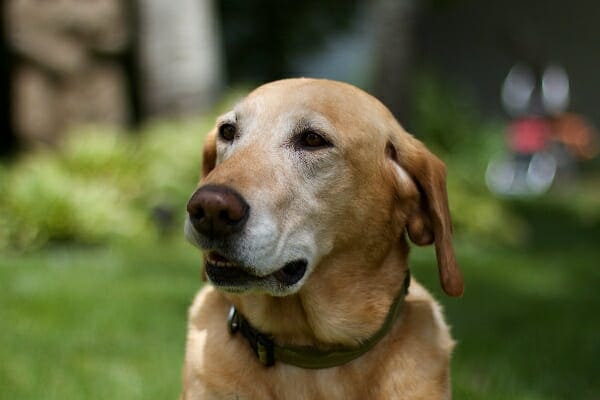
Recently, a longtime friend and client brought in his 10-year-old black Labrador Retriever, Dixie. I had known her since she was about three months old. Dixie pranced into the vet clinic with the same happy attitude that she is known for.
However, Dixie’s dad looked very concerned. As I asked what was going on, my client started describing some changes he had noticed at home recently. His dear Labrador Retriever was no longer sleeping through the night. She was also barking more than normal and had started to show some aggression towards her “brother,” a small Terrier mix. It was very obvious that something was changing with his beloved dog.
Finally, he looked up at me and said, “My dog is doing things I never would have expected from her. Can dogs become senile?” I looked back at him and told him, “Yes, unfortunately, dogs can develop dementia.”
I went on to explain to my client that our canine companions are living longer than they used to because of the wonderful care they receive at home and from their veterinarian. This is great news because it means we get more time with our dogs. However, it also means that an increasing number of dogs are living long enough to develop dog dementia—also called Canine Cognitive Dysfunction in Dogs (CCD) or Cognitive Dysfunction Syndrome (CDS).
What is dementia in dogs?
Dementia occurs in senior dogs as they age. Their brain undergoes changes that are very similar to what doctors see in human Alzheimer’s disease or dementia patients. In fact, a 2019 article published in Frontiers in Neuroscience compared canine cognitive dysfunction and Alzheimer’s disease in detail. These brain changes can affect a dog’s memory, behavior, sleep patterns, activity, and appetite.
In recent studies, it has been estimated that approximately 28% of senior dogs develop CCD by 11 to 12 years old. When dogs reach the ages of 15 to 16 years, it is estimated that approximately 68% have doggie dementia.
What are the signs of dementia in dogs?
The first signs of canine dementia may be difficult for you to recognize. Early signs of cognitive decline are sometimes very subtle. That’s why it is important that dog parents know what to look for.
Dog dementia symptoms are grouped into three stages—mild, moderate, and severe. There are typical patterns that appear within each stage. However, it’s important to note that not every dog follows these exact patterns or stages.
So any of the signs described below could be seen at any time once dementia sets in.
3 stages of dog dementia
Stage one: Mild
In the early stage of dementia in dogs, signs tend to be more mild and easier to miss. You may notice changes in your dog’s sleep patterns and maybe mild changes in how your senior dog socializes with you or other pets.
Stage two: Moderate
The moderate stage is when signs may become more apparent to you. The most frequent sign of dog dementia at this stage is house soiling—even though your dog was previously house-trained.
Stage three: Severe
The last stage is severe symptoms. In this stage, the signs mentioned above tend to increase. Also, you may notice your dog starting to wander around the house throughout the night instead of sleeping. Your dog may begin to bark more at things that aren’t really there.
5 signs of dementia in dogs
Let’s explore the five signs of dog dementia in depth.
1. Disorientation
Some dogs with dementia seem to lose their sense of direction or may walk around appearing confused. Disorientation can be seen in a variety of ways in our senior dogs. Some dogs may walk up to furniture and appear unsure of how to go around it.
If you have ever seen the movie A Bug’s Life, the scene at the very beginning of the movie when the leaf falls and blocks the line of ants carrying food is similar to disorientation. That leaf falling blocks the path that the ants always take, and they become disoriented and need the other ants to lead them around the leaf back to the correct path.
Sometimes, as our senior dogs become disoriented, they might need help just like this to re-learn how to go around the couch or table to get where they want to go.
As our beloved companions age, they may also experience vision changes or cloudy eyes in dogs. Impaired vision can combine with mild dog senility to create more significant confusion and disorientation.
Other signs of disorientation include:
- Forgetting where the water bowl or doggy door are located even though they have always been in the same spot.
- Walking in circles as if stuck in that motion and don’t know how to stop.
- Getting stuck in a corner or standing with the head leaning on the wall like he or she doesn’t know what to do (head pressing).
- Standing at the wrong side of the door when it is opened.
If you begin to see your dog exhibiting any of these signs, but you are not sure if your dog is truly disoriented, take a video to show your vet. This will help you explain what you are seeing so your vet can figure out the best way to help your pup.

2. Changes in social behavior
One of the most common reasons dog parents bring their dog to the vet is social behavior changes at home. These changes may occur with the people living in the house or with other pets. As mentioned, doggie dementia affects our dogs’ memories. This means they may forget those that they live with or forget how they normally play with other dogs or cats.
Some dogs become less interested in playing with or receiving attention from their people. This may mean they no longer care when company comes over. They used to get excited or bark to greet guests, but now they don’t. Other dogs may become more needy and want extra attention.
Finally, the change that is usually the most concerning to owners, is sudden aggression toward people or animals. This was one of the big problems my client was seeing because Dixie was attacking her terrier “brother.”
If you begin to see changes in behavior at home, especially more aggressive behavior, please discuss it with your veterinarian immediately. While these changes may be related to dementia in dogs, it is important to make sure that there are no other health problems going on.
Arthritis in dogs or other causes of pain in dogs could also cause your senior dog to act differently. A painful dog is often more likely to growl or snap when painful parts (such as hips or back) are touched.
3. Changes in sleep patterns
In some cases, altered sleep patterns may be the first sign that you recognize in your furry friend because this interrupts your own sleep. Dogs with dementia often start waking up more in the middle of the night than they previously did. Dementia can be one of many causes of senior dog anxiety at night.

Your dog may do different things when he or she wakes up. Some may pace back and forth all night as if they are anxious about something. Other dogs may wake up barking as if someone knocked on the door or they saw a ghost. And others may wake up and decide they are starving and need to eat right then!
Some dog parents describe this stage as being similar to having a newborn baby at home. Or others may compare it to sundowning in humans with Alzheimer’s (which is why CCD is sometimes called sundowners in dogs). It is okay to be frustrated when this happens because it is exhausting for both you and your dog!
4. Accidents in the house
As canine cognitive dysfunction progresses, some senior dogs may forget the commands and tricks you previously taught them. When you say “sit,” “come,” or “stay” they may just look puzzled. Senile dogs may also forget all that hard work you put into house training. Inappropriate urination or defecation in the house may occur due to:
- Increased anxiety that occurs with dementia.
- Going outside and forgetting what they were supposed to be doing.
- Forgetting where the doggy door is or how to use it.
- Forgetting their body cues and not realizing they have to go until it’s an emergency or too late.
- Forgetting how to signal to you that they need to go out.
However, accidents in the house can happen for other reasons in senior dogs. Urinary incontinence in older dogs, Cushing’s disease in dogs, diabetes in dogs, administration of medications like prednisone for dogs, or urinary tract infections in dogs may also cause urinary accidents. It is important to discuss accidents and other signs with your veterinarian to ensure he or she has the needed information to make the right diagnostic and treatment plan.
5. Increased anxiety and changes in activity or appetite
As mentioned, doggie dementia may cause increases or decreases in activity. Increased activity usually presents as pacing or restless nights. On the other hand, dog parents may easily mistake decreased activity during the day for age-related slowing down. Dementia patients commonly want to sleep more during the day (more than the number of hours an old dog should sleep) or may not be as excited to play as they used to be.

Activity may also change because anxiety can become worse once dementia sets in. Sometimes, dogs can sense the changes happening. They are scared and confused because they don’t remember how to follow commands or they keep getting lost around the house.
In addition to confusion-based anxiety, some senior dogs with dementia may develop noise-based anxiety. This may include reacting to fireworks, thunder, or even small noises like car alarms or the stove beeping. Another common sign some owners notice is that their four-legged friend is more attached to them. This can be a result of separation anxiety.
Since activity can decrease and anxiety can increase, another sign is decreased eating and drinking. If your old dog is not eating well, CCD may be the cause. This may occur because dogs feel too tired or confused to get up and go to the bowl. Also, they could forget where the bowl is located or forget that they were hungry or thirsty.
How is doggie dementia diagnosed?
The most important diagnostic step is for dog parents to notice the signs at home. You spend the most time with your furry friend and you know him or her best. Dogs often tend to behave differently at the vet than they do at home, so your vet may not be able to see what you see.
It is important that you let your veterinarian know when your dog’s behavior is changing and you think something is wrong. If you are confused about what your senior dog is doing or don’t know how to describe it, pull out your smartphone. Pictures and videos can help your vet “see” what is happening.
Additionally, you could consider filling out a canine cognitive dysfunction checklist and bringing it to the vet appointment. This sort of tool can provide an overview of the symptoms your dog is exhibiting, which also helps with the diagnostic process.
Once you bring your dog to the vet, he or she will ask you to describe what is going on. Typically, your vet will also ask a variety of follow-up questions. Sometimes he or she may recommend different tests such as blood tests for dogs, X-rays, ultrasound, CT, or MRI. These tests can help rule out other health issues that could have similar signs.
These steps are important because there isn’t an easy “yes” or “no” test that can definitively say if your dog has dementia. Ultimately, your vet makes the diagnosis based on your observations after ruling out other conditions.

How are signs of dementia in dogs treated?
Unfortunately, there is no cure for doggy dementia. But we can treat some of the symptoms to improve quality of life. Your veterinarian may prescribe medications or supplements to help keep your dog comfortable and manage anxiety or disrupted sleep patterns.
Some of the more common may include:
- Melatonin for dogs, which may help restore normal sleep-wake cycles—As a word of caution, some formulations of melatonin, especially melatonin gummies, may contain the sugar substitute xylitol, which is toxic for dogs. Always check the label for xylitol (sometimes called birch sugar) before giving melatonin supplements to your dog.
- Anti-anxiety medications such as trazodone for dogs
- Anipryl® (Selegiline for dogs), a medication that affects signaling chemicals in the brain to manage the signs of dementia
- Omega-3 fatty acids for dogs
- S-adenosylmethionine (SAMe)
- Medium chain triglycerides (MCT oil for dogs), which provide easy-to-use energy for the dog’s brain and may help support and improve cognitive function in dogs with CCD. A great source of high quality MCT oil formulated for dogs is Dr. Buzby’s Brain Boost™ organic MCT oil for dogs.

There are a variety of medications, supplements, and diets that may help with dog dementia beyond the short list shown above. Your vet is the best person to decide which of these options are right for your dog, which is why they are not covered in more detail here.
Please keep in mind that senior dog supplements are not regulated by the FDA and some are more effective than others. I always advise talking to your veterinarian before beginning any OTC supplements for your dog.
Things you can do at home to help your dog’s memory
There are also activities you can do at home to help your dog’s memory. You may have heard human doctors recommend puzzles to Alzheimer’s patients. Puzzles can be good for dogs too! You can try different “thinking games” at home such as food puzzles (found online and at most pet stores).
Some owners play “watch the food” where they put a piece of food under a cup and leave two cups empty. Then they move the cups in a circle on the floor and the dog has to find the food. This is a great way to keep your senior dog mentally stimulated, and can also be a way to encourage them to eat.
For dogs with severe dementia symptoms, a consultation with a veterinary behaviorist may be helpful to develop strategies to help keep them comfortable and calm.
Back to my client, the lovable Labrador with dog dementia
Dixie’s relationships with her dad and “fur sibling” improved after starting anxiety medication and learning “thinking games.” She loves to play hide-and-seek with her dad. He told me that once he taught her this game, their relationship grew back to where it was and her activity level seemed to improve.
She still has some hard days, but she continues to love food and going on her walks. Her dad understands that just like with human Alzheimer’s or dementia, it can progress over time. And he knows that eventually he will have to face that dreaded decision of when to euthanize a dog with dementia. However, he is making the most of her golden years and plays an important role in helping her improve!
Hope for dogs who are showing signs of dementia
If your senior dog is showing some signs of dementia in dogs or if he or she has recently been diagnosed with CCD, it can be normal to feel scared or unsure of what is next. However, there are so many ways you can improve your dog’s quality of life.
Dementia doesn’t have to define the last chapters of your dog’s life. Be sure to ask your veterinarian any questions that you have and work with him or her to develop a plan for your dog. Together, you can help your senior dog have comfortable, happy golden years in spite of his or her doggie dementia diagnosis!

Does your dog have dementia?
Please comment below to share his or her story.


My boy Tucker is 16 1/2 at least . He was a rescue so we don’t know his age for sure but we’ve had him 15 years this month. He has always been the sweetest and best cocker spaniel you can imagine. We call him our golden boy because he is so good and he is also golden in color. His cognitive decline started over two years ago with a vestibular event that left him with a head tilt for a few months and it seemed to affect his hearing as well. Fast forward to today, he paces all the time, is in diapers as he will go whenever inside or out although he never had one accident in the house his entire life. He soils the house daily as well. We solved the night time pacing by giving him CBD oil every night and put a pen around his bed in our bedroom. This has worked beautifully and I am so grateful for the sleep. Before that, he paced all night. He paces during the day too but not as bad. To calm him, I will put him in his gated area and stay with him until he falls asleep. It’s like putting a baby down for a nap. Then I know he is resting and I can get things done. I work from home but when we leave the house he gets stressed and nervous and paces and sometimes has accidents while we are gone. I am like so many others that have posted in that I don’t think it is time yet even though my family does. He still knows me and totally relaxes when I hold him and rub his ears. The minute I stop, the pacing resumes. We have baby gates everywhere since we have stairs and have to carry him up and down as he doesn’t have the hind end strength to navigate stairs and has taken a small fall before. There is one very unusual thing that has developed is that he will randomly hop if he gets excited. I mean it is like when Rudolph was learning to fly. He leaps so high, we don’t know where the strength comes from and it worries us he will hurt himself but it still brings a smile. I visit this site daily and your blog has been invaluable to me in trying to evaluate his progression and quality of life. He still enjoys and leaps for meals and treats. But does not enjoy his walks anymore. I think he only feels comfortable inside the home. I am praying for some sign to let me know. We have had many sweet dogs and know this is the last loving act we can give them. He lost his lifetime cocker companion three years ago. We had hospice come to our home to put her at peace and to let Tucker know what happened to her. We will do the same for him as well as we have a little 4 year old pup that will miss him as well. They are our family and this decision is so so hard.
Dear Patti,
My heart goes out to you as you face some difficult decisions ahead for your beloved pup. He sounds like an amazing boy, and I can only imagine all the wonderful memories you’ve made together over the last 15 years. I pray for your strength in the hard times and for clarity to know when is best to say goodbye. Wishing you all the best and give your sweet boy a hug for me. ♥
Thank you Dr. Buzby! It is so incredible that you take the time to help so many with such hard and heart wrenching decisions. I think my biggest concern right now is knowing how to tell how much mental anguish the dog is having when confused and pacing. I think we have gotten so used to managing his confusion by herding him the right direction to go out the back door and herding him back inside or showing him where his food is, etc. that maybe we are losing sight of how much he may be suffering. We keep making accommodations and are happy to do it although it is a LOT of work. I can identify with what others have said in not wanting to give up on him but I don’t want to minimize his anxiety either. I SO wish I knew how he was feeling and perceiving his world. My husband says he’s not living his best life but I tell him I cannot make the decision until I can have no regrets. Although that probably isn’t possible anyway. Thank you for listening!
Dear Patti,
I understand how hard it is to make these impossible choices for a beloved pup. It is tough to get a grasp on quality of life when most of the issues are mental and not physical. I do think mental disease causes just as much suffering, if not more, than physical disease. Here are links to other articles that may be helpful:
1. Dementia in Dogs: When to Euthanize Your Beloved Senior Dog
2. Using a Quality of Life Scale for Dogs
3. How Will You Know When It’s Time to Euthanize Your Dog? 5 Caring, Heartfelt Messages
I’ll be keeping you in my thoughts and praying for you and your sweet pup.
My 16 yr old chorkie Moose started acting different, standing at the wrong side of the door, wandering back and forth through the house for hours , just really odd for him , not sleeping in the evenings as he always did, having more accidents in the house, whining and even howling he never howled ( even though it was the cutest thing) Mentioned this all to the vet and I think she knew but wanted to double check my observations so upon consultation with her other doc they came back to me with he had dementia. I thought wonderful he already had cataracts and was having more symptoms with that issue and his hearing is bad now this on top oh and arthritis in his hips.
Well now he just constantly pees and poops in the house and then goes to the door. Even if he is showing me signs he has to pee I take him out he won’t leave the porch it’s like he is terrified of the outside. On his good days he will go out and do good and look at us like see what I did. But the next day back to going in the house . We have pads everywhere sometimes he hits them most times he doesn’t . I tried diapers that just tweaked him out completely! He won’t take his meds and his supplements most nights when he does he has better days but I’m not going to force his
“Special treats” what we call them. It’s three soft chews for his hips, melatonin, and a probiotic, plus his actual med for his hips.
Idk if he is suffering he still greats me everyday after work and he has become much closer to my mom recently to the point where she can now hold him for about 20 mins and he sits quiet in her arms where before all this he was and never wanted to cuddle! Now he will snuggle up with her for a while and then seems to settle for a few hours . Can’t complain about this she loves every minute of this with him she is 92 so it does them both good. I just don’t know how to help the indoor accidents. I feel so bad for him, I don’t feel like he’s ready to go yet. I’ve never had a dog this old and don’t know how to help him.
Thanks for listening
Dear Pamela,
My heart goes out to you as you face this difficult situation with your senior guy. I can only imagine how hard it must be as the full-time caretaker of a dog with dementia, especially when taking care of an elderly parent as well. I know you mentioned you tried diapers. Were they actual diapers that cover the rear end and have a hole for the tail? If so, your boy may do better with male wraps that only go around the belly and cover the prepuce. It won’t help with fecal accidents, but if most of the issue is urination, then they could be very helpful. Some dogs don’t like the feel of a male wrap or diaper if used by themselves, but if partially covered by a sweater or shirt they may tolerate them better. Dogs can be picky (as I am sure you are aware!) and you have to take things day by day. I am glad your boy seems to be doing well despite his dementia symptoms and it’s wonderful he has been such a blessing to your mom. I will attach links to other articles with more information on how to evaluate quality of life. Praying for your comfort and strength as you navigate this emotional path ahead.
1. Using a Quality of Life Scale for Dogs
2. When Caring For A Sick Pet Becomes Too Much: Pet Caregiver Fatigue
3. Canine Cognitive Dysfunction in Dogs: Signs, Symptoms, Solutions
4. Dementia in Dogs: When to Euthanize Your Beloved Senior Dog
My 15 year old dog recently got diagnosed and I guess I knew it but I’m still in denial about this stage of life. It’s been very stressful and my first experiences with an aging dog. This cognitive thing in combination of advanced cataracts is incredibly hard. The article is spot on what I’m dealing with. Her only focus is going for a walk or eating. That’s the only difference is she has an appetite and she’s completely fixated on food and treats. And I do mean fixated. She’s just weird about actually eating tho and has to be coached. Hard to explain. Having a lot of accidents in the house now and all the pacing or just standing still and staring. It’s so hard to see her this way. She has no interest in toys and the only real time I see her personality is going for a walk or of course feeding her. She doesn’t even bark anymore. I want so bad to help her but I can’t. Night time is hard cause I need to sleep for work but she’s ultra clingy and paces or begs for food but nothing satisfies her. I feel bad ignoring her so I rarely get full sleep anymore. I’ve had her for 12 years and she’s definitely my kid as I didn’t have any. I just want her happy and see her thru this part of her life, I wish it were easier on me. And all this is only in the last year. She’s still the best dog ever so I’ll love on her and do my best to make her happy.
Dear Marie,
My heart goes out to you as you walk this difficult path with your senior girl. Being a full-time caregiver to a dog with dementia is so very hard. Here are links to other articles that address your specific situation:
1. When Caring For A Sick Pet Becomes Too Much: Pet Caregiver Fatigue
2. Dementia in Dogs: When to Euthanize Your Beloved Senior Dog
Hoping you can make the most of each day you are gifted. Wishing you both happiness and comfort. Bless you. ♥
hey, ive been up most of the night. my 15.5 year old female chihuahua Olivia has had same symptoms as yours pretty much. i saw her change and just figured it was age when i had to get up a couple times at night to tale her downstairs to potty. maybe 4 or 5 months ago she started making waking me up at night and i would take her downstairs because she wouldn’t tinkle on her pads i habe in my room. once we got back upstairs i wiuld get us back in bed and ready to fall asleep and she would get up and stand at the end of the bed until i would let her down….then she would sit and just look at the corner of my room or walk around with no purpose…so i take her down again and she dosnt do.anything…she dosnt need to potty or drink or eat. sorry for rambling , i am tired. we started giving her a a chewable med for dementia like 30 days ago and she had like 3 good weeks. no all nighters! but the last couple days shes been pretty bad and she disnt eat anything yesterday and she hasnt dtayed still for more than 30 minutes tonight. reading this page gives me a little comfort but its hard to watch her at night. so hard to get sleep when i know shes just stating at the wall on my bedroom floor. im gonna try to stay positive and just keep her mind as occupied as possible. im gonna try to walk.her 2x a day if i can. its hard cuz im disabled. have you noticed your dogs breathing at night? a couple times i habe watched her back rasie as she breathes in and out and all of a sudden her back jumps….almost like a hiccup. it happens no matter where she is in her breath movment. im wondering if this is bothhering her and what it is cuz ive only noticed on 2 occasion and it lasted a few minutes. sorry for spelling errors. very tired. I’ll say a prayer for your fur baby. just do the best you can. thats all we can do. stressing about it wont help her or me.
Dear Tim,
I am sorry you are in this difficult situation with your senior girl. Caregiving for a dog with dementia can be very hard and often carries a heavy burden. If you are worried about whether Olivia is suffering, I encourage you to reach out to your vet for a quality-of-life assessment. Ultimately, you have to trust your intuition as you know her better than anyone. Sometimes letting go is the most loving option and only way to offer peace and rest. I pray you will find the advice you need to make the best decision for everyone involved. Wishing you strength and comfort as you navigate this emotional path.
I am so sorry about this. My 16 year old was diagnosed today with CCD and he lost his vision a few years ago and today we went back to the vet because he still has not barked since last October and I won’t leave him alone if he is awake at night so I sit with him and the only thing that he likes are walks and eating. I know how you feel. I have been sleep deprived also
Dear Zoe,
Sending you my sympathy and praying for your strength as you navigate this difficult path. ♥
I think my 14 year old ShihTzu also has Doggy Dementia. Everything in this read, along with the comments is very much him right now. He has cataracts and is already blind but such a sweet and chill little man. But then he had some seizures, decreased appetite and started pacing around all the time even at night. This is so heartbreaking to see, knowing that there’s nothing I can do about it. I give him all the love and support that I can. He’s been with me through hardships and I cannot imagine life without him.
Dear Angelina,
I am sorry your senior guy is having issues with cognitive dysfunction. Please don’t hesitate to reach out to your vet to see if there are any medications or supplements that might offer relief from these severe symptoms. Try to make the most of the time you are gifted. Wishing you both comfort and peace.
I rescued a chocolate lab. He is about 8 years old. He sleeps all day and I have not heard him bark once. I’ve had him for almost 2 months. I came across your post due to my searching to figure out what may be the cause. He has been to the vet several times. No mention of cognitive issues.
Hi Aurora,
I am glad you are taking such an active role in advocating for your senior guy. Unfortunately, without examining your dog myself, it is hard to know if this behavior is normal or cause for concern. It is possible that this is just your boy’s personality and there is nothing wrong with his cognitive function. Please make sure your vet is aware of your concerns and don’t hesitate to bring up the topic of canine dementia. It may be that you could try some supplements or other therapies just to see if they make a difference. Hoping you can get the answers you need to ensure your sweet boy remains happy and healthy for as long as possible.
I have a 10 year old greyhound. He was diagnosed with Sundowners/ Dementia a couple months ago. I started seeing changes during the night. He would wander around the house, looked confused and very disoriented. I’d find him in the middle of a hall staring at the wall whining. Lately he’s gotten very needy and needs to be near me all time. Other symptoms are popping up a little at a time but I’ve learned one thing. I need to keep everything in the same place and something as simple as a new bowl will throw him off. His sibling shows no signs but he is changing. When talking to my vet she says the bigger dogs will sometimes show signs earlier. I never thought of these 2 as seniors but he’s showing more signs now. He shows a little more fear than he use to. But he’s still good with the other greyhounds we have but very close to his sister. So keeping everything as normal and in the same place and nothing new is helping some. We’re taking one day a time. He still loves his walks and rides and will still play with his toys so we will continue that. And routine means everything.
Hi Judy,
I am sorry your senior guy is struggling with dementia. I am glad you have a good routine in place, and he seems to be maintaining fairly well. Thank you for sharing your experience with us. Wishing you continued success as you navigate this difficult path. Bless you and yours!
So sorry to hear about your fur baby…gabapentin has really helped my boy, we are able to sleep through the night most of the time..don’t know if it works for every dog but it’s really helped us
Old Man Lou is 16 and diagnosed with dementia around a year and an half ago.
He sleeps a lot during the day now and can get confused or bark at nothing from time to time, however main symptom we struggle with is: like clockwork at around 3 or 4am he wakes up crying and confused and goes searching the house + pacing the hallway looking for a parent to help him…. The parents being us who are literally in the room his bed was in. When we walk out to get him he thinks – ooh you’re up it must be morning + time for breakfast!
Being a one meal a day guy for all the years we have had him we, started splitting his meals so that he can eat half his food at night before bed. This was an experiment we found tends to push his pacing routine out to the *actual* morning.
Recently though, he has been forgetting he has had dinner right after eating it, possibly just a further sign of decline.
Despite this he still clearly has some joy in life. Sitting in the sun by the back door, taking short walks – even occasionally the elderly zoomies when our kids get home from school! We love him to bits.
Hi Jen,
Old Man Lou sounds like such an awesome guy. What a blessing you have shared 16 years together! Thank you for sharing your experience with our readers. I love the community this forum has created where we can all offer encouragement and sympathy to each other. I am praying for your strength as you navigate the unknown path ahead. Wishing Lou and your family all the best. ♥
I’ve just realised tonight that my 16 yo blueheeler might has a dog’s dementia, as I’ve fed her a dinner and 10 minutes layer she was demanding it like she never had it!
Also, she was waking up at about 4.30-5am every morning to “talk” or start crying for food. Normally we feed her at 6am.
Another symptom is she became a littbit aggressive/jealous to her younger “sister” kelpie.
I wonder if dog’s melatonin will help her?
Hi Lenna,
I am sorry your senior girl is dealing with these new behavior issues. While they could definitely be symptoms of dementia, it is always best to rule out other medical causes as well. Has your pup had any lab work done recently? I encourage you to mention your concerns to your vet and ask about the possibility of using melatonin to help decrease the severity of your dog’s symptoms. Hoping you can get some answers and find a way to ensure your girl remains happy and healthy for as long as possible.
yes! she still loves the short walk and loves to see me when i get home. it so very hard to know if they are suffering. if i have to get up with her at night and let her walk aimlessly i will but not if i lnew she was scared. if she is just kind of in la la land…well that dosnt make me feel so bad but if she is scared….i dont know. i can let her go through that. its hard becuz shes not very vocal at all. i trained her not to bark a long time ago. so i just wake up when i feel her at the end of my.bed. she is also 95 percent deaf. she has glossy eyes but can see. i habe 55 inch.t.v. that plays a rain soundtrack witj a giant bush. its supposed to look like a window i guess. when shes doing bad and i turn on the light or at least a t.v. show i thibk it helps her. i think next time she wont settle down i will just wake myself up and put on the t.v. and see if she will feel safer to sleep. then ill go back to sleep. i like.this forum. maybe we all can share things that help with this illness. i will tey to share something more positive next time. thanks for letting me share. lets hang in there. i thibk you are good pet parents if your dog is old enough for this illness and the fact you are on this website. lets remeber we are doing all we can amd that our friends have had good lives with us! all of this is part of life. so lets handle.this part the best we can with no regrets. God bless.
Tim
A friend adopted a dog from the animal shelter about a month ago that was found as a stray. It looks most like a Lhasa Apso or possibly a Shih Tzu. The fur is completely white. They estimate the dog is 7 years old.
The dog is very aggressive but in a less predictable way than I’ve encountered. It bit me on the hand and would bit at my pant legs while barking as I was walking in the apartment. After it bit me my friend told me it bit a maintenance worker and I think at least one other person in the short time she’s had it. It has also tried to bite her although not nearly as frequently.
When I came to the door the dog began barking. My friend opened the door and the dog barked more and its body la gage was very excited or aggressive. We gave it a little time to calm down.. It seemed calm so I bent down slowly and waited for any reaction. It was still appearing calm but on guard. Then I began to slowly put the back of my hand toward the dog and it remained calm. So I pet it for a minute or so. As soon as I started pulling my hand away it lunged and bit my thumb. Leaving two deep puncture wounds.
So, I went into apartment to clean my wounds and see the apartment as I’d never been there before. Then we left with the dog trying to but my leg and getting my pants instead. As we were going out the door the dog pushed out. My friend couldn’t catch the dog in time. So I needed to. Using my leg mostly I was able to stop it and then return it inside the apartment. It didn’t try to bite me. But once back in the apartment it became very aggressive again and probably would have bitten me.
When my friend and I returned we went inside to watch a football game. I sat on a chair and my friend sat on the couch. I could see both times in the apartment the dog generally tried to stay between me and my friend.
While we watched the game and talked. I the dog had calmed. My friend gave me a treat to give to the dog and I did, carefully letting it see the treat in my hand but dropping it to the floor when the dog got close enough it could try to bite instead. It showed no aggression until after it finished the treat. At that point it barked at me. I had been careful not to move after dropping the treat. So it barked without me doing anything. It didn’t bark long.
.Then the dog was quiet and sat beside me. Still somewhat between me and my friend. I tried slowly offering my hand with the back of it facing the dog. As soon as my hand was within its site as it was facing my friend
it barked and tried to bite.
After awhile again I tried only this time my hand came in from behind to the back of the dog’s neck. It didnt react. Which surprised me as I expected because it couldn’t see my hand it would be more aggressive. I began to pet the dog and it let me do it for as long as I wanted. It even made positive sounds when rubbing behind its ears and was twisting its head to let me pet the ears more. I kept one hand on the back of its head while petting. Just in case it tried to turn its head and bite but it didn’t.
I even moved my hand to its chest so it could see me. I had to basically do it under the jaw in the neck. So I could stop it if it tried to bite. But as long as I was petting it. There was no signs of aggression or biting.
I began to pet the dog on the back near its tail to see if it would try to turn and bite. But all it did was that funny squatting and butt wagging dogs do when they like it.
I also was using the petting to see if it had any sensitive areas like the hips, ears belly, legs and even lower jaw. No sensitivity or even displeasure with me petting or massaging any of those areas.
But as soon as I’d pull my hand away from petting. If it was in the line of site for the dog it would begin barking and snapping for about 10-20 seconds and then stop. So long as I didn’t move.
It even came up to me a few times while it was wandering around the apartment and sat in a way which seemed to indicate it wanted to be pet. So that showed it didn’t seem to have a constant need to be between my friend and me.
When I was leaving my friend stayed on the couch and I was letting myself out. As I began to walk away the dog became aggressive and was biting my pant leg. The dog had been in the living room so I wasn’t coming towards it, I was walking away.
It tried to escape when I opened the door. So I had to use my leg and them hands to get it back into the apartment. No aggression or biting. As soon as it was in the apartment and I was closing the door it started being aggressive again.
My friend is disabled and already is attached to this dog. They didn’t seem to react to the dog biting me with the seriousness I’d expected. They basically were saying ‘he does that’. The fact they didn’t warn me ahead of time and at least have the dog in a leash reflects that.
After talking with them I learned they had a family dog when they were young that would bite anyone that tried to come near them. This seemed almost to be seen as a good thing especially since the dog wasn’t protective of other family members like that.
So, I know regardless of why the dog is being aggressive. I have to try to convince me friend that the aggression and absolutely the biting cannot be tolerated by them.
But my question is about the dog. It was aggressive right from when she adopted it.
Since it was a stray they don’t know the history. One clue may be when the dog was found it was in good health showing whomever had it before at least took some degree of care for it.
I know this likely is one which needs a professional trainer. Especially since it may take some training for the dog AND my friend. Unfortunately my friend is disabled and on a fixed income. So that may not be an option.
Here are my thoughts on what the root cause may be. Of course it could be a mixture of some of these too:
– It has always been allowed to be this aggressive
– It has not yet settled into its new home so it’s on more on guard than usual.
– It has some type of dementia or other ailment setting in changing its behavior.
– It learned some survival behaviors while abandoned to protect itself, etc. They don’t know how long it was on the streets.
I want to try to help. But if the underlying issue is something like dementia, a stroke or ? Anything I do will not be of any help. I’m on a fixed income too so paying for professional training isn’t an option. The animal shelter is a county shelter so they don’t offer any of those services for free or at a reduced rate.
Are there things I can do that will help determine whether this is learned behavior. Or this is due to an underlying medical issue? Do these breeds get things like dementia at 7 (an estimate by the vet. So it could be 8 or 9).
Of course I’m concerned about the dog biting someone, including my friend. But I’m also concerned that they would get sued if it bites someone. And they already have limited funds. Also, since my friend has to spend a lot of time at home. People may just opt not to come visit as much but not tell them it’s because of the aggression from the dog. Or, it will come to a point after biting someone that the dog has to be euthanized and enough time has gone by my friend is even more attached to the dog. So for her sake and the dog’s sake I want to try to help if I can. I had trained German Shepherd’s with a breeder when I was young. As well as having adopted 5 rescued dogs during my life. Learning to train them specifically based upon the challenges they had. Which mostly seemed to stem from some kind of abuse or lack of socialization at the hands of their prior families. I could be wrong but this dog doesn’t seem to be reacting in a way that I’ve experienced before me with dogs that have been abused. Unless maybe it’s a combination of abuse and other factors like a medical issue.
Thanks you for any insight you may have.
Dear Doug,
I commend you for being such a good friend and trying to find some answers. Unfortunately, this is just a BAD situation. This behavior cannot be tolerated. While it could be possible to treat this aggression with behavior training, the odds are not in this dog’s favor. Without some thorough testing, there is no way to know if a medical cause is to blame. But in most cases, aggression comes from fear, which comes from a lack of socialization during the very early formative days of a dog’s life. Aggression can also be genetic and can be passed to puppies from their mother/father. I am not sure where you are located, but in my state after biting and breaking the skin, this dog would be required to undergo rabies quarantine and would be at risk of being deemed dangerous by the city (imposes some very strict regulations on how the dog can be kept and handled for the rest of its life). I hate to say this, but euthanasia could be the best option. When a dog is a danger and risk to the lives of humans, there isn’t much wiggle room for how to proceed. You may have to contact animal control and get their help to ensure your friend is safe. Praying for clarity and strength to navigate this tough path. Bless you. ♥
This dog is recourse guarding, which is your disabled friend.
He needs a behaviourist as well as a trainer. Shelter are not a good place for dogs as some animals cannot handle the noise, stress and differant human lack of behaviour.
All these things need to be untrained. Your friend must lear to destress the dog through play and games to release his or her energy. The room is his safe place as the kennel was. See if there is a shelter that offers training.
I have been managing my 16 year old Bichon/shih tzu’s CCD for over a year now. He’s blind, but other than that he’s healthy, until his episodes of being uncontrollably terrified for hours on end started. Pacing, shaking, drooling, climbing on things that he can’t even really climb in as if a door should be there. He was diagnosed with CCD and we’ve been managing with Selegiline daily and Gabapentin when needed. It worked wonders, and he was mostly himself again. Such a happy guy, and absolutely thrilled when I take him on walks. He tends to now go through what we call “dementia episodes”, where his brain seems to slip and he struggles for a few days, and then bounces back. He’s currently in one, and it’s awful, depressing, and maddening. He absolutely will not stop pacing the house. For over two days now. I literally don’t know how his body allows it. It is absolutely non stop. And the sound of his nails kind of dragging on the floor, constantly, is so draining. He is obsessed with water, and so I have to limit it. Even with that, I’m having to take him out every two hours to try and prevent accidents, he will just pee while walking. This morning I tried to hand feed him and it’s if he’s forgotten how to eat. He barely opens his mouth and just kind of uses the side of his mouth to try and push food in…I have no idea of he will come out of this episode, or if I should even wait and see. 3 days so far of non stop pacing. I feel like his body and legs will just give out…He hasn’t touched a toy, he will go on walks but, I don’t see the joy he usually has for them, it’s just as if he’s forging forward on instinct. I’ve come to the point of thinking I’m going to make the decision and put him down multiple times now, and then he’s improved. But I don’t even know how much longer I can take this emotional rollercoaster. It is awful to lose a dog this way. I don’t know if he currently knows who I am, he just trudges around me all day.
Dear Clarissa,
I am so sorry your boy is struggling, and his mental state is declining. While he may bounce back again after a few days, it is clear the improvement will only be temporary. It is ok to let go while there is still some joy, before all happiness is lost and the only thing that remains is confusion and suffering. I will attach links to other articles with more information on how to know when to say goodbye. Praying for clarity in the midst of this emotional situation and wishing you and your sweet boy comfort and peace.
1. Dementia in Dogs: When to Euthanize Your Beloved Senior Dog
2. Using a Quality of Life Scale for Dogs
3. When Caring For A Sick Pet Becomes Too Much: Pet Caregiver Fatigue
4. Preparing for Your Dog’s Euthanasia: 10 Thoughts for Peace
first of all I would like to say thank you for posting this about our struggle with your wee dog journeys end, it has really helped me immensely to make up my mind .. Like you, I have been going mad emotionally with lack of sleep and just plain frustration as to my dogs up and down in health. Doing well for a few days then going downwards again .. she has kidney disease and was doing well for the past year .. she is 17 now and showing an increase in pacing during the night and during the day time hours .. watching her is sheer agony 🙁 she is till eating but drinking less .. its as if she has to remind herself how to lap at the water so I took to using the syringe .. she still eats and that is where the decision making was a problem, As they say if they are still eating and drinking there is hope, but in this case I feel its now the only enjoyment she has left and she does struggle to eat due to loosing her balance all the time .. Everything you have written here is what I’m going through with her and it has come to the stage whereby I no longer can keep it up without it totally draining me, meaning she will not be looked after as she deserves in her waning days due to my own ongoing tiredness .. I am booking her in to have a home euthanasia .. It is time !! I now know that after reading your post !! So thank you again , it has eased much in my endless back and forth for weeks as to when is the right time ..
Dear Susan,
I am sorry you are facing this difficult decision for your senior girl. From what you describe, I agree that saying goodbye is the most loving option. I am praying that her passing will be smooth and peaceful. Wishing you comfort and strength as you navigate this emotional path ahead. Bless you and your sweet girl. ♥
I’m going to ask my dog’s doctor next week, but I’m curious about if some of my senior dog’s very recent behavior might be dementia? This evening she was watching my sister prepare her food, and she started darting her head around? Looking at the floor, at something that wasn’t there, floor, sister, where the bowl will go, so on. Quite quickly. She usually just sits and waits for me to get the food ready. I gave her a bath before this, and since the bath she has seemed more engaged, energetic, and a lot of tail wagging. It’s new behavior, as of this evening. I used warm water, so maybe she’s just feeling better joint wise? She also lost a ton of undercoat (and she’s still wet,) so maybe isn’t quite as hot as before? I’ve been looking it up for 20 minutes or so, but I’m not really finding anything about other dogs with cognitive decline doing this.
Hi Nikki,
I am sorry your senior girl has started having these strange episodes. Of course, without examining her myself, I can’t make specific conclusions. But it would be good to rule out the possibility of seizure activity. I encourage you to talk to your vet and schedule an appointment to have her evaluated. Hoping this puzzling behavior is nothing to be concerned about and wishing you all the best.
My pup is 13 and has started wandering the house and waking me up every single night. I close all the closet and bathroom doors so he doesn’t get stuck or lost. I find him staring at nothing with confusion and being unable to climb into his bed that’s less than 6 inches off the floor. I can’t remember the last time I’ve slept peacefully because of this. He’s mainly sleeping during the day but has become extremely clingy and needs to be touching me all day. He still eats and uses the bathroom normally but isn’t excited to play or be around anyone but me. I am EXHAUSTED!
Dear Tired dog mom,
My heart goes out to you with this difficult situation you are facing. You are not alone, and I read comments from others that feel the same way every day. I know you want to do what is best for your pup and sometimes saying goodbye is the most loving option. The most heartbreaking thing about dementia is it breaks the bond we share with a beloved pup. When they no longer are comforted by our presence and the daily tasks of caregiving drive a wedge between you, it could be time to offer them freedom from their struggles and peace. I will attach links to other articles with more information. Praying for your comfort and strength. Bless you and your sweet boy.
1. Using a Quality of Life Scale for Dogs
2. When Caring For A Sick Pet Becomes Too Much: Pet Caregiver Fatigue
3. Dementia in Dogs: When to Euthanize Your Beloved Senior Dog
Our dear little papillon will be 19 in April. Having recently lost both a mother and MIL to dementia I am aware of the stages and many characteristics of this disease. I had heard senior dogs can suffer from dementia and fear my dog may be well into stage 4. He lost his hearing 3 years ago and his eyesight has deteriorated in recent years. For a while I sensed he had some peripheral vision but now his sight is all but gone. We stopped walking him about two years ago when he began falling off the curb and showing increased anxiety on his walks. We take him outside regularly to do his business but accidents happen indoors frequently and, as of late, he soils his bed at night. More recently when we take him outside he may or may not remember to do his business and barks for no apparent reason, at least none that we understand. This week I have noticed him wandering around the house more than usual and bumping into furniture. He is also walking in circles and can’t seem to stop. Your article confirms many of the characteristics of late stage dementia. We love him dearly and want him to be comfortable but worry that he may be suffering. Other than a good appetite our papillon is showing increased signs of dementia. Do we let nature take its course and see him through his final days or months? Wish we could tell what he would want.😔
Dear Monika,
My heart aches for you with all the loss you have endured. I am sorry you are now facing a similar situation with your beloved pup. I generally do not recommend waiting for a dog to pass on their own. A natural death is often not very peaceful or something you would want to experience. I will attach links to other articles with more information on how to know when it is time to say goodbye. There are great comments from other readers as well. I am hopeful you will find the advice you need to navigate this difficult path. Wishing you strength and comfort for the tough days ahead. Bless you and your sweet boy.
1. Using a Quality of Life Scale for Dogs
2. Dementia in Dogs: When to Euthanize Your Beloved Senior Dog
3. Dog Euthanasia: Knowing When to Say Goodbye
4. Preparing for Your Dog’s Euthanasia: 10 Thoughts for Peace
Reading this has made me feel much better about life with our Sparky, who is certainly 20 years old. Now I understand that the problems are mine, because it’s hard sometimes! He’s always had ADHD which caused him to travel a 123 kind of path, which made it easier to catch him when he’d been abandoned as a pup after a financial crisis that caused many breeders to shut down. He’s a Tibalier. He’s always been super active, encouraging me to walk six miles a day plus active play! My figure misses those times! 🤣 But now he can’t make it up the stairs to go to bed, so for the last season I’ve been sleeping on the couch so that he doesn’t try to follow me upstairs. Now he goes OUT for sleep, so I’m probably good there. My husband & I carry him down the backyard steps so he doesn’t fall because he’ll often try to just jump it with seeming enthusiasm, and we usually have to carry him up lest he bash his face trying to jump up. He finds the water bowl just fine, but often he doesn’t remember which side of the door opens. A gentle foot guide sets him through the door where he skips like a puppy awaiting his treat! Eating has become a real issue though, other than Milk Bones and cat food. He began to refuse dry food, so I added moist. Doing a combination of dry puppy food with canned senior seems to’ve made a great difference, but he’ll only eat if I sit next to him and either stir the food or hand feed it (EW). Then yesterday he ate a whole cup of just dry food!? The problem with eating is that he spins, stepping in it, and burns so much energy that he’s gotten thin! My husband had the thought to get some of those chewy semi moist food bits, and we’re giving those chunks more often as treats than Milk Bones.. That, in combination with the puppy food, has put some weight on him. The wet food gets crusted on his nose, but he lets me clean him without complaining. He struggles to stand at times, slipping around, but we have hardwood floors with some rugs. I bought some rubber shelf lining to make an eating matt for him and it works. He has his teeth, he’s not incontinent, though he sometimes shit-walks if I don’t pay close attention. He’s obviously daft at times. Sometimes it takes two hours to feed him, and it’s a pain! But is he a problem or is the problem mine to deal with? I think this guy has a lot more to offer if I’m patient and caring. Some people have said it’s time to CALL IT, but Is it? He playfully bites my fingers when I get his toes and skips in the air when he comes inside… NOTHING like any 20 year old dog I can find on the Net! Sure he sleeps a LOT, but he’s still sparking! The last real heath issue he had was 3 years ago when he jumped so high in excitement at my husband coming home that he fell and bruised his kidneys. This does not sound like a dog ready to call quits! If it takes an hour to feed him, well I can sit on the floor and watch videos while stirring his food or holding it up for him. I wash my hands OFTEN! 🤣 NO, I’m not giving up, and when this current Arctic blast has passed we’re going for some walks! It’s difficult, and a pain, but I don’t see signs of any real suffering anymore than my old knees and brain farts give me! We’re hanging in there with the old dude! I do NOT see any signs that we need to CALL IT. I feel more reasonable now. Thank you for this site!
Hi Tree,
I am glad the article helped you to feel more confident in your decisions and was encouraging. It sounds like Sparky is living his best life and is well cared for. Wishing you both many happy days ahead. Enjoy each day you are gifted and give your sweet boy a hug for me!
Just reading of this all for the first time. My 13 year old Staff is showing alot of these signs. Most of them to be honest.
He paces at night, whines and cries at nothing, is repeatedly off his food, sleeps ALOT, drinks then drinks again making himself cough back up the water, isn’t interested in walks after asking to go for one, asks to go out then wants to come straight back in, most recently (as of tonight actually and how I came across this page) he growled and snapped unprovoked at my infant son.
I thought it was just signs of his age, I didn’t even know things like this existed in dogs and I’m having alot of trouble coming to terms with it.
Dear Andrew,
My heart aches for you as you face this uncertain future for your senior boy. I am sorry his mental state is declining, and you may have to make some difficult decisions about his quality of life. I will attach links to other articles with more information. Wishing you the best as you navigate this emotional path.
1. Canine Cognitive Dysfunction in Dogs: Signs, Symptoms, Solutions
2. Using a Quality of Life Scale for Dogs
3. Dementia in Dogs: When to Euthanize Your Beloved Senior Dog