Unfortunately, nasal tumors in dogs can cause significant destruction to the nasal cavity and carry a poor prognosis. To empower and comfort dog parents who are walking through this diagnosis with their beloved senior dog, integrative veterinarian Dr. Julie Buzby explains the types, symptoms, diagnosis, and treatment for nasal tumors in dogs. Plus, she discusses how to know when it is time to euthanize your dog with a nasal tumor.

When a lump or bump pops up on your dog’s skin, it’s usually pretty obvious. However, if the tumor is hiding in your dog’s nose, it’s a whole different story.
Often, a nasal tumor can grow in secret for several months before being found. And the initial symptoms are similar to those of allergies or an upper respiratory infection, so you may have no idea there is something far more sinister lurking in your dog’s nose.
Thankfully, nasal tumors aren’t super common—they only account for roughly one percent of cancers in dogs. But if your dog happens to have nasal cancer, that number probably doesn’t bring you much comfort.
What may help, though, is having a better understanding of what is going on with your dog. It can’t necessarily change the outcome, but it can help you navigate a nasal tumor diagnosis and know how to help your dog.
What are nasal tumors in dogs?
The term “nasal tumor” refers to any sort of abnormal growth that occurs in the nasal cavity. While nasal tumors can occur in any dog breed, they tend to be more common in dolichocephalic (i.e. long-nosed) breeds like Dachshunds, Collies, and Greyhounds.
And dogs living in urban environments also seem to be at a higher risk of developing a nasal tumor. This may be due to the increased exposure to air pollution which tends to accompany living in a major city.
Like many types of cancer, nasal tumors are more common in middle-aged to senior dogs, with the average age of onset being 10 years.
What are the types of nasal tumors in dogs?
About 20% of nasal tumors are benign growths such as fibromas or polyps. These tumors tend to stay on the surface of the nasal cavity rather than invading the bony structures. And they don’t cause nearly the damage that malignant tumors do.
The remaining 80% of nasal tumors are malignant. From most to least common, these tumors include:
- Adenocarcinoma
- Squamous cell carcinoma
- Undifferentiated carcinoma
- Fibrosarcoma
- Chondrosarcoma
- Osteosarcoma in dogs
These tumors tend to progress rapidly and are highly locally invasive. In other words, they can quickly enter and destroy the surrounding tissues. In some cases, malignant nasal tumors can even eat through the bone that separates the nasal cavity from the brain. Or they can damage the dog’s eye, cause facial deformities, or obstruct the dog’s airway.
Sometimes, in the later stages, the tumor can also metastasize (i.e. spread) to the lungs or lymph nodes. This is fairly rare, though. Most of the damage and the resulting symptoms are due to the initial tumor and its effects on the nasal cavity, eye, or brain.
What are the symptoms of dog nasal tumors?
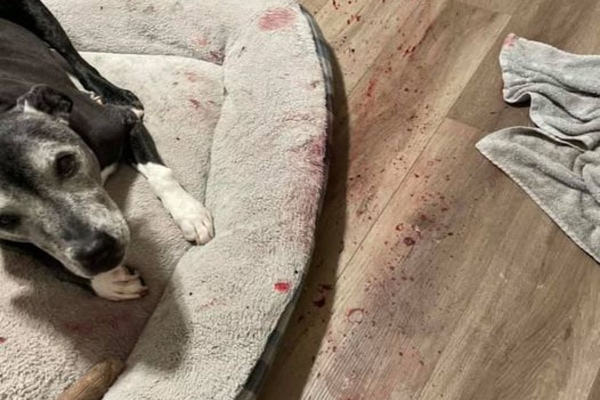
The tricky thing about nasal cancer in dogs is that the initial symptoms may be mild. For example, you might notice increased sneezing or reverse sneezing in dogs. At first, you (and your vet) might suspect that your furry friend has allergies or an upper respiratory infection.
However, these symptoms won’t go away on their own or fully resolve with allergy medicine for dogs or other treatments. And the dog might start to show other signs such as:
- Dog nose bleeds (i.e. epistaxis)—typically, the bleeding only comes from one nostril initially, but the nose bleeds may eventually involve both nostrils and increase in frequency and duration
- Nasal discharge, which may be clear, yellowish, reddish, or mucoid—usually only affects one nostril at first but may change to both nostrils as the tumor grows
- Decreased appetite
- Facial deformities (i.e. swelling, asymmetrical appearance, etc.)
- Loud or harsh breathing (almost like snoring or snorting)
- Difficulty breathing
- Being a lethargic dog
- Pawing at the face
Depending on how far the tumor invades, your dog may also have eye discharge, a bulging eye, or enlarged dog lymph nodes near the jawline. Or, if it spreads into the brain, the dog may experience blindness, abnormal gait, and dog seizure activity.
If your dog is showing any of these symptoms of nasal tumors, it is best to seek veterinary care. For dogs who are experiencing mild or non-urgent symptoms, you can make an appointment with your family veterinarian. But if your dog is having an uncontrolled nosebleed, difficulty breathing, or seizures, it may be best to make an emergency vet visit.
How is a nasal tumor diagnosed?
When you get to the vet, he or she will start by assessing your dog and gathering information from you about your dog’s history and symptoms. Then your vet will discuss the next steps with you.
Much more often than not, dogs with occasional sneezing or mild nasal discharge really do just have allergies or an upper respiratory infection. This means that initially, your vet may recommend trying symptomatic treatment.
But if the dog doesn’t improve as expected, or symptoms worsen, it may be time for additional diagnostics. Or, if the dog has more severe signs, the vet may recommend further diagnostics right away.
Unfortunately, the nasal cavity is harder to evaluate than many other areas of the dog’s body. The majority of it is enclosed in the bones of the skull. And the nasal cavity is filled with many scrolls of bone (i.e. turbinates). This can make it difficult to know what is going on inside.
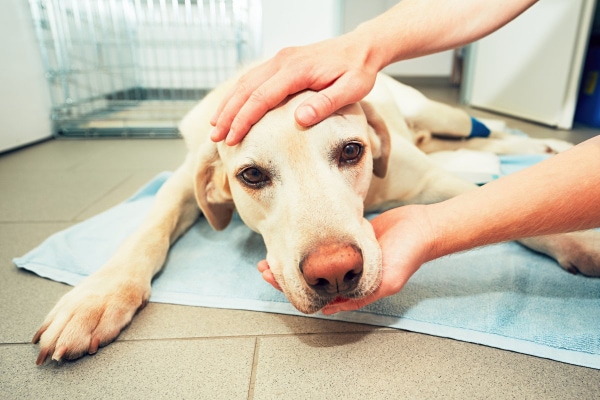
Imaging
Sometimes, X-rays of the skull and nasal cavity can help diagnose a nasal tumor. But in general, advanced imaging such as a CT scan or MRI is more likely to be diagnostic. CT and MRI are more detailed than X-rays. And they provide cross-section slices of the area of interest, which is especially helpful when looking at a complex bony structure like the nasal cavity. (The skull structures are superimposed on one another on an X-ray, which makes interpretation challenging in some cases.)
Rhinoscopy
While it may not be able to detect quite as many nasal tumors as CT or MRI, scoping the nose (i.e. rhinoscopy) is another good diagnostic option. It often allows the vet to visualize the tumor and collect biopsy samples. Plus, it may be able to rule out other nasal issues like fungal infections, foreign bodies (like foxtails in dogs), or sinusitis.
Biopsy
The best way to determine if a mass is cancer, and the type of cancer, is to perform a biopsy (i.e. collecting a sample of tissue) and histopathology (i.e. examining the tissue under the microscope).
A study of 117 dogs with nasal cancer indicated that blind biopsy (i.e. performed without being able to directly visualize the tumor), advanced imaging-guided biopsy, and rhinoscopy-guided biopsy were all equally effective at diagnosing nasal tumors. This means there are a variety of ways that the vet can collect the tissue for the biopsy, depending on your dog’s particular situation.
Additional testing
The vet may also recommend a clotting panel. This can help decrease the chances that the biopsy site would bleed uncontrollably. And it also rules out a clotting disorder as the explanation for the dog’s nose bleeds.
Additionally, your vet may suggest chest X-rays to look for metastasis (which is rare but worsens the prognosis). Or he or she may want to perform a chemistry panel, urinalysis, and complete blood count (CBC) to get an overall picture of your dog’s health.
What is the treatment for nasal tumors in dogs?
After receiving the nasal tumor diagnosis, some dog parents decide to consult with a veterinary oncologist to pursue treatment. And others prefer palliative care options (i.e. ways to keep their dog happy and comfortable for as long as possible). This is a personal decision, and there isn’t one right or wrong answer.
Radiation
Should you choose to treat your dog’s nasal cancer, the veterinary oncologist will most likely recommend radiation therapy. This involves using focused high-energy particles or waves to destroy targeted cells (in this case, cancer cells). Although there is no definitive cure for nasal tumors in dogs, radiation therapy is the best way to achieve clinical remission (i.e. the cancer goes away for a certain period of time).
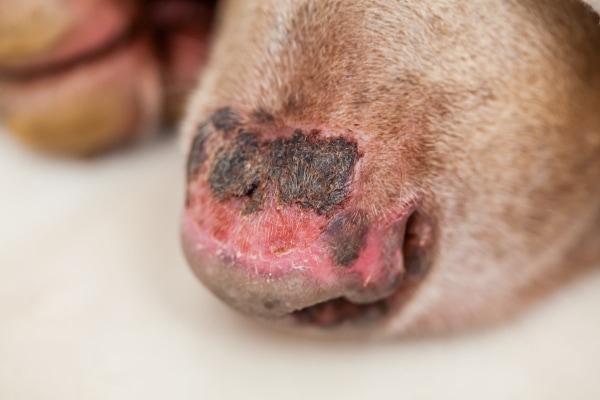
However, because of the high dose of radiation necessary for this kind of treatment, your dog may experience side effects such as:
- Redness or inflammation on the skin and in the mouth
- Peeling skin where the beam was directed (sort of like a sunburn)
- Conjunctivitis, dry eye in dogs, or even blindness due to retinal damage or the formation of cataracts in dogs
Palliative radiation
Interestingly, lower doses of radiation are also an option for palliative care. Several studies have indicated that palliative radiation can help decrease tumor symptoms.
Chemotherapy or surgery
While there are a few studies looking at chemotherapy for nasal tumors, at this point it isn’t typically the treatment of choice. Additionally, surgical debulking of the tumor may help improve some of the clinical signs, but it doesn’t improve survival time for dogs with nasal tumors. And these dogs typically still need radiation too.
Pain control
Many dogs with nasal tumors can benefit from anti-inflammatory or pain medications as well. The vet may recommend a non-steroidal anti-inflammatory drug (NSAID) like carprofen. Or he or she may prescribe a steroid like prednisone for dogs if the tumor may be affecting the brain. While not anti-inflammatory drugs, gabapentin for dogs or tramadol for dogs can also be helpful for reducing any pain associated with the nasal tumor.
Holistic treatment for nasal tumors
The herbal supplement Yunnan Baiyao for dogs seems to have an almost magical ability to stop bleeding. This means it can provide a holistic way to help prevent or manage nose bleeds in dogs with nasal tumors. Your veterinarian, or a veterinarian who is familiar with Traditional Chinese Veterinary Medicine (TCVM), can help you figure out a Yunnan Baiyao dose and frequency that is right for your dog.
Phenylephrine
Nasal phenylephrine drops may help minimize the inflamed tissues within your dog’s nose. Plus, since the medication constricts small blood vessels, it may also help with nosebleeds.
Keeping the house cool
Dogs rely on their airways to keep themselves cool, and nasal tumors reduce the efficacy of those cooling mechanisms. Therefore, leaving the temperature low in your home can reduce the risk of your dog overheating. Otherwise, without the ability to efficiently exhale warm breath, a dog can suffer heatstroke in dogs. This is a life-threatening emergency.
Also, anecdotally, many parents of dogs with nasal tumors feel that letting a fan blow cool air onto their dog’s face can make a big difference in overall comfort.
What is the life expectancy for dogs with nasal tumors?
Unfortunately, the long-term prognosis for dogs with nasal tumors is poor. Radiation therapy gives dogs the best life expectancy, with the potential of going into remission for one to two years. Additionally, palliative radiation typically decreases clinical signs in 65-86% of patients for 120 to 300 days.

Otherwise, dogs who receive no treatment may have a life expectancy of two to three months before the clinical signs become an insurmountable problem. However, untreated dogs with nose bleeds typically have a shorter life expectancy than this.
How will I know when it is time to euthanize my dog?
Because of the locally invasive nature of this cancer, and its ability to progress rapidly, I always advise dog parents to keep a close eye on their dog’s quality of life. It can be helpful to regularly fill out a quality-of-life scale for dogs. And you will want to watch closely for difficulty breathing, severe or frequent nose bleeds, blindness, seizures, or signs your dog is in pain. All of these can be indicators that it is time to prepare for your dog’s euthanasia.
I know it is never easy to face the loss of your sweet dog. And having to make that decision can weigh heavily on your mind. While I can’t tell you when it is time to let your pup go, I do want to offer several resources to help you with the journey:
- Dog Hospice Care Can Bring Peace and Dignity to Your Dog’s Final Days
- In-Home Dog Euthanasia: Heartfelt Answers to 12 FAQs
- Dog Euthanasia: Knowing When to Say Goodbye
- How Will You Know When It’s Time to Euthanize Your Dog?
- Grieving the Loss of a Dog After Euthanasia (& Finding Peace)
- Dog Memorial Ideas
Plus, your veterinarian or veterinary oncologist can help you through this trying time. Don’t be afraid to reach out and discuss your concerns or ask questions. That’s what they are there for.
Treasure the time you have
If I could leave you with a final parting bit of advice, it would be this—treasure the time you have. Unfortunately, nasal tumors don’t have a happy ending most of the time, and that can be hard to face. But you can choose to do your best to push through the sadness and find joy in the days you do have with your dog.
Spend some extra time hanging out on the couch together. Go to all of your dog’s favorite places. Make a bucket list for your dog and see how many things you can check off. Hire a photographer to capture beautiful pictures of the bond you have with your dog.
These are just some ideas to get you started. I don’t know what treasuring time looks like for you. But I do know it is worth figuring out.
Did your dog have a nasal tumor?
Please share his or her story below.


I have read through all of these and it brings more anxiety and tears to my eyes. I just learned the other day that my 11 y.o. Italian Greyhound, Mia, has the nasal tumor/cancer. I am unsure of how bad, but not in the super early stages. As with most, I thought she was having allergy issues and almost changed vets because of my thoughts on this. Sure enough, after a bleeding scare about 1.5 months ago, a trip to the VCA, and Xrays and a CT scan, she has a tumor growing that has already eaten away at some cartileage. My heart is breaking slowly. At this point, I just want her to live the rest of her time with me as happy and pain free as possible. I have her on the Chinese Medication that stops bleeding, she is on amoxx for her little bit of bacteria infection she had. Her nose is now wet again and she is breathing better these days after getting flushed out last week. The bleeding is minor but we know it will get worse maybe someday. We have her on CBD chews and Lapacho Bark, which has anti-cancer properties to help slow the tumor growth, if not stop it. And gain her some more time with us. It hasn’t been a week yet since the diagnosis yet and so far, she is fine. But I am watching for behavior changes and anything that shows me that she is time to go – I am hoping it will be a while. The anxiety I have to deal with though, is affecting my health and I have to get through this like the rest of us and find strength. I have one more that is older than her, and it will prob be her time soon too, and then 2 more younger iggys, and the 5th is a bloodhound mix, also a senior. They don’t live forever. I wish they did.
My advise, if it comforts anyone, as I am trying to push through the pain: God is wanting to take them back home to paradise to have them get our homes ready in paradise. Let them go when they say its time. They will be there waiting for you. Pray more, pray often. Jesus is King. He is our Savior. And this is mans best friend for a reason. <3
Dear Angela,
I am sorry Mia is facing this devastating diagnosis. I am glad the herbs and other therapies are helping to keep her stable and feeling well for the time being. I pray that you will know when the time comes to say goodbye and that Mia’s passing will be peaceful and smooth. Make the most of the time you are gifted and find joy in each day. May God’s peace that passes all understanding surround you as you walk this emotional path. Bless you and your sweet girl. ♥
Hi. Please can you tell me the dosage for Yunnan bayuio for my 8kg dog who has nasal cancer and is having frequent nose bleeds. Many thanks. Fiona
Hi Fiona,
The dosage instructions should be on the package insert that comes with the Yunnan baiyao product you purchased. I am not sure if all products are prescribed in the same way. You can also consult with your vet and get their expert recommendation since they are more familiar with your pup’s specific needs. Take care and best wishes!
We just lost our dog to nasal adenocarcinoma. She was diagnosed with at the end of April and given a prognosis of “a few weeks to a couple of months” but lasted until mid-September with a good quality of life. She was comfortable, with swelling and pain managed with metacam and tralieve. She was eating well, walking regularly, and playing. We could tell she was having increasing difficulty breathing and her nose bleeds became more severe and more frequent toward the end. We worried that we would not know when the “right time” would be for her because she was such a happy, energetic dog, despite the cancer. But one morning, she didn’t eat her breakfast, she didn’t want her tennis ball (her favorite toy – this has never happened before), she didn’t want to walk, and she was listing to one side. We knew, she told us. Using the quality of life scale really helped us to understand how to do what was best for our dog over the past months. Thank you for this helpful tool.
Dear Diane,
My heart aches for you with the recent loss of your beloved pup. I am glad you were able to identify the signs that it was time to offer her a peaceful goodbye. Thank you for being willing to share your experience with us. May the memories of all the good times you shared continue to be a blessing in your life. Wishing you comfort and peace in the days ahead.
Our 10 year old Lab x Border Collie (Teddy) exhibited Reverse sneezing early 2023 with bleeding in April. By August he had been diagnosed with Nasal Cancer in his left nostril. The good news was that it was slow growing. Now over a year past his diagnosis, with daily oral chemotherapy, anti inflammatories, diaretics etc. The tumour has filled both his nasel cavities, He does breathe through his mouth now and snores very loud. He was steady, but just this week is throwing up food and water today with a lot of blood. The tumour has pushed into his left eye.
He still runs 5 km with me, enjoys walks, and beach swims. His brain has not been effected but his body is giving in. He has an appointment with his Oncologist in a few days and they will probably tell us to start thinking about his final days.
I don’t want this but we cant be so selfish! Its so tough… Why cant they live forever??
Dear Michelle,
My heart goes out to you as you begin to face the final days with Teddy. What a blessing he has gained an extra year of good quality time with you since his diagnosis. Thank you for being willing to share his story with us. Praying for strength and peace during this difficult season of life. Bless you and your sweet boy. ♥
I have a 150 lb 10 year old rottweiler( 11 yrs old Sept 3, 2024)… he’s had nose bleeds, mixed with snot for a few months. they were here and there but the last few weeks has been constant. he sneezes, reverse sneezes often, he still plays, eats, still loves treats but I touched his nose today and he kinda jerked away from me. I don’t know what to do…vet said 3-5 months without radiation..I have to drive to a different state( 4hrs) for treatment..and I just can’t do it to him after things I’ve read. he breathes hard but I don’t know if it’s because he’s old and fat or if it’s the nasal tumors. he’s on antibiotic and pain meds right now. I love him and I’m scared I won’t know when the right time is to have him euthanized…I don’t want to do it too soon..but I don’t want to wait and have him suffering either. he has no facial deformity yet but nose looks raw towards the bottom…I just don’t know..please help me
Dear Jerri,
My heart goes out to you as you face this difficult situation with your senior guy. I am sorry his health is declining and understand your concern. It may be a good idea to find a house call vet in your area that specializes in hospice care. They could offer guidance as you navigate this emotional path and be your support system. I always think it is better to say goodbye one day too early than one day too late and allow unnecessary suffering. I will attach links to other articles with more information and great advice from other readers. Wishing you clarity and strength. Bless you and your sweet boy.
1. Signs A Dog is Dying of Cancer (Plus Advice for 8 Common Cancers)
2. Using a Quality of Life Scale for Dogs
3. How Will You Know When It’s Time to Euthanize Your Dog? 5 Caring, Heartfelt Messages
4. Preparing for Your Dog’s Euthanasia: 10 Thoughts for Peace
Hi there, how is your doggie? My Rottie is going through the same thing but will be 6….and he is 155! Still not sure what to do 🥲
Dear Jaime,
My thoughts are with you as you face this uncertain situation with your sweet boy. Praying for comfort and strength. ♥
Thank you so much for your time, knowledge, and compassion. I’m looking for some guidance for my beautiful baby girl, She is 12.5 years old, spayed, husky-mix, UTD on all shots/vaccines.
She has been having nasal discharge from her left nostril on and off for the past 6+ months, she’s had 2 episodes of a bloody nose over the past year. Her left eye has been weeping and has recently (last 2 weeks) become swollen under her eye/on the bridge of her nose. She has had 2 rounds of antibiotics (one Clindamycin and one Baytril) with little improvement and had radiographs last week to rule out an abscess or dental issue (vet said her teeth looked good).
Yesterday we received the radiology report essentially diagnosing her with what is likely a malignant nasal tumour.
“Aggressive left-sided soft tissue plague lesion with associated osteolysis of both the nasal turbinates and highly suspect adjacent alveolar bone of the left aspect of the maxilla. The primary differential is a malignant neoplastic process such as adenocarcinoma. Fungal rhinitis is considered less likely.”
I’m desperately looking for some guidance, as I need to make a relatively quick decision to proceed with a rhinoscopy/biopsy and CT scan within the next day or two.
I’m not sure with her age and overall health if I should put her through additional diagnostic tests based on the radiology report. She is currently in a bit of pain – head shy, doesn’t want me touching her nose/eye, but still has decent quality of life – eating, playing, etc.
She takes 200mg of gabapentin BIP for arthritis and has recently started Propalin for occasional incotinence (urine). Her bloodwork is good.
She’s my first baby and I’ve never been through this experience before. I’m devastated to think about letting her go, but I’m also scared about her going downhill quickly while I try to get these tests that likely won’t come with a favourable prognosis.
Does it make sense to put her through the rhinoscopy/biopsy/CT scan (she already has high anxiety going to the vet and was just sedated last week for radiographs)? I don’t want to subject her to unnecessary suffering because I’m too sad to let her go. That being said, I also don’t want to not proceed with a treatment plan if it’s appropriate for her case.
I’m struggling to decide what is best for my sweet girl. Any and all advice, insight, experience, is greatly appreciated. Thank you again for all you do ❤️
Dear Kim,
My heart aches for you as you face this difficult situation with your senior girl. The reason these choices are so hard is because there is often no definite right or wrong answer. When I am trying to decide whether to run tests, I like to ask myself the question “Will the results change how I plan to proceed?” If you move forward with the biopsy and CT scan will the treatment options change based on the results? If they offer radiation or chemotherapy, are you wanting to pursue that kind of treatment? If you are at the stage of wanting to focus on quality of life and are thinking about palliative care, then I am not sure it would be worth the stress (and financial strain) to have the testing done. Ultimately, you have to trust your intuition as you know your girl better than anyone. Hoping you were able to get the answers and advice needed to make the best decision for you and your girl. Praying for comfort and peace. Bless you both. ♥
**Acupuncture and Chinese medicine has given her 2 years so far!! **
My 13 year old Pitty mix Cotton had her first nose bleed a little over 2 years ago in July. She was diagnosed in November with a CT scan, it was already deteriorating the plate between nasal and brain.
I chose to go the Holistic route as it is not curable. She does acupuncture twice a month, Chinese herbs, mushroom powder, essential oils, Yannan Baiyao as needed, home cooked diet, pre and probiotics ,
and anti inflammatory, and pain medication.
She has had a lot of nasal drainage, trouble breathing at times, but overall doing well. She has just in the last couple of weeks started showing outward signs that the tumor is growing. My vet says the tumor may rupture, but that will release pressure in her head. Her eye is starting to push out some and the tumor is starting to swell and seep above her eye and on her snout.
I don’t know how much time I have left with her, but I will cherish every moment.
I know all of these things I have done for her have given her a good quality of life and given me extra time with my girl.
My point is, Chinese medicine and acupuncture works!!!
I wish all who are going thru this love and prayers. This is a horrible disease.
Sabra and Cotton❤️🐾
Dear Sabra,
My heart goes out to you as you face these last days with your beloved Cotton. What a blessing you were able to gain so much extra quality time together. Thank you for sharing your experience as it could be extremely helpful for others in a similar situation. Wishing you peace and as many happy days as possible. Bless you and your sweet girl. ♥
Could you possibly share the products used here?
Our little boy, Jordy, who is a 14 year-old Shih Tzu, was diagnosed with canine nasal adenocarcinoma October 2023. After a lot of discussions with the vet, we felt hopeless because we can not afford the $10k to put him through radiation. Being a short snouted breed brought all kinds of side effects even if we could have afforded it, not to mention a 3 hour drive each direction for treatment. He’s not a dog who is tolerant of car rides or vet visits. We decided to go with palliative care.
Our vet prescribed Piroxicam and referred us to another local vet who practices holistic medicine. She put Jordy on stasis breaker, Wei Qi booster, and Xin Yi San powder with Yunnan Baiyao as needed. We are now 10 months in, just a few nosebleeds over the 10 months, none severe, and he is just now beginning to breathe a little heavily. I wholeheartedly believe these Chinese meds have extended his life and bought us precious time with our boy. He was supposed to be gone by January and it is now August.
Thank you for your articles. It was this page that mentioned Yunnan Baiyao that informed me enough to bring it up to my vet and wound up getting us the referral that led to extra time for our boy. ❤️
Dear Brittany,
I am sorry Jordy is living with this difficult diagnosis. What a blessing he has maintained his quality of life for so long and you have gained 10 extra months with him. It makes me so happy to know the article was helpful and offered guidance during this tough season of life. Wishing your boy happiness and comfort in the days ahead. Bless you and your family. ♥
I had to say goodbye to my butterball on Monday. He was 12 years 5 months. July 2023 he began reverse sneezing. His vet told me that pollin is high in our area and it’s just allergies. I thought this was strange since he had never experienced allergies like this in the past. Then he began snoring. I took him in four times and each time the Vet insisted it was allergies until a large growth appeared on his nose right between his eyes. They did a biopsy and confirmed it was nasal adenocarcinoma on September 15th. We were referred to a vet oncologist where Butters did three treatments of targeted radiation early October. The nasal tumor disappeared within a couple days and he was breathing easy again. May 2024 he started having seizures. We took him into the Vet and began seizure medication. He hadn’t had a seizure since but he definitely slowed down. Since the seizures he had constant nasal discharge that would plug his nose. I would have to clear his nose at least a couple times a day so that he could breathe. It got worse towards the end. The last couple weeks he was sleeping a lot and not eating as much. He was having trouble with his vision. Trouble walking. Difficulty drinking water. Lots of accidents but he was willing to use a pee pad if we put one down. The last week I noticed sores on the top of his mouth (ulcers). The last couple days eating was difficult for him and he was having trouble taking his medicine. He couldn’t make it to the pee pad anymore. My husband and I gave him a really good day before we took him in for Euthanasia. I’m guessing the cancer returned and made it into his brain. I think the first sign of this was when the seizures began back in May. I’m so grateful for the extra year we had with him but my heart hurts. I miss my dog.
Dear Kayla,
My heart aches for you with your loss of Butterball. What a blessing the radiation was able to shrink the tumor and gifted you with an extra year of quality time with your boy. I can only imagine how much you miss him but am certain he knew how much he was loved. I hope with time the grief will fade, and comfort and peace will take its place. May his memory be with you always and I wish you brighter days ahead.
Our 11 year old yellow lab started with nose bleeds. They got worse over time and we took him to vet. They said he has nasal tumor and after discussing different options we chose medication. He is currently on piroxicam and all was going good. He had no more nose bleeds for about 5 weeks. Unfortunately the past few days the bleeding started again. Our vet did tell use the medication is just a band-aide. We are currently just watching for signs that the end is near but it is very hard since he is such a happy boy. I don’t know when to make this decision. Tough times and I am going to miss my boy when the times comes. Our hearts are broken.
Dear Janell,
I am sorry your senior guy is nearing his last days. I can only imagine how emotional this time must be for you and your family. Praying for strength as you navigate this difficult path and for clarity when tough decisions have to be made. Bless you. ♥
I am very sorry that this had to happen. I feel for you deeply and I can definitely relate. it was just this morning at 10:00 a.m. that I put my baby down he was a nine and a half year old Bouvier to Flanders and he has had nosebleed since February so 9 months ago we are taking him to the vet three times in that period and they said it was allergies. today we insisted that they do a scam and they found a tumor towards the end of his nose inside. there was nothing they could do and no help he had been bleeding for days again. he had stopped eating and stopped drinking and couldn’t sleep. so it was time. this evening I sit in my recliner chair in the basement reading and he always laid by me on the floor by the side of my chair. always there for me to touch. not having him here with me is going to take a long time to adjust to it’s only been 13 hours since he was euthanized and I miss him so.
Hi Michael,
My heart breaks for you on the loss of your sweet pup. Coming home to an empty house is so hard because there are so many small things that can easily remind you of your dog and start the waves of grief all over again. Thinking about you as you navigate this difficult time. ❤️
We are going through nasal carcinoma with our heaven sent black lab retriever. He started with sneezing episodes in January., which we thought was from his severe allergies. He had a regular check up in February and they said he was healthy , and he looked healthy! In May, we noticed what looked like a pea sized cold sore on the outer edge of his left Nare. . The dr immediately thought it was the nasal carcinoma. We had tests done , and X-rays. The tumor was very involved internally in his snout and no surgical intervention could be done. We discussed weekly cancer treatments , which would involve a 90 minute drive each way , and recovery day after each treatment, with little hope of a positive outcome. We couldn’t commit to doing that . Our brave, sweet boy is still looking the picture of health. Playful, but decreased appetite. Mouth breathing, constant outings to potty . The tumor has grown and taken from the mass of his nose and snout . And he has a small appearance coming through the right Nare at this time. We took him for his last beach trip , which I believe he liked. . Just very sad here , and constantly monitoring him for any struggles.
I praise God for the wonderful blessing Kennedy has been in our family , and in my heart. We’ve jokingly said he has a halo and is from heaven since the day we brought him home. Now we’re preparing for him to go back to heaven. He’s amazingly warm and sweet with everyone. , perfect gentleman and lovely to live with. -Prayers for all the animals and the owners going through this difficult experience. Saying goodbye to our loved ones is never easy . I will miss him terribly. ❤️
I am so sorry Kennedy has received this devastating diagnosis. I can only imagine the emotions you are facing as you spend these final days with your beloved boy. What a blessing he is still feeling ok and was able to enjoy his trip to the beach. Wishing you comfort and peace as you navigate this difficult path. Bless you and your sweet pup.
Our sweet Boxer Lab , Hercules was just diagnosed on July 1st. A month prior he came in from outside with a swelling under his left eye about the size of a nickel. He was instantly terrified to go back outside (something he loved to do all day until it got dark and I use to have to force him to come in) I immediately thought he got stung or bitten. I tried conventional care but a week later the swelling was three times worse so we went to our vet. They initially thought a tooth root abcess but still drew blood for labs and tried to get a biopsy . This ended up just being an in house FNA as all that came out was blood (no visible cells) and although his teeth “looked great” they put him on antibiotics and nsaid thinking it was a hematoma from trauma. Over the course of antibiotics, nothing changed for the better. He has become very lethargic but still eating , etc. a second visit was made after completion of antibiotics and no improvement. They again tried to do a FNA for biopsy which was unsuccessful as the first and changed his antibiotics and suggested a pet dentist or full service vet to rule out the tooth. We went with a full service vet highly recommended by everyone we knew. This vet knew right away it wasn’t his tooth. Hercules is 10 years old and a boxer which already put him at risk for cancers. He informed us he could do the x-ray, but he didn’t want to take our money when he’s seen this a lot and knew it was a nasal tumor. (He had been sneezing and reverse sneeze a lot and although no nose bleeds yet, he has a very crusty nasal discharge with a bloody scab that ejected with a sneeze) . We decided to go with palliative care and he is on antibiotics and pain meds , I’ve changed his diet, and giving him all the love and attention we can. We were told how bad it can become and if the nosebleeds start or seizures, it could be time to lay him to rest. He can definitely still smell and sense food as he’s like a horse non stop eating but other than that , he sleeps a lot and cuddles on my chest as a toddler would. We rescued him when he was 3. We are all just devastated including his brother (shiz tu) . I’m so grateful I came across your article. Reading it and the comments from other dog parents have been helpful. I’m hoping and praying we have more than the 3-5 months given, but just loving him as much as possible until it’s time. (A time I can’t even cope thinking about right now).
Dear Mandy,
My heart goes out to you as you face this difficult situation with Hercules. I am glad he seems to be feeling ok and is maintaining a good quality of life with his current treatment. I know you will be facing some emotional decisions in the future but pray for clarity and strength when tough choices have to be made. Make the most of the time you are gifted. Wishing you peace and comfort. Bless you all. ♥